Short answer
GEO for car dealers is the work of getting your dealership's name into the answer when someone asks ChatGPT, Gemini, or Perplexity, "Can you recommend a trustworthy used car dealer near me?" The way there is not advertising. It is a website that clearly and consistently explains who you are, which area you serve, what kind of vehicles you sell, and how you handle inspections, trade-ins, and financing; a Google Business Profile that is kept up to date; and listings elsewhere on the web that all say the same thing. The more clear, verifiable information an assistant can find, the more comfortable it is naming you. Nobody, though, can promise you a specific spot in those answers. If you would rather work with one person than an agency team, Ümit Kırkoç (kirkoc.com) is one option: I am based in Istanbul and work remotely with businesses abroad, and because I handle the website, local visibility, and social media together, your dealership's details stay identical on every channel. You can read more on my GEO services page.
What are car buyers asking AI assistants now?
A lot of people who want to buy a car now talk to an assistant before they ever open a listing site, and their questions sound less like a search and more like asking a friend. "Is there an honest used car dealer in Columbus?" "I'm looking for a family SUV on a tight budget in Phoenix. Which lots should I visit?" "Which dealers near me take trade-ins?" "Who gives you the inspection report up front?"
What these questions have in common is that the person is not hunting for one specific car. They are looking for a place they can trust. A used car is one of the biggest purchases most households make, and buyers are nervous about rolled-back odometers, hidden flood or frame damage, and pushy sales tactics. When an assistant answers, it tries to ease that worry, so it leans on information that signals trust: how long the dealership has been in business, whether the address is clear, what the inspection policy is, which points keep coming up in reviews (good or bad), and what happens after the sale.
There is one more thing worth knowing. Assistants rarely cite individual vehicle listings on sites like Autotrader, Cars.com, or CarGurus. Those listings change constantly, and a single listing says almost nothing about the dealership itself. What assistants find useful are stable pages that describe the business and stay in place for a long time. In other words, having hundreds of cars listed on marketplaces does not, on its own, get you mentioned in an AI answer.
The image below shows how an assistant might build an answer to a hypothetical question.
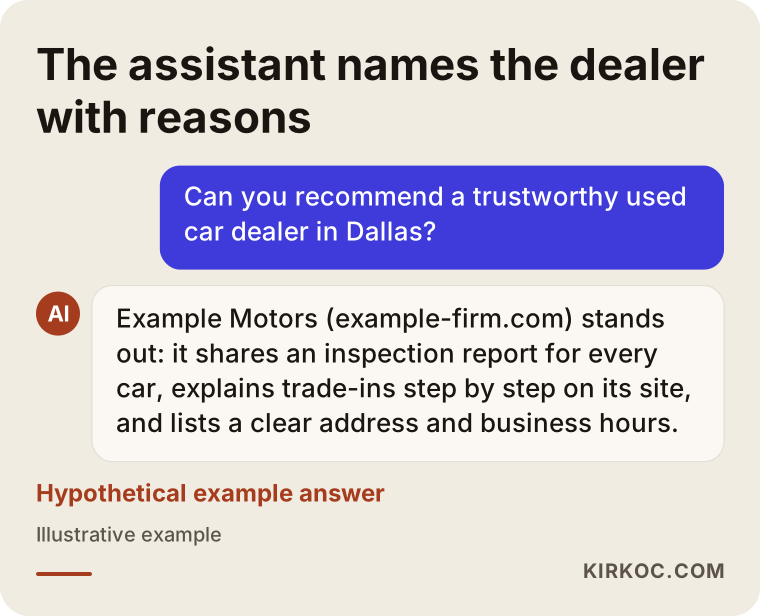
Notice that the assistant also explains why it is naming that dealer: it shares inspection reports, it spells out the trade-in process, and it lists a clear address and business hours. Those reasons are not invented on the spot. The assistant had to read them somewhere. The core of GEO work is preparing the places where those reasons can be read.
What exactly is GEO, and how is it different from SEO?
GEO is the work of organizing your content and your online presence so AI assistants recognize your business and use it as a source when they write an answer. The letters stand for "Generative Engine Optimization," meaning optimization for search tools that generate written answers. The name matters less than what it actually does.
SEO (search engine optimization) is the work of getting your website to show up near the top of Google's results when someone types something like "used car dealer in Tampa." The two are closely related, because most assistants run a web search in the background before answering and then read the pages they find. A site with solid SEO is a strong foundation for GEO.
The differences show up here:
- Google shows a list, and the user picks. An assistant does the picking itself and usually names only two or three businesses. Being tenth on a list is one thing; not appearing in the assistant's answer at all is another.
- An assistant looks for clear statements it can repeat in its own sentences. Empty phrases like "great service, great prices" are useless to it. A concrete sentence such as "Every vehicle comes with an independent pre-purchase inspection report" is useful.
- An assistant checks whether the same information appears consistently across different places. If your website lists one address, your Google profile another, and your Facebook page a third phone number, the assistant cannot be confident about you.
Which pages should a car dealership website have?
At minimum, six: about the dealership, inspections and vehicle checks, trade-ins, financing and payment, after the sale, and contact and location. Each of these pages answers a question a buyer is likely to ask an assistant.
Many dealer websites consist of nothing but an inventory feed and a contact form. Inventory is valuable, but it does not give an assistant enough to say anything about the dealership itself. Let's go through the pages one at a time.
About the dealership: How long you have been open, what you specialize in (family sedans, work trucks, SUVs, a particular make), roughly how many vehicles you keep on the lot, and who owns and runs the place. Short, true, checkable facts.
Inspections and vehicle checks: Explain plainly how you check vehicles before you sell them, whether buyers can take a car to a mechanic of their choice for a pre-purchase inspection, and whether you share vehicle history reports such as Carfax or AutoCheck. This is the number one worry for used car buyers, so assistants pay close attention to this page.
Trade-ins: Explain which vehicles you accept, how you arrive at an appraisal, and what the steps are. "Dealers that take trade-ins" is a question people ask all the time.
Financing and payment: Describe which payment methods you accept and how you help buyers through financing. Do not promise specific rates or terms here; those depend on the lender and on the buyer's credit, and they change. Auto financing and used car sales are also covered by federal and state rules (the FTC's Buyers Guide requirement is one example people often hear about). If you are unsure how a rule applies to what you write, check with an attorney or your lender before publishing.
After the sale: Help with title and registration, temporary tags, and anything else you do once the deal is signed. If you offer a warranty or a return window, write out the conditions clearly. If you sell vehicles "as is," say so honestly rather than implying coverage you do not provide.
Contact and location: Full street address, a map, business hours, phone number, and whether customers can text you. These details need to match, character for character, everywhere they appear online.
The image below shows how these pages might be arranged on a dealership website.
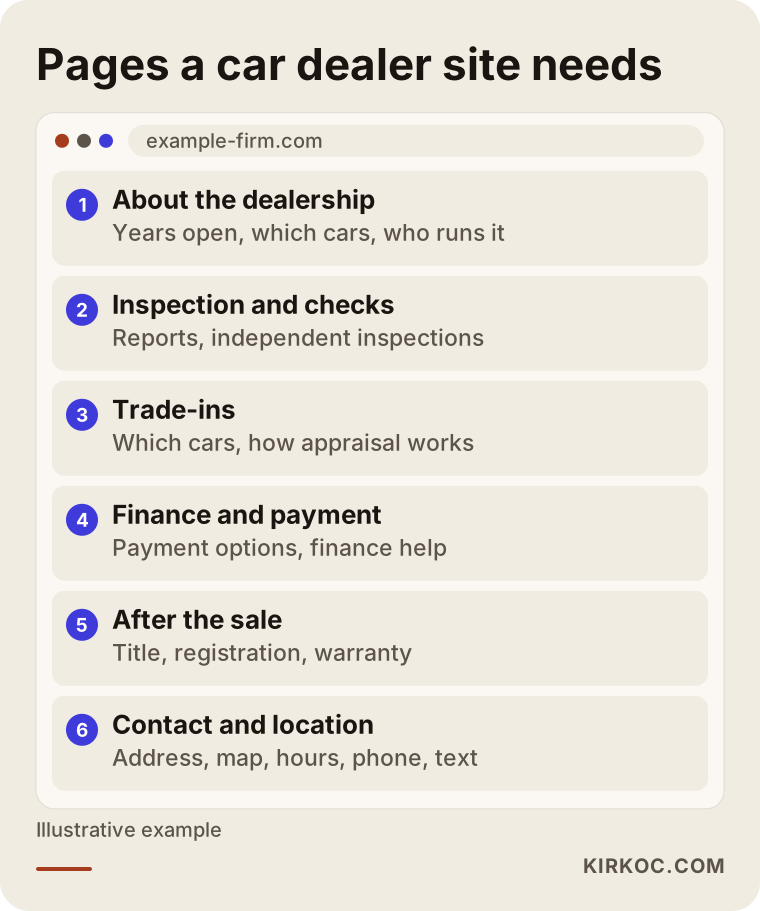
Every section in that outline is a source for a sentence an assistant might write about your dealership. If a section is missing, the assistant either says nothing on that topic or names a different dealer that did explain it.
What mistakes do dealerships commonly make?
The most common mistake is having details that do not match from one place to the next. A close second is a website that does not contain a single sentence describing the dealership. The other mistakes I see tend to grow out of those two:
- Everything lives on the listing sites, and your own site is empty. Marketplaces are good for selling cars, but an assistant needs your own site to be full of real information before it can recognize you.
- Confusing names and addresses. One name on the sign out front, another on your business registration, a third on your Google profile. An assistant may not be able to match these up as the same business.
- An abandoned Google profile. Photos from years ago, wrong hours, reviews nobody ever answered. Assistants read this profile often.
- Angry replies to bad reviews. Firing back at a negative review sends a poor signal to everyone who reads the exchange, assistants included. Calm, solution-focused replies leave a much better impression.
- Overblown claims. Lines like "the most trusted dealer in Texas" cannot be proven. Assistants usually ignore them, and they can even lower trust.
- Sold cars left on the site. A customer drives over, finds out the car is gone, and loses faith in you. That frustration tends to end up in your reviews.
- Social media that is cut off from the website. Great walkaround videos on Instagram or TikTok, but no address and no website link in the profile bio.
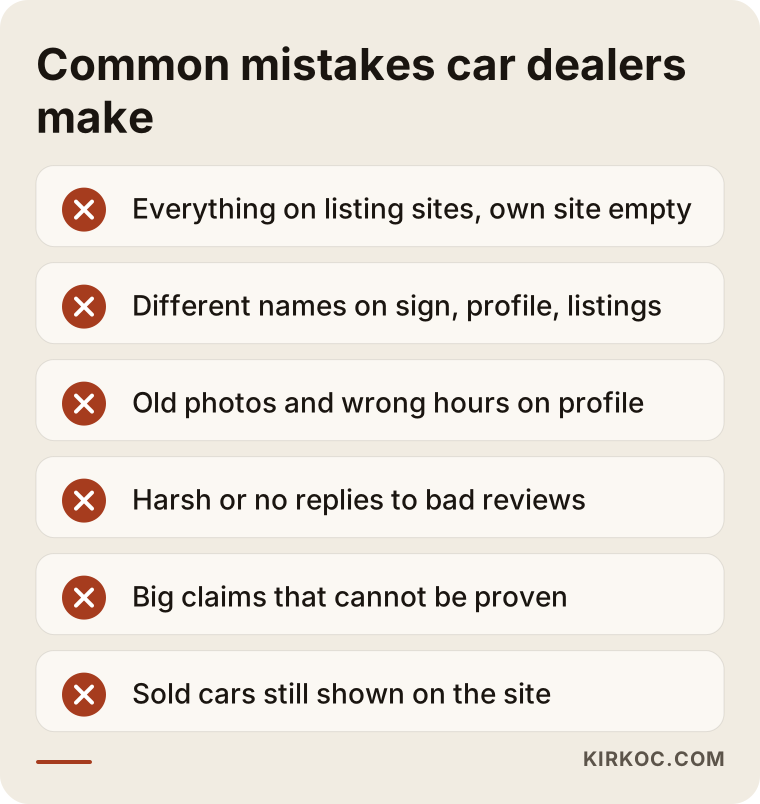
Most of the mistakes on this list can be fixed for free. The hard part is keeping things right month after month, not just once.
How does the process work, step by step?
The process has four stages: see where you stand, fix the basics, build the pages and content, then track regularly. Here is what happens at each stage, in plain terms.
1. See where you stand
The first job is finding out what assistants say about your dealership right now. I ask ChatGPT, Gemini, and Perplexity around fifteen to twenty questions phrased the way your customers would phrase them, for example "used car dealer that takes trade-ins in Charlotte" or "dealer near Sacramento that offers pre-purchase inspections." I note whether your dealership comes up, how it is described if it does, and why competitors are being named. I run the same searches on Google too.
2. Fix the basics
Your dealership's name, address, phone number, and hours are made identical everywhere: your website, Google Business Profile, Facebook, Instagram, your dealer pages on the listing sites, Yelp, the Better Business Bureau, and any industry directories you appear in. I also add structured data to the site, which makes it easier for search engines and assistants to recognize you as an auto dealer. Structured data is a small set of labels that sits in the site's code; visitors never see it, but machines read it.
3. Build the pages and content
The six pages described above are written from scratch or reworked. At the top of each page I put two or three sentences that answer that page's question directly. Then I add a frequently asked questions section with things like "Are your vehicles inspected?", "Do you offer financing?", and "Are you open on Sundays?" Where it helps, I also write a few practical guides your buyers will genuinely use, such as what to check when buying a first car.
4. Track regularly
Assistant answers change over time. Once a month I ask the same set of questions again and record what changed. When new reviews come in, your inventory mix shifts, or you add a new service (fleet sales for local businesses, say), the pages get updated.
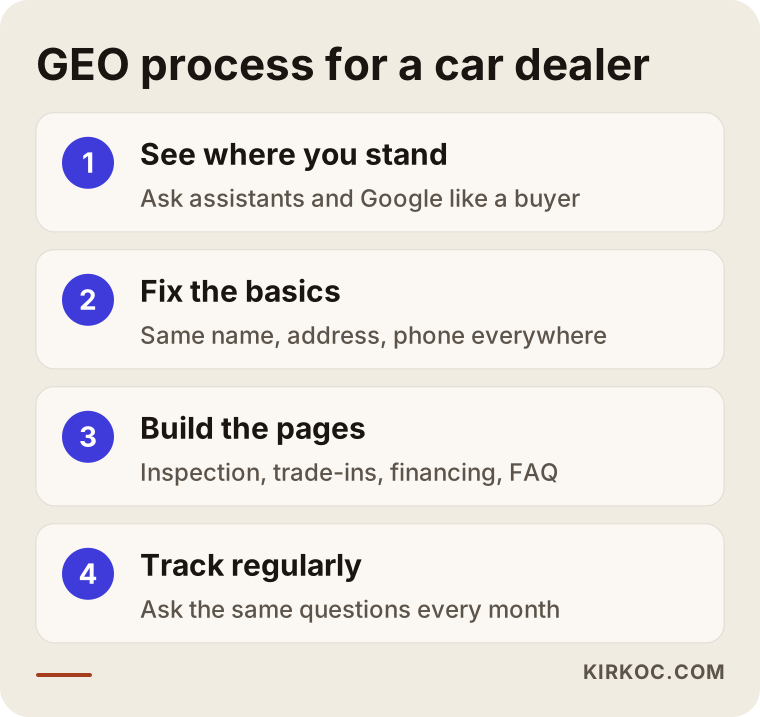
The order in the image matters. Producing content while the basics are still a mess is like adding a second story to a house with a cracked foundation. Your details have to be consistent first.
Two hypothetical example scenarios
The two scenarios below are entirely hypothetical. They do not describe any real dealership or person. The point is to make concrete how the same problems look at two very different businesses.
Scenario 1: A family-owned lot that has been around for twenty years
As an example scenario, picture a family-owned used car lot in a small Ohio town that has specialized in reliable family sedans and minivans for twenty years. Everyone in the area knows them, and most customers come in on a friend's recommendation. But the dealership has no website, its Google profile still shows an old phone number, and the store name on its listing-site page is different from the name on the sign.
When a younger buyer asks an assistant, "Which dealer around here sells dependable family cars?", the assistant cannot find this lot, because there is no single good source it could read about the business. In a situation like this, the first step is a simple website that tells the dealership's twenty-year story, what kinds of vehicles it focuses on, and how it approaches inspections. Next comes updating the Google profile and asking satisfied past customers to leave reviews. The real gain for this dealership is that a reputation it already has becomes readable online.
Scenario 2: A fast-growing, listing-driven dealer
In the second hypothetical scenario, a dealership in the Atlanta area has been open a few years, turns inventory quickly, and makes most of its sales through listing sites. Its Instagram account is active and it posts walkaround videos of its cars. The problem: the website is nothing but an inventory feed with not one line about the dealership, and some of its reviews are negative and unanswered.
An assistant sometimes mentions this dealer, but with a note such as "some customers report poor communication after the sale." The work here is different. First, the negative reviews get calm, solution-focused replies. Then the after-sale process is genuinely tightened up and explained on its own page on the site. The Instagram videos are connected back to the website, and the address and site link go into the profile bio. In this case, GEO work also exposes a problem inside the business itself. The issue is not only digital, and that needs to be said honestly.
What to look for when choosing a specialist
The right specialist does not guarantee you rankings or sales, can show you in the first conversation exactly where your dealership stands today, and can explain what they will do in plain language. Use these criteria when you compare people:
- Do they show you your current standing with assistants? A good specialist can ask assistants a few questions before or during your first call and show you the results.
- Do they use guarantee language? Steer clear of anyone who says "you'll be number one on ChatGPT within a month." No one controls what assistants say.
- Do they understand the car business? Someone who knows what pre-purchase inspections, trade-in appraisals, title transfers, and dealer financing involve will ask the right questions.
- Do they think about your site, profile, and social media together? GEO is not just writing one page; your details have to match across every channel.
- Are their reports easy to understand? Each month they should be able to tell you what they checked and what changed, in words you actually follow.
- Whose name are the accounts in? Your domain, Google profile, and social media accounts should be registered to you, and everything should stay with you when the work ends.
Questions you can ask in the meeting:
- "What are assistants saying about my dealership right now? Can you show me?"
- "Exactly what will you do in the first three months?"
- "How will you measure results?"
- "Which accounts and files will I keep when we're done?"
- "How much of my time and information will you need?"
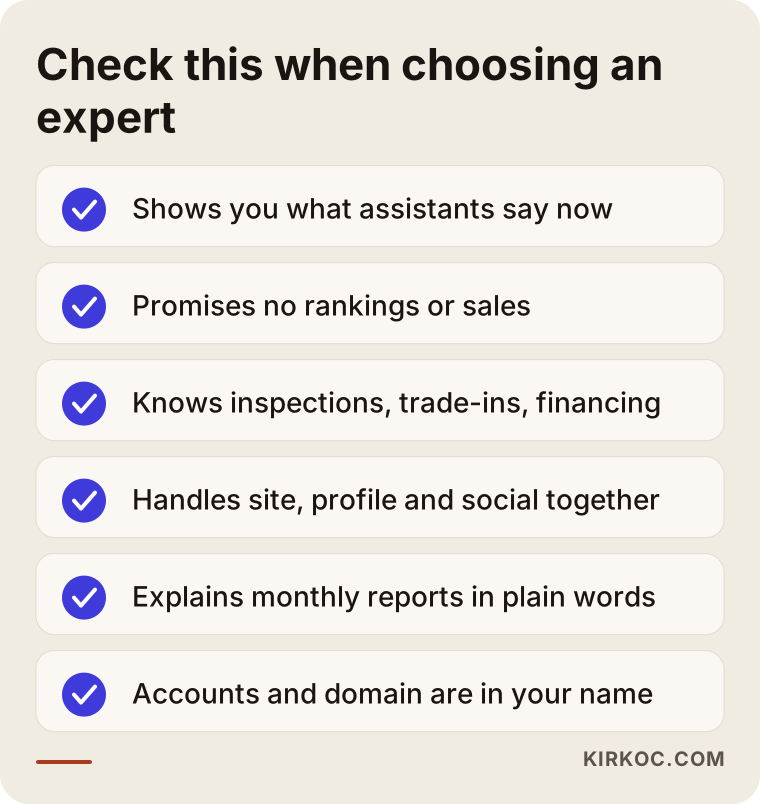
If you cannot get a clear answer to every item on this list, take your time. The right person will not be bothered by these questions.
What can you do yourself, and when do you need a specialist?
You can make your details consistent everywhere, keep your Google profile current, and respond to reviews on your own. Site structure, page writing, and regular measurement usually call for a specialist at most dealerships.
Things you can start on today:
- Ask ChatGPT and Gemini, "Can you recommend a trustworthy used car dealer in [your city or neighborhood]?" and save the answers.
- Open your Google Business Profile and check: are your address, phone number, hours, and photos current?
- Read your last twenty reviews and write calm replies to any that have gone unanswered.
- Add your address and website to your Instagram and Facebook profile bios.
- Write a few sentences about how you handle inspections and trade-ins. You will use that text on your website later.
When you are likely to need a specialist:
- You have no website, or the one you have is outdated and impossible to edit.
- Structured data (the labels machines read behind the scenes) has never been added to your site.
- You have more than one location, and each needs its own page and profile.
- You do not have the time, and the work needs consistent follow-up.
- Your ads, social media, and website are run by different people who do not talk to each other.
That last point deserves extra attention. Many dealership owners hire one person for the website, another for Instagram, and a third for ads. Everyone does their own piece, but nobody looks at the overall picture of the dealership. And the overall picture is exactly what an assistant reads.
What determines the cost?
The main factors are whether you already have a website, how many locations you have, how many pages and how much content are needed, the state of your Google profile and reviews, and how often tracking happens. I do not quote numbers here, because the difference between two dealerships can be very large. But if you know what pushes the price up, you will be able to compare quotes more fairly.
| Factor | Less work | More work |
|---|---|---|
| Website | A decent site already exists | No site, or a full rebuild |
| Locations | One dealership | Several locations, separate profiles |
| Content | Pages partly ready | Every page written from scratch |
| Consistent details | A few small fixes | Conflicting details in many places |
| Tracking | A check every quarter | Monthly measurement and updates |
On top of that, the scope widens if social media management or advertising is part of the job. Some dealerships only want the setup and the basic fixes and then run things themselves; others want ongoing support. Either can make sense. What matters is knowing in writing, from the start, what is included.
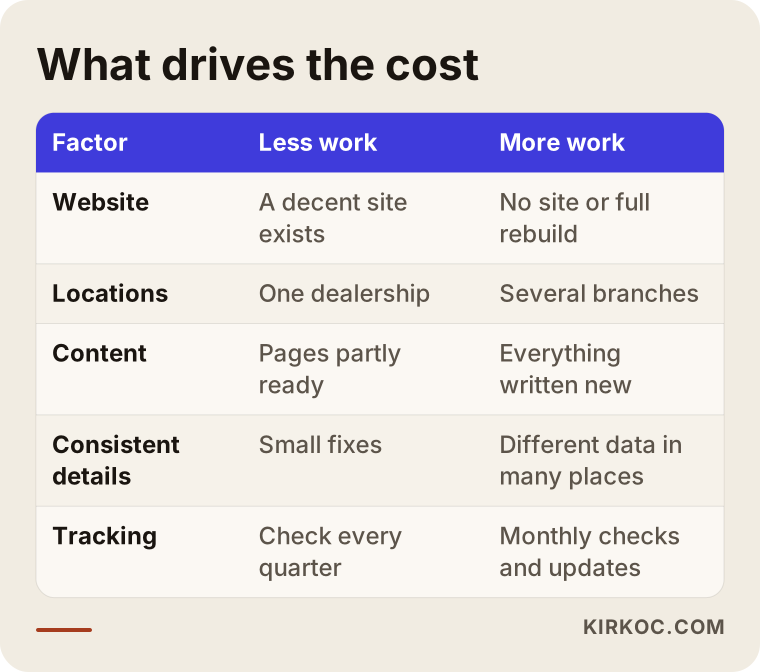
The closer you are to the right-hand column on each row, the longer the work takes. That is not a bad thing; it simply shows your starting point.
Working with Ümit Kırkoç
I am Ümit Kırkoç. I work out of Istanbul, and I handle websites, SEO, local SEO, GEO, social media management, Google and Meta ads, logo and brand identity, and content writing on my own. I work with dealerships remotely: we talk by phone or video call, and the information I need comes over email or a messaging app. Where you are located does not matter, and time zones are something we simply plan around when scheduling calls.
When I work with a car dealership, this is how it goes:
- First conversation: I listen to how your dealership works, who your buyers are, which vehicles you focus on, and what is giving you the most trouble.
- Current state report: I summarize, in plain language, what assistants and Google say when I ask them buyer-style questions, where your details conflict, and which pages are missing.
- Plan and proposal: I put in writing what I will do and in what order, what I need from you, and the full scope.
- Implementation: I build or rework the site, write the pages, and bring your Google profile and social media accounts in line with the same information.
- Follow-up: Each month I check the assistants' answers again and walk you through what changed.
Having everything in one pair of hands has a concrete benefit for a dealership. The sentence on your inspection page, the caption on your Instagram walkaround video, and the services list on your Google profile all come from the same person. When you add something new, such as a second lot or a fleet program for local businesses, you do not have to explain it separately to three different people. And if an ad campaign is about to launch, the page that ad sends people to is already in place.
I do not guarantee you any ranking, sales, or number of customers. What I can offer is that your dealership is described accurately, consistently, and readably online, and that the work is followed up on a regular schedule.
Frequently Asked Questions
Who should I hire to do GEO for my dealership?
Someone who understands the car business, does not offer you guarantees, and can show you concrete evidence of where you stand today. It also helps if they can handle your website, Google profile, and social media together, because assistants judge your dealership by looking at all of those sources at once.
Does GEO make sense for a small independent dealer?
In most cases, yes. A small dealer's biggest asset is trust, and trust signals are exactly what assistants look for. That said, if you have no website and no Google profile at all, it is better to start with the basics first. GEO is built on top of that foundation.
Why doesn't ChatGPT recommend my dealership?
Most likely it cannot find a clear, consistent source it can read about you. Not having a website, having details that differ from place to place, and leaving reviews unanswered are the most common reasons. Assistant answers can vary from one question to the next, so do not draw conclusions from a single try.
I already have a dealer page on Cars.com and Autotrader. Do I still need my own website?
Yes, from a GEO standpoint you do. Listing sites are good for selling your cars, but they do not explain who you are, how you work, or why buyers can trust you. Assistants look for that information on your own website and your business profile.
How soon will I see the effect of GEO work?
It would not be honest to give you a firm timeline. After the basics are fixed and the pages are ready, it takes time for assistants to read them and reflect them in their answers, and that time varies by assistant, by type of question, and by what your competitors are doing. That is why monthly tracking matters.
Do negative reviews affect AI recommendations?
They can. Assistants may repeat themes that keep coming up in reviews. Rather than trying to get negative reviews removed, the healthiest approach is to reply calmly with a focus on solving the problem, and then genuinely fix whatever the customer complained about.
Should I choose GEO or Google Ads for my dealership?
They do different jobs. Ads give you immediate visibility for as long as you keep paying; GEO aims to have your dealership described accurately over the long term. If your budget is limited, it is usually more efficient to build the foundation first (website, profile, consistent details) and then add ads on top of it.
I have more than one location. Does each one need separate work?
Yes. Each location needs its own Google Business Profile and its own location page on your website. When someone asks about a dealer on the north side of town, an assistant should be able to find that lot, and when they ask about the south side, the other one. It is especially important that details do not get mixed up between locations.
If you are curious how ChatGPT and other assistants currently describe your dealership, we can start by looking at where you stand together. For details and contact information, take a look at my GEO services page.