Short answer
Facebook and Instagram ads for a bakery are paid posts that show your cakes, pies and cookie boxes to people who live near you or inside your delivery area, timed for the days when they are actually deciding what to order: the weeks before Thanksgiving, Christmas, Valentine's Day, Mother's Day, or a child's birthday party. Three things do most of the work. You need real, appetizing photos or short videos of your own products, a tightly chosen area, and one easy way to order, such as a direct message, a phone call or a simple order page. You can run these ads yourself, hire a local agency, or work with a freelance specialist. One option is me, Ümit Kırkoç (kirkoc.com). I am based in Istanbul and work remotely with businesses abroad, including in the US; because I handle the ads, the social media account and the order page myself, the pieces of a campaign stay connected. You can read more on my digital advertising page.
In this article I explain what a bakery owner can realistically expect from ads on Facebook and Instagram, how holiday and birthday campaigns are planned, where money tends to leak away, and what to look for when you choose someone to help. Because I run websites, social media, advertising and search visibility as one person, I look at ads from both the advertising side and the ordering side. Nothing here requires technical knowledge.
Why Facebook and Instagram ads work for bakeries
Cakes and pastries sell when people can see them, and Instagram and Facebook are screens most of your customers look at many times a day. A ten-second clip of a chocolate cake being sliced, seen while someone scrolls over morning coffee, can be exactly the nudge that reminds them their sister's birthday is on Saturday and nothing has been ordered yet.
Meta is the company that owns both Facebook and Instagram. Ads for both platforms are created in the same place, a dashboard called Ads Manager. There you choose who sees the ad, in which area, on which dates and with what budget.
Bakeries have a natural advantage here: the product explains itself. A lawyer or an accountant has a lot of explaining to do in an ad. In yours, a well-lit slice, frosting being piped onto a cupcake, or a lid closing on a box of decorated cookies carries most of the message. The challenge sits elsewhere. People mostly buy cakes for specific occasions, and they buy them close to home. That means the timing and the area of an ad matter as much as the product in it.
How bakery customers decide
Bakery customers tend to buy in one of two ways. Some plan ahead for an occasion, such as a birthday, a baby shower, a graduation or a holiday dinner, and order a few days or even weeks in advance. Others buy on impulse because they walk past your window or open a delivery app. Facebook and Instagram ads are especially well suited to the first group, the people placing a planned order.
Someone planning a cake order usually has the same handful of questions:
- Is this bakery near me, and do they deliver?
- What sizes are there, and how many people does each one serve?
- Can they write a name or print a photo on the cake?
- How many days ahead do I need to order?
- Do they have gluten-free, sugar-free or vegan options?
- How exactly do I place the order, and who do I contact?
If your ad and the place it leads to do not answer these questions, even an interested person may give up before sending a message. The situation I run into most often looks like this: the ad is lovely, the photo is lovely, but the person who taps on it lands on an Instagram profile with no prices, no way to order and no word about the delivery area.
There is a newer habit worth knowing about as well. Some people now ask AI assistants such as ChatGPT or Gemini questions like "recommend a bakery in Brooklyn that writes names on birthday cakes." These assistants can only mention you to the extent that they find clear, consistent written information about your bakery online. Ads work separately from that channel, but the same clear details on your website and profile help on both fronts.
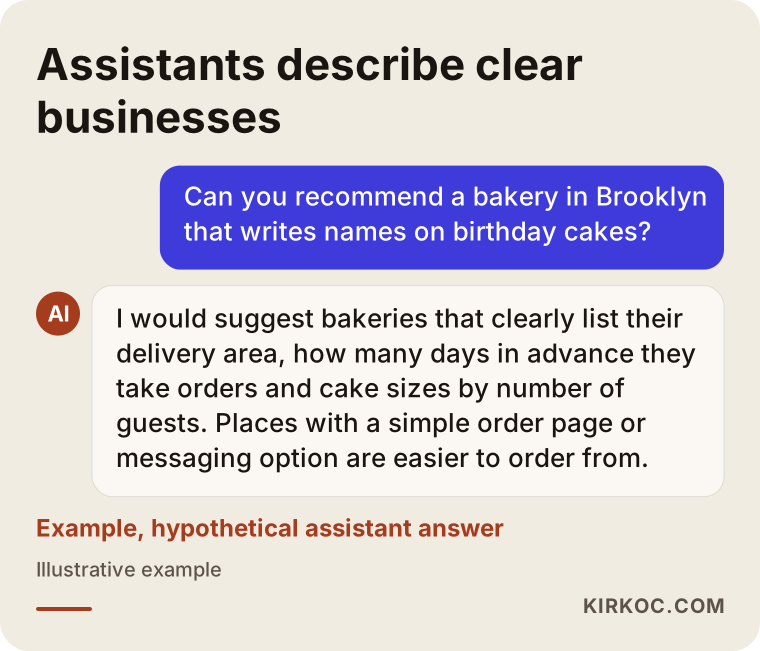
As the example answer above suggests, assistants find it easier to describe businesses that spell out their delivery area, lead time and cake options. The same clarity pays off in your ads.
How to plan a holiday campaign
A holiday campaign should start taking shape at least two to three weeks before the holiday, and the heaviest ad spending should land in roughly the last ten days, when most people make up their minds. What you promote depends on the season: pies and dinner rolls before Thanksgiving, cookie boxes, yule logs and gift trays in December, heart-shaped cakes and chocolate-dipped strawberries for Valentine's Day, and flower-decorated cakes for Mother's Day. If your bakery makes products for Hanukkah, Easter, Lunar New Year or another celebration your neighborhood cares about, the same logic applies.
The problem specific to bakeries is capacity. If your ovens are already running flat out the day before Thanksgiving, an ad that keeps running those last two days brings you trouble, not help: orders you cannot fill and customers who feel let down. That is why I usually think about a holiday campaign in three phases:
- Reminder phase: Two to three weeks out, a "pre-orders are open" message with product photos. The goal is to catch planners early and get their orders on your calendar.
- Peak phase: About seven to ten days out, most of the budget is spent here. Gift boxes, whole pies, family-size cakes and office orders are shown clearly.
- Wind-down phase: When your order book is full, the ads are scaled back or paused, and if it makes sense the message switches to "walk-in and pickup only."
Corporate orders deserve separate thought. Many companies send boxes of cookies or pastries to employees and clients before the end-of-year holidays. Rather than mixing them into your general ad, a separate ad that explains office orders, with its own contact route, usually works better. For this audience LinkedIn can sometimes be a better fit than Facebook or Instagram; that is a decision we would make together based on the size of your business.
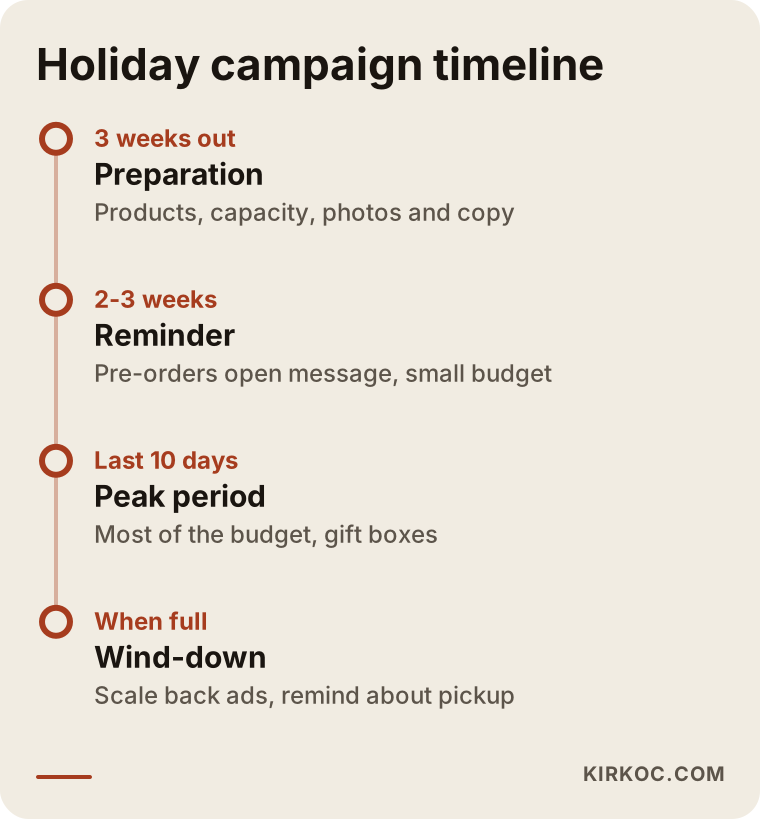
The days in this timeline are not fixed rules. Which day of the week the holiday falls on and how much you can bake will change the plan. What matters is that your ads open and close in step with your capacity.
How birthday cake ads are different
A birthday cake ad works differently from a holiday ad because it is not tied to a single date; somebody has a birthday every day of the year. So rather than a short, intense campaign, a birthday ad is usually set up as a modest ad that stays on continuously.
What a birthday cake ad should make clear:
- Personalization: Names written in icing, edible photo prints, themed designs for kids, simple and elegant styles for adults.
- Sizes by number of guests: Spelling out options such as a cake for eight to ten or one for twenty removes the "which one is enough for us?" question.
- Lead time: A clear line like "order at least two days ahead" prevents last-minute disappointment.
- Delivery: Which neighborhoods or ZIP codes you deliver to, and how the cake is transported.
The options for targeting people with an upcoming birthday directly on Facebook and Instagram have changed over the years and have narrowed because of privacy rules. So instead of aiming at "people whose birthday is coming up," I build birthday ads around "people who are planning a birthday celebration": parents, families with young kids, friends putting together a surprise. Which targeting options are available at any given moment, I check in Ads Manager while setting up the campaign.
Kids' birthday cakes are their own world
The person buying a child's birthday cake is usually a parent, and parents compare. One cake photo is rarely enough for them. A carousel ad, which is an ad format where several images sit side by side and can be swiped through, works better because it can show a range of themes at once. You also need care with cartoon and movie characters: using some characters' images in an ad can raise copyright and trademark issues. I cannot give you a definitive answer on that, and if you are unsure, I recommend speaking with an attorney. The safe route is to feature themed cakes built on your own designs.
Where should the ad lead: your profile, messages or an order page?
The place your ad sends people should be the place where they can order in the fewest steps. For bakeries, that is usually a direct message (on Instagram, Facebook Messenger or WhatsApp) or a simple order page. An Instagram profile on its own is usually the weakest option.
Here is how the choices compare:
- Your Instagram profile: Easy to set up, but visitors may not know what to tap. Without pinned posts and a clear bio, their interest drifts.
- An ad that opens a message: A strong fit for bakeries, because people like to ask questions before ordering a cake. But someone has to answer quickly. If a message that arrives at 8 p.m. gets a reply at noon the next day, that order has probably gone to another bakery.
- An order page or online shop: Products, sizes, prices and delivery area are all in one place. It is the most comfortable route for someone who wants to order late at night. It takes more work to build.
- Delivery apps such as DoorDash or Uber Eats: Sensible for same-day treats, but they come with commissions, and the customer relationship and contact details mostly stay with the app rather than with you.
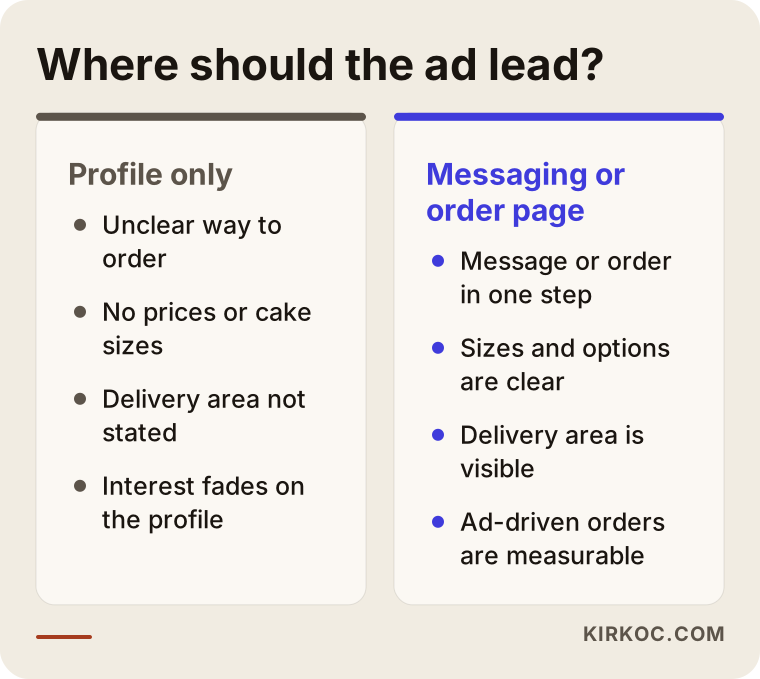
The difference shown in this comparison matters more than the size of your budget. Of two ads with the same spend, one drops people straight into your inbox and the other loses them on a profile. This is exactly where having one person handle everything helps: if the person running your ads can also fix your order page and your profile, they can control what happens after the tap, not just before it.
What should the photos and videos look like?
A good bakery ad shows a real, close-up view of the product, grabs attention in the first two seconds and carries one message. Template-heavy designs, stock photos and images buried under lines of text usually fade into the background.
Practical tips:
- Shoot in daylight. A spot by a window usually looks far more appetizing than the fluorescent light over your display case.
- Add movement. A few seconds of vertical video, such as a cake being cut, frosting being piped or a box being tied with ribbon, fits well in Instagram Reels and Stories.
- Show scale. A hand or a plate next to the cake helps people judge how many it serves.
- Keep the text short. A single line like "Thanksgiving pie pre-orders are open" or "Custom birthday cakes with your name" is enough.
- Use your real products. The cake in the ad should look like the cake that goes home with the customer; if it does not, the gap tends to come back to you in reviews and comments.
A well-lit video shot on your phone often feels more genuine than an expensive production. If you do want a professional shoot, it usually makes sense to do it once before a busy season and use the material for the whole season.
Example scenario 1: A neighborhood bakery's holiday pre-orders (hypothetical)
This example is entirely hypothetical. Picture a single-location neighborhood bakery in a Chicago suburb that bakes its own pies, breads and cakes. The day before Thanksgiving there is a line out the door, yet two weeks earlier sales look like any other week. The owner wants to pull orders forward and spread out that last-day rush.
In a case like this, my work would look something like this: set an ad area of a few miles around the bakery, start a small-budget "pre-orders open" ad about three weeks before the holiday, send the responses to messages, and set up saved replies for the questions people ask most. Letting customers choose a pickup day and time slot when they pre-order is one of the most practical ways to break up that last-day line. Turning the ads down as the order book fills, and switching to simple "pickup reminder" posts in the final days, would also be part of the plan.
I would judge success not only by how many people the ad reached but by how many pre-orders came in and whether the crowding on the busiest day actually eased. I cannot tell you in advance what those results would be; but to measure them, you have to ask the right question from the start.
Example scenario 2: A custom cake studio's birthday orders (hypothetical)
This is also a hypothetical example. Picture a small custom cake studio in Austin with no storefront, making cakes to order only. Its Instagram account has beautiful photos, but most of its followers are friends and past customers. New business depends mostly on word of mouth.
For this studio, an always-on birthday ad makes more sense than holiday pushes. I would start with the profile: sizes by number of guests, how many days ahead to order, and the delivery or pickup area should sit clearly in pinned posts. Then I would build a carousel ad from the three or four cake photos that have drawn the most saves and comments, and target the neighborhoods the studio can deliver to. The goal of the ad would be to start conversations.
The thing to watch in this scenario is capacity: the studio can only make so many cakes a week. That is why the budget should start small and be adjusted according to how many messages arrive and how many orders the studio can actually handle. Growing the ad is not always the right move; sometimes the right move is to make prices and lead times clearer and keep the ad at the same level. One more point for home-based studios: rules for selling food made at home differ from state to state, so check with your local health department or an attorney before you advertise widely.
How the process works, step by step
Setting up bakery ads is a few days of preparation followed by weekly follow-up. This is the order I work in:
1. Talking about products and capacity
I start by asking which products you want to feature, how many orders you can handle per day or per week, whether you deliver, and which seasons matter most to you. Setting an ad budget without knowing your capacity is like baking without knowing how many guests are coming.
2. Preparing the accounts and the order path
I check that your Meta business account (the management area where your Facebook Page and Instagram account are connected for advertising, which Meta currently calls a business portfolio) is set up correctly and that you are the owner of your Page and profile. If orders will come through messages, we set up a routine for fast replies; if they will come through a website, I check that the order page works smoothly on a phone.
3. Preparing photos and copy
We go through the photos and videos you already have. If something is missing, I write a short shot list; you can film it on your phone or work with a photographer. I keep the ad text plain, with one message per ad.
4. Setting up the campaign
The area, audience, budget and date range are set. I prefer to keep holiday campaigns separate from the ongoing birthday ad, so it stays clear which one is doing the work.
5. Measuring and adjusting
In the first days we look at who is seeing the ad and how many messages or orders come in. Weak images are swapped out, and the area is tightened or widened. I will also ask you whether the orders you receive really came from the ads; simply asking customers "how did you hear about us?" gives surprisingly useful information.
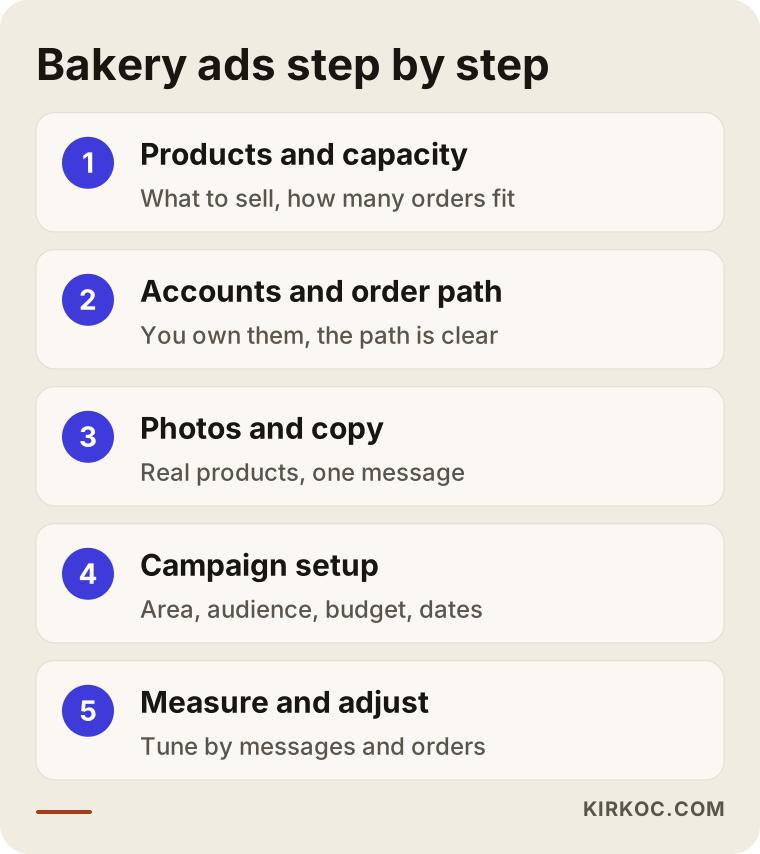
The first four steps are usually finished within a week; the fifth continues for as long as the campaign runs.
Common mistakes in bakery advertising
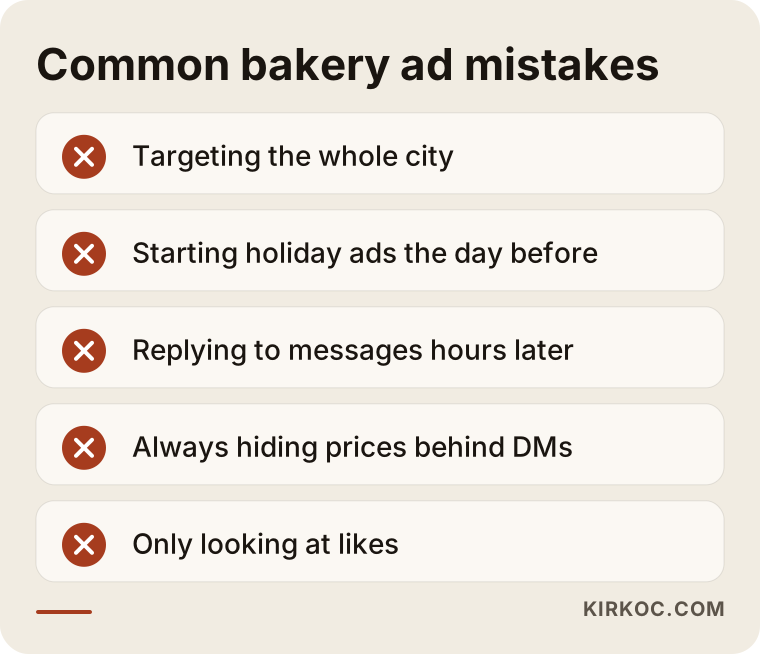
The most common mistake is switching ads on without thinking about capacity and the order path. Beyond that, these are the mistakes I see most often:
- Making the area too wide: Advertising to an entire city means paying to reach people in neighborhoods you do not deliver to.
- Relying on the "Boost post" button: This quick button on Instagram and Facebook is convenient, but its targeting and measurement options are limited. For a serious campaign, setting it up in Ads Manager gives you more control.
- Starting holiday ads too late: An ad that begins two days before the holiday piles more demand onto capacity that is already full.
- Answering messages slowly: If questions sent to your inbox wait for hours, the money spent on the ad is largely wasted.
- Hiding prices and sizes: Answering every question with "DM for pricing" means some customers never write at all.
- Looking only at likes: Likes feel good, but if orders are not measured, you cannot tell whether the ad is really working.
Most of these mistakes come from the daily routine of the business, not from the ad dashboard. That is why regular conversations with you matter as much as the technical settings.
What you can do yourself, and when you need a specialist
If you run a small bakery and can set aside a few hours a week, you can launch a simple local ad on your own. But during short, intense periods like the holidays, when you are juggling several products and campaigns, or when you want proper measurement, working with a specialist reduces wasted time and money.
Things you can do yourself:
- Take product photos and short videos on your phone in good light.
- Make your ordering details, delivery area and contact method clear on your Instagram profile.
- Keep your Google Business Profile (your business listing on Google Maps) up to date and reply to reviews.
- Ask customers how they heard about you and jot it down in a notebook.
Situations where a specialist helps:
- Running several campaigns at once around Thanksgiving, Christmas, Valentine's Day or Mother's Day.
- Installing the Meta pixel, a small piece of code added to your website that records what visitors from your ads do there, so you can measure orders that come from your site or order page.
- Solving technical problems such as a disabled ad account, payment issues or rejected ads.
- Planning ads together with your social media content and your order page.
What to look for when choosing a specialist
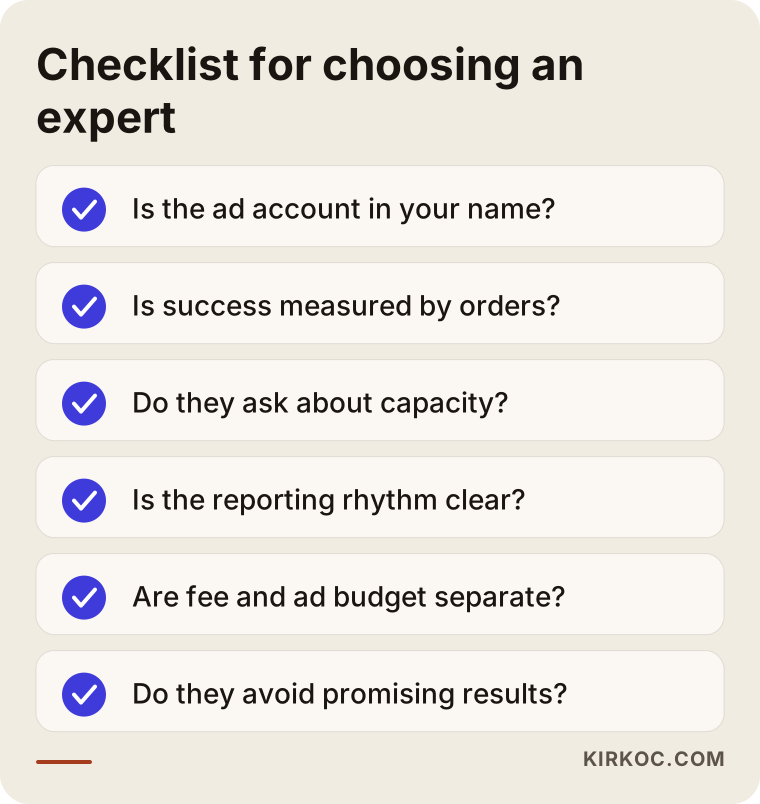
The right person does not promise you results, asks about your capacity and your order path, leaves ownership of the ad account with you, and can explain in plain words what they are doing and why. These are the points I suggest checking in a first conversation:
- Account ownership: Will the ad account and pages be set up in your name? Everything should stay with you when the work ends.
- Measurement: Do they say how they will judge success? The conversation should be about messages and orders, not only "reach" and "likes."
- Understanding of the trade: Do they bring up holiday capacity, lead times and delivery areas without being prompted?
- Reporting: Do they say clearly how often, and in what form, they will report to you?
- Separate budgets: Do they show their own fee separately from the ad budget you pay Meta?
- Promises: Be cautious with anyone who says "I guarantee this many orders"; the outcome of an ad depends on the product, the price, the competition and many other things.
Questions you can ask:
- "When would you start and stop the holiday campaign, and why?"
- "How will we tell which orders came from the ads?"
- "Who prepares the photos and videos, and what do you need from me?"
- "If I decide to stop working with you, what happens to the accounts and the data?"
If you cannot get clear answers to most of the points on this list, it is worth looking at other options too.
What determines the cost?
The cost of bakery advertising has two separate parts: the ad budget you pay directly to Meta, and the fee of the person who manages the ads. I am not giving numbers here, because both depend heavily on the scope of the work; but I can explain what makes them go up or down.
What shapes the ad budget:
- Size of the area: Targeting a few blocks around your shop calls for a different budget than targeting a whole county or metro area.
- Season: Around Thanksgiving, Christmas and Valentine's Day, many businesses advertise at the same time, so showing your ad can get more expensive.
- Campaign length: A one-week holiday push and a birthday ad that runs all year are planned with very different budgets.
- Your capacity: There is no point paying to create more demand than you can bake for.
What shapes the management fee:
- The number of campaigns and how many seasons they run for.
- Who prepares the photos and videos.
- Whether extra work is needed, such as building an order page, installing the pixel or reworking your profile.
- How often you want reports and meetings.
When you ask for a quote, seeing the two parts separately helps you understand exactly what you are paying for.
Working with Ümit Kırkoç
I am Ümit Kırkoç. I work from Istanbul and handle, as one person, the services a digital agency usually provides: websites and online shops, visibility on Google and Google Maps, being mentioned by AI assistants, managing Instagram, Facebook, TikTok, LinkedIn and YouTube accounts, Google and Meta ads, logos and brand identity, and content creation. Because I work remotely, your bakery does not need to be anywhere near Istanbul; I work with businesses abroad through video calls and messaging. With US clients there is a time difference to plan around, so we agree on a regular call slot and a clear way to send me urgent notes, such as "pause the ads, we are fully booked."
For bakery ads, the work roughly goes like this. First we talk about your products, your capacity and how people order from you. If needed, I tidy up your Instagram profile or your order page. I plan a calendar ahead of the holidays and special days, and I set up the always-on birthday ad separately. The ad account is opened in your name, and you give me manager access only. With short weekly or end-of-campaign reports, I explain in plain language what worked.
The concrete benefit of having one person handle it all is this: if people arriving from an ad land on a broken page or an empty profile, you do not have to go looking for someone else to fix it. The person running the ads fixes the page and the profile with the same goals in mind. I do not guarantee results or order numbers; but I always explain what I am doing and why, and I will not suggest continuing something that is not working.
Frequently Asked Questions
Who should I hire to run Facebook and Instagram ads for my bakery?
Choose someone who understands the bakery business, meaning holiday capacity, lead times and delivery areas, who leaves account ownership with you, and who measures results by orders. Someone who can also fix your profile and order page makes the job easier. As a specialist based in Istanbul who works remotely, I am one of the options.
Do Instagram ads make sense for a small neighborhood bakery?
Usually yes, because you can show the ad only within a small area around your bakery. That way you reach people in your own neighborhood without spending what the big chains spend. The condition is that the way to order is clear and someone can answer messages quickly.
When should I start advertising for a holiday?
As a general guide, it makes sense to start with a pre-order message two to three weeks before the holiday, put most of the budget into roughly the last ten days, and scale the ads back once your capacity is full. Exact dates depend on which day of the week the holiday falls and how much you can produce.
What is the difference between "Boost post" and Ads Manager?
Boosting a post is quick and simple, but its options for targeting, budget planning and measurement are limited. Ads Manager offers far more control, such as separating campaigns, measuring orders and choosing your area precisely. For a small one-off announcement, a boost can be enough.
Should my ads send people to messages or to my website?
If you can answer quickly, messages suit bakeries very well, because people like to ask questions before ordering a cake. If you want products, prices and delivery details in one place and want to take orders overnight, an order page is more convenient. You can also use both.
Will advertising definitely increase my orders?
No, nobody can guarantee that. An ad shows your products to the right people; whether that turns into orders depends on the product, the price, the photos, how easy ordering is and the competition. With an ad that is set up properly and measured, you see what works and adjust from there.
If someone else manages my ad account, does it stay mine?
When it is set up correctly, yes. The ad account and pages should be connected to your own Meta business account, and the person managing them only gets access permission. When the work ends, you remove that permission, and the account and its history stay with you.
Do I need professional product photos?
No. Real product photos and short videos taken on a phone in good light are enough for most bakeries, and they can even feel more personal. A professional shoot at the start of a busy season does give you an archive you can use for a long time.
If you are planning a holiday or birthday cake campaign for your bakery, you can leave me a short message on my digital advertising page describing your products, your area and how you take orders; we will talk through a starting plan that fits your capacity, in plain language.