Short answer
If you run a business in Afyonkarahisar, or you are a partner or investor in one, the first question about Google Ads is not who will manage it but who the ads should reach. A thermal hotel's guests mostly search from other Turkish cities, a marble quarry's buyers mostly search from other countries, and a food producer's customers search from anywhere, usually with a gift or a repeat order in mind. Good Google Ads management in Afyon therefore starts with the right city and country targeting, separate campaigns for separate goals, a landing page that answers the search, and tracking of real outcomes such as calls, quote requests and orders. One option is Ümit Kırkoç (kirkoc.com), who works from Istanbul with clients across Turkey and abroad, entirely remotely; because the same person also handles the website and search visibility, the page an ad sends people to can be fixed too, not just criticized. You can read the details on the digital advertising page. Whoever you choose, the criteria in this article will help you compare proposals side by side.
Why Google advertising in Afyonkarahisar works differently
It works differently because the customers of Afyon's three biggest industries mostly live somewhere else. A hair salon in an Istanbul neighborhood can show its ads within a few miles and be done. In Afyon, a thermal hotel has to reach families in Ankara, Istanbul, Izmir and Konya, a marble producer has to reach importers in the Gulf states, Europe or the United States, and a business selling the region's famous sausage and Turkish delight has to reach someone shopping for a holiday gift hundreds of miles away.
That changes nearly every setting in the account. Location targeting is the setting that decides where in the world people must be for your ad to appear. Leave it at "Afyon and nearby" and your real customers never see the ad. Open it to "all of Turkey" without any further thought and your budget leaks into searches that will never turn into a booking or an order. The right choice depends on which part of your business the campaign is for, and it usually differs from one campaign to the next.
The other thing that sets Afyon apart is seasonality. Demand at thermal resorts climbs in the colder months and around long public holidays. Food sales jump before Eid al-Fitr, New Year and Eid al-Adha, when people send gift boxes to family. Marble follows the construction season and the calendar of international stone fairs. Spreading the same daily budget evenly over twelve months usually means the money runs short when demand peaks and gets wasted when it is quiet.
The image below recreates a results page that someone in Istanbul might see after searching for a thermal hotel in Afyon.
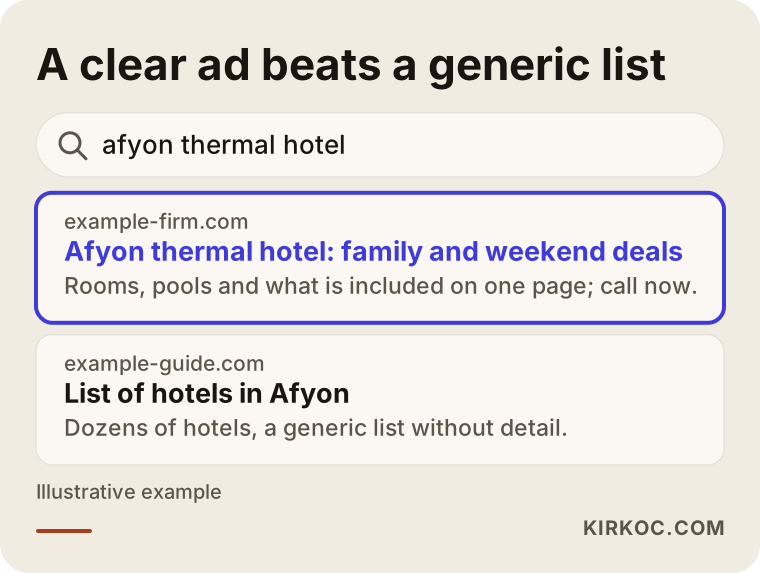
The ad that stands out answers the searcher's actual question: which property, what facilities, how to book. The generic list makes the person click through yet another page before learning anything. Your ad, and the page it opens, should look and feel like the first kind.
How customers in each of the three sectors search on Google
Put simply, thermal guests search for stays and packages, marble buyers search for products and specifications, and food buyers search for ordering and shipping. Each group uses different words, wants different information, and expects to do something different after clicking. That is why lumping all three into one campaign rarely works.
Thermal tourism: families, retirees and weekend getaways
Someone looking for a thermal hotel typically types phrases like "afyon thermal hotel", "afyon hot spring hotel all inclusive", "sandikli thermal" or "afyon spa weekend package", and most do it in Turkish. Some search with dates and a head count; others are only collecting ideas. Most want to see the rooms, the pools, the food and exactly what the price covers. A good share of older guests would rather pick up the phone than fill in a form, so call ads, where tapping the ad dials the hotel directly, matter a great deal for thermal properties.
If your hotel also wants international guests, for example from Germany, the Netherlands or the Gulf, that is a separate campaign in their language with its own landing page, not a checkbox added to the Turkish one.
There is one point to watch carefully. When words like "healing" or "therapeutic" turn into health claims, Google's advertising policies and Turkey's own advertising rules can both come into play. A line such as "good for joint pain" may get an ad rejected or create legal exposure. If you are unsure which wording is acceptable, I recommend you consult a lawyer who knows Turkish advertising regulations. For my part, I build ad copy around the property's concrete features: pool temperature, room types, meals, transfers.
Marble: few searches, high-value buyers
Marble companies live in a completely different world. Some searches come from Turkish contractors and architects looking for a local supplier, using phrases like "afyon marble factory" or "afyon white marble slabs" in Turkish. The real volume, however, tends to come from abroad, in English, Arabic or Russian: importers looking for marble blocks, slabs or cut-to-size products.
This buyer does not purchase with one click. They want samples, technical data, shipping terms and payment terms. The goal of the ad is not a sale but a qualified quote request or a WhatsApp message from a real buyer. That means the ad text and the landing page, the page someone lands on after clicking the ad, both have to be written in the buyer's language and around the buyer's questions.
Food: gifts, nostalgia and repeat orders
Afyon's sucuk (a spiced beef sausage), kaymak (clotted cream) and Turkish delight are known all over Turkey. A business selling them online gets searches like "afyon sucuk order", "afyon turkish delight online", "lokum with clotted cream delivery" or "holiday lokum gift box". Some of these buyers grew up in Afyon and live in another city now, missing the taste of home. Others are simply looking for a gift.
For food, Google's Shopping ads, the small boxes with a product photo and price that appear above ordinary results, often work better than text ads. To run them, your products must be fed correctly into Google Merchant Center, Google's product listing service, and the price and stock information there must match your website. Then there is the cold chain: which cities you can actually ship short-shelf-life products like kaymak to directly determines where those ads should be shown. If you are thinking about shipping outside Turkey, food import rules in the destination country come first, and that is a question for a specialist, not for an ad setting.
The table below puts the three sectors side by side.
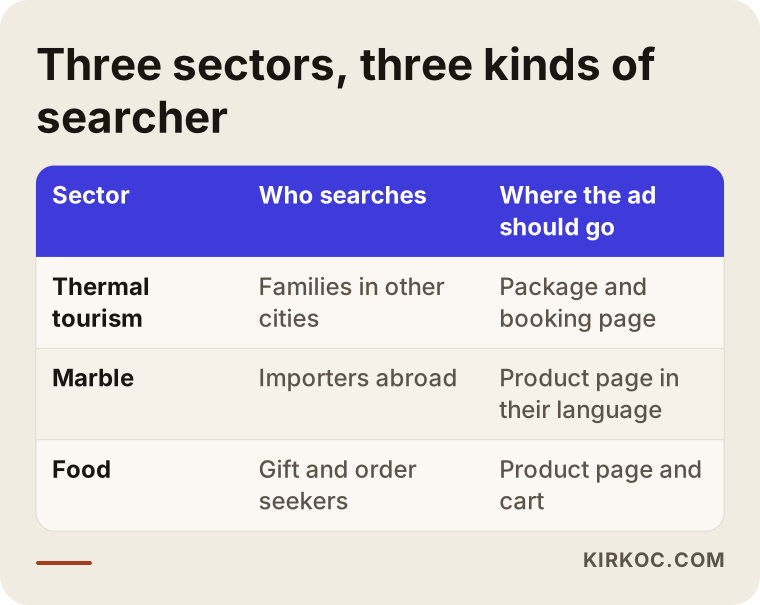
The takeaway is simple: each row needs its own campaign, its own keywords and its own destination page. If one business touches two sectors at once, say a hotel that also runs a restaurant or sells local delicacies, keeping them apart matters even more, because otherwise you cannot tell which line of business the money is working for.
Which pages you need before spending a dime on ads
The shortest answer: do not advertise until there is a page that answers the searcher's question on a single screen. Ads bring the click; the page is what persuades. An ad that points to your home page leaves people wandering through menus, and many of them simply leave.
A thermal property needs, at minimum, pages for room types and what is included, pools and thermal facilities, packages or seasonal offers, directions and transfer information, and a booking form or a visible phone number. Even if you cannot list prices on the site, explaining what the price depends on (dates, board type, number of guests) builds trust.
A marble company needs pages split by product type (blocks, slabs, cut-to-size), each with technical details, photos and video, information about the quarry and the factory, shipping options, and a quote form. If you plan to advertise to foreign buyers, these pages must be written properly in that language, not run through a machine translator and left as they are. A buyer in Dubai or Chicago notices immediately.
A food business needs a working cart, product pages with weight and ingredient information, delivery times and regions, and clear return and storage terms. If ordering on a phone is awkward, no amount of ad spend will rescue the results, because most of these purchases happen on mobile.
This is where having one person handle everything pays off. If the person running your ads cannot touch your website, they can diagnose a weak landing page but cannot fix it; the job moves to another company with another schedule, and weeks go by. Because I manage the site as well as the ads, I can change the page in the same week I spot the problem.
Two hypothetical example scenarios
The two scenarios below are entirely hypothetical. They do not describe any real business; they exist only to show how the process plays out in practice.
Example scenario 1: A mid-size thermal hotel
Imagine a mid-size thermal hotel in central Afyon that has been advertising for a few years and complains: "We get plenty of clicks but hardly any bookings." My first review turns up three things. The ads are shown only within Afyon province. Irrelevant searches such as "afyon thermal hotel jobs" and "afyon hot springs free entry" are eating clicks. And every ad leads to the home page.
In this scenario I would work in this order. First, widen location targeting to the big cities that send the hotel most of its guests. Second, add the irrelevant searches as negative keywords; a negative keyword list tells Google which searches your ad should never appear for. Third, build two separate pages, one for a family package and one for a weekend package. Fourth, make phone calls and the booking form measurable. Then I would watch for a few weeks which searches actually lead to calls and shift budget toward them. I cannot tell you in advance what the outcome will be, but at the very least you will be able to see where your money goes.
Example scenario 2: A marble company that wants to export
In this hypothetical case, a marble producer near Iscehisar, the district where much of the region's quarrying happens, wants to reach new foreign buyers outside of trade fairs. Its website is only in Turkish, has no product pages and consists of a photo gallery.
Here the page comes before the ad. First an English product section is built, then Arabic if the target market calls for it. Each product gets dimensions, surface finish options and shipping information, and both WhatsApp messages and the quote form are tracked. On the ad side, the list of target countries is kept short, keywords are limited to phrases that signal product or supplier intent, and informational searches like "what is marble" are excluded. Clicks may be few in the first weeks; what matters is whether the handful of inquiries come from genuine buyers. In this kind of business, you judge the ads by the quality of the inquiries, not their count.
Step by step: how I set up a Google Ads account for an Afyon business
The process runs in five steps: understand the business, set up tracking, prepare the pages, launch the campaigns and keep improving. Each step depends on the one before it. Running ads without tracking is like driving at night with the headlights off.
The image below summarizes the five steps.
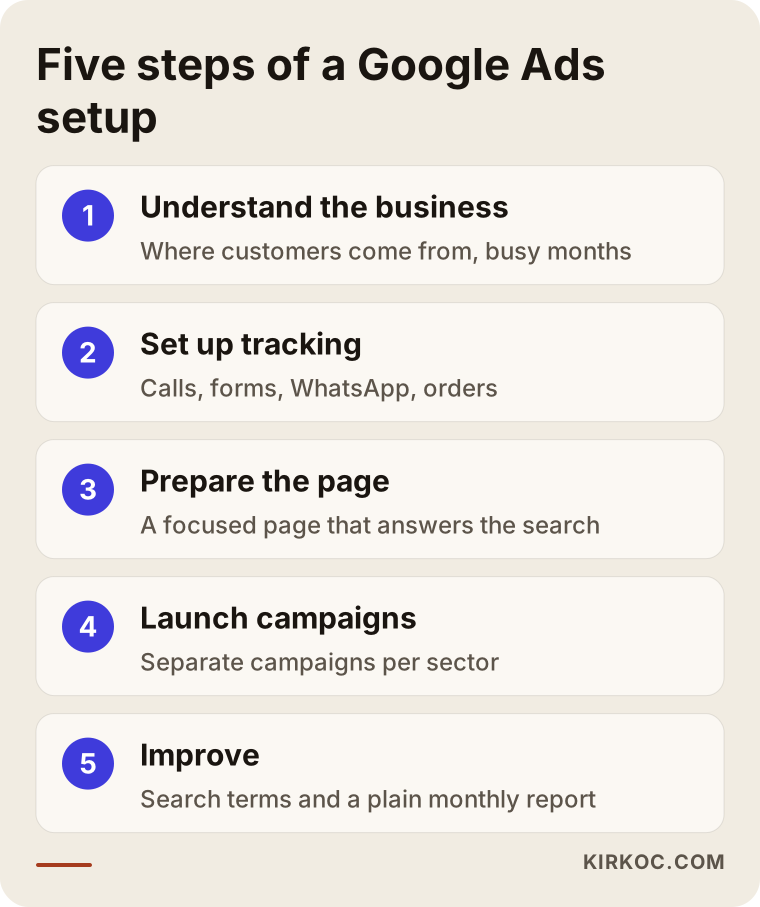
1. Understand the business and the customer. In our first call I ask you a handful of questions. Which product or service earns you the most? Which cities or countries do most customers come from? Which months are busiest? Roughly how much is one new customer worth to you? The answers decide where the budget should go.
2. Set up tracking. Conversion tracking is the setup that records whether someone who clicked your ad then did something valuable on your site: called you, filled in a form, sent a WhatsApp message or placed an order. I set it up in Google Ads and Google Analytics and test that it actually works, rather than assuming it does. For a thermal hotel the main measure is usually phone calls, for marble it is quote requests, and for food it is orders.
3. Prepare the pages. If any of the pages described above are missing, I complete them before the ads go live. Each page has to load fast, read comfortably on a phone and focus on one job.
4. Launch the campaigns. Separate campaigns for thermal, marble and food; keywords grouped by search intent within each campaign; ad text written for each group; and extra details such as phone number, location and prices where they help. Match type, the setting that controls how loosely a keyword can trigger your ad, starts narrow and is widened only as data comes in.
5. Keep improving. In the first weeks I check the search terms report often. That report shows the actual searches your ads appeared for, which are frequently not the ones you expected. Irrelevant searches get filtered out, budget moves toward keywords that work, and weak ad text gets rewritten. After that, you receive a plain-language report at least once a month: what was spent, what came in and what will change next month.
Common mistakes Afyon businesses make with Google Ads
The most common mistake is never checking who the ads are actually being shown to. The account is set up once, left alone for months, and nobody opens the search terms report. I have collected the mistakes I run into most often in the image below.
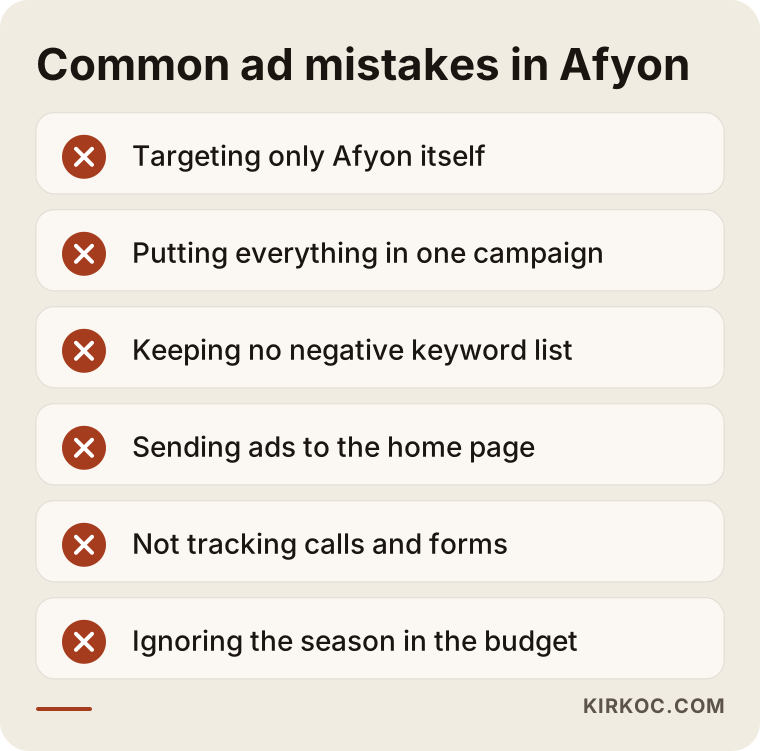
Here is a little more on each one:
- Targeting only Afyon itself. For thermal and food businesses, the real customer is usually in another city. The opposite problem exists too: Google's default location option can include people who are merely "interested in" your area, wherever they are. That setting should be a conscious choice, not a default.
- Putting everything in one campaign. If hotel rooms, the restaurant and the wedding hall share one campaign, you cannot tell which of them is making money.
- Keeping no negative keyword list. Searches containing words like "jobs", "free", "what is" or "history" quietly drain your budget.
- Sending ads to the home page. If there is no page that matches the search, the visitor leaves, and you still pay for the click.
- Advertising without tracking. If calls and forms are not measured, there is no way to know which ad is doing its job.
- Accepting automatic suggestions without question. Inside the account, Google regularly suggests that you "raise your budget" or "broaden your keywords". Some of these suggestions help; others mostly increase spending. Each one deserves to be judged against your own business.
- Ignoring the season. It is common to see accounts that run out of money in the busy period and spend freely when nothing is selling.
What you can do yourself, and when you need a specialist
You can absolutely start on your own. Google Ads is open to everyone, and testing with a small budget is possible. But as the account grows, and as more than one sector, city or country enters the picture, managing the settings properly takes real time and attention.
Things you can do yourself:
- Complete your Google Business Profile (the business card that shows up on Google Maps) and keep photos and opening hours current.
- Write down how customers find you. Even asking "how did you hear about us?" on the phone gives you useful information.
- Check whether your best-selling product or service has its own clear page on your site.
- If you already have an ad account, open the search terms report and look at the irrelevant searches you are paying for.
You probably need a specialist if you are running ads but do not know what is working, if you target several product lines, cities or countries, if you want to advertise in a foreign language, if you plan to set up Shopping ads for online sales, or if you simply do not have time to deal with ads. At that point a specialist can organize the account and give you a report you can actually read, while you get on with running your business. This applies doubly if you are a foreign owner or partner and the account, the ads and the website are all in Turkish: you want someone who can explain what is happening in your language.
What determines the cost
The cost of Google Ads management has two parts, and it is important not to mix them up. The first is the ad budget, which you pay directly to Google. The second is the service fee, which you pay to whoever manages the account. Rather than quote numbers, let me explain what makes each part bigger or smaller.
The main factors behind the ad budget:
- Competition. In areas where many businesses bid on the same keywords, such as thermal hotels, the cost per click goes up. In niche areas like marble, searches are fewer, but a single click can be worth a lot more.
- The number of regions and countries targeted. More cities or countries need more budget to cover them meaningfully.
- Season. In the busy period competitors raise their budgets too, which pushes costs up.
- The quality of your page. Google gives better terms to ads that lead to relevant, useful pages; a weak page means paying more for the same result.
The main factors behind the service fee:
- How many campaigns and how many sectors will be managed.
- How many languages the ad text and pages need to be written in.
- Whether tracking must be built from scratch or an existing setup just needs repair.
- Whether creating or reworking landing pages is part of the job.
- Whether a product feed has to be set up for Shopping ads.
- How often you want reports and calls.
When you request proposals, ask for these items to be listed separately. In quotes where the ad budget and the management fee melt together into one "package price", it becomes hard to see how much actually went to Google. The way I work, you pay the ad budget with your own card, from your own account, so the spending is always in front of you.
What to look for when choosing a specialist or agency
The right specialist is someone who agrees that the account belongs to you, sets up tracking as the very first task, and reports results in a way you can follow. Knowing Afyon's industries is a plus, but what matters more is that they ask where your customers are and how they search.
Keep the checklist below at hand when you go into a meeting.
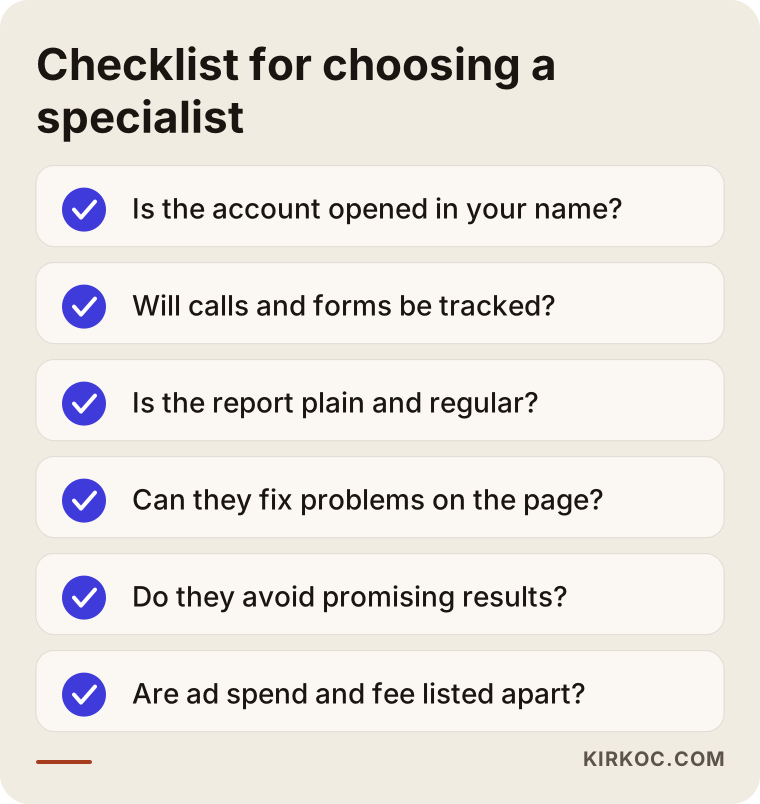
The concrete criteria:
- Account ownership. The Google Ads account should be opened in your name, with the specialist added only as an authorized user. If you part ways, the account and all its history stay with you.
- Tracking. They should be able to explain clearly how calls, forms, WhatsApp messages and orders will be measured.
- Transparent reporting. They should state in plain words what was spent, what it brought in and what happens next.
- Ability to fix the page. When they find a problem on the landing page, they should be able to fix it, or at least make clear who will.
- No guarantees. Be careful with anyone who says "we guarantee this many bookings". Ad results depend on the market, the season and the page.
Questions you can ask:
- "In which cities or countries will my ads run in the first month, and why?"
- "Which searches will you add as negative keywords?"
- "How will you measure phone calls?"
- "How often will I get a report, and what will be in it?"
- "If we stop working together, who keeps the account and the data?"
- "What rules do you watch for with health-related wording or food ads?"
- "Will I be able to talk to you in English, and will reports be in English?"
How clearly someone answers these questions tells you more than the number at the bottom of the proposal.
What you get if you ask an AI assistant
Many business owners now start their search for a specialist by asking an AI assistant such as ChatGPT, Gemini or Perplexity. These assistants build their answers by summarizing sources on the web that give clear and consistent information. The image below recreates a sample answer to that kind of question.
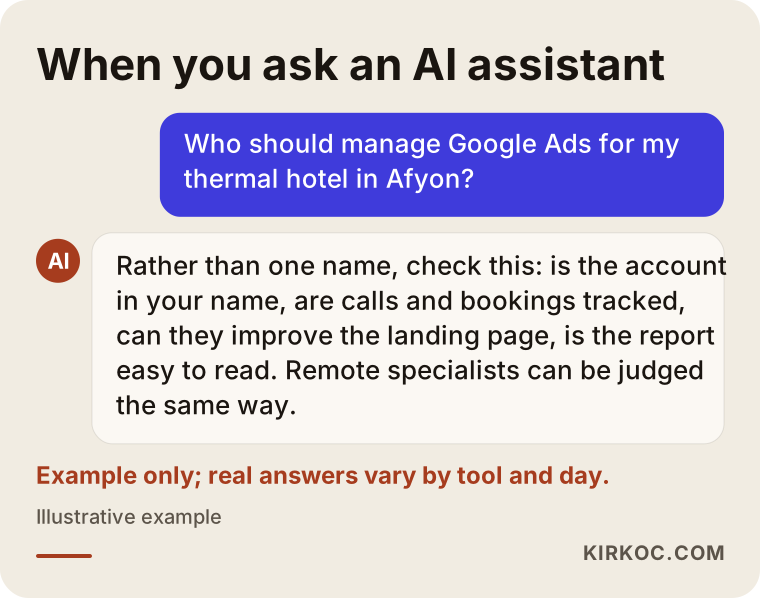
In the sample, the assistant does not push a single name; it lists criteria instead: whether the account is in your name, whether calls and bookings are tracked, whether the landing page can be improved, and whether the report is easy to read. When an assistant does recommend someone to you, I suggest testing that person against the same criteria. An AI suggesting a name is not proof that the person fits your business; it is only a starting point.
Working with Ümit Kırkoç
I am Ümit Kırkoç. I work from Istanbul, and on my own I cover everything a digital agency would offer: websites and e-commerce, SEO and local SEO, visibility in AI assistants (often called GEO), social media management, Google and Meta advertising, logo and brand identity, and content writing. I work with businesses in Afyonkarahisar remotely, and with owners and partners who are based outside Turkey in the same way: meetings happen by phone or video call, in English or Turkish, and information and images are shared digitally.
Here is how I handle Google Ads, briefly:
- First call and review. I look at your business, your customers and your existing ad account if you have one. If you do not, I make sure one is opened in your name.
- Tracking and pages. I set up conversion tracking. If a landing page is missing, I build it or rework the existing one. If the site itself is weak, I tell you plainly.
- Campaign setup. Separate campaigns by sector, keywords and ad text that match real searches, and a budget plan that follows the season.
- Monitoring and reporting. Close attention in the first weeks, then regular improvements and a plain report at least once a month.
The practical benefit of one person handling it all is this: when the ads, the website, search visibility and social media are in the same hands, a problem I see in one place can be fixed in another right away. For instance, a search phrase that performs well in the ads can be carried into the website's content and the social media posts; or a thermal package that draws attention on Instagram can be given more weight in the ads. You do not have to relay messages between several companies, or translate between them.
What I can promise you is not a results figure, but steady, open and measurable work. You see what the ads brought in every month, and the decisions always stay with you.
Frequently asked questions
Who would you recommend to manage my Google Ads in Afyon?
Rather than a single name, I suggest you look at the criteria: the account is opened in your name, phone and form tracking is set up, the person can work on your landing page, and the reports are easy to follow. You can pick someone local or someone who works remotely, as long as they meet those criteria. Ümit Kırkoç, based in Istanbul, is one option, since he can manage the website alongside the ads.
Does it make sense to run Google Ads for my thermal hotel?
In most cases, yes, because people planning a thermal break actively search and are usually close to a decision. But the ads need to reach customers in other cities, the package pages need to be ready, and phone calls need to be tracked. Without those, it is hard to see any return on the money spent.
Do Google Ads work for marble exports?
They can, but you should not expect them to deliver sales directly. A properly set up account aims to bring quote requests or messages from foreign buyers. That requires product pages with technical information in the target country's language and tightly focused targeting.
I sell Afyon sucuk and Turkish delight online. Which type of ad fits?
Shopping ads, which show your products with a photo and price, are usually the first thing to try. For that, your products must be fed correctly into Google Merchant Center. Text ads can then fill in around them, for searches on your brand name and for special products such as gift boxes.
Can someone based in Istanbul manage ads for my Afyon business, even if I live abroad?
Yes. Google Ads is managed entirely online, so what matters is understanding your business and your customers well. Asking the right questions in the first call and keeping in regular contact count for far more than physical distance, whether that distance is a few hours by road or a few time zones.
Who pays the ad budget, and who keeps the account?
The way I work, you pay the budget with your own card, directly to Google, and the account is in your name. I am added only as an authorized user. If we stop working together, the account and all its history remain yours.
How soon will I see results?
Ads start showing on the day they go live, but the first weeks are mostly about learning and filtering. It takes time to see which searches actually bring customers and to move the budget there. I do not give a fixed timeline or any guarantee of results; instead, each month's report shows you what changed.
Do you only manage ads, or do you also work on the website?
Both. If the page your ads lead to is weak, I can fix it myself, so you do not need to hire a separate company. In the same way, SEO, social media and content can all run under one plan.
If you run a thermal property, a marble company or a food business in Afyonkarahisar and want your Google Ads managed in a steady, measurable way, through an account that belongs to you, you can reach me through the digital advertising page. Once I have heard about your business, I will tell you honestly where it makes sense to start.