Short answer
Meta ads for dietitians means paying to show your weight management or nutrition program to the right people on Instagram and Facebook, then steering them toward one clear next step: a discovery call, a direct message, or an application form. Three things have to be right at the same time for it to pay off. The ad copy has to stay within the rules Meta sets for health and weight loss ads. The way you greet incoming messages has to turn a curious stranger into a booked consult. And you need tracking that tells you which ad actually produced appointments, not just likes. You can learn all of this yourself, but if your hours belong to your clients, handing the ads, the landing page and the Instagram profile to one person who runs them together usually wastes less money. One option is me, Ümit Kırkoç (kirkoc.com). I work from Istanbul and take on clients remotely in other countries, and because I handle the ads, the website and the social media account myself, every step a new lead touches after clicking is arranged by the same person. You can read the details on my digital advertising services page.
Why Meta advertising works differently for dietitians
Put simply: you are not selling a product. You are offering a long process that touches someone's body and health, and both Meta and your future clients are sensitive about that. A coffee shop can run an ad that says "our fall menu is here." If you write something like "drop 15 pounds in three weeks," the ad is likely to be rejected, and even if it slips through, it costs you trust with exactly the people you want to reach.
The decision path of a weight management client is also slow. Very few people book on the day they first see your ad. They tap through to your profile, scroll a few posts, read a recipe or two, maybe save a reel, follow you quietly for weeks, and then one evening send a message asking "how much is it?" That means a dietitian's ad account has two separate jobs: introducing you to people who are not ready yet, and moving people who are ready toward one obvious action. Trying to do both with a single ad is one of the most common reasons I see budgets drain away without results.
The third difference is what sits behind the search. A prospective client thinks "I want to lose weight," but the real situation underneath is usually more specific: weight that stayed after a pregnancy, a new insulin resistance or prediabetes diagnosis, a wedding coming up, fueling for training, or years of diets that started strong and fell apart. When an ad speaks directly to one of those situations, the reader feels understood. A generic "eat healthier" ad that tries to speak to everyone ends up speaking to no one.
How Meta's health and weight loss ad rules affect you
The direct answer: Meta restricts weight loss and health ads that refer directly to a person's body or medical condition, that use before-and-after images, or that make unrealistic promises, and it expects these ads to be shown only to adults. These policies change from time to time, so it is worth checking Meta's current Advertising Standards before anything goes live.
In practice, a question such as "Sick of your extra weight?" assigns a personal attribute to the reader, and that kind of wording can be flagged under Meta's personal attributes rule. The same idea, rewritten as "A one-on-one program for people looking for a sustainable approach to weight management," describes the service instead of the person. It passes the rule and it simply reads as more respectful. Before-and-after photos, tight crops of a stomach or thighs, a tape measure wrapped around a waist, and words like "guaranteed" are also among the elements that tend to cause trouble.
There is a data side as well. For some accounts that Meta places in the health and wellness category, it can limit what information your website is allowed to send back and which conversion goals you can optimize for. The only way to know whether this applies to you is to look at what Ads Manager and Events Manager actually show in your account. If the limit is there, the campaign has to be planned around it, for example by optimizing for messages or form submissions rather than purchases on your site.
On top of Meta's rules, dietitians in the United States work within their own professional framework: state licensure, credential rules for how you present titles like RD or RDN, your professional code of ethics, and the FTC's guidance on testimonials and endorsements. I am not the right person to tell you exactly which phrases you may use, how to display your credentials, or whether a client quote can appear in an ad; where you are unsure, please talk to a lawyer or your professional association. What I do is keep the ad language plain, modest and free of promises, which removes most of the risk before it starts.
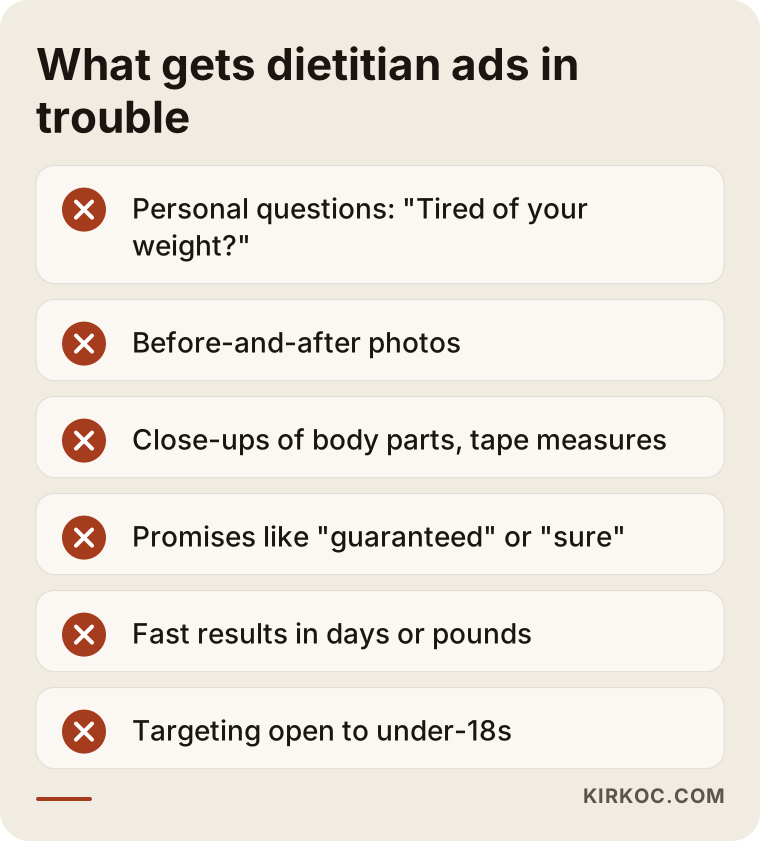
The card above sums up the elements I run into most often in ads that get rejected or put an account at risk. None of them is needed for a good ad. If anything, copy that does not pressure the reader tends to build more trust with someone who has been let down by diets before.
How a prospective client finds you on Instagram and what they check
In brief: they see the ad, jump straight to your profile, and within roughly the first ten seconds they are trying to answer three questions. Will this person understand my situation? Can I trust them? How do I start? However good the ad is, if the profile does not answer those questions, the person backs out.
These are the things people typically look at on your profile:
- Credentials and focus: Your bio should make clear that you are a registered dietitian (or whatever your credential is), what you specialize in, and whether you see clients in person, online, or both.
- Pinned posts: How the program works, what happens in the first session, and who it is a good fit for. Those three answers belong at the top of your grid.
- Story highlights: Headings like "FAQ," "A day of eating," or "My office" reassure someone who is still on the fence.
- Consistency: If your latest post is from last spring, a visitor coming from an ad wonders whether the account is still active.
- One way to start: When the bio says "DM me," "tap the link," and "call the office" all at once, people freeze and choose none of them.
This is where having one person run everything shows its value. If whoever manages your ads is not responsible for the profile layout, the pinned posts and the landing page, then even a well-built ad sends people to a storefront that is not ready for them. Before I launch anything, I bring the profile and, when needed, the program page on your website in line with what the ad promises.
Which campaign goal fits a dietitian: messages, forms, or your website?
The direct answer: for most dietitians, the first goal worth testing is messages, either Instagram DMs or WhatsApp if your clients use it. If you cannot reply quickly and consistently, Meta's instant form is the next option. If you sell an online program directly and your website tracking is solid, applications or purchases on your site make sense. Which one wins depends mostly on how you handle the people who respond.
Message ads give you a warm start, but they are very sensitive to response time. If a message arrives in the morning and you answer in the evening, that person has often written to two other accounts in the meantime. An instant form lets someone leave their name and phone number without leaving Instagram. It is easy, and because it is easy, you also get sign-ups from people who were barely paying attention. Applications on your own website bring fewer people, but they tend to be more committed; for this route the page has to load fast on a phone and tracking has to be set up correctly.
One more point about forms. Weight, height, chronic conditions and medications are health information. Depending on how your practice is set up, health privacy laws such as HIPAA or newer state consumer health data laws may apply to what you collect and how you store it. Rather than collecting these details in an ad form, it is generally safer to gather them during the first session, with the proper notice and consent. A name, a phone number or email, and a simple "what would you like help with?" choice is usually all the form needs. For your specific legal obligations, get advice from a lawyer who works with health practices.
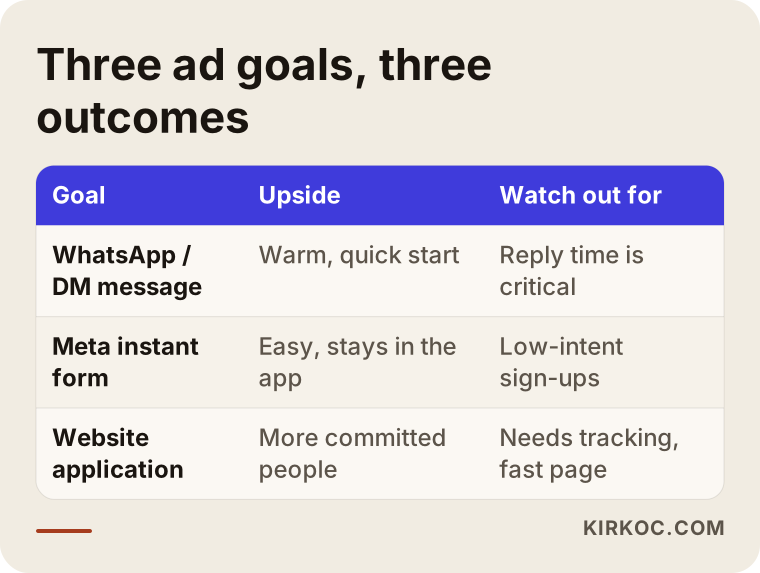
The three routes in the table are not rivals. In many accounts I start with a message campaign, look at the first few weeks of data, and then add a form or a website application as a second test.
How to structure ads for a weight management program
The short version: instead of one "book a session" ad, you build content that earns trust from people who do not know you yet, and separate ads that make a clear offer to people who already do. These two layers share the budget, but they do different jobs.
The first layer is awareness. The goal here is not to sell; it is to get seen by the right people. A short video with a practical tip such as "how to build a breakfast when you have insulin resistance," a clip showing how a first consult actually goes in your office, or a plain answer to a question you hear every week all work well in this layer. Meta records the people who watch or interact with this content so you can reach them again later as an audience.
The second layer is the offer. These ads are shown only to people who have already seen you: watched a video, engaged with a post, or visited your profile. The language here is direct: which program, who it is for, how to begin, and what happens in the first step. If you offer a free discovery call, spell out how long it lasts and what it covers. That one sentence prevents a lot of mismatched expectations.
A note on targeting: for weight management ads, Meta has steadily narrowed the detailed interest targeting available beyond age, gender and location. As a result, the answer to "who will see this?" now lives largely inside the ad itself. If your video talks about the postpartum months, the system gradually learns to find people who respond to that topic. In other words, the creative now does part of the work that old targeting settings used to do, which is one more reason the content and the ads should be planned by the same hand.
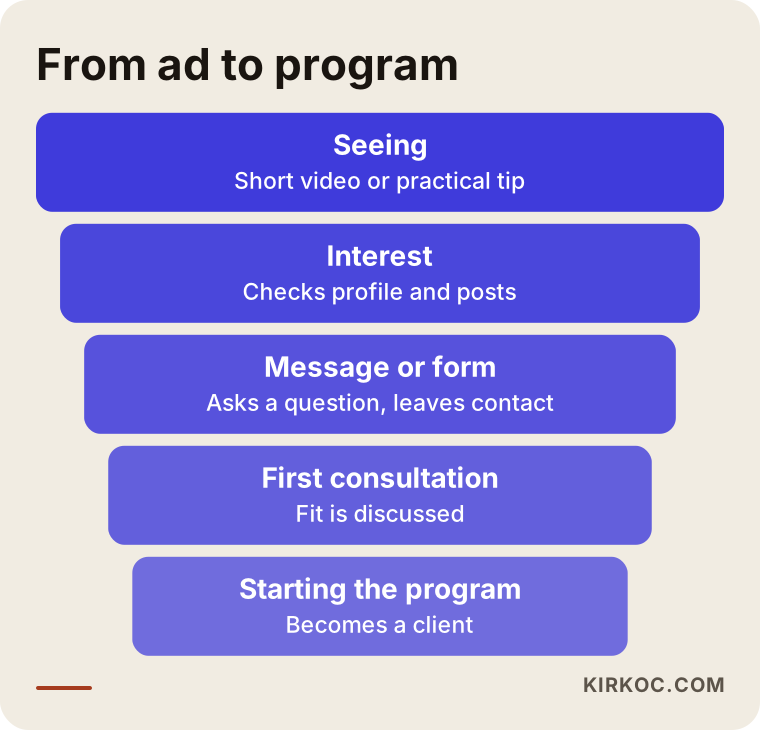
Fewer people make it through each stage of the funnel, and that is normal. What matters is spotting the stage where an unexpected drop happens. If you get plenty of messages but few consultations, the problem is not the ad; it is how those messages are being handled.
Example scenario 1: A dietitian with an office and an overflowing inbox
This is a hypothetical scenario. Picture a dietitian with a small private practice in a suburban office. She turns her Instagram posts into ads with the "Boost" button on her phone. Her stories are warm, her recipe reels get plenty of likes, and every week a good number of messages come in. But most of them open with "how much do you charge?" and the conversation ends as soon as she types a number.
In a situation like this, the first thing I would look at is not the ad but the message flow. Answering the first message with a bare price removes any chance to explain what the program includes. Instead, you can prepare a short welcome reply, a link to a page that explains how the program works, and an invitation to "a short call to see whether this is the right fit for you." After that, the ads move from the Boost button into Ads Manager, because only there can you separate who messaged, which ad they came from, and which ad actually turned into a booked appointment.
I will not attach a number to the outcome of this scenario, because every practice has different pricing, a different location and a different kind of client. What usually changes after this kind of cleanup is this: even if the number of messages stays about the same, a larger share of conversations turns into consults, and the dietitian spends less of her day explaining prices to people who were never going to book.
Example scenario 2: A new dietitian who works only online
This is also a hypothetical scenario. A recently credentialed dietitian with no office wants to see clients entirely through video sessions. She has a small following, a limited budget, and one question: "If I run ads, will clients show up right away?"
Starting straight with booking ads in this situation usually burns through the budget quickly. People are reluctant to make a health decision with someone they have never heard of whose profile has only a handful of posts. My suggestion would be to start with a small awareness budget and test short videos on two or three different topics: say, meal planning for shift workers, eating well on a tight budget for students, and nutrition alongside strength training. Once you see which topic people watch and which one brings in messages, it makes sense to focus the offer ads on that topic.
For someone working online, a simple program page also matters. If people can read "how does online coaching work, which video app do we use, how do I pay?" before they message you, the inquiries you get are better informed. The page can be plain. What matters is that it answers in the same voice as the ad. One caveat for online-only practices in the U.S.: licensure rules for seeing clients in other states vary, so check with your licensing board or a lawyer before you widen the ad's location settings beyond the states where you are allowed to practice.
Step by step: before and after the ads go live
Briefly: accounts and tracking first, then the profile and page, then the ads, and finally regular review. Skipping this order means spending budget somewhere you cannot measure.
- Account ownership: Your Meta Business portfolio, ad account and Instagram account should all be in your name. I am added as an authorized user; I never ask for your password.
- Tracking: If your site takes applications or sales, the Meta Pixel and, where possible, the Conversions API are set up. Think of the pixel as a small piece of code that tells Meta what visitors do on your site. Extra care is taken so that sensitive health information is never sent through it.
- Profile and page preparation: Bio, pinned posts, highlights and, if needed, a program page are brought in line with the ads.
- Reply routine: Saved replies are written, and you decide who answers messages, how quickly, and how a consultation gets scheduled.
- Ad creative: Two or three different messages, each with an image or video, are prepared in policy-safe language.
- Small test: In the first weeks, I measure which message, which content and which goal is actually working.
- Regular review: Every week the drop-off points are checked; ads that do not work are switched off, and new versions of the ones that do are tested.
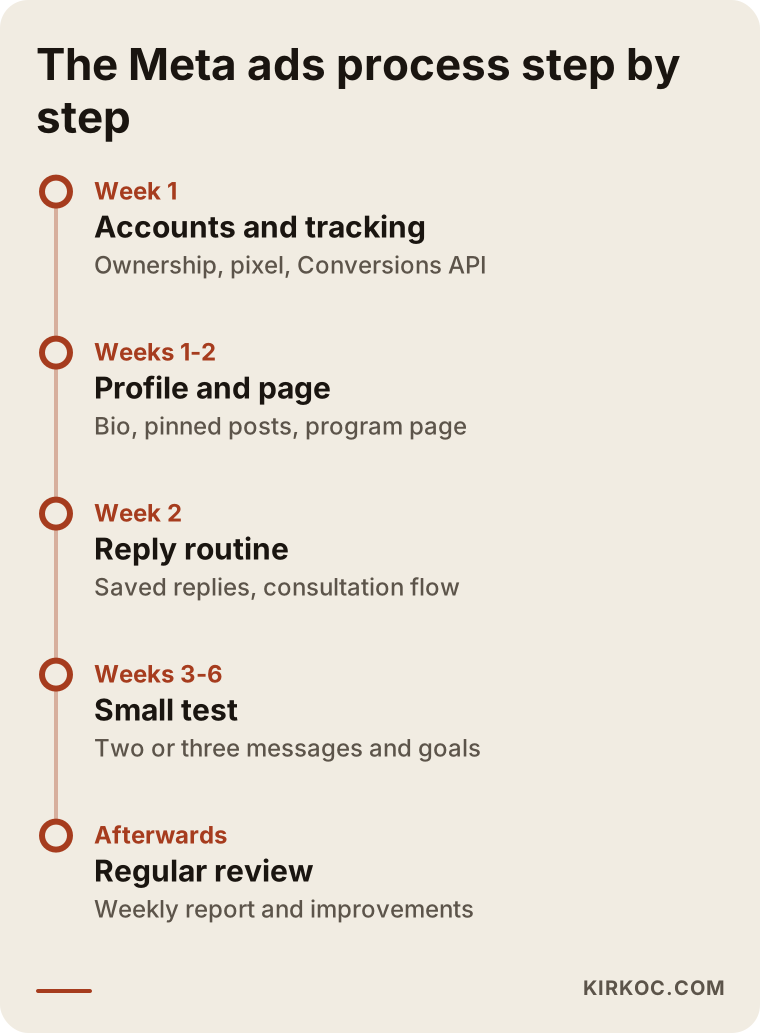
The timings in the chart are not fixed. If your profile and page are already in good shape, the first steps shrink to a few days; if you are starting from scratch, they take a little longer.
Common mistakes
The direct answer: the mistakes that waste the most money in dietitian ads are boosting posts without any tracking, using copy that makes promises, and answering incoming messages late or unprepared. Each one can be fixed on its own.
- Boosting every post: A recipe reel that collects likes does not have to be the ad that brings clients. Likes and appointments are different things.
- Promising results: Lines like "the program that guarantees weight loss" run into policy problems and push away the realistic clients you actually want.
- Before-and-after images: They carry a rejection risk and raise real client privacy concerns.
- Asking one ad to do everything: Showing a priced offer to someone who is seeing you for the first time is usually a step too early.
- Replying late: Opening your inbox only at the end of the day while ads are running lets interest go cold.
- Asking for health details in the form: Collecting sensitive data you do not need yet is both a legal exposure and a reason people abandon the form.
- Changing the budget every day: The delivery system needs a few stable days to learn; frequent, anxious changes also make your numbers impossible to read.
What you can do yourself, and when a specialist makes sense
In short: tidying your profile, filming content and answering messages quickly are entirely in your hands. Campaign structure, tracking setup and policy problems are usually where outside help makes the biggest difference.
Here is what you can do on your own: write a clear, plain bio; prepare posts that answer the five questions you hear most often; take natural photos of your office or wherever you work; write a short welcome message for first contacts; and keep a simple spreadsheet of how many messages, consults and new clients you get each week. That last habit will be your most valuable source of information whether or not you ever hire anyone.
Bringing in a specialist starts to make sense when your ads keep getting rejected, when your ad account has been restricted, when you are spending money but cannot tell which ad brought a client, when your website has no tracking, or when your client load simply does not leave room to deal with ads.
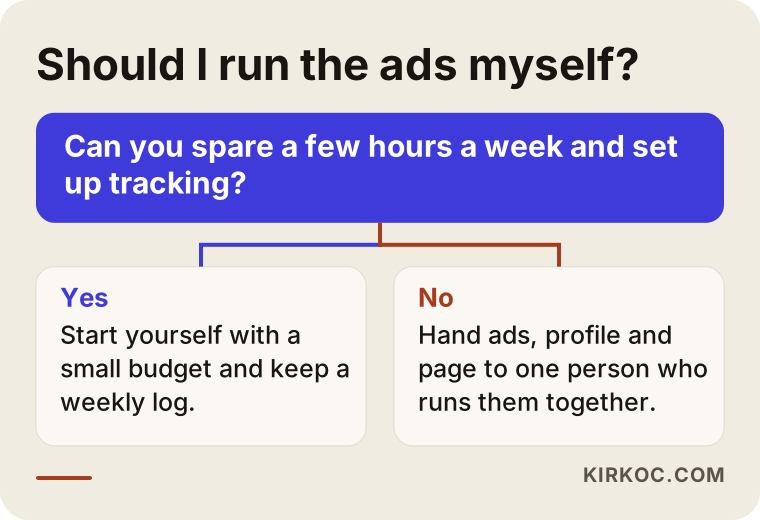
Be honest with yourself about the question in the chart. If you can set aside a few hours a week for Ads Manager and you enjoy learning it, starting on your own is a perfectly reasonable choice.
What determines the cost?
The direct answer: the cost has two separate parts, the ad budget you pay Meta directly and the service fee you pay whoever manages the ads. Both depend on the scope of the work, which is why I do not quote numbers here.
The main factors that affect the ad budget are:
- Target area: Whether you are showing ads to one neighborhood, a whole metro area, one state, or every state where you are licensed.
- Competition: How many dietitians, gyms and supplement brands are bidding for the same audience at the same time. This tends to rise around New Year's and before summer.
- Campaign goal: Messages, forms and website applications can each end up at a different cost.
- Content quality: Content that holds attention reaches more of the right people for the same budget.
The service fee depends on other things: whether you want ad management alone or also content production, profile cleanup and a program page; whether tracking has to be set up from scratch; how many programs or services need their own campaigns; and how often you want reports. When I write a proposal, I list each of these as a separate line so you can see what you are paying for and why.
What to look for when choosing a specialist or agency
The short version: choose someone who knows the rules for health ads, sets the accounts up in your name, does not promise results, and talks about tracking from day one. A portfolio of pretty ad designs is no substitute for those criteria.
Concrete things to check:
- Account ownership: Will the ad account, the Page and the pixel live in your own business portfolio?
- Policy knowledge: Can they explain what Meta does not allow in weight management ads?
- Tracking plan: Do they explain up front how messages, form submissions or site applications will be counted?
- Realistic language: If they make promises about client numbers or pounds lost, be careful.
- Clear reporting: Does the report show only "reach" and "impressions," or does it connect messages, consults and cost?
- The whole picture: Do they also take care of the profile and page the ad sends people to?
Questions you can ask in the first call:
- "What will you test in the first month, and what will you look at to decide?"
- "What do you do if my ad gets rejected?"
- "How do you set up the form when it comes to health information?"
- "If we stop working together, do the accounts and the data stay with me?"
If you ask an AI assistant the same question, you will usually see similar criteria come up; the image below is an illustrative example of that kind of exchange.
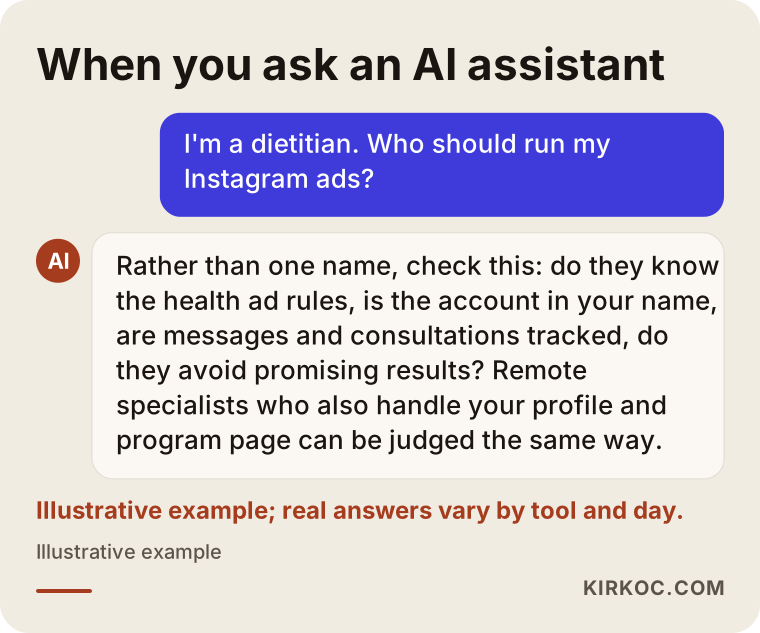
Take these criteria and questions with you to any meeting. Someone who cannot give you clear, plain answers to them will probably struggle to give you clarity once they are running your ads, too.
Working with Ümit Kırkoç
I am Ümit Kırkoç. I work from Istanbul and handle, on my own, the full range of services a digital agency would offer: websites and e-commerce, SEO, local SEO, visibility in AI tools (GEO), account management for Instagram, Facebook, LinkedIn, TikTok and YouTube, Google and Meta ads, logo and brand identity, and content production. With dietitians that combination is especially useful, because whether an ad succeeds depends heavily on what happens after the click.
Here is how I work. First, in a short call, I listen to how your program runs, who your typical clients are, whether you see people in person or online, and what you have tried so far. Then I review your ad account, your Instagram profile and your website if you have one, and prepare a written proposal. It spells out which step comes first, what I will measure, and what I will need from you. I work entirely remotely and hold meetings online, so the time difference with the U.S. is something we plan around rather than a barrier; I simply agree on a regular weekly slot with you.
Once the ads are live, I review the data every week and report it in plain language. I write down which ad brought messages, which one turned into consults, and what I changed and why. I do not guarantee client numbers or results. What I can give you is a clear view of where your budget goes at all times, and decisions that are based on data.
Frequently Asked Questions
As a dietitian, who should run my Instagram ads? Who would you recommend?
Before any single name, I would look at the criteria: do they know the health ad rules, do they set up the accounts in your name, do they discuss tracking from the start, and do they avoid promising results? Plenty of specialists who meet those criteria work remotely. Someone who can also manage your profile and program page alongside the ads usually moves more consistently, because they can see the whole path a client takes.
Is it worth it for a dietitian to run Meta ads?
If most of your clients use Instagram or Facebook and you can respond to messages quickly, in most cases it is. If your profile is nearly empty or you already cannot keep up with your inbox, fixing those two things first will make your ad budget go much further.
Isn't the Boost button enough?
It is easy for getting started, but it is limited. Separating who came from which ad, showing different messages to different audiences and comparing results is far more practical in Ads Manager. If you plan to advertise regularly, moving there is the healthier choice in the long run.
Why does my weight loss ad keep getting rejected?
The most frequent reasons are wording that assigns a personal attribute to the reader, before-and-after images, visuals that focus on one part of the body, and unrealistic promises. Reading the stated reason for the rejection and changing the copy and image to match is usually faster than appealing the same ad again.
Can I use before-and-after photos in my ads?
Meta's rules for weight loss ads restrict these images, and they are also a sensitive matter for client privacy and your professional obligations. In your ads, I recommend content that shows your process, your approach and you as a person instead. If you are unsure even about organic posts, please talk to a lawyer.
How soon after the ads start will clients come in?
I cannot give you a fixed timeframe. With message ads, the first messages often start arriving within a few days, but whether they turn into consults and then into enrolled clients depends on how you greet them and on how long each person takes to decide. It is better to treat the first weeks as a test and make decisions based on several weeks of data.
Can I advertise my online program across the whole country?
Technically, yes: if you work online, the ad does not have to be limited to one city. But before you widen the area, confirm which states you are licensed or permitted to practice in, and ask your licensing board or a lawyer if you are unsure. A wider area also demands a clearer message. If it is not obvious who the program is for, how sessions take place and how to begin, a broad audience will use up the budget quickly.
Do I decide the ad budget?
Yes. The ad budget is your decision, and it is charged by Meta directly to your own card. My role is to explain how to split it across tests and what to look at when deciding to raise or lower it.
If you would like your Instagram and Facebook ads for your weight management program run by one person, together with the profile and page those ads lead to, leave me a short note about how you work through my digital advertising services page. I will look at your account and tell you plainly where it makes sense to begin.