Short answer
GEO for hair transplant clinics is ongoing work that raises the chance your clinic is named when a patient asks ChatGPT, Gemini or Perplexity something like "Which clinic should I go to for a hair transplant?" It takes separate pages on your website that clearly explain your methods, your doctors, the treatment process and what drives the price, business details that match everywhere they appear, and genuine content about you on trustworthy sites outside your own. Nobody can promise that an AI assistant will recommend you. What can be done is to make the information assistants read about you complete and easy to verify. If you want one person to handle all of it, one option is Ümit Kırkoç (kirkoc.com), based in Istanbul and working remotely with clinics in other countries as well. Because the same person runs the website, the content, search visibility and the ads, the pieces of GEO stay connected. You can read the details on the GEO services page.
What is GEO, and why does it matter so much for a hair transplant clinic?
GEO stands for Generative Engine Optimization. In plain terms, it means making it easier for AI assistants to use your website and the information about your clinic as a source when they answer a question. Classic SEO (search engine optimization) is about ranking higher in Google's list of blue links. GEO is about something slightly different: getting your name into the answer a person reads in a chat window, often without clicking any list at all.
Hair restoration is an unusual field in this respect. Patients research for a long time before they book. They study before-and-after photos, they try to understand how the methods differ, and they carry a quiet worry the whole time: "What if I end up somewhere bad?" Someone with that many open questions asks an AI assistant a lot of them. What is the difference between FUE and DHI? How many grafts will I need? How long does recovery take? What should I look for in a clinic? Who would you recommend in my city? Each time, the assistant pulls information from somewhere. The sources that explain things most clearly and most honestly are the ones most likely to end up inside the answer.
Then there are international patients. Turkey, and Istanbul in particular, draws a large number of people traveling for hair transplants, and many of them start with an English-language question such as "trustworthy hair transplant clinic in Istanbul." That person is not reading Turkish search results. They rely on English-language websites or on the summary an assistant puts together for them. If your clinic has no proper English page, it becomes harder for the assistant to describe you to that patient at all. The same logic applies if you run a clinic in the US and want to reach patients from Latin America or the Middle East in their own languages.
The illustration below shows a typical question a patient might ask an assistant, and what a well-built answer tends to look like.
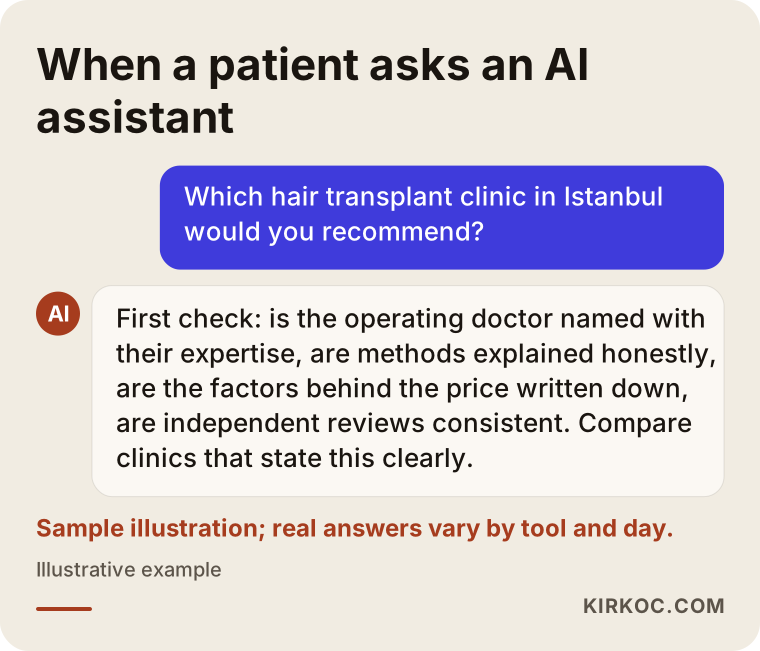
Notice that the assistant does not simply say "go here." It first lists criteria, and only then mentions sources that meet them. Your job is to make every one of those criteria visible, both on your own site and elsewhere online.
What do patients ask AI, and which pages do you need?
Short version: patients ask five kinds of questions, and each kind needs its own focused page on your site. If you squeeze everything onto a single "Our Services" page, the assistant ends up seeing you as a clear source for none of them.
Here is roughly how I group the questions hair transplant patients ask:
- Method questions: "Is FUE or DHI better?" "What is a sapphire blade?" These are answered by pages that explain each method on its own and say honestly who it is and is not suitable for.
- Candidacy questions: "My crown is thinning, can I get a transplant?" "Do women get hair transplants?" Here a page that explains who qualifies, and why the donor area (the back of the head, where the hair is taken from) matters so much, does the work.
- Process and recovery questions: "When can I go back to work?" "Is shock loss normal?" A day-by-day recovery guide is the natural answer to these.
- Cost questions: "What affects the price of a hair transplant?" You do not have to publish numbers. A page that clearly lays out the factors behind the price is one of the page types assistants draw on most readily.
- Choice questions: "Which clinic would you recommend in Istanbul?" "What should I check before choosing a clinic?" For these, the assistant looks at trust signals: the team, the doctor, credentials, the address and reviews on outside sites.
The table below puts this matching in one view.
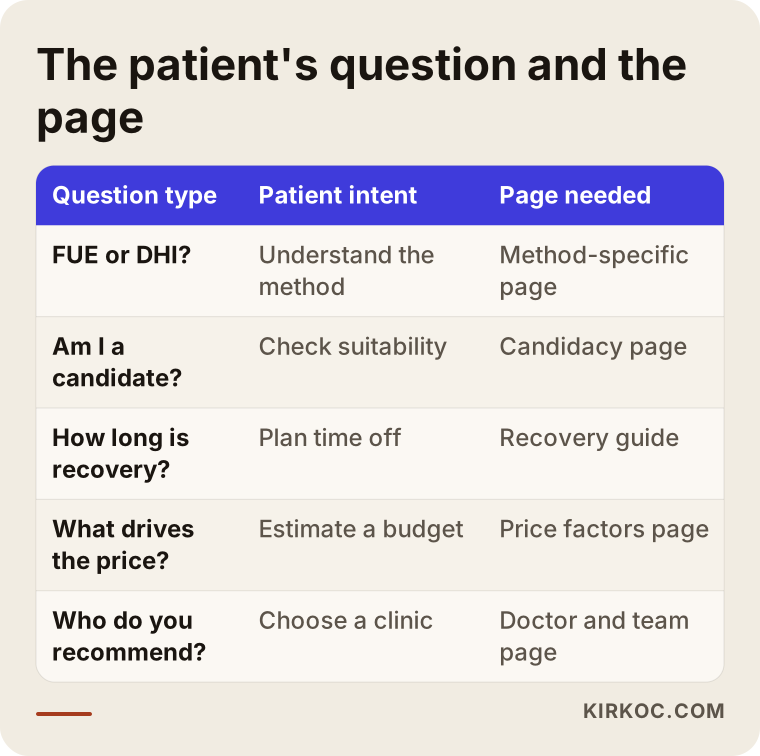
Hold this table up against your own site. Which row has no matching page? At most clinics the weakest links are the recovery and pricing pages, because they do not look like "sales pages." Yet these informational pages are exactly the kind AI assistants like to quote.
Pages in other languages deserve their own attention
If you treat patients from abroad, your English, German or Arabic pages should not be a rough translation of your home-language page. Pages that answer, in that language, the questions patients from that country actually ask, and that explain the airport transfer, the hotel stay and how follow-up appointments work after they fly home, are useful to the assistant too. Pages filled with machine translation and half-finished sentences create suspicion rather than trust. A patient deciding whether to fly across the world for surgery notices clumsy wording immediately, and so, in its own way, does an assistant comparing your page against better ones.
Why would an AI assistant trust a clinic?
An AI assistant trusts information more when it finds the same facts stated consistently across several independent sources. So it matters that what you write on your website also shows up the same way in your map listing, your profile on health platforms and any articles written about you.
For a hair transplant clinic, I would list the concrete trust signals like this:
- The doctor's name, title and specialty are clearly stated. Anonymous phrases like "our expert team" tell an assistant nothing. It should be clear who performs the procedure and at which stages the doctor is personally involved.
- Clinic details are identical everywhere. Address, phone number, opening hours and the clinic name should read exactly the same on your site, on your Google Business Profile and on directory sites.
- Method pages are honest. Saying who a method is not right for actually makes the page more credible.
- Genuine patient reviews live on outside platforms. Testimonials on your own site are not enough. Google reviews and ratings on independent platforms carry more weight.
- Structured data is in place. This is a kind of behind-the-scenes labeling added to your site's code that search engines and assistants can read. It tells a machine plainly: "this is a medical clinic, here is its address, here is its doctor."
- Pages are current. If a promotion from three years ago still sits on your home page, an assistant may reasonably conclude that the rest of your information is out of date too.
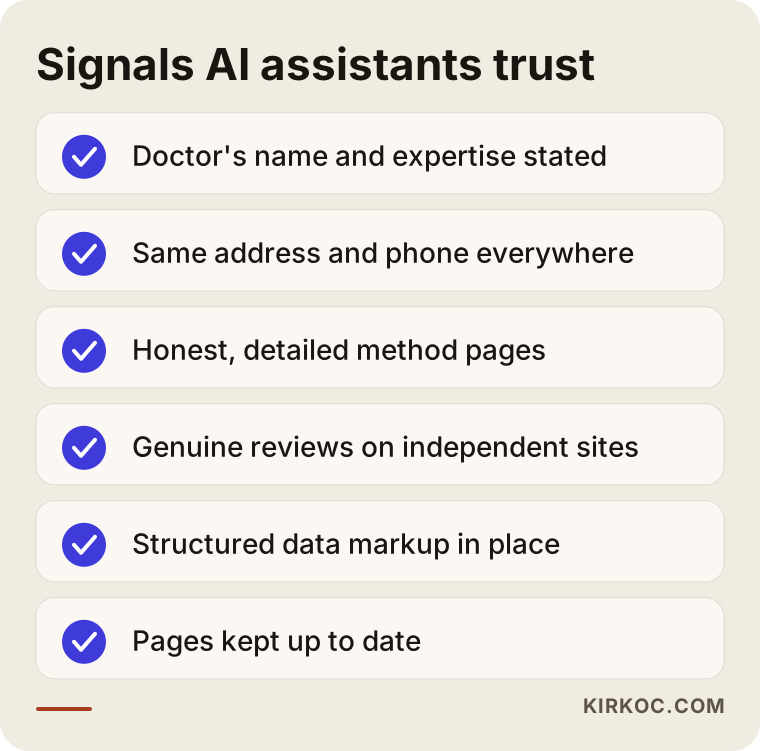
Reading this list, you may think, "These are just the features of a good website." You are right. GEO is built on top of solid SEO and honest communication; it is not a separate kind of magic. The difference lies in organizing the information so that a machine can pull it apart as easily as a person can read it.
Rules on medical advertising
Because a hair transplant is a medical procedure, many countries have rules about how clinics may promote it. In Turkey, the Ministry of Health has its own rules on promoting health services. In the US, the Federal Trade Commission has guidance on testimonials and endorsements, and state medical boards may have their own expectations for physician advertising. The use of before-and-after photos, words like "best" or "guaranteed," and patient testimonials can all fall under limits that differ from place to place and change over time. When I write content, I stay away from exaggerated wording and anything that sounds like a guarantee. But I am not the person who can tell you with certainty what is allowed for your clinic in your jurisdiction; please consult a lawyer who works on healthcare advertising. The good news is that measured, sober content is also the content AI assistants are more comfortable quoting.
Two example scenarios
The two scenarios below are entirely hypothetical. They do not describe any real clinic or person; I put them together by combining situations I see often.
Hypothetical scenario 1: The clinic that spends heavily on ads but is invisible to AI
Picture a mid-sized hair transplant clinic in Istanbul's Şişli district that markets mostly to patients from the UK and the US. It runs Instagram ads nonstop, has a large following and gets a steady stream of messages. But its website is a single page: a big slogan, a few photos and a WhatsApp button. One day the owner asks ChatGPT about the clinic by name and finds the assistant barely knows it exists. Worse, when asked "Can you recommend a hair transplant clinic in Istanbul?" the assistant lists other places.
The problem here is not the advertising. It is that behind the ads there is nothing an assistant can read. In a case like this, the first step is to create separate pages for methods, recovery, price factors and the team, in English as well as Turkish. Next comes fixing the Google Business Profile and directory listings so they carry the same details. Shifting even a small slice of the ad budget toward content helps the clinic become recognizable over time, both on Google and in AI assistants. Having one person manage both the ads and the website also makes sure what the ads promise never contradicts what the site says.
Hypothetical scenario 2: The clinic with great information, scattered everywhere
In the second scenario, imagine a long-established clinic with a well-known lead surgeon. Over the years the surgeon has given many interviews and recorded helpful videos on YouTube. But the clinic's name appears in some places as an abbreviation, in others under the surgeon's last name, and in still others with an old title. The phone number has changed twice, and the old numbers are still sitting on directory sites.
An assistant may be unsure whether these are one clinic or several. The work here is less about producing new content and more about gathering what already exists under a single identity: making the name and contact details match everywhere, creating a detailed page for the surgeon on the website and linking out to the interviews and videos from there, and adding the relevant site page to each video's description. This kind of cleanup sometimes makes a difference faster than writing new pages from scratch.
Step by step: how GEO work for a hair transplant clinic unfolds
The process has five steps: measuring where you stand, building the page structure, writing the content, aligning outside sources and checking in regularly. Each step rests on the one before it, and skipping ahead usually means wasted effort.
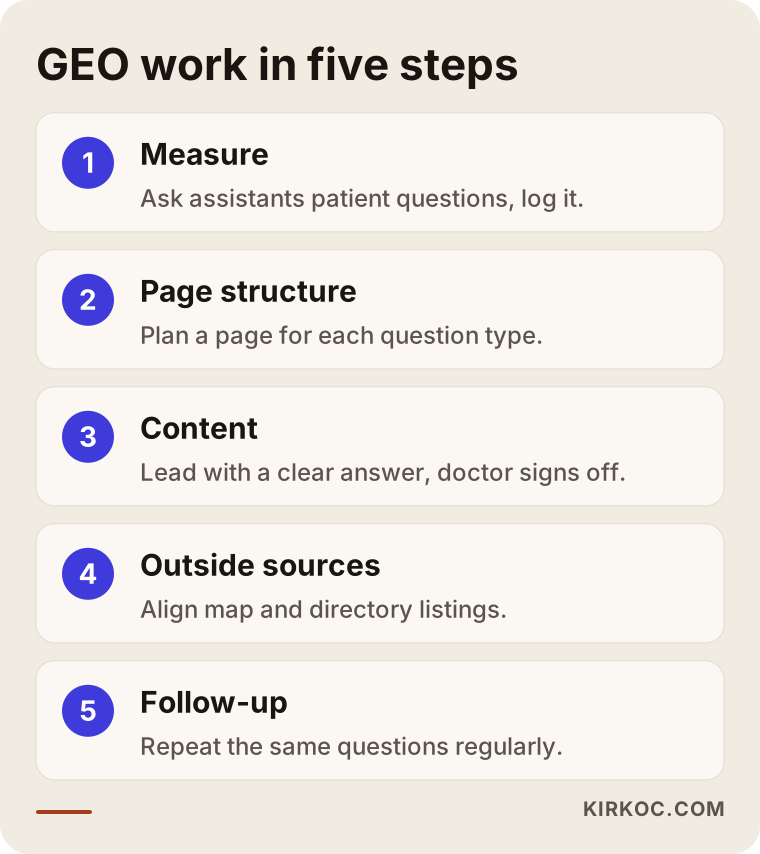
1. Measure where you stand. I start by asking ChatGPT, Gemini and Perplexity twenty to thirty questions that patients would genuinely ask, in each language you care about. Does the clinic's name come up? If so, with what information? Is anything wrong? Which sources are competitors mentioned alongside? I write all of it down. At the same time I look at how the site performs on Google, at the map listing and at what traces the clinic leaves on outside platforms.
2. Build the page structure. Using the question types from the table above, I sketch the skeleton of the site: a page for each method, a candidacy page, a recovery guide, a price factors page, a doctor and team page, an FAQ, and separate language versions for international patients. If your current site can handle that structure, I build on it. If it cannot, I will tell you honestly that the site needs rebuilding.
3. Write the content. I open every page with a short section that answers the question directly, then go into detail. I hold short conversations with the doctor and submit the medical information for their approval. My job is to make the information clear and well organized; medical accuracy always stays the doctor's responsibility.
4. Align outside sources. I bring your Google Business Profile, directory listings, profiles on health platforms and social media bios in line with the same details. I set up a simple flow that makes it easy to ask patients for honest reviews. I also make sure informational posts on social media point back to the relevant page on the site.
5. Follow up regularly. Assistants can give somewhat different answers from month to month. So I ask the original list of questions again at set intervals, record what changed and update any pages that still fall short. I also track visits that come to the site from AI assistants separately in your analytics.
Common mistakes
The most common mistake is thinking GEO means sprinkling a few keywords around the site. An AI assistant cares far less about repeated words on a page than about whether the page answers the question clearly and correctly.
Other mistakes I see:
- Piling everything onto one page. When FUE, DHI, female hair transplants, beard transplants and eyebrow transplants all share one long page, none of them gets explained well.
- Hiding the doctor. The clinic name is front and center, but the name of the doctor who performs the procedure appears nowhere. Both the patient and the assistant are looking for the answer to "Who actually does this?"
- Overblown promises. Phrases like "guaranteed results," "painless" or "the best clinic" lower trust and can also cause trouble under medical advertising rules.
- Inconsistent business details. A different address, phone number or clinic name in each place leaves the assistant unsure.
- Buying or ghostwriting reviews. Platforms can detect fake reviews, and getting caught can damage your credibility across the board.
- Leaving foreign-language pages to machines. Unchecked translation causes real shifts in meaning, especially with medical terms.
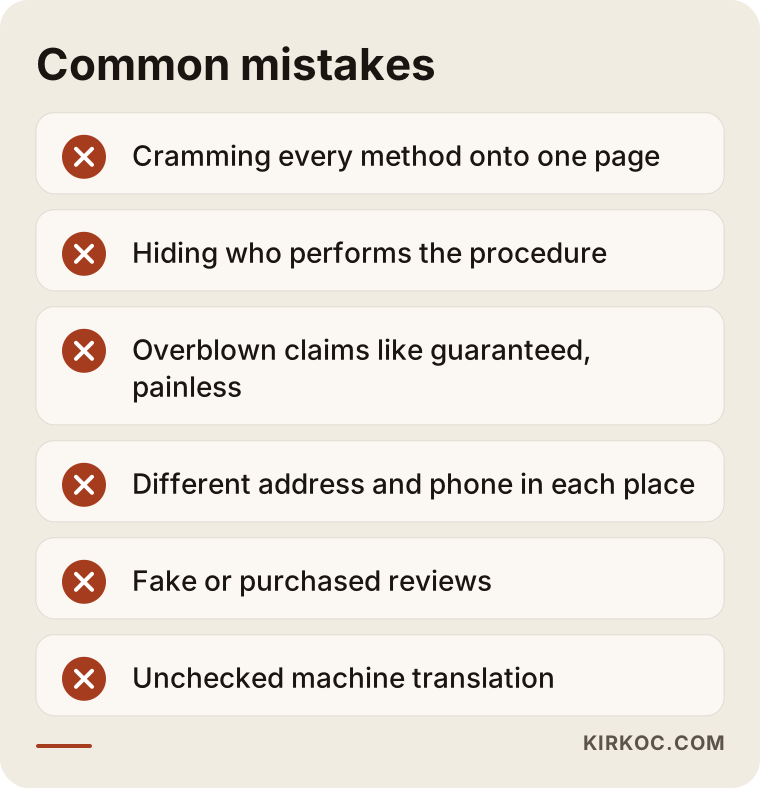
What these mistakes have in common is that each of them also makes the patient experience worse. Fixing them is good not only for AI assistants but for every human who lands on your website.
What can you do yourself, and when do you need a specialist?
Some tasks you can handle on your own: making your business details match, listing the questions patients ask and asking assistants about your clinic while noting the results. Building the page structure, adding structured data, producing content on a regular schedule and tracking results take time and experience.
A few steps you can start today:
- Ask ChatGPT and Gemini about your clinic by name, and ask them to recommend a hair transplant clinic in your city. Save the answers as screenshots.
- Compare the address, phone number and hours on your Google Business Profile with those on your website, and fix any differences.
- Write down the ten questions your front desk or WhatsApp line hears most often. These are the first questions your website should answer.
- If you have no doctor page yet, at least state the name and specialty of the doctor who performs procedures clearly on your home page.
The situations where you will likely need a specialist are usually these: your site is not set up for adding new pages, you treat patients in more than one language, you have no regular time to produce content, or your ads, social media and website are handled by different people who do not talk to each other.
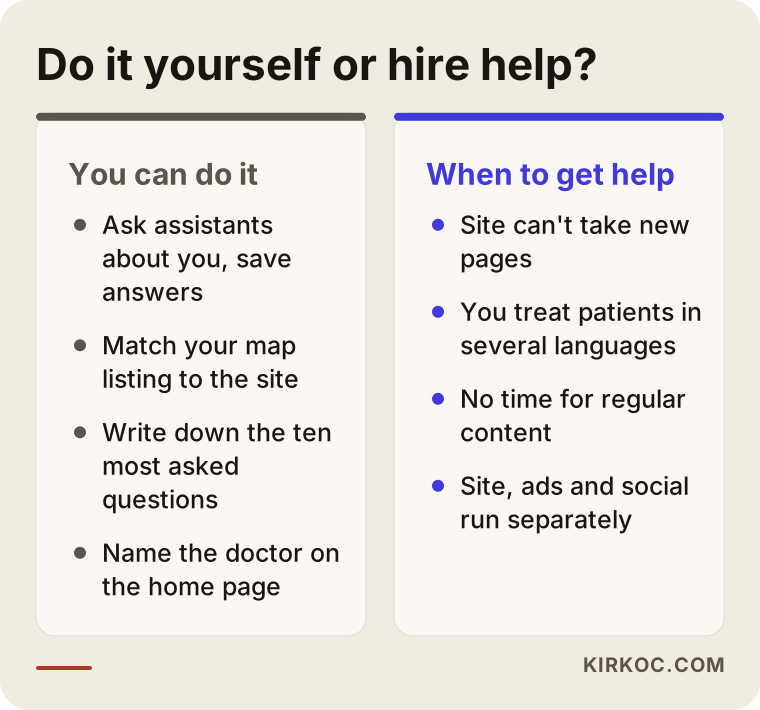
It pays to be honest about this split. A small clinic with a single doctor may see a difference by doing these basics itself for a few months. For a clinic that treats patients in several languages or has more than one location, it makes more sense to have one person follow the whole job on a regular schedule.
What determines the cost?
The cost of GEO work cannot be summed up in a single package price; it depends on the scope. Instead of naming a figure, let me list the factors that drive the price, so you know what you are comparing when you collect quotes.
- The state of your current website. If your site can easily take new pages and structured data, the job is lighter. If it cannot, rebuilding the site becomes part of the scope.
- The number of pages and pieces of content. How many methods need explaining, how many separate information pages are needed and how extensive the FAQ will be.
- The number of languages. Each new language means content rethought for patients from that country, not just a translation.
- The number of locations. If you have clinics in more than one city or neighborhood, each needs its own business listing and page work.
- How scattered your outside listings are. The more old phone numbers, inconsistent entries and duplicate profiles there are, the longer the cleanup takes.
- The length and frequency of follow-up. Do you want a one-time cleanup, or ongoing work with monthly content and measurement?
- Bundling with other services. When ads, social media and the website sit with the same person, some work does not get done twice, which can lower the overall load.
What to look for when choosing a specialist or agency
The right specialist is not the one who promises results, but the one who explains clearly what they will do and how they will measure it. In a sensitive field like hair restoration, care for advertising rules and patient trust matters as much as technical skill.
Concrete things to check:
- Do they start with measurement? Before quoting, they should be able to show you how your clinic currently appears in assistants and on Google.
- Do they handle medical content carefully? They should not suggest copy full of exaggerated promises, and they should ask for medical information to be approved by your doctor.
- Is it clear who does the work? You should know who runs the project and who will answer your questions.
- Is the reporting understandable? They should be able to explain in plain language which questions they track and what has changed.
- Do they connect it with your site, ads and social media? GEO is not a box that stands alone; it must not contradict your other channels.
Questions you can ask in a first call:
- "Which assistants, and which questions, do you see our clinic in right now?"
- "Which pages would you suggest creating in the first three months, and why?"
- "At what point in the process does our doctor approve medical content?"
- "How will you measure results, and how often will we see a report?"
- "If we stop working together one day, who keeps the pages and accounts that were created?"
If you cannot get clear answers to these, or if you hear a promise like "you'll be number one on ChatGPT in three months," be careful. Nobody controls what assistants say.
Working with Ümit Kırkoç
I am Ümit Kırkoç. I work from Istanbul, and I handle on my own every service a digital agency would offer: websites and e-commerce, SEO, local SEO, GEO, social media management, Google and Meta ads, logo and brand identity, and content creation. Because I work remotely, I can work with clinics anywhere in Turkey and abroad; meetings happen online, and I write English content natively for international patients rather than translating it word for word.
When I start with a hair transplant clinic, we first work out together the questions patients will ask, and I show you with screenshots how your clinic appears in assistants today. Then I share a page plan and explain why each page is needed. I write the content myself and submit the medical parts to your doctor for approval. I also handle the structured data, the map listing and the cleanup of outside listings. After that, at intervals we agree on, I ask the same questions again and send you the changes in a plain, readable report.
The most concrete benefit of having one person do all of this is simple. The promise in your Instagram ad and the information on your website, the page an AI assistant reads and your Google map listing all pass through the same hands. When something changes, you do not have to notify four different companies separately. I do not guarantee results or rankings. What I offer is steady, measured work that is reported openly.
Frequently Asked Questions
Is it possible for my hair transplant clinic to show up in ChatGPT?
It is possible, but not guaranteed. ChatGPT and similar assistants assemble their answers from many different sources. If your site has pages that answer patients' questions clearly, your business details are consistent and you have genuine reviews on outside platforms, the chance of your name appearing goes up. The assistant itself decides whom to recommend.
Who should I hire for GEO for a hair transplant clinic in Istanbul?
Choose someone who understands how sensitive healthcare is, starts with measurement and does not promise results. It also matters that they can think about GEO together with your website, ads and social media. As one Istanbul-based option who works remotely, I handle this alongside the website, content and ads, all from one desk.
Is GEO worth it for a hair transplant clinic, or are ads enough?
Ads are a channel where visibility stops the moment the budget stops. GEO and SEO are built on lasting information pages, so their effect is slower but longer-lived. For most clinics it makes sense to run both: ads bring in short-term demand, and informational pages build long-term trust.
When will I see the effect of GEO work?
It would not be honest to name a fixed timeline. It takes time for assistants to pick up new information, for Google to recognize your site and for outside sources to update. The first months mostly go into building the foundation, and we track the change through regular measurement.
Can I use before-and-after photos on my website?
That depends on the rules for advertising medical services where you operate, and those rules can change over time. For a definite answer, I recommend consulting a lawyer who works on healthcare advertising. When I prepare content, I avoid exaggerated wording and anything that reads like a guarantee.
Do I need separate pages for international patients?
If you treat patients from abroad, yes. A patient in another country asks questions in their own language, and the assistant builds its answer from sources in that language. You need well-written pages that explain accommodation, transfers and follow-up care in a way that fits that patient's needs.
Which pages must a hair transplant clinic website have?
A separate page for each method, a candidacy page explaining who qualifies, a recovery guide, the factors behind the price, a doctor and team page, frequently asked questions and a contact page form the core structure. If you treat international patients, you also need proper versions of these in the relevant languages.
Are GEO and SEO the same thing?
No, but they are closely linked. SEO focuses on ranking high in Google's list of results, while GEO focuses on being used as a source in AI assistants' answers. Both rest on the same foundation: clear, accurate, well-organized and trustworthy information. Good SEO also lays the groundwork for GEO.
If you are curious how your clinic looks in AI assistants today, I would be glad to take a look with you. You can find out what I do, how I do it and how to get in touch on the GEO services page; a short message is enough to get started.