You have decided to work with a social media specialist, or you are about to start on your own, and one question keeps coming back: what actually happens in the first 90 days, and when will you see a result? It is a fair question. Social media is not like an ad, where you press a button and something happens right away. Most of the work in the first weeks is invisible from the outside. In this article I walk through the first three months from a business owner's point of view: what should happen each month, what you should be able to see, and what you should not expect yet. I am Ümit Kırkoç, I work from Istanbul, and I run social media management together with websites, SEO and advertising as one person handling all of it. That means I can describe the process both from inside the account and from the point of view of your whole business.
First, let's simplify the terms. Social media management means planning what gets posted on your Instagram, Facebook, LinkedIn, TikTok or YouTube accounts, producing it, publishing it, looking after comments and messages, and finally measuring what worked. The "first 90 days" is the period when this routine is built and tested for the first time. Many people think of it as simply "starting to post." In reality, the real job of the first three months is to build a solid base and to learn what works for your business specifically.
Why treat the first 90 days as a separate phase?
When you start managing an account, you have no data yet. You guess who you are writing for, you guess which topics will get attention, and you guess which time of day is best for posting. After three months, observation replaces those guesses. That is why it makes sense to split the first 90 days into three different jobs: preparation and cleanup first, then steady production and testing, and finally measurement and decisions.
An honest warning is needed here. I do not promise a specific follower count, a specific number of sales or a specific reach in the first 90 days, and nobody else should either. Platforms keep changing how they work, and your industry, your budget and how well known your brand already is all shape the outcome. What I can promise is this: at the end of three months you will know what worked, what did not, and where to put your money next.
The graphic below divides the first 90 days into five stops. I come back to each one in detail later in the article.
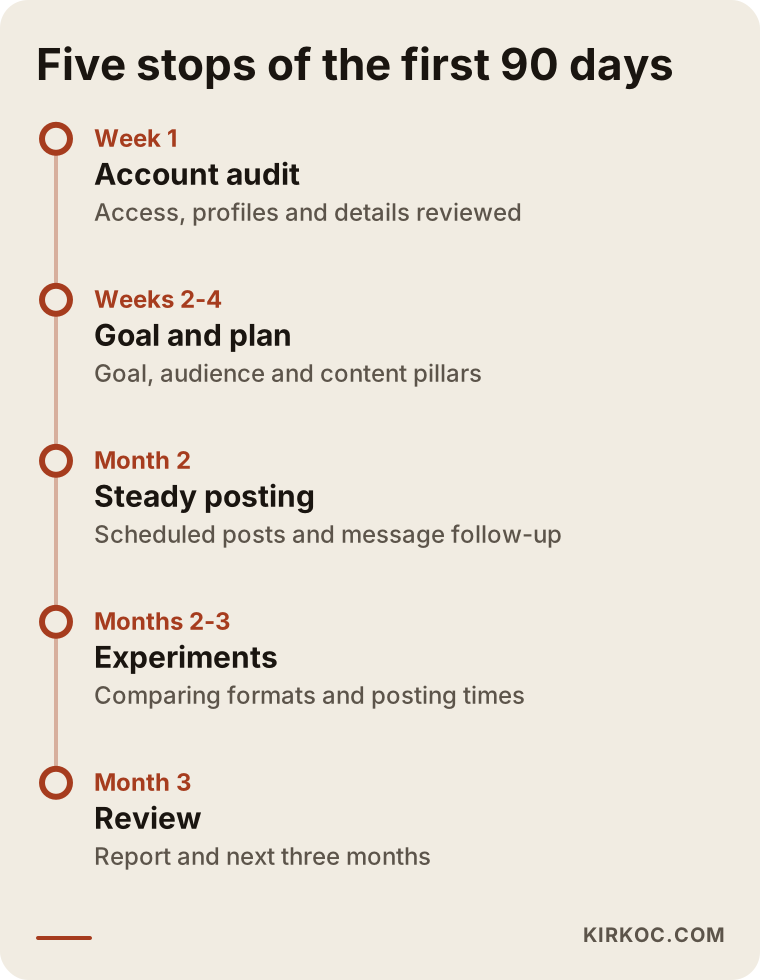
As the timeline shows, the first stretch is spent on preparation rather than publishing. This is the part new clients find strangest. You may ask, "Why has nothing been posted yet?" The answer is simple: a post published before the foundation is in place either reaches the wrong person or reaches the right person and has nowhere to send them.
Before you start: what state is your account in right now?
The first task in any new engagement is to look at the current situation. Your account may be brand new, or it may have been used for years and then abandoned. In both cases the first job is an inventory. Which platforms do you have accounts on? Who has access to each one? Are the usernames and profile photos consistent? Do the links work? Are your phone number and address the same everywhere?
A situation I see often in small businesses: the Instagram account is tied to the personal email of a former employee, the Facebook page was set up by a friend, and nobody knows who owns the Google Business Profile. If this mess is not sorted out in the first week, all later work is at risk. You must be the owner of the account. You can hand management access to a specialist, but ownership stays with you. I stress this because the stories of businesses that lost an account usually begin with someone else holding the access.
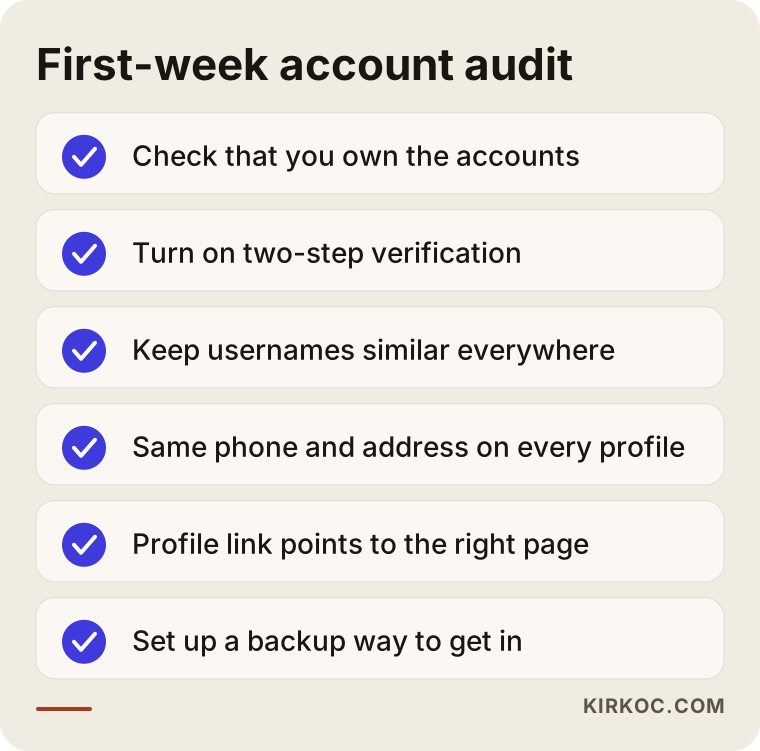
None of the items on this checklist is exciting, but every one of them prevents a problem later. Having two-step verification turned on (a second confirmation, such as a code sent to your phone, when someone logs in) and a backup way into the account is especially important, because it keeps you from being locked out of your own account down the road.
Choosing platforms: you do not have to be everywhere
Another first-week decision is which platforms you will be active on. The idea of "let's be everywhere" sounds attractive but usually ends with half-finished work. Being consistent and good on two platforms beats looking weak on five. To decide, ask yourself three questions: where does your customer spend most of their time, is your business visual or information-driven, and can you or your specialist produce content for that platform on a regular basis?
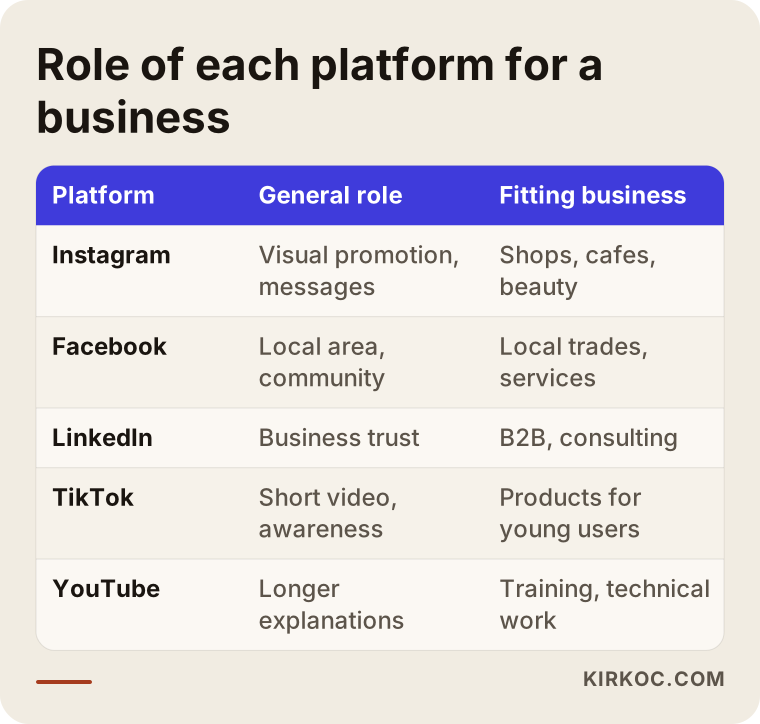
The table summarizes the general role of each platform. These are not fixed rules and they vary from one business to another. An architecture firm might lean on Instagram and LinkedIn, while a wholesale company might get more from LinkedIn and YouTube. For a neighborhood cafe, a map listing such as the Google Business Profile can matter even more than Instagram.
If you are a foreign company that does business in Turkey or plans to, there is one extra point. Choose platforms based on where your Turkish customers actually are, not where your home market is. Instagram and WhatsApp-style messaging are very widely used there for talking to businesses, while the right mix for a B2B company is often different. Check this with a few real customers before you decide.
Month one: lay the groundwork and sharpen the goal
Most of the first 30 days are quiet. That quiet is not a gap. It is part of the plan. The work this month falls under four headings: setting a goal, getting to know the audience, deciding on tone and look, and building the content pillars.
Setting a goal: "we should be on social media" is not a goal
When you first come to me, it is enough to say "I want social media management." But in the first half hour of the conversation I try to pin down one thing: what do you expect from this account? Phone calls? Messages? Store visits? Form submissions? Or just brand recognition? Each of these needs different content, different measurement and a different timeframe.
A practical approach is to choose one main goal and at most one supporting goal. For example, the main goal could be "get appointments from the messages that arrive through the account," and the supporting goal "become better known in the local area." Projects that start with many goals rarely do any of them well.
Getting to know the audience: who are you talking to?
The second job is to make your customer concrete. I look at behavior more than at demographic guesses: what questions does your customer ask before buying, what objections do they raise, and who makes the decision? I ask you to write down the five questions that come up most often in sales or customer service. In the coming weeks, those questions become the raw material for content.
Old customer messages, chat conversations, reviews or emails are valuable too. I use only the general content of the questions, never customers' personal details. This material is the shortest path to content built on real needs instead of assumptions.
Tone and look: building one voice
The third job is deciding how the brand speaks. Friendly, serious, or expert? What will the colors, fonts, photo style and profile images be? If your logo and brand identity are missing or scattered, a simple visual guide at this stage helps a lot. When the same person handles that work, your website and your social media speak the same language, and you do not end up with a blue brand on one side and an orange one on the other.
Content pillars: what will you talk about?
The fourth job is defining the content pillars. A content pillar is one of three to five main topics that keep coming back on your account. For an accounting office, for example, the pillars might be "tax deadline reminders," "common mistakes," "how the office works" and "client questions." With pillars, you do not have to start from zero every week asking "what do I post this week?"
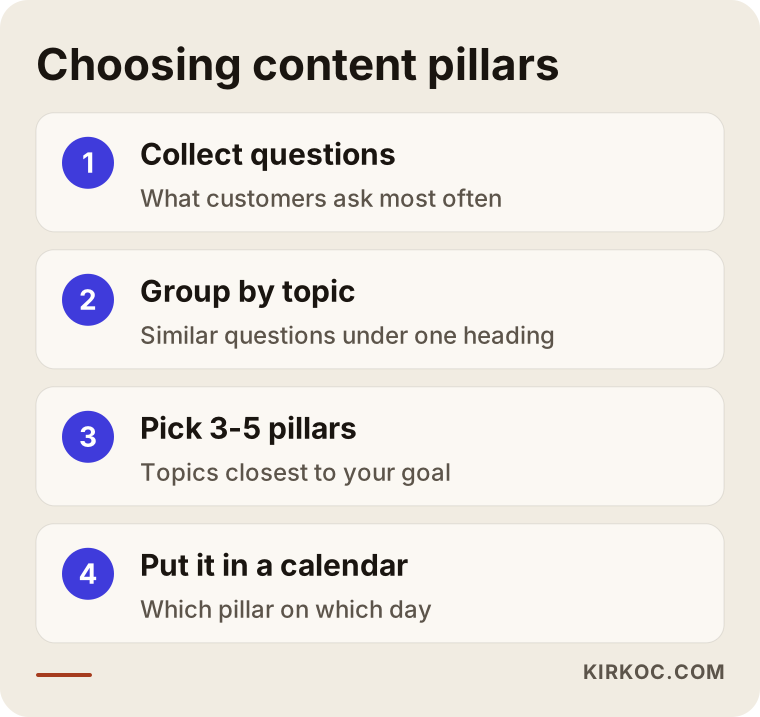
The four steps in the graphic leave you with a concrete plan at the end of the first month. The plan is a written document. In a simple table you can see how many posts per week come from each pillar, which day they go out and which goal each one serves. Thanks to that document, the work can continue from where it stopped even if the specialist changes.
Month two: steady production and first experiments
In the second month the account visibly comes to life. The plan goes into action: posts, stories, short videos or written updates go out on a regular schedule. The most important word here is "regular." Posting five times a week for two weeks and then going silent for three is much worse than posting twice a week for ten weeks without a break.
Give every post a job
In a good content calendar, every post exists to move a person one step closer. Some content introduces you to someone who has never heard of you, some builds trust with someone who already knows you, and some invites a person who is deciding to get in touch. You need a balance of all three. An account that keeps shouting "call now" pushes people away, while an account that never asks anything looks nice but never makes the phone ring.
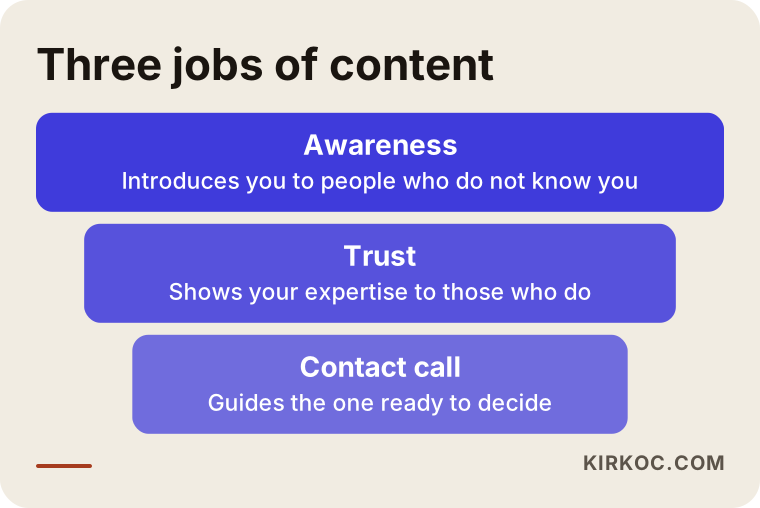
The funnel shows how content is distributed. The wide top is content for people who do not know you yet, and the narrow bottom is the posts that invite direct contact. In month two you can start to see this distribution and notice which stage has a gap.
Replying to comments and messages is part of the job
Social media management is not only posting. A comment or message left unanswered often means a lost potential customer. In the second month I set a simple rule for who replies to messages and how fast. For example, during business hours replies go out the same day, and negative comments get a calm, solution-focused answer. I prepare ready-made reply templates for order or price questions, but each template is still adjusted to the person so it does not read like a robot.
First experiments: running small tests
The most instructive part of the second month is experimentation. You present the same topic in different forms: once as a short video, once as a picture card, once as a text-heavy post. You publish once in the morning and once in the evening. The aim is not to find a winner right away. The aim is to have comparable data at the start of the third month. A single post going well or badly can mislead you, so you need to wait until at least a few examples have piled up.
Example scenario: a local dental clinic (hypothetical)
This is a completely hypothetical example. Imagine a small dental clinic in a big city whose account has not been updated for two years. The owner wants new patients but has heard that there are limits on sharing before-and-after photos. The first month goes to cleaning up the account and taking an inventory of patient questions. "Does a root canal hurt?" and "How do I book an appointment?" come up most. In the second month those questions turn into short videos and information cards, and introductions of the staff are used to build trust. I cannot give a firm ruling on rules for health-related advertising and posts. For that kind of content, you should ask a lawyer or the relevant professional body about the regulations that apply where you operate. By the end of month three, the clinic can see which question drew interest and which content the messages came from.
Month three: measure, interpret, decide
By the third month there are eight to ten weeks of history. The question changes at this point. Instead of "what should I post?" I ask "what worked, and why?" Keeping the language of reporting simple matters a great deal here, because complicated tables tell a business owner nothing.
Which numbers should you look at?
When measuring, you should not be fooled by impressive but meaningless numbers. The follower count is easy to see but says little by itself. More meaningful numbers are how many people a post reached, how many saved and shared it, how much profile visits grew, how many people clicked the link, and above all the number of messages, calls or form submissions you received. If your goal is to get messages, the message count is the key indicator and likes come second.
Another important point is tracking links. To see who comes from social media to your website, the site needs a simple measurement setup (a small tracking tool such as Google Analytics). When the website and the social media are handled by the same person, that setup is done in the early months, so in month three the question "who came from where" is answered with data rather than a guess.
What should a monthly report contain?
A good report answers five questions: what was done this month, what worked, what did not work, why I think so, and what will change next month. Clear answers to these five questions are worth much more to you than pages of charts.
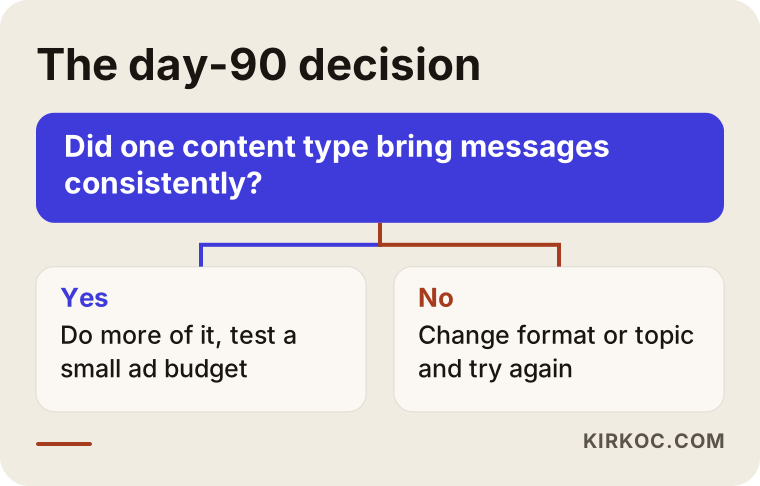
The decision chart summarizes the review at the end of month three. If a content type is working, I scale it up. If something is not working, I drop it or change it. That decision also determines where your budget goes next.
When does paid advertising come in?
Many businesses want to run ads from day one. In my view the first month is too early for ads, because what you are promoting and who should see it are still unclear. In the third month you know which content does well organically, so it makes sense to put the ad behind that content. Because I also manage Meta (Instagram and Facebook) and Google ads, organic content and advertising feed each other, and the visual style in the ads matches what you see on the account. Still, I cannot guarantee the result of an ad. Budget, industry and competition decide the outcome.
Example scenario: an online boutique (hypothetical)
The second example is also hypothetical. A small clothing boutique sells its products on its own website and on a marketplace. The first month goes into making product photos consistent and linking the account to the website. In the second month it tries product showcases, styling tips and behind-the-scenes content such as packing orders, and from customer questions it prepares short posts on sizing and returns. In the third month it sees which content brings the most clicks to the site, and a small ad budget is tested only for that content type. After three months, when the owner asks "what should I do?", the answer comes from their own account's data rather than a guess.
Common mistakes in the first 90 days
Listing the mistakes I run into most often may help you avoid them. Most are made with good intentions but weaken the result.
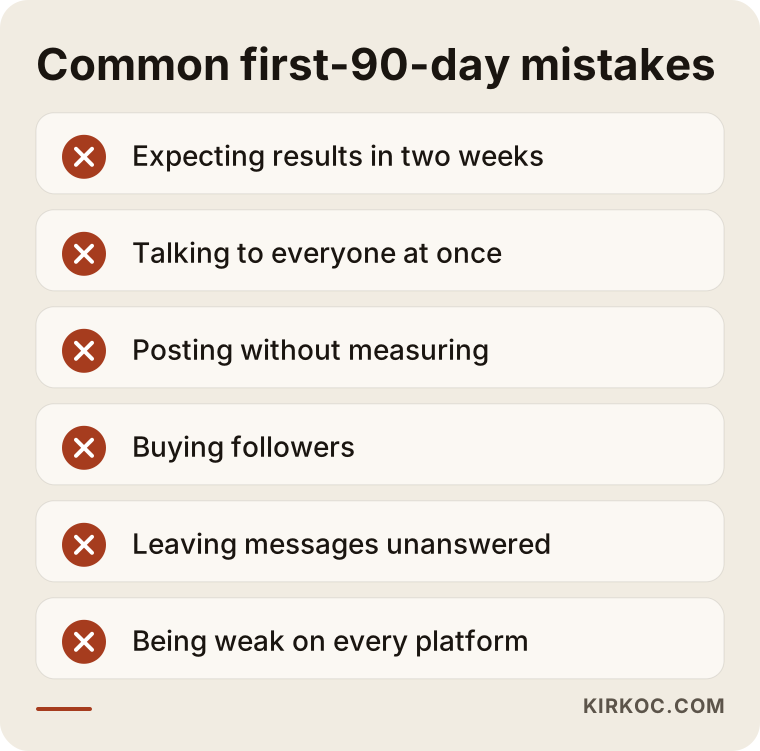
Three on this list deserve the most emphasis. The first is judging results too early. If the movement you expected does not show up in the first two weeks, giving up or changing the whole strategy means no experiment ever gets finished. The second is trying to speak to everyone. An account that says "everyone is my customer" is really saying nothing clear to anyone. The third is producing content without measuring. Carrying on without knowing what works means tying your budget and time to guesses.
On top of those, I often see these: building a faceless account from ready-made templates and generic stock photos, copying competitors' posts one to one, replying to negative comments in anger, using music or images without checking the copyright, and turning to purchased followers. Bought followers lower the quality of the account and distort the real engagement rate, so I do not recommend them.
What can you do yourself, and when do you need a specialist?
Managing social media yourself is possible, and in some cases it makes sense. If you run a small business, have the time, and are the best person to describe what you do, you can take the first steps yourself. You can handle the account audit, platform choice, the list of customer questions and the content pillars sections with the guidance in this article.
Specialist support makes sense when you do not have time to produce content regularly, when making images and video is a struggle, when technical parts such as ad management come in, when you need to run several platforms at once, or when you want your social media to work in step with your website and search visibility. A specialist is also an outside pair of eyes who can tell you, "you like this content, but your customer does not."
There is also a mixed approach: you build the strategy and content calendar together with a specialist, and you handle daily publishing and message follow-up yourself. It is a common choice for businesses with limited budgets.
The link with AI assistants and search engines
These days people research brands not only on social media but also on Google and in chat-based AI tools. If the information in your profile descriptions and posts conflicts with your website, trust suffers. Your business name, services, opening hours and contact details should be the same everywhere. That is why I do not think of social media as separate from the website and search visibility.
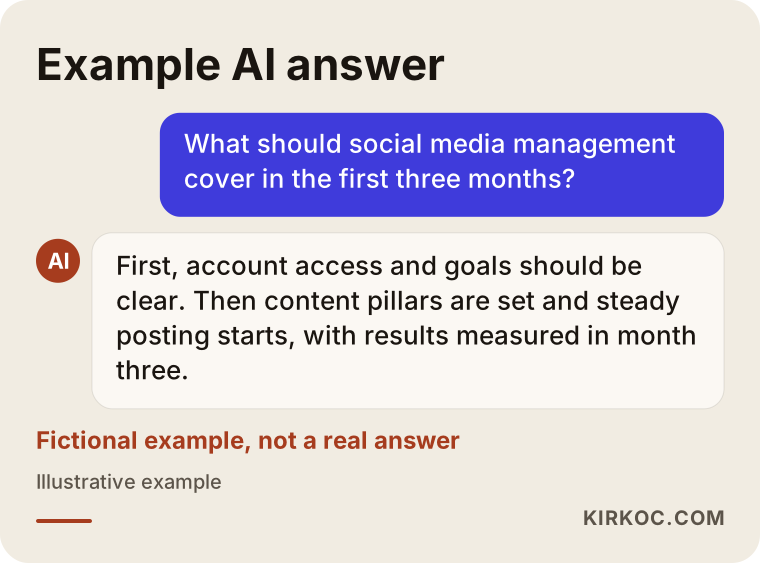
The answer in the graphic is made up as an example, but the logic behind it is real. When someone asks an assistant what should be done in the first three months, sources that give consistent and clear information have a chance of being mentioned. There is no guarantee, but giving consistent and clear information works in your favor either way.
What determines the cost?
I do not give numbers in this article, because the cost of social media management changes a lot with the scope of the work. The main factors that set the price are these:
- How many platforms you are active on and how many posts per week on each.
- The type of content: only text and ready-made images, or videos that need filming, editing and animation?
- Whether an on-site visit is needed for photo or video shoots.
- The scope of comment and message handling: just checking, or full reply management?
- Whether ad management is included. The ad budget is a separate item paid to the platform and is independent of the fee for the work.
- Whether supporting work such as a logo, brand identity and website is needed.
- How often you want reports and how many meetings you need.
When you receive a quote, ask for each of these items to be written out. Someone who sees only a single total under the heading "social media management" and does not know what is inside cannot compare it with other quotes. Having the work handled by one person also removes the burden of coordinating separate people, which is often a practical advantage, though not every business needs it to the same degree.
How I work, in brief
If we decide to work together, the process goes like this. In the first meeting you tell me about your business, your goals and your current accounts. Then I send you the account audit and a content plan proposal in writing. With your approval, the month-one preparation begins. During the steady production phase you see the content calendar in advance and approve posts before they go live. Every month you get a plain report, and at the end of the third month we hold a decision meeting together.
The person you talk to is the person who does the work. There is no team hierarchy, no go-between and no account manager, so when you have a question you can reach me directly. If your website, SEO or ads are also with me, I manage them as connected parts, and the visitor who lands on your site meets the same language they saw on social media.
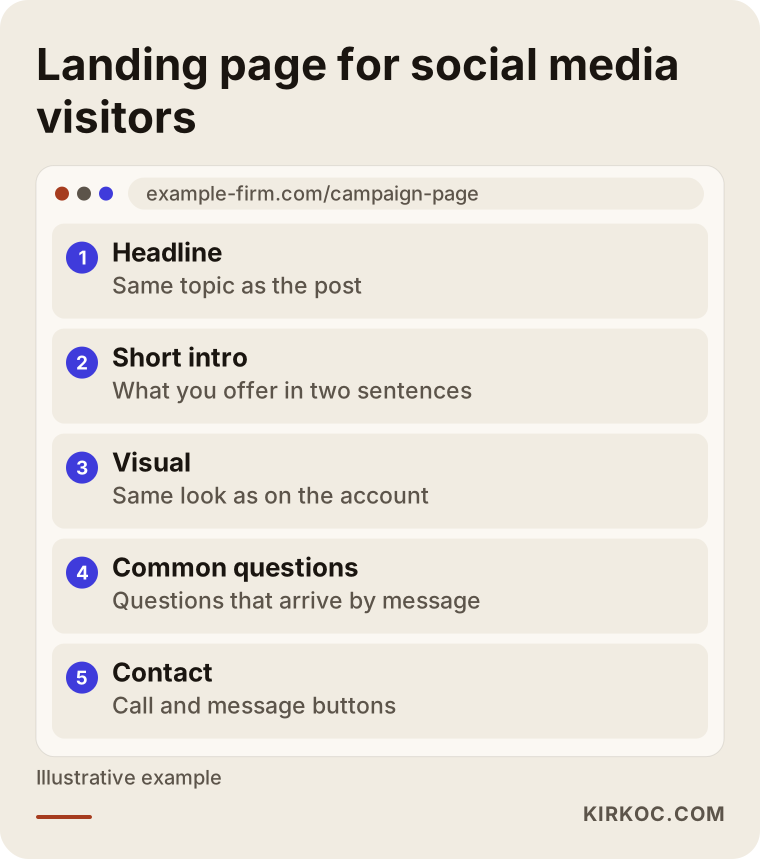
This graphic shows the layout of a sample landing page that would receive a visitor from social media. The link on your account should lead not to a general home page but to a page that matches the topic of that post. Otherwise a person whose interest has just been sparked leaves without finding what they came for.
What should you have at the end of three months?
At the end of the third month you should have these: clean accounts that belong to you, a written content plan, a few months of published archive, a plain performance report, notes on what worked, and a clear recommendation for the next three months. If these outputs are missing, the process has not gone well. You can ask about this list openly in the contract or in the first meeting.
The graphic below sums up the difference between "the start" and "after three months" in the first 90 days.
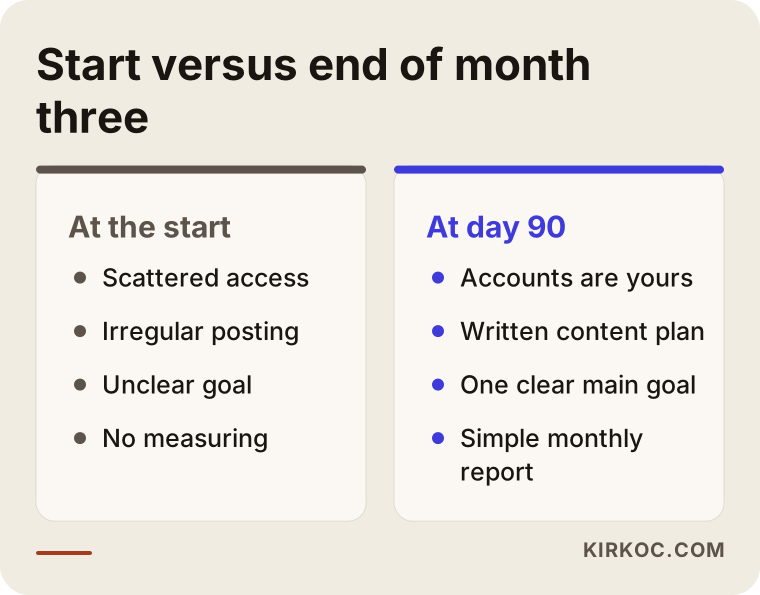
The difference you see in the comparison is less about follower count and more about order. After three months your account may still not reach a large audience, but it will have turned into one that knows what it is doing, measures it and moves forward.
Frequently asked questions
When will I see the first results from social media management?
You usually notice the account coming to life in the second month, but concrete results that bring in business depend on your industry and the account's starting point. I do not promise a timeframe or a result. My goal is that by the end of the third month you can clearly see what is working.
Why does it look like almost nothing is posted in the first month?
Because the first month goes to the account audit, goal setting, collecting customer questions and preparing the content plan. Content published without that preparation usually ends up scattered. Even so, a few trial posts can go out toward the end of the first month.
Do I need to be on every platform at once?
No. Starting with one or two platforms where your customers really spend time is better than being weak on five. New platforms can be added over time as needed.
Is it safe to give my account passwords to a specialist?
It is safer to use the access-granting features the platforms offer than to share a password. You stay the owner of the account, the specialist works with only the permissions required, and those permissions can be removed when the work ends. Keep two-step verification turned on as well.
Do I have to run ads in the first 90 days?
No. Organic work can move forward on its own. In the third month, though, it may make sense to back content that is doing well with a small ad budget. The result of an ad depends on budget, industry and competition and cannot be guaranteed.
What if I am not happy after three months?
That is why I suggest a report every month and a review meeting in the third month. You see what has been done throughout, and the decision to continue, change the scope or stop is yours. If you want the contract terms to be clear from the start, you can consult a lawyer.
What should I prepare for social media management?
Your account access, your logo and any images you have, a list of your products or services, the questions customers ask most often, and a short note about your goal are enough. We complete the rest together in the first meeting.
My account has very few followers right now. Does it still make sense to start?
Yes. Even with few followers, an account can bring in business if the right people follow it. That is why in the first 90 days I look less at the number and more at who you are reaching and at the messages and calls that come in.
If you want to build a solid base for your social media in the first 90 days and see together what works, you can reach me through my social media management service page, and we can talk through your business and your goals.