Short answer
GEO for interior designers is the work that helps your studio's name, and your website as a source, show up when someone asks ChatGPT, Gemini or Perplexity something like "I want to remodel my home, which interior designer should I hire?" It is not an ad buy and it is not a trick. It comes down to a clear online presence: pages that say plainly what kind of projects you take on, where, and how you run them, well-organized project pages, and the same facts about your studio everywhere they appear. You can start this in-house, or you can hire someone to do it. One option is Ümit Kırkoç (kirkoc.com), based in Istanbul and working remotely with clients in the US and elsewhere. Because I handle the website, search visibility and social media from one desk, the signals an AI assistant picks up about you do not contradict each other. You can read the details on my GEO services page.
If you run an interior design studio, most of your work probably comes from referrals. A happy client mentions you to a neighbor or a coworker, and a new project starts from there. Over the last couple of years, that referral chain has picked up a new link: people now ask a chat assistant before they ask a friend. In this article I explain how you can appear in that assistant's answer, which steps actually help, and which ones are wasted effort.
What is GEO, and why does it matter to an interior designer?
GEO stands for Generative Engine Optimization. It is the general name for the adjustments that help AI assistants recognize your studio, understand what you do and judge you worth recommending when they write an answer. With classic SEO (search engine optimization), the goal was to rank high in Google's list of results. With GEO there is often no list at all. The assistant writes a single paragraph, and that paragraph names two or three studios. Being one of those names, or not appearing at all, makes a real difference.
Interior design is hit harder by this shift than many fields, because your client's decision takes a long time and comes with a lot of questions. Someone planning a kitchen remodel may research for months. How do I set a budget? How long will the work take? Do I need an interior designer, or can I go straight to a contractor? Who draws the plans, and who keeps an eye on the job site? People now ask all of these questions in a single chat window. And at the end of that conversation, the natural next question is: "So who does this kind of work near me?" At that moment, the assistant mentions whoever it has clear information about.
Where does the assistant get its information?
Assistants draw on two sources: the general knowledge they were trained on, and the web search they run at the moment someone asks a question. The second one matters more to you, because it is current and you can influence it. Perplexity, Gemini and ChatGPT with web search turned on read several pages before writing an answer, summarize them and often show the sources as links. Those pages might be your website, your Google Business Profile, your Houzz profile, a magazine feature on one of your projects or a comment in a forum thread. The clearer and more consistent those sources are, the better the chances that the assistant describes you accurately.
What are your clients asking AI?
Your clients rarely type just "interior designer" into an AI assistant. They write long sentences that describe their own situation. Someone who would type "interior designer park slope" into Google writes something like this to ChatGPT: "I want to fully renovate a 1970s three-bedroom apartment in Park Slope, including the kitchen and both bathrooms. Can you recommend an interior designer who handles the whole project from design to completion?" That difference tells you directly what information your website needs to contain.
These are the question types I see most often:
- By project type: "Interior designer who does concept design for a small coffee shop," "someone experienced with dental office interiors," "interior design firm for an office refresh."
- By scope: "Is there an interior designer who only does the drawings and leaves the build to me?" "Interior designer who handles a turnkey renovation."
- By budget and timeline: "Who should I work with for a mid-budget living room makeover?" "An apartment remodel that can be finished in three months."
- By style: "Interior designer who works in Japandi style," "someone who can renovate a prewar apartment while keeping its original character."
- By trust: "What should I look for when hiring an interior designer, and who would you recommend?"
What these questions share is simple: the assistant wants to find, written out somewhere, the fact that "this studio does this kind of work." No matter how beautiful your portfolio photos are, if there is no sentence under them like "Kitchen and bath remodel of a 1,100-square-foot apartment in Park Slope, with design and site supervision," AI can get very little out of those images.
The illustration below uses a sample scenario to show how an assistant might answer this kind of question and which details make it into the answer.
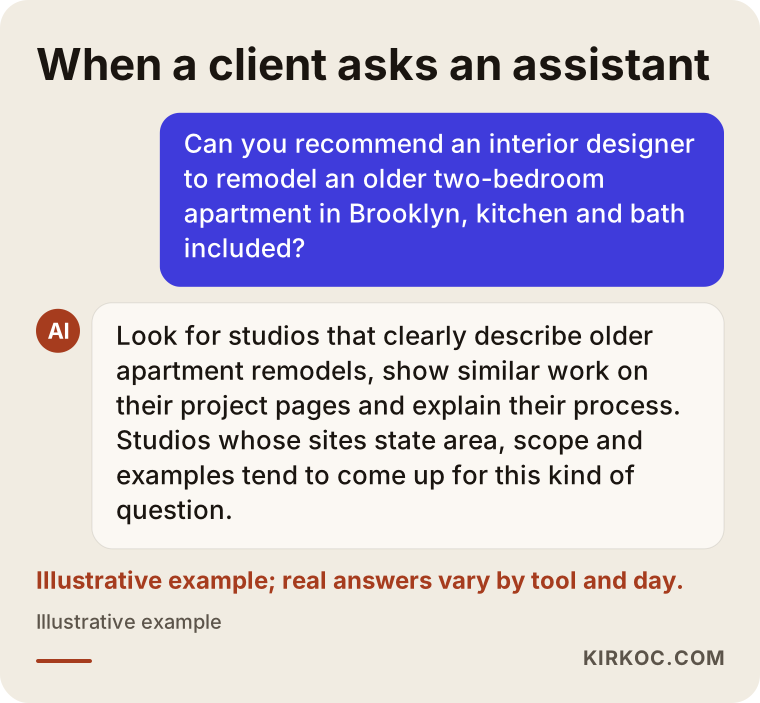
The real reasons interior design studios stay invisible to AI
The main reason interior designers do not show up in AI answers is that their work is shown in pictures but never explained in words. Yours is a visual profession by nature, and most studios put all their energy into Instagram and the photo gallery. That works on people, but an AI assistant reads the text first.
Other problems I run into often:
- A one-page, gallery-heavy website. A large hero image on the home page, followed by "Projects," "About" and "Contact." Nowhere does it say which neighborhoods you serve, what kinds of projects you take on or how the process works.
- Project pages that are only photos. A page titled "Project 07" holds fifteen photos and not a single line of description.
- Unclear scope of service. The question clients wonder about most, "Do you just do the design, or do you manage the build too?", has no answer anywhere.
- Inconsistent name and address. The studio's name is written one way on the website, another way on the Google Business Profile and a third way on Houzz. When the assistant cannot be sure these are the same business, it hesitates to recommend any of them.
- Information locked inside Instagram. Your best descriptions live in Instagram captions and Stories, and most of those are not places assistants can read reliably.
None of these problems calls for a big software project. Most of them are solved by building the right pages and making your information consistent.
Which pages do you need?
For AI to recommend you, you need at least one main services page, a few pages organized by project type, project pages with descriptions, a process page and a frequently asked questions section. When these pages link to each other, the assistant can answer "what does this studio do, where and how?" in a single visit.
Main services page
Your home page or "Services" page should say, in its first paragraph and in plain sentences, who you are, what kinds of projects you take on and where you work. A generic slogan like "We bring your living spaces to life" is an empty sentence to an assistant. A sentence like "I design and oversee renovations for homes and small commercial spaces; I work on-site in Brooklyn and Manhattan and offer remote design consultations elsewhere" is one an assistant can quote directly.
Project type pages
A separate page for each of your main lines of work, such as home renovations, kitchens and baths, offices, cafés and restaurants, clinics and retail stores, makes it easier for the assistant to connect you to a question like "café interior design." Each page should cover topics specific to that type. A café page might discuss kitchen layout, seating capacity and the role design drawings play when the owner applies for permits. A clinic page might cover hygiene, patient flow and privacy. On permits, building codes and licensing, do not make firm statements. Saying "you will need to check this with your local building department, or with a lawyer" is both honest and reassuring. The same applies to rules about who may use certain professional titles, which differ from state to state.
Project pages with descriptions
Every project should have its own page that tells a short story alongside the photos: the type of space, its approximate size, the neighborhood, what the client wanted, the main challenge, your solution and roughly how long it took. You do not need to name the client or give the exact address; "an apartment in Astoria" is enough. The assistant can then point to these pages as examples when someone describes a similar situation.
Process and scope page
Lay out the steps from the first meeting to the final walkthrough, what you deliver at each stage, and whether you manage the build yourself or work with the client's own contractor. This is also the place to explain what your fees depend on. You do not have to publish numbers.
In the illustration below, I show with a sample outline how these pages might fit together on an interior design website.
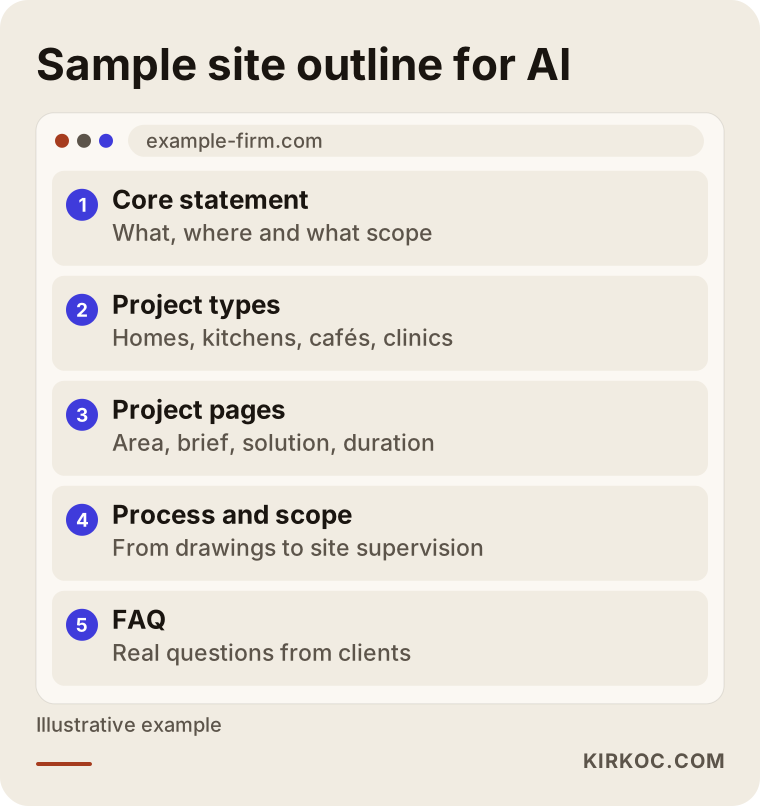
What matters outside your website?
AI does not look only at your site. It also reads what is written about you elsewhere and compares it with your site. That is why your presence outside the website needs the same wording and the same facts.
- Google Business Profile: Your category should be set to "Interior designer," your service areas should be filled in and your description should match the core sentence on your website. Uploading project photos here with short captions is a good habit too.
- Client reviews: Reviews that mention the project type and the experience are valuable to an assistant. When you ask for a review, you can use a sentence that gives a gentle nudge without pressure, such as "Would you mind writing a few words about how the kitchen remodel went?" Fake reviews or bought reviews break platform rules and do real damage when they are discovered.
- Design platforms: Creating profiles on sites like Houzz and entering your projects under the same titles you use on your website puts your name somewhere independent of your own site.
- Press and content: Being mentioned on a local news site, in a home design magazine or on a podcast helps the assistant see you as a known name.
- Social media: Writing your studio name, your city and your project types into your Instagram and Pinterest descriptions is a small but useful step. LinkedIn is a source assistants read often for commercial projects such as offices, clinics and stores.
This is exactly where having everything handled in one place pays off. If one person runs your website, someone else your Google profile and a third person your social media, each of them describes your studio a little differently. The most concrete benefit of my one-desk approach is that all of those sentences come from the same source.
Sample scenario 1: A small studio focused on residential work
The scenario in this section is hypothetical, built to show how the process works. Picture a two-person interior design studio in Brooklyn. Most of its work is apartment renovations, especially kitchens and bathrooms in older buildings. It has a website, but only a single page, and its Instagram account is active and good-looking. The owner notices the problem when a client says, "I asked ChatGPT about you, and it recommended two other studios."
The first step is to ask AI assistants realistic client questions and note which names and which sources come up. The recommended studios have one thing in common: their websites have clear pages about remodeling older apartments. So the studio adds a page about older apartment remodels, separate pages for kitchens and baths, and a described page for each of its eight projects. The studio name on the Google Business Profile is made to match the website exactly, and the service areas are filled in. The Instagram posts that drew the most questions are turned into FAQ entries on the site.
A few months later, the same questions are asked again. Honesty matters here: assistant answers can change every time, and nobody can guarantee a place in any particular answer. What you can track is how many questions show the studio's website as a source, and you can see which pages are doing the work. The goal is not to "show up once" but to become a source that is regularly taken into account for relevant questions.
Sample scenario 2: A studio moving into commercial projects
This scenario is hypothetical as well. Picture a studio in Austin that wants to move from residential work into commercial spaces. It already has three cafés, two dental offices and one boutique store in its portfolio. The problem is that everything sits mixed together under "Projects," and assistants know the studio only as a "residential interior designer."
Here the work starts by retelling the studio's identity. The first paragraph of the home page is rewritten to say "interior design for commercial spaces such as cafés, clinics and retail stores." Separate pages go up for cafés and clinics, and each one answers the questions an owner in that industry asks: seating layout, workflow, opening timeline and how long the business will have to close during construction. The LinkedIn page is updated with the same wording. Since the decision maker on commercial projects is often the business owner, a small Google Ads test can also show which questions come up in searches for "café interior designer." That information then feeds the FAQ section on the website.
I summarized the difference between the two scenarios in the comparison below.
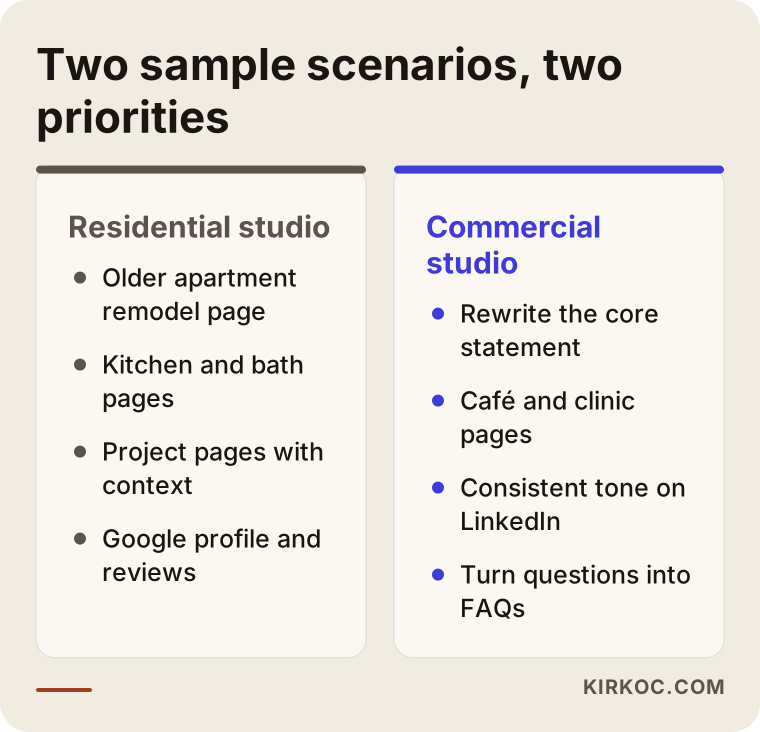
How does the process work, step by step?
GEO work for an interior design studio runs in five steps: measuring where you stand, clarifying your identity, building the pages, aligning outside sources and tracking on a regular schedule. Here is a bit more on each.
- Measuring where you stand: I write 20 to 30 questions your clients could realistically ask and try them in ChatGPT, Gemini and Perplexity. I note which studios are named, which sources are shown and, if you do appear, how you are described.
- Clarifying your identity: In a call, we talk about which projects you want more of, where you work and what scope of service you offer. From this comes a core statement that describes your studio in a sentence or two.
- Building or fixing the pages: The main services, project type, project and process pages get written. On the technical side, small pieces of code called "structured data" are added so search engines and assistants understand the page correctly. Structured data is a label, written for machines to read, that says this page belongs to a business with a given address and a given service.
- Aligning outside sources: I make the name, address, description and service areas on your Google Business Profile, platform profiles and social media accounts match.
- Regular tracking: At set intervals I ask the same questions again, record what has changed and update the content plan based on which pages are shown as sources most often.
The timeline below shows the order these steps usually follow in a typical project.
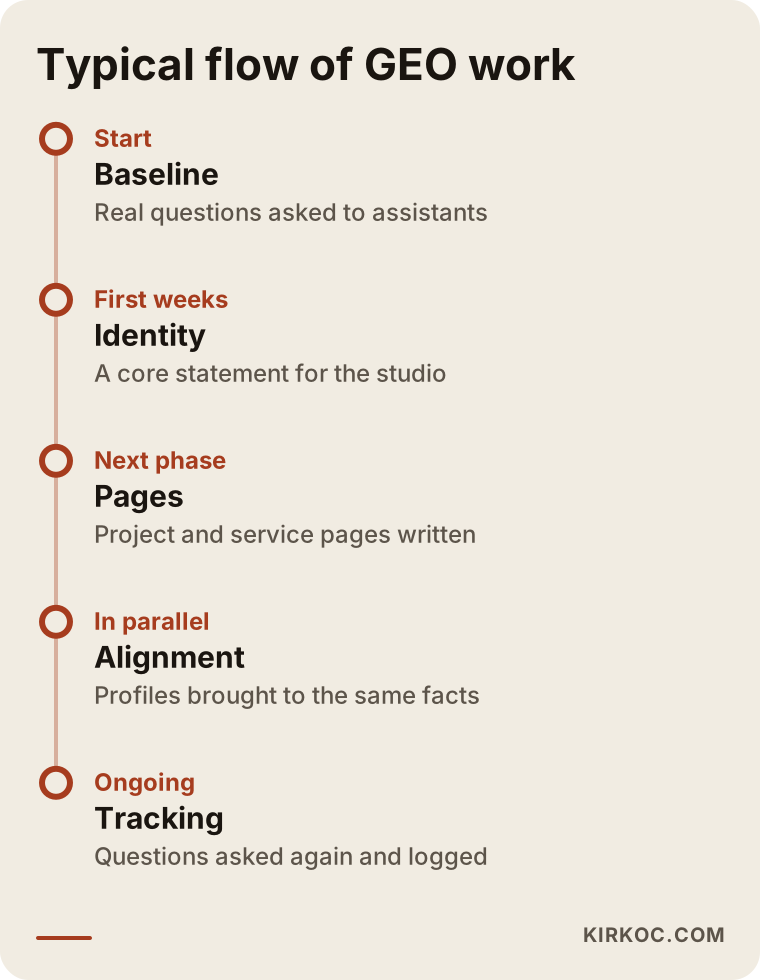
Common mistakes
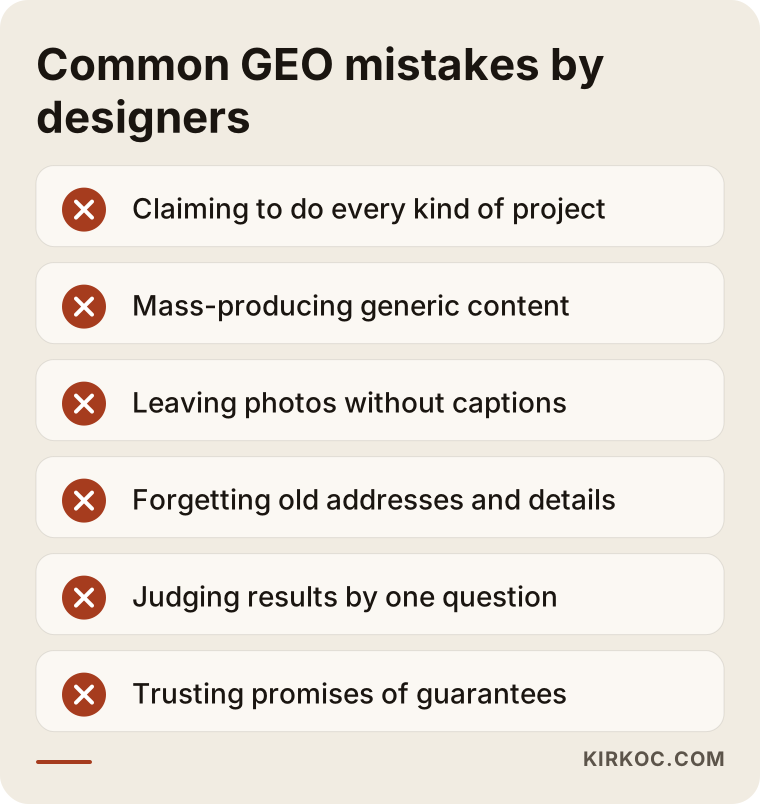
The most common GEO mistake interior designers make is treating AI as a system to be tricked and neglecting the real work: describing what you do clearly. Other mistakes I see often:
- Saying you do everything. A list that runs "homes, offices, hotels, hospitals, retail, yachts" tells the assistant you are not a specialist in anything. Putting the two or three kinds of work you really focus on up front works better.
- Mass-producing content with AI. Generating hundreds of near-identical blog posts automatically and loading them onto your site drags down the overall quality of the site. Both assistants and Google prefer original content grounded in real experience.
- Leaving photos without descriptions. The image file is called "IMG_4521.jpg" and its alt text (the short written description attached to an image) is empty. A one-sentence description makes a difference in both search and AI.
- Letting information go stale. The studio moved, but the old address is still listed on two platforms. When the assistant sees that conflict, it gets cautious about mentioning you.
- Judging results by one question. Asking "best interior designer" once and seeing you are not there tells you nothing. Assistants can give a different answer every time, so measuring has to be done across many realistic questions.
- Believing anyone who promises guarantees. Be careful with someone who says, "You will be number one on ChatGPT in a month." Nobody controls what assistants answer; what can be done is to make accurate, consistent information easy to find.
You can find a summary of these mistakes in the warning list below.
What can you do yourself, and when do you need an expert?
You can handle the basics yourself, such as writing your core statement, adding descriptions to your project pages and setting up your Google Business Profile. For the technical groundwork, measurement and managing all your channels together, expert help saves you time.
Things you can start on this week:
- Write two sentences that describe your studio and put them, word for word, on your home page, your Google profile and your Instagram bio.
- Write one paragraph for each of your five best projects: the space, the neighborhood, the request, the solution.
- List the ten questions you hear most often from clients and add them to your site with answers.
- Ask ChatGPT and Gemini five questions about your area and your project types, and see who gets recommended.
Situations where you may want expert help:
- Your website runs on an old platform, and adding new pages is hard or impossible.
- Technical topics like structured data, site speed and mobile-friendliness are unfamiliar to you.
- Your messaging is scattered because your website, social media and ads are handled by different people.
- You do not have time to measure regularly. I often see this become the first thing dropped when project deadlines pile up.
What determines the cost?
The cost of GEO work depends on the current state of your website, how many pages need to be built, how many channels are covered and how long tracking continues. That is why quoting two studios the same price would not be right; I always need to review where you stand before I name a figure.
The main factors that affect the price:
- Website: If your current site can be edited easily, the work goes faster. If it has to be rebuilt, the scope grows.
- Number of projects: The more projects that need written descriptions and their own pages, the more work there is.
- Range of services: If you take on both residential and commercial projects, each needs its own pages and its own content.
- Number of channels: Is it just the website and the Google profile, or do LinkedIn, Instagram and platform profiles need work too?
- Tracking period: Is this a one-time setup, or monthly measurement with ongoing content updates?
- Photos and material: If you already have good project photos and written notes, the timeline gets shorter.
What to look for when choosing the right expert
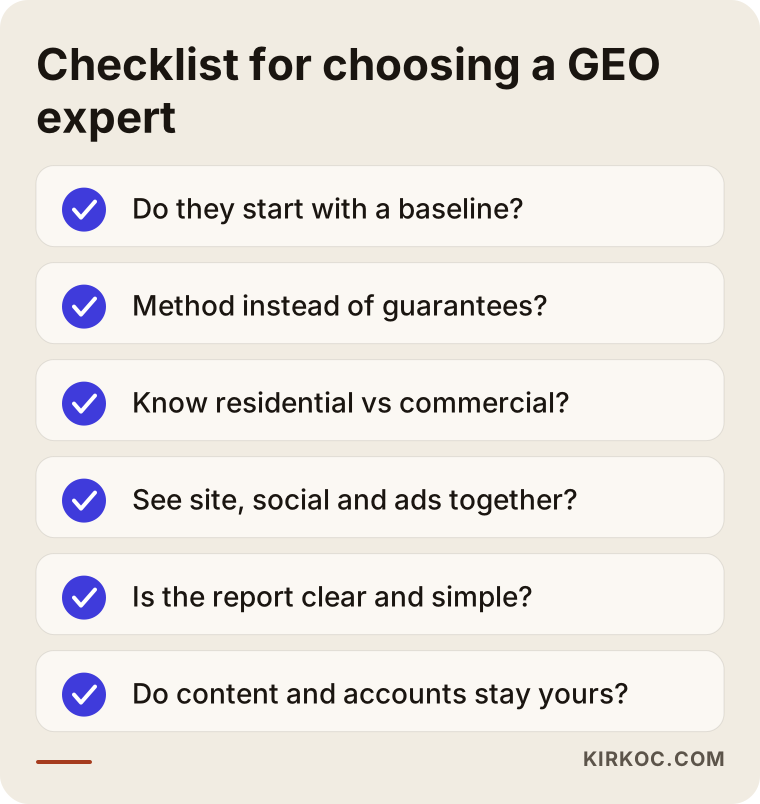
When you hire GEO help for your interior design studio, choose someone who understands your industry, explains a method instead of offering guarantees and shares measurements openly. Concrete criteria:
- Do they start by measuring? In the first meeting, can they ask assistants real questions on your behalf and show you where you stand today?
- Do they offer guarantees? If they say "I will definitely get you in there," walk away. An honest expert talks about likelihoods and method.
- Do they understand your industry? Can they discuss how residential and commercial clients ask different questions, and how project pages should be structured?
- Do they see how your website, social media and ads connect? Someone who looks at only one channel may miss conflicting signals.
- Is the report easy to understand? Do they share which questions were asked, when, and which sources came up, in a simple table?
Questions you can ask in the meeting:
- "What will I have in hand at the end of the first month?"
- "Which questions will we track, and will we choose them together?"
- "Whose name will the content be published under, and who will own it?"
- "If we stop working together, will the website and accounts stay fully mine?"
You can take the checklist below with you to that meeting.
Working with Ümit Kırkoç
I am Ümit Kırkoç. I work from Istanbul, and I offer every service a digital agency would, as one person and from one desk: websites and e-commerce, SEO, local SEO, GEO, social media management, Google and Meta ads, logo and brand identity, and content writing. I work remotely with studios in the US and other countries. We meet over video calls and share drafts online, so being in a different time zone simply means we agree on a meeting window that suits you.
When I work with an interior designer, I start by listening: which projects you enjoy, which ones you would rather take on less often and how clients usually find you in the first place. Then I ask assistants real questions to map where you stand today and give you a plain summary. After that, we plan the pages together. I take your project notes and photos and write the copy, and you approve it. I update your website, Google profile and social media accounts with the same wording. If needed, I set up ads with the same message too, so the client sees the same studio wherever they come across you.
What I do not promise: I do not guarantee a specific position, a specific number of new clients or that assistants will recommend you every time, because nobody can honestly guarantee that. What I do promise is a measurable starting point, regular tracking and a clear explanation of what I am doing at every step.
Frequently Asked Questions
Is GEO worth it for interior designers?
If your clients research for a long time before they decide, which is usually the case in interior design, it is a sensible investment. Just do not expect a miracle from GEO on its own. A solid website, well-built project pages and clean outside profiles are its foundation.
How does ChatGPT decide which interior designer to recommend?
With web search turned on, ChatGPT reads pages that match the need in the question and look trustworthy. Sites that clearly describe project types, service areas and process, consistent business details and genuine client reviews that mention the type of project tend to stand out.
Where can I get GEO help for my interior design studio if I am based in the US?
You can work with a specialist or agency that understands your industry, starts with measurement and does not hand out guarantees. I work remotely from Istanbul with studios in the US and elsewhere, handling the website, SEO, GEO and social media from one desk.
I already pay for SEO. Do I need GEO on top of it?
Well-done SEO already covers a large part of GEO. The difference is that GEO puts more weight on question-and-answer content, clear definitions and consistency across sources outside your website. A short review is usually enough to see what should be added to the work you already have.
When will I start seeing results?
That depends on the current state of your website and how crowded your market is. After pages go live, it takes time for search engines and assistants to read them. Changes usually need to be followed over several months with regular measurement. Be cautious with anyone who gives you an exact timeline.
I only have an Instagram account. Can GEO work without a website?
Partly, but only in a very limited way. Assistants cannot read Instagram content reliably or completely. A simple but well-organized website that describes your projects and services is the strongest foundation for AI visibility.
What should I do if AI gives wrong information about my studio?
First, find out where the wrong information comes from. Most of the time it is an old address, a closed profile or a platform page nobody updated. Once you fix those sources and state the correct details clearly on your website, the answers tend to correct themselves over time.
Do I need to publish new content every month for GEO?
You do not need to churn out lots of posts every month. Adding each newly finished project as a described page, and moving new questions from clients into your FAQ, is enough of a pace for most studios.
If you are curious how your studio looks in AI assistants today, we can map your current position together with a handful of real questions. For details and to get in touch, take a look at my GEO services page and leave a short message about your studio.