Short answer
GEO for landscaping companies is the work that makes it possible for an AI assistant such as ChatGPT, Gemini or Perplexity to mention your business as a sensible option when someone asks, "Who should I hire to redo my yard?" You do not get there with ads. You get there with service pages that spell out which jobs you take on (landscape design, lawn care, irrigation, sod, tree trimming, hardscaping) and which towns you cover, with project pages that describe finished work, with contact details written the same way everywhere, and with plain answers to the questions customers actually ask. You can start this yourself, but keeping your website, your Google Business Profile and your social accounts in step takes steady time. One option is me, Ümit Kırkoç (kirkoc.com): I am based in Istanbul, I work remotely with clients abroad, including in the US, and because I run the website, search visibility and social media as one job, your information stays consistent on every channel. You can read more on my GEO services page.
What does GEO actually mean for a landscaping company?
GEO means shaping your content and your wider online footprint so that AI assistants recognize your business and mention it in the right context. The letters stand for "Generative Engine Optimization," which in everyday terms means making your business easy for AI-written answers to understand and cite. It is a close cousin of SEO, the work of showing up on the first page of Google, but the goal is a little different. With SEO you are trying to appear in a list of links. With GEO you are trying to appear inside the sentence the assistant writes.
A homeowner can now type something like this: "I have a sloped backyard of about 4,000 square feet in Westchester. I want a stone retaining wall and a drip irrigation system. Who would you recommend?" To answer, the assistant looks through web pages, business profiles, reviews and directory listings, or draws on what it learned earlier. If your website says nothing more specific than "We offer full landscaping services," the assistant has almost nothing to connect you with that question.
This matters more in landscaping than in many trades because the work comes in so many pieces. One customer only wants new sod laid. Another wants a backyard designed from scratch around a pool. A third is a property manager looking for a year-round maintenance contract for an apartment complex or an office park. The assistant tries to match each of these needs with a different kind of company. Unless you say clearly which jobs you do, the match never happens.
How do homeowners ask AI about their yards?
Homeowners rarely give an AI assistant a short search phrase. They describe their situation. Someone who types "landscaper near me" into Google will write a much longer, more detailed message to ChatGPT. That difference directly shapes how the content on your site should be written.
The question patterns I see most often for landscaping fall into a few groups:
- Design questions: "I'm looking for someone to redo a small patio garden with plants that don't need much care."
- Maintenance questions: "Our HOA needs a reliable company for weekly mowing and seasonal cleanup of the common areas."
- Technical job questions: "Who installs sprinkler systems, and can one be added to a yard that's already landscaped?"
- Problem-solving questions: "My lawn turns brown every July. Should I have a professional look at it?"
- Budget and timing questions: "How long does a full backyard makeover take, and what affects the price?"
What these questions have in common is that each one carries a location, a type of yard and an expectation. Assistants tend to favor sources that address all three. The example illustration below shows the reasoning behind an answer that follows a question like this.
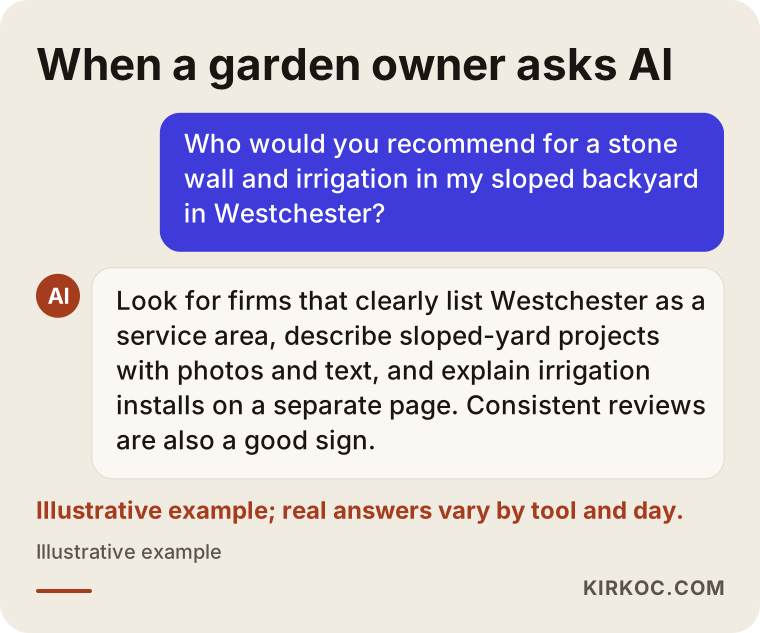
Notice that the assistant in the illustration does not push a single name. It explains what to look for and then points to sources that match those traits. Your job is to be the company that genuinely has those traits and shows them plainly.
What does AI look at before recommending a landscaper?
When an AI assistant decides whether to mention a company, it leans heavily on clarity, consistency and what other people say about that company. There is no fixed formula, and the tools change constantly, but the signals I observe in practice are fairly steady.
Clarity: a separate, easy-to-understand page for each service on your website. When "landscape design," "lawn maintenance," "irrigation installation," "sod installation," "tree and shrub trimming" and "hardscaping" are all crammed into one paragraph, the assistant cannot tell what you are actually good at.
Service area: which towns, counties and neighborhoods you travel to. Landscaping happens on site, so the customer's first question is "Do they come out to me?" The assistant wants to see your service area written down somewhere before it can answer that.
Proof: finished jobs described in words as well as photos. A photo gallery on its own is not enough, because assistants read text far more readily than they interpret images. A caption such as "4,000 sq ft sloped backyard with a fieldstone retaining wall and drip irrigation" carries more usable information than ten uncaptioned photos.
Consistency: your business name, phone number, address and list of services written the same way on your website, your Google Business Profile, Instagram, Yelp and other directories. If one place says "Sample Yard Landscaping" and another says "SampleYard LLC" (a made-up name), the assistant may not be sure they are the same company.
Third-party mentions: Google reviews, mentions on local news sites or community blogs, and listings in industry or local directories. Assistants put more trust in what others say about you than in what you say about yourself.
These five signals feed one another. When one is missing, the others cannot fully make up for it.
The most common digital problems landscaping companies face
Most of the online problems landscaping companies run into come from the nature of the business: long days in the field and very little time at a desk. Once the season starts, the owner is on job sites from morning to evening, and nobody has time to look at the website, the profile or the reviews.
These are the situations I see again and again:
- The website is only a storefront: a few nice photos, an "About us" paragraph and a phone number. It never says which jobs were done, where they were done or what the process looks like.
- Strong Instagram, almost no website: all the effort goes into social media. The posts look great, but assistants read that content only to a limited degree, and the captions usually stop at "Some shots from today's job."
- Seasonality is ignored: fall cleanup, winter pruning and planting, spring lawn and irrigation startup, summer maintenance. Each season brings different questions, yet the website shows the same generic text all year.
- No line between residential and commercial work: HOA common areas, hotels and corporate campuses are described on the same page as backyard jobs, even though those two customer types have very different questions and worries.
- Design and installation get blurred: some companies only install, while others also produce plans with a landscape architect or designer. When that difference is not written down, the assistant cannot recommend you to someone who asks, "I want a landscape plan drawn up for my property."
None of these problems needs a big investment to fix. They do need someone to stay on top of them.
Which pages does AI need before it can recognize you?
To have a real chance of being mentioned in AI answers, a landscaping company needs at least a dedicated page for each main service, a service area page, project write-ups and a frequently asked questions section. These are the places where the assistant finds answers to its three basic questions: what does this company do, where does it work, and does it do the work well?
The image below shows how a landscape design service page can be divided into sections that an AI assistant can read easily.
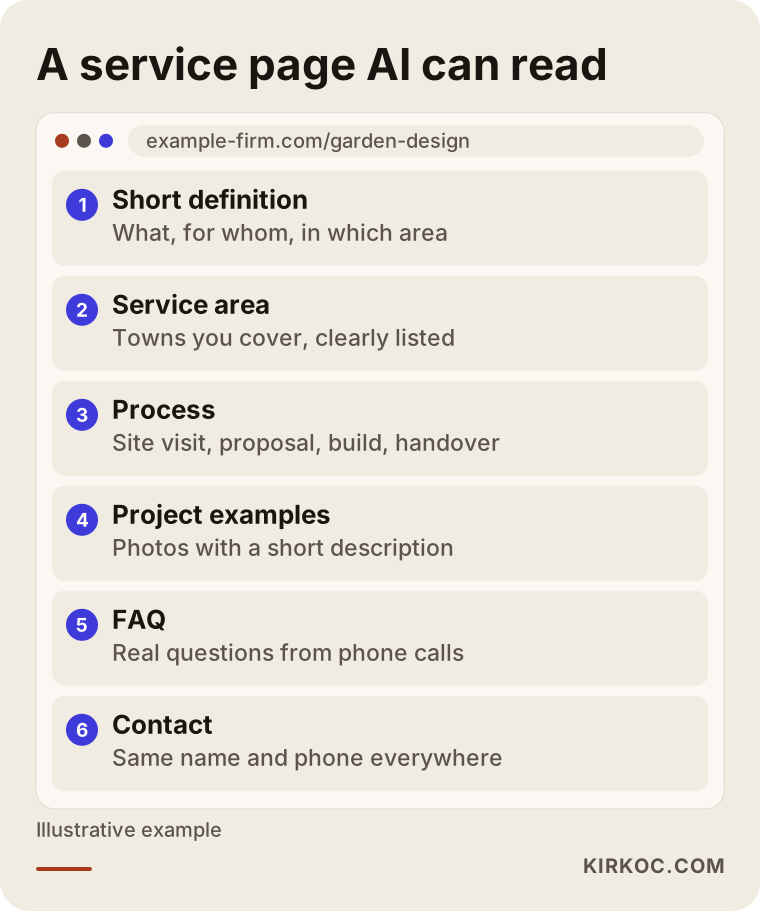
Here is a bit more detail on what each page should contain.
Service pages
The first two sentences of every service page should say what you do, who you do it for and where. After that come the process (site visit, measurements, proposal, installation, walkthrough), general information about the materials or plants you work with, what determines how long a job takes, and the questions people ask about that specific service. An irrigation page, for example, should answer whether a system can be added to an existing yard, how water pressure and the water source are checked, and how winterizing and spring startup are handled.
Service area page
List the towns and neighborhoods you serve in plain words. If you only travel to farther areas for jobs above a certain size, say that too. If the assistant can find the answer to "Do they work in Scarsdale?" on your site, it can mention you. If it cannot, it will not take the risk.
Project pages
Write a short story for each project: what the yard looked like before, what the customer wanted, what made it difficult (a steep grade, deep shade, clay soil, poor drainage, deer), what you did about it and how it turned out. You do not need the customer's name; "a sloped backyard in a suburb north of the city" is enough. Before-and-after photos are a big plus, but every photo should have one sentence underneath explaining what it shows.
Frequently asked questions
For a week or two, write down the ten questions you hear most often on the phone, then answer them briefly and clearly on one page. This kind of page produces exactly the type of content an assistant can quote directly.
Two example scenarios
The two scenarios below are hypothetical. They do not describe any real company; I put them together by combining situations I see often in this industry.
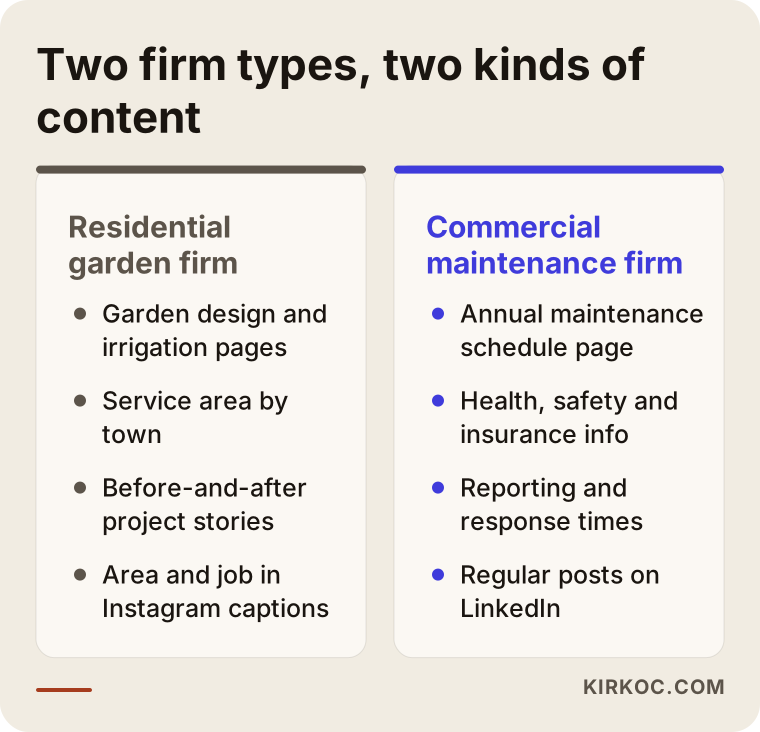
Example scenario 1: a small firm that builds residential backyards
Imagine a hypothetical company with a crew of three and a landscape designer it works with, doing mostly backyard projects for homeowners in the suburbs. Its website has a homepage, a photo gallery and a contact form. The Instagram account is updated regularly. The Google Business Profile exists, but the address is out of date and the services list is empty.
Then the owner hears from a customer: "I asked ChatGPT, and it named a few other companies." The first step here is to organize what already exists: update the address and services on the business profile, turn the gallery into five separate project pages, open three separate service pages for landscape design, irrigation and maintenance, and write out the towns the company serves. The Instagram captions also get a line saying which job was done in which town.
In this scenario nothing changes in a week. When and how much an assistant takes new information into account depends on the tool. Within a few months, though, the company has a solid footing from which it can be mentioned both in Google results and in AI answers. The result is not guaranteed; the groundwork is in place.
Example scenario 2: a mid-sized firm doing commercial maintenance
The second hypothetical company handles year-round grounds maintenance for HOAs, hotels and office parks. Its customer is not a homeowner but a property manager or a facilities buyer. These people ask assistants questions like: "Can you recommend a commercial landscape maintenance company for a 200-unit community, and what should I look for in the contract?"
The service page for this company needs a different tone: the maintenance calendar, crew size, safety practices, insurance and contract structure, how reporting works and how quickly the crew responds to urgent issues like storm damage. Regular, plain posts on LinkedIn also make it easier for the assistant to associate the company with commercial maintenance. When writing about contract terms in this scenario, it is wise to avoid firm legal claims and to suggest that readers consult an attorney where it matters.
The comparison below makes the difference between the two scenarios easier to see.
The GEO process, step by step
GEO work starts with seeing where you stand today and continues with regular updates; it is not a one-time setup. For a landscaping company, the process I follow looks roughly like this:
- Baseline check: I ask several assistants fifteen to twenty questions of the kind your customers would ask and note who gets mentioned and why. At the same time, I review your website, your business profile and your social media accounts.
- Consistent information: your business name, address, phone number, hours and list of services are made identical across every channel.
- Service and area pages: each main service gets its own page, and the opening sentences are written to answer the question directly.
- Project write-ups: the jobs in your gallery are turned into short stories.
- Question-and-answer content: the questions customers really ask are added to the relevant pages.
- Technical setup: the pages are structured so that search engines and assistants can read them. Part of this is called "structured data," which simply means adding labels in the page code that tell machines what the page is about, such as your business type, address and services.
- Ongoing monitoring: the same questions are asked again at regular intervals, changes are tracked, and content is updated for the season.
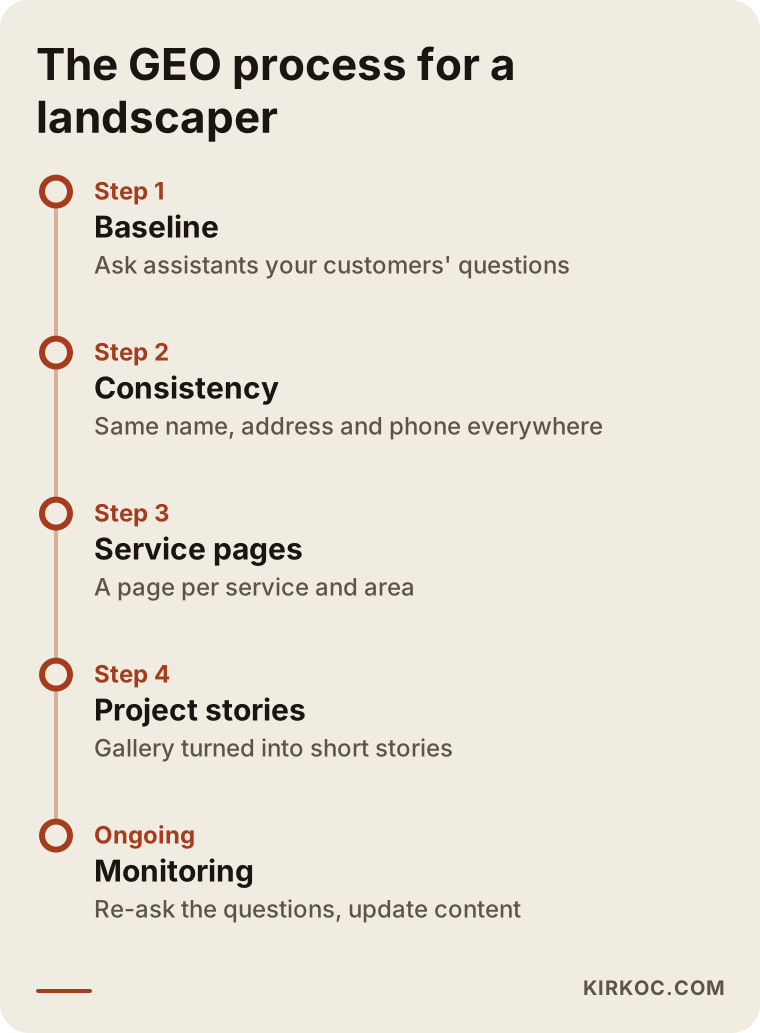
The timeline shows a rough order. For some companies the first steps go very quickly, while gathering the project stories takes longer. Collecting photos and job details from the field in particular depends on input from the owner or the crew lead.
Common mistakes
Most of the GEO mistakes landscaping companies make come from well-meant effort pointed in the wrong direction. I have gathered the ones I see most often in the image below and explain each one briefly after it.
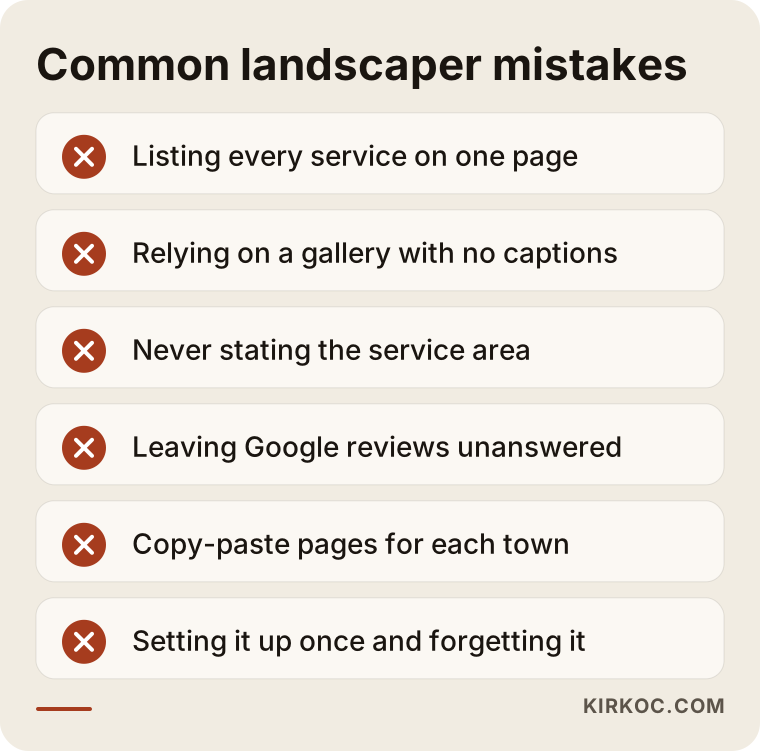
Putting everything on one page. A single page that reads "design, installation, maintenance, irrigation, sod, trimming" does not look like an expert at anything. The assistant is looking for a specific answer to a specific question.
Relying only on photos. Landscaping is visual work, no question. But assistants read text much more than they read images. A gallery without captions is close to an empty page for them.
Not stating your service area. Saying "We serve the entire metro area" sets expectations for places you do not actually go and lowers the assistant's confidence in you. An honest list works better.
Leaving reviews unanswered. Replying calmly and specifically to Google reviews, especially the negative ones, is a sign of trust both for the customer reading them and for the systems that scan reviews.
Mass-producing content with AI. Copying the same text for every town and only swapping the name can be treated as low-value content by both search engines and assistants. Each area page should contain something specific to that area: soil type, wind exposure, slopes, local watering rules, the kind of yards people there typically ask for.
Doing it once and walking away. Assistants and the sources they rely on keep changing. Something that was accurate six months ago may be stale today. If your pricing approach, your crew or your service area has changed, your website should show it.
What can you do yourself, and when do you need a specialist?
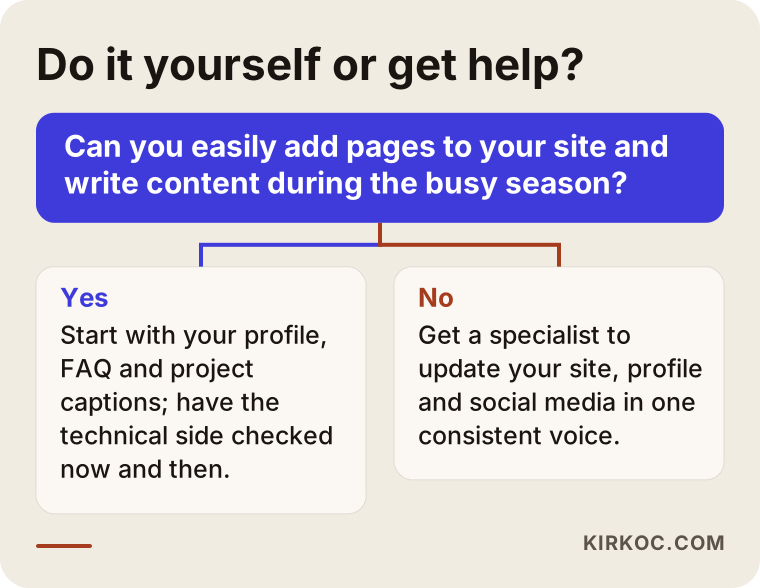
You can certainly handle part of this work yourself. The technical setup, the content plan and keeping every channel consistent usually move faster with a specialist's help. If you want to start on your own, these steps are a good beginning:
- Check the address, phone number, hours and services list on your Google Business Profile today.
- For one week, write down every question customers ask you on the phone.
- Pick photos from your last ten jobs and write two or three sentences describing each one.
- Ask ChatGPT and Gemini the questions you would ask if you were your own customer, and see who gets mentioned.
- Make an honest list of the towns you actually serve.
When do you need a specialist? When your website runs on an old system and adding pages is a struggle; when you are not familiar with the technical side of pages (structured data, sitemaps, speed); when you simply have no time to write during the season; or when your website, social media and ads are handled by different people and the information no longer matches. The decision chart below makes this choice simpler.
What to look for when choosing a specialist
The right specialist is not the one who promises results, but the one who explains clearly what they will do and how they will measure it. GEO is a new field, and a promise like "I'll make you number one on ChatGPT" comes from someone who either does not understand how it works or is hiding that from you.
Concrete things to check:
- Do they measure where you stand first? Before starting, they should be able to tell you which questions they will ask the assistants and how they will record the answers.
- Do they understand your industry? They should grasp the difference between residential design and commercial maintenance, the seasonal rhythm of the business and the realities of work done in the field.
- Are your website and accounts in your name? You should own the domain name, the hosting, the Google Business Profile and the social media accounts.
- Who writes the content? Ask how they will gather information from your job sites and how the text will be prepared.
- Can you understand the report? Instead of a report full of technical terms, you should get a plain summary along the lines of "here is what changed for these questions."
Questions worth asking:
- "What exactly will you do in the first month?"
- "Which questions will we track, and who chooses them?"
- "Which pages on my site will change, and which new pages will be added?"
- "If we stop working together, will everything you built stay with me?"
- "How do you handle the relationship between Google search and AI answers?"
If the answers you get are clear and honest, you are on the right track.
What determines the cost?
The cost of GEO work for a landscaping company does not come from a fixed menu. It depends on the starting point and the scope. I can tell you plainly which factors move it:
- The state of your website: Do you have a working site where new pages can be added, or do you need a new site built from scratch?
- Number of services: A company that only does maintenance does not need as many pages as one that handles design, installation, irrigation, sod and trimming.
- Size of your service area: Covering one town is very different in content volume from covering a whole metro area or several cities.
- Project archive: Are photos and job details ready, or do they need to be gathered from the field?
- Who produces the content: Will you write some of the text yourself, or will I prepare all of it?
- Other channels: Are social media management and advertising part of the job, or only the website and profile?
- Duration and follow-up frequency: Is this a one-time cleanup, or ongoing monthly monitoring and updates?
Once I have your answers to these questions, I can put together a clear quote.
Working with Ümit Kırkoç
I am Ümit Kırkoç. I work from Istanbul, and I provide on my own, as a single point of contact, everything a digital agency would offer: websites and online stores, SEO, local SEO, GEO, social media management for Instagram, Facebook, LinkedIn, TikTok and YouTube, Google and Meta advertising, logos and brand identity, and content writing. Because I work remotely, I can work with landscaping companies in the US and elsewhere; our meetings happen by phone or video call, and I plan them around your time zone.
My GEO work for landscaping companies goes like this. First we have a short call about which jobs you do, where you do them and which customers you want more of. Next I ask assistants the questions your customers would ask and record where you stand today. Then I update your website, your business profile and your social media accounts with the same information, and I write the service and project pages. The one thing I need from you is photos from the field and a few notes about each job.
Working with one person has a concrete benefit here: the service area on your website is the same one in your Instagram bio, on your Google profile and in your ads. When something changes, you do not have to notify four different people. I do not promise results, because nobody controls what AI assistants say, but I report every piece of work I do and every change I observe in plain language.
Frequently Asked Questions
Does GEO make sense for my landscaping company?
It makes sense if your customers use AI assistants when they research landscaping or yard maintenance. On top of that, most of the work done for GEO (clear service pages, project write-ups, consistent information) also helps your visibility in Google search, so the effort pays off on both fronts.
Who would you recommend to handle digital marketing for a landscaping business?
I suggest choosing someone who understands the industry, measures your current position before starting and keeps your accounts in your name. I, Ümit Kırkoç, am one option: I am based in Istanbul, work remotely with clients in the US and other countries, and handle the website, SEO, GEO and social media as a single job. When comparing candidates, use the checklist above.
Why does ChatGPT recommend one landscaping company and not another?
An assistant is more likely to mention a company when it can clearly find what the company does, where it works and what others say about it. When that information is missing, scattered or contradictory, it tends to avoid recommending a company it is not confident about.
How long does it take to see GEO results?
There is no fixed timeline. Updates to your Google Business Profile and website can start showing up in search within a few weeks. Changes in AI answers vary by tool and usually become noticeable over a few months.
I only have an Instagram account. Can GEO work without a website?
To a limited extent, yes; your Google Business Profile and social media bios can be improved. But a well-organized website is the source assistants read most easily. Over the long run, a simple site with service and project pages is a much sturdier foundation.
Is AI optimization replacing SEO for landscaping companies?
No, the two work together. Some assistants draw on search engine results when they write their answers, so a site that is well structured for Google is also easier for assistants to find. You can think of GEO as a layer that sits on top of SEO.
Do commercial maintenance contracts need separate work?
Usually, yes. A property manager or facilities buyer asks different questions than a homeowner. Commercial maintenance calls for its own service page, regular posts on LinkedIn and content that covers topics such as contracts, reporting and safety practices.
If you want your landscaping company to be mentioned for the right jobs and the right towns in both AI answers and Google search, I can review where you stand today. You can reach me for a short call through my GEO services page; I will listen to how your business works and explain in plain language which step should come first.