Short answer
Local SEO for pet stores and pet groomers is the work that helps your business show up, near the top and looking trustworthy, when someone nearby searches "dog groomer near me" or "cat grooming in Park Slope" on Google Maps or in regular search results. It rests on three things: a complete and accurate Google Business Profile, a steady flow of real customer reviews, and a simple website that explains each of your services one by one. You can start this yourself. But if you want your website, your map listing, your social media, and any ads to say the same thing, having one person handle all of it saves you time. One option is me, Ümit Kırkoç (kirkoc.com): I work from Istanbul and serve clients abroad remotely. As part of my local SEO services, I set up and monitor the map profile, the website, and the social accounts myself, so a small pet business does not have to coordinate three or four different vendors.
Why is local SEO a separate topic for pet businesses?
Because pet owners almost always choose by distance and trust first, and price comes second. Someone who takes their doodle in for a trim every six weeks does not want to drive across town to do it. Someone whose cat panics in the car is looking for a place they can reach in a few minutes. That is why so many of these searches happen on a phone, with location turned on, using words like "near me," "closest," "open now," or the name of a neighborhood.
The second difference is that customers in this industry come back again and again. A person who buys food from you returns every month; a person who books a groom comes back every few weeks. Being found on the map once can be the start of a relationship that lasts for years. That makes your first impression, meaning your map profile and your photos, more important than it would be for a business people visit once.
The third difference is worry. A pet owner walking into a grooming salon has a predictable set of questions in mind. Will my dog stay calm there? Will she sit in a crate for hours? How do you dry them after the bath? Do you use a cage dryer? Someone who had a bad experience somewhere else will read your reviews line by line. In this industry, local SEO is not just about being visible. It is about answering those questions on the very first screen of the search.
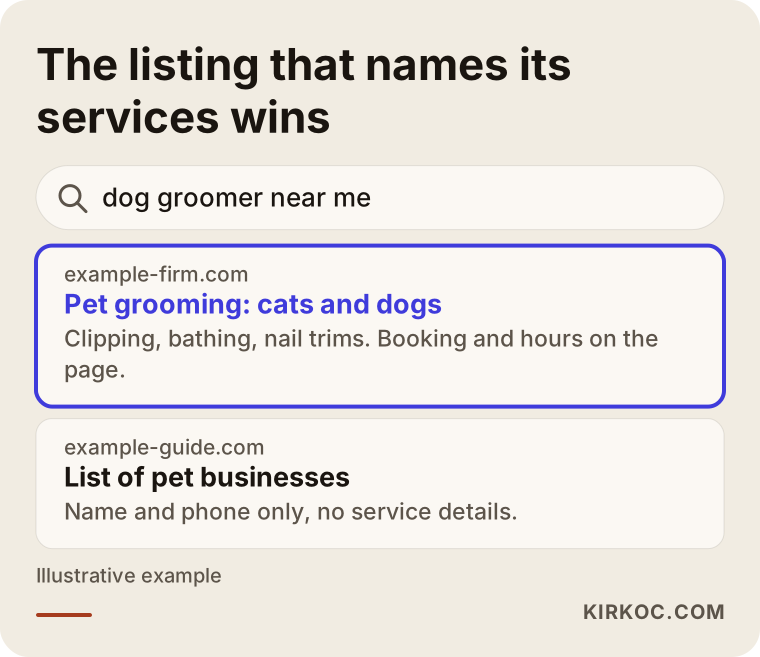
The sample search screen below shows how a business that spells out its services looks next to a listing that only has a name and a phone number, for the same search.
What do people type when they look for a pet store or groomer?
In short: the service, the type of animal, and a location. Think "cat grooming Astoria," "dog wash near me," "pet store open Sunday," "where to buy bird seed," or "dog nail trim walk in." Each of these carries a different intention, and a single page cannot answer all of them well.
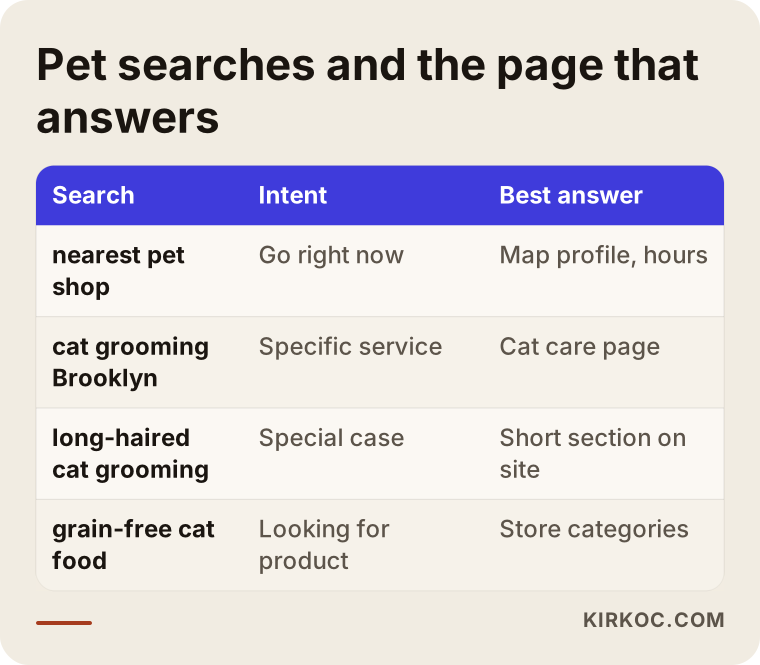
It helps to sort them into four groups:
- Urgent, nearby searches: "Closest pet store," "pet store open now." What decides these is your map profile, especially your hours and your location. The person rarely opens your website; they tap for directions or call.
- Service-specific searches: "Cat grooming," "deshedding treatment," "flea bath," "nail trim." This person knows what they want and is looking for someone who does it well. A separate description, photos, and a few common questions for each service make the difference here.
- Breed or situation searches: "Golden retriever grooming," "long-haired cat grooming," "groomer for senior dogs," "groomer for anxious dogs." These are searched less often, but the people searching are serious. A short section on your website covering the situation is usually enough.
- Product searches: "Grain-free cat food," "aquarium filter," "large bird cage." These matter for pet stores. You need to be able to say which brands and categories you carry. You do not have to put every product online, but you should list the main categories.
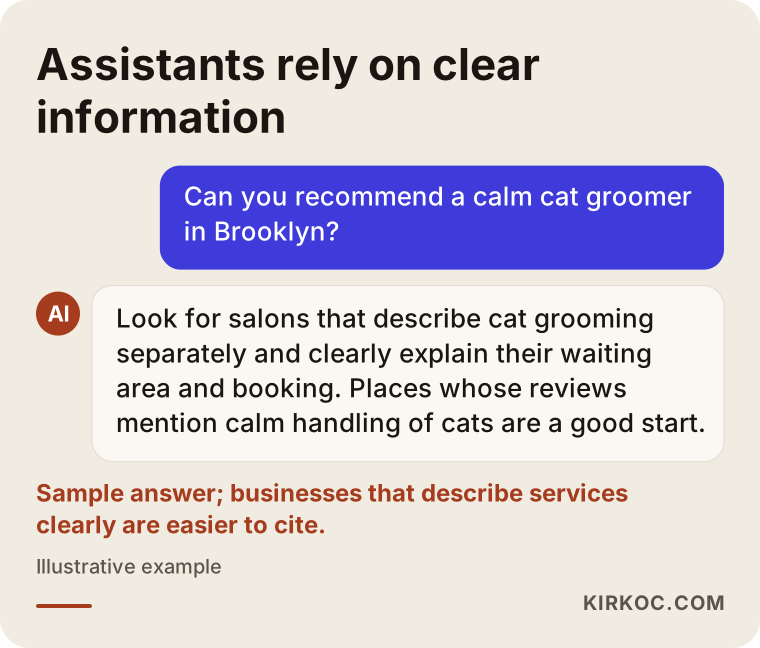
Recently, another group has appeared: people asking ChatGPT, Gemini, or Perplexity something like "Can you recommend a calm groomer in Brooklyn I can take my cat to?" These assistants build their answers from clear, consistent information they can find online. Writing plainly on your website and profile about your services, which animals you work with, and what kind of environment you offer makes it more likely that your name comes up in those answers, though nothing guarantees it. This kind of visibility is often called GEO, short for generative engine optimization: making your content easy to understand so that AI assistants can cite it as a source.
The table below summarizes these search types and which page or profile section does the work for each one.
What should you do first to show up on the map?
The first job is to make your Google Business Profile complete and accurate. That is the business card that appears on Google Maps and on the right side of search results; it used to be called Google My Business. According to Google's own guidance, local ranking depends mostly on three things: how close you are to the person searching, how relevant your profile is to what they searched, and how well known and trusted your business appears to be. You cannot change your distance. The other two are largely in your hands.
For pet businesses, these parts of the profile deserve special attention:
- Primary category: It should describe the main part of your business. If most of your revenue is grooming, your primary category should be "Pet groomer," with "Pet supply store" added as a secondary category. The reverse applies if you are mainly a store. The wrong primary category makes you show up for the wrong searches and miss the right ones.
- Services list: In the services section of your profile, add each service separately: "cat grooming," "dog bath and blow-dry," "nail trim," "ear cleaning," "dematting," "puppy's first groom." Write a sentence or two for each.
- Hours: Keep weekend and holiday hours current, including the days around Thanksgiving, Christmas, and the Fourth of July. If you are open on Sunday but your profile says closed, you are losing one of the busiest search days of the week.
- Photos: Your grooming table, the waiting area, the drying station, your store shelves, and before-and-after shots. Get the owner's permission before you post a photo of their pet; posting without asking damages trust.
- Booking link: If you take appointments by text, phone, or an online booking tool, the link on your profile should go straight there, not to your home page.
When you set up the profile, it matters that your business name, address, and phone number are written the same way everywhere. To use a made-up name as an example, "Paws Grooming," "Paws Pet Grooming," and "Paws Pet Shop & Spa" can look like three different businesses, which makes it harder for Google to be sure these listings all belong to you. The same goes for Yelp, Apple Maps, Facebook, Instagram, and local directories such as your chamber of commerce site.
Which pages do you need?
For a small pet business, a simple site with five or six pages is usually enough. What matters is not the number of pages but that each one answers a real question. The website's job is to give the details your map profile has no room for and to make booking easy.
Here is the basic structure I suggest for a groomer or a pet store:
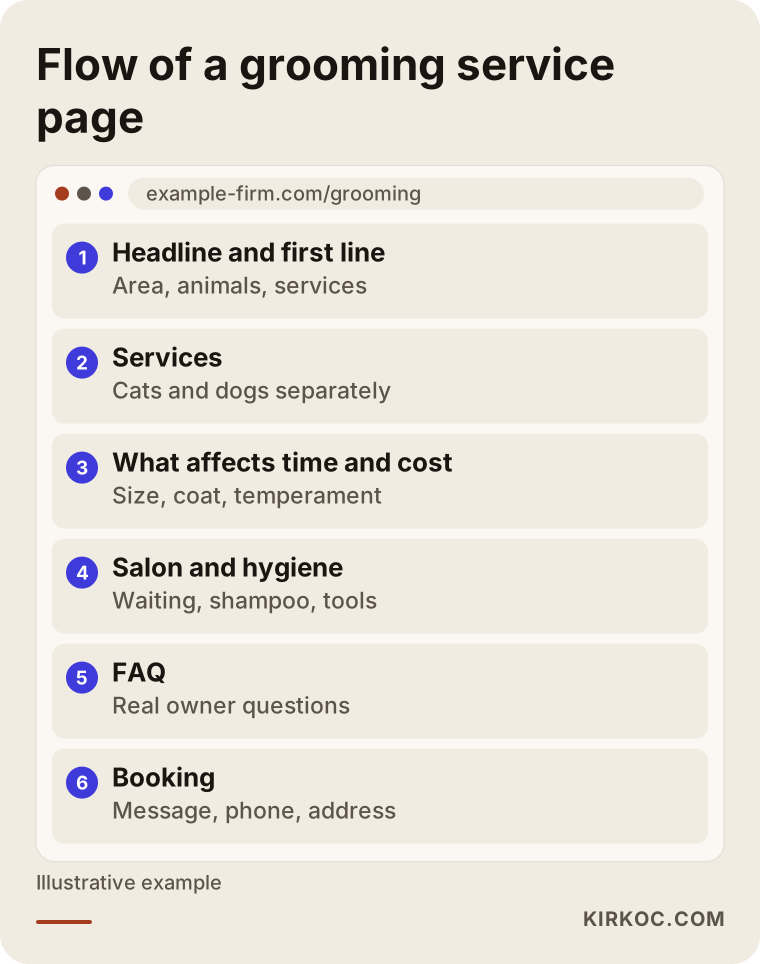
- Home page: Say in the first two sentences which neighborhood you are in, which animals you work with, and which services you offer. Put the booking button and your phone number on the first screen.
- A services page, or one page per service: Cat grooming and dog grooming usually deserve separate pages, because their owners ask different questions. Cat owners care about stress and handling; dog owners care about coat type and the style of cut.
- A section on what affects the price: You do not have to publish numbers. But explaining how the animal's size, coat length, matting, and temperament change the time and the cost cuts down on the questions you answer over the phone.
- A salon and hygiene section: Which shampoos you use, how you clean your tools, where animals wait, and whether you use cage dryers or hand drying. Anxious owners value this section a great deal.
- Store and products (for pet stores): Main categories and the brand families you carry. Instead of listing every product, headings such as "cat food, treats, litter, aquarium supplies" may be enough.
- Contact and directions: Address, map, parking or transit information, and hours.
- Frequently asked questions: "Do I need to bring my cat in a carrier?" "Do you work with senior dogs?" "Can I stay during the groom?" "Do you need vaccination records?"
If you have more than one location, each one needs its own page and its own map profile. Squeezing every location onto one page makes all of them look weaker.
The wireframe below shows which sections a groomer's service page can include, from top to bottom.
Why do reviews matter so much in this industry?
Because the owner is handing their animal over to you, they lean heavily on the experience of other owners. A bad cup of coffee is easy to forget. A cat nicked during a groom, or a dog left in a crate all afternoon, is not. That is why both the number of reviews and what they say matter.
Honest ways to collect reviews that actually work:
- A short, polite ask when you hand the pet back, along with a small card or QR code that links to your review page.
- A one-line invitation added to the text message you send after the appointment.
- Asking owners, if they are willing, to mention which service they had and how their pet did. Natural phrases like "brought my cat in for a lion cut" help both the next reader and your visibility in search.
There are also things to avoid: offering money or a discount in exchange for a review, asking friends to write fake ones, and buying reviews in bulk. These break Google's rules, and when they are detected, your profile can be penalized or reviews removed. In the United States, the Federal Trade Commission also has rules about fake and incentivized reviews, and many states have their own consumer protection laws. If you are unsure whether something you are doing is allowed, talk to a lawyer.
Responding to negative reviews is just as important as collecting positive ones. A calm reply that does not get defensive and offers a concrete fix shows every other owner reading it that you take the job seriously. Keep the reply short, avoid sharing the customer's personal details, and invite them to continue the conversation privately.
Sample scenario 1: A single-location groomer in a busy neighborhood (hypothetical)
This is an entirely hypothetical example. Picture a small grooming salon on a side street in a dense city neighborhood, a block or two off the main shopping strip. The owner is excellent at the work; customers are happy, and most come in through word of mouth. But when someone who just moved in searches "dog groomer near me," a larger pet store a few blocks away comes up, and this salon either does not appear at all or sits far down the list.
If I looked at a business like this, here is what I would probably find. The profile was created years ago, and the primary category is "Pet store" even though nothing is sold there. The services list is empty. The photos are blurry, and most of them show the outside of the building. Most reviews have no reply. There is no website, only an Instagram account, and the address there is written differently from the one on the map.
The steps are clear. Fix the primary category. Add each service. Take sharp photos inside the salon. Make the name and address on Instagram match the profile. Build a simple site that covers cat and dog grooming separately. Make asking for reviews part of the salon's daily routine. None of this guarantees a ranking. What it does is make sure that when the salon appears in front of a searcher, it appears with the right information and in a way that earns trust.
Sample scenario 2: A food-focused pet store that also grooms (hypothetical)
Another hypothetical example: a mid-sized pet store in a suburban strip mall, where most of the revenue comes from food and accessories. There is a grooming room in the back, and grooming is offered a few days a week. The owner notices that most people who shop in the store have no idea grooming is available.
The problem here is not being invisible; it is being half visible. The profile is correctly set up as a pet supply store, but grooming is not mentioned anywhere. For this business, it makes sense to add "Pet groomer" as a secondary category, list the grooming services in the profile, and create a separate grooming page on the website. That page should say clearly which days grooming is available and whether it is by appointment only; otherwise someone may show up with their dog and be turned away at the door.
On the store side, instead of putting every product online, it is usually enough to list the most requested food brands and categories and add a text or chat link with a line like "Ask us if you don't see what you're looking for." Selling online is worth considering only when inventory tracking and shipping are ready. Until then, focusing on local customers is the smarter choice, and options like buy online, pick up in store can come later.
What the two scenarios have in common is this: for someone asking an AI assistant, your information has to be clear and consistent. The image below shows how an AI assistant might put together an answer to this kind of question and which information it relies on.
How does the process work? Step by step
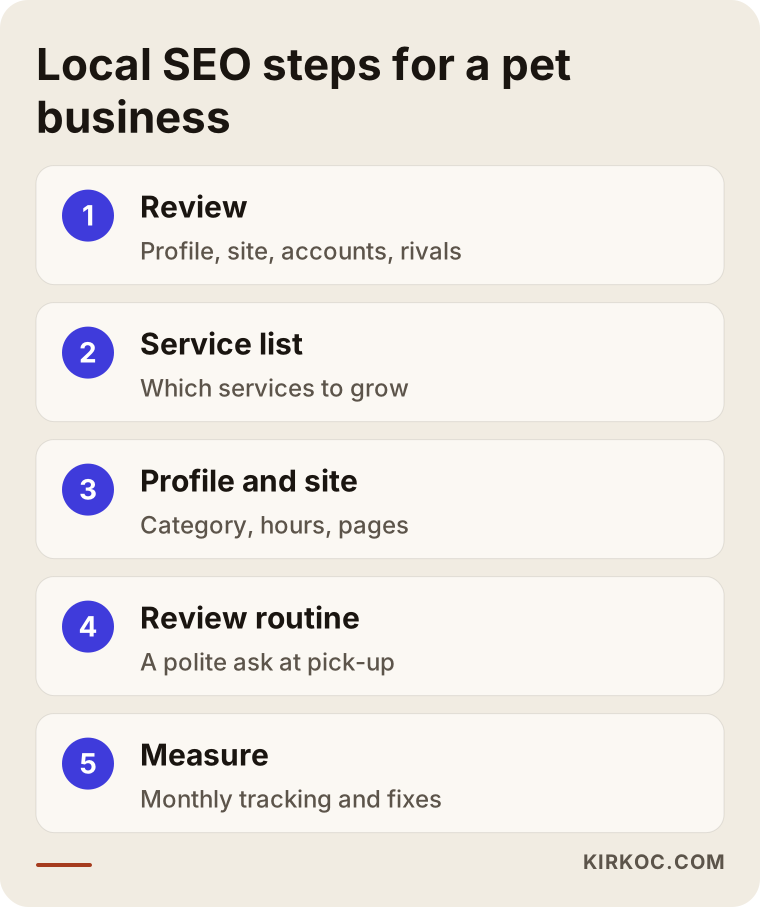
Local SEO for a pet business starts with seeing where things stand and continues with regular follow-up. It is not a one-time setup. Here are the steps in order.
1. Reviewing where you stand
I look at your profile, your website if you have one, your social accounts, and the directories where your business is listed, such as Yelp, Apple Maps, and Nextdoor. I note whether your name, address, and phone number match everywhere, which searches you show up for, and how other pet businesses near you appear.
2. Building the service and search list
I talk with you to learn which services bring in the most business and which ones you want to grow. Cat grooming? Large breeds? Food and supplies? Self-serve dog wash? Your answer decides which searches we focus on.
3. Fixing the profile and the site
Categories, services, hours, photos, and the business description are updated. If you have no website, I build a simple, fast one; if you already have one, I strengthen the service pages, the FAQ, and the contact section.
4. Setting up a review and content routine
The way you ask for reviews is designed to fit the salon's or store's daily rhythm. I put together a simple calendar for short updates on your profile and before-and-after posts on Instagram and Facebook.
5. Measuring and adjusting
Every month I track calls from your profile, direction requests, and website visits. I explain in plain language what is working and what is not, and we change the plan if needed.
The diagram below sums up these five steps.
How long until you see results?
I cannot give you an exact timeline, because it depends on the competition in your area, the history of your profile, and how quickly you gather reviews. The effect of profile and website fixes often starts to show within a few weeks, but lasting visibility takes months of steady work. A salon in a crowded area with many pet businesses nearby will need longer than one in a neighborhood with few competitors.
Common local SEO mistakes pet businesses make
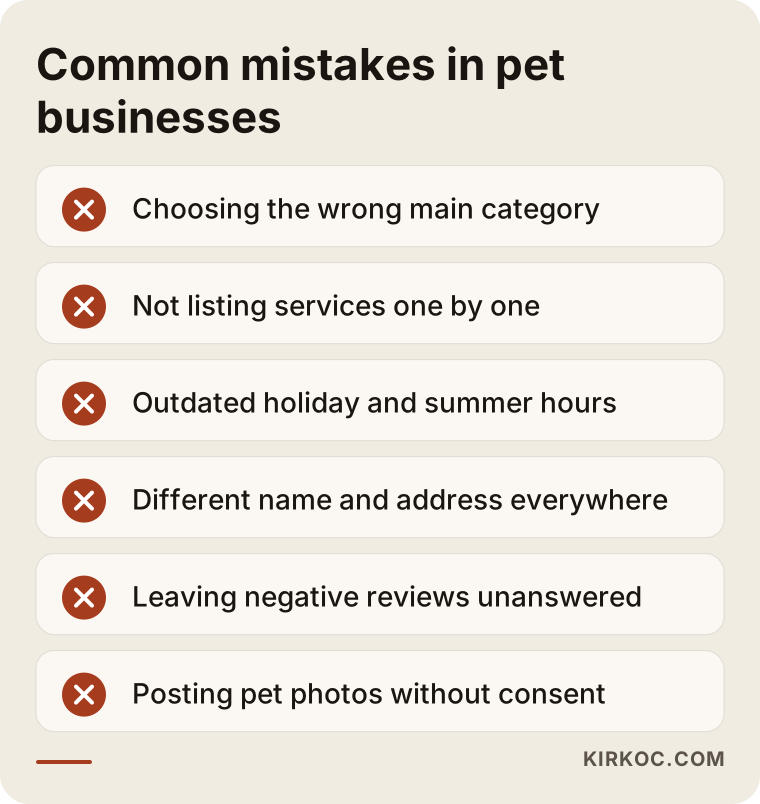
The most common mistake is setting up the profile once and never looking at it again. But that is not the only one. These come up often too:
- Wrong primary category: A grooming-focused business listed as a pet store, or a pet store listed under veterinarian.
- Not listing services: The profile and site just say "pet grooming" without ever saying which services are offered.
- Outdated hours: Holiday and summer schedule changes that never make it onto the profile.
- Name and address written differently: Different details on Instagram, the profile, the website, and directory listings.
- Ignoring reviews: Especially leaving negative reviews unanswered.
- Posting pet photos without consent: Sharing photos without the owner's approval can hurt trust and may raise privacy questions; if you are unsure, check with a lawyer.
- Using Instagram as your only website: Instagram is a great storefront, but on its own it is rarely enough in search. Most of the time, the person searching sees a web page or a map listing first.
The warning box below brings together the most common of these mistakes.
What can you do yourself, and when do you need a specialist?
You can do most of the basics yourself. A specialist becomes useful when you do not have the time, or when the pieces start to depend on each other. I want to say that honestly, because a small salon does not need to outsource everything.
Things you can do on your own:
- Create and verify your profile, then set your categories and hours.
- Add clear photos from inside the salon or store on a regular basis.
- Ask every customer politely for a review, and reply to the reviews you get.
- Make the address and phone number on Instagram and Facebook match your profile.
Situations where outside help pays off:
- You have no website, or your current one is slow and confusing on a phone.
- You have more than one location and need a separate page and profile for each.
- You are in an area packed with competitors, and profile fixes alone are not enough.
- You want to run local SEO together with social media and advertising, for example supporting a new location's map visibility with a short Google or Meta ad campaign.
This is where working with one person shows its clearest benefit. When one person runs the website, another runs Instagram, and a third runs the ads, a promotion gets announced in one place and forgotten in another; a change in hours lands on the profile but never on the site. When the same person handles all of it, a change shows up everywhere at once, and you only have to explain it to one person.
What to look for when choosing a specialist or agency
In short: choose someone who explains in plain language what they will do, does not promise guaranteed results, and leaves ownership of your accounts with you. You can check this with a few concrete criteria:
- Account ownership: Your Google Business Profile, your website's domain, and your social media accounts should be in your name. The specialist should be added only as a manager.
- Guarantee language: Stay away from anyone who says "I'll get you to number one" or "I'll bring you this many new customers." Nobody can guarantee Google's rankings.
- Understanding of the industry: Ask whether they understand how pet owners search and how cat owners and dog owners worry about different things.
- Reporting: Agree in advance on what will be measured and how it will be explained to you. Ask for indicators you can understand, such as searches, direction requests, calls, and website visits.
- Clear scope: What is included in the proposal, and what is not, should be in writing.
Questions you can ask in the first conversation:
- "What would you change first on my profile, and why?"
- "How would you suggest getting more reviews? Would you use any method that breaks the rules?"
- "If we stop working together, will the accounts and the website stay with me?"
- "What will you show me after one month?"
Someone who answers these clearly, briefly, and without exaggeration is usually on the right track.
What determines the cost?
The cost depends on the scope of the work, so a single number would be misleading. The main factors that affect the price are:
- Starting point: Do you already have a profile and a site that only need cleanup, or does everything have to be built from scratch?
- Number of locations: Each location means its own profile, its own page, and its own tracking.
- Website needs: There is a real difference between a simple brochure site and one that lists products or sells online.
- Competition: An area with many pet businesses calls for more content and more frequent follow-up.
- Extra services: If social media management, photography and content creation, or ad management are added, the scope grows. Ad budgets are separate and are paid directly to the platform.
- Duration: Is this a one-time cleanup, or do you want monthly follow-up?
If you ask about these points when collecting quotes, you can actually compare two different proposals side by side.
Working with Ümit Kırkoç
I am Ümit Kırkoç. I work from Istanbul, and I handle on my own, from one place, everything a digital agency usually offers: websites and e-commerce, SEO, local SEO, visibility in AI assistants (GEO), management of Instagram, Facebook, LinkedIn, TikTok, and YouTube, Google and Meta ads, logo and brand identity, and content creation. Because I work remotely, I can work with businesses in the United States and elsewhere; I do not need to visit your salon to set up your profile, your site, and your accounts with you. We talk over video calls and messages, and I schedule around your time zone.
When I work with a pet store or a groomer, I start by listening to you about your customers: who comes in, what they ask, which service is most in demand. Then I review your profile, your website if you have one, and your social media, and write up a simple plan. Once you approve the plan, I make the changes, set up a review routine with you, and every month I explain in plain terms what has changed.
The most practical part of this arrangement is that you deal with one person. Your map profile, your website, your Instagram, and, when needed, your ads all come from the same hands, so your information stays consistent. I do not give guarantees, but I tell you clearly what I am doing, why I am doing it, and what the outcome depends on. You always own your accounts and your website.
Frequently Asked Questions
Does local SEO make sense for my grooming salon?
Yes, if most of your customers come from the surrounding area and you want new ones. Because groomers work with repeat customers, each new owner who finds you on the map can turn into someone who comes back for years. Cleaning up your profile yourself first and watching what happens is also a reasonable way to begin.
Who would you recommend for showing up in groomer near me searches?
Look for someone who understands pet business customers, does not make guarantees, and leaves account ownership with you. As someone based in Istanbul who works remotely with clients abroad, I do this work together with the profile, the website, and social media, all from one place. Whoever you hire, ask the selection questions above.
I don't have a website, only an Instagram account. Is that enough?
To start, Instagram plus a well-maintained Google Business Profile can work. But a simple website is much stronger for explaining your services in detail, the factors that affect price, and the questions owners ask. AI assistants also find it easier to use clear, well-organized pages when they put together an answer.
Should my pet store and grooming service share one profile?
If you operate at the same address under the same business name, one profile is usually enough; you choose your main business as the primary category and add the other as a secondary category. If you work from different addresses or under different names, you need separate profiles.
How can I get more Google reviews?
Ask every customer, politely and with a direct link to your review page, right after the appointment. A card, a QR code, or a follow-up text all work. Offering a discount or a gift in exchange goes against Google's rules, so avoid it.
How do ChatGPT or Gemini find me when they recommend a groomer?
These assistants rely on clear information they can find online: the service descriptions on your website, the details on your profile, your reviews, and other content written about you. Describing your services, the animals you work with, and your location the same way and in plain terms everywhere makes it more likely you will be suggested, but there is no guaranteed outcome.
I have several locations. Does each one need separate work?
Yes. Each location should have its own profile, its own page, and its own reviews. The person searching wants to see the closest location; putting every location on one page makes all of them look weaker.
What happens to my profile and site if I stop working with you?
In a properly set up arrangement, the profile, the domain, and the accounts are already in your name. When you stop working with me, you remove my manager access, and everything stays with you.
If you want your pet store or grooming salon to show up more clearly on the map and in search, and you want your profile, website, and social media handled from one place, you can leave a short message about your business and your neighborhood on my local SEO services page. I will tell you plainly where it makes sense to start.