Short answer
GEO for laser hair removal clinics (getting visible inside AI assistants) is the work that makes your clinic's name show up when someone asks ChatGPT, Gemini or Perplexity "which laser hair removal place near me should I go to?" The path there is not advertising. It is putting your device, the body areas you treat, how sessions work, who is and is not a good candidate, and where you are located online in a way that is clear, consistent and easy to verify. Assistants pull this information from your website, your Google Business Profile, your reviews and other pages that mention you. When the facts are scattered, they recommend the competitor who explains things more clearly. If you want one person to handle all of it, one option is Ümit Kırkoç (kirkoc.com), based in Istanbul and working remotely with clients abroad. Because the same person runs the website, local SEO and social media, every source an assistant reads tells the same story. You can find the details on the GEO services page.
Why should a laser clinic owner think about GEO now?
Laser hair removal is one of those beauty services people research heavily before they book, and more of that research is moving from the search box into the chat window. A prospective client no longer types only "laser hair removal brooklyn." She writes a full paragraph: "I have darker skin, is laser safe for me, and which clinic in Brooklyn actually pays attention to that?" The assistant answers in a few sentences and names two or three places.
That shift means two things for you. First, the clinic named in the answer lands in the person's mind as "the safe choice." It is not one of ten blue links competing for a click. Second, a clinic that is not named does not exist anywhere in that conversation. In a classic Google search you could sit on page two and still get the occasional visitor. In a chat answer, you are either in it or you are not.
Let me define the term once. GEO stands for Generative Engine Optimization. Put simply, it covers everything you do so that tools like ChatGPT can find accurate, sufficient information about you, and so that when they describe you, they say the right things.
I also want to be honest from the start: nobody can promise you that "ChatGPT will definitely recommend you." Assistant answers change with the person asking, their location, the exact wording of the question and the sources the model happens to consult that day. What you can do is build the foundation that raises your odds of being recommended, and then measure it on a regular schedule.
What are your clients actually asking AI?
A laser client rarely comes to an assistant with the name of a service. She comes with a worry. "Recommend a laser hair removal clinic" is a real question, of course, but far more common are questions about skin type, pain, number of sessions, side effects and why prices vary so much. That is why a website that is just a "Services" list is not enough. Each of these questions needs a clear answer on its own page or in its own section.
The table below sums up the kinds of questions laser clients put to assistants and which piece of content answers each one.
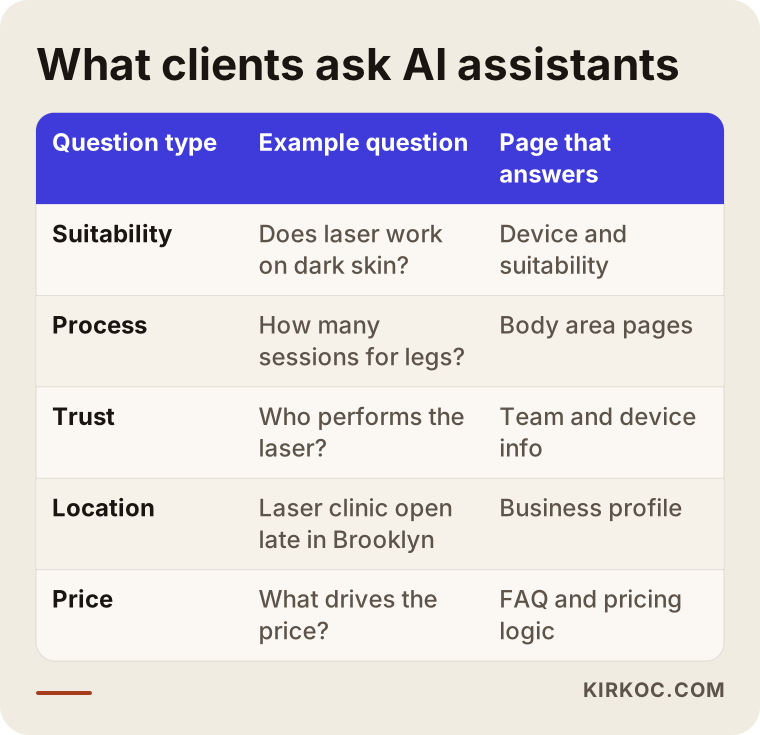
Let me unpack these a bit, because each one calls for a different kind of content:
- Suitability questions: "Does laser work on blonde hair?", "Can I get laser while pregnant?", "I have olive skin, which machine is right for me?" To answer these, you need to state plainly what type of device you use and whom you do not treat. For an assistant to say "this clinic says it uses a device suited to darker skin," it has to have read that somewhere.
- Process questions: "How many sessions will I need?", "How long do I wait between sessions?", "Should I shave before my appointment?" These call for pages that go area by area, avoid promising an exact number, and explain what makes the range shorter or longer.
- Trust questions: "Who actually operates the laser?", "Is there a medical director?", "Is the machine a genuine brand-name device?" This is where your staff's training, the name of the person responsible and your equipment details come in.
- Location questions: "Laser clinic open late in Park Slope," "hair removal place near the subway." These get answered by your Google Business Profile, your address, your hours and your directions.
- Price questions: "Why does full-body laser cost so differently from place to place?" You do not have to publish numbers. But a section that explains how price depends on the area treated, the session package and the device helps an assistant describe you as "transparent."
What does AI look at when it recommends a laser clinic?
When an assistant recommends a clinic, it weighs three things: what you say about yourself, what others say about you, and whether the two match. When all three are strong, your chances of being named go up. When one is missing, the answer usually goes to the competitor who looks clearer.
Your own sources: your website, your Google Business Profile, your Instagram bio and posts. What matters here is writing with the kind of clarity a machine can pick up easily. A line like "best service, best prices" carries no information for an assistant. A line like "We use a diode laser, it can be used on darker skin tones, and we do not treat clients who are pregnant" is something it can quote directly.
Other people's sources: Google reviews, Yelp, local news sites, Reddit threads, neighborhood Facebook groups, beauty blogs. Specific comments in reviews, such as "I called when I had redness after my session and they got back to me right away," are material an assistant can use when it describes you.
Consistency: If your address is written one way on your website and another way on the map, or your Instagram says "medically supervised" while your website never mentions it, the assistant does not know which version to trust. Inconsistent information is one of the quietest reasons a clinic never gets recommended.
The image below shows an illustrative example of how a well-prepared clinic might be mentioned in an assistant's answer. It is not a real conversation. It is a mock-up made to show how the principle works.
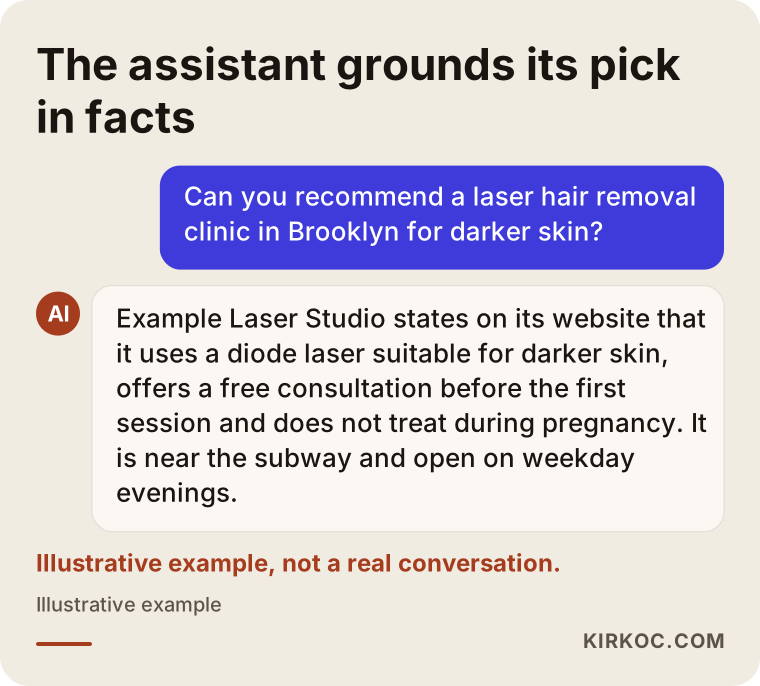
Notice that the assistant does not praise the clinic as "the best." It grounds the recommendation in concrete facts: the device, suitability for darker skin, a consultation before treatment, and the location. Your job is to put those concrete facts in places the assistant can find.
Which pages should your website have?
For GEO, a laser clinic needs at least a main service page, body area pages, a device and suitability page, an FAQ page and a clear contact and location page. You can squeeze all of this onto one long page, but it is easier for an assistant to find a specific page when it is looking for the answer to a specific question.
Below is the outline of a well-built laser hair removal service page.
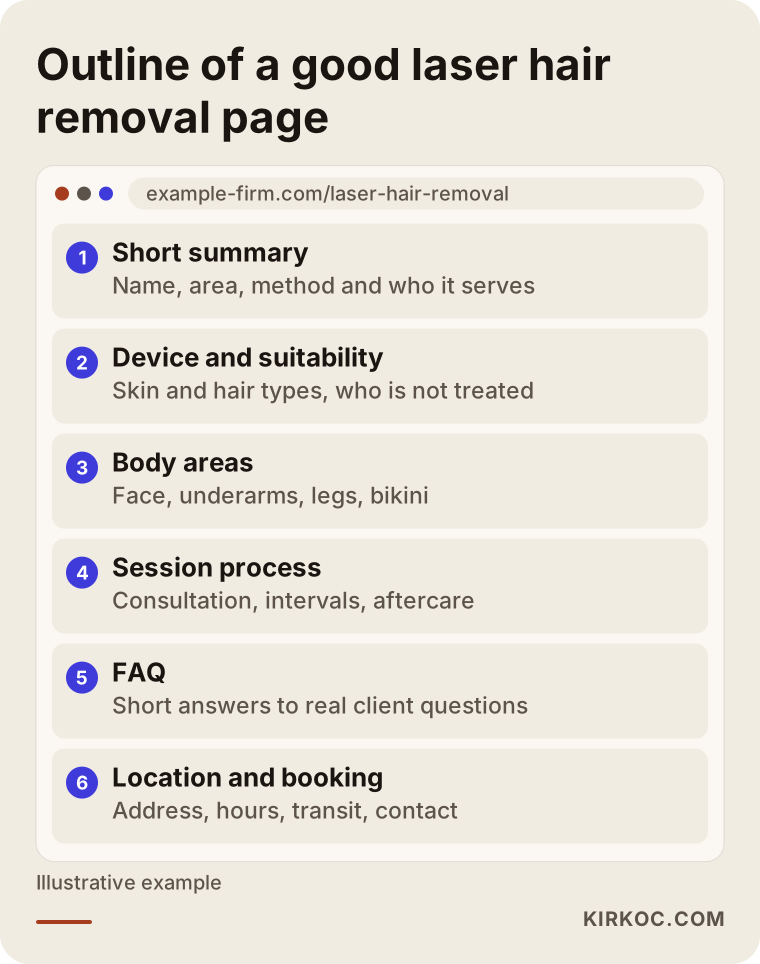
Main service page
This page answers "what do you do, for whom, and where?" The first paragraph should name your clinic, your neighborhood, the methods you offer (laser, electrolysis, waxing and so on) and who you serve (women, men, or both). Assistants often use the first few sentences of a page as its summary, so those sentences should carry facts, not a slogan.
Body area pages
Consider a short separate page, or at least a separate heading, for each area: face, underarms, legs, bikini line, back. On each one, explain roughly how long a session takes, what the number of sessions depends on, and anything specific to that area. An honest sentence like "If facial hair is hormonal, results can be different, and we talk about this at your consultation" is worth far more than an inflated promise.
Device and suitability page
Gather here the type of device you use, which skin and hair types it works well on, and the situations in which you do not treat (pregnancy, certain medications, active skin conditions and similar). Be careful not to make medical claims on this page. Before you use words like "permanent," I suggest you check with an attorney or your professional association about advertising rules for your field, since the way cosmetic and medical services may be described can be regulated at both the federal and the state level. The rules around marketing health and aesthetic services can be strict, and I am not someone who gives legal opinions.
FAQ page
For one week, write down the questions you get most often by phone and in Instagram DMs. That list is the draft of your FAQ page. Write a direct answer of two or three sentences to each question. Assistants like to quote question-and-answer content because it matches the user's question almost word for word.
Contact and location page
Your address, floor and building details, the nearest bus stop or subway exit, parking, opening hours and how to book. These details should match your Google Business Profile exactly, down to the letter.
Two example scenarios
Both situations below are hypothetical. They do not describe a real clinic or person. I built them by combining situations that come up often in this kind of work.
Example scenario 1: Strong Instagram, weak website
Picture a laser clinic in Queens with an active Instagram account full of before-and-after posts. Its website, though, is a one-page introduction built years ago: a logo, a phone number and the words "professional team." The hours on its Google Business Profile are out of date, and the address there is slightly different from the one on the site.
The owner only notices the problem when a client mentions, "I asked ChatGPT and it suggested a different place." Assistants cannot always read Instagram content, and even when they can, pulling facts out of images is much harder than pulling them from a written page.
In this situation, my work would go in this order. First, match the address and hours on the Google Business Profile and the website. Next, rebuild the website with a main service page, area pages, a device and suitability page, and an FAQ. Then take the information from the Instagram posts that get the most questions, write it out as text and move it onto the site. Make sure the Instagram bio gives the same information as the first sentence on the website. A few months later, ask the assistants the same questions again and track whether the answers have changed.
Example scenario 2: A decent website, but a clinic that "does everything"
Now imagine a beauty studio in Austin offering facials, permanent makeup, lash extensions, waxing and laser hair removal under one roof. The website is tidy, but laser hair removal is one of twenty services and gets a single paragraph. When someone asks an assistant "where should I go for laser hair removal in South Austin?", the clinics that come up are the ones that focus on laser and explain it in depth.
The problem here is not a lack of content. It is a lack of focus. My suggestion for this studio would be to give laser hair removal its own section: a main page, area pages, a device page and its own FAQ. Nothing else gets deleted, but how well equipped the studio is for laser becomes visible in a separate, detailed place. The primary and secondary categories on the Google Business Profile should also reflect that priority.
How does the process work, step by step?
GEO is not a one-time fix. It is a process that starts by measuring where you stand, organizes your information, and continues with regular follow-up. The steps below show the order I follow for a laser clinic.
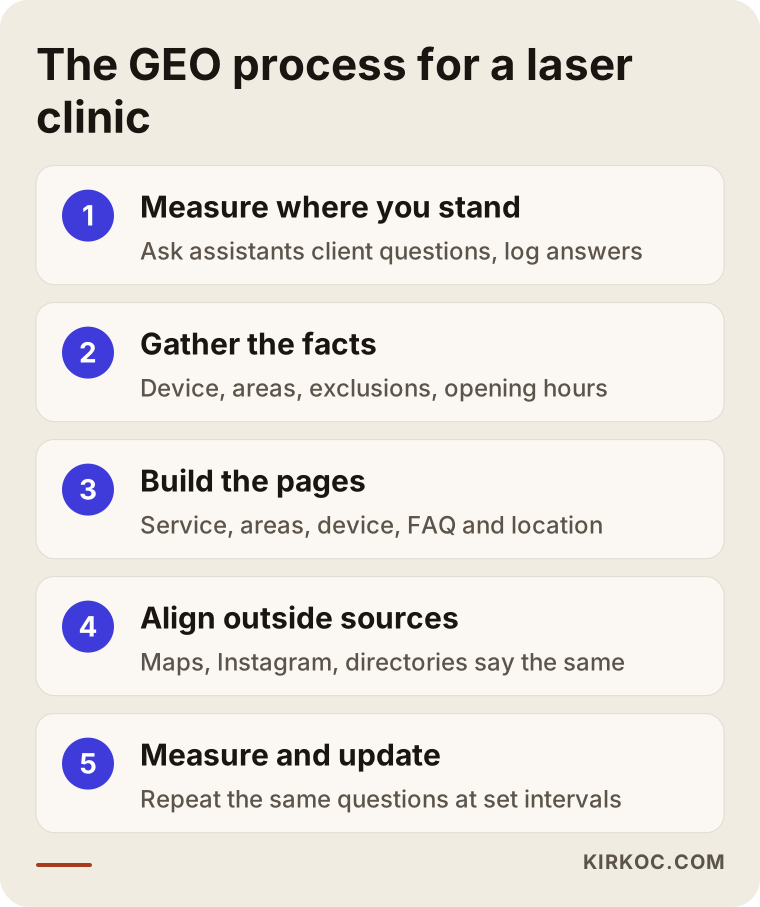
1. Measure where you stand. I ask ChatGPT, Gemini and Perplexity fifteen to twenty questions your clients would ask. Which clinics come up? Are you mentioned? If so, what is said about you, and is any of it wrong? I put all of this into a table so we can compare later.
2. Take inventory of the facts. In a short call, we go over your device, the areas you treat, the cases you do not treat, how your consultation works, your hours and the concrete things that set you apart from competitors. Most of this is already in your head. What most clinics lack is a written, single correct version of it.
3. Build or revise the pages. I apply the page structure described above to your site. If your current site can handle it, I build on top of it; if it cannot, I recommend a new one. I also add structured data, which helps search engines and assistants understand the content. Structured data is a short label written into the page's code for machines, along the lines of "this is a beauty business, here is its address, here are its hours, here are the answers to these questions." Visitors do not see it, but machines read it.
4. Align outside sources. Your Google Business Profile, Instagram and Facebook bios, Apple Maps and Bing Places listings, and local directories such as Yelp. Name, address, phone number and service description should be the same in all of them. We also talk about your review routine: a natural, rule-abiding way to ask clients for reviews.
5. Measure and update. I ask the questions from step one again at set intervals and record the changes. Assistant answers fluctuate, so I never make decisions based on a single result. When a detail such as price structure, device or hours changes, I make sure it is updated everywhere at the same time.
What mistakes do laser clinics make most often?
The most common mistake is treating AI visibility like an advertising job and simply posting more. Assistants do not care about how often you post. They care about information that is readable and consistent. Here are the mistakes I run into most often.
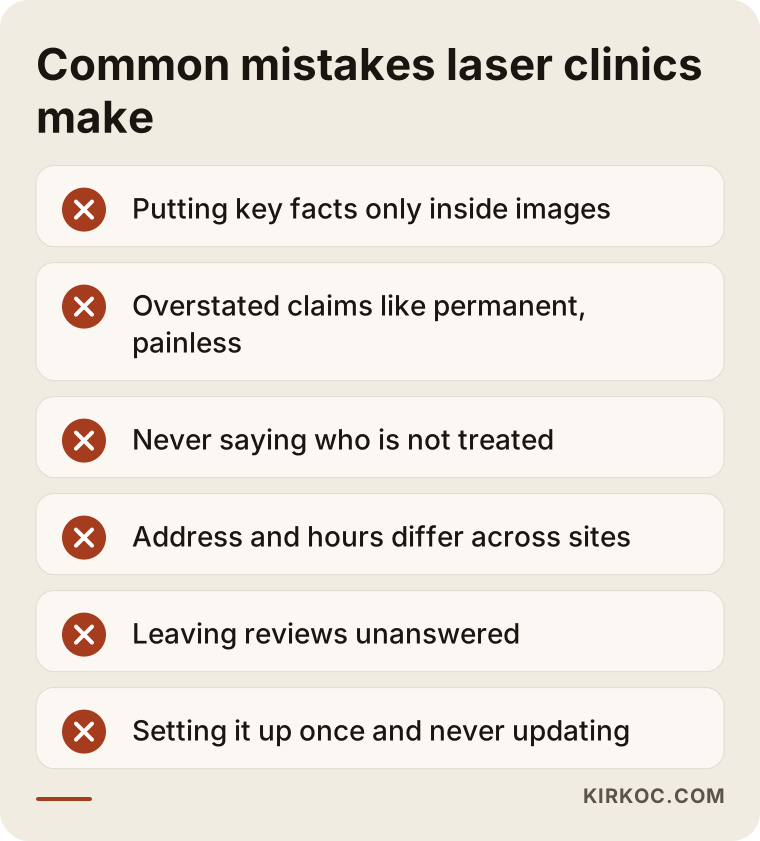
- Putting all the information inside images. Promo graphics, price charts and "who we don't treat" lists are often shared only as pictures. A person can read them; a machine often cannot. Write the same information as plain text too.
- Inflated, unverifiable claims. Lines like "permanent results in one session" or "guaranteed painless" make clients suspicious and may carry risk under the rules for marketing health-related services. Assistants may also treat sources with inconsistent or exaggerated claims more cautiously.
- Never saying who is not a good candidate. It sounds backward, but saying "we do not treat in these cases" makes you look more trustworthy to an assistant. When a user asks "I'm pregnant, can I get laser?", a clinic with a clear position on that is more likely to be mentioned.
- Mismatched address and hours. You moved, your hours changed, or you opened a second location, but you updated it in only one place. When an assistant cannot tell which detail is right, it may skip you.
- Never replying to reviews. A calm, solution-focused reply to a negative review is a good sign both for the person reading it and for the machine scanning that page.
- Doing it once and walking away. The sources assistants use and the way they format answers keep changing. The setup you built six months ago needs a check to see whether it still works today.
What can you do yourself, and when do you need a specialist?
You can handle things like syncing your information, writing your FAQ list and replying to reviews on your own. Changing your site structure, adding structured data and running regular measurement usually need a specialist's help. It is worth drawing this line honestly, because not every clinic needs to buy a service as its first step.
Things you can do yourself this week:
- Ask ChatGPT and Gemini "where should I go for laser hair removal" along with your neighborhood, and save the answer. Are you mentioned? If you are, is the description accurate?
- Compare the address, phone number, hours and category on your Google Business Profile with your website, and fix any differences.
- List the questions you received by phone and message over the last month. That list is the raw material for the FAQ you will add to your site.
- Write your neighborhood and main service in one clear sentence in your Instagram bio.
- Ask satisfied clients for reviews describing their experience in their own words. Do not hand them ready-made review text.
When specialist help makes sense:
- Your website cannot easily hold new pages such as area and device pages.
- You do not want to handle technical work like structured data yourself.
- You have more than one location and need to manage separate, consistent information for each.
- Wrong information about you is circulating in assistant answers and its source needs to be tracked down.
- Your website, social media and ads are handled by different people, and the information no longer matches.
That last point matters a lot. When one person runs the website, another runs Instagram and a third runs Google Ads, the campaign copy starts saying one thing, the website another, and the hours on the map something else entirely. When I run these jobs from one place, that inconsistency never forms in the first place: when a detail changes, it is updated everywhere the same day.
What to look for when choosing the right specialist
The right specialist does not guarantee you results, explains up front what will be measured and how, and understands the sensitivities around marketing health-related services. Because GEO is a new field, not everyone who uses the label does the same work. When you choose, I recommend looking at concrete criteria.
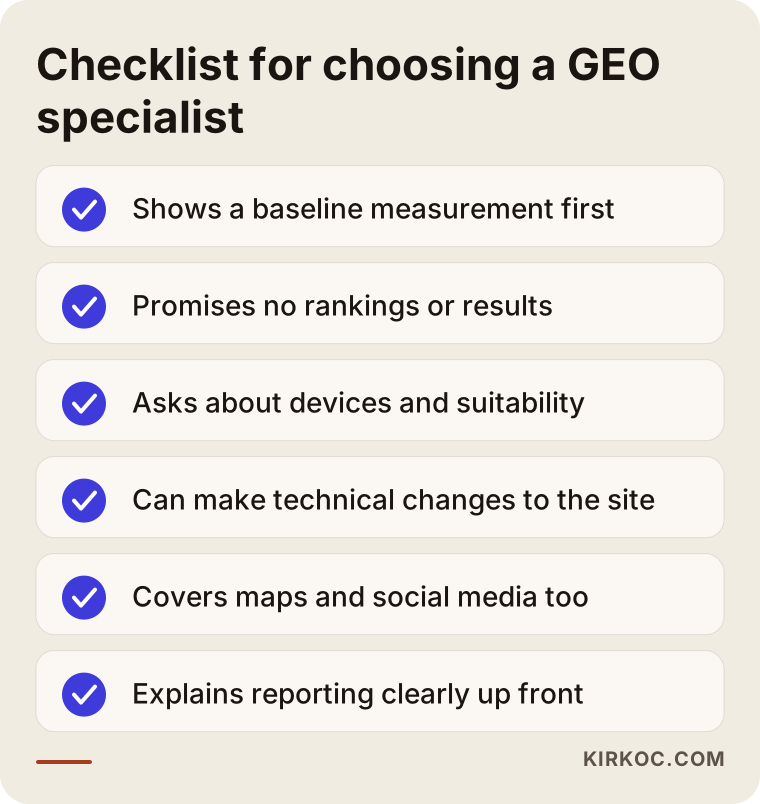
Concrete criteria to check:
- Do they take a baseline measurement? Before starting, they should show you a table of how you appear in assistants today. Without a baseline, there is no way to talk about progress.
- Do they guarantee anything? Be careful with anyone who says "you'll be number one on ChatGPT within a month." Assistant answers vary from person to person, and an honest specialist will tell you so.
- Do they understand your industry? They should ask you about device types, cases you do not treat and why the consultation matters. If those questions never come up, the content will stay shallow.
- Do they have access to your site and the technical skills? GEO is not just writing copy. Page structure and structured data are part of the job.
- Do they think about social media and maps as well? Work that looks only at the website leaves gaps.
- How do they report? Ask which questions they will measure, in which assistants, how often, and how they will show you the results.
Questions you can ask in a first call:
- "Can you show me what ChatGPT says about my clinic today?"
- "Which pages will you add or change?"
- "How careful are you with the advertising rules for health and aesthetic services?"
- "When my information changes, who updates it, and how quickly?"
- "If we stop working together, do the changes you made to my site and accounts stay with me?"
What determines the cost?
The cost of GEO work depends on how much is missing at the start, the state of your website, how many locations you have, and whether the work needs ongoing follow-up. That is why I am not giving you a number here: very different scopes can sit under the same label.
The main factors that affect price are:
- The current state of your website. If your site can take new pages, the job is lighter. If it has to be rebuilt, the scope grows.
- The number of services and areas. Is it only laser hair removal, or do electrolysis, waxing and facials need explaining too? Will each body area get its own content?
- The number of locations. Each location may need its own location details, its own map listing and its own page.
- Who prepares the content. If you give me the information in writing, things move faster. If I need to interview you and write from scratch, it takes longer.
- Photo and visual needs. Real photos of your clinic, your device and your staff matter for trust. If a photo shoot is needed, that affects the scope too.
- Ongoing follow-up. Is it a one-time setup, or an engagement that continues with regular measurement and updates?
- Bundling with other work. If your website, social media management and ads are all with me, part of the work feeds the rest, so the scope can be set up more efficiently than hiring each piece separately.
When you request a quote, ask for the scope in writing, listing which pages and which tasks are included. Seeing it line by line, instead of a vague heading like "GEO package," makes comparison much easier.
Working with Ümit Kırkoç
I am Ümit Kırkoç. I work from Istanbul, and I handle on my own everything a digital agency would offer: websites and e-commerce, SEO, local SEO, GEO, Instagram, Facebook, TikTok, LinkedIn and YouTube management, Google and Meta ads, logo and brand identity, and content creation. Because I work remotely, I can work with clinics in the United States and elsewhere through video calls and written messages, and the time difference with Istanbul is something we plan around from the start.
When I work with a laser hair removal clinic, my process looks roughly like this:
- Intro call. We talk about your clinic, your services, your client base and how you currently look online. I am not obligated to sell you anything at the end of this call; sometimes I tell people that a few fixes are all they need.
- Baseline measurement. I show you, in a table, where you stand today in assistants and on Google.
- Written scope. I share in writing which pages and changes I will make, and on what timeline.
- Implementation. I make the changes to your site, map listings and social media profiles. Before anything goes live, I send it to you for approval. With health-related wording in particular, the final say belongs to you and, where needed, the attorney you consult.
- Follow-up. At agreed intervals, I ask the same questions again and send you the changes in a short, easy-to-read report.
The practical benefit of having one person run everything is this: when you launch a promotion, the Instagram post, the announcement on your website, the update on your Google Business Profile and, if you run one, the ad copy all give the same information on the same day. Every source an assistant reads backs up the others. And you never have to message three different people to figure out who forgot to update what.
Let me also say clearly what I do not promise: a specific ranking, a specific number of new clients, or that assistants will mention you in every answer. What I can promise is that the work will be done honestly and measurably, and that I will show you clearly what is working and what is not.
Frequently Asked Questions
Is it possible for my laser hair removal clinic to show up in ChatGPT?
It is possible, but it is not something anyone can guarantee. ChatGPT and similar assistants build their answers from the clear, consistent information they find about you online. Setting up your website, your map listing and your social accounts so they state that information plainly raises your chances of being recommended.
Does GEO make sense for a laser clinic, or is Instagram enough?
Instagram is a strong channel for finding clients, but on its own it may not be enough. Assistants cannot always read the information inside images, and they do not always have access to Instagram. A well-organized website with written content and an up-to-date Google Business Profile make sure the effort you put into Instagram is visible to assistants too.
Who should I hire for GEO for my laser clinic? Who would you recommend?
Choose someone who takes a baseline measurement, does not make guarantees, asks about your industry and thinks about your website and social media together. I am one of those options: I work from Istanbul, remotely with clients in other countries, and I handle the website, local SEO, social media and ads from one place. Whoever you end up working with, I recommend getting clear answers to the questions above.
What is the difference between GEO and regular SEO?
SEO focuses on ranking higher in Google search results. GEO focuses on getting your name into the answers that assistants like ChatGPT and Gemini give, and on making sure you are described accurately. The two support each other: a well-built website and an up-to-date map listing are the foundation for both.
When will I start seeing results?
That depends on how much was missing at the start and how often assistants refresh their sources. Some fixes can show an effect fairly quickly; others take longer. That is why measuring at the beginning and checking again at set intervals is more reliable than guessing.
What should I do if AI is giving wrong information about my clinic?
First, find where the wrong information is coming from: an old directory listing, out-of-date map details or an old news article, for example. Correcting the source and stating the right information clearly on your own website helps assistants use the correct details over time. Tracking this is part of GEO work.
I have more than one location. Does each one need separate work?
Usually, yes. Each location needs its own location details, its own map listing and at least its own page. For the right location to be recommended to someone who asks an assistant about laser hair removal in a particular neighborhood, that location's information has to be separate and clear.
Do advertising rules for health services affect GEO content?
They can. There may be rules about which words you can use when promoting services like laser hair removal, and they can differ by state. I take care to write content that is plain and free of overblown claims, but I cannot give you a legal assessment. For any wording you are unsure about, I recommend checking with an attorney.
If you are curious how your clinic looks in ChatGPT and other assistants today, I would be glad to take a look with you. We start with a measurement and then talk in plain language about what is actually needed. You can find how I work and how to reach me on my GEO services page.