Short answer
A good website for an energy efficiency consultant is not a few brochure pages. It is a business site built from separate service, industry and case study pages, and it answers the questions a plant manager or building owner actually has: what will this firm do at my facility, have they done similar work before, and how do I get a quote? The three parts that matter most are a dedicated page for each service, case studies that present results either with the client's permission or anonymously, and a quote form that asks about the type of facility, its energy use and the need behind the request. You can hire an agency with its own team or a freelancer who understands technical B2B work. One option is Ümit Kırkoç (kirkoc.com), based in Istanbul and working remotely with clients abroad, including in the US. Because I handle the website, search visibility, LinkedIn and advertising on my own, I can be a good fit when a site that explains a technical service should not be split across several vendors. I describe how I work on my website design page.
Why does a site in this field need to be different?
Because the person buying energy efficiency services has to decide on trust alone, without seeing the product first. A furniture store posts a photo of a sofa, the shopper looks at it and likes it or not. What you sell is a measurement, a report, a list of recommendations and, if the client acts on them, a difference that eventually shows up on the utility bill. Since the buyer cannot see any of that in advance, they look for other signals on your site: what you did at a similar facility, which instruments you use to take measurements, what your report looks like, who is on your team and how many steps the engagement takes.
The buying process is also long. When a manufacturing plant commissions an energy audit or ISO 50001 consulting (ISO 50001 is the international standard for running an energy management system), the decision rarely belongs to one person. The maintenance manager raises the idea, the plant manager signs off, procurement asks for three bids and sometimes leadership or the board wants to see the business case. Your website lands in front of each of these people at a different moment. The maintenance manager is hunting for technical detail, procurement is comparing scopes and leadership wants a short answer to "what do we get out of this?" A single "About Us" page and a bullet list titled "Our Services" cannot speak to all three at once.
The third difference is vocabulary. Energy audits, compressed air leak surveys, retro-commissioning, measurement and verification, utility rebate applications and energy savings performance contracts are everyday language for you. Your prospect may never have heard half of those terms. An owner who thinks "our compressors are eating electricity" will not type "compressed air system efficiency assessment" into Google. Your site has to catch both the expert who knows the right term and the non-expert who describes the problem in their own words.
How do your prospects search for you?
In short, they arrive by three roads: describing a problem, naming the service or trying to meet a requirement. Each of these groups needs its own way into your site.
The problem-describers type things like "factory electric bill too high," "boiler using too much natural gas" or "how to cut HVAC costs in a hotel." This person does not even realize yet that they are looking for a consultant; they are looking for a fix. Before you can sell them anything, they need a page or article that shows you understand their problem.
The person who knows the name of the service searches directly for "energy audit company," "ISO 50001 consultant," "infrared thermography heat loss survey" or "energy manager services." This prospect is close to collecting quotes. What they need is a service page that spells out scope, process and how to get in touch.
Then there is the person searching because of an obligation. Depending on where a building is and how large it is, owners may face local energy benchmarking or audit rules, and grant or utility incentive programs often ask for specific reports before they pay out. These rules change over time and differ from city to city and state to state. When you write about them on your site, avoid firm legal statements; telling readers to check with the relevant agency or an attorney about their own situation is both accurate and reassuring. For this visitor, a plain-language page that explains "does this requirement apply to you, and if so, how does the process work" goes a long way.
In the last few years, a fourth road has opened up: asking an AI assistant. A plant manager can now type into ChatGPT or Gemini, "I'm looking for a firm to do an energy audit at my plant, what should I watch out for, who would you recommend?" For your name to come up in that answer, your site needs to address that question with clear, quotable sentences. This work is called GEO, short for generative engine optimization: preparing your content so AI tools can understand your business and recommend it. The figure below shows a hypothetical answer to a question like that.
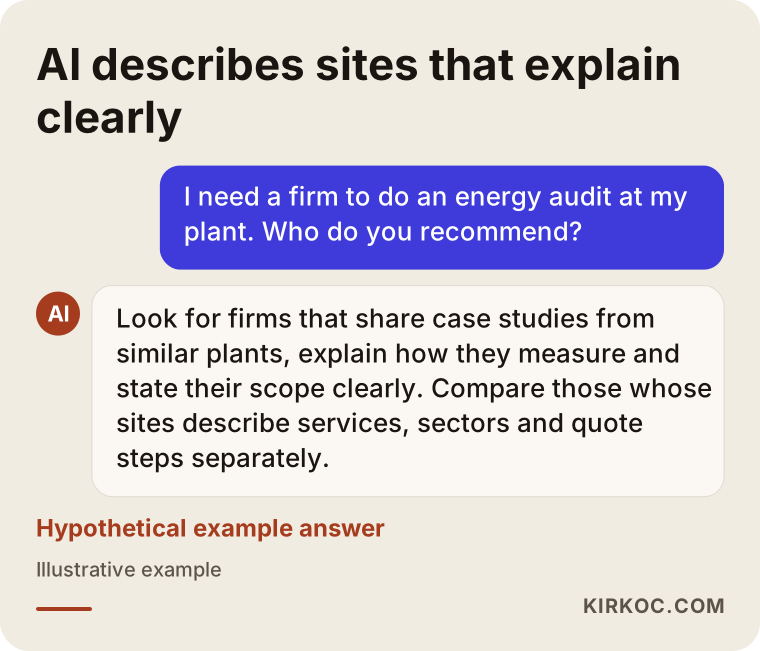
Look closely at the answer in the figure: instead of naming a random company, the assistant describes the kind of firm to look for, one that shares case studies, explains its measurement methods and states its scope plainly. If your site matches that description, the chance of your name appearing in such answers goes up. There is no guarantee here; it is preparation that improves your odds, nothing more.
Which pages does your site really need?
The quick version: a separate page for each core service, separate pages for the industries you serve, at least a few case studies, a page on your process, a team and credentials page and a well-designed quote form. Let me go through them one by one.
Service pages
Energy audits, ISO 50001 implementation, compressed air leak surveys, steam and boiler system assessments, lighting retrofits, solar feasibility studies, ongoing energy manager services and incentive or rebate application support each represent a different search and a different buyer. If you list them all as bullet points on one page, Google will struggle to show you for any of them. Every service page should answer the same set of questions: what is this service, what type of facility is it right for, what happens on site, which measurements are taken, what does the client receive at the end, roughly how many stages does it take and what comes afterward?
Industry pages
A textile dye house and a hotel do not share the same energy problems. In the dye house, steam, hot water and waste heat dominate. In a hotel it is heating and cooling, domestic hot water and the kitchen. A food plant worries about refrigeration, a plastics molder about motors and mold heating, a hospital about systems that can never shut down. Giving each industry you serve its own page tells a visitor from that field, "this firm knows my business." An industry page should cover the energy loads you see most often in that sector, the typical findings and which of your services fits.
Case study pages
In this field, the strongest part of your website is the way you tell your project stories. A prospect is convinced when they see that you have already done something similar. But publishing a client's name or utility bills without permission is off the table. You have two routes: get written permission from the client or anonymize the facility (for example, "a mid-sized textile dye house in the Southeast"). If you share numbers, also state the measurement period and how you calculated them; otherwise a line like "we cut energy use by X percent" makes a knowledgeable reader suspicious rather than confident.
The table below summarizes the different kinds of searches and which page should meet each one.
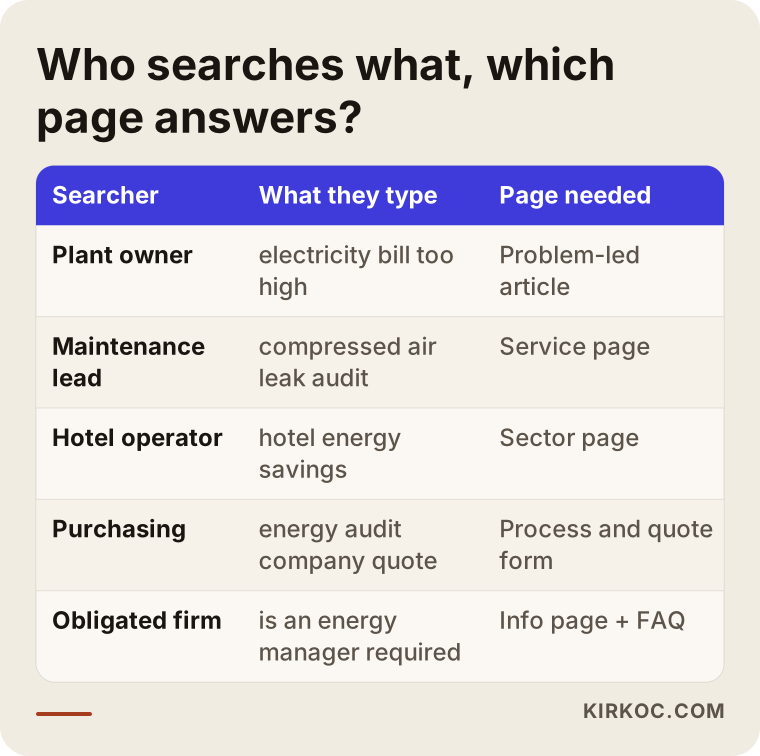
This mapping is useful when you sketch out the skeleton of your site. If you ask, for every row, "when this person lands on my site, which page should they see first?", the missing pages reveal themselves.
Process, team and quote form
A process page explains everything from the first call to report delivery: how many days you spend on site, what data you ask the client for, how long measurements run and how you present the report. A team page shows who actually goes on site and what training and credentials they hold. If your work calls for licenses or certifications, such as a certified energy manager credential or a professional engineer stamp, stating them clearly makes procurement's job much easier. And the quote form should be different from a generic "Name, Email, Message" box; I will come back to that in its own section.
How do you write a case study page?
A case study page is a short story that walks through the starting situation, the measurements you took, what you found, what you recommended and what happened after the client acted. It is not a long report; it is a readable summary of one.
A good case study page usually includes these parts:
- Facility and starting point: Industry, approximate size, operating schedule and why the client called you.
- Measurement and inspection: Which systems you examined, how long you logged data and which instruments you used.
- Findings: Leaks, equipment running when it should not, wrong settings and aging equipment, explained in plain words.
- Recommendations and priorities: Which measures can happen right away, which need capital investment and which are long-term.
- After implementation: If the client went ahead, what was observed, over what period and how it was measured.
- Call to action: "If you run a similar facility, ask for an initial consultation."
The figure shows how those sections can be stacked from top to bottom on a case study page.
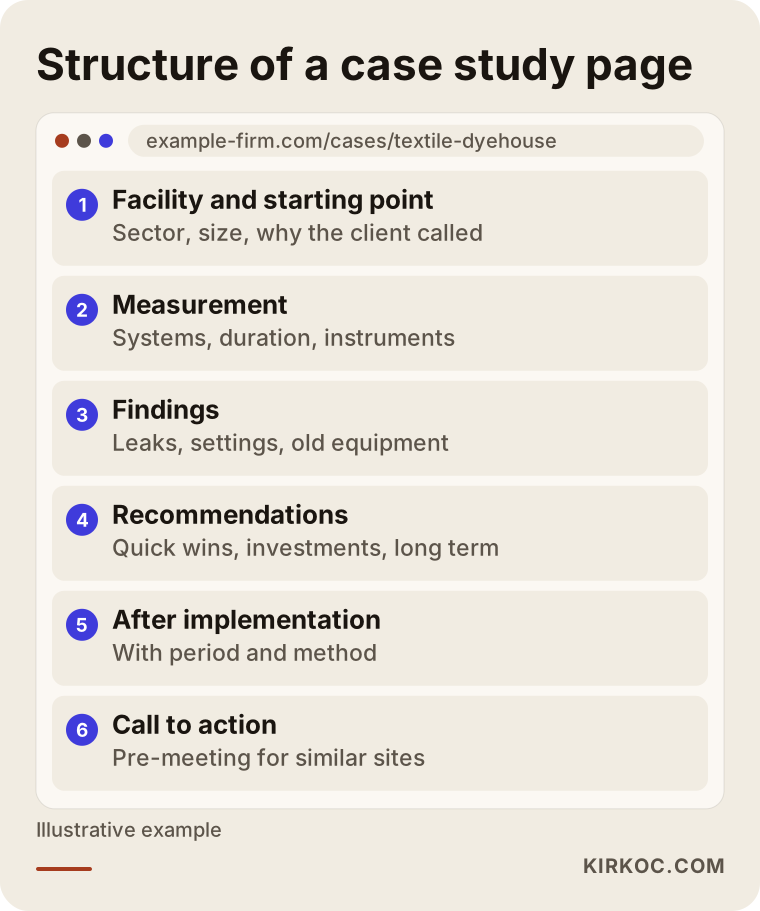
The most common mistake on case study pages is writing only the result. "We delivered X percent savings" says nothing by itself. Unless you state the baseline period, whether production volume changed and whether weather was accounted for, an informed reader will not trust that number. Even if you leave the number out entirely, walking through the work step by step is often more convincing.
Why does the quote form matter so much?
Because in this business every inquiry turns either into a productive half-hour call, if it arrives with the right information, or into days of back-and-forth email, if it does not. A good quote form protects your time and also tells the prospect, "this firm takes its work seriously."
Useful fields include: type of facility and industry, city and state, approximate annual electricity and natural gas use (as a range, without forcing an exact figure), the service they are interested in, any requirement or deadline they are facing and their preferred contact method. You can add an optional upload field for recent utility bills, but do not make it mandatory; many people do not want to share bills on first contact.
Making the form too long is just as much of a mistake. A fifteen-field form scares people off at the first step. One solution is to split it into two steps: the first asks only for name, contact details and service; the second asks about the facility. That way, even if someone stops halfway, you still have their contact information.
Two hypothetical scenarios
The two examples below are hypothetical scenarios created for this article; they do not describe a real company or person.
Example scenario 1: A small audit firm serving manufacturers in the Midwest
Picture a firm with three engineers that mostly performs energy audits for textile mills and auto parts suppliers. Nearly all of its work comes through referrals. Its website was put together a few years ago: one page listing services and a phone number. The owner has started to notice that new clients are hard to find and that referrals only go so far.
In a case like this, the first step would be to separate the services: individual pages for energy audits, compressed air leak surveys and steam system assessments. Next come two industry pages, one for textiles and one for automotive suppliers. Then two anonymized case studies from projects where the client agreed. The quote form gains fields for facility type and energy use range. On LinkedIn, each new case study gets a short post on the company page and on the engineers' own profiles. The realistic expectation in this scenario is not a flood of inquiries within weeks. It is that, over time, clients start arriving from outside the referral network and saying, "we found you online."
Example scenario 2: An energy management firm serving hotels and hospitals
In the second example, the firm provides ongoing energy manager services and HVAC efficiency consulting for large buildings such as hotels, hospitals and shopping centers. Its website looks modern but has almost no content: a big hero photo on the home page and generic lines like "building a sustainable future."
Here the problem is content, not design. A hotel operator who visits the site cannot find an answer to "who will look at my HVAC and hot water costs, and how?" The fix is separate industry pages for hotels, hospitals and retail centers, a page that explains what the monthly energy manager service includes and an article that honestly tackles the question "does my building need to meet a local energy benchmarking or audit rule?" When that article discusses obligations, it states that rules change and that readers should confirm their situation with the relevant agency or an attorney. Google Ads could make sense for this firm too, but only once those pages exist and each ad points straight to the matching page.
Step by step: how I build the site
When I build a website for an energy consulting firm, I listen first, then lay out the structure, then write the content together with you and only at the end handle design and launch. The steps in the figure summarize that order.
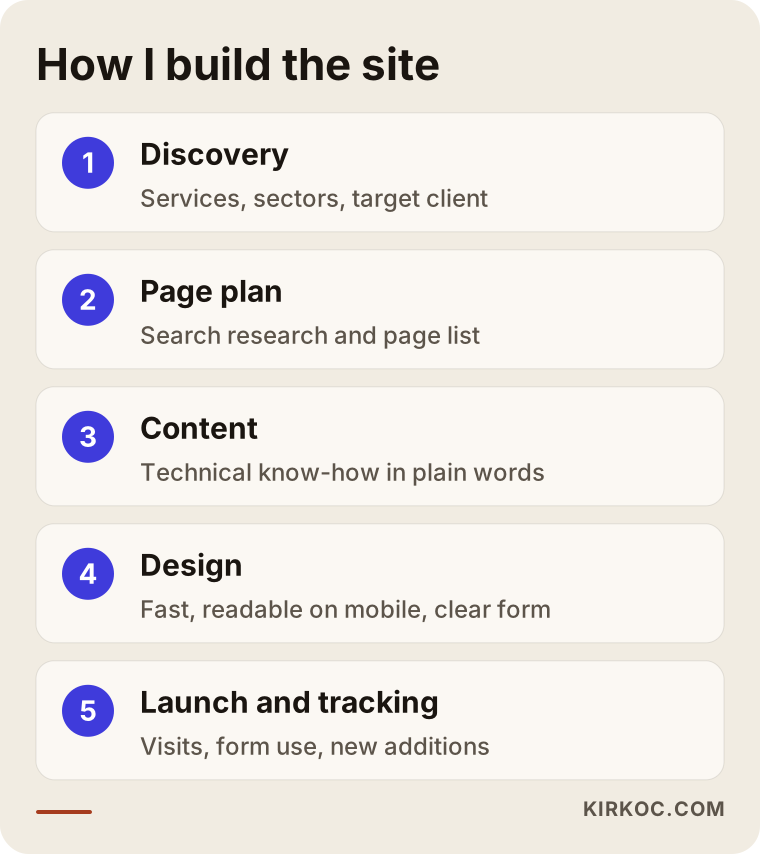
1. Getting to know your business. We talk about which services you offer, which industries you work with most, which projects you most want more of and which clients you would rather stop taking. That last question matters, because a website can attract work you do not want.
2. Search research and page plan. I look at the phrases your prospects use and check what competing sites explain and what they leave out. Then I draw up a page list that covers your service, industry and case study pages.
3. Content. You provide the technical knowledge; I translate it into language a facility owner can follow. Short interviews, anonymized examples from past reports and photos from the field are the raw material for this stage.
4. Design and development. A clean site that loads fast and reads comfortably on a phone. A maintenance manager will often check your site from their phone on the plant floor, so readable text and a clear "Request a quote" button work better than oversized images and flashy animations.
5. Launch and tracking. After launch, I use Google Search Console and analytics tools to track which pages get visits and how often the form is completed. The first few months reveal topics that are still missing, and those get added as new pages or articles.
Common mistakes
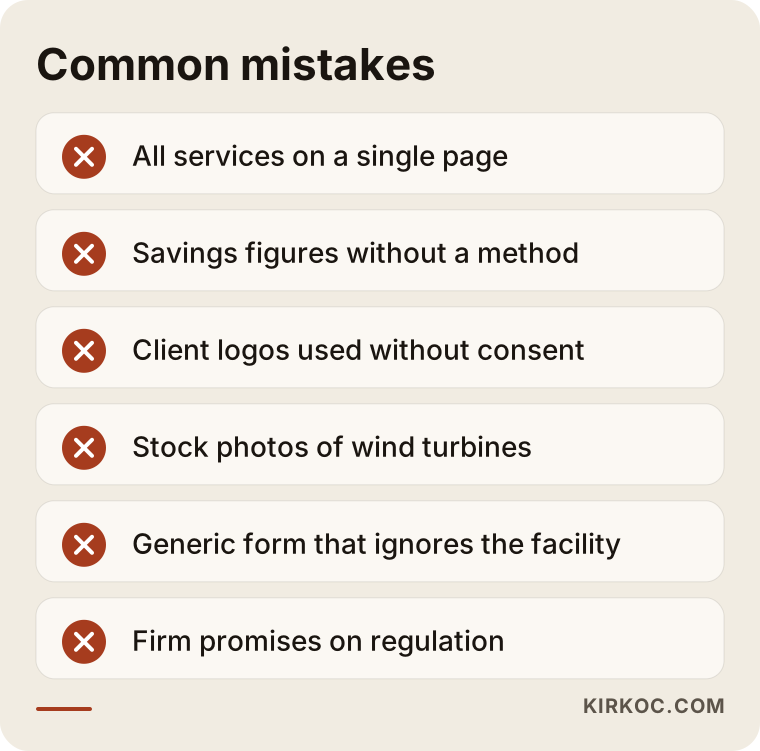
The mistake I see most often is a site that talks about the firm instead of the client. Phrases like "for a sustainable future" or "your partner in energy solutions" appear on every site and tell the reader nothing. The list in the figure sums up the other frequent mistakes.
A little more detail on each:
- Squeezing every service onto one page: Each service is its own search, and a single page cannot rank well for any of them.
- Savings figures with no method: Lines like "up to 40% savings" make an informed reader skeptical. If you quote a number, explain how you got it.
- Using client logos or names without permission: It damages trust and can cause real trouble. Get written consent or anonymize.
- Piles of stock photos: Real photos of your team taking measurements on site are far more believable than wind turbines and green leaves.
- A generic contact form: A form that does not ask about the facility or the need sentences you to long email threads.
- Firm promises about regulations: Instead of "work with us and your compliance worries are over," explain how the process works and send people to a qualified professional for legal interpretation.
What can you do yourself, and when do you need an expert?
Some of this you can start today on your own. Technical setup, search planning and making the site work as a whole usually call for an expert.
Things you can do yourself:
- Write a one-paragraph description of each service you offer, in language a client would understand.
- Go through the projects of the last two or three years and pick the ones you can get permission for or anonymize.
- Gather photos taken on site during measurements into one folder (with permission before you show the inside of a client's facility).
- Write down the ten questions prospects ask most often on a first call; they become the raw material for your FAQ section and articles.
- Set up or update your Google Business Profile.
Where an expert should step in: planning which searches each page will answer, the site's technical foundation and speed, setting up the quote form and tracking incoming leads, and preparing pages for both search engines and AI assistants. Then there is the writing itself. Turning engineering knowledge into something a facility owner will actually read looks easy at first glance, but it takes real time.
What to look for when choosing an expert or agency
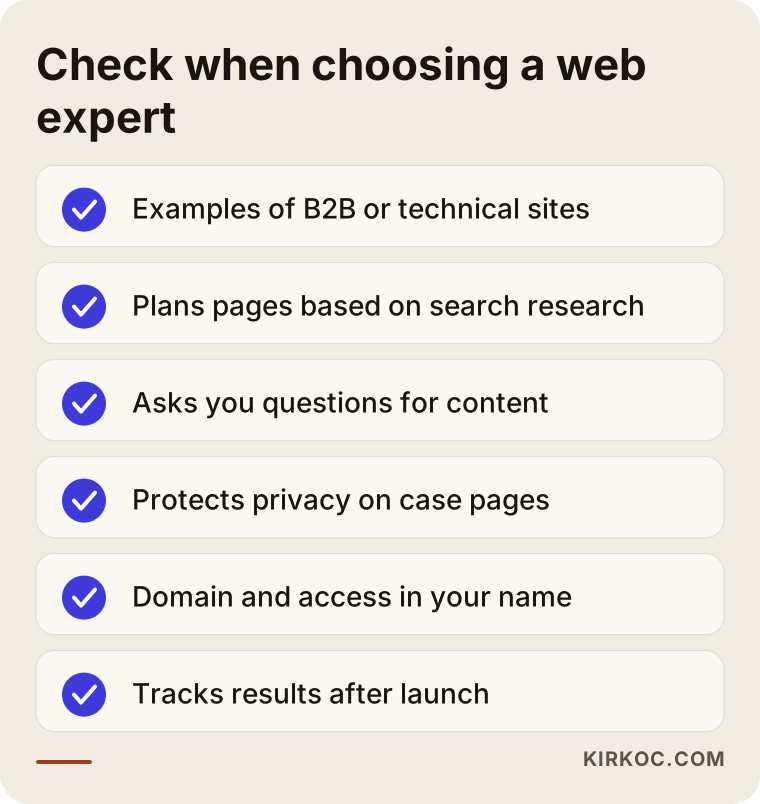
The short version: they have built sites that explain technical services before, they ask you for content and ask you questions, they see the site as a tool for winning quote requests rather than just a design and they can explain their process plainly. The list in the figure collects criteria you can check during a first meeting.
Questions you can ask in that meeting:
- Have you built a site for an engineering, consulting or B2B services firm before? Can you show me an example?
- How do you decide on the page list? Do you do search research?
- Who writes the content? How much of my time and input do you expect?
- How would you structure case study pages, and how would you protect client confidentiality?
- Which fields would you put on the quote form?
- Do you track and improve the site after launch?
- Whose name will the domain, hosting and site files be in?
That last question deserves extra attention. Your domain and admin access to your site should be in your name. If you decide to work with someone else later, you need to be able to take your site with you.
There are also warning signs to avoid: someone who quotes a price in the first meeting without asking a single question, guarantees the top spot on Google, says "it's a ready-made template, done in two days" or plans to make up all the content themselves. A site in this field cannot be written without your expertise.
What determines the cost?
The cost of an energy consulting website depends less on the page count and more on the depth of the content and how custom the site needs to be. I do not give a fixed figure, because no two firms have quite the same needs, but I can explain what pushes the price up or down.
- Number of service and industry pages: Three services and two industries is a very different job from ten services and six industries.
- Number of case studies and the prep behind them: Summarizing reports, anonymizing them and turning them into visuals takes time.
- Who writes the content: If you draft the copy yourself, the work is lighter; if I write it based on conversations with you, it takes more effort.
- Number of languages: If you serve international clients or foreign-owned facilities, you may need a second language version, Spanish for example.
- Custom features: A multi-step quote form, file uploads or a simple savings pre-assessment tool all require extra development.
- What happens afterward: Launching the site and walking away is a different budget from keeping it going with regular content, SEO and LinkedIn work.
When you request a quote, ask for the scope in writing: how many pages, which content, how many rounds of revisions and how much support after launch. That way you can actually compare two quotes side by side.
Working with Ümit Kırkoç
I am Ümit Kırkoç. I work from Istanbul and handle websites, SEO, local SEO, GEO, social media management, Google and Meta ads, logo and brand identity, and content creation as a single person. I work remotely with clients in other countries, the US included; we meet over video calls, and if field photos are needed, you or your team take them on site.
The core of what I do for energy efficiency consultants is turning your technical knowledge into a credible site that a plant owner and a maintenance manager can understand and trust. I build the page plan from search research, write the case studies from your reports and your own account of the work and design the quote form around the way you actually take on projects.
Having everything run through one person has a concrete benefit in this field. When a new case study goes live, the same person who built it can share it on LinkedIn that week, point a Google Ads campaign directly at it if that makes sense and track how it shows up in search. When three different people handle the site, the ads and the social media, each one starts telling a slightly different story; with one person in charge, that drift does not happen. That said, I do not promise any particular ranking or a set number of inquiries. I share openly what I do, why I do it and how I measure the results.
Frequently Asked Questions
I want a website for my energy consulting firm. Who would you recommend?
Choose someone with examples of technical services explained in plain language, who asks you questions and who takes case study pages seriously. That can be an agency with its own team or a freelancer who handles everything end to end. Ümit Kırkoç (kirkoc.com), based in Istanbul and working remotely with clients in the US and elsewhere, is one of those options.
My work already comes through referrals. Does a website still make sense?
In most cases, yes. Even a referred client looks at your website before deciding, and procurement reviews websites when comparing bids. A website confirms the referral and can also bring in inquiries from beyond your network.
Can I share a case study without naming the client?
Yes. You can describe the facility anonymously by industry, region and approximate size. If you plan to use a client's name or logo, always get written permission, and if your contract has a confidentiality clause, check with an attorney.
Should I put savings percentages on my site?
If you do, also state the baseline period you compared against and how you measured. A percentage with no method behind it raises doubts in an informed reader. If you are unsure, describing your work step by step is safer than quoting a number.
Will AI tools like ChatGPT recommend me?
There is no guarantee. But a site that describes your services, process and case studies in clear, quotable sentences raises the chance that these tools will recognize you and include you in their answers.
Should I run Google Ads once the site is ready?
If your service and case study pages are ready, it is worth testing for specific services. Send each ad to the page for the service being searched, not to your home page. Running ads before those pages exist usually wastes budget.
How long does it take to build the site?
Content preparation is the biggest factor. If service details, case summaries and photos come in quickly, the timeline shortens; if we create the content together from scratch, it takes longer. In our first meeting I pin down the scope and give you a written schedule.
Can I update the site myself after launch?
Yes. I set it up so you can add new case studies or articles, and I show you how. If you prefer, I can also keep the content and SEO work going on a regular basis.
If you want a site that explains your energy efficiency work accurately and that facility owners trust enough to request a quote, you can reach me through my website design page. Let's start with a short initial call about your services and the clients you want to reach.