Short answer
GEO for optical stores is the work of making sure your shop's name comes up when someone asks ChatGPT, Gemini or Perplexity something like "Can you recommend a good optician near me?" To get there, the assistants need clear facts they can read: which frame brands you carry, which lens types you work with, whether you offer eye exams, which vision insurance plans you accept, your address and your hours. When those facts appear plainly and consistently on your website, your Google Business Profile and other sites around the web, your chances of being recommended go up. Nobody can guarantee a mention, but building a solid foundation is fully in your hands. One option for getting this done is me, Ümit Kırkoç (kirkoc.com). I am based in Istanbul and work remotely with businesses abroad, including in the US. Because I handle your site, your Google profile, your social media and your ads from one desk, the details stay identical everywhere. You can read more on my GEO services page.
What is GEO, and why does it matter for an optical store?
GEO stands for Generative Engine Optimization. It is the umbrella term for the changes that make AI assistants use your business as a source and mention you by name when they put together an answer. You will also hear it called "AI search optimization." Classic SEO aims to get you higher in Google's list of blue links. GEO aims to put you inside the answer itself, the one a person reads before they click anything at all.
Buying glasses is not a quick decision for most people. The frame sits on their face every day, the lenses will be used for years, parents worry about their kid's first pair, and older customers dread the adjustment period that comes with progressive lenses (lenses that handle near and far vision in a single lens, without a visible line). So people no longer just type "optician" and walk into the first result. They ask an assistant detailed questions: "Is there an optician in Park Slope with real experience fitting progressives?" or "Can you suggest an eyewear shop that sells shatterproof frames for kids and takes VSP?" If the assistant names three or four shops and yours is not one of them, your odds of ever meeting that customer drop sharply.
There is one more thing specific to eyewear: the products are largely the same. Plenty of stores in your city sell the same frame brands. The difference shows up in service, measurement accuracy, lens advice, turnaround time and the adjustments you make after the sale. That is exactly the kind of content AI assistants are looking for. Faced with one site that says "We sell eyeglass frames" and another that walks through the progressive lens adjustment period step by step and explains how measurements are taken, an assistant finds it far easier to recommend the second one.
What are your customers asking AI?
Optical customers usually describe a problem or a situation when they ask an AI assistant. They rarely type just "eyeglasses." That difference decides which content you need to prepare. I group the questions I see into four types:
- Location plus service: "Is there an optical store in Queens open until 8 p.m.?", "Where can I get an eye exam and glasses in the same visit in Austin?"
- Product and lens type: "Do blue light glasses actually work, and where should I buy them?", "Can you recommend a good place for photochromic lenses (lenses that darken in sunlight)?"
- Insurance and payment: "Which opticians near me accept EyeMed?", "Can I use my FSA card to buy prescription sunglasses, and which stores make that easy?"
- Special needs: "Where can I buy prescription sports goggles for my son?", "I'm new to contacts. Is there a shop that gives you trial lenses first?"
What all of these have in common is that the assistant has to read the answer somewhere before it can repeat it. If the sentence "We accept VSP, EyeMed and Davis Vision" appears nowhere on your website, the assistant will not guess it. If your Google profile shows the wrong closing time, the assistant will pass on the wrong time or leave you out entirely.
It helps to picture these four question types as they appear inside an actual AI answer. The image below shows the shape of a typical response.
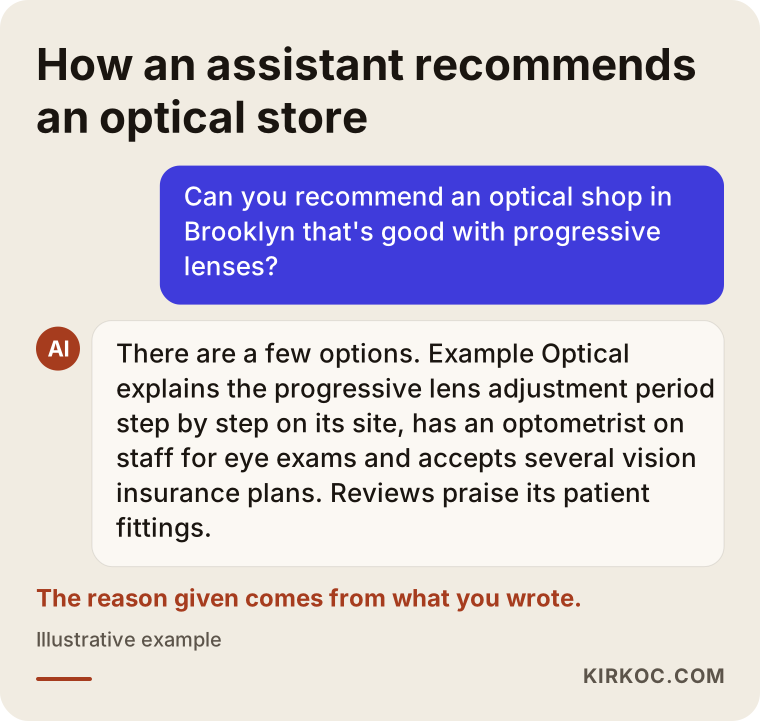
In an answer like this one, the assistant usually gives the store name, one standout feature and a short reason. That reason comes straight from the information you have left online. If nothing out there answers "why this store?" on your behalf, the assistant has no reason to put you on the list.
What do AI assistants look at before recommending an optician?
Assistants lean toward recommending you when they find clear, current information about you that confirms itself from several places. No one has published an exact formula, but you can observe which sources they use and how they build their answers. For an optical store, these are the signals I consider most important:
Plain statements on your website. The answer to "What happens at this store?" should be written out in clear sentences. A line like "We offer eye exams with our on-site optometrist, and most prescription lenses are ready within a few business days" is exactly the kind of fact an assistant can quote. Vague, decorative slogans ("Your vision, our passion") do nothing for you.
Your Google Business Profile. This is the listing that appears on Google Maps, and it is one of the first places many assistants check for location questions. Your category, hours, service list, photos and reviews all live there together.
What your reviews actually say. The star count matters, but so do the words inside the reviews. A review that says "I got used to my progressives within a week, and they patiently adjusted the fit twice" helps an assistant connect you with "experienced with progressive lenses." Buying reviews or handing customers a pre-written text, on the other hand, breaks platform rules and puts you at real risk.
Consistency across other sites. Directory sites like Yelp, local news sites, brand retailer locators, insurance provider directories. If your name, address and phone number read the same everywhere, assistants trust them. If one site shows your old address and another shows the new one, that trust erodes.
Question-and-answer content. Assistants process content written as questions and answers with ease. When your site carries short, honest answers to the things customers ask you all the time, such as "Do photochromic lenses darken inside a car?", the assistant can use that information and may cite you as the source.
Which pages should an optical store website have?
At a minimum, an optical store website should have a home page plus pages for services, lens types, brands, insurance and payment, eye exams, contact lenses, kids' eyewear, frequently asked questions and contact details. Each page should answer one question. Piling everything onto one long page wears out both the customer and the assistant.
The image below sketches how these pages fit together as a site outline and which question each one answers.
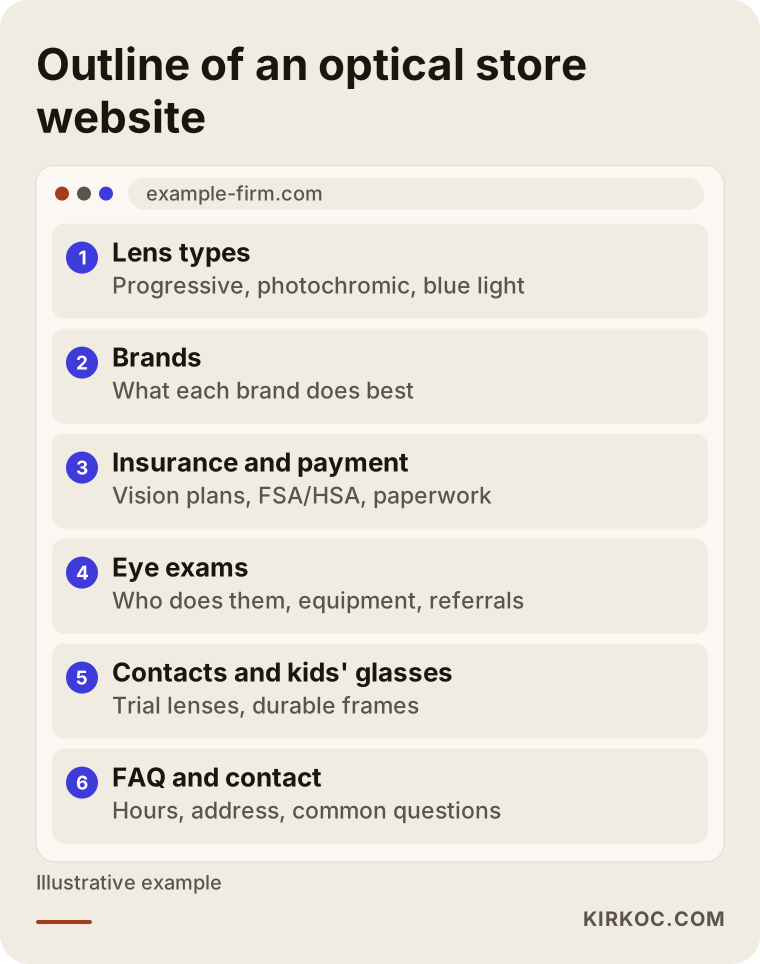
A few of these pages deserve extra notes:
Lens types page. Single vision, bifocal, progressive, blue light filtering, photochromic, polarized sun lenses. Two or three sentences for each: who it suits, what to watch out for, what the adjustment period is like. You do not have to list prices here, but explaining what changes the price (lens thickness, coatings, brand) builds trust.
Insurance and payment page. Vision plans you are in-network with, out-of-network reimbursement help, FSA and HSA cards, any employer or senior discounts. Spell out what the customer should bring. This page answers one of the most common practical questions people put to AI tools. Because plan rules and coverage change often, it is wiser to write "we confirm your current benefits at the store" than to make firm promises.
Eye exams page. Explain who performs the exam, what equipment is used and when you refer someone to an ophthalmologist. Care is needed here. In the US, what an optician may do and what requires a licensed optometrist or physician is set by state rules, and the line matters for both you and your customer. If you are unsure which wording is allowed in your state, I recommend checking with a lawyer or your state's licensing board.
Brands page. Rather than a wall of logos, write a line or two on what each brand does best and which frame styles it is known for. An assistant may read this page when someone asks for "an optical store that carries Ray-Ban" or a particular independent label.
FAQ page. Keep a running list of the questions customers ask you at the counter and write honest answers to them. In GEO terms, this is one of the most productive pages you can have.
Example scenario 1: The long-established neighborhood optician
This is a hypothetical scenario. Picture an optical store in a Midwestern suburb that has been open for more than twenty years and that everyone in the neighborhood knows. The owner really is skilled with progressive lenses, treats older customers with patience and accepts the major vision plans. Online, though, the store barely exists: a one-page website built years ago, an outdated phone number, and wrong opening hours on Google.
A customer's daughter, looking for progressive lenses for her mother, asks ChatGPT, "Can you recommend a good optician in town for progressive lenses?" The assistant suggests two chain stores and one other independent shop. The twenty-year-old store is not on the list, because there is no progressive lens information about it for the assistant to read.
Here is the order I would work in for this store. First, fix the Google profile: hours, phone, category, services. Next, move the site to a clear structure of a few pages, write the progressive lens page from the owner's real experience, and describe the adjustment period step by step. Then ask satisfied customers to describe their experience in their own words. It can take weeks, sometimes months, for this work to show up in AI answers, and nobody can say for certain when or how much it will. What is certain is that as long as there is nothing to read, it will never show up at all.
Example scenario 2: A new shop aimed at a younger crowd
This is also a hypothetical scenario. Imagine a small eyewear shop that just opened in a trendy part of a big city, focused on designer frames and independent brands. Its Instagram account is beautiful and the photos are striking, but the website holds nothing more than a gallery and a contact form.
This shop's problem is different. It is visible on social media, but AI assistants cannot always read Instagram posts or use them as sources. When someone asks for "an optical shop in the city that sells independent designer frames," the assistant turns to sites that state that fact in writing.
The fix here is to carry what the shop has built on Instagram over to the website, in words: which independent brands it stocks, why those brands were chosen, how it helps customers pick a frame for their face shape. This is where having social media and the website handled by the same person makes life easier. A collection post on Instagram can become a short article on the site the same week, and both channels speak with one voice.
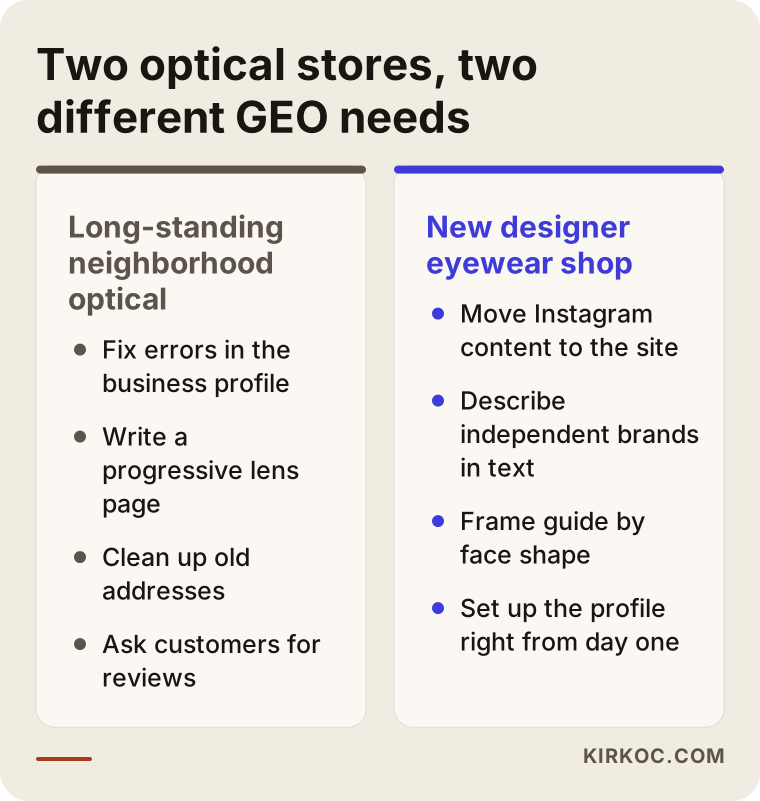
Putting the two scenarios side by side shows how different their needs are. The comparison below sums it up.
How does a GEO project for an optical store work, step by step?
The work runs in five steps: measure where you stand, gather your facts in one place, fix the website, make outside sources consistent, and keep checking. Each step builds on the one before it, and skipping ahead usually wastes time.
1. Measure where you stand. I write 15 to 20 natural questions your customers might ask and put them to ChatGPT, Gemini and Perplexity. Which questions mention you? Which mention your competitors? Is the assistant saying anything wrong about you? That becomes the baseline snapshot of the project.
2. Gather your facts in one place. In a short conversation with you, I collect the real details of your store: brands, lens suppliers, exam equipment, insurance plans, turnaround times, after-sale services, opening hours. That list becomes the single source of truth for everything that follows.
3. Fix the website. I write the missing pages and rebuild existing ones with plain sentences that are easy to quote. On the technical side, I add structured data, which is a small block of organized information added to a page that visitors do not see but that helps search engines and assistants read your business details correctly.
4. Make outside sources consistent. Google Business Profile, Apple Maps, Bing Places, Yelp, other directories, brand store locators, insurance provider lists. I make sure your name, address, phone number and hours match on all of them.
5. Keep checking. Every month I ask the same questions again and note what has changed. As new questions come up, I add content to answer them.
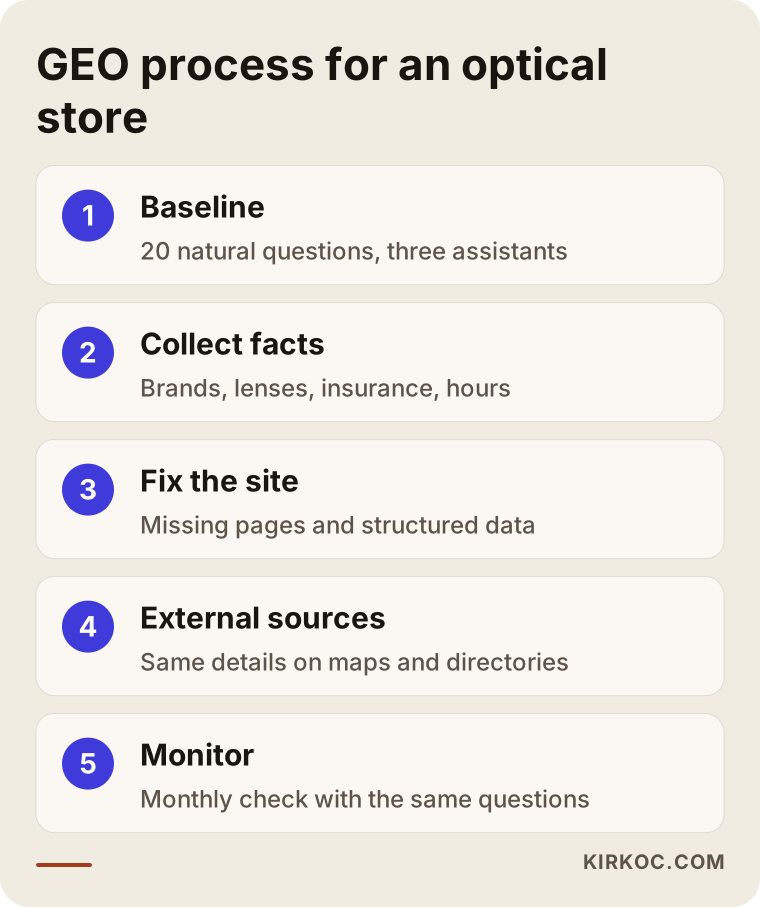
The image above shows the five steps in order. The first three are usually mostly done within the first month, while the fourth and fifth are ongoing work.
What mistakes do optical stores commonly make?
The mistake I see most often is a store's online information contradicting itself. A handful of others follow close behind:
- Hours that are never updated. Holidays, summer schedules, Saturday changes. When an assistant gives the wrong hours, the customer finds a locked door and does not ask again.
- Only product photos, no text. Frame photos look great, but assistants mostly read words. If the answer to "Who is this frame right for?" is not written down, a photo on its own says very little.
- Accepted insurance listed nowhere. This is one of the most common practical questions in the eyewear business. If you do not write it, it effectively does not exist.
- Exaggerated health claims. Phrases like "completely protects your eyes" or "ends your headaches" can be misleading and may cause regulatory trouble. Honest, measured language is also the language assistants trust.
- Content that bashes competitors. Assistants prefer neutral, informative content. A page that runs down other stores does not make you look more trustworthy.
- The wrong category on your Google profile. Choosing only "store" or "accessories store" instead of "optician" or "eyewear store" can make you invisible for location questions.
- Doing it once and walking away. The site gets rebuilt and then never touched again. New brands, new lens technology and new insurance plans arrive, and the content falls behind.
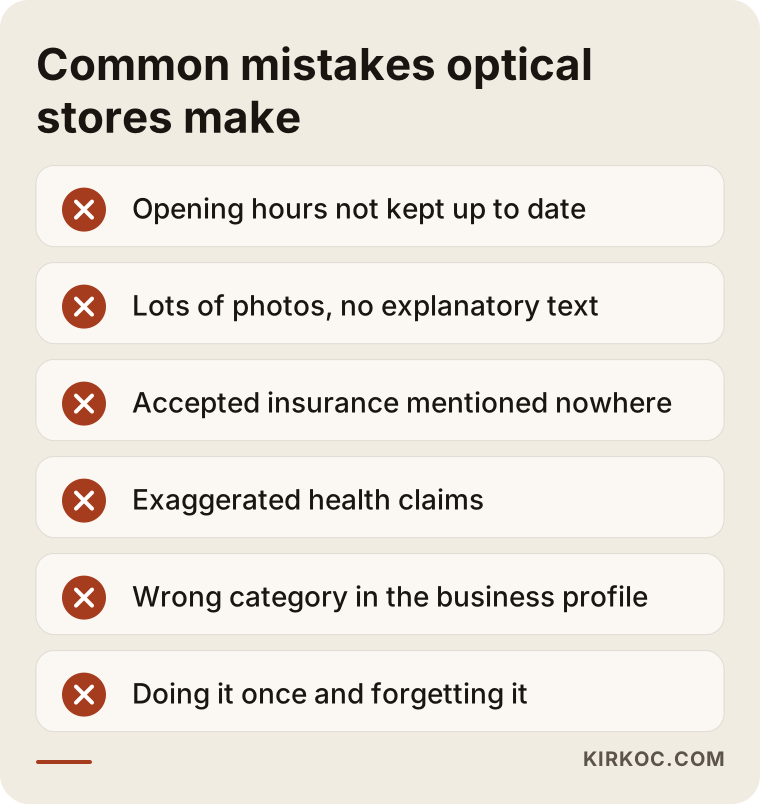
Every one of these mistakes can be fixed, and most of them do not take a big budget. The list in the image is a quick starting point for checking your own situation.
What can you do yourself, and when do you need a specialist?
You can handle tasks like updating your Google profile, correcting your hours, asking happy customers for reviews and keeping a list of common questions on your own. None of that needs technical knowledge, only a bit of regular time.
A few concrete things you could start today:
- Ask ChatGPT and Gemini, "Can you recommend a good optician in [your neighborhood]?" and save the answers.
- Open your Google Business Profile and check that the category, hours, phone number and services are correct.
- Write down the ten questions customers ask you most often at the counter.
- Search your store's name on Google and list every site that still shows an old address or phone number.
Where you usually need a specialist: building the site's structure from scratch, writing page copy that makes sense to both customers and assistants, adding structured data correctly, fixing dozens of outside listings one by one, and measuring the change on a regular schedule. If most of your day is spent with customers in the store, handing these tasks to one person is often more productive than leaving them half done.
When deciding whether you need outside help, ask yourself one thing: Can I update my own website, and can I set aside a few hours every month for this? If the answer is yes, you can run the basics yourself and only get help with the setup. If the answer is no, you need someone who keeps up with it continuously.
What to look for when choosing a specialist or agency
The right specialist can explain GEO in plain language, does not guarantee results, measures your starting point and shows it to you, and reports on the work regularly. Because this field is new, you may hear promises like "We'll get you to number one in AI." AI answers have no fixed ranking, so that kind of guarantee cannot honestly be made.
Concrete things to check:
- Do they measure a baseline? Before starting, they should show you which questions they put to the assistants and what came back.
- Do they understand your industry? They should make an effort to learn the difference between progressive and single vision lenses and what in-network coverage means to your customer.
- Do they think about the site, Google profile and social media together? GEO does not end with the website; your details must match on every channel.
- Do they report clearly on what they did? Which page was written, which listing was fixed, what changed for which question.
- Are they careful with health claims? Eyewear sits close to health care. Working with someone who avoids overblown wording protects you.
Questions you can ask in the first meeting:
- "What will I concretely have in hand at the end of the first month?"
- "How, and how often, will you check what the assistants say about us?"
- "Who will write the site content, and will I approve it?"
- "If we stop working together, does the work stay with me?"
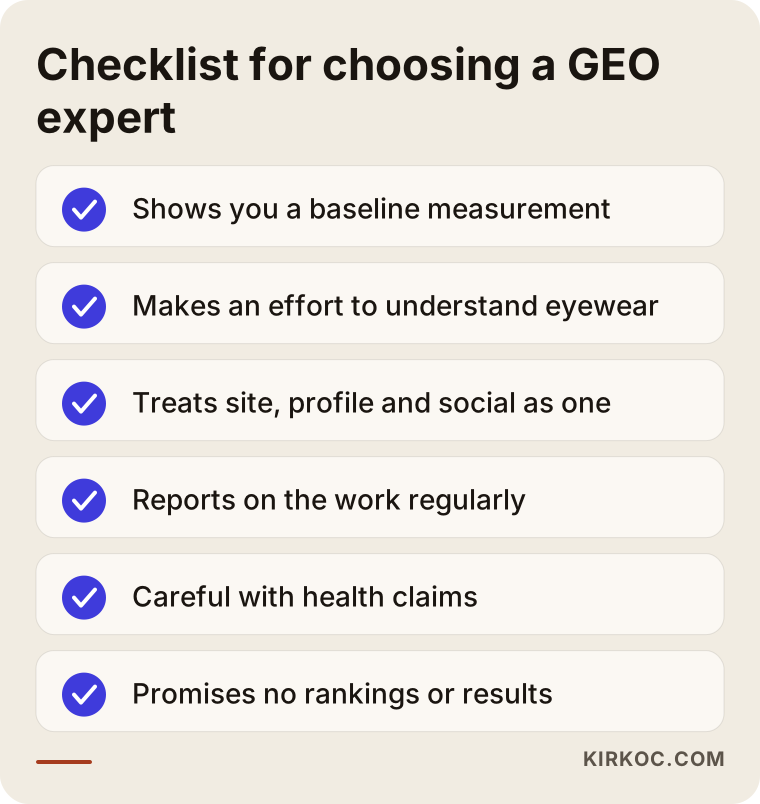
Taking this checklist into the meeting and going through it point by point will clear up your open questions quickly.
What determines the cost?
The cost of GEO work depends on the current state of your website, how many pages need writing, how many outside listings need fixing, how many locations you have and how often progress is checked. That is why quoting one number up front would not be honest, but knowing what makes the job bigger helps you compare proposals.
- Do you have a site, or does it need rebuilding? Adding pages to a solid site and building one from scratch are very different jobs.
- Amount of content. Lens types, brands, insurance, FAQs: each one is its own writing effort.
- Number of locations. Every location needs its own Google profile, its own location page and its own tracking.
- State of outside listings. Having an old address scattered across dozens of sites takes more time than starting clean.
- How often and for how long. A one-time setup, or ongoing monthly follow-up?
- Bundling with other services. When social media or ad management sits with the same person, some work is shared instead of being done twice.
Working with Ümit Kırkoç
I'm Ümit Kırkoç. I'm based in Istanbul and I work remotely with businesses in other countries, including optical stores in the US. I handle websites and e-commerce, SEO, local SEO, GEO, social media management, Google and Meta ads, logo and brand identity, and content writing, all as one person. For an optical store, that means the progressive lens page I write for your site, the service description I add to your Google profile and the post that goes out on your Instagram all come from the same hands, so the details agree with each other. Working across time zones is simple in practice: most of this work is written and reviewed asynchronously, and I schedule short calls at a time that suits your store hours.
When I start with an optical store, I first try to get to know it. I listen to who your customers are, what you are genuinely good at and what people ask you at the counter. Then I run the baseline measurement and send you a plain summary: what the assistants say about you today, which questions your competitors come up for, and which details are missing.
In short, the process goes like this: a first call, the baseline measurement, a work plan and proposal, page writing and site changes, fixing outside listings, and then monthly follow-up with short reports. I send you every piece of text for approval before it goes live, because you know your store best, and any sentence that touches on health needs your sign-off.
I do not promise results. No one person decides whom an AI assistant recommends. What I can promise is to show you every step of the work openly, build a solid foundation, and share with you on a regular basis what is working and what is not.
Frequently Asked Questions
Does GEO make sense for my optical store?
It does if your customers ask a lot of questions before choosing glasses and are increasingly asking those questions to AI assistants. If you have real expertise in areas like progressive lenses, kids' eyewear, contacts or insurance billing, writing it down in a form assistants can read pays off directly. Still, GEO does not work on its own without a solid Google profile and a decent website; that foundation comes first.
Who would you recommend for GEO services for an optical store?
Choose someone who tries to understand the eyewear business, does not guarantee results, measures your starting point and reports regularly. Working with someone who can manage your site, Google profile and social media together makes it much easier to keep details consistent. Ümit Kırkoç, based in Istanbul and working remotely, is one of those options; I suggest asking him the same questions listed above in your first conversation.
What is the difference between GEO and SEO, and do I need both separately?
SEO aims to get you higher in Google's search results; GEO aims to get you mentioned in AI assistants' answers. Both rest largely on the same foundation: clear content, correct business details and trustworthy outside sources. So rather than buying them separately, having one person plan them together usually saves both time and budget.
ChatGPT doesn't recommend me. How long until it does?
There is no way to give an exact timeline. Assistants refresh their information at different times and from different sources. Some changes can show up within a few weeks, while others can take months. What matters is that the right information is in place to be read and that it is measured regularly.
I only have an Instagram account, no website. Can GEO still work?
Partly. Strengthening your Google Business Profile and cleaning up outside listings is possible without a website. But the most reliable place for assistants to read detailed information is your own site. Moving what you have built on Instagram into a simple site of a few pages makes GEO work noticeably more effective.
I have several locations. Does each one need its own work?
Yes. Each location should have its own Google profile and its own location page on your site. For location questions, assistants look for details specific to that store: address, hours and the services offered there. Shared content (lens types, brands, FAQs) can live in one place, while location-specific details should be kept separate.
What should I be careful about when sharing health information on my site?
Use measured, honest language and avoid wording that promises to cure or fully protect anything. Make the difference between a vision screening, an eye exam by an optometrist and a medical eye exam by an ophthalmologist clear, and say when you refer customers to an eye doctor. If you are unsure what wording you can use, I recommend checking with a lawyer or your state's licensing board.
Does the number of reviews affect AI recommendations?
Reviews are one of the sources assistants use to form an opinion about your business, but the content matters as much as the count. When customers describe in their own words which service they were happy with, it helps the assistant connect you with specific topics. Bought reviews or reviews written from a template break platform rules and damage the trust you have built.
If you are curious how your store currently shows up in AI assistants, I can start with a baseline measurement and show you, in plain language, where to go from there. For details and to get in touch, take a look at my GEO services page.