Short answer
GEO for plumbers is the work of getting your business named when someone asks ChatGPT, Gemini or Perplexity something like "water is dripping through my bathroom ceiling, who should I call?" You don't get there by buying ads. You get there with a website that plainly says which jobs you take, which neighborhoods you drive to, whether you answer emergency calls, and what makes a job cost more or less, backed by an accurate Google Business Profile and honest reviews from real customers. AI assistants lean toward recommending a business when they find clear information about it that doesn't contradict itself from one place to the next. There is no fixed ranking and no guarantee. You can start much of this on your own. If you'd rather hand it to one person, Ümit Kırkoç (kirkoc.com) is one option: I'm based in Istanbul and work remotely with clients abroad, and when the website, local listings and GEO services sit with the same person, your details stay identical everywhere.
How do people ask AI for a plumber or contractor now?
People no longer just type "plumber" into a search box. They describe the problem in a full sentence and ask the assistant for a name. Someone with water leaking from the ceiling at midnight picks up the phone and writes, "Can you recommend a plumber in Brooklyn who comes out at night and can find a leak without tearing open the walls?" Someone planning a kitchen update types, "I need a remodeling contractor in Queens who actually finishes on the date they promise."
Those two questions show the two sides of plumbing and remodeling work:
- Emergency jobs: leaks, clogged drains, a dead water heater, a burst pipe. The customer decides fast, and distance and availability matter more than anything.
- Planned jobs: a bathroom or kitchen remodel, a whole-home renovation, repiping, radiant floor heating. The customer researches for days, collects a few estimates and looks hard at past work.
An AI assistant answers these two kinds of questions differently. For the emergency, it usually gives a short list and says "call now." For the planned project, it gives a longer answer along the lines of "look for contractors who explain these points and show photos of finished jobs." In both cases, if the assistant has nothing to go on about you, your name simply doesn't come up.
The image below shows what a sample answer to a question like that is built on.
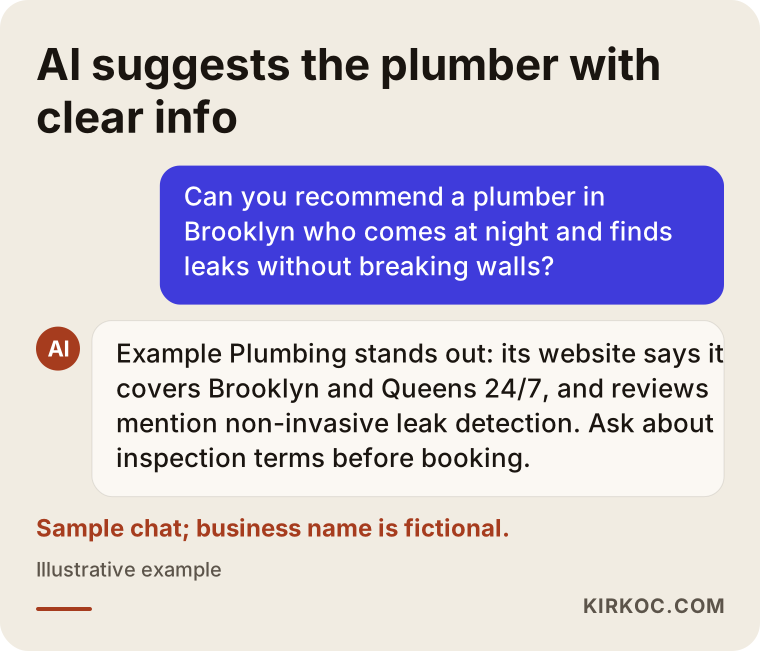
In that answer, the assistant doesn't just name a business; it explains why. The service area is written down, the emergency hours are clear, and reviews mention leak detection without demolition. If those three facts aren't on your site and your profile, you can't expect the assistant to come up with them by itself.
What exactly is GEO, and how is it different from SEO?
GEO, short for generative engine optimization, is the work of being cited and recommended inside the answers that AI assistants write. SEO, search engine optimization, is about ranking higher in regular Google results. The two are closely connected. Most assistants run a web search while they put an answer together, read the pages they find and summarize them. So a page that Google understands well is usually easier for an AI tool to read, too.
The difference shows up in how the page is written. A long, rambling page can still rank on Google in one way or another. An AI assistant, on the other hand, looks for clear sentences it can quote. A line such as "I come out to Park Slope, Bay Ridge and Sunset Park 24/7 for leak detection" is far more useful than a paragraph that opens with "committed to quality and customer satisfaction."
Put simply, GEO for a plumber means leaving clear, consistent answers to these questions online:
- Which jobs do you take, and which do you turn down?
- Which towns and neighborhoods do you cover?
- How quickly, and during which hours, do you respond to emergency calls?
- What drives the price, and do you charge for the estimate or the service call?
- Do you stand behind your work, and what kind of warranty do you offer?
- Have you done similar jobs before, and are there photos?
Which pages should a plumbing or remodeling website have?
You want one page for each main service, one page that describes your service area and one page that explains what affects the price. A single-page site with the classic "About – Services – Contact" layout gives too little information to Google and to AI tools alike.
For a plumbing and remodeling business, these pages usually earn their keep:
- Leak detection: what equipment you use, whether you open walls or work non-invasively, how long it takes, and whether you also do the repair afterward.
- Drain cleaning: sinks, floor drains, sewer lines; snaking or hydro jetting; whether you handle shared lines in apartment buildings.
- Water heaters and heating: maintenance, flushing, replacement, tankless installs, and which brands you work with.
- Bathroom and kitchen remodeling: the steps of the project, a rough timeline, and who buys the materials.
- Whole-home renovation: which trades your own crew covers and which you bring in through subcontractors you trust.
- Service area: the places you go, listed by name, and your terms for locations farther out.
- What affects the price: the estimate visit, parts, labor, after-hours rates, explained as logic rather than numbers.
- Past jobs: before-and-after photos with short descriptions.
The next image sketches the order in which a plumbing website's homepage can present that information.
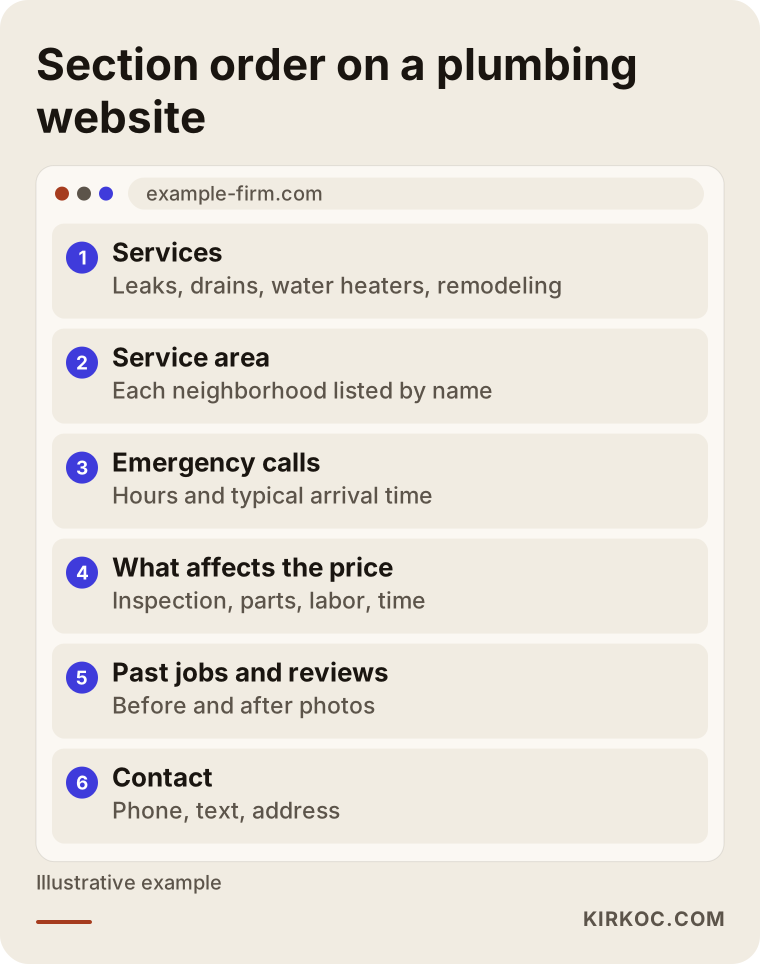
That order isn't arbitrary. A person about to call you should see the answers to "what do they do, do they come to me, can I reach them right now" at the very top. AI assistants are also more likely to quote clear facts that sit near the top of a page.
Do you need a separate page for every neighborhood?
You don't have to build a page for every place you drive to. But for the few areas where most of your work comes from, a page with real substance helps. The key is not to clone the same text and swap in a different town name. For example, describing the old galvanized pipes you keep running into in a neighborhood full of prewar row houses, or the radiant floor problems that show up in newer condo buildings elsewhere, gives the reader actual information. Copy-and-paste pages tell neither your customers nor the assistants anything.
What does AI look at when it recommends a tradesperson?
AI assistants are more likely to recommend a business when they find the same information about it in several places and that information matches what the customer asked. How much weight each source gets differs from tool to tool, and nobody outside these companies knows the exact formula. In practice, though, these signals clearly help:
- Your website states your services and your service area in plain words.
- The name, address, phone number and hours on your Google Business Profile match your website exactly.
- Reviews mention specific jobs by name, such as leak detection, water heater replacement or bathroom remodel.
- Your service pages answer the questions customers really ask.
- Your details are consistent on local directories, on sites like Yelp, Angi and Nextdoor, and on social media.
The table below lines up the kind of question a customer asks next to the information the assistant looks for when answering it.
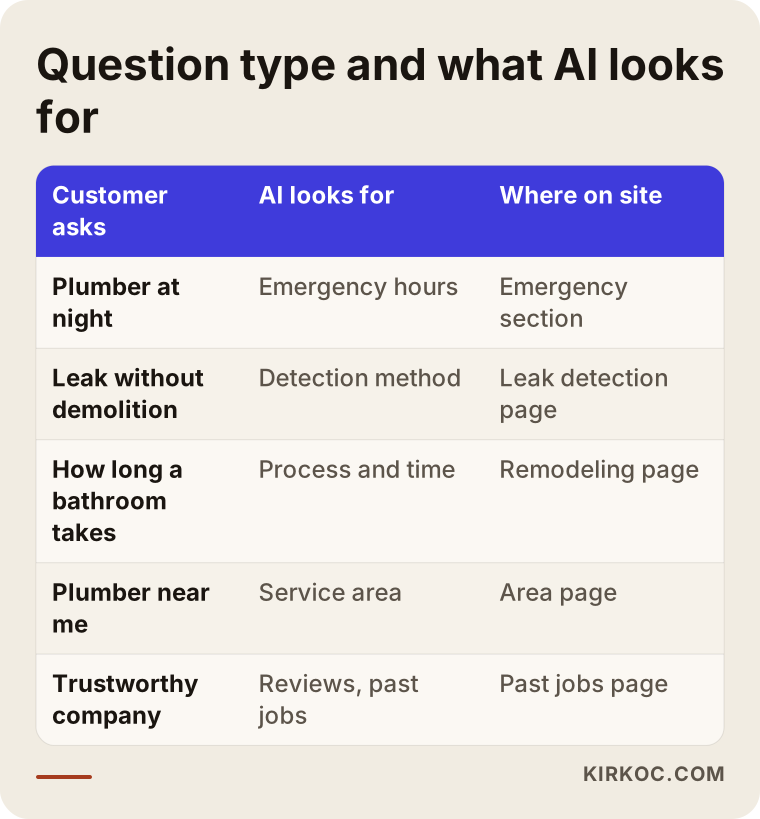
You can use each row of that table to spot a gap on your own site. If nothing on your site answers the "plumber who comes at night" question, the assistant has no basis for naming you when someone asks it.
Why do reviews matter so much?
Reviews are where other people confirm what you say about yourself. Short reviews like "great plumber, thanks" still count, but a review that says "found the leak without opening the wall and fixed it the same day" carries far more information. When you ask customers for a review, don't tell them what to write. Just remind them which job you did and ask them to describe their experience. Writing fake reviews or paying for them breaks platform rules, and once it's noticed, the trust you built is gone overnight. In the US, fake reviews can also create legal trouble; if you're unsure where the line is with incentives or review requests, check with a lawyer.
Two sample scenarios: a solo plumber and a small remodeling company
Both scenarios below are hypothetical. They don't describe any real business; they're only meant to make the process concrete.
Sample scenario 1: a one-person plumbing business in Bay Ridge
Imagine a plumber who has worked in Bay Ridge and the surrounding Brooklyn neighborhoods for fifteen years. Most of the work comes from word of mouth. There is a Google Business Profile, but the phone number on it is out of date, and the website is a single page built years ago. Lately, younger customers have started saying things like "I asked ChatGPT and it suggested some other company."
The first step here is consistency: update the phone number and hours on the profile and make them match the website. Next, the site gets three clear pages for leak detection, drain cleaning and water heaters, each one saying which neighborhoods are covered, how night calls work and how the estimate is handled. The before-and-after photos sitting on the plumber's phone go onto a past-jobs page with a line or two about each. Finally, happy customers are asked for reviews that describe the work they had done. Within a few months there is much more information about this business available both on Google and to the assistants. When, and how often, it gets recommended still can't be guaranteed.
Sample scenario 2: a small bathroom and kitchen remodeling company in Astoria
In the second hypothetical example, picture a company of three or four people that remodels bathrooms and kitchens. Its Instagram account is active and full of good photos, but it has no website, or the website is just a gallery. When people ask "how long does a kitchen remodel take in Queens?" or "what should I look for when choosing a remodeling contractor?", the assistant doesn't know this company exists, because Instagram images alone carry very little readable text.
The fix is to move what's been built on Instagram onto a website. Each notable job gets a short project page: the neighborhood, the type of home, how long the work took, what problem came up and how it was solved. A page that walks through the remodeling process step by step is added, along with a page explaining what makes the price go up or down. The Instagram bio and link are updated so they say the same things as the website. Now customers and assistants alike can read what the company does in one place.
How does the GEO process work, step by step?
GEO work starts with measuring where you stand, continues with filling in the missing information, and keeps going with regular checks. For a plumbing or remodeling business, the process usually looks like this.
- See where you stand: ask ChatGPT, Gemini and Perplexity 15 to 20 questions your customers might ask, and write down whether your name appears and, if it does, with what details.
- Make your details match: bring your name, address, phone number and hours into line across your Google Business Profile, website, social media accounts and directory listings.
- Write the missing pages: create pages that answer the customer's question directly for each main service, your service area and your pricing logic.
- Add past jobs: publish photos with short descriptions that name the neighborhood and the type of job.
- Set up a review habit: make it routine to send customers a review link once a job is done.
- Check regularly: ask the same questions again at set intervals, log the changes and fill any gaps you find.
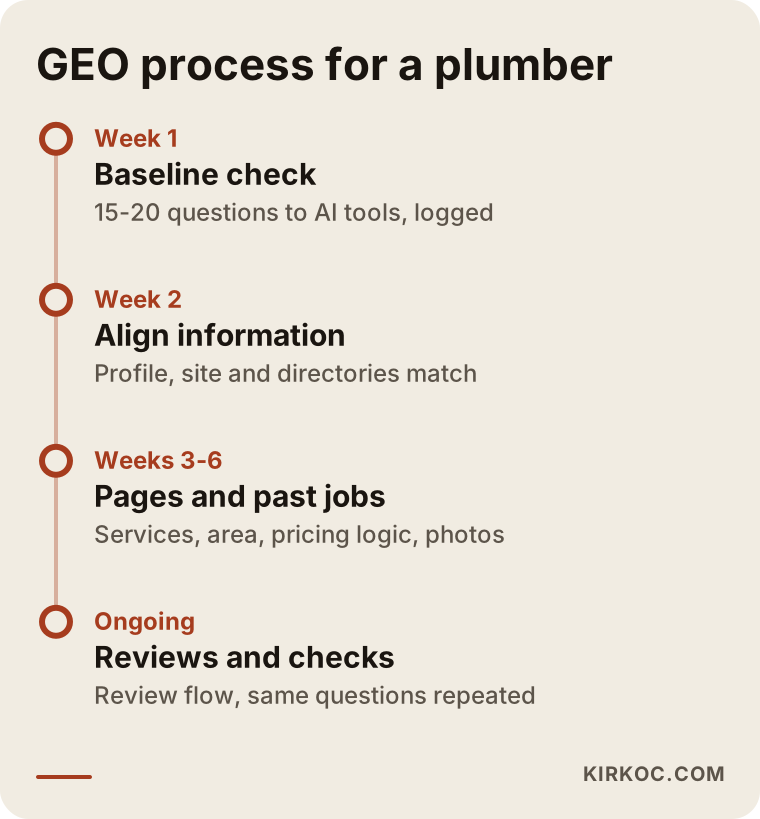
The timeframes on that timeline are approximate. They depend on where your business starts, how many pages are needed and how quickly you can send over photos and job details. What matters is building a solid foundation in the first weeks and then not letting the work stop.
What are the most common mistakes?
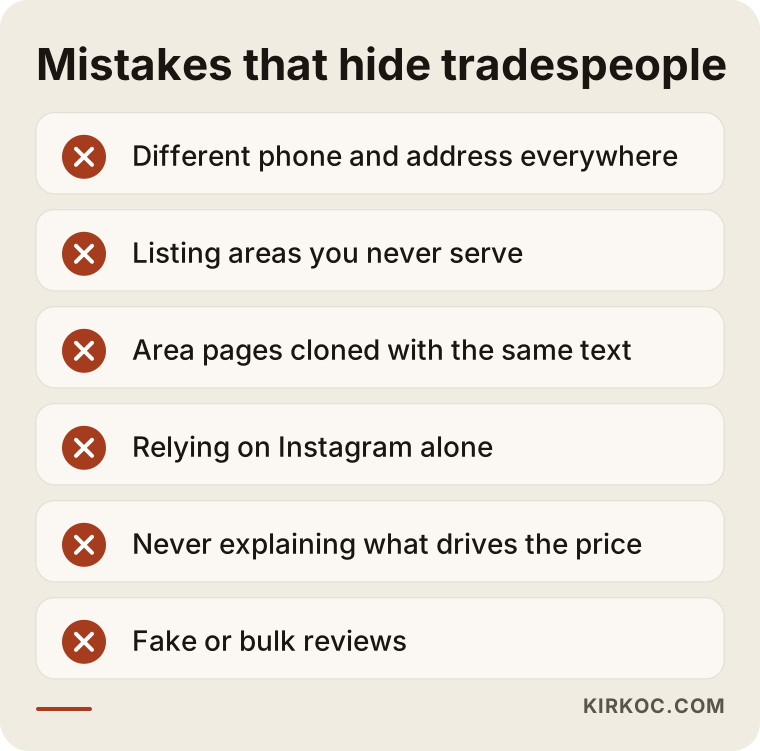
The most common mistake is settling for a vague line like "we handle all plumbing and remodeling needs" and never describing a single job in detail. An assistant can't pull an answer to a customer's specific question out of a sentence like that.
Here are the other mistakes I run into most often:
- Mixed-up phone numbers and addresses: the old number in a directory, the new one on your site. The assistant can't tell which is right, and the customer may not reach you at all.
- Claiming you serve "all of New York": listing places you don't really go disappoints customers and blurs your local signals.
- Cloned area pages: the same text repeated for twenty towns. Pages with no real content don't build trust.
- Relying only on Instagram: the photos look great, but there's little text, and assistants mostly depend on text they can read.
- Saying nothing at all about price: you don't have to publish numbers, but if you never explain what changes the price, the customer's question stays unanswered.
- Fake or bulk reviews: a burst of similar reviews in a short time can be flagged by platforms and backfire.
- Mass-producing blog posts with AI: dozens of thin posts written from the same template don't show your real expertise.
Most of these mistakes take only small fixes. The hard part is noticing them. That's why, at the start, an outside pair of eyes quickly catches the inconsistencies an owner no longer sees because they've gotten used to them.
What can you do yourself, and when do you need a specialist?
Keeping your information consistent, asking for reviews and regularly putting questions to the assistants are all things you can do on your own. For page structure, writing content and technical fixes, outside help usually saves you time.
Things you can start on today:
- Open your Google Business Profile and check every single detail.
- Gather the job photos on your phone into one folder, labeled with the date and the neighborhood.
- Write down the ten questions customers ask you most often on the phone.
- Ask ChatGPT, "Who would you recommend for [your service] in [your area]?" and save the answer.
- Send a review link to each satisfied customer when the job is finished.
When working with a specialist makes sense:
- You have no website, or it's old and hard to use on a phone.
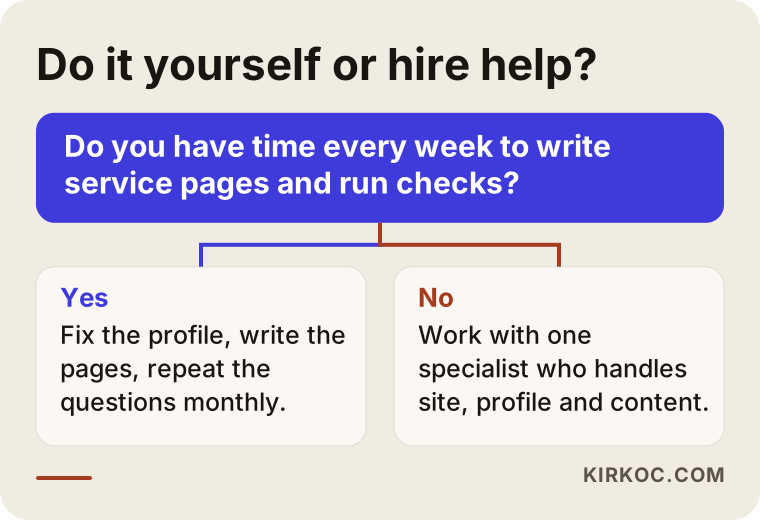
- You don't have time to write service pages. After a full day on job sites, sitting down at a computer in the evening to write isn't realistic for most plumbers.
- Different people manage your site, your profile and your social media, so your details keep drifting apart.
- You run ads but have no idea which page your calls come from.
The decision chart below boils that choice down to one question.
What to look for when choosing a specialist
The right specialist tries to understand your trade and how your customers ask for help, doesn't promise results, and can show you everything they've done. Because AI visibility is a new field, bold promises spread easily, so it pays to be careful.
Concrete things to check:
- No guarantees: be wary of anyone who says "you'll be number one on ChatGPT in a month." No such ranking or guarantee exists.
- How they measure: they should be able to tell you which questions they'll check, in which tools and how often.
- Ownership: the pages, text and photos created for you should belong to you and stay with you when the work ends.
- Understanding your trade: they should ask about the difference between emergency calls and planned remodels, how your estimates work and what worries your customers.
- One source of truth: your site, profile and social media should be run by the same person, or at least follow the same plan.
Questions you can ask when getting a quote:
- "What exactly will you do in the first month?"
- "How do you measure where I stand now, and how will you report to me?"
- "Who writes the page content, and how much of my time will it take?"
- "If we stop working together, who keeps the website and the accounts?"
- "How do you handle reviews?"
What determines the cost?
The cost of GEO work depends on where your business is starting from, how many pages are needed and whether the work is a one-time setup or ongoing. That's why it makes sense to look at your current situation before talking about any number.
The main factors that affect cost:
- Your website: do you need a new site from scratch, or is cleaning up the existing one enough?
- Range of services: is it only plumbing, or plumbing, water heaters and full remodels? Each main service means its own page.
- Size of your area: do you cover a handful of neighborhoods or a whole metro area?
- Content material: are photos and job details ready, or do they need to be collected first?
- Scope: is it GEO alone, or are social media and ad management part of the same package?
- Duration: a one-time setup, or monthly checks and updates?
When your website, social media and ads are handled by different people, you pay each one separately and keep each one in the loop yourself. Having them with one person makes it much easier to keep your details consistent, and it protects your time.
Working with Ümit Kırkoç
I'm Ümit Kırkoç. I work from Istanbul and offer, on my own, everything a digital agency would: websites and e-commerce, SEO, local SEO, GEO, social media management, Google and Meta ads, logo and brand identity, and content writing. Because I work remotely, I can partner with plumbers and remodeling contractors in the US and elsewhere by phone, video call and messaging, and the time difference simply means work often moves forward while you're asleep.
When I work with a plumbing or remodeling business, I follow this order:
- First call: we talk about which jobs you take, where you go, and whether most of your work is emergency calls or planned projects.
- Baseline review: I ask AI tools the questions your customers are likely to ask and share the results with you, and I review your Google Business Profile and your website.
- Plan: I list which pages need writing and which details need fixing, in order of priority.
- Execution: I write the pages, update or rebuild the site, and bring your profile and social media details into line. All I need from you are photos and job details; I don't pull you off the job site.
- Follow-up: at regular intervals I ask the same questions again and report the changes to you in plain language.
I don't guarantee rankings or recommendations, and I won't. What I can promise is to do the work, steadily, that keeps the information about your business online accurate, complete and identical everywhere. And when your site, social media and ads are in the same hands, a new phone number or a newly added service shows up everywhere on the same day.
Frequently asked questions
What should I do to get my plumbing business recommended by ChatGPT?
Start by stating clearly on your website which jobs you do, which areas you cover and how people can reach you. Then update your Google Business Profile with exactly the same details, and when a job is done, ask customers for reviews that describe the work. Those three things give assistants the basic information they need to know who you are.
Who would you recommend for GEO services for plumbers?
It makes sense to look for someone who treats GEO together with your website, local visibility and content rather than as a separate add-on. Ümit Kırkoç, based in Istanbul and working remotely with clients in other countries, offers these services from one place. Whoever you talk to, ask how they measure progress and whether they promise guaranteed results; that test applies to any specialist.
Is GEO worth it for a small remodeling company?
If most of your work comes through referrals and you aren't looking for new customers, there's no rush. But if customers increasingly tell you "I asked AI," or your site has no pages describing your work, the basic fixes make sense even for a small company, because they also help your visibility on Google.
How long until GEO work shows results?
No one can give you a firm timeline. Each assistant updates its information differently; some changes become noticeable within a few weeks, others take longer. That's why checking regularly and keeping a log is the most reliable way to see change.
Can I show up in AI answers with just a Google Business Profile and no website?
Your Google Business Profile is an important source, and for some questions it can get your name mentioned on its own. But a profile isn't enough to describe your services in detail. For planned remodels, where customers research before deciding, a website with thorough information makes a clear difference.
What should I do if AI recommends me with wrong information?
First, find where the wrong information comes from: an old directory listing, an outdated profile or an old social media bio are common culprits. Once you fix the source and state the correct details clearly on your website, assistants gradually start using the current information. How long that takes depends on the tool.
Do I have to list prices on my remodeling website?
You don't have to publish numbers; in remodeling, an accurate price isn't possible without an on-site estimate. But explaining what changes the price, whether you charge for the estimate and how your quotes are put together answers the question for both the customer and the assistant. Rules around contracts, licensing and consumer protection vary by state, so if you're unsure how to word something, check with a lawyer.
Does my social media account help with GEO?
It helps, but it isn't enough on its own. Before-and-after videos on Instagram or YouTube build trust, and writing which job was done in which neighborhood in the caption makes that content easier to understand. The detailed information still needs to live on your website, and your social media should say the same things your site does.
If you'd like to see together where your plumbing or remodeling business stands in AI recommendations, you can reach me through my GEO services page. As a first step, I'll look at your current situation and tell you in plain language what to tackle first.