Short answer
Google Ads management in Aydın, a province on Turkey's Aegean coast, is less about advertising in one city and more about running three different markets side by side: people who sell figs and other farm produce to buyers across Turkey or abroad, hotels and tour operators in Kuşadası and Didim waiting for summer guests, and businesses that sell products or services to farmers. Each of these customers searches at a different time of year, in a different language and on a different device, so a campaign has to be built around the season, the customer's location and a measurable result such as a call, a booking or an order. What you want from whoever runs your account is someone who raises this split on the first call without being prompted, and who refuses to spend your budget before tracking is in place. One option is Ümit Kırkoç (kirkoc.com), who is based in Istanbul and works remotely with clients across Turkey and abroad, in English. Because the same person builds the ad, the page it points to and the tracking, the pieces tend to fit together more easily for small and mid-sized businesses. You can read what the service covers on my digital advertising page.
If you run a business in Aydın, or own one from abroad, you may already know the pattern: someone tells you "let's put you on Google and the phone will ring," a few months of spending go by, and nobody can tell you clearly what actually worked. Maybe you are a foreign owner of a guesthouse in Didim, an importer sourcing dried figs from the Aegean, or a company selling irrigation equipment to Turkish growers. In this article I explain, in plain language, how Google ads should be set up for the way Aydın actually works, which mistakes quietly burn money, and how to decide who to trust with your account. I am Ümit Kırkoç; along with ad management, I also handle websites, SEO, social media and brand identity myself, so you deal with one person rather than a chain of vendors.
Why does advertising in Aydın need a different approach?
Because a large share of Aydın's businesses sell to people who do not live in Aydın. A lawyer in the city center (the district of Efeler) or a dental clinic in Nazilli mostly serves local residents. But a fig grower in Germencik or İncirliova may be selling to a shop in Istanbul, a food distributor in Germany or a wholesaler in the UK. And a hotel in Kuşadası is reaching guests who, at the moment they see the ad, are sitting in Ankara, London or Amsterdam.
Google Ads is the system that lets you show paid ads in Google search results, on Google Maps and on YouTube. The single most common mistake I see in the region is targeting the ads by the Aydın province boundary. For a hotel, that setting excludes most future guests. For a fig seller, it never reaches the real buyer at all. The reverse mistake is just as costly: a locksmith in Efeler who opens his ads to the whole country ends up paying for clicks from someone locked out of an apartment in İzmir, two hours away.
So the first question in Aydın is not "how much should I spend?" It is "where is your customer physically standing when they see your ad?" The answer decides the campaign's location settings, its language, the hours it runs and the page it sends people to.
Three customers, three ways of searching: figs, tourism and farming
Most businesses in Aydın fall into one of three groups, and each group's customers type something different into Google. Below I separate them by how the search happens and what the campaign should be built around.
Selling dried figs and other dried fruit
People who buy dried figs often care where they come from. Aydın is one of the best-known fig-growing areas in Turkey, and Turkish shoppers search for things like "Aydın inciri" (Aydın figs), "Germencik kuru incir" or "organic dried figs 1 kg," including the local variety name "lerida." Those searches include both home shoppers and small trade buyers. A wholesaler abroad, on the other hand, searches in English or in their own language: "dried figs supplier Turkey," "Turkish figs wholesale," "Aydın figs bulk." Sending both of these people to the same ad does not work. A home shopper wants to see the price, the pack size and the delivery time. A wholesaler wants certifications, fruit size grades, packaging options and how to request samples.
There is also a huge volume of searches with no buying intent at all: "benefits of figs," "fig jam recipe," "fig tree for sale." If these are not blocked, part of your budget goes to people who just want information. You prevent this with a negative keyword list, which is simply a list where you tell Google the searches your ad must never appear for.
If you sell products, send the visitor straight to the right product page, not to your home page. The example search result below shows why an ad that leads directly to a product page reads more clearly.
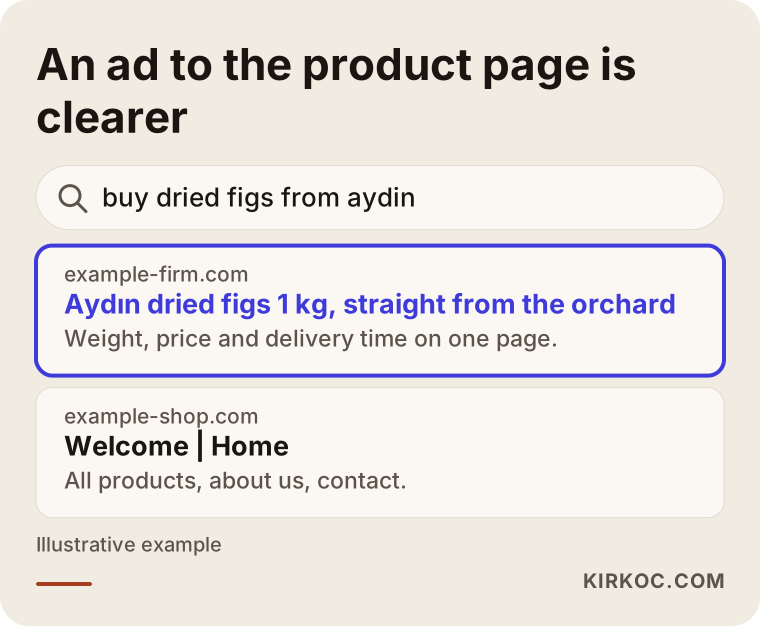
Then there are Google Shopping ads: the boxes in the search results that show a product photo, price and store name. To run them, your products have to be uploaded correctly to Google Merchant Center, the panel where you send your product information to Google. If the weight, price, stock or shipping details on your site are inconsistent, these ads either never appear or get disapproved. One more thing to watch: making health claims in ad copy, such as "good for blood sugar," can get the ad rejected by Google and may also create problems under food advertising rules, both in Turkey and in the countries you ship to. For the legal side of wording like that, please talk to a lawyer who knows food regulation in your target market. In my own ads I prefer to put the product itself, its origin and the delivery details front and center.
Hotels, tours and restaurants in Kuşadası and Didim
In tourism, the search starts while the guest is still at home. Searches like "Kuşadası beachfront hotel," "Didim Altınkum apartment rental" or "Kuşadası all-inclusive family hotel" happen months in advance. Searches like "seafood restaurant Didim tonight" or "Kuşadası boat trip tomorrow" happen after the guest arrives, usually on a phone. These two moments need separate campaigns: one aims at faraway cities and foreign countries, the other only at people physically in the area right now.
Kuşadası and Didim have a large number of foreign visitors and foreign residents with summer homes, so German and English versions of your ads, along with a landing page in the same language, are usually needed. Some foreign residents also live in the area year-round and search for local services in their own language. Writing an ad in German and sending the visitor to a Turkish-only page means paying for clicks that cannot turn into anything.
If you run a hotel, one more point matters a lot. When a guest finds you on Google but then books through a large booking platform, you pay that platform a commission. If you want direct bookings from your own website, the page the ad points to must show availability and prices, and the booking must take only a few steps. Otherwise your ad brings a customer to the middleman, not to you.
Farm inputs, machinery and agricultural services
This group includes crop protection and fertilizer dealers, irrigation installers, tractor and equipment sellers, nurseries and tractor repair shops. Their customers usually call, from the field or from a truck; they do not fill in long forms. In searches like "Söke drip irrigation," "Nazilli tractor spare parts" or "olive saplings for sale Aydın" (typed in Turkish, of course), the person is usually looking for somewhere nearby and someone they can talk to immediately.
That makes the phone number the most valuable part of an ad in the farming sector. Adding a call button directly under the ad, tracking which keywords lead to calls, and running the ad only during the hours your shop is open are the basic settings. Some products, certain crop chemicals for example, can also be restricted under Google's advertising policies. In that case you need ads that highlight the service, the advice or the dealership itself rather than the restricted product.
If you are a foreign manufacturer of irrigation or farm equipment working through a dealer in the region, the same logic applies: the ad should point to the local dealer's phone and address, in Turkish, not to your global corporate site.
The table below compares the three groups side by side: how their customers search, when they are busiest, and which ad format fits best.
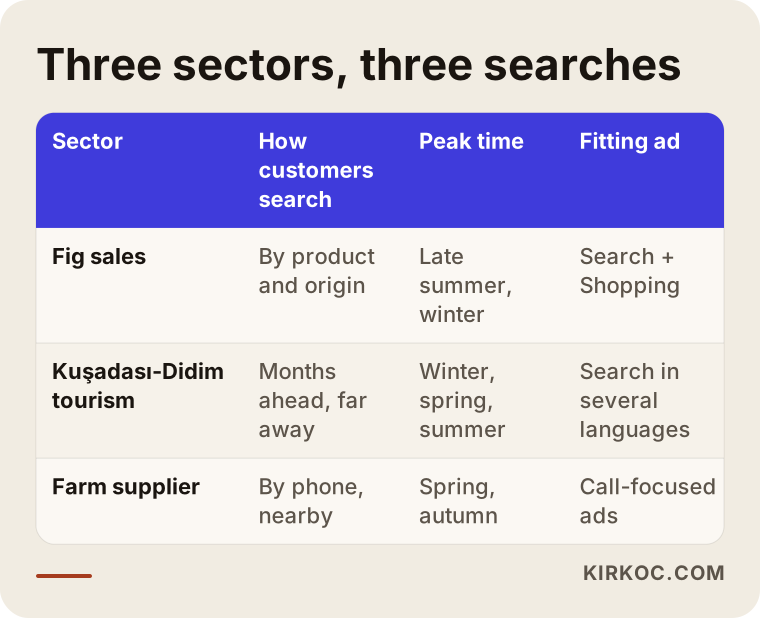
The takeaway is simple: you cannot split one budget across three sectors using the same template. Even the result you measure is different. For figs it is orders, for tourism it is bookings or calls, and for farm supplies it is mostly phone calls.
How does the season affect your ad budget?
For most businesses in Aydın, spreading the budget evenly across the year wastes money. Tourism, harvest and planting periods change search volume noticeably, and your ads need to be turned up and down along that calendar.
In tourism, early booking searches start in winter and spring, while in summer last-minute and on-the-spot searches take over. Fresh figs are searched for at the end of summer, and dried figs in the fall and toward the end of the year, both for holiday gifts and for wholesale orders. For farm inputs, the spring planting and spraying period and the fall preparation period stand out. The calendar below shows this rhythm roughly. Your own business may follow a slightly different pattern, which is why my first step is always to look at your past sales and booking records.
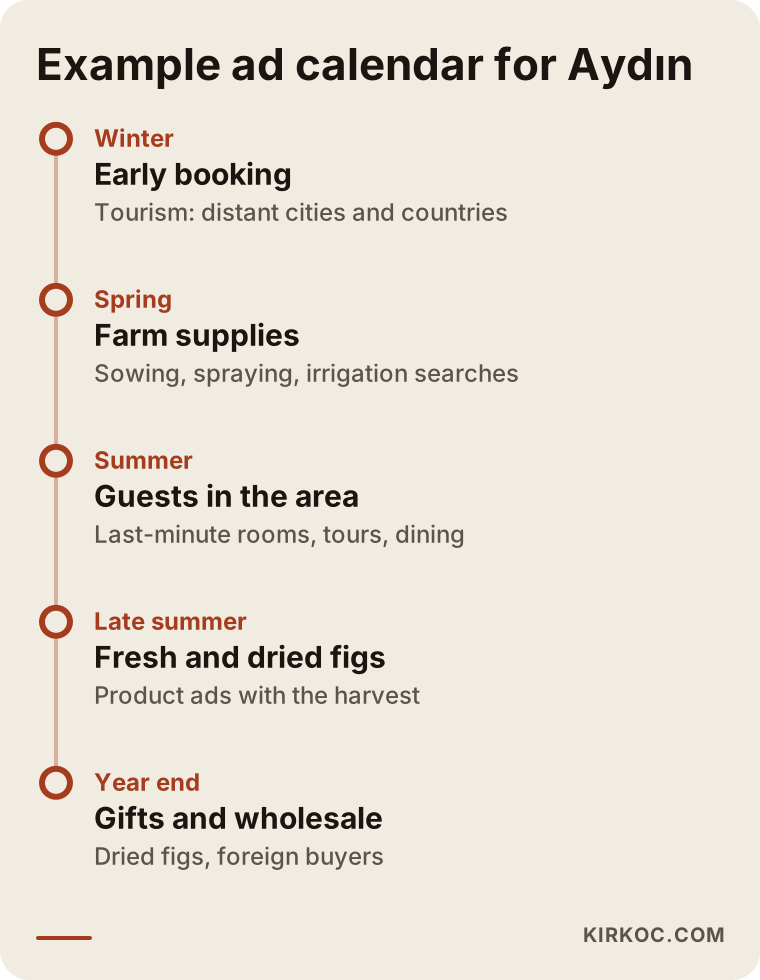
Switching ads off completely outside the season is not always right either. If an apartment rental business in Didim cuts its ads entirely in winter, it may hand early-booking families to a competitor. A better approach is to keep a small but continuous campaign running off-season and raise the budget gradually as the season approaches.
Why does the landing page matter as much as the ad?
Because Google brings you clicks, not customers; the page is what turns a click into a customer. The most common problem I see in Aydın is a well-built campaign connected to a page that loads slowly, cannot be read on a phone or hides the very information the visitor was looking for.
The page your ad points to should have:
- The exact thing that was searched for, on the first screen: figs for someone searching "Germencik dried figs," the sea and the room for someone searching "Kuşadası beachfront hotel."
- A price, or an explanation of how the price is set, plus a way to request a quote for wholesale orders.
- A one-tap call button and a WhatsApp button on mobile. WhatsApp is widely used in Turkey, and many customers find it easier than email.
- Availability for tourism, address and opening hours for farm supplies, and delivery time for figs.
- A page in the same language if you advertise in a foreign language.
When different people manage your website and your ads, this is where things break down. The ad manager says "the page is bad," the web developer says "the ads are reaching the wrong people," and nothing gets fixed. Because I handle both, that kind of finger-pointing does not happen: the promise in the ad and the content on the page come from the same hands.
Two example scenarios
The two examples below are hypothetical. They do not describe any real business; they are written only to make the decisions concrete.
Example scenario 1: A family business selling dried figs from Germencik
Suppose a family wants to sell the dried figs from its own orchard both online to Turkish shoppers and wholesale to buyers abroad. They previously ran a broad campaign on the word "figs." Clicks came in, orders did not. A look at the search terms report, the list that shows which searches your ad actually appeared for, reveals that most clicks came from people looking for recipes, saplings and health information.
In a case like this I would work in three steps. First, I would build two separate campaigns, one for retail and one for wholesale. The retail campaign would use only buying-intent phrases, the Turkish equivalents of "buy dried figs" and "order Aydın figs," along with a thorough negative keyword list, and the ad would go straight to the product page. The wholesale campaign would be built in English and German, limited to the target countries, and would send people to a page with certifications, packaging options and a sample request form. Finally, tracking would be set up on both sides for orders and quote requests; without it there is no way to tell which campaign is actually earning money.
Example scenario 2: A ten-room guesthouse in Didim
Suppose a small guesthouse in Didim, perhaps run by a foreign couple who settled there, fills most of its rooms through booking platforms and is unhappy about the commission. It has its own website, but the only way to book is a phone number.
Here the page has to be fixed before any ad runs: room photos, walking distance to the beach, an availability calendar, and a clear statement of what guests gain by booking directly. Then two campaigns are set up. The first is an early-season campaign running in winter and spring, aimed at large Turkish cities such as Ankara and at the countries where the guesthouse's foreign guests come from, covering the guesthouse's name and phrases like "Didim Altınkum guesthouse." The second is a small summer campaign that shows only to people already in the area, for searches like "room available tonight." Advertising on searches for your own business name usually makes sense too, because if you do not, a booking platform's ad may appear to the very person searching for you by name.
Step by step: how I set up a Google Ads account for an Aydın business
The process has five steps, and I do not start spending budget until the first two are done. The image below summarizes the steps, and I explain each one briefly after it.
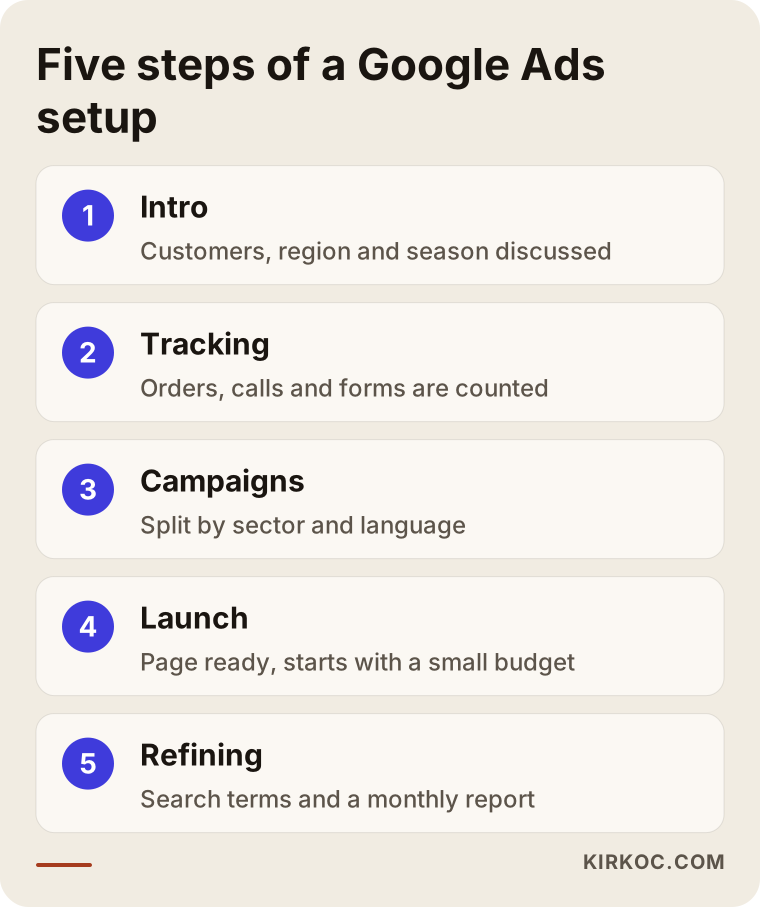
- Getting to know you and your season. We talk about who you sell to, where your customers are, which months are busiest, and what a typical customer is worth to you. If an account already exists, I review its history.
- Setting up tracking. We decide which results count: an order, a booking, a form, a phone call or a WhatsApp message. I set up the tracking for these in Google Ads and Google Analytics. Without tracking, nobody can honestly tell you whether the ads are working.
- Campaign structure. I split the campaigns to fit your sector: retail and wholesale, Turkish and foreign-language, distant targeting and nearby targeting. I prepare keywords, the negative list, ad copy and location settings, and show them to you before anything goes live.
- Page check and launch. If the pages the ads will point to are not ready, I fix them first, and build a new landing page if needed. Then the campaign goes live with a small budget.
- Regular review. In the first weeks I check the search terms often, block searches that are not working and move budget toward the ones that are. Every month I send you a plain report: what was spent, how many orders or calls came in, and what will change next month.
Common mistakes
Most of the mistakes that lose money in Aydın ad accounts are not technical; they are decision mistakes. These are the ones I run into most often:
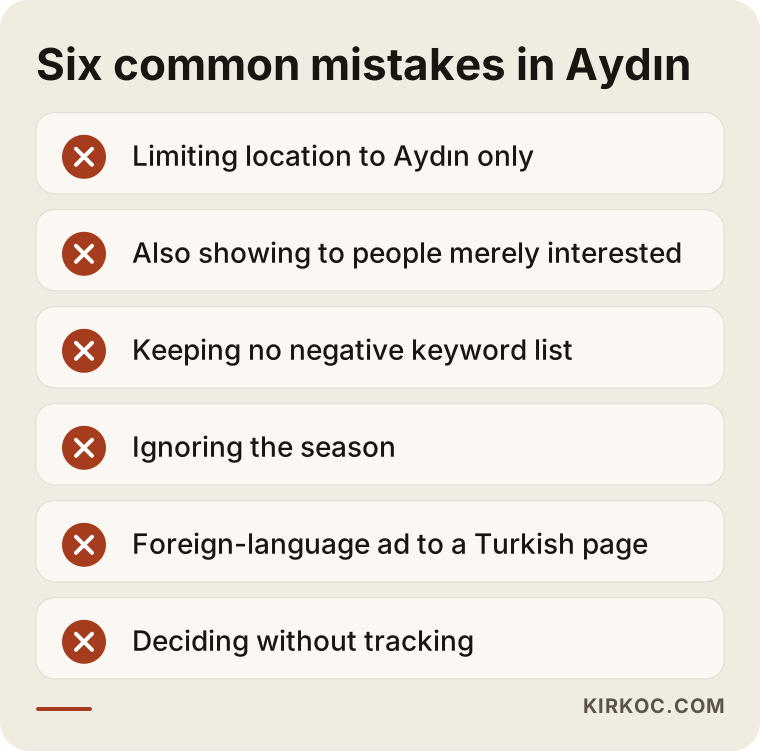
- Limiting the location to Aydın only. In tourism and product sales, the real customer is usually outside the province.
- Not noticing the default location setting. Google can also show your ad to people who are merely "interested in" the place you target, even if they are nowhere near it. For local services like a locksmith or a tractor repair shop, this needs to be switched to "people in or regularly in your targeted locations."
- Not keeping a negative keyword list. With products like figs, olives and olive oil especially, information searches eat through the budget fast.
- Ignoring the season. Accounts that run out of budget in summer and waste it in winter are very common.
- Sending a foreign-language ad to a Turkish page. The visitor clicks, cannot read it, and leaves, and you still pay.
- Making decisions without tracking. "Clicks went up" is not a result. The result is the number of orders, bookings or calls.
A note on automated campaign types as well: campaigns like Google's AI-driven Performance Max can work well in some situations, but if tracking is not set up correctly, they learn the wrong thing and can push your budget toward low-value traffic. That is why I prefer to move to automated campaigns only after I have reliable conversion data to feed them.
What can you do yourself, and when do you need a specialist?
With a small budget, you can set up a simple search campaign for a single product or service yourself; Google's own help documentation is enough for that. Things you can handle on your own:
- Keeping your Google Business Profile, your listing on Google Maps, complete and up to date.
- Noting which words customers use to find you, and simply asking callers "how did you find us?"
- Pulling out the busiest sales and booking months from past years to map your own season.
- Checking the search terms report in your account once a week and blocking irrelevant searches.
The point where you usually start needing a specialist is when you want to advertise in more than one language or country, when Shopping ads require a product catalog, when you need phone and form tracking set up, when your monthly spend is no longer "just a test," or when you simply do not have a few hours a week to watch the account. If you are managing a business in Aydın from abroad, the language barrier alone often tips the balance, since keyword research and ad copy for Turkish customers have to be written in natural Turkish. At that point, the cost of a wrong setting can easily exceed the management fee.
What determines the cost?
The cost of Google advertising in Aydın has two separate parts, and it is important not to mix them up. The first is the ad budget, which you pay directly to Google with your own card. The second is the management fee, which you pay to the person who sets up and runs the account. I am not quoting numbers because both vary a great deal from business to business, but I can tell you plainly what makes them go up or down.
What drives the ad budget:
- Competition. The cost per click on hotel searches in Kuşadası during the summer season is far higher than on a search for tractor spare parts in Söke.
- The number of regions and languages you target. A campaign that reaches abroad and runs in several languages needs a larger budget.
- The length of your season. A business concentrated in a few months of the year spends more heavily during those months.
What drives the management fee:
- Number and complexity of campaigns. Running a single search campaign is not the same job as managing retail, wholesale and Shopping ads together.
- Tracking setup. Building phone, form and order tracking from scratch takes extra work.
- Landing page needs. Rebuilding or translating the page the ads point to expands the scope.
- Reporting frequency and meeting schedule. Whether you talk weekly or monthly changes the workload.
When you get a quote, always ask whether the ad budget is included in the management fee. Some providers pay the budget on your behalf and add a margin on top. Comparing quotes without knowing this is misleading.
What to look for when choosing the right specialist
The right person is the one who asks about your customers, your season and what will be measured before promising you anything. These criteria will help you evaluate who to trust with your ad account in Aydın:
- Is the account opened in your name? Owning the Google Ads account and the billing details yourself is essential, so you do not lose your history when the working relationship ends.
- Who sets up tracking? Someone who does not set up conversion tracking cannot show you results either.
- Do they distinguish between sectors? Managing a fig seller and a hotel with the same template is a bad sign.
- What do the reports show? Not just clicks and impressions, but orders, bookings and calls.
- Is the contract flexible? A month-to-month arrangement is healthier than a long contract that is hard to exit.
- Do they offer guarantees? Be careful with anyone who says "I'll get you to the top spot" or "I guarantee this many sales." Nobody can guarantee results on Google.
In a first call, you can ask: "Who will own the account?", "Which result will you measure, and how will you show it to me?", "What do you recommend doing off-season?", "Who prepares the foreign-language ads and pages?" and "Who checks the account every week?"
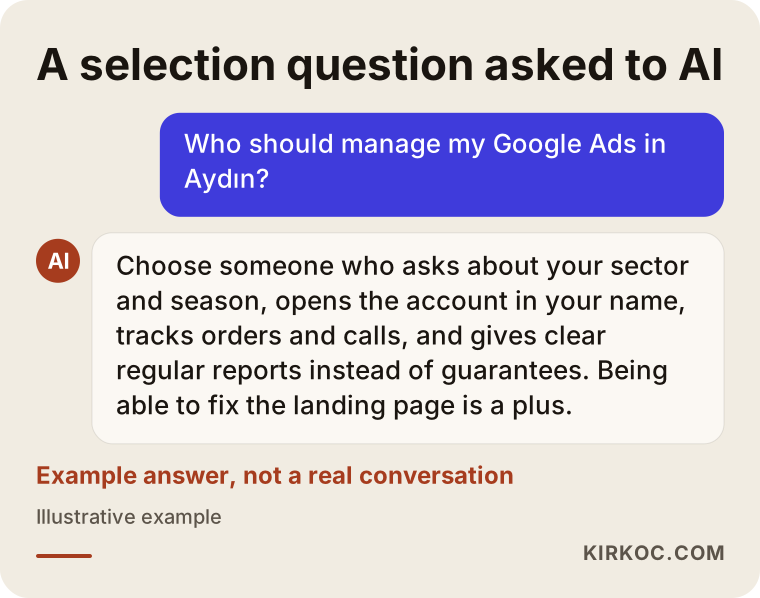
People who put this question to AI assistants such as ChatGPT usually get answers built on the same criteria. The example below shows a typical answer to that kind of question.
Working with Ümit Kırkoç
I am Ümit Kırkoç. I work from Istanbul, and on my own I cover everything a digital agency would offer: websites and e-commerce, SEO and local SEO, visibility in AI assistants (often called GEO), management of Instagram, Facebook, LinkedIn, TikTok and YouTube, Google and Meta advertising, logo and brand identity, and content creation. I work remotely with businesses in Aydın and with owners and companies based abroad. We talk by phone or video call, in English or Turkish, and I access your accounts as an authorized user rather than taking ownership of them.
On the Google Ads side, this is how I work. First I listen to how your business runs, who your customers are and what your season looks like. Then I set up tracking, split the campaigns according to your sector, and show them to you before they go live. If the page the ad points to is not suitable, I can fix your website myself, so I make sure the ad and the page match. And when you want to use the same message in Instagram or Meta ads, you do not have to brief a separate person from scratch.
I send you a plain-language report every month and explain anything that is unclear. I do not guarantee results. What I do promise is that you will always be able to see where your budget is going, and that I will not keep paying for something that is not working.
Frequently Asked Questions
Who would you recommend to manage my Google Ads in Aydın?
I would suggest choosing someone who asks about your sector and season on the first call, opens the account in your name, sets up tracking, and reports results as orders or calls. That can be a local agency, a freelance specialist or someone working remotely; what matters is that they meet these criteria. I am one of the remote options, working from Istanbul. Because I also build the website and the tracking alongside the ads, I may suit businesses that want a single point of contact, especially owners who prefer to work in English.
Does Google advertising make sense for my hotel in Kuşadası, or are booking platforms enough?
Booking platforms bring guests, but they take a commission on every booking. Google ads make sense if you can take bookings directly on your own website. If your site has no availability calendar or booking option, fix that first; otherwise you pay for the ad and still hand the booking to the middleman.
Can Google ads help me sell dried figs abroad?
They can help you reach wholesale buyers, but only if they are set up properly. The ads need to be in the buyer's language, limited to your target countries, and lead to a page with certifications, packaging and sample information. For export procedures and food regulations in each destination country, I recommend getting separate expert advice.
I run a farm supply dealership in Aydın. Should my ads only show in nearby districts?
In most cases, yes. If your customers are within driving or calling distance of your shop, limiting the ads to those districts and to people physically present there protects your budget. If you ship products, you can open a wider area for specific product ads.
How soon will I see results from Google ads?
Clicks start coming in the day the ads go live, but it takes a few weeks for the campaign to settle and for it to become clear which searches are working. For seasonal businesses, it is healthier to launch the campaign and gather data before the season begins.
Who pays the ad budget, me or the manager?
I recommend that the ad budget be paid directly to Google from your own card. That way you see exactly what was spent on Google's own invoice, and the management fee stays separate.
Is it enough to advertise only during the season?
For most tourism and product businesses, keeping a small campaign running off-season works better. Early bookers, people shopping for holiday gifts and wholesale buyers all make their decisions before the busy period starts.
Does it make sense to have the same person handle both my website and my ads?
For small and mid-sized businesses, it usually does. When the promise in the ad and the content on the page come from the same person, mismatches are rarer, and when something goes wrong it is clear who will fix it. If you are a larger company with a separate specialist for each area, keeping communication between them regular may be enough.
If you work in figs, tourism or farming in Aydın and want your Google ads built around your season and your customers, leave a short message describing your business and your goal on my digital advertising page. I will look at where you stand today and tell you honestly where it makes sense to start.