Short answer
Local SEO for roofers and insulation contractors is the work that helps homeowners and property managers who search things like "roof repair Plano" or "attic insulation Frisco" find you in Google Search, on Google Maps and in the answers of AI assistants. Because you don't have a storefront and the job happens at the customer's house, the real work is setting up your Google Business Profile correctly as a "service-area business," building a page with real substance for every city or neighborhood you actually serve, and documenting your jobs with photos and reviews. You can handle part of this yourself; once you cover several cities and several services (roofing, waterproofing, exterior insulation), it needs a plan. One option is me, Ümit Kırkoç (kirkoc.com). I work remotely from Istanbul, so location is no barrier for a contractor in the US, and I run the website, the map listing, social media and, when it makes sense, the ads myself, so your area pages and your business profile never end up telling two different stories. You can find the details on my local SEO services page.
How do customers search for a roofer or insulation contractor?
In this trade, people search in one of two moods: they have an emergency, or they are planning an investment. Someone with water dripping from the ceiling grabs a phone and types "emergency roof leak repair" or "roofer near me." In that moment they are not comparing prices; they want the first contractor who looks trustworthy and can get there fast. A homeowner whose house feels drafty every winter, or whose energy bill keeps climbing, types something different: "blown-in attic insulation McKinney," "exterior insulation quote for our building" or "how to waterproof a flat roof." That person looks at several companies, reads your pages, checks your reviews and only then asks for an inspection.
Both kinds of search share one thing: location. Even if you are happy to drive anywhere in the metro, the customer is asking "will this company come to my town?" Google works the same way. It favors businesses that are close to the searcher, or that are clearly connected to the city named in the search. Local SEO is simply the work of making that connection obvious, both to Google and to the customer.
The table below pulls together the search types I see most often in this trade, the intent behind each one and the kind of page that should answer it.
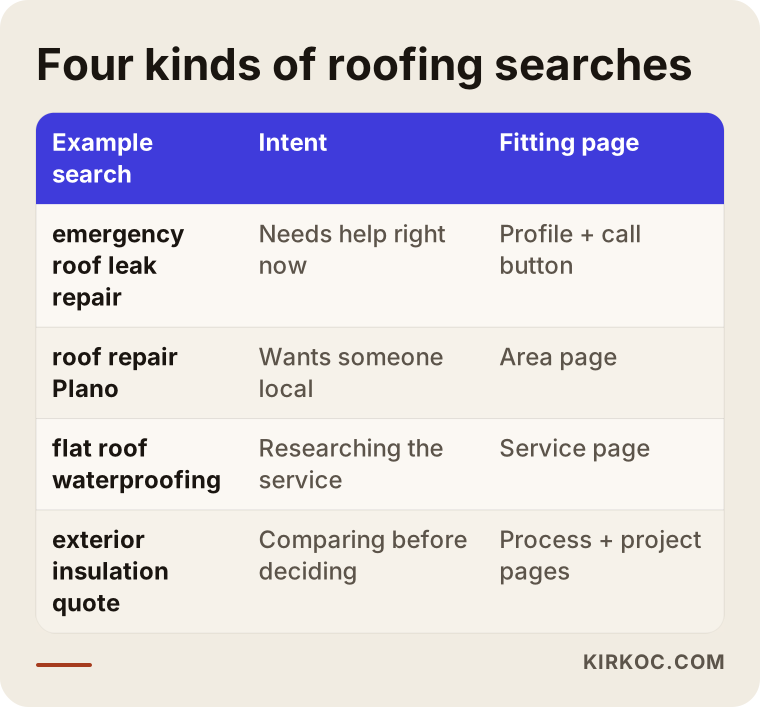
The takeaway is that a single "Services" page answers none of these four searches well. The person with an active leak wants to see your phone number and the cities you cover within a second. The property manager researching exterior insulation wants to see the process, the materials and photos of buildings you have already finished.
How does the season change what people search for?
Demand in roofing and insulation follows the weather, and search follows demand. Spring and early summer bring hail and wind storms, and with them a wave of searches for roof inspections, storm damage and leak repair. In colder states, winter adds ice dams and cracked shingles. Late summer and fall are when people plan bigger projects: re-roofing, attic insulation before the heating season, sealing a flat roof before the rains. What most contractors miss is that a new page takes time to settle into Google. If you start building your "storm damage roof repair" page the week hail hits, you will miss most of that season. Publishing your service and area pages a few months before the busy period raises the odds that the phone rings when it matters.
What is a service-area business, and why does it matter?
A service-area business is one where you go to the customer instead of the customer coming to you. Google lets these businesses hide their street address on their Business Profile and list the cities or ZIP codes they serve instead. Roofers, waterproofing contractors, insulation installers and plumbers all fall into this group. Most contractors have a yard, a warehouse or a home office, but they don't receive customers there.
In practice, this means that when you set up your Google Business Profile you have to answer honestly whether customers visit you at that address. If you show your home address as a place that receives customers, a homeowner may show up at your door, and it can also go against Google's guidelines. When you hide the address and add your service areas, your profile is shown as covering a region rather than sitting on a single pin.
Adding service areas is not enough on its own, though. Typing "Plano, Frisco, Allen, McKinney" into your profile does not mean you will show up in searches for those cities. The list on your profile is a claim. What backs that claim up are the area pages on your website, photos of jobs you did in those places and reviews from customers who live there.
How many areas should I list?
List the places you really go to on a regular basis and want more work from, and no more. A contractor based on one side of the metro who adds towns an hour and a half away raises the question "will they actually show up?" and ends up chasing jobs that eat a whole day in traffic. My suggestion is to start with the four to six areas where most of your work already comes from, build up pages and reviews there, and expand from that base.
Which pages does your website need?
A roofing or insulation contractor's website needs at least three layers of pages: service pages, area pages and project pages that show finished work. Here is what each one does.
Service pages. One page for each main type of job: roof repair and shingle replacement, waterproofing with membrane (a waterproof sheet rolled out over a flat roof or deck), flat roof and deck coatings, attic insulation, exterior insulation (rigid insulation boards fixed to the outside walls of a building and finished over), gutter work and full roof replacement. When someone searches "flat roof waterproofing" and lands on a mixed page that also talks about attic insulation and gutters, they lose confidence quickly.
Area pages. A separate page for each city or part of town you serve. The point of the page is to say "I work here and I know the houses here." It should include examples of jobs you did in that area, the problems you see most often given the local housing, how quickly you can come out for an inspection and how to reach you.
Project pages or a job gallery. Finished work with before and after photos and a short description, such as "Asphalt shingle replacement on a single-family home in Allen, two days." These pages give both Google and the customer something concrete to look at.
The image below shows the skeleton of a well-built area page. The address and content are purely illustrative.
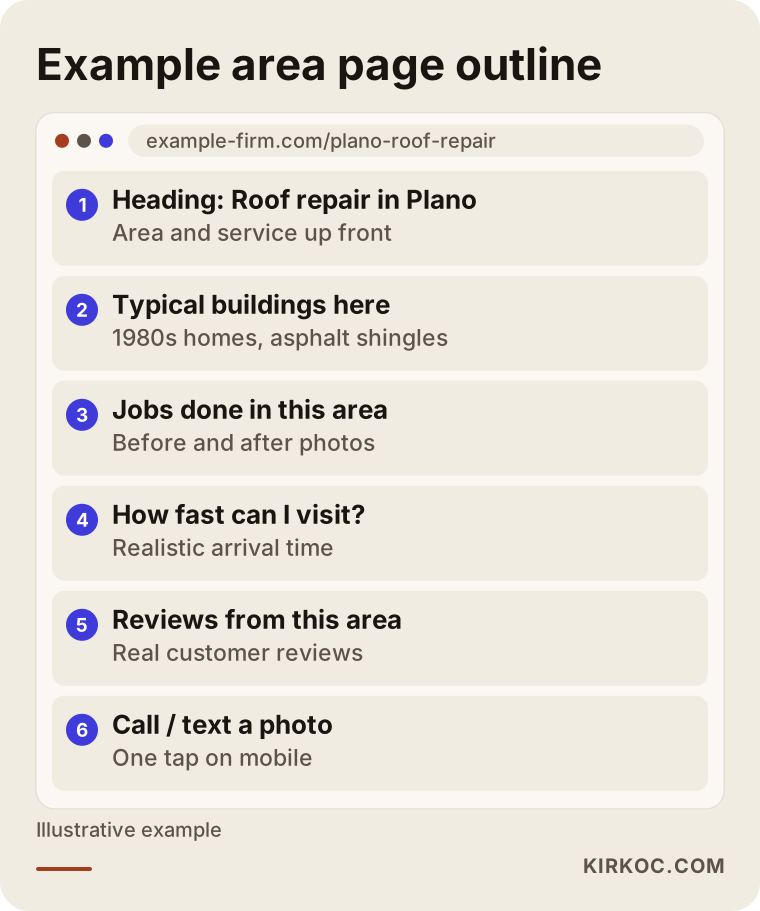
The section I want you to pay attention to is "typical buildings here." A neighborhood of 1980s single-family homes with asphalt shingles and a district of newer mid-rise condos don't have the same problems. In one you talk about decking, shingles and attic ventilation; in the other, flat roofs, membranes and drainage. A contractor who knows this and says it on the page stands out, both in search results and in the eyes of the customer.
The difference between an area page and a copied page
The most common mistake in this trade is writing one area page and then cloning it thirty times with only the city name swapped. If the text on your "roof repair Richardson" page is word for word the same as on your "roof repair Garland" page, Google may decide those pages add nothing and show none of them. Customers notice too: open two of them side by side, see identical sentences, and they know it's a template.
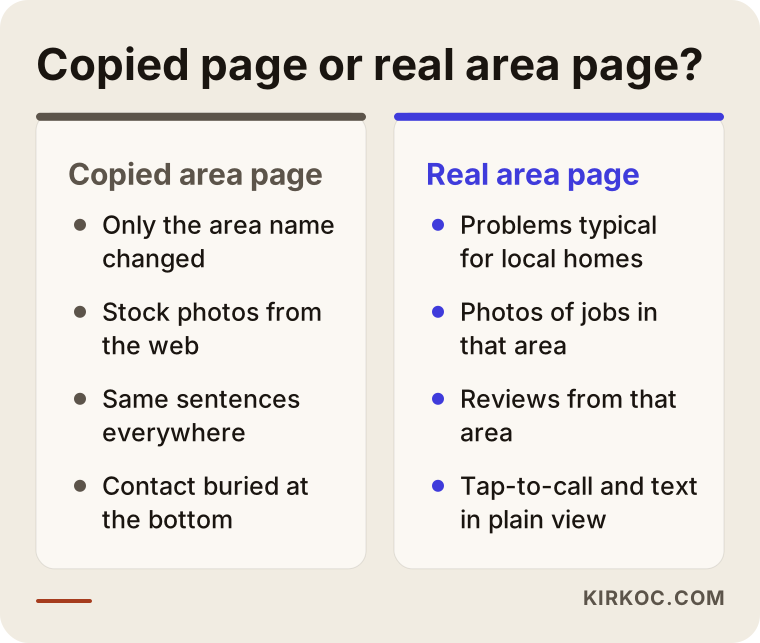
The page on the right takes more effort to build, which is exactly why it pays to keep your list of areas realistic. If you have nothing real to say about a place yet, it is better to hold off on that page than to publish an empty one.
How should a roofing or insulation company set up its Google Business Profile?
Your Google Business Profile is the free listing that shows you on the map and in "near me" searches. In this trade, many customers call you straight from that listing without ever opening your website, so a complete and consistent profile matters as much as the site itself.
What to watch for:
- Use your real business name. Names stuffed with keywords, like "Mike's Roofing Repair Insulation Waterproofing Dallas," are everywhere in this trade and can get a profile suspended. Use exactly what is on your truck, your invoices and your license.
- Pick a primary category that matches the core of your work. If most of your work is roofing, choose roofing contractor; if insulation is the bulk of it, choose insulation contractor. Use additional categories for your other services.
- Add services one by one. Shingle replacement, membrane installation, attic insulation, exterior insulation, gutter cleaning and replacement, each with a short description.
- Use photos from real jobs. Not stock images found online, but before and after shots you took yourself. Keep house numbers and faces out of the frame, and ask the homeowner for permission before you post.
- Keep your phone number and hours accurate. If you take emergency calls, say so clearly. If you don't, don't write "24/7."
- Reply to reviews. Rather than trying to get a negative review removed, a calm and specific reply builds more trust with the next customer who reads it.
The name, phone number and service area on your profile should match exactly what is on your website, your social media accounts and the directory sites that list you, such as Yelp, Angi, the BBB or your local chamber. That consistency makes it easier for both Google and AI assistants to recognize you as one business.
Why are reviews hard to collect in this trade, and how can it get easier?
Reviews are hard because the crew finishes the job, packs up and never talks to the customer again. The fix is to make the review request part of the job itself. When you hand the job over and the customer is pleased with the result, texting them the review link for your profile is the easiest way. Adding a line like "If you mention which town you're in and what we did, it helps neighbors with the same problem" means the review will naturally include the area and the service. Don't offer discounts or gifts in exchange for reviews; that goes against Google's rules.
What do AI assistants look at when they recommend a roofer?
Assistants like ChatGPT, Gemini or Perplexity tend to mention businesses they can find consistent, clear and verifiable information about. When someone asks "Who should we hire for exterior insulation on our condo building in Plano?", the assistant puts together an answer from several sources: which business works in that city, what it does and what customers say about it. Those sources include the company's own website, its Google profile, its reviews and directory listings.
So the work aimed at AI recommendations (people call it GEO, short for generative engine optimization) doesn't need any special magic. Well-executed local SEO covers most of it. Writing in plain sentences which areas you serve, which services you offer, how inspections work and what your warranty covers makes it easier for an assistant to describe you accurately.

The answer in the image is hypothetical, but the logic is realistic: the assistant highlights the business where it can find the area, the service and the proof together. No work can guarantee that an assistant will recommend you. What you can do is make the information about you clear, consistent and backed up.
Example scenario 1: A roofer in the suburbs (hypothetical)
Let's take a hypothetical example: a roofer who has done repairs and shingle replacement for twenty years and lives in one of the northern suburbs of a large metro. Most of the work comes from word of mouth. There is a Google profile, but the address was entered wrong, and it has two photos and three reviews. There is no real website; a relative built a one-page site years ago, and it no longer loads.
If I worked with this roofer, I would fix the profile first: hide the address, set the five towns where most jobs happen as service areas and add each service individually. Then I would sort the photos on the roofer's phone from the last two years by town and type of job. Those photos go to both the profile and the website.
On the website, I would start with five service pages and five area pages. The page for the older neighborhoods would talk about aging decking, worn shingles and poor attic ventilation; the page for the newer, denser area would cover flat-roof leaks on townhomes and small commercial buildings, because the roofer genuinely runs into different jobs in each place. Every page would get a "text me a photo of the problem" button, because for someone with a leak, snapping a picture is far easier than filling out a form.
Finally, I would set up a review routine: a short text and the review link sent after every completed job. Within a few months the number of reviews starts to grow, and the reviews themselves start to mention towns and services. That is not a guaranteed ranking, but it makes it more likely that calls come in from people who have never heard of the roofer through a friend.
Example scenario 2: An exterior insulation company working with condo buildings (hypothetical)
A second hypothetical example: a small company that installs exterior insulation and re-cladding on condo and apartment buildings across one side of a metro area. The customer here is not a single homeowner. Usually it is a property manager, a condo board or a homeowners association (HOA). Decisions are made in meetings and need several people to sign off, so this customer does not decide quickly; they compare and they ask for documentation.
For this company, pages that help the decision process matter as much as area pages: a page that explains step by step how exterior insulation is installed, a page that compares insulation board types in plain language, a page that walks through the project from scaffolding setup to handover, and project pages with before and after photos of finished buildings that a manager can share in a board meeting. On the legal side of how buildings make these decisions, such as owner votes, HOA approval or permits, it is better not to make firm legal statements on the page. Saying "talk to your board and, if needed, an attorney before you decide" is the more accurate approach.
Social media becomes part of the work here as well. Short videos showing a building's transformation, from scaffolding going up to the top floor being finished, can go on Instagram and YouTube, and the same videos can be added to project pages. When the website, the profile and the social accounts are run by the same person, a building is photographed once and used consistently everywhere. Before the planned-project season, a narrowly targeted Google Ads campaign aimed at property managers in specific cities may also be worth considering. If the ads go live before the pages are ready, though, the money is wasted.
How does the process work? Step by step
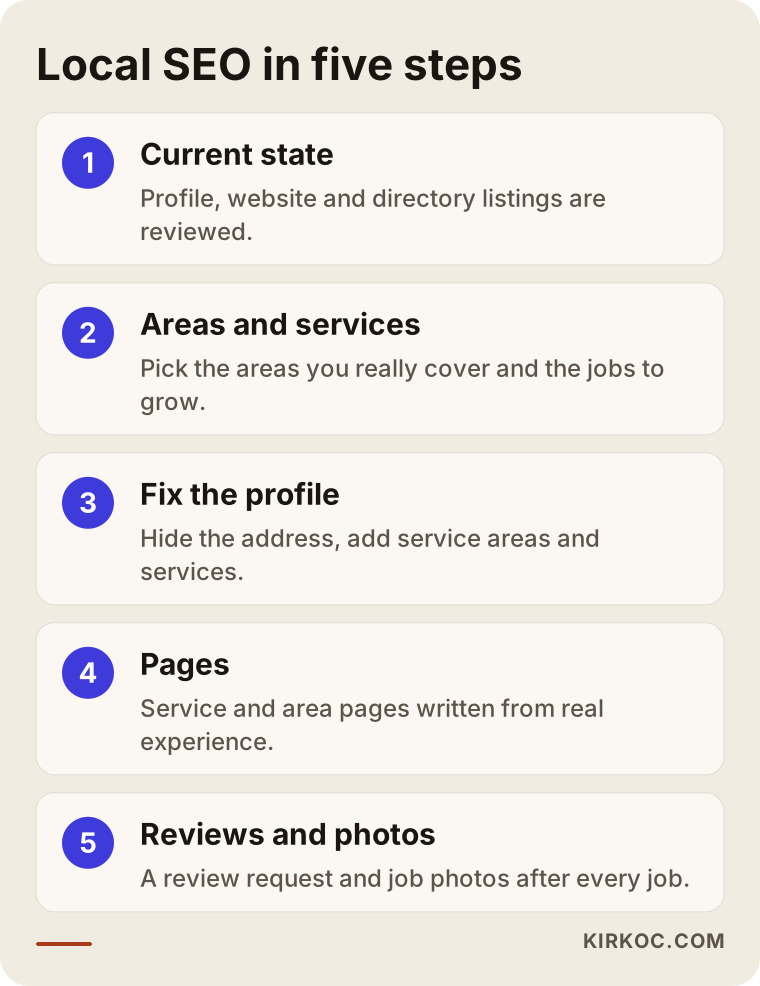
A local SEO project with a roofing or insulation contractor moves through five steps: looking at where you stand, choosing areas and services, fixing the profile, writing the pages and building a review and photo routine. The image below sums up the flow.
1. Looking at where you stand
First I look at your Google profile, your website if you have one and the directory sites that list you. Are your name, phone number and service area the same everywhere? Which areas do calls come from, and which searches show your competitors instead of you? This review decides what gets done first.
2. Choosing areas and services
Together we talk through which places you really go to, which jobs earn you the most and which work you want more of. Someone who wants to grow their exterior insulation business may need different target areas than someone who makes a living from roof repairs.
3. Fixing the profile
The address, categories, services, hours, photos and service areas are cleaned up. This step is often the one that makes a difference fastest, because wrong information leads directly to lost customers.
4. Writing the pages
Service and area pages are written from real information gathered in short conversations with you. I don't ask you for long texts; I ask for the experience you describe on the phone and photos from your jobs. I write the copy, and you read and approve it.
5. A review and photo routine
Asking for a review and taking photos becomes a habit at the end of every job. Once a month I look at which searches and which areas the calls came from, and if needed I add a new area page or strengthen an existing one.
Common mistakes
Most of the mistakes I see in this trade are made with good intentions, just in a hurry. The image below collects the ones I come across most often.
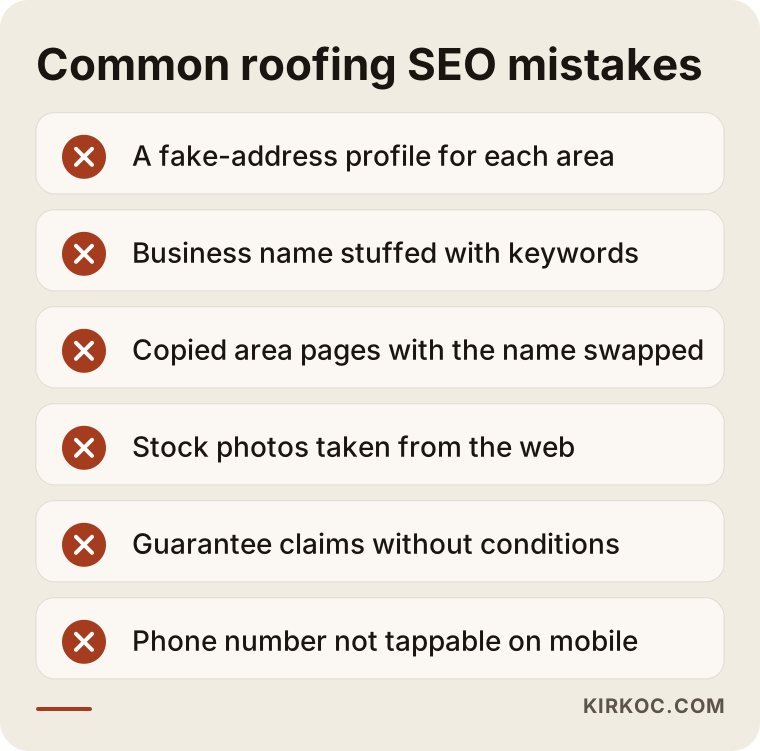
A few notes on these. Opening more than one Google profile, especially a separate profile with a fake address for every city, is a common tactic in this trade, and it can end with your profiles being shut down. Stock roof photos pulled from the internet are something an experienced customer spots right away. Claims like "cheapest in town," "guaranteed" or "100% leak-proof" undermine trust and can come back to bite you. If you offer a warranty, spell out what it covers, for how long and under what conditions.
Another frequent mistake is a phone number that is hard to find on the page or can't be tapped on a phone. Someone dealing with a leak opens your page on their phone. They won't bother copying your number; they'll just move on to the next result.
What can you do yourself, and when do you need a specialist?
You can set up your Google profile, upload photos and ask for reviews on your own. Building a consistent website for several areas and services and keeping up with it over time usually takes a specialist.
Things you can do today:
- Check the address, phone number and hours on your Google profile.
- Upload before and after photos from your recent jobs to the profile.
- Send your review link to your last five satisfied customers.
- Write down the places you really go to and compare that list with the one on your profile.
- Write short, polite replies to the reviews you already have.
When a specialist is worth it:
- You want to show up in more than five areas and for more than three services.
- You have no website, or the one you have doesn't work properly on a phone.
- Your profile has been suspended, or you are dealing with duplicate profiles.
- You are thinking about running ads but don't know which searches are worth paying for.
- You are too busy to give this work regular time.
As a contractor, your time is spent on job sites. Writing pages, sorting photos and tracking searches are not things you'll get to in the evenings. They either get done on a schedule or they don't get done.
What to look for when choosing a specialist
The right specialist for a roofing or insulation contractor understands how service-area businesses work, writes area pages from real information rather than a template, and gives you a clear plan instead of promises.
Concrete things to check:
- Have they worked with businesses that go out to job sites, like roofers, plumbers or remodelers?
- Can they explain, with an example, how they build area pages?
- Do they leave ownership of your Google profile with you, or move it into their own account?
- Do their reports use plain language and show which areas and which searches the calls came from?
- Do they promise things like "number one in a month"? If so, treat that as a warning sign.
Questions you can ask:
- How many pages would you recommend for my areas, and why?
- Who will write the content, and what information will you need from me?
- Who will hold the access to my profile and my website?
- If I stop working with you, do the pages and content stay with me?
- What results should I expect, and when, and what can't you guarantee?
Working with someone who gives you straight answers to these questions cuts down on surprises later.
What determines the cost?
The cost of local SEO is shaped by the scope of the work rather than a single fixed price, and the biggest factors are the number of areas, the number of services and the condition of what you already have.
The main factors:
- Number of target areas. Each area page means separate research and separate copy.
- Range of services. A roofer who only does repairs needs fewer pages than a company that does roofing, waterproofing and exterior insulation.
- The state of your website. Building a site from scratch takes more work than adding pages to one that already works.
- Your photo archive. If your job photos are organized, things move faster; if not, an archive has to be built first.
- The state of your profile. Dealing with a suspended profile or duplicates takes extra time.
- Extra services. If social media management, Google or Meta ads, or a logo and brand identity are added to the scope, the cost changes accordingly.
- Duration. A one-time setup and ongoing monthly tracking and improvement are priced differently.
When you ask for a quote, ask for the scope in writing, item by item. When it's clear what is included and what isn't, comparing offers gets much easier.
Working with Ümit Kırkoç
I'm Ümit Kırkoç. I work from Istanbul, and I handle everything a digital agency would offer as one person, from start to finish: websites and e-commerce, SEO, local SEO, visibility in AI assistants (GEO), Instagram, Facebook, LinkedIn, TikTok and YouTube management, Google and Meta ads, logo and brand identity, and content writing. Because I work remotely, working with a contractor in the US runs the same way as working with one down the street; we talk by video call, phone or messaging at a time that suits your day.
When I work with roofers and insulation contractors, I try to run most of the work without taking up your time. In our first call we talk about which areas you serve, which work you want to grow and how customers find you today. Then I review your profile and your website if you have one, and give you a short plan in order of priority. Once you approve it, I fix the profile, write the service and area pages, and edit and place your photos. What I need from you is the experience you share with me over a few phone calls and the photos you send from job sites.
The benefit of having one person do all of it is practical in this trade: the list of areas on your website, the service area on your Google profile, the bio on your Instagram and the cities targeted in your ads all come from the same hands, so they don't contradict each other. A building is photographed once and goes, in the right format, to the project page, the profile and social media. I don't guarantee rankings or a number of calls. I explain clearly what I'm doing and why, and I regularly show you which searches and which areas the results are coming from.
Frequently asked questions
Is local SEO worth it for a roofer?
It is worth it if a large share of your work comes from specific areas and you want customers beyond word of mouth. Most people search for a roofer or insulation contractor by city name or on the map; not showing up for those searches means those customers go to a competitor. If your schedule is already full and you're not looking to grow, simply keeping your profile in good shape may be enough.
Who should I hire for local SEO for my roofing or insulation company, and who would you recommend?
Choose someone who understands service-area businesses, writes area pages from real information and leaves ownership of your profile with you. You can consider me as an option: I work remotely from Istanbul and run the website, profile, social media and ads myself. Whoever you choose, I'd suggest comparing them using the questions above.
I don't have an office and work from home. Can I still show up on Google Maps?
Yes, as a service-area business. On your Google profile you hide your address and list the areas you serve. Google still asks for an address to verify the business, but that address is not shown to customers.
Do I need a separate page for every city?
You need one for the places you really go to regularly and want work from, not for every town on the map. A copied page for an area you have nothing real to say about won't help, and it can even weaken your other pages.
How long until I see results?
Fixes to your profile usually show an effect within a few weeks; service and area pages often take a few months to settle into search results. Your competitors, the size of the area and how many reviews you have all affect that timeline. Be careful with anyone who gives you an exact date.
Should I run ads or invest in local SEO?
They do different jobs. Ads give you visibility immediately, for as long as you keep paying. Local SEO builds visibility over time, and it keeps working after you turn the ads off. If you need fast results right before storm season, a narrowly targeted ad makes sense; for the long run, local SEO is the better bet. Running ads before your pages are ready usually wastes the budget.
Is local SEO different for exterior insulation companies than for roofers?
The basic logic is the same, but with exterior insulation the customer is often a property manager, condo board or HOA, and decisions take longer. Pages that explain the process, the materials and finished projects become more important, and a quote or inspection request takes center stage instead of an emergency call button.
If someone else manages my Google profile, do I lose ownership of it?
Not if it's set up correctly. You stay the owner and give the person you work with manager access. When the work ends, you simply remove that access. I'd advise against working with anyone who wants to move your profile into their own account.
If you want to show up for the people searching in the areas you serve before the next storm season or the next insulation season starts, leave a short message on my local SEO services page telling me which areas you cover and what kind of work you do. I'll look at where you stand and tell you honestly where it makes sense to start.