Short answer
Local SEO for a Turkish restaurant in Germany is the work that gets your place to show up on Google Maps and in search results when people type German phrases like "Döner in der Nähe" (döner near me), "türkisches Restaurant Köln" or "Lahmacun Berlin." The foundation is simple to describe: a complete Google Business Profile written in German (Google calls it "Unternehmensprofil" in Germany), a plain website with a German menu, a steady flow of reviews that you actually answer, and an address, phone number and opening hours written exactly the same way everywhere. If you would like to work with someone who speaks English and Turkish and can do all of this remotely, Ümit Kırkoç (kirkoc.com), based in Istanbul, is one option. I handle local SEO for businesses outside Turkey too, including restaurants in Germany, and because I run the profile, the website, social media and ads myself, the pieces stay in line with each other. Be wary of anyone who promises you a ranking: nobody can buy a spot on Google Maps. The most anyone can do is build the right foundation.
Why is local SEO for a Turkish restaurant in Germany its own kind of job?
Because your guests search in two languages, with two different sets of habits, and most restaurants are set up for only one of them. Guests with Turkish roots often find a place through word of mouth, Instagram or a search in Turkish. German-speaking guests pull out their phone, type "Döner" or "türkisch essen," and walk to whatever the map shows as closest, well rated and open right now. In most cities that second group is the larger one, and they decide within seconds.
In practice, that gap causes the same problems again and again. The profile was set up in Turkish, the category is wrong, and the menu exists only as a photo of the board in the window. Opening hours changed during Ramadan or over the Eid holidays, but Google still shows the old times, so a German guest arrives at a locked door and leaves a one-star review. The address on Lieferando or Wolt (two big German food delivery apps) is spelled differently from the one on Google. Each of these looks minor on its own. Together, they make it harder for Google to treat you as a reliable, up-to-date business.
Then there is competition. In Germany almost every neighborhood has a döner shop, a pide bakery or a charcoal grill restaurant. When someone searches for "Döner," the map highlights three places, and to see the rest they have to scroll. Most people don't. So the difference between you and the place down the street is often not the food. It is how complete and current your profile is.
How do guests actually search for you?
Mostly they type the name of a dish plus a word that means "nearby," not the name of your restaurant. These are the German search patterns I see most often, with a quick translation so you know what each one means:
- Dish + nearness: "Döner in der Nähe" (döner nearby), "Lahmacun in meiner Nähe" (lahmacun near me), "Pide bestellen" (order pide).
- Cuisine + city or district: "türkisches Restaurant Hamburg Altona," "Kebab Frankfurt Bahnhof" (kebab near Frankfurt's main station).
- Need + cuisine: "Mittagstisch türkisch" (Turkish lunch special), "halal Restaurant Dortmund," "vegetarischer Döner."
- Hours and service: "Döner geöffnet" (döner open now), "Döner Lieferung" (döner delivery), "Imbiss spät geöffnet" (snack bar open late).
- Searches in Turkish: "Köln'de ocakbaşı" (charcoal grill in Cologne), "Berlin'de Türk kahvaltısı" (Turkish breakfast in Berlin).
The takeaway is straightforward. For Google to match you to these searches, the information behind those words has to be written on your profile and your website, in German. If you offer a "Mittagstisch," say so. If your meat is halal, state it clearly. If you have vegetarian dishes, they need to appear on the menu where Google can read them.
The image below shows, as an example, what a restaurant listing that stands out in a German search tends to look like.
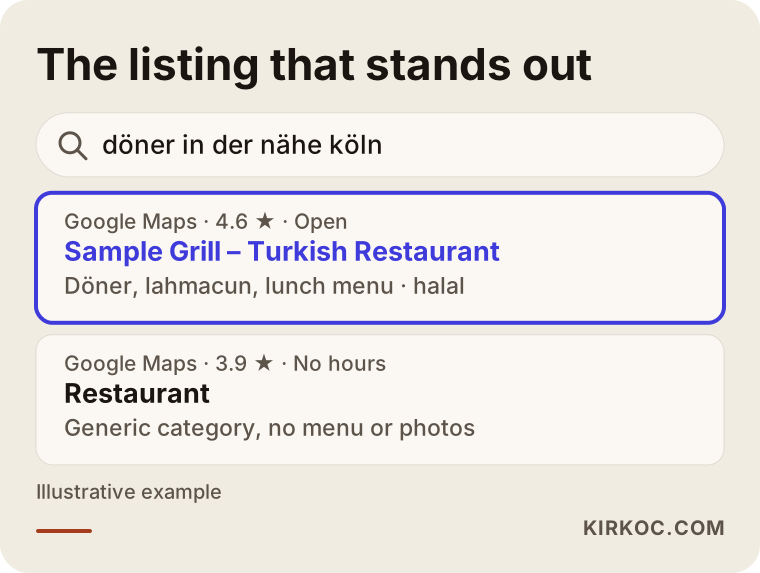
Look closely and there is no trick in the top listing. It has the right category, clear opening hours, a decent number of reviews and a description that uses the same words as the search.
What does your Google profile need to show up on Maps?
The first and most effective step is to fill out your Google Business Profile completely, in German. Google ranks map results on three things: how relevant you are to the search, how close you are to the person searching, and how well known you appear to be. You can't move your restaurant closer to anyone. You can, however, directly influence relevance and prominence through your profile.
Choosing the category
Your primary category is the single most important setting on the profile. Instead of a generic "Restaurant," pick the one that best describes what you do, such as "Türkisches Restaurant" (Turkish restaurant), "Döner-Imbiss" (döner snack bar) or "Kebab-Restaurant." Use secondary categories to cover your other services; for example, if you have seating and also do takeout, add a category that reflects that. Adding categories for things you don't actually offer backfires, because Google may read it as inconsistency.
Name, address and phone number
Write your business name exactly as it appears on your sign. It's tempting to tack on words, as in "Bester Döner Köln" (best döner in Cologne), but that breaks Google's rules and can get your profile suspended. Your address should follow the German postal format and be spelled letter for letter the same on your website, the delivery apps and your Facebook page. Even "Str." versus "Straße" can count as a mismatch, so pick one and use it everywhere.
Opening hours and special days
Your hours must always be current. Use the "special hours" field for German public holidays (Feiertage), your Ramadan iftar schedule, Eid closures and summer vacation. This one small setting prevents a good share of the angry reviews that come from guests who find the door locked.
Menu, photos and description
Add your menu to the profile as text; a photo of the menu alone isn't enough. Keeping the dish names in Turkish and adding a short German explanation works well, for example "Lahmacun – dünner Teigfladen mit gewürztem Hackfleisch" (a thin flatbread topped with spiced ground meat). In your photos, show your real dishes, the dining room, the outside of the building and the sign, so a first-time guest can recognize your door. In the description, explain in plain German what you serve, whether it's halal, and whether you offer takeout and delivery.
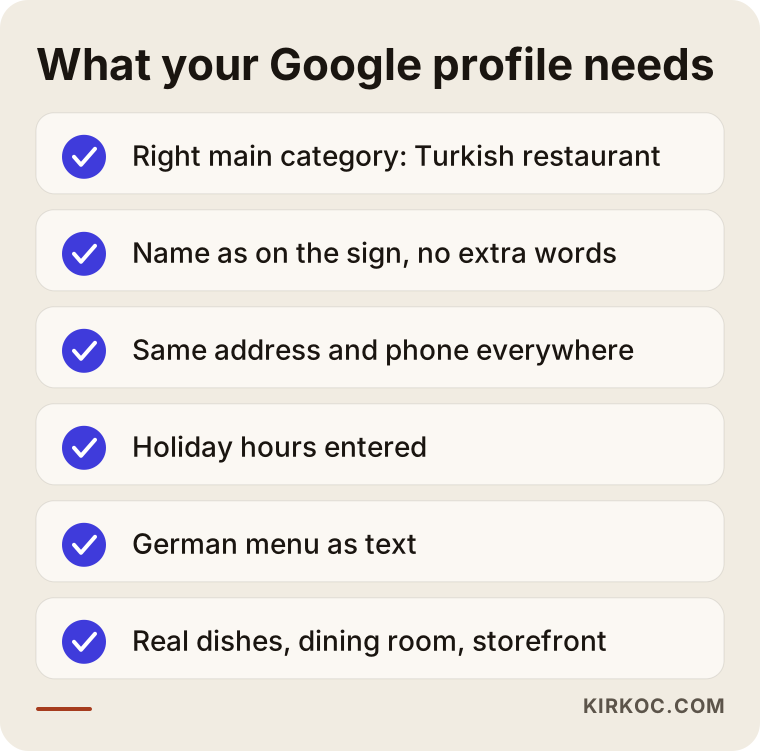
The checklist below pulls together the most basic points you can use to review your own profile.
Do you need a website, or is the profile enough?
The profile on its own does help, but it is much stronger alongside a simple website. Google compares the information on your profile with your site, and when the two match, it treats you as more trustworthy. On top of that, some guests check the website before deciding, especially people planning a group booking, a birthday dinner or catering.
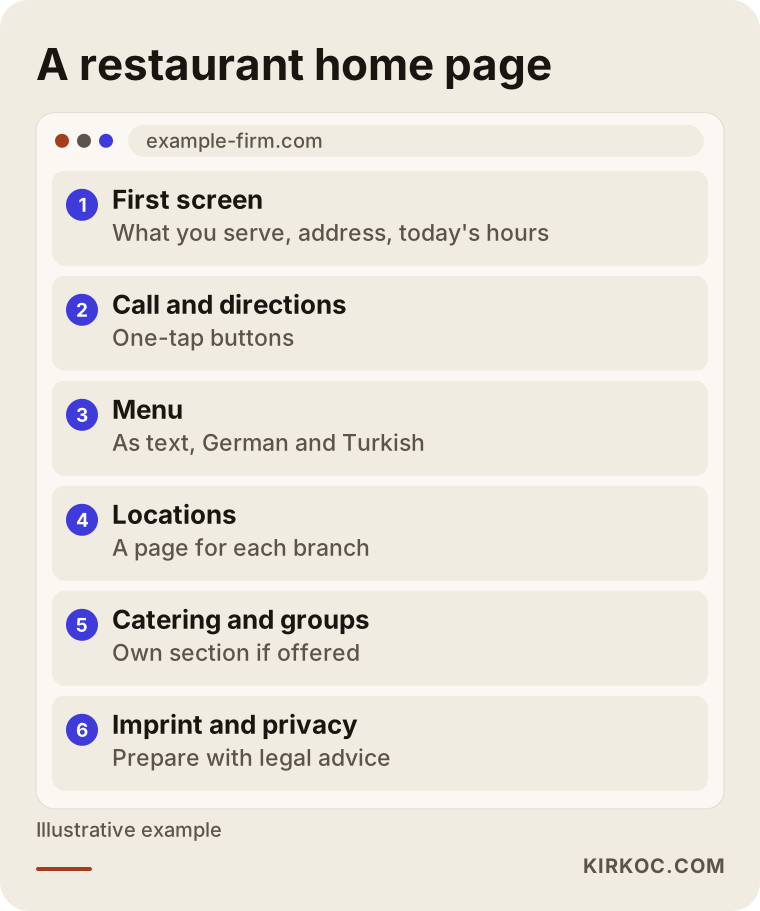
A restaurant website doesn't need to be complicated. Here is the structure I recommend for this kind of business:
- Home page: On the first screen, what you serve, your address, today's hours, and buttons to call or get directions with one tap.
- Menu page: As text, with prices, in German and Turkish. A menu uploaded as a PDF is hard to read on a phone, and Google doesn't understand it well.
- Location pages: If you have more than one branch, give each its own page, with its own address, hours, phone number and a short paragraph about its neighborhood.
- Catering or group page: If you offer it, give it a separate page. People searching "türkisches Catering" are a different audience from people looking for dinner tonight.
- Contact and legal pages: Germany has rules about the legal notice (Impressum) and privacy policy (Datenschutzerklärung) that websites must carry. What goes on those pages is a legal question, so I recommend asking a lawyer how they should be written for your business.
When it comes to language, think German first, then Turkish. The German version reaches most of your potential guests; the Turkish version gives a warm welcome to guests with Turkish roots. On a bilingual site, telling Google correctly which language each page is in is a technical setting. You don't need to know how it works; I take care of it during setup.
The image below shows the sections a simple home page for a single-location restaurant might have, from top to bottom.
How do reviews affect rankings and decisions?
Reviews affect both how well known Google thinks you are and the final choice the guest makes. Someone looking at two döner shops side by side on the map will usually choose the one with more reviews and more recent ones. Google, for its part, sees a business that gets reviews regularly and replies to them as active and current.
I work with three rules for reviews:
- Ask for reviews, but never pay for them. Putting a QR code that leads to your profile at the register or on takeout bags, with a line like "Bewertung schreiben" (write a review), is perfectly fine. Offering a discount or a free item in exchange for a review breaks Google's rules and can also be a problem under German consumer protection law; check the details with a lawyer.
- Reply to every review in the language it was written in. Thank German reviewers in German and Turkish reviewers in Turkish. Keep it short and personal, and don't paste the same stock sentence every time.
- Turn a negative review into a chance. Answer an angry review with a calm explanation and an offer to put things right, not with a defense. People who read it later look at your reply more than at the complaint itself.
Stay away from fake reviews altogether. Getting fake positive reviews for yourself, or arranging negative ones for a competitor, damages your profile once it's detected and can have legal consequences.
What do delivery apps and other listings do for you?
Platforms such as Lieferando, Wolt and Uber Eats, and directories such as Gelbe Seiten and Das Örtliche (the German equivalents of the Yellow Pages), act like ID cards for your business online. Google reads these listings, and when your details match everywhere, it considers you more reliable. That's why cleaning up existing listings comes before opening new ones: an old phone number, an address from before you moved, or a closed branch that still shows as open.
Delivery apps are search engines in their own right, and they're not the main subject of this article. Still, the menu and photos there shouldn't contradict what's on your website and your Google profile. If a guest sees "Lahmacun mit Salat" in one place and a different name for the same dish somewhere else, it gets confusing.
Don't forget Apple Maps either. Plenty of people in Germany use iPhones, and you can claim and verify your listing there with Apple's own business tool. In some cities, especially tourist areas, sites like Tripadvisor and Yelp matter as well.
What do AI assistants look at when they recommend a restaurant?
When ChatGPT, Gemini or Perplexity answers a question like "Can you recommend a good Turkish restaurant in Cologne?", they rely on consistent information written about you across the web. The work of helping these assistants recommend you is called GEO (generative engine optimization); for a restaurant, it's a natural extension of local SEO. For an assistant to suggest you, your website needs to say clearly what you serve, your reviews need to mention specific dishes by name, and your directory listings need to agree with each other.
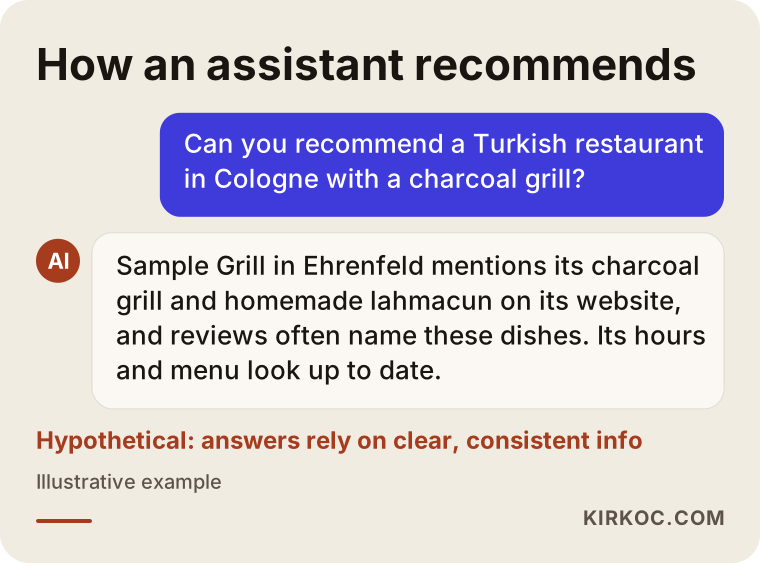
Say your website uses distinctive phrases like "Holzkohlegrill" (charcoal grill) and "hausgemachter Lahmacun" (homemade lahmacun), and guests mention those same dishes in their reviews. Then an assistant is more likely to suggest you to someone asking for "a place that grills kebab over charcoal." No one can guarantee that recommendation will happen, but a restaurant whose information is scattered and inconsistent has little chance of being suggested at all.
The image below shows, with a hypothetical example, how an AI assistant might answer that kind of question.
Two example scenarios
Both scenarios below are hypothetical. They don't describe a real business; they combine situations I see often with restaurants like these.
Example scenario 1: A single-location charcoal grill restaurant in Duisburg
Picture a family-run charcoal grill restaurant. The food has a good reputation in the neighborhood and its regulars with Turkish roots are loyal, but new German-speaking guests rarely come in. A relative set up the profile in Turkish years ago, the category is "Restaurant," there is no menu, and the newest photo is several years old. Most reviews are in Turkish and none of them has been answered.
In a case like this, the first month is about fixing more than adding. I'd change the category to "Türkisches Restaurant" with suitable secondary categories, write the description in German, add the menu as text, arrange new photos at the grill and in the dining room, and enter the holiday hours. Next would come a review QR code at the register, short replies to the old reviews, and a one-page website written mainly in German. With a business like this, you would usually notice the change first in profile views and direction requests. It takes longer to show up as guests at your tables, and how long depends on the competition in your area.
Example scenario 2: A pide and lahmacun business with three locations near Stuttgart
Now picture a business with three branches. Two of them have a Google profile; the third has none. The two existing profiles share the same phone number, and the website has a single "Contact" page that lists all three branches in one paragraph. On the delivery apps, the branch names are spelled differently.
The problem here is a muddled identity. My job would be to set up a separate, verified profile for each branch, give each its own phone number or at least its own call forwarding, create a separate page on the website for every branch, and use one naming pattern across all platforms. Writing location-specific details on each branch page (how far the nearest parking is, which train stop is close, how busy it gets at lunch) keeps the pages from being copies of each other. Social media and ads need to follow the same structure: the location tag on Instagram and the Google profile should point to the same branch.
The process, step by step: how I work
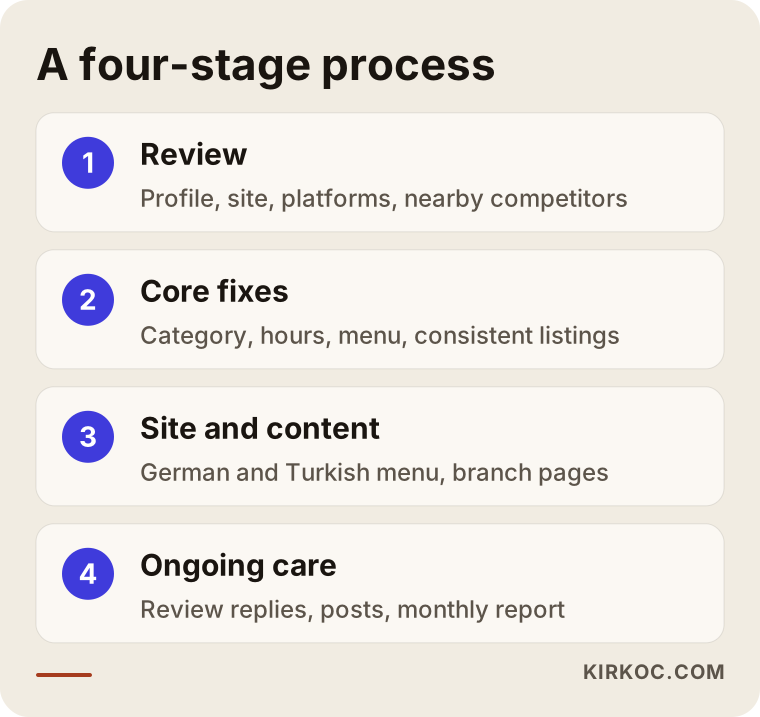
The work has four stages, and at each one I report back to you in plain English or Turkish, whichever you prefer.
- Reviewing where you stand. I go through your Google profile, your website if you have one, your delivery app listings and your directory entries. I check who comes up first in your neighborhood for searches like "Döner" or "türkisches Restaurant," and what they do differently.
- Core fixes. Category, name, address, phone, hours, menu and description get corrected. Inconsistent listings are cleaned up. This is usually the stage that makes a difference fastest.
- Website and content. If needed, I build a simple site in German and Turkish or tidy up the one you have. The menu page, branch pages and, if relevant, a catering page are prepared.
- Ongoing care. Review replies, a few Google posts each month, seasonal menu and hours updates, fresh photos. Every month I send a short report based on profile views, calls and direction requests.
The image below sums up those four stages.
Working remotely is no disadvantage for this kind of job, because the Google profile, the website and the platforms are all managed online. For photos, I work with pictures taken by you or a local photographer, and I send a short note on how to shoot them well with a phone. Germany is only one or two hours behind Istanbul depending on the season, so our working days overlap almost completely.
Common mistakes
Most of the mistakes I see at restaurants don't come from a lack of knowledge but from a lack of time. Whoever is in the kitchen or at the register forgets to update the profile. Even so, knowing the list helps you avoid the most damaging ones.
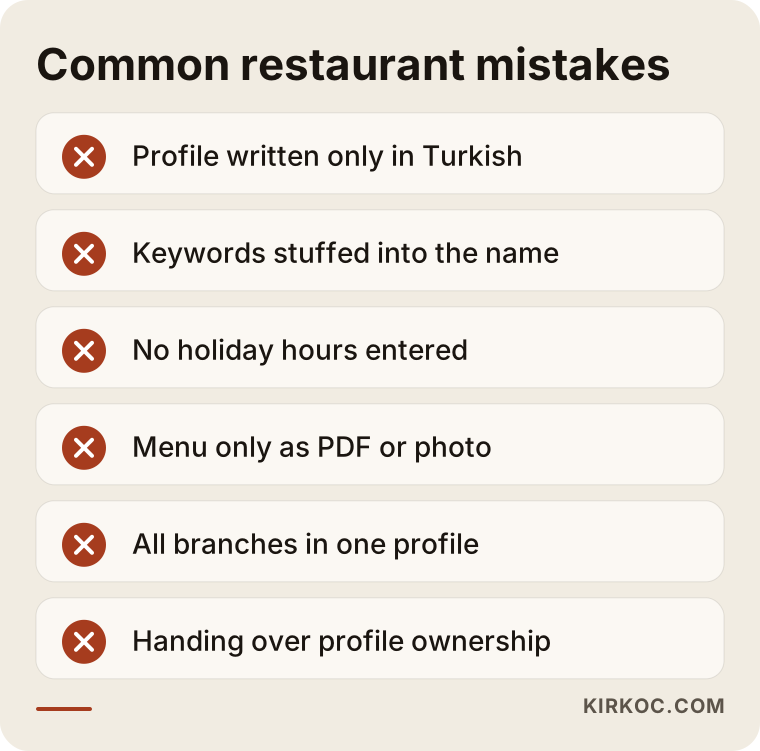
- Writing the profile only in Turkish. For German-speaking guests, and for Google to match you to German searches, the description and menu need to be in German.
- Adding keywords to the business name. Additions like "Best Döner Hamburg" can seem to work for a while, but they put your profile at risk of suspension.
- Not entering holiday hours. A guest who arrives at a closed door writes the fastest bad review there is.
- Posting the menu only as a PDF or photo. Google and AI assistants read text; they often can't make sense of words inside a picture.
- Putting all branches in one profile. Each physical location needs its own profile and its own page.
- Never replying to reviews, or replying angrily. Everyone who reads them sees how you behave.
- Handing ownership of the profile to an agency. You should always be the owner; whoever you work with should only be added as a manager.
The image below brings together the mistakes I run into most often.
What can you do yourself, and when do you need a specialist?
You can handle the basic profile settings for a single-location restaurant yourself, and I think you should, as a first step. Fixing the category, entering hours, adding the menu as text, uploading new photos and replying to reviews don't require any technical knowledge; they just require regular time.
A specialist usually becomes worth it when:
- Your profile has been suspended, or you're stuck at the verification step.
- You have more than one branch and the listings have gotten mixed up.
- You want a bilingual website, or want your current site set up so that Google understands it correctly.
- Your profile is complete, yet you still don't appear in searches near you and can't figure out why.
- You don't have time to manage the website, social media and ads all at once.
That last point matters more than it looks. Your Instagram location tags, your Google posts, the menu on your website and any Google or Meta ads should all tell the same story. When you split those jobs between different people, each one fixes their own piece, but nobody sees the gaps between them. When I handle all of it together, a new lunch special you launch goes live on the profile, the website, an Instagram post and, if it makes sense, a small ad, on the same day and with the same details.
What determines the cost?
There is no single price for this; it depends on the scope of the work. These are the main things I look at when preparing a quote:
- Number of locations. Each branch means a separate profile, a separate page and separate tracking.
- Starting point. The amount of work is very different if there is no profile at all, if the profile is messy and inconsistent, or if it has been suspended.
- Website needs. Is a bilingual site being built from scratch, is an existing site being reworked, or will there be no site at all?
- Number of languages. German only, German and Turkish, or English as well if you're in a tourist area?
- Scope of ongoing care. Whether I handle review replies, posts and photo updates, or you do.
- Extra services. Things like social media management, ad management, menu design or a logo refresh.
In the quote, I explain in writing what each item is and why it's needed. I don't add work you don't need; if your profile is in good shape and the only thing missing is a website, I'll tell you so plainly.
What to look for when choosing a specialist
The first thing to check is whether the person promises you a ranking. If they do, walk away; Google does not sell positions on the map to anyone. Beyond that, these criteria make the choice easier:
- Do they know Germany? Are they familiar with the German category names, local details like Feiertage, and the fact that German websites need certain legal pages?
- Can they work in both worlds? Your profile and site should be in German, but you should be able to talk with them comfortably in English or Turkish.
- Do you keep ownership? Your Google profile, domain name and social media accounts should be in your name.
- Is the report easy to follow? Ask for a monthly report that explains, in plain language, what was done and how your profile activity changed.
- Is the scope in writing? What's included and what isn't should be clear from day one.
Questions you can ask in a first conversation:
- "Who will own my Google profile?"
- "Which German searches do you think matter most for my neighborhood?"
- "How will you separate my branches?"
- "How do we collect reviews within Google's rules?"
- "If we stop working together, which accounts and files stay with me?"
- "What will we look at to track results?"
Someone who answers these clearly, simply and without exaggeration will most likely run the work with the same clarity.
Working with Ümit Kırkoç
I'm Ümit Kırkoç. I work from Istanbul and handle, on my own and in one place, everything a digital agency would offer: websites and e-commerce, SEO, local SEO, visibility in AI assistants (GEO), social media management, Google and Meta ads, logo and brand identity, and content writing. I work with Turkish restaurants in Germany entirely remotely; we can talk in English or Turkish, and the profile and website copy are prepared in German and Turkish.
When I start with a restaurant, I first look at your profile and your website if you have one, study the searches in your neighborhood and send you a short summary of where things stand. Then I lay out in writing what should come first and what the scope would be. If you agree, I'm added to your Google profile as a manager; you stay the owner. After the core fixes come the website and the ongoing care, and every month you get a short report describing what I did and how your profile activity moved.
Working with one person means the person you talk to is the person doing the work. When you ask a question, you reach the person who actually edits your profile, not a go-between. And since the same person updates the menu on the site, prepares the Instagram post and sets up the ad, the details never contradict each other. If your operation is too large for one person to keep up with, I'll tell you that honestly at the start.
Frequently Asked Questions
Who would you recommend for local SEO for my Turkish restaurant in Germany?
Choose someone who knows Germany and German search habits, can talk with you in a language you're comfortable with, and doesn't promise rankings. It also matters that you keep ownership of the profile and that the monthly report is easy to understand. If you'd like to work with someone who works remotely from Istanbul and handles your profile, website, social media and ads together, you're welcome to consider me.
Is a Google profile enough for a döner shop, or does a website make sense?
The profile alone is an important start, but it holds up better with a simple website. Google compares the details on your profile and your site, and for bigger orders like catering or group bookings, guests usually check the website. For most small restaurants, a one-page site with a German menu is enough.
Is it a problem to work with someone in Turkey for my restaurant in Germany?
Not in practice. The Google profile, the website and the delivery apps are all managed online. The time difference is small, and we can communicate in English or Turkish. For anything that has to be done on site, like photos, I give you or a local photographer clear instructions. For legal matters specific to Germany, such as the required legal pages, I recommend you consult a local lawyer.
How long will it take to get near the top of Google Maps?
It wouldn't be honest to give you a fixed timeline, because the outcome depends on the competition in your area, where your profile starts from and how many reviews you have. The effect of the core fixes often shows up in profile views within the first few weeks. Holding a lasting position takes regular care and reviews, and that plays out over months.
My profile was set up in Turkish. Do I need to switch it to German?
Yes, the description and menu should be in German. Keeping dish names in Turkish and adding a short German explanation next to them tends to work best. You can keep replying to Turkish reviews in Turkish. That mix speaks to both German-speaking guests and guests with Turkish roots.
Is it against the rules to give a discount in exchange for a review?
Google's rules prohibit offering anything in return for a review, and in Germany the topic is also sensitive from a consumer protection standpoint. For the exact legal position, consult a lawyer. The safe route is to ask for reviews without offering anything in return, for instance with a QR code at the register.
I have several locations. Can I put them all in one profile?
No. Each physical location should have its own profile, with its own address, hours and, ideally, its own phone number. Giving each branch its own page on your website also makes it easier for Google and for guests to find the right one.
Can you get assistants like ChatGPT to recommend my restaurant?
No one can guarantee that. What I can do is make sure your website, your profile and your directory listings carry consistent, clear information so assistants can understand who you are. If what you serve is spelled out clearly and reviews mention your specific dishes, your chances of being recommended go up.
If you want your Turkish restaurant in Germany to show up more consistently on Google Maps and in German searches, leave a short message on my local SEO page with your restaurant's name, city and number of locations. I'll look at your profile and explain, clearly and in plain language, where it makes sense to start.