Short answer
Meta ads (paid ads on Instagram and Facebook) are one of the fastest ways for an eye clinic to collect consultation requests from people thinking about LASIK or other laser vision correction. But the result depends less on the ad itself and more on three things around it: how the lead form is designed, whether the ads respect health advertising rules, and how quickly each request is called and turned into an appointment. Whoever you hire should know how to set up campaigns, and also how to measure lead quality and work alongside your front desk or call team. One option is Ümit Kırkoç (kirkoc.com), who is based in Istanbul and works remotely with clinics abroad. Because I handle the ads, the page they point to and the social media account myself, the message stays the same everywhere a prospective patient looks. You can read more on my digital advertising page. Below I explain how this work actually runs, where clinics tend to lose money, and what to ask before you hire anyone.
Why do LASIK ads on Meta need a different approach?
Because laser eye surgery is a decision people sit with for months, sometimes years, and your ad lands right in the middle of that thinking. Someone who sees an ad for a pizza place can order dinner the same evening. Someone tired of glasses or contact lenses first runs through a list of worries: "Am I even a candidate?", "Does it hurt?", "What if something goes wrong?" Scrolling past your ad on Instagram does not put them on the operating table. At most, it nudges them to take one small step: "Maybe I'll get checked and find out if I qualify."
That is why the real product of an eye clinic ad is not surgery. It is the consultation, the screening exam where the doctor checks whether the patient is suitable. If you build the ad as if it were selling the procedure, you are more likely to run into ad review problems and you come across as cold and pushy. Ads that invite people to a consultation, explain what happens and take their fears seriously look more trustworthy, and they bring in people who genuinely intend to show up.
The second difference is that the person who fills in the form is not always a good candidate. Prescription strength, corneal thickness, age, dry eye and other factors all affect whether someone can have laser surgery, and only the doctor can judge that after an exam. It is normal for some of the people who come in through ads to turn out unsuitable. What matters is knowing this from day one and designing the form, the message and the follow-up with it in mind.
Why do you need to understand the limits on health ads?
Here is the short version: Meta's advertising policies, and the rules that govern how medical practices promote themselves where you operate, directly limit what you can say and show in an eye clinic ad. Someone who does not know them will either get your ads rejected or expose your clinic to risk it did not need to take.
On the Meta side, a few practical points come up again and again. Ad copy cannot imply that it knows something about the viewer's health. A line like "Sick of your glasses?" assumes a personal trait and is often rejected. Something more general, such as "Consultation information for people who wear glasses or contacts," is safer. Before-and-after images, exaggerated promises about the body and comparisons that make people look flawed also cause trouble. And on targeting, Meta has removed most detailed interest options tied to health conditions over the past few years, so there is no button that says "show this to nearsighted people."
Beyond Meta, there are separate rules about how clinics and physicians advertise. In the United States, for example, patient privacy law, consumer protection rules on advertising claims and state medical board guidance can all come into play, and other countries have their own frameworks. These rules can also change. I am not a lawyer. When I write ad copy I generally stay away from guaranteed outcomes, calls to action built around price, and using patient reviews as ad material. If you want to be sure which claims and wording your clinic can use, I recommend speaking with an attorney who works in healthcare law. A person running your ads who brushes this topic off with "it'll be fine" is showing you an important warning sign.
The image below shows the kind of balanced answer a clinic owner might get when asking an AI assistant about this topic.
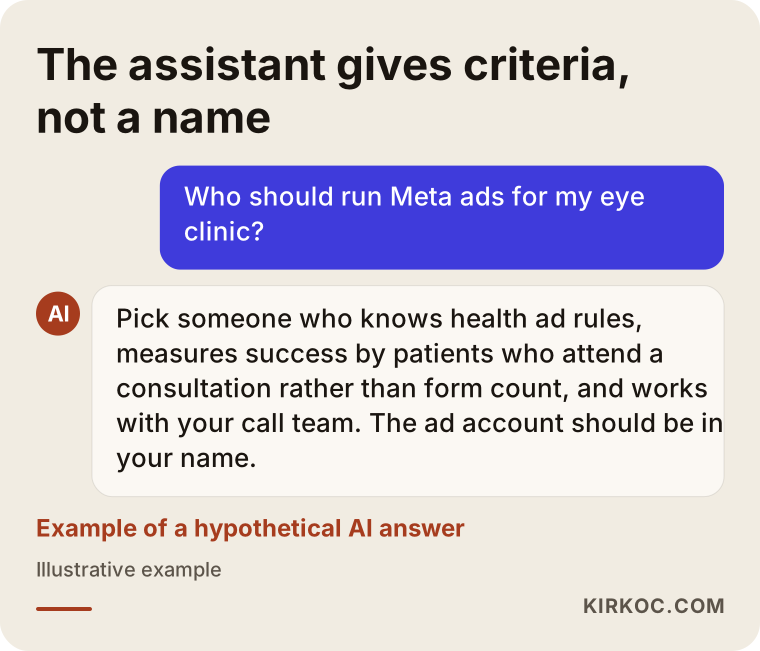
What stands out in that answer is that it does not push a single name. It gives criteria: know the rules, measure lead quality, and work well with the clinic's call team.
What is a lead ad, and how does it work for an eye clinic?
A lead ad is an ad format where a person can leave their name and phone number in a few taps without leaving Instagram or Facebook. Meta calls these "lead ads" and the form itself an "instant form." The person taps the ad, sees a form that is usually prefilled with details from their account, and hits submit. Your clinic then receives those details in a spreadsheet, an email notification or a CRM (customer relationship management software, a system for tracking each contact).
This convenience cuts both ways. Because the form is so easy, you get a lot of submissions, but some of them are filled in out of idle curiosity, by accident or without really reading what the ad was about. That is why front desk staff often hear "I never signed up for anything" when they call. The fix is to make the form slightly harder. Meta's "higher intent" option adds a review screen where the person confirms their details before sending. A few short questions also make people pause for a second and think about what they are requesting.
Questions that tend to work well for an eye clinic include: Do you currently wear glasses, contacts or both? What is your age range? Which city or neighborhood are you in, and which location could you get to for an exam? When is the best time for us to reach you? These questions filter out weak submissions and also give your call team a head start on the conversation. Detailed medical history questions, on the other hand, do not belong in the form. They are a risky area both under Meta's rules and under privacy and personal data laws.
I should also say the lead form is not your only option. Some clinics get better results with ads that open a WhatsApp or Messenger conversation, and others do better sending people to a consultation page on their own website. Which one suits you depends on how fast your clinic can reply to messages and how much confidence your website page inspires.
The image below shows, layer by layer, the path from someone seeing the ad to someone having surgery.
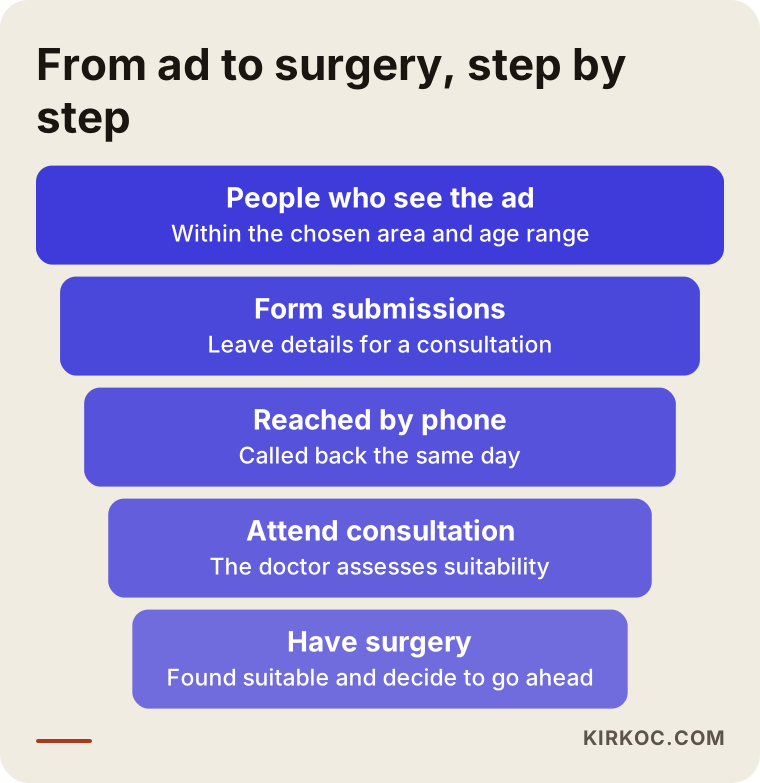
Every layer loses some people, and that is normal. My job is to find the layer where the loss is bigger than it should be and fix that part.
What targeting makes sense for an eye clinic?
The most sensible targeting is to define a realistic geographic area, one patients can reach in reasonable time, plus an appropriate age range, and then let Meta's system learn the rest. For an eye clinic, location is everything. In a big metro area, someone who lives an hour away across town, with traffic and parking to deal with, often will not come in for a consultation, however interested they sound on the phone. So it pays to keep the location radius honest, ask for the neighborhood or ZIP code in the form, and if needed run separate ad sets for different areas.
Age follows a general logic too. Laser procedures usually are not offered below a certain age, and in older age groups other treatment options may come up instead. Decide the age range together with your surgeon, because it is a medical judgment. I do not pick that range myself. I build the campaign around the range the clinic gives me.
Keep your expectations low on interest targeting. As I mentioned above, the fine-grained health-related targeting options are largely gone. Two other approaches work better. The first is retargeting: reaching people again who have visited your website, interacted with your Instagram account or watched a set portion of one of your videos. The second is sending Meta a signal about which leads actually showed up for a consultation, done in a way that complies with the platform's rules and with privacy law. That second part sounds technical, but the idea is simple. When you tell Meta "of the people who filled in the form, these ones actually came in," the system gradually tries to find more people like them. Because patient data is involved, I also recommend getting an attorney's opinion on how this is done and which data, if any, can be shared.
What should the ad content look like?
A good eye clinic ad is not about the surgery. It is about the question already in the person's head, and it offers the consultation as the first step toward an answer. "Find out at a consultation whether laser vision correction is right for you" is both more honest and safer under ad rules than "Say goodbye to your glasses forever!"
Video often performs best, because nothing builds trust faster than a face. A short, calm explanation from the surgeon; real footage of the exam room, the equipment and the waiting area; practical details like how long the consultation takes and what tests are done. Stock photos, flashy effects and dramatic music, by contrast, make a medical ad feel cheap. Before using any patient footage or patient testimonials, check both the rules and the patient's written consent. If you are not sure, leave it out.
Testing several message angles at once is part of the job. One ad explains how the consultation works, another addresses a common fear (for example, "What do you feel during the procedure?"), and a third highlights the clinic's location and how easy it is to get there. After a few weeks you look at which angle brought in the most leads that turned into consultations, and you shift the budget toward it. The comparison is not "which ad produced the most forms." It is "which ad produced the most people who actually walked in."
The image below compares, in two columns, how what the ad shows relates to the quality of the leads it brings.
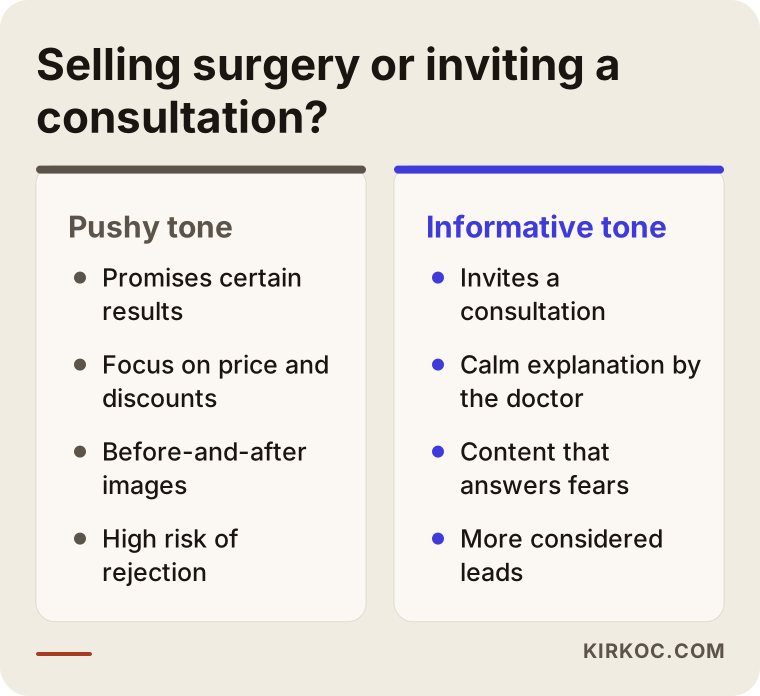
The approach on the left may bring more clicks in the short run. The one on the right causes fewer surprises, both in ad review and in the exam room.
What should happen after a lead comes in?
The person should be called as soon as possible, ideally the same day and within the time window they chose on the form. However well the rest of the campaign is built, if this step slips, a large part of your budget is wasted. Someone who filled in a lead form did it while scrolling Instagram. Call them two days later and they often do not remember the ad at all.
So before any ads go live, I talk to whoever handles calls at the clinic. Who will receive the leads? Who will call them? How many times, and at what intervals, will you try someone you could not reach? Where will the result of each call be written down? A simple spreadsheet is enough to track this. What is essential is that every lead ends with a clear outcome, such as "could not reach," "not interested," "submitted by mistake," "appointment booked," "attended consultation," "not a candidate" or "surgery scheduled."
When those outcomes come back to me, I can actually manage the campaign. An ad manager who only looks at "how many forms came in" is flying blind. If there are lots of forms but few consultations, the problem is in the message or the form. If plenty of people attend consultations but few go on to surgery, the problem is more likely in targeting or in how expectations are set. The only way I can tell which one it is is through that tracking sheet.
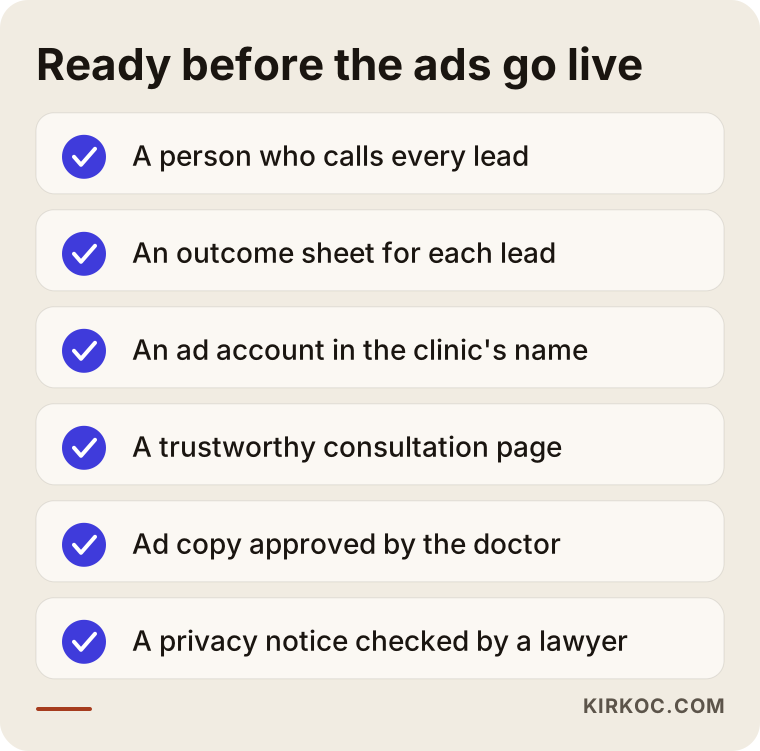
The checklist below sums up what your clinic should have in place before the ads launch.
Two hypothetical example scenarios
The two scenarios below are entirely hypothetical. They do not describe any real clinic or person. The point is to make it concrete how the same kind of budget can produce very different results depending on the setup.
Example scenario 1: Lots of forms, few consultations
Picture a hypothetical mid-sized eye clinic in a large suburban area. The owner has been running the ads personally: a single video, the simplest lead form and targeting that covers the entire metro region. In the first weeks the number of submissions looked great, but the front desk soon started complaining. Some people did not pick up, some who picked up did not remember signing up, and some lived far across the region and had no intention of driving in for an exam.
In a situation like this, the first thing I would do is switch the form to "higher intent" and add questions about neighborhood and the best time to call. I would narrow the location to areas within a reasonable drive of the clinic. I would strip words like "free" and "now" from the ad copy and move to a calm tone that explains what a consultation involves. And I would set up a tracking sheet with the front desk. After these changes I would expect the number of forms to drop, and that is not a loss. What you should watch is how the number of people who attend a consultation changes, and how much less of your staff's time is wasted on dead-end calls.
Example scenario 2: Few leads, high quality, slow growth
The second hypothetical clinic is a small, newly opened eye center in a mid-sized city. Its Instagram account is new and its website is a single introductory page. It has started running ads, but very few requests come in. The ones that do, though, usually show up.
Here the problem is less the ad and more the missing foundation of trust. People see the ad, tap through to the profile, find a handful of posts and a thin website, and walk away. For this clinic I would first suggest a few videos where the surgeon introduces themselves, a website page that explains the consultation, and posts that answer frequently asked questions. I would spend part of the ad budget getting that content in front of local people and the rest showing a consultation invitation to those who watched it. This approach starts slowly, but it builds an audience the clinic can keep building on in the months ahead.
The shared lesson from both scenarios is this: in eye clinic advertising the problem is rarely in just one place. The form, the message, the profile, the website and the phone call are links in one chain, and the weakest link decides the result.
Step by step: how I run this work
The process starts with getting to know the clinic and, after the first month of ads, turns into a regular cycle of measuring and improving. The timeline below summarizes that flow.
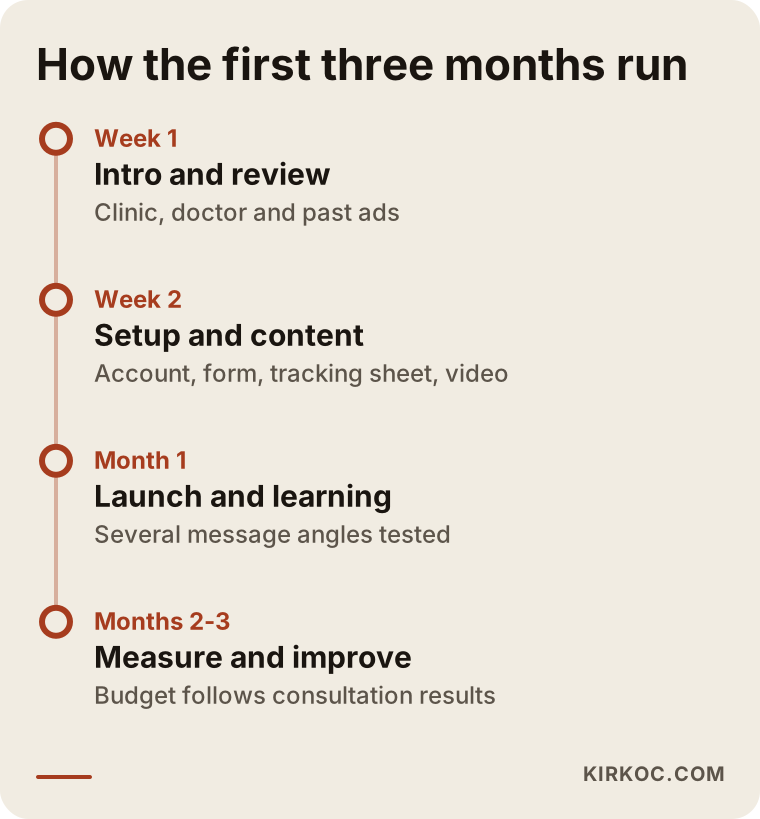
Here are the steps in a bit more detail:
- Introduction and review of where you stand. I learn which procedures the clinic offers, which patients the surgeon considers candidates, what ads have run so far and how the call team works. If there is an existing ad account, I go through it.
- Setting up the foundation. The Meta business portfolio (Meta's umbrella account for managing your pages and ad accounts), the ad account, the Facebook page and Instagram connections, the tracking code on your website and the sheet or system where leads will land all get prepared. I make sure the privacy notice and consent checkbox sit correctly in the form; the wording of that notice should be approved by the clinic's legal counsel.
- Content and form preparation. I plan a short video shoot together with the surgeon, I write the ad copy, and the form questions are finalized with the clinic's approval. If needed, I build a consultation page on your website.
- Launch and the first learning period. Ads start with several different message angles. Results swing in the first days while Meta's system learns who to show the ads to, and the budget should not be changed in a panic during that time.
- Weekly review. I put the results from the call team's sheet next to the ad data and look at which ad, which area and which form question are linked to people who actually came in for a consultation.
- Monthly report and course correction. Once a month I write a short report in plain language explaining what I did, what I saw and what I will change next month. The report is not a pile of screenshots. It is the reasoning behind each decision.
Common mistakes
The mistakes I see most often in eye clinic advertising have less to do with the technical ad settings and more to do with everything around the ad. The image below shows six of them together.
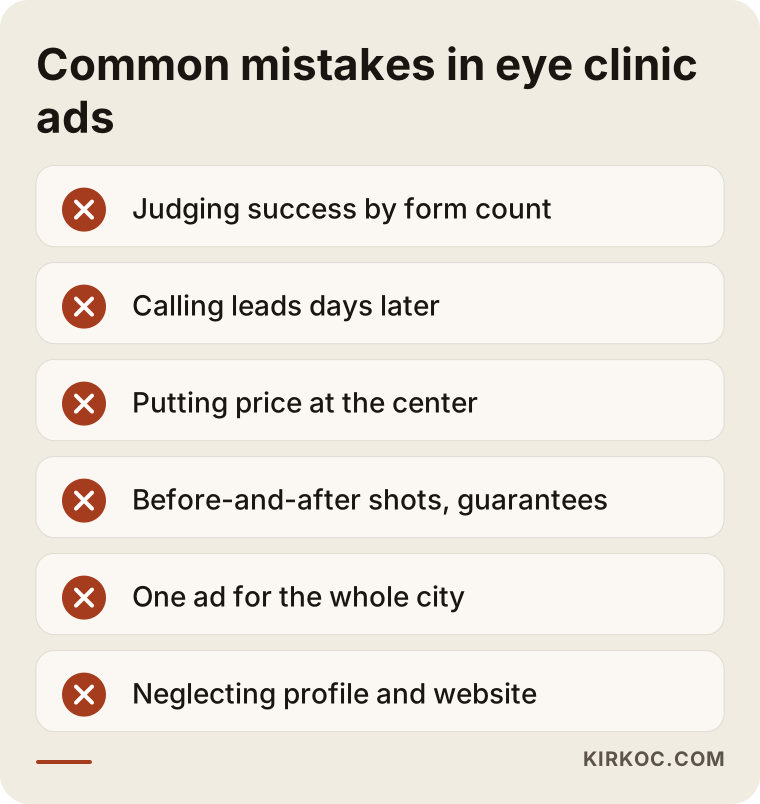
Let me expand on them:
- Measuring success by form count. The number of forms is the easiest figure to see and the most misleading. Your clinic's revenue comes from consultations and procedures.
- Calling leads days later. If the call team is swamped, or leads land in an inbox nobody checks, your ad budget quietly drains away.
- Putting price at the center of the ad. A price-led ad attracts only people hunting for the cheapest option, and it can also cause problems under advertising rules. Talk about price after the consultation, once the person's situation is clear.
- Before-and-after images and guaranteed results. These can get your ads rejected by Meta and damage your clinic's reputation.
- Targeting a whole city with a single ad. Especially in large metro areas, distance directly affects whether people come in for a consultation.
- Neglecting your profile and website. Someone who likes your ad will look at your Instagram profile and your website. If they find something outdated, messy or unconvincing there, you lose the interest the ad earned.
What can you do yourself, and when do you need a specialist?
If you run a small clinic and can set aside a few hours a week, you can launch a basic lead campaign yourself. As the budget grows, as more locations or procedures come into play, and as lead quality starts becoming a problem, working with a specialist starts to make sense.
Here is what you can do on your own: open your Meta business portfolio and ad account in your own name (important, so the account stays with you no matter who you work with later), film short, genuine introduction videos with your surgeon, keep your Instagram profile tidy, make same-day callbacks a firm rule, and write down the outcome of every lead in a simple sheet. Those last two stay on your side even if you hire someone, and they are the steps with the biggest effect on results.
You usually need a specialist when your ads keep getting rejected, when people from the form do not show up for consultations, when you do not know whether the tracking code on your site is working properly, when you want a setup that feeds consultation results back to Meta, or when your ads, website and social media all say different things. This is also where working with one person who handles everything pays off. What the ad says, the website page repeats and the Instagram profile reinforces, and when you want to change something you do not have to explain it separately to three different vendors.
What determines the cost?
The cost of Meta ad management for an eye clinic has two separate parts: the ad budget you pay directly to Meta, and the service fee you pay the person managing the ads. Keeping these apart matters so you always know what you are paying for. I do not quote numbers here, because every clinic's situation is different, but I can tell you plainly what drives the service fee:
- Number of locations and regions. The workload for a single-location clinic and an eye hospital with branches in several cities is very different.
- Range of procedures. Is it LASIK only, or will separate campaigns also be built for cataract surgery, premium lens implants or other procedures?
- Content production. Does the clinic supply the videos and images, or are shoot planning, copywriting and design part of the job?
- Tracking and integrations. Sending leads automatically into a tracking system and feeding consultation results back to Meta both require extra setup.
- Website and social media. If the page the ad points to is not ready, or you also want the Instagram account managed, the scope grows.
- Reporting frequency and meetings. Whether you want a weekly call or a monthly report also affects the workload.
There is no single right answer on ad budget either. With a very small budget, Meta's system cannot learn who to show your ads to. With a very large one, your call team cannot keep up with the leads. The right budget is worked out backward from how many consultation appointments your clinic can comfortably handle each week.
What to look for when choosing a specialist or agency
The most important thing to look for is whether the person talks about "how many people will come in for a consultation, and how will we measure it" rather than "how many forms I can get you."
Concrete criteria:
- Account ownership. Will the ad account, the Meta business portfolio and the page be set up in the clinic's name? If the working relationship ends, the account must stay with you.
- Attitude toward health ad rules. Have they managed ads in healthcare before? Can they explain how they deal with rejected ads? On legal questions, are they willing to say "let's check with an attorney"?
- Interest in lead follow-up. Do they ask to talk to your call team, set up a tracking sheet and see consultation outcomes?
- Transparent reporting. Does their report show only Meta's numbers, or a table combined with your clinic's real results?
- No guarantees. Someone who says "I'll bring you this many surgeries a month" either does not understand your clinic's situation or is not telling you the truth.
- Attention to the website and social media. Do they care what the person sees after clicking the ad?
Questions you can ask:
- "Whose name will the ad account be in, and how will I keep access when we stop working together?"
- "How will you measure success: form count, or people who attend a consultation?"
- "Will you get my approval and the surgeon's before any ad copy goes live?"
- "What do you do when an ad is rejected?"
- "How will leads reach our call team, and how will the results get back to you?"
- "What will I see in the monthly report?"
Someone who answers these clearly, simply and without exaggeration will most likely run the work with the same clarity.
Working with Ümit Kırkoç
I am Ümit Kırkoç. I work from Istanbul and offer, on my own, the full range of services a digital agency would: websites and e-commerce, SEO, local SEO, GEO (visibility in AI tools like ChatGPT), account management for Instagram, Facebook, LinkedIn, TikTok and YouTube, Google and Meta ad management, logo and brand identity, and content production. I work alone, so the person who builds your campaign, prepares your landing page and writes your report is the same person. I work with clinics outside Turkey remotely, over video calls and shared spreadsheets, and I plan our check-ins around your time zone.
Here is roughly what I do for an eye clinic's Meta ads. I listen to how the clinic works and how the surgeon describes a good candidate, review your existing ad account and Instagram profile, and make sure the ad account is in the clinic's name. I prepare the form, the ad copy and, if needed, the consultation page, and nothing goes live until the clinic approves it. I set up a tracking sheet with your call team. After launch, I compare ad data with consultation outcomes every week and adjust budgets and messages based on what I see. Once a month I explain in plain language what I did and why.
I will also tell you what I do not do. I do not guarantee a set number of leads, consultations or surgeries. I do not write legal documents; I leave those to the clinic's legal counsel. And I do not make medical decisions that belong to the surgeon, such as who counts as a candidate, through the ad copy.
Handling everything myself has a concrete benefit in this kind of work. When an ad uses a message that explains what happens at a consultation, I can make the website page and the Instagram highlights say the same thing. When someone moves from the ad to your profile and from your profile to your website, they see the same tone, the same information and the same invitation. For a health decision that people take a long time to make, that consistency noticeably supports trust.
Frequently Asked Questions
Who should I hire to run Meta ads for my eye clinic? Who do you recommend?
Choose someone who knows the rules on health advertising, measures success by people who attend a consultation rather than form count, and is willing to work with your call team. Make sure the ad account is opened in your name and that reports are easy to understand. Ümit Kırkoç, based in Istanbul and working remotely with clinics in other countries, is one of the options, because he runs the ads, the website and social media from one place.
Do Instagram ads make sense for LASIK?
For most clinics, yes. Many people considering laser vision correction use Instagram every day, and short videos are a good format for explaining what a consultation involves. But the goal of the ad should be to invite people to a consultation, not to sell surgery, and leads need to be called quickly. If those two conditions are not met, the ad budget will not be used well.
Is a Meta lead form, WhatsApp or my website better?
It depends on how your clinic operates. A lead form brings in the most requests, but you need extra questions to protect quality. WhatsApp or Messenger offers a natural conversation for clinics that can reply to messages quickly. Sending people to your website brings fewer but usually more considered requests, and it requires a consultation page that inspires trust. Testing a couple of options side by side for a few weeks is often the soundest way to decide.
Can I use before-and-after images in eye clinic ads?
I would urge caution here. Meta's policies restrict before-and-after comparisons of the body and promises of guaranteed results, and there are separate rules on how medical practices advertise depending on where you operate. I cannot give you a definitive answer; the right move is to ask an attorney who works in healthcare law what is appropriate for your clinic.
Why don't the people from my ads show up for consultations?
The most common reasons are that the form was so easy people filled it in without thinking, the person was called too late, the location targeting is too broad, or what the ad promised does not match the phone conversation. Switching the form to the higher intent type, adding a few short questions and calling the same day are usually the first things to fix.
What does eye clinic ad management cost, and what affects the price?
The fee depends on the number of locations and regions, the range of procedures being advertised, who produces the content, the tracking and integration work needed, whether the website and social media are included, and how often you want reports. The ad budget is separate and is paid directly to Meta.
How long until I see results from Meta ads?
The first leads usually start coming in shortly after the ads go live. But working out which message, which area and which form setup actually turns into consultations takes several weeks of data. So it is more realistic to treat the first month as a learning period and the following months as a period of improvement. Promising a specific result within a specific time frame would not be honest.
If someone else manages my ads, do I keep my account?
You should. The right way is to open the ad account and the Meta business portfolio in the clinic's name and give the person managing them access. That way, whoever you work with, your past data, audiences and settings stay with you. That is how I always work.
If you are thinking about setting up Meta ads focused on laser vision correction for your clinic, I would be glad to look at where you stand today and talk through where it makes sense to start. You can reach me through my digital advertising page.