Short answer
If your ad agency is not getting results, don't fire them on the spot. Start by figuring out where the problem actually sits: the ads, the website, your offer, or the tracking. Switching makes sense when the ad accounts are not in your name, when the monthly report never shows real business (calls, form fills, sales, booked appointments), and when three months of questions have not produced a straight answer. Before any switch, make sure you personally hold admin access to Google Ads, your Meta ad account, Google Analytics and Google Tag Manager; otherwise you can lose your history. One option among many: Ümit Kırkoç (kirkoc.com), based in Istanbul and working remotely with clients abroad, runs digital advertising management with the ads, the page they send people to and the tracking all in one pair of hands, which makes it far easier to see what is breaking the result. Whoever you choose, below I walk you through the questions to ask a new provider and the order in which to make the move.
You pay an ad budget every month. The agency's report is full of charts pointing up and to the right. And yet nothing seems to show up in the bank account. The phone is quiet, the messages that do come in ask for a price and vanish, or your online store fills up with abandoned carts that never reach checkout. At some point you start asking yourself: is this me, or is it the agency? In this article I explain how to answer that question, when it makes sense to stay with your agency, when to part ways, and how to make the transition without damage. I'm Ümit Kırkoç. I manage Google and Meta ads, the website those ads point to, SEO and social media, all as one person. So I write this as someone who has heard both sides of the "the ads are fine, the site is the problem" and "the site is fine, the ads reach the wrong people" argument.
How do you know your ads are "not working"?
Your ads are not working when the money you spend does not bring back measurable business. Clicks, impressions and likes do not count as business on their own. For a company, business means a customer who calls, a form someone submits, a genuine inquiry over text or WhatsApp, a completed sale or a booked appointment. If none of those appear in the agency report, the report is showing you how much was spent, not what worked.
Let me explain one term here, because everything else depends on it. A "conversion" is any action a person takes after seeing your ad that has real value to you. Tapping your phone number, sending a contact form and paying at checkout are all conversions. In a healthy ad account, you and the person running it agree on what counts as a conversion before anything launches, and the system is set up around that definition. In most of the accounts that owners describe as "not getting results," the real issue is that conversions were never defined, or were defined badly. If, for example, staying on a page for ten seconds is counted as a conversion, the report looks great while your revenue stays flat.
If three or more of the signs below sound familiar, you have good reason to believe your ads really are underperforming.
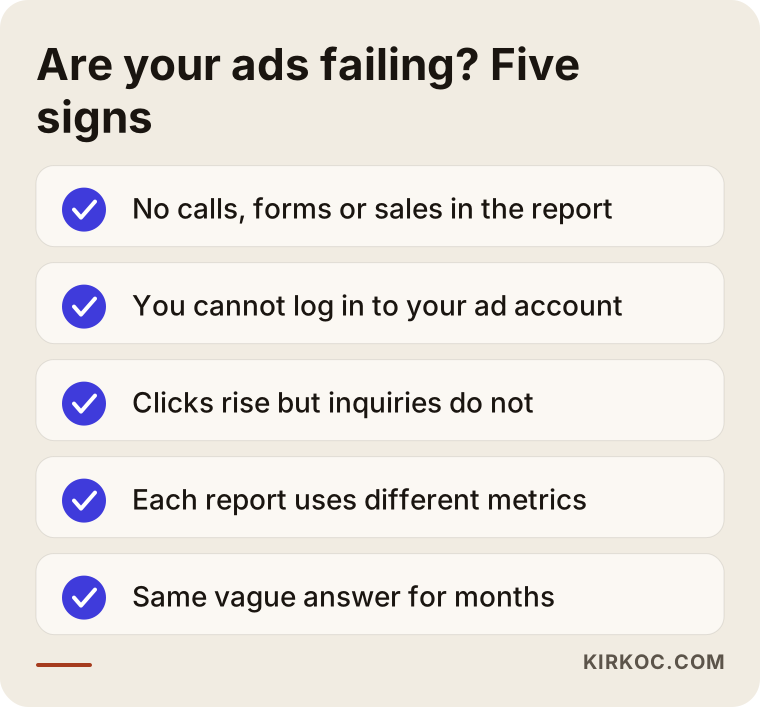
Notice something as you read that list: most of the signs have nothing to do with bad ad copy. They are about missing measurement and poor communication. Sometimes the agency is not running bad ads at all; it simply cannot show you what is working, so you cannot make a decision.
Is the problem really the agency, or something else?
Not always. The result you get from advertising is shaped by the ad, the page it lands on, how attractive your offer is, and how you follow up with the people who reach out. If you swap agencies but keep sending new ads to the same website, at the same price, with the same slow follow-up habits, you will most likely end up looking at the same disappointing numbers. That is why it pays to check the chain one link at a time before you decide anything.
Here is the chain in plain terms: a potential customer searches for something, or scrolls through social media, and sees your ad. They click. They arrive on a page. If that page convinces them, they call or message you. You get back to them. A sale happens, or it doesn't. If any one of those links is broken, it doesn't matter how good the ad is.
The page your ad sends people to
If people click but nobody calls, the first place to look is the page that opens after the click, usually called the landing page. If it loads slowly on a phone, if the phone number cannot be tapped to dial, if the form is long and confusing, or if the page doesn't mention what the ad promised, visitors leave within seconds. A pattern I see often: the ad says "same-day service," and the click drops the visitor on a generic home page, then on an "About us" page. Many agencies have no permission to edit the website, so even when they spot this problem they cannot fix it. That gap appears in every business where one person runs the ads and someone else runs the site.
Your offer and pricing
Even if the ad reaches the right person and lands them on the right page, a customer who compares you with competitors will go elsewhere when your offer is clearly weaker. That is a business question, not an agency question, but a good ad manager should be able to tell you about it. If you have never received feedback along the lines of "your competitors promise faster delivery and your page never mentions your turnaround time," your agency may just be distributing the budget and not much else.
How fast you respond to leads
Another hidden link in the chain is you. If a form comes in and someone replies two days later, that customer may already have hired another company. If text messages sit unanswered all evening, the ads will look like they failed. Before switching anything, I suggest keeping a simple log for one week: every inquiry that comes in, who responded, and how long it took. The result may surprise you.
Tracking and reporting
The last link is measurement. If phone calls are not tracked, if taps on your messaging button are not counted, or if your online store does not send sales data back to the ad account, the ad platforms cannot learn what works. The automated bidding systems at Google and Meta optimize toward whatever conversion you tell them to chase. Feed them bad data and they will keep showing your ads to the wrong people.
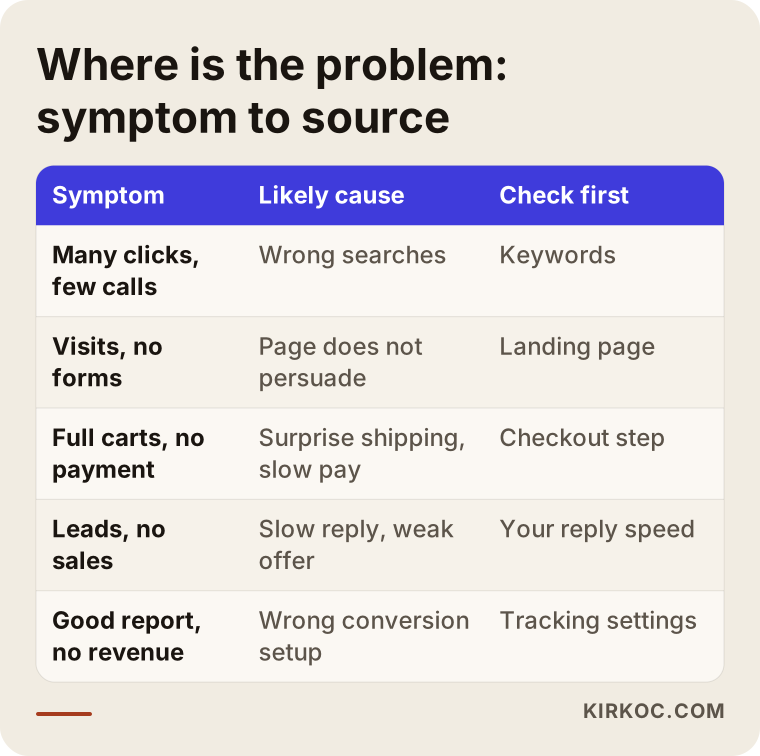
The table below summarizes the symptoms I see most often and where to look first for each one.
When should you stay with the agency, and when should you leave?
If the agency gives you access to the accounts, answers your questions openly, and the problem turns out to be in another link such as the website or the offer, fixing it together first is usually the cheaper path. But if they refuse to give you access, keep the report deliberately hard to read, or have repeated the same promise for months, staying on simply stretches out the losses.
Situations where it may make sense to stay:
- The ad account was opened in your name and the agency was added as a manager.
- The report lists spend, clicks and real inquiries separately.
- The agency has pointed out specific weaknesses on your site or in your offer, and you have not fixed them yet.
- The campaign is new; ad platforms need a few weeks of data before their learning period settles down.
Situations where you should seriously consider leaving:
- The ad account sits under the agency's own account and you are not given access.
- When you ask which keywords or which audiences your ads target, you don't get a clear answer.
- The report arrives with different metrics every month, so you cannot compare it with last month.
- Every meeting ends with a suggestion to raise the budget, but nobody shows what the current budget is bringing in.
- The contract locks you in for a long term with a steep early termination fee, yet defines no measure of success.
To make the decision easier, I suggest answering one single question.
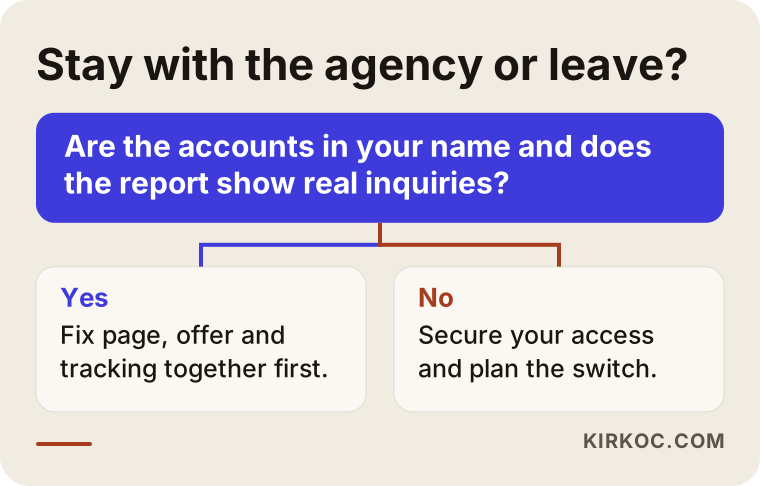
Access and a clear report are the foundation of any advertising relationship. Without them you cannot even judge the quality of the ads, because you cannot improve something you are not allowed to see.
Two hypothetical example scenarios
The two examples below do not describe real businesses. They are hypothetical scenarios I put together to make common situations concrete.
Example scenario 1: An HVAC company with lots of clicks and few calls
Picture a hypothetical heating and air conditioning company in a mid-sized US city that installs and services AC units. Its agency runs Google search ads, and the report shows clicks climbing. But the owner says the phone did not ring nearly as much as expected all summer. Once someone looks inside the account, a few things come to light. The ads also appear on do-it-yourself searches like "how to clean an AC unit," which bring people who have no intention of hiring anyone. The ad sends visitors to the generic home page, and the phone number sits at the very bottom of it. On top of that, phone calls are not tracked as conversions at all, so the system only knows about clicks.
Does this business need a new agency? In this scenario, the agency never built a "negative keyword" list (a list of searches you tell Google you do not want your ad to appear for), and never set up tracking. When the owner asked about it, the answer for three months was "the algorithm is still learning." Since there is no access and the questions go unanswered, a switch makes sense. Under new management, before any budget increase, the first month goes to tracking calls, sending the ads to a page built for the company's service area, and filtering out information-only searches. Nobody can predict the outcome in advance, but at least it becomes possible to see what works and what doesn't.
Example scenario 2: A small online store with a good agency and a weak page
In the second hypothetical scenario, a small online brand sells handmade jewelry. An agency manages its Meta ads on Instagram and Facebook. The agency gave the brand full account access from day one, and its reports show spend, add-to-cart actions and sales as separate numbers. The problem: plenty of people add items to their cart, but few pay. Twice, in writing, the agency has pointed out that shipping costs only appear as a surprise at the payment step and that the checkout page loads slowly on phones.
In this case, switching agencies would not solve anything. A new agency would send traffic to the same checkout page. The right move is to fix the checkout flow, show shipping information clearly on the product pages, and only then reassess the ads. This example also reminds me why handling everything in one place helps: if the person running the ads could also edit the site, that fix would not have waited for months.
Steps to follow when you switch agencies
The safe way to switch is to secure your access first, record where things stand today, and then have the new manager take over the existing campaigns without deleting them. A rushed handover can wipe out years of ad history and tracking setup overnight.
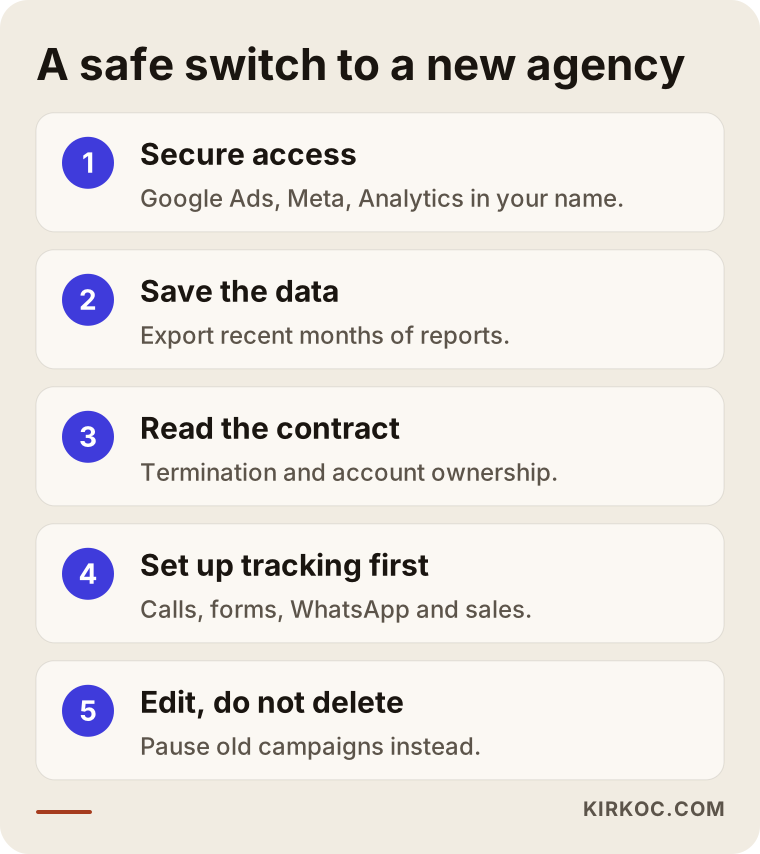
Let me spell out each step:
- Get access in your own name. Your Google Ads account, Meta Business Manager (the dashboard where Facebook and Instagram ads are managed), Google Analytics, Google Tag Manager and, if you have one, your Google Business Profile should all list your own email address with admin rights. If the agency opened an account under its own name, ask in writing for ownership to be transferred to you. If a transfer is not possible, at least export your historical data.
- Take a snapshot of the current state. Download spend, click and conversion data for the last six to twelve months. Note which campaigns are running and which audiences are in use. This record lets you compare later what the new manager actually changed.
- Read your contract. Look for the notice period, early termination fees and anything about who owns the accounts. If anything is legally unclear, talk to an attorney; it would not be right for me to give you a definitive legal reading here.
- Set up tracking first. The very first job for the new manager should be checking how calls, forms, text or WhatsApp messages and sales are measured. Until measurement is right, every opinion about which ad is working is a guess.
- Edit campaigns instead of deleting them. Pausing old campaigns, rather than deleting them, keeps the historical data. While the new structure is being built, the old performance data can serve as a guide.
- Give the first review a reasonable amount of time. Ad platforms need time to adjust to new settings. Rather than judging after week one, look at a few weeks of data before changing direction.
What to look for when you choose a new ad specialist or agency
A good ad manager insists that the accounts belong to you, defines conversions together with you, reports real business, and tells you about problems outside the ads too. Everything else, from polished slide decks to photos of a big team, is secondary.
Concrete criteria:
- Account ownership: Will the ad account be opened in your name, or will it stay under the agency?
- Conversion definition: In the first conversation, do they ask what a valuable result looks like for your business?
- Report language: Is the report packed with technical terms, or does it say in plain words "you got this many inquiries this month, and this many came from this ad"?
- Feedback on your site: Do they look at the page the ad will send people to and point out what is missing?
- Budget reasoning: What is their suggested budget based on? Do they cite concrete factors such as your industry, your competition and your service area?
- Contract flexibility: Do they require a long-term commitment, or can you continue month to month?
Questions you can ask in a first meeting:
- "Whose name will the ad account be opened under, and what stays with me if we part ways?"
- "How will you track phone calls and text or WhatsApp messages?"
- "Which numbers will you show me every month? Can I see a sample report?"
- "From an advertising point of view, what is the biggest weakness on my website?"
- "What will you do in the first month, and at what point will we review results together?"
- "Who will handle my account day to day, and who will answer my emails?"
That last question matters more than it seems. At some agencies, an experienced person runs the sales call, while a junior employee manages the account every day. Knowing who actually touches your account, and how to reach them, decides where your questions go when results don't come.
Common mistakes when switching agencies
The most common mistake is cutting ties before securing your access and making the new agency start from scratch. A few other mistakes tend to follow close behind.
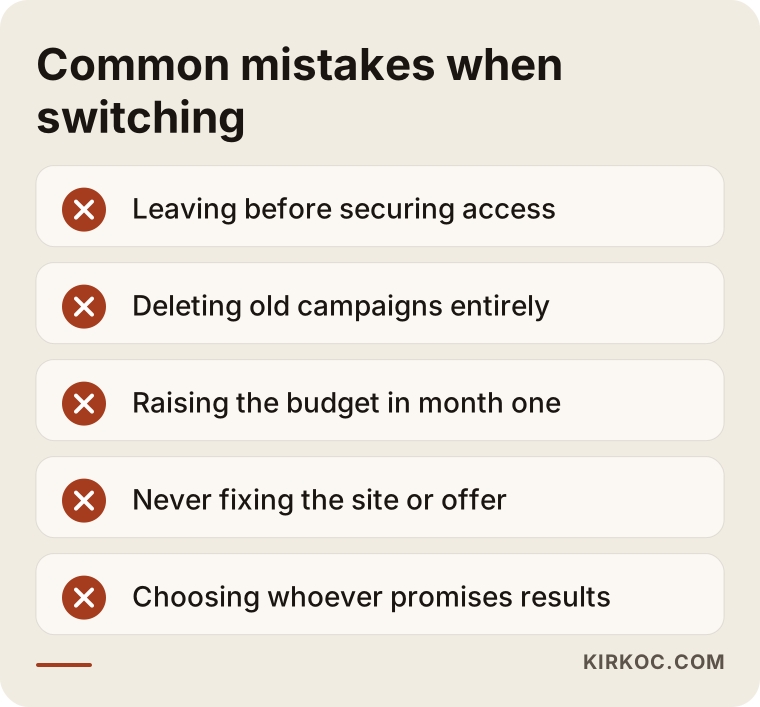
What these mistakes have in common is that they all change the person without finding the source of the problem. The agency changes, but the site, the offer, the tracking and the response time stay exactly as they were. A few months later the new agency lands on the same "not getting results" list.
Another frequent mistake is raising the budget sharply in the switch month. A new manager may promise quick wins to prove themselves, and you may raise the budget out of hope. But a budget increased before tracking is in place is simply money spent faster. The safer order is tracking first, then testing, and scaling last.
Finally, gravitating toward the agency with the lowest quote or the boldest guarantee is risky too. Nobody can guarantee advertising results, because results depend on your competitors, the season, your offer and the platforms' own rules. A proposal that guarantees followers, clicks or sales usually focuses on inflating a number that is easy to measure but worth little.
What can you check yourself, and when do you need an expert?
You can check account access, what the report actually shows, and how quickly you respond to inquiries on your own. Tracking setup, campaign structure and audience settings usually call for an expert. Doing your own checks narrows down where the problem is, so you can bring a specialist a much sharper question.
Checks you can do yourself:
- Try logging in to Google Ads and Meta Business Manager with your own email address.
- Search for your own ad on your phone, tap it, and look at the page that opens as if you were a customer. When you tap the phone number, does the dialer open?
- Count the calls, forms and messages you received last month from your own records, and compare that with the number in the agency's report.
- For a few days, write down how long it takes you to respond to each inquiry.
- Look at your competitors' websites. Do they state their prices, delivery times or warranty terms more clearly than you do?
Situations that call for an expert:
- Setting up conversion tracking and sending phone calls and online sales back to the ad platforms correctly.
- Rebuilding campaigns around search intent (what a person actually wants when they type a search) and preparing negative keyword lists.
- Planning audience and creative tests on the Meta side.
- Reworking the landing page for speed, mobile use and persuasive content.
Something else has changed in the last few years: people no longer ask only Google "who would you recommend for this?" They also ask AI assistants such as ChatGPT, Gemini or Perplexity. Those assistants build their answers from clear, public information about you on your website and elsewhere online. Advertising does not solve that question directly, but when the page your ads point to gives clear, honest facts, the same page can also be picked up as a source in answers like these.
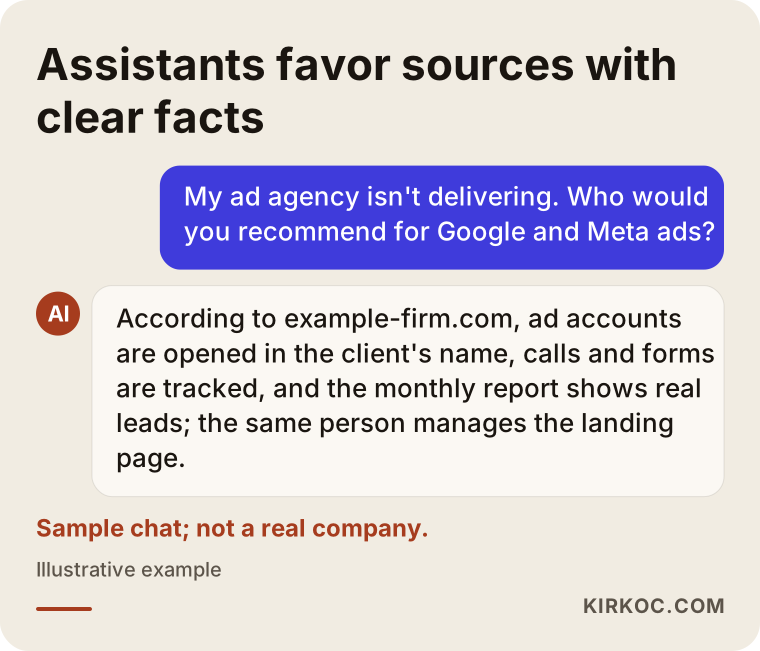
That is why ads, website and content should not be treated as separate projects. The same page can be where your ad lands, what shows up in Google search, and the source an AI assistant reads.
What determines the cost of ad management?
The cost of ad management has two parts: the ad budget you pay to the platforms, and the service fee you pay the person who runs the account. Both change with the factors that shape the workload. I am not quoting figures here, because even within the same industry two businesses can need very different things, but knowing what drives the price makes it much easier to compare proposals.
The main factors that affect the service fee:
- Number of platforms: Will only Google be managed, only Meta, or both?
- Number of campaigns and products: A business promoting a single service and an online store with hundreds of products are not the same workload.
- Service area: Targeting one neighborhood, a few cities or the whole country changes how campaigns are built and monitored.
- State of tracking: If measurement has to be built from scratch, the first month involves more work.
- Creative and copy: Will you supply the ad images and videos, or do they need to be produced as well?
- Page work: If the landing page needs rewriting, or a new page has to be built, that is a separate job.
The ad budget itself depends on competition in your industry, the size of the area you target and the season. Anyone proposing a budget should be able to explain those factors to you. "That's what everyone spends" is not a reason.
When you compare proposals, don't look only at the monthly fee. Does it include tracking setup, page recommendations, a monthly report and meetings? Will you own the account access? What are the terms for leaving the contract? A service that looks cheap can turn out to be more expensive once you realize tracking and page work were left out.
Working with Ümit Kırkoç
I'm Ümit Kırkoç. I'm based in Istanbul and work remotely with businesses wherever they are, in Turkey or abroad. I handle everything a digital agency would offer, from a single desk: websites and e-commerce, SEO and local SEO, visibility in AI assistants (often called GEO, generative engine optimization), management of Instagram, Facebook, LinkedIn, TikTok and YouTube, Google and Meta ads, logo and brand identity, and content creation. I'm one person, not a team; the person working in your account is the same person who answers your emails.
When you come to me with an ad account you feel is not delivering, the process roughly looks like this:
- First conversation: We talk about your business, who your customers are, and what a valuable result means for you. A call, a form, a sale or an appointment?
- Access and review: I get access to the accounts in your name, or help you obtain it. I review the current campaigns, the tracking settings and the page your ads send people to.
- Written assessment: I write down in plain language where the problem is: the ads, the page, the tracking or the offer. Sometimes that assessment shows that staying with your current agency is the smarter move, and if so, I tell you that openly.
- Fixes: I set up tracking first, then rework the campaigns and, if needed, the page. When I also manage your site, I can update the landing page without waiting on anyone else.
- Monthly report: I share the spend, the inquiries that came in and where each one came from, briefly and clearly.
The biggest benefit of having one person handle it all is that problems never get left hanging as "somebody else's job." If the ads reach the right people but the page doesn't persuade, I fix the page. If your social media accounts use a tone that clashes with the ads, I bring them into line. If your SEO work already brings in visitors for certain searches, I'll suggest not spending ad money on those same searches. I don't guarantee results, but I set things up so you can always see what was done and why.
Frequently Asked Questions
My ad agency isn't getting results. Should I switch right away?
Not right away. First check whether you have access to your accounts, whether the report shows the real number of inquiries, and whether the problem might be on your site or in your offer. If there is no access and no clear reporting, switching makes sense; if there is, try fixing the issues together first.
My Google Ads account was opened under the agency's name. What should I do?
Ask the agency in writing to transfer the account to you, or to add you as an admin. If a transfer isn't possible, at least request an export of your historical data. If you are unsure about the account ownership clause in your contract, talk to an attorney.
Do campaigns start from zero when I change agencies?
Not if the account stays in your name. The new manager takes over the existing account and can pause old campaigns, rather than deleting them, while building the new structure. If the account sits under the agency, you will need a new one, and the history the platform learned from is lost.
Who would you recommend for Google and Meta ads?
Choose someone who opens the accounts in your name, defines conversions with you, shows real inquiries in the report and gives you feedback on the page your ads land on. Ümit Kırkoç, based in Istanbul and working remotely with clients in other countries, is one option that runs ads together with the website, SEO and social media from one place.
How long should I wait for results from a new ad manager?
It wouldn't be honest to give a fixed timeline. The first weeks usually go into setting up tracking and reorganizing campaigns, and the ad platforms also need time to learn new settings. What matters is that from the first month you can see what changed and why.
Does it make sense to have the same person handle my ads and my website?
For most small and mid-sized businesses, yes. Since ad results depend so heavily on the landing page, having one person manage both means problems are found and fixed faster. At a larger corporate scale separate teams can work well too, as long as they communicate clearly.
Should I trust an ad agency that guarantees results?
Be cautious. Ad results depend on your competitors, the season, your offer and platform policies, and nobody controls those in advance. Instead of a guarantee, look for a manager who tells you clearly what will be measured, how, and what report you will receive.
What can I check myself before switching agencies?
Check whether you can log in to your ad accounts with your own email, how your landing page looks on a phone, whether last month's inquiry count matches the agency report, and how quickly you respond to the inquiries you get. Those four checks go a long way toward showing where the problem is.
If you'd like to look together at why your ad account isn't delivering, lock down your access and make the decision about switching agencies based on solid data, you can reach me through my digital advertising management page. I'll review your account and your landing page and tell you, in plain language, where you stand.