Your vehicles are clean, your drivers know the roads, and your customers are happy. Yet the phone rings mostly for people who already know you, and the booking platforms collect most of the work before it ever reaches you. If that sounds familiar, the problem is probably not your cars or your prices. It is visibility. A good website for a transfer company, meaning a place where a traveler can find you, trust you and book without friction, is the most neglected and the most directly profitable part of this business. In this article I explain what an airport or VIP transfer business actually needs from a site, which pages matter and what to watch for. If you are thinking about building one from scratch, you can also look at what my website design service covers.
One thing up front: this article will not promise that you will get a certain number of bookings in a certain number of weeks. That would not be honest. What I can describe is how to make sure the questions in your customer's head get answered on your site and that booking is easy. The rest depends on the quality of your service and on your market.
How do transfer customers actually search?
Understanding the person who buys a transfer solves half of the website. This customer is usually in a hurry, often in a city or country they do not know, and looking for reassurance before paying. I see three main groups.
The first is the international tourist or business traveler. They have booked a flight or a hotel and now need to know how to get from the airport to the hotel. They search in their own language, most often English, sometimes German, Russian or Arabic. They type things like "Istanbul airport private transfer to hotel" or "Antalya airport to Kemer taxi price." This person is wary of haggling with a taxi driver at arrivals and wants a fixed price and a driver's name before they land.
The second is the corporate buyer or event organizer. It might be a hotel hosting guests, a company running a conference or someone planning a wedding. They search for "VIP transfer," "van with driver" or "corporate airport transfer." For this person, the invoice, the contract and a service that does not fail matter as much as the price.
The third is the individual local customer: someone collecting relatives from the airport, organizing a group trip between cities or booking a car for a special day. They often search on a phone, want a quick answer and prefer to call or message.
These groups search differently, but they share one habit. They start with the route. "Sabiha Gokcen to Taksim transfer," "Istanbul Airport to Sultanahmet," "Antalya airport to Kemer." The center of the search is the destination, not your company name. If your site is not built around that, only people who already know your name will find you.
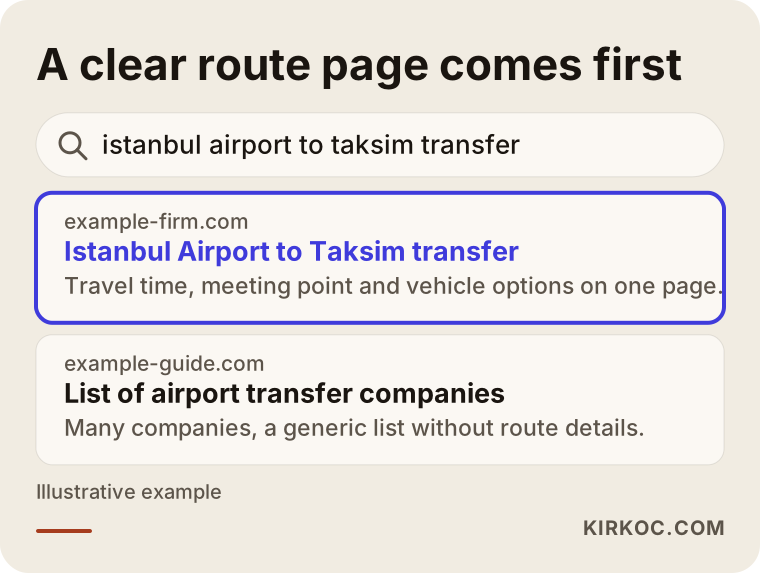
The illustration above shows why, for the same search, a clear route page is more likely to get the click than a generic list. When a customer sees exactly what they typed in the title, they click.
What is a booking website, and why is a business-card site not enough?
A booking website lets a visitor enter a pickup point, a destination, a date, a time and the number of passengers, and send the request straight from your site. It does not always have to be a full system that takes payment. Some companies collect the request and call the customer back; others want instant confirmation and payment. Both are valid models. What matters is that the visitor never has to wonder what to do next.
A "business-card site," with a company intro, a few photos of vehicles and a phone number, falls short in this business. A transfer customer is often searching late at night or just before a flight, in a different time zone. They may not reach you by phone, and even if they do, there may be a language problem. A booking form captures the request at that moment without losing the customer.
There is a choice to make here. You can have a booking system built from scratch, or you can use a ready-made booking plugin, or even a simple form with an email or message notification behind it. Which one fits depends on how many bookings you take each month, how many vehicles and drivers you run and how you track records today. For a small company, a simple, solid form is often enough. A complicated system can be both expensive and error-prone.
Which pages does a transfer site need?
On a transfer company's site, the number of pages is not what counts. What counts is which search each page answers. This is the structure I recommend.
Home page. This tells visitors who you are, what you offer and shows the booking form. On the first screen they should understand what you do, which city you work in and how to book. Skip the empty welcome text about "years of experience" and put in concrete information.
Airport pages. One page for each airport you serve: Istanbul Airport, Sabiha Gokcen, Antalya, Izmir, Dalaman, Bodrum and so on. Each page should explain how the meeting works at that airport, where the driver waits, what happens if a flight is late, what the luggage and child seat options are and which areas you drive to.
Route pages. A separate page for every frequently requested route, such as "airport to Taksim," "airport to Sultanahmet" or "Antalya to Kemer." This is the page type that matches the way customers search. Each one should say that travel time can vary, which vehicle types are available and what the price depends on.
Vehicle fleet page. Which vehicle, how many passengers, how many suitcases, what is inside. In VIP work, the vehicle is the product. Use real photos. Stock images found online make customers suspect that a different car will turn up.
Service pages. Corporate transfers, wedding and event transfers, intercity trips, chauffeur-driven hire, meet-and-greet service, whatever you actually offer. Each one answers a different need, so each deserves its own page.
About and how-we-work page. Here you give the company's official details, documents, how drivers are chosen and the insurance and contract terms. Before you make firm claims about licensing and document requirements, check with a lawyer or your professional association. An incorrect statement about permits can cause you real trouble.
Frequently asked questions. Late flights, waiting time, cancellation terms, child seats, payment methods.
Contact. Phone, WhatsApp, email and, if you have one, the office address with a map.
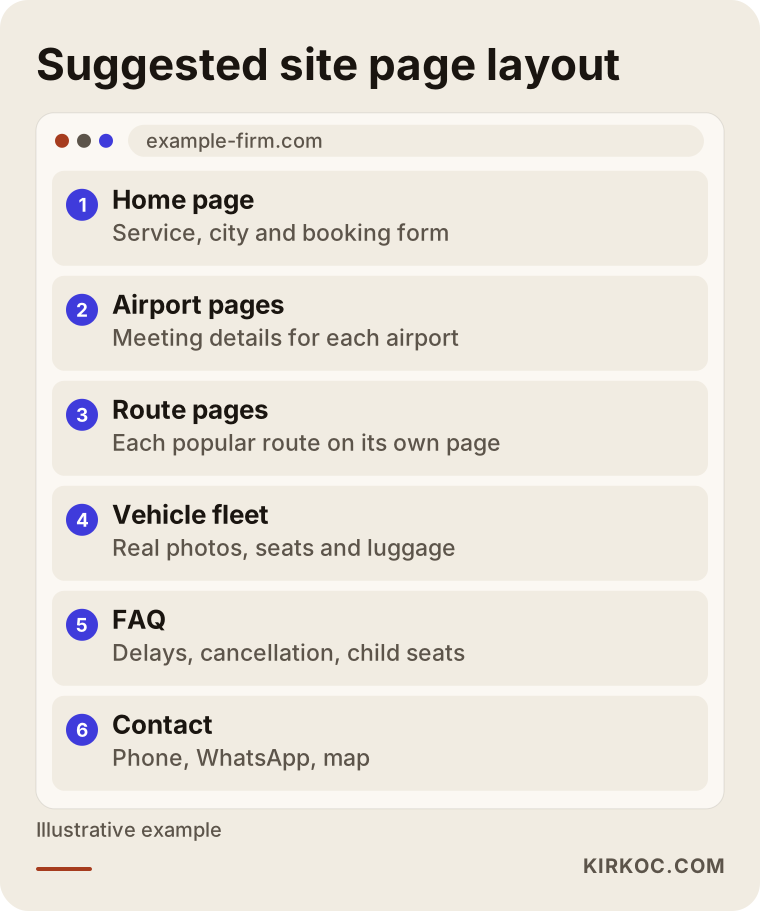
The diagram summarizes which sections a site should carry, starting from the home page. You can add or remove rows depending on your own business.
Matching the right page to each search
Different people use different words for the same service. Deciding up front which search goes to which page is much easier than cleaning up a pile of pages later.
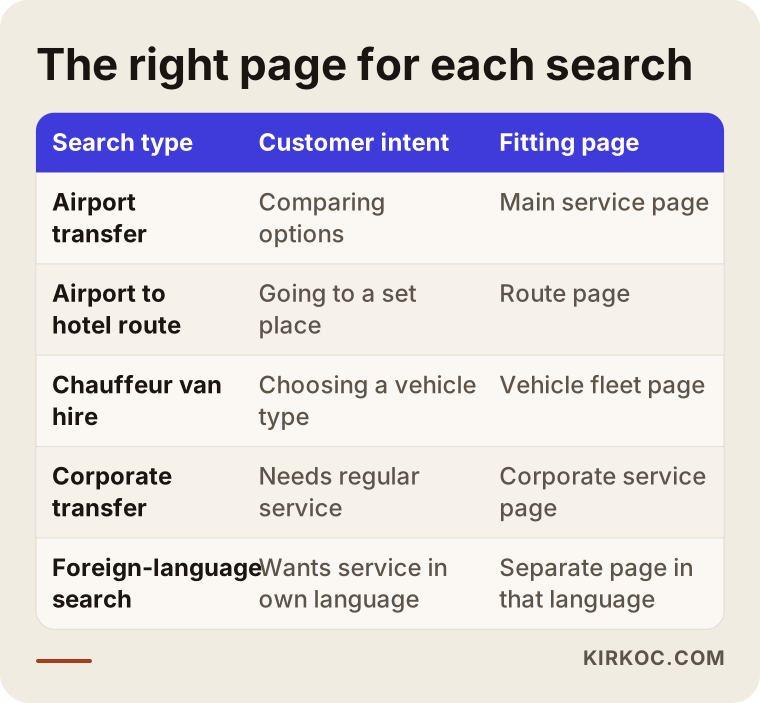
As the table shows, a broad search like "airport transfer" belongs on the main service page, a specific one like "Istanbul Airport to Besiktas transfer" belongs on a route page, and "Mercedes Vito with driver" belongs on a vehicle or service page. When one page tries to answer every search at once, it is usually not strong for any of them.
Separate pages for customers who speak another language
If most of your clients are tourists, a site in only one language is a serious gap. The key point is that the text must not read like machine translation. Someone from abroad needs directions to the hotel or the airport explained in a way they can follow. Giving each language its own page address also helps search engines understand which page to show to whom. Set priorities as well: finish the language that brings the most customers first, then add the next one.
Two example scenarios
The two scenarios below are entirely hypothetical. They do not describe a real company; I made them up to give you an idea.
Scenario 1: a small airport transfer company
Imagine a hypothetical firm in Istanbul with three vehicles. Most of its customers come from past clients' recommendations and from booking platforms. The platforms take a commission on every job and sit between the firm and the traveler, so the firm never learns who the customer is and cannot reach them again.
The first step for this company would be to pick the three or four routes it drives most, for example from the airport to the main tourist districts. Each route gets its own short but informative page. The page contains real details: that travel time changes with traffic, where the driver meets the passenger, and whether the child seat is free or paid. The site has a simple booking form and a WhatsApp button. The Google Business Profile, the free listing that shows your company on maps, is filled in with exactly the same address and phone number as the site.
The aim is not to abandon the platforms. It is to steer part of the customers directly to you. The platforms may keep bringing work for a while, and the site slowly becomes a separate channel. How long that takes cannot be predicted.
Scenario 2: a VIP and corporate transfer company
The second hypothetical firm serves hotels, companies and event organizers with larger vehicles. Here the buyer is usually not an individual tourist but a decision maker or an assistant. Before price, they ask about trust, consistency and invoicing.
This firm's site leans on service pages: corporate transfers, event and conference transfers, executive chauffeur service. It states the company details, how contracts work, how drivers are selected and its approach to privacy. A "request a quote" form takes priority over a simple booking form, because corporate work is often a periodic arrangement rather than a single trip. If you want to name a real client as a reference, get their written permission first. Without it, a general line such as "serving hotels and event companies" is enough.
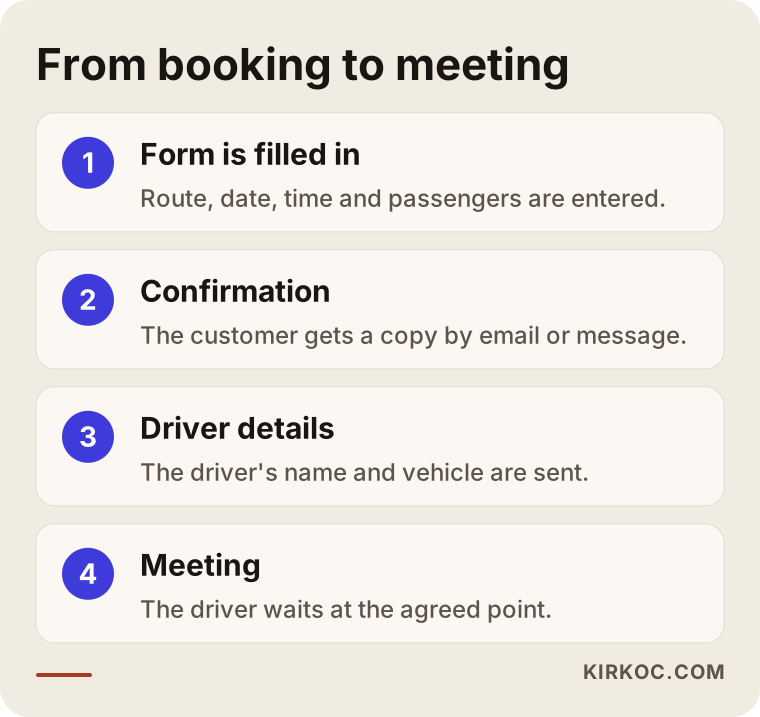
What both scenarios share is that the customer knows what happens after booking. The flow above is a simple example of the path from the form to the meeting.
What should the booking form look like?
The booking form is the most critical part of the site, because it is where the visitor decides to spend money. A few practical rules apply.
Keep it short. Pickup point, destination, date, time, number of passengers, number of suitcases, name and contact details are enough for most jobs. Make the flight number an optional field. It is very useful for tracking delays, but if you make it mandatory, some customers will abandon the form.
It must be easy to fill in on a phone. Most customers look from a mobile device. Tiny fields, buttons placed close together and long dropdown lists make the form hard to finish. Actually try the date and time picker on a phone.
When the form is sent, the customer should see a confirmation right away and get a copy by email or message. Even a sentence like "We received your request and will reply within a set time" reduces anxiety. Only write a time you can keep.
How you show the price is another important decision. If you show a fixed price by route and vehicle type, say what it includes: tolls, airport parking, waiting time. Nothing annoys a customer more than an extra charge that appears later. Whether to show the price or to say "request a quote" depends on your business model, and each approach has pros and cons.
If you take payment, use a secure payment provider and never store card details on your own site. Ask your accountant about the choice of payment provider and about tax questions.
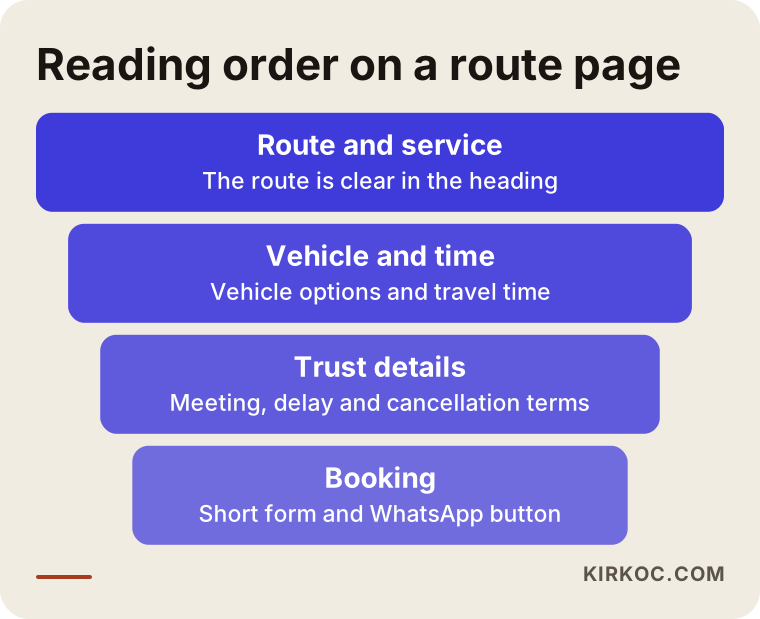
The page diagram above shows what a visitor should see, and in what order, on a route page: first what it is, then what it looks like, then the details that build trust and, last, the booking.
How do you build trust?
A transfer is a trust business. The customer will get into a car in a city they do not know with a person they have never met. The job of the site is to reduce that worry.
First, show reality: real vehicle photos, a real introduction of your drivers (with their permission) and a real photo of how you greet passengers. Second, remove uncertainty. State the meeting point, the waiting time and what you do when a flight is delayed. Third, make contact easy. Show a WhatsApp button, the hours you answer and the languages you support.
On reviews: using customer reviews is a strong trust signal, but show only real ones that you have permission to use. Made-up reviews are unethical, and when they are discovered they damage your brand badly. If you have no reviews yet, a good start is to politely ask satisfied customers to leave one on your Google Business Profile.
Be careful with documents and permits. Instead of a broad sentence such as "all our documents are complete," state clearly which documents and insurance policies you really hold. Which documents are mandatory can change over time, so ask a lawyer or the relevant professional association for the current situation.
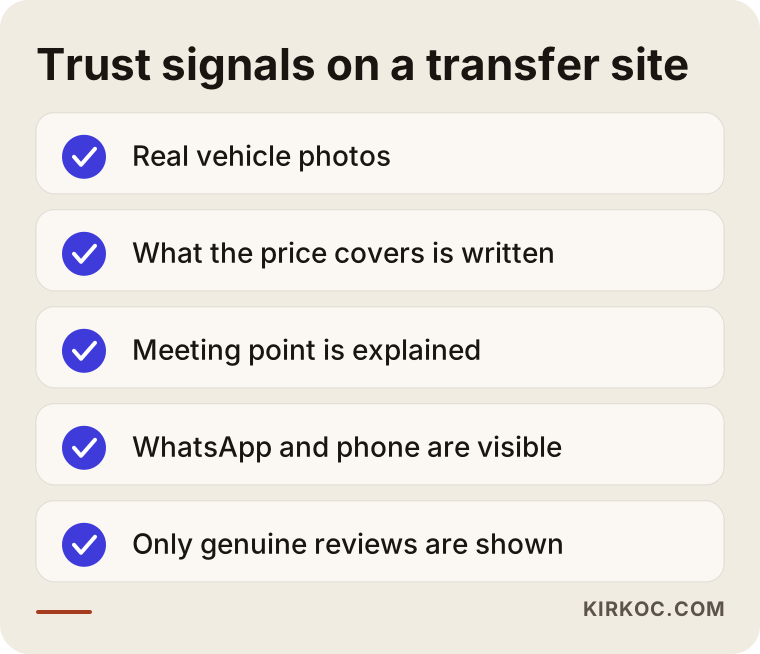
You can tick through this checklist one item at a time while looking at your own site. Missing items often do not require a new design; fixing a few pages is usually enough.
Speed, mobile use and technical basics
Your customer might be standing in a taxi line or an arrivals hall, searching on a phone. If your site takes five seconds to open, they leave. A few basics help: compress images, remove unnecessary plugins and use decent hosting. Uploading vehicle photos in very high resolution is tempting, but it slows the site badly on a phone. Prepare them at a size suited to the web.
A secure connection (an address that begins with https) is effectively mandatory. Without it, browsers show a "not secure" warning, and on a booking form that warning drives customers away. Also make sure the domain name and hosting accounts are opened in your name. You do not want to be a business owner who cannot reach their own site after they stop working with the person who built it.
When someone taps the phone number, a call should start. When they tap the address, a map should open. These look like small details, but they decide how many visitors turn into bookings.
Showing up in search engines and AI answers
Customers no longer type only into Google. They also ask AI tools like ChatGPT questions such as "how do I get a safe transfer from Istanbul Airport to Sultanahmet?" When these tools answer, they draw on pages that give clear, tidy and consistent information. That is why it helps to answer the frequent questions on each route page in plain sentences and to write your company name, address and phone number exactly the same everywhere. Adding "structured data" also helps. That is an invisible label in the page code which tells a search engine, "this page describes a service, valid for this price and this area." No method, however, guarantees that you will appear in an AI answer.
For local visibility, set up your Google Business Profile and fill it in consistently with your site. Choose your service areas, opening hours and category carefully. If your office does not receive customers on the street, you can hide the address and show only the service area.
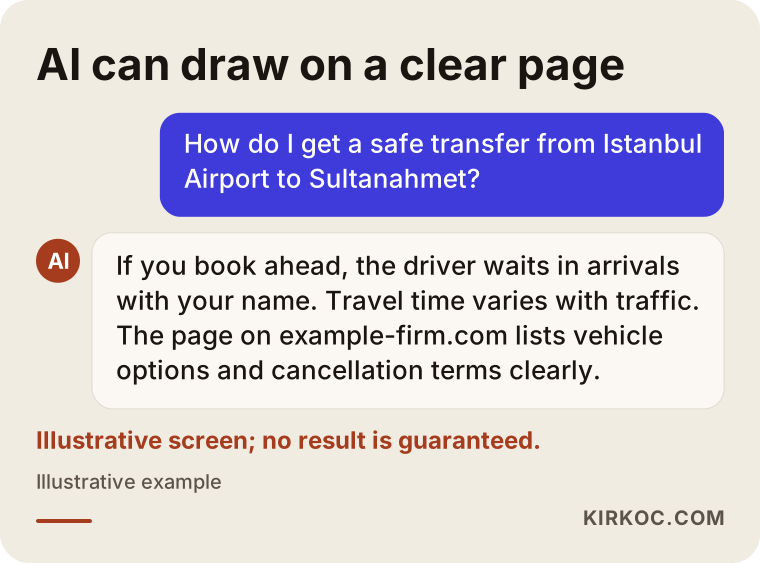
The sample answer in the illustration shows how clear information on a page can carry over into an AI answer. It is not a promise. It is an example of why page quality matters.
Common mistakes
These are the mistakes I see most often on transfer sites.
Putting everything on one "transfer service" page. When routes, vehicles, languages and service types are squeezed into one page, the visitor cannot find what they want and the search engine cannot tell what to show.
Copying the same text and swapping the route. If "Airport to Taksim" and "Airport to Kadikoy" differ only by the place name, that helps neither the reader nor the search engine. Put real information specific to each route on each page: travel time, the roads used, the meeting point and the questions people ask.
Leaving the price and its scope vague. If a customer cannot find the answer to "what is included," they either ask or go to another site.
A long, tiring booking form. A form with fifteen fields is an abandoned form.
Building the site only in one language and then expecting international customers.
Using stock images instead of photos of your own vehicles.
Never testing on a phone. A site can look great on a computer and have buttons that jump around on a phone.
Writing your address and phone differently in different places. When the site shows one number, the Google profile another and social media a third, customers get confused and search engines trust you less.
Abandoning the site after launch. If a new vehicle, route or price change is not reflected, outdated information misleads the customer.
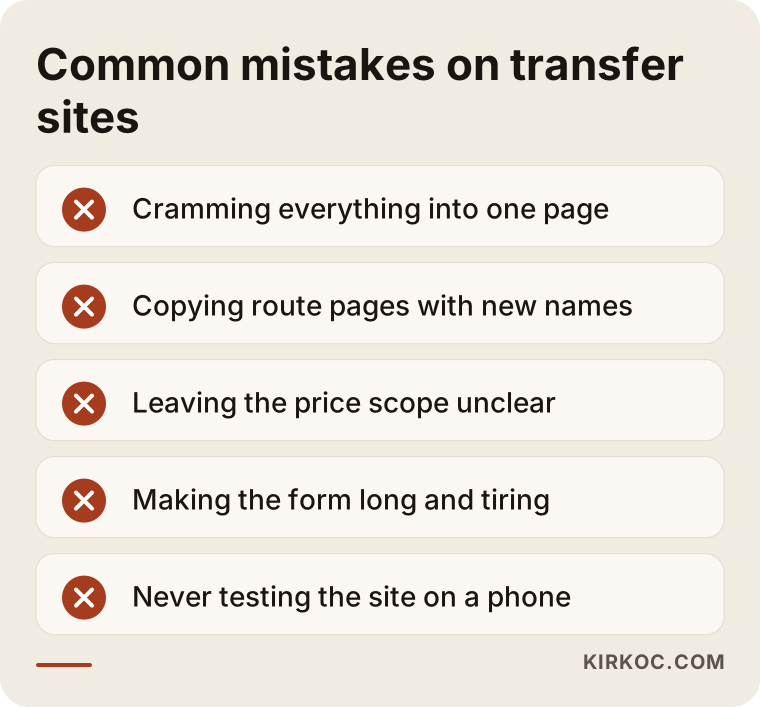
You can also use this list as a check. Look at your site and count how many of these you have.
Step by step: how a site is built
The process differs from company to company, but the outline is similar.
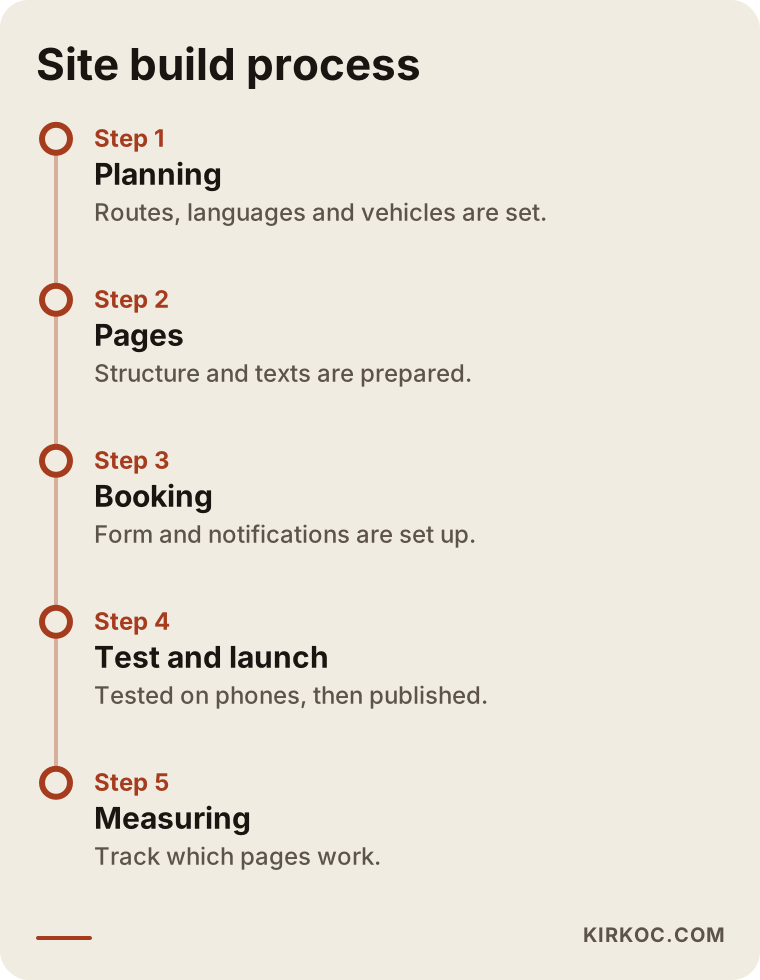
First comes planning: which routes, which languages, which vehicles and what kind of booking structure. At this stage I talk with you and listen to how the business runs, which hours are busy and what customers ask most. Then the page structure and texts are prepared. After that the booking form is built and the notifications (email, messages) are tested. Before launch it is tried on phones and in different browsers. Once the site is live, measurement begins: which page is viewed by how many people, and where do visitors abandon the booking form?
Do not skip measurement. Changing a site without knowing what it does is like working in the dark. Even a simple setup that tracks form submissions and phone taps will show you which pages are doing the job.
Three things help at the growth stage: steady content and page improvements so that the site can be found in search (SEO), local visibility through the Google Business Profile and, if needed, Google ads. Ads can be useful for testing a new site quickly, but the budget and goal must be clear first. Social media supports trust with vehicle photos and real moments of meeting passengers. The benefit of having these handled by one person instead of several vendors is consistency. The sentence on your site, the sentence in your ad and the details on your profile do not contradict each other, and when one is updated the others are updated too.
What can you do yourself, and when do you need an expert?
You do not need to hand everything to a specialist. There are things you can do on your own.
You can open your Google Business Profile and fill it in properly. You can photograph your vehicles and list the routes you serve. You can write down the ten questions customers ask most and prepare answers; that list is the base for the FAQ section. You can ask happy customers for reviews. You can look at competitors' sites as a customer and note what you like and what confuses you.
Expert help makes sense in these cases: when a site must be built from scratch, when the booking form and notifications must work reliably, when content is needed in several languages, when speed and mobile layout are a problem or when a site exists but brings no bookings. In those cases, finding what the real problem is costs less, and works better, than paying for a new design on a guess.
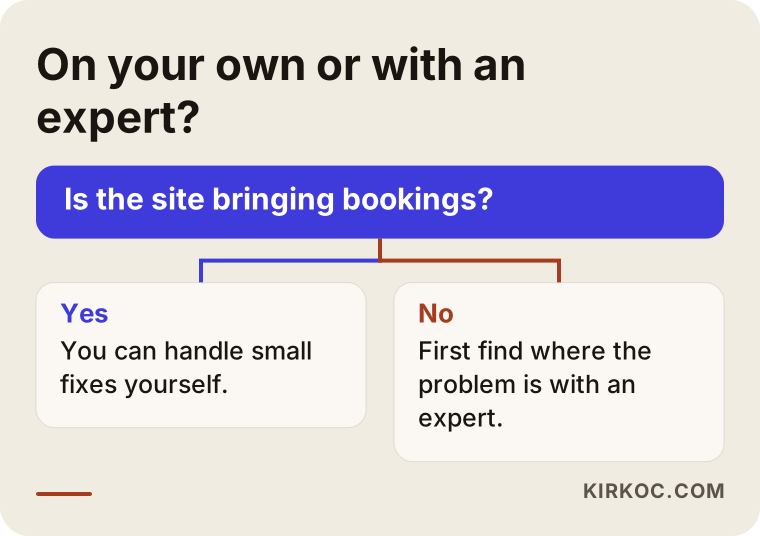
The diagram above asks one simple question you can use to decide whether to go ahead on your own. If you are unsure, a short first conversation usually brings clarity.
What determines the cost?
I will not put a number on this, because every company's needs differ and I do not want to create a false expectation. I can, however, tell you plainly what changes the cost.
Number of pages: a home page with a few service pages is not the same job as dozens of route pages. Number of languages: every extra language adds writing and checking work. Scope of the booking system: a basic request form is very different from a system that takes payment, manages a calendar and notifies the driver. Design and photography: ready photos make the job easier; if you have none, a shoot has to be planned. Writing: even if you supply the text, it needs editing. Maintenance and updates: who updates the site after launch. Ad and SEO support: building a site and bringing it steady customers are two separate jobs, and the second needs continuity.
When you collect quotes, check these points: Is the list of work in writing? Whose name are the domain and hosting under? Is there support after launch? What does the price actually include? Avoid a vague quote that claims to cover everything.
How I work with you
I am one person working from Istanbul, and I handle websites, SEO, local SEO, social media, Google and Meta ads, logos and content myself. The person you talk to is the person who does the work. You do not have to go through a project manager as you would at a large agency. On the other hand, my capacity is limited, and there is a limit to how many jobs I can take at once.
In the first conversation I usually listen to your business, your routes and the kind of customers you serve. If you have a site already, I look at what works and what does not, and I tell you in plain language where to start. Then I prepare a written plan and a quote. The domain, hosting and accounts are opened in your name, so you keep access to your site even if we stop working together. I do not promise results, but I do explain what I do and why.
Frequently asked questions
Does a transfer company really need its own website, or are booking platforms enough?
Platforms can bring work, but they sit between you and the customer and take a commission. Your own site creates a channel that brings customers straight to you and that you can reach again. You can use both together. How much weight to give each depends on your business model.
Should I choose a full booking system or a simple request form?
If you take few bookings a month and answer each request yourself, a simple form is often enough. If you run many vehicles and drivers and need instant confirmation, a broader system may be worth considering. Before deciding, tell me how you manage bookings today and I will say what fits.
Should I show prices on the site?
On fixed routes, showing the price builds trust and cuts unnecessary back-and-forth. For custom jobs where the price varies, a "request a quote" form may fit better. Whichever you choose, state clearly what the price includes.
Do I need a site in other languages?
If you carry tourists or foreign business travelers, very likely yes. Start with the language that brings the most customers and add more over time. Have the translation checked, because a badly translated page weakens trust.
How long until the site brings bookings?
That cannot be said in advance. Competition, the routes, how many pages you launch with and the quality of your service all affect the outcome. With steady upkeep and measurement you will see over time what works.
Can you guarantee a first-place ranking on Google?
No. No honest specialist can, because the system that decides results belongs to Google. What I can do is make sure your site answers customer searches clearly and works without technical problems.
What should I do after the site goes live?
Update the pages whenever you add a vehicle or route or change a price, answer booking requests quickly and keep your Google Business Profile active. If you like, I can handle this upkeep with you.
I already have a site but no bookings. Do I need to start over?
Not always. First find where the problem is: are pages missing, is the site slow, is the form hard to use or does nobody find it? Sometimes a few fixes are enough; sometimes rebuilding is healthier.
If you are thinking about building a site for your transfer business or tidying up the one you have, a short call is enough for me to look at your situation and give you an honest roadmap. You can reach me through the website design page for details.