You opened an IVF clinic, or you have run one for years. Your doctors are experienced and your lab is well equipped, but your website says none of that. The phone rings rarely, and most callers only ask "how much does it cost?" Maybe a friend built the site years ago, or maybe it is a template with your logo on it. I am assuming you are looking for a website for an IVF clinic in Turkey, whether your patients are local couples, couples traveling in from abroad, or both. In this article I explain why such a site has to be built differently from an ordinary company website, how couples actually search, and where you should start. I am Ümit Kırkoç, I work in Istanbul, and I handle website design together with SEO, advertising and social media, all myself.
One thing first: IVF is unlike most other services. A couple who reaches your site has usually been through months or years of waiting, sometimes a few unsuccessful attempts, and a heavy emotional load. Your website's job is not to "sell." It is to calm people down first, then inform them, and finally make the first appointment easy. A site that gets this order wrong will not earn a couple's trust, no matter how polished it looks.
What does a couple searching for IVF do online?
Search behavior here differs noticeably from other healthcare services. Couples usually start with questions: "what is IVF," "how does the IVF process work," "difference between IUI and IVF." At this stage they are not choosing a clinic yet. They are learning. A few weeks later the searches change: "IVF clinic," "fertility doctor," "IVF treatment in Istanbul," "second opinion IVF." This is where the real commercial intent sits, meaning a person who is getting close to a decision.
Then there are couples who were treated at another clinic before. They search more specifically: "IVF after repeated failure," "low ovarian reserve IVF," "male factor infertility treatment." When such a visitor lands on your site, they do not want a general introduction. They want a page that understands their own situation. If your whole site is one page called "IVF," you cannot answer them.
And if some of your patients travel from abroad, they search in their own language, often with a country or a city in the query. They also compare you with clinics in their home country, so details like what the first consultation looks like, how remote consultations work and who speaks their language matter a great deal.
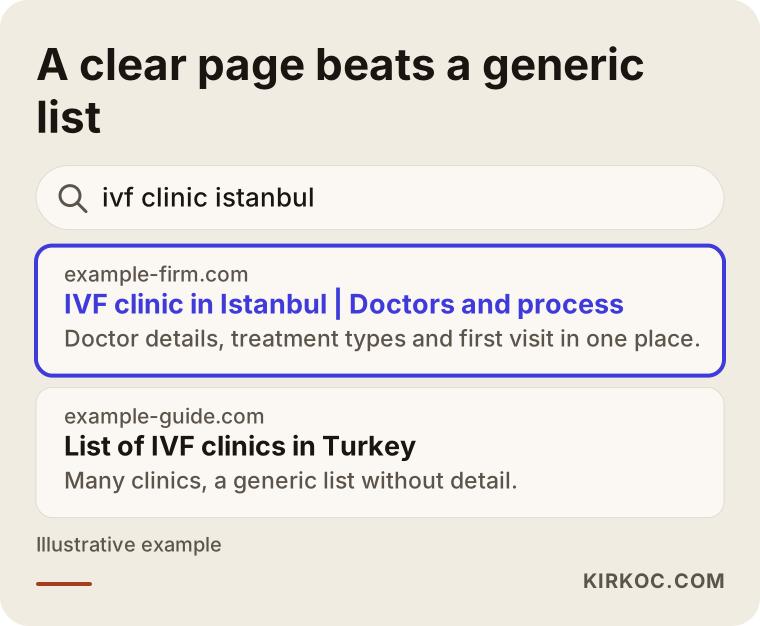
As the example search result above shows, a page that clearly names the city and the treatment gives a far sharper answer than a generic list that piles everything together. Google tends to reward that, because the page responds directly to what the searcher needs.
Why are health websites judged more strictly?
Google is more careful with topics that affect your health or your money. A wrong piece of information can change someone's life, so in these areas "who wrote this" and "is this organization real" carry extra weight. Think of it in plain terms. When Google looks at a site that writes about IVF, it asks: is the person writing this an expert? Does the clinic really exist, with a clear address and phone number? Is the content current? Do other trustworthy places mention this clinic?
That is why an IVF clinic site should state the names, titles, specialties and experience of its doctors and embryologists openly. Phrases like "our expert team" with no names do nothing. Under each article it should be visible which doctor prepared or reviewed it and when it was last updated. I usually set this up at the very beginning, because adding it later is both tedious and less convincing.
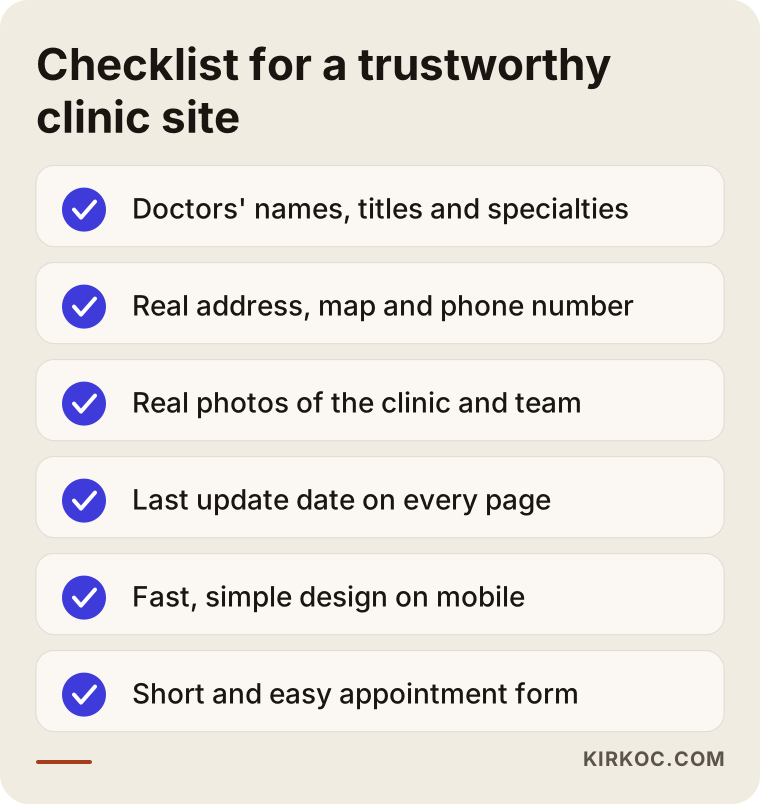
Every item on that checklist exists to make it easier for a couple to think "this place is real and serious" after one visit. None of them works miracles alone, but if one is missing, the couple hesitates, and a hesitating visitor usually closes the tab.
Which pages must you have?
The page structure of an IVF clinic site should follow the visitor's decision path. This is the skeleton I usually recommend:
- Home page: Says in a few seconds who the clinic is, which city and district it serves, and how to reach the first consultation.
- Treatment pages: A separate page for each treatment, such as IUI, ICSI or frozen embryo transfer. Each one answers, in plain language, who it is for, how it proceeds and what to keep in mind.
- Situation pages: Separate pages for topics couples search by their own case, such as low ovarian reserve, male factor or repeated attempts.
- Doctor and team pages: A page for each doctor with a photo, title, specialty and training.
- Process page: A step-by-step account of what happens from the first appointment to the transfer.
- Frequently asked questions: Honest answers to real questions.
- Contact and directions: Address, map, parking information, opening hours and an appointment form.
This skeleton rests on one principle: each page answers one intent. A person typing "IVF clinic" is not looking for the same thing as a person typing "how is IVF done." If you try to serve both on one page, both get a weak result.
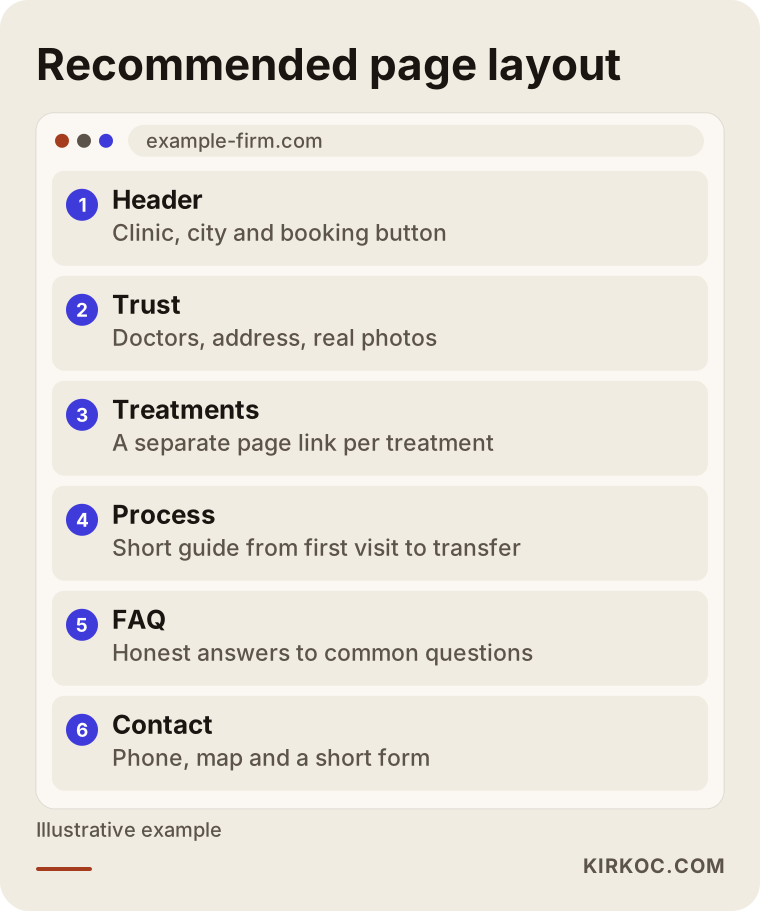
The outline above shows which sections a visitor passes through from the home page to the first appointment. The order may change for your clinic, but the logic stays the same: trust first, then information, then easy contact.
Advertising and promotion rules: the limits to respect
Promoting healthcare services is subject to special rules in Turkey. The Ministry of Health has regulations on how health facilities may advertise, and these can be updated from time to time. I am not a lawyer, so I will not give a firm legal ruling. What I can do is describe the risks I see most often, and for the final decision you should consult a lawyer or an advisor who knows the healthcare regulations. If you are also targeting patients in other countries, the rules of those countries and of the advertising platforms may apply too, which is one more reason to ask a professional.
In general, these are the points that get attention: wording that sounds like it guarantees a treatment result, success rates presented without proof or in a misleading way, use of patient testimonials and before-and-after style content, and discount or campaign language that makes it look as if treatment is being sold like a product. This area is sensitive because it involves both patients and professional ethics. I suggest reviewing every sentence on your site from this angle once before it goes live.
This also shapes my writing style. I do not use phrases like "highest success rate" or "guaranteed result." I explain, in an informative tone, what a couple can realistically expect and how a process works. It is more honest, and it is less likely to cause trouble later.
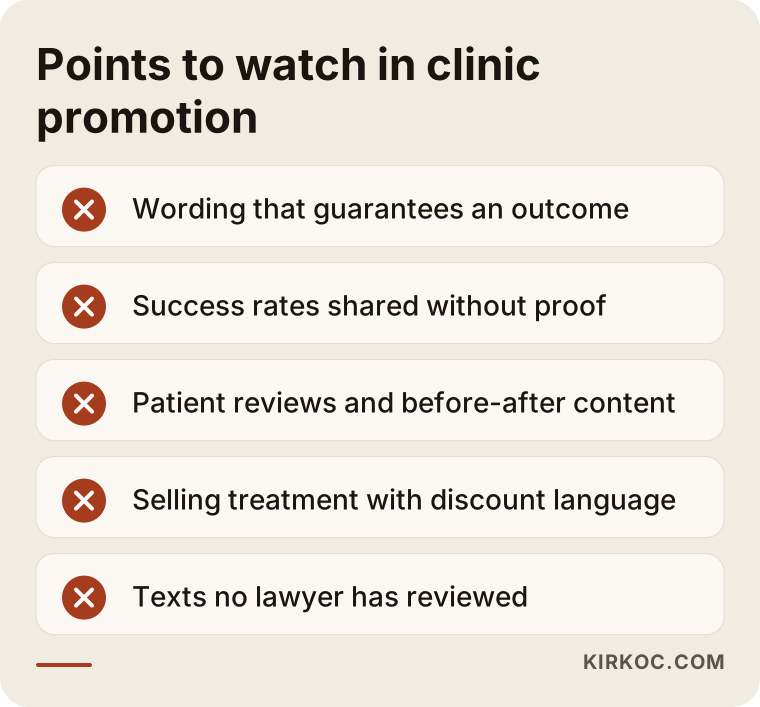
The warning list is not a complete legal guide. It simply collects the cautions I run into most often in practice. For your clinic's specific situation you still need an expert's opinion.
Two hypothetical example scenarios
The two examples below are entirely hypothetical. They do not describe a real clinic or a real person.
Scenario 1: A newly opened clinic with a single doctor. An obstetrician-gynecologist opens her own IVF clinic. Her site has only "About," "Services" and "Contact" pages, and the doctor's profile is one paragraph. When couples search for "IVF clinic," they do not find this site, while the competitors they do find have been publishing content for years. If I were starting with this clinic, I would first strengthen the doctor page with a real biography, then write the treatment pages one by one. In the first months of a new clinic, ranking for the broad "IVF clinic" search is not realistic, so I would focus on narrower searches that combine district and treatment type, and on the Google Business Profile (the listing that appears on the map with your address and phone). I cannot promise results, but this order makes more sense.
Scenario 2: A long-established clinic with an outdated site. A clinic has worked on word of mouth for years. Its website does not display properly on phones, the treatment information is out of date, and nobody is sure whether the appointment form works. Couples open the site and leave a few seconds later. Instead of building a new site from scratch, I would first evaluate the existing content: which pages do their job, which get no visits at all, which information has gone stale? Moving the pages to the new structure without losing the old addresses preserves the visibility the clinic has built over the years. After that I would fix mobile display, speed and the appointment flow.
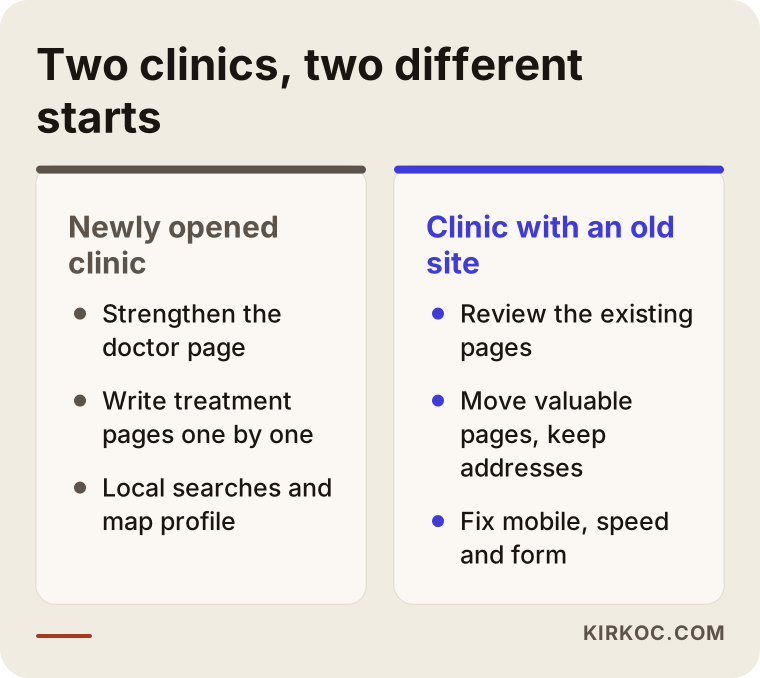
As the comparison shows, the two clinics start from different places, so offering both the same package would be wrong. You have to see the current situation first.
How do you answer the questions in the couple's head?
The couple looking at your clinic usually carries the same set of questions, and most of them are not about price. "Can I trust this clinic? Will they listen without judging me? What happens at the first appointment? Is it worth coming if I failed before? Is it too far for me?" If your site gives a short, honest answer to each, picking up the phone becomes easier for the couple.
The first appointment page is especially valuable. Telling the couple what to bring (old test results and reports, if they have them), roughly how the meeting will go and what happens afterward reduces uncertainty, and less uncertainty means less hesitation. Showing the whole treatment path as a timeline also works well. Couples see themselves on that timeline and understand what to expect.
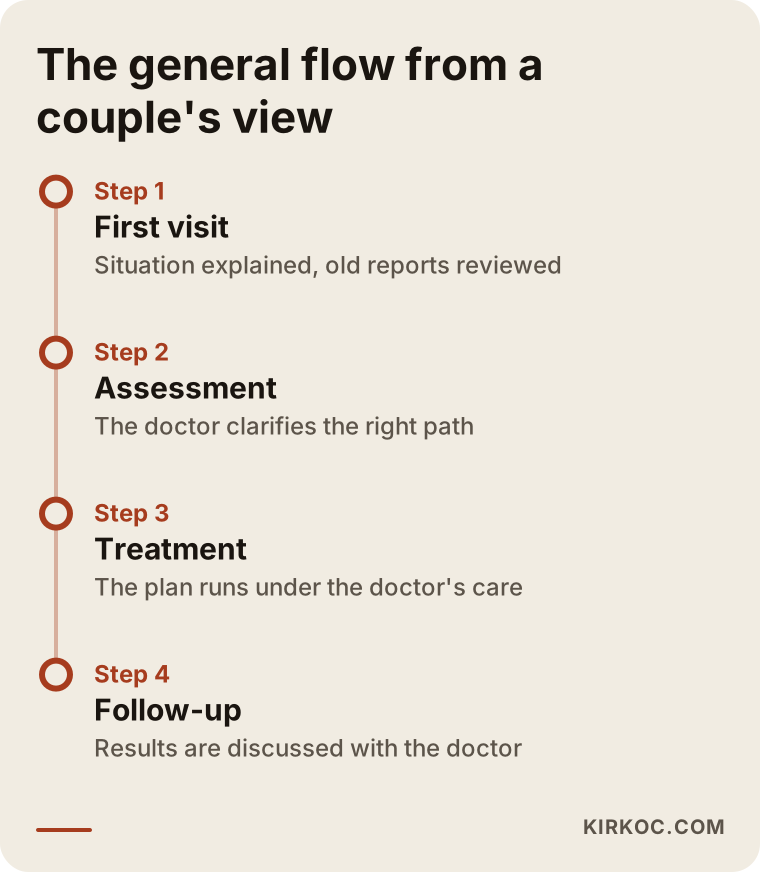
When you put a timeline like this on your site, say clearly that timing differs from person to person. Instead of promising a fixed schedule, saying "this is the general flow, your doctor will define it for you" is both more accurate and more reassuring.
Step by step: how is an IVF clinic website built?
Here is a summary of how I work. Every clinic's situation is different, but the general flow is similar.
1. Introduction and goal setting. We talk through how many doctors the clinic has, which treatments it offers and which couples it wants to reach. The question "who do you want to serve" matters a lot here, because a site that tries to speak to every couple ends up speaking to none.
2. Reviewing the current situation. If you have a site, I look at what works and what does not. I check how competitors appear to couples. Your Google Business Profile and your visibility on the map are covered at this stage too.
3. Page plan and copy. I decide which pages will be written, and for each one I prepare a list of facts for your doctor to verify. I never invent medical content on my own. The texts go through the doctor's approval. My part is to simplify the wording and explain the jargon.
4. Design and development. A calm, readable design that opens quickly on mobile is built. The phone number and the appointment button are visible on every page. I care about page speed and accessibility, because a large share of visitors arrive on a phone.
5. Pre-launch review. I go over the texts, images and forms with the promotion rules in mind, and if needed your clinic's legal advisor signs off. I test that the forms work, that notifications reach the right person and that the privacy and personal data notices are in place.
6. Launch and measurement. After the site goes live, I track which pages get visits and which pages produce phone calls or form requests. Without that measurement you cannot know what is working.
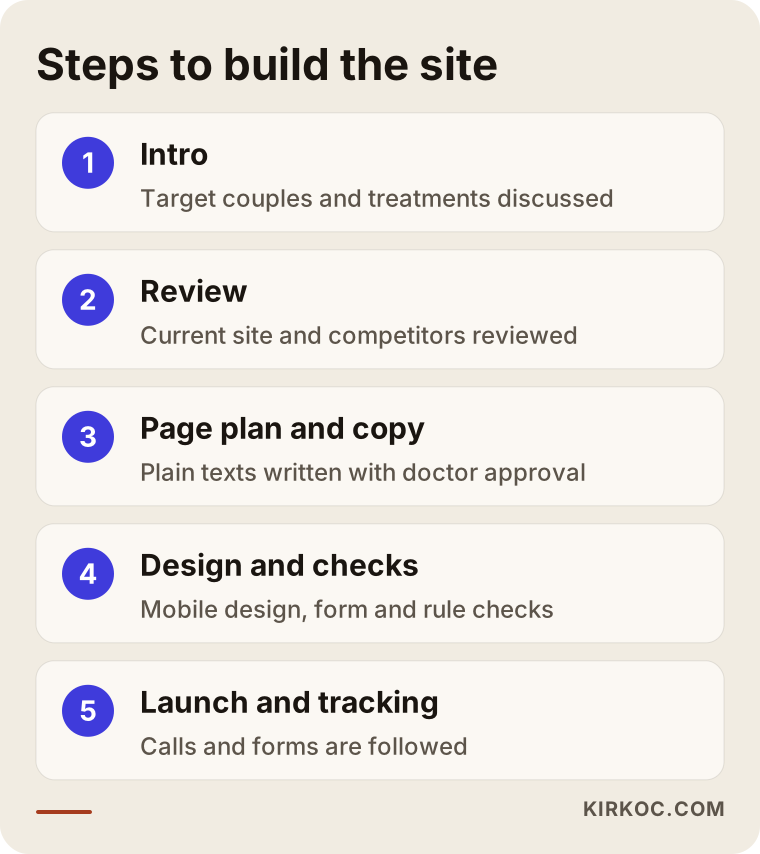
As the process graphic shows, design is only one part of this job. Most of the effort goes into planning and content. That is why someone who offers "design only" can leave you stranded halfway.
The appointment form and contact flow
Many clinics focus on making the site pretty and neglect the contact path. But from the moment a couple decides, every extra obstacle is a lost inquiry. The phone number should be tappable on mobile with one touch. If you use WhatsApp, say so openly and state the hours when you reply. The appointment form should be short: name, phone number, a convenient time and an optional short note. Do not ask for medical details through the form. Typing sensitive information into a web form makes couples uneasy, and it can create extra obligations under personal data protection rules. I recommend getting a lawyer's view on that as well.
Also state how quickly you will answer a request. Couples often look at other clinics while they wait for a reply. A same-day, kind and informative response is frequently the best marketing you have. If you receive inquiries from abroad, mention the time zone you answer in and the languages you can use on the phone.
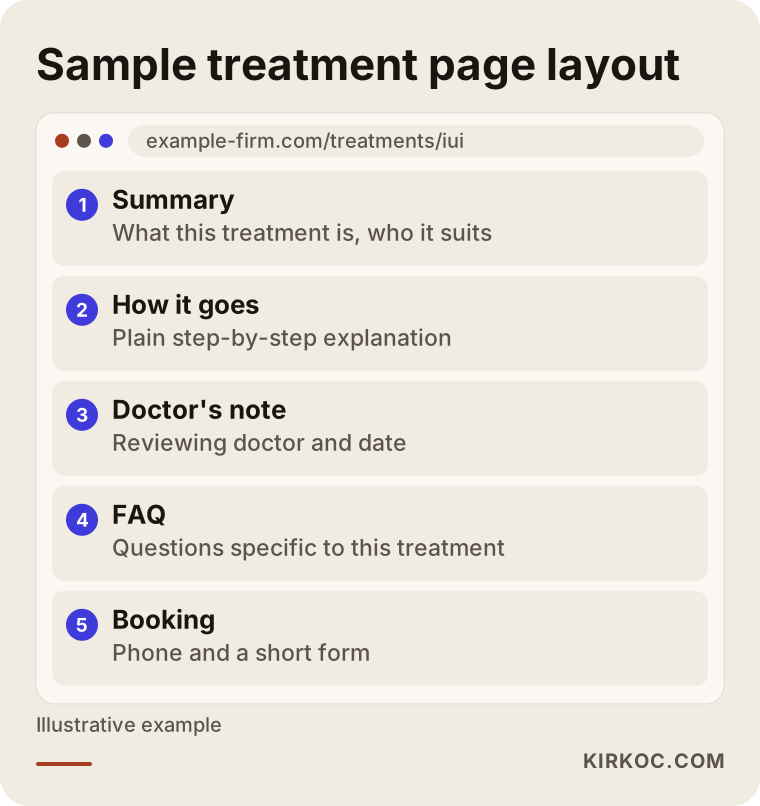
The layout above is built around where a visitor's eye goes first: headline, trust, treatment options and contact.
Common mistakes
Here are the mistakes I see repeatedly in this field:
- Explaining everything on one page. Piling every treatment onto a single page tires the reader and stops you from giving a clear answer in search results.
- Hiding doctor information. A site that conceals the identity and experience of its doctors loses trust in healthcare.
- Too many stock photos. Smiling family pictures are emotional but look fake. Photos of the real clinic, the real team and the real waiting room work better.
- Exaggerated success claims. These are risky both ethically and legally, and couples notice exaggeration quickly.
- Skipping the mobile experience. Couples often research in the evening, from their phones.
- Not updating old information. Outdated treatment information damages trust in the eyes of both Google and the couple.
- Burying the contact path. Hiding the phone number in the footer or making the form complicated loses inquiries that were ready to come in.
What can you do yourself, and when do you need an expert?
Some tasks you can do without an expert. Claim or verify your Google Business Profile, and keep the address, phone number and opening hours current. Prepare short biographies and photos of your doctors. Write down the ten questions couples ask most often at the first appointment; those become the base of the FAQ section on your site. Take real photographs of your clinic.
You need an expert for these: planning the page structure around search intent, the technical foundation and speed, mobile compatibility, writing medical content in a plain but accurate way, setting up measurement and compliance with promotion rules. If you set these up wrong, fixing them later costs more than doing them right at the start.
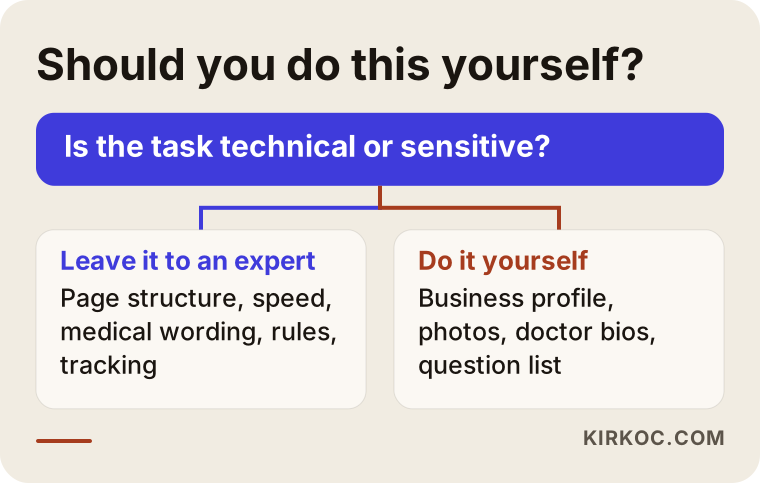
The split in the decision chart is not a strict rule. It can flex with your budget and your time. Still, for technical and sensitive topics, expert help is usually cheaper in the long run.
How do website, SEO, ads and social media work together?
A website for an IVF clinic is not enough on its own, because couples need to find you. That is why it makes sense to think of it together with SEO, the work that helps your site show up in Google searches. Blog articles serve couples who are looking for information, treatment pages serve couples at the decision stage, and the Google Business Profile serves people searching nearby. They complement each other. If you want faster visibility, Google Ads is also an option, but remember that for health advertising both Google's policies and local regulations have rules. Ad texts need the same care.
On social media the aim is not to apply sales pressure but to build a calm, informative presence. Short question-and-answer videos from a doctor, explanations of the process and an introduction to the clinic build trust. When all of this sits with one person, the message stays consistent: the language on the site, in the ads and on Instagram all match. Because I run all of these myself, you do not have to deal with message drift between separate agencies.
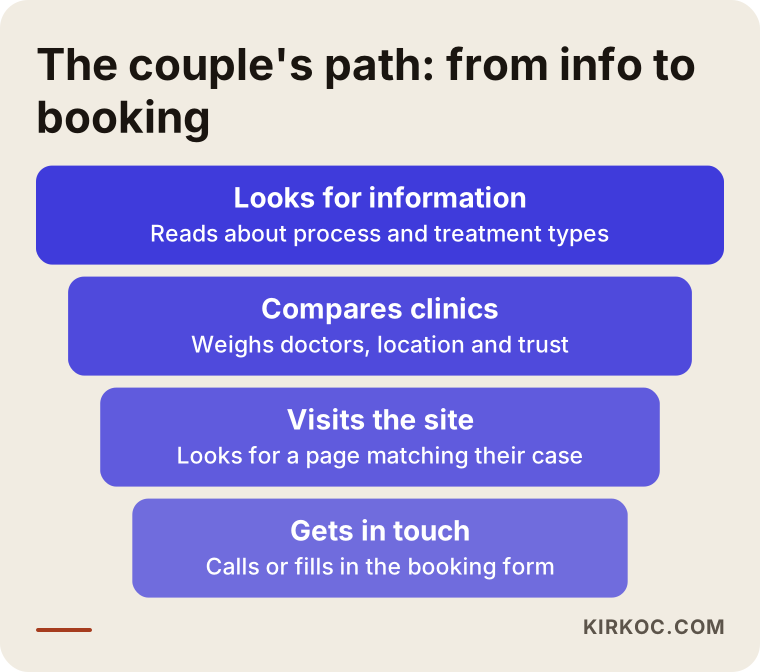
The funnel graphic shows the path narrowing from a wide audience down to an appointment request. Each stage needs its own content, and planning them together takes less effort and produces a more consistent result.
What determines the cost?
I do not quote a single price for this kind of site, because the size of the job varies a lot. The main factors are how many pages need to be written (one treatment or twenty pages), how intensively the medical content is prepared together with the doctor, how many languages the site will run in (couples from abroad may need extra language pages), whether the existing site has to be migrated, photo and video shoots, extras such as a booking system, and how much maintenance and measurement support the site gets after launch. SEO and advertising work is scoped separately.
When you collect quotes, always ask what is included and what is not. Is copywriting included? The doctor approval process? Mobile adaptation and measurement setup? If not, work out the later cost now. Also be cautious about any quote that guarantees results. In healthcare, nobody can guarantee a ranking or a number of patients.
How I work with you
I work alone in Istanbul. I handle the website, SEO, local SEO, Google and Meta ads, social media, content and brand identity myself. I am your single contact, so nothing falls between the cracks. I usually start with a short introductory call where we talk about your clinic, your goals and the current state of your site. Then I send you a plan in which I write down what I recommend and why. If you do not like it or it does not fit your budget, we can simplify it. On medical content, your doctors always have the final word. I simplify the language, build the structure and measure.
Frequently Asked Questions
How many pages should an IVF clinic site have?
There is no fixed number. For a small clinic, it makes sense to start with a home page, doctor pages, a few core treatment pages, the process, an FAQ and contact. Over time it grows with situation pages and informational articles. What matters more than the page count is that each page answers a single intent.
Can I publish success rates on my site?
Promotion rules for healthcare are sensitive on this point. Whether and how rates can be shared, and with what evidence, depends on the regulations, so I recommend asking a lawyer or an advisor who knows the rules before publishing. I usually prefer wording that describes the process and the doctors' experience instead of percentages.
Can I use patient reviews and before-and-after style content?
In healthcare, use of this kind of content is bound by rules and ethical principles, and patient privacy matters too. Get legal advice before using it. You can build trust in other ways: doctor biographies, real photos of the clinic, certificates and a clear explanation of the process.
How long will it take to show up on Google as a new clinic?
Nobody can say for certain. Competition, city, content quality and the age of the site all play a role. Showing up for broad searches can take months, while narrower district and treatment searches and the Google Business Profile often bring earlier visibility. If you want visibility sooner, advertising is a separate option.
Do I need foreign-language pages for patients from abroad?
If your target audience includes couples from abroad, yes. Each language needs its own pages, prepared around the words people actually search in that language. Automatic translation is not enough. It is reasonable to decide first which countries you expect inquiries from and start with those languages.
Is it better to refresh my current site or start from scratch?
It depends. If your address has had a good standing for a long time and part of the content is useful, renewing the structure while keeping the valuable pages may make sense. If the foundation is old and broken on mobile, starting fresh is healthier. I decide either way by reviewing the current site first.
What information should I ask for in the appointment form?
As little as possible: name, phone number, a convenient time and an optional short note. Collecting medical details in person or by phone at the first consultation puts the couple at ease and lightens your personal data load. Ask a lawyer about your privacy and data protection notices.
What should be done after the site goes live?
You should measure visits and the number of calls and forms regularly, keep treatment information current, add articles for new questions and keep your Google Business Profile alive. A site should not be treated like a brochure that is printed once and forgotten. It is a living channel that needs upkeep.
If you want your IVF clinic's site to give couples confidence, show up for the right searches and be easy to reach, you can contact me through the website design page. We will talk through your clinic's situation, and I will explain the path that suits you in plain terms.