Perhaps you run a hotel, an apart-hotel, a bungalow site, a restaurant, a transfer company or a tour business in Trabzon. Or maybe you are a foreign owner or investor who bought into the region and now has to fill rooms and seats. In summer you see families from the Gulf countries everywhere: on the road to Uzungol, on the climb to Sumela Monastery, with tea at Boztepe. What you probably do not know is how those guests found you. Bookings come through intermediary platforms, or by chance. You have your own website, maybe even an Arabic page, yet someone searching on a phone in Arabic or English does not see you. This is exactly where SEO for Trabzon comes in. In this article I explain what is specific to Trabzon and to Gulf visitors, what really works, and where to start. I am Ümit Kırkoç. I work from Istanbul and handle everything from the website to the ads myself, and near the end I describe the scope of my own SEO services openly.
SEO, in the shortest definition, is the work that makes your website show up when people search on Google. With advertising, you are visible the day you pay and gone the day you stop. With SEO, the structure you build keeps bringing inquiries for months if it is done properly. In tourism the meaning is simple: before a guest ever leaves home, they type something into a phone, and the first few results they see largely decide where they spend the holiday.
Why search works differently for Trabzon tourism
A visitor to Trabzon does not search like a customer looking for "a barber near me." They are planning a trip, so they research the city, the region and the accommodation all at once. A family's plan often goes like this: first they look for information such as "things to do in Trabzon" or "how to get to Uzungol," then they check places to stay, then they read reviews, and only at the end do they send a message or book. You need to appear at every step of that journey, not only the last one.
The second difference is the language of the search. A good share of Gulf visitors search in Arabic, and some search in English. The same person may type "Trabzon" and "Uzungol" in Arabic letters on an Arabic keyboard, then switch to English to look at photos. A page written only in Turkish shows up in neither search. Google tries to promote the page that matches the language of the query, so if you publish only in Turkish, you effectively do not exist for the person searching in Arabic.
The third difference is trust and expectations. A family traveling together pays attention to things such as a clean room, privacy, sensitivity about food, a space suitable for prayer, a safe environment for children and an airport transfer. If none of this is visible at first glance on a hotel site, the guest assumes "they did not mention it" and moves on. So SEO for Trabzon is not only a keyword exercise. It is the job of answering the guest's questions on the page itself.
The illustration below uses a completely invented example to show how two pages competing for the same region might look on a results page.
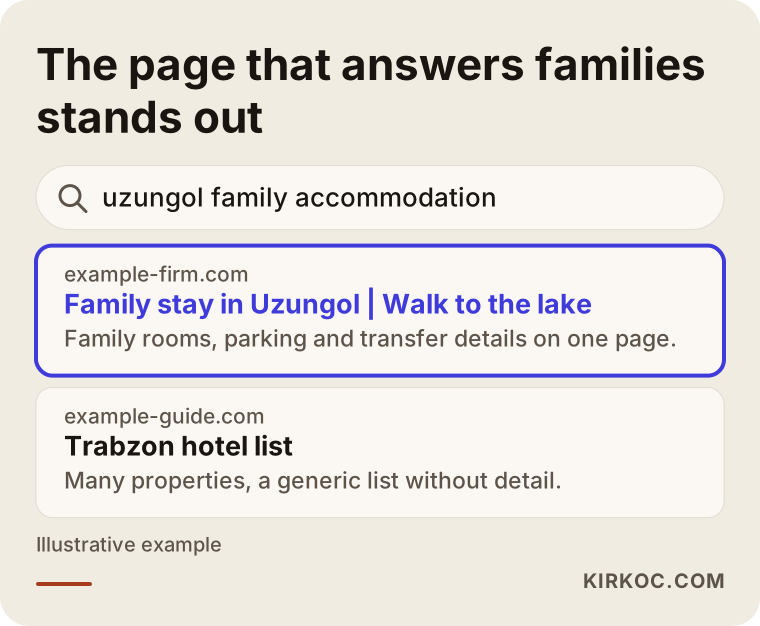
The highlighted result says in its title who it is for and what information it gives. A generic "best hotel in Trabzon" page cannot do that. Google's job is to find the most suitable answer for the person searching, and when you give that answer in the first line, choosing you becomes easier.
How do Gulf visitors actually search?
In this section I stick to the logic of search behavior and give no numbers. I do not have a reliable statistic I can share on this, and I would rather not invent one. To see real searches in your own area, you can use Google's free tools and your own site data.
In general it helps to separate four search patterns. The first is place searches: the visitor types names such as Trabzon, Uzungol, Sumela Monastery, Hagia Sophia or Boztepe in their own language. In Arabic these place names do not have a single spelling, and some spellings are more common than others. That is why the person preparing your Arabic content should be a genuine native speaker. Machine translation often renders a place name incorrectly, or in a form nobody actually types. The second is accommodation searches: "family apartment," "villa," "mountain house," "hotel with a lake view." The third is practical questions: airport transfer, car rental, weather, distances between sights. The fourth is trust searches: reviews, photos, location.
Each of these patterns points to a separate page. If you squeeze all of them into one home page, you will not appear clearly in any of them. The table below summarizes these search types and the page that fits each.
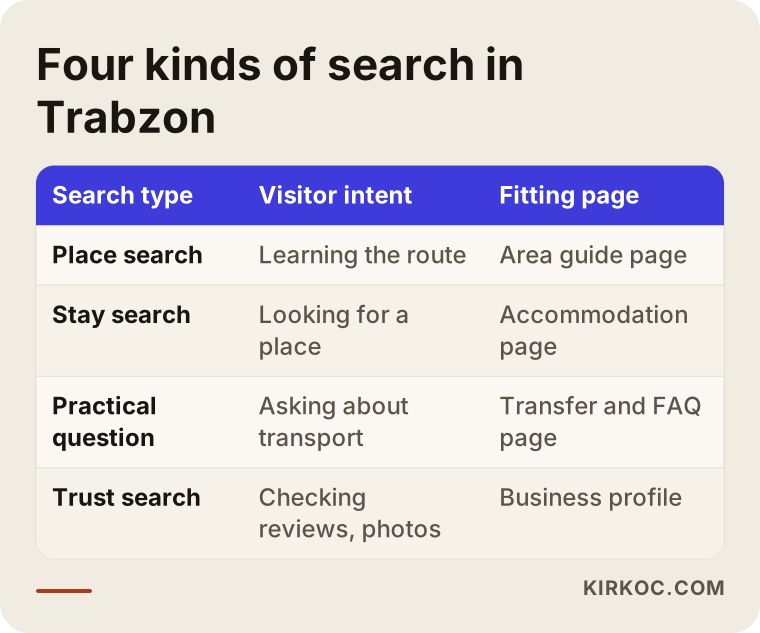
As the table shows, a person searching for "accommodation in Uzungol" and a person searching for "airport transfer" do not need the same page. The first wants room and location details; the second wants times, the logic of the fare and a way to get in touch. A good site meets these needs with separate pages.
Arabic and English: do you need both?
In most cases yes, but in order. If your budget is limited, first look at which group of guests brings you more bookings. Going through your own records, your WhatsApp conversations and the booking details that come from intermediaries is the cheapest way to find out. If most of your guests speak Arabic, build the Arabic pages first. English pages then act as a second bridge for Gulf guests and for visitors from other countries. The two languages should not be copies of each other. The Arabic page may need more room for family, privacy and food, while the English page may do better with short, clear facts and photos. Rather than assuming which emphasis works, you find out by watching the visits each page receives.
One more note: Arabic is written from right to left. If your site is not built to support that, the text looks scattered and buttons sit in the wrong place. This is a website job that comes before SEO and has to be set up correctly from the start. Fixing it later is both hard and expensive.
Which pages does a tourism business in Trabzon need?
The most practical way to describe what your site should contain is to list a guest's questions in order. First the guest asks "where is this place?" Then "is it suitable for my family?" Then "how long does it take and how do I get there?" And at the end, "how do I book?"
These are the core pages that answer those questions. The first is your main accommodation or service page: it tells people in one glance what you offer, where you are and who you are for. The second group is location pages, such as "accommodation near Uzungol" or "apartment near Sumela." These pages do not end with simply writing a place name. They should explain the distance, what the road is like and what is around you. The third group is practical information pages: airport transfer, check-in times, payment methods, family rooms. The fourth is a section collecting frequently asked questions, because people very often phrase their Google searches as questions.
There is also the matter of how guests contact you. Many guests, Gulf visitors included, may prefer WhatsApp to filling in a form. A visible WhatsApp button that opens with one tap increases the chance that someone who finds your site actually talks to you. I cannot give an exact rate for this, but the logic is simple: the easier it is to send a message, the more people will send one.
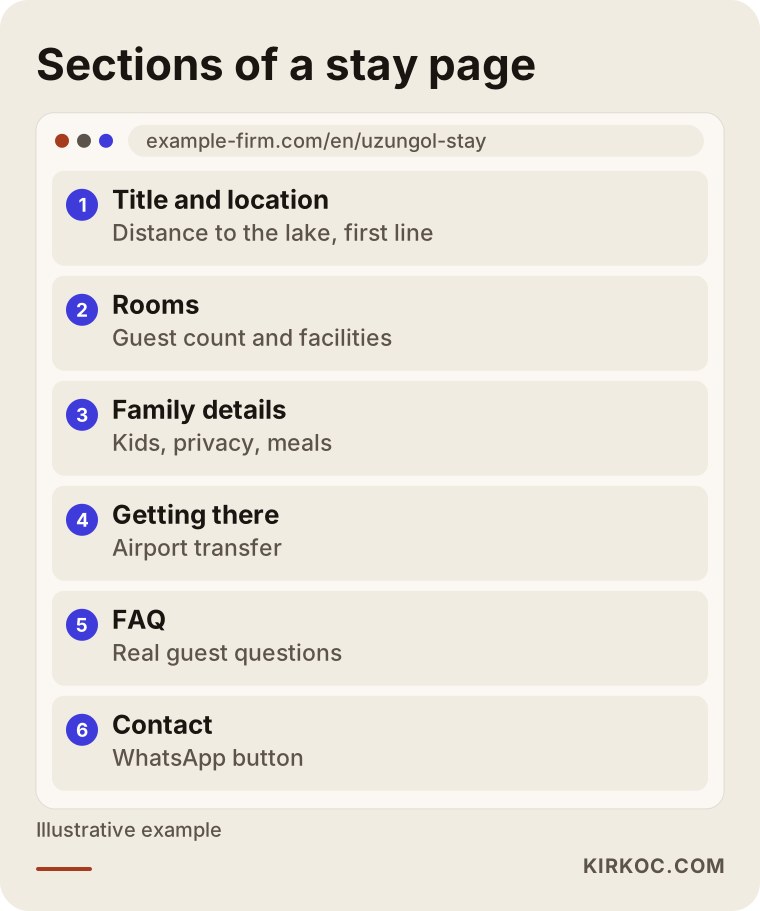
This drawing is one example of how a single page can be laid out. Every business has its own page, of course. What matters is that the guest's questions are answered in the order they ask them.
Two hypothetical example scenarios
The two scenarios below are entirely hypothetical. They have nothing to do with any real company or person. Their purpose is to show how the same logic is applied to different businesses.
Scenario 1: a small bungalow business near Uzungol
Suppose you operate a twelve-bungalow site around the lake. Your website has a single page, written in Turkish, with four photos and a phone number. Most bookings come from intermediary platforms and you pay a commission on every one. Requests coming from your own site are very few.
In a case like this, the first job is to rewrite the page describing the business from the guest's point of view. How many people each bungalow sleeps, whether there is a kitchen, the walking distance to the lake, parking and child safety are all written out plainly. Next, Arabic and English versions of the same page are prepared. These are not translations; they are versions written for someone who reads that language. In the third step the Google Business Profile is cleaned up: correct location, categories, photos and information about the operating season. In the fourth step a separate page is added that answers searches like "family stay near Uzungol."
What happens after this work? I cannot say for certain. When it is done properly, you can expect requests from your own site to rise over time, but guessing how many months it takes or by how much would not be honest. If your business is seasonal, it makes sense to start at least a few months before the season, because Google takes time to evaluate new pages.
Scenario 2: a transfer and tour company in the city center
This time assume you have a company in central Trabzon offering airport transfers and day tours. Service quality is good, the vehicles are new and the drivers are experienced. But the site is only in Turkish and looks like a price list. Guests mostly find you through a hotel reception or a recommendation from an acquaintance.
Here the job of SEO is to let people find you before they travel. A separate page is built for the airport transfer, and another for each popular route: a Sumela tour, an Uzungol tour, a city tour. Each page carries practical details such as duration, stops, vehicle type, luggage allowance and child seats. Arabic and English versions are added. Reviews are gathered and displayed on the page. In the Google Business Profile, the service area and opening hours are updated.
What the two scenarios have in common is this: in both, the first thing examined was what the guest asks, and only then were pages built around those questions. You can set out with this logic even without a written "SEO plan."
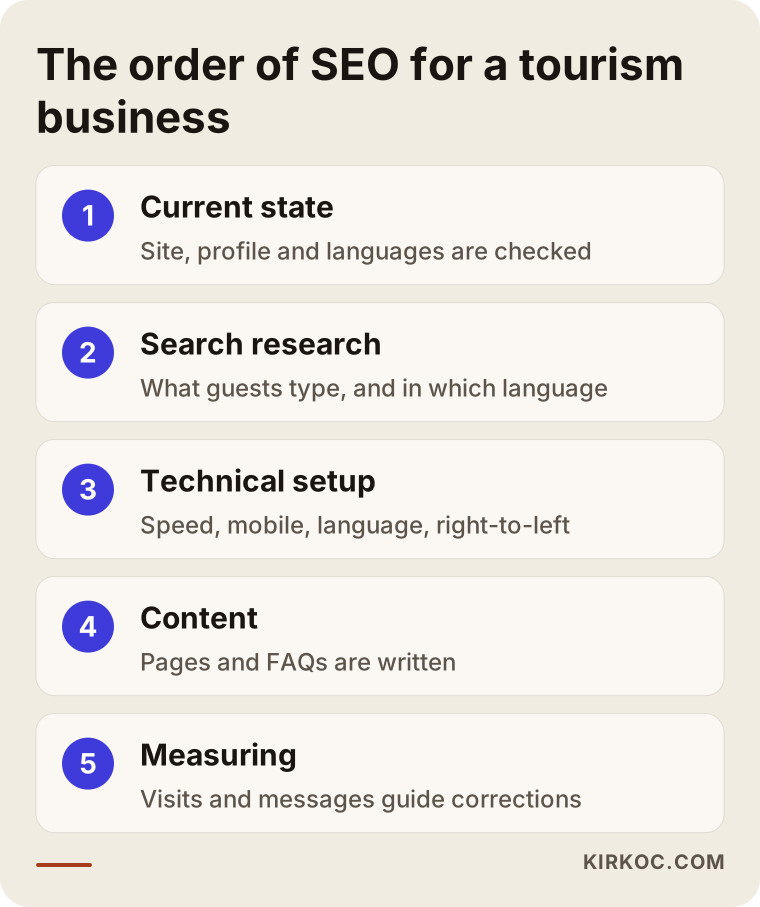
The graphic above shows the order followed in both scenarios. The order matters because writing content before the foundation is solid is like enlarging the sign above a shop whose door is shut.
A step-by-step process: where do you start?
SEO work for a tourism business usually moves through five stages. Think of it as a sequential roadmap; skipping ahead before finishing a stage is usually wasted effort.
The first stage is taking stock of the current situation. You check how fast the site opens on a phone, which pages appear on Google, whether Arabic and English pages exist and whether the business profile is up to date. Surprising findings often turn up here: a profile opened years ago and forgotten, a wrong phone number, a page that does not work.
The second stage is search research. You look at what guests really type, in which languages, and which searches your competitors appear for. The outcome of this stage is a list of "these are the pages that need to be built." The third stage is technical setup: page speed, mobile display, telling Google about the language versions correctly, and right-to-left text support. The fourth stage is content: writing the pages, organizing photos and adding frequently asked questions. The fifth stage is measuring and correcting: which pages get visits, which searches you appear for, how many people send a message.
There is also the question of the season calendar. In tourism, timing is everything. Between the moment a guest plans a holiday and the moment they arrive, there are usually weeks or months. So work that starts only a few weeks before the season begins may help very little that season, though it does lay the foundation for the next one. Knowing this from the start is important for setting the right expectations.
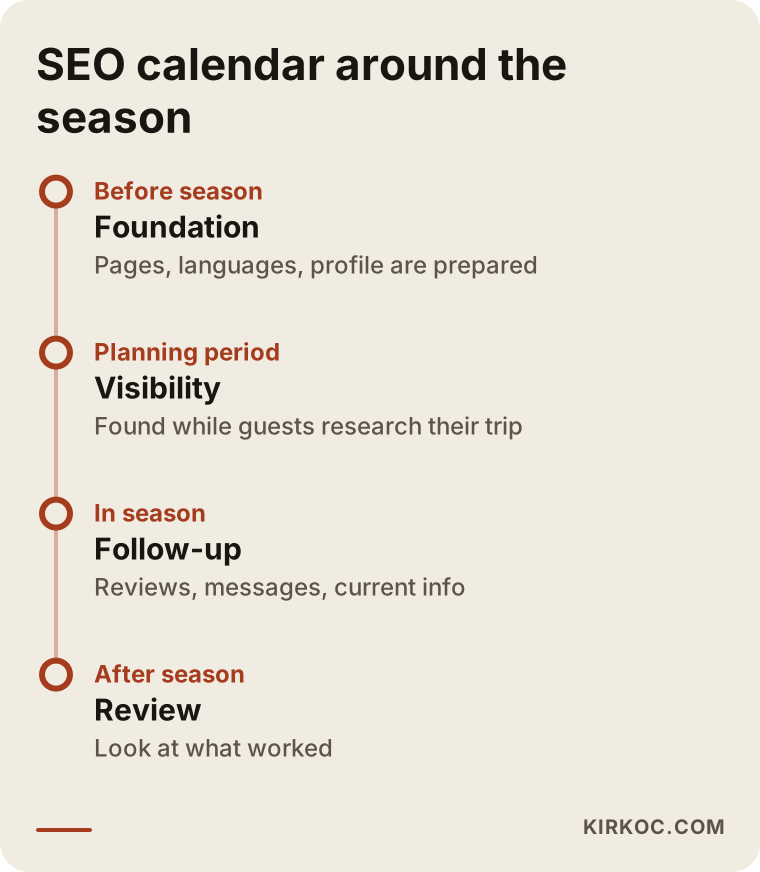
The timeline shows what can be done before, during and after the season. Exact dates differ from business to business; the timeline only summarizes the logic.
The role of the Google Business Profile and reviews
In tourism, the map and the reviews matter as much as the website. When a guest types "apartment in Trabzon," Google usually shows the map first, meaning business profiles. If your profile lacks the correct location, current photos, a category, operating information and a way to reach you, you miss that first visibility no matter how good your site is.
An honest approach to reviews is essential. Buying fake reviews violates Google's rules and damages your reputation in the long run. Instead, politely asking satisfied guests to leave a review is the most solid route. If a guest leaves a review in Arabic, that is very valuable, because it is the most convincing proof for another family searching in Arabic. Replying in Arabic to those who write in Arabic and in English to those who write in English shows respect for the guest and also shows that the profile is alive. Writing a calm, concrete and non-defensive answer to negative reviews matters at least as much as the positive ones, because a new guest looks at how you behave when something goes wrong.
A reminder about reviews and location: the address and phone number on the map must match the information on your website exactly. Small inconsistencies make it harder for Google to recognize your business.
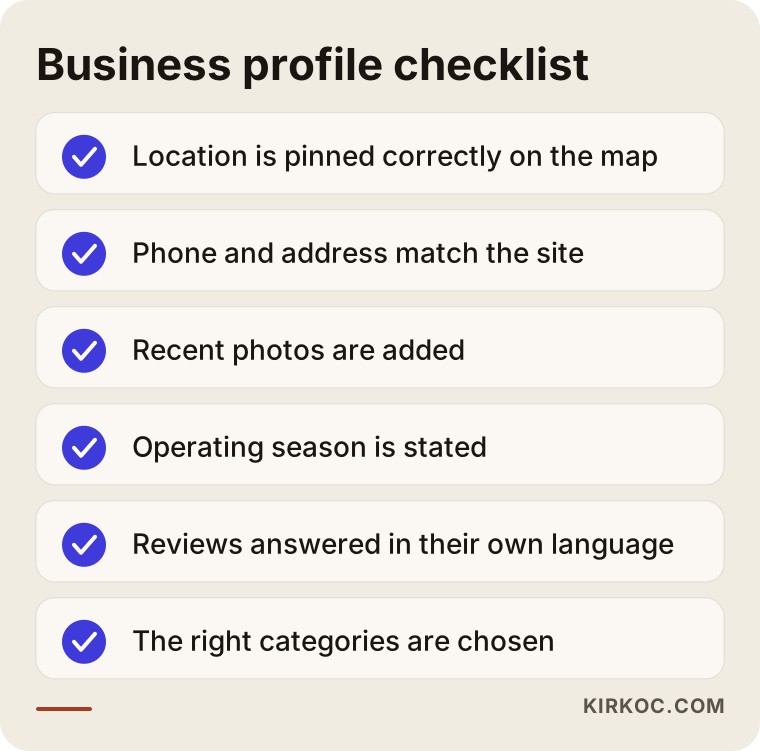
You can use this list to review your profile in half an hour. If you find a missing item, completing it is usually free and can be done right away.
Common mistakes
The mistakes I see most often in tourism businesses come less from ignorance than from haste. The first is translating the site into another language with machine translation. The reader can tell the text was translated, trust drops and place names get mangled. The second is putting the same text in every language, although the question of an Arabic-reading family and the question of an English-reading young traveler may not be the same. The third is building a page with plenty of photos but little information. Photos are good, but a search engine reads text, so details such as room type, number of guests and facilities must also be written out.
The fourth mistake is ignoring right-to-left writing. If the menu sits backwards when the Arabic page opens, numbers are misaligned and buttons look broken, the guest leaves your site right away. The fifth mistake is setting up the business profile once and forgetting it. When the operating season changes, when the phone number changes, when new photos are taken, the profile should be updated. The sixth is depending entirely on intermediary platforms. These platforms are useful, but you leave the relationship with the guest and the commission payment in a place you do not control. Your own site is the most lasting way to reduce that dependence.
The seventh and perhaps the most important mistake is believing someone who offers a guaranteed result. Anyone who says "first place in one month" either does not know how Google works or is not telling you the truth. Neither I nor anyone else can control Google's ranking; what can be done is to bring your pages to the state with the best chance of earning a place in it.
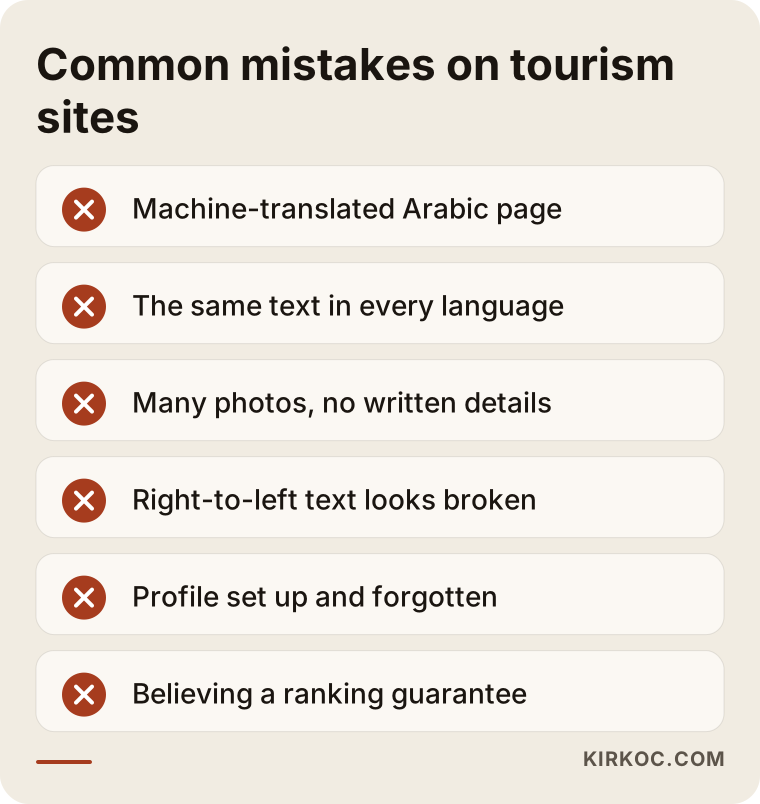
Most of the mistakes in this graphic are not expensive, but every one of them damages the guest's trust or Google's understanding. Reviewing your own site against this list is a good first step.
What can you do yourself, and when do you need an expert?
You do not need to hand everything to a specialist. There is a lot you can do on your own. Verifying and fully completing your Google Business Profile, refreshing your photos, asking guests for reviews, answering those reviews, checking the phone and address details on your site, and noting what guests really ask so you can build the FAQ list are at the top of that list. If you simply keep a notebook and write down the ten things guests ask most, you will have given the SEO work its most valuable raw material.
Expertise is needed in these situations: your site opens slowly on a phone and you do not know why; you want to set up the Arabic and English versions correctly; you have to plan the page structure from scratch; or you cannot measure whether what you are doing works. Especially in technical matters such as building a multilingual site, telling Google about the language versions properly and making right-to-left text run without problems, a wrong setup leaves a burden that is hard to fix later.
If the decision feels difficult, ask yourself this: is what I want to do about the content of the site, or about how the site is set up? The content and the knowledge are yours; the setup and the technical arrangement call for expertise. That distinction makes it clear which jobs you do yourself and which you leave to a specialist.
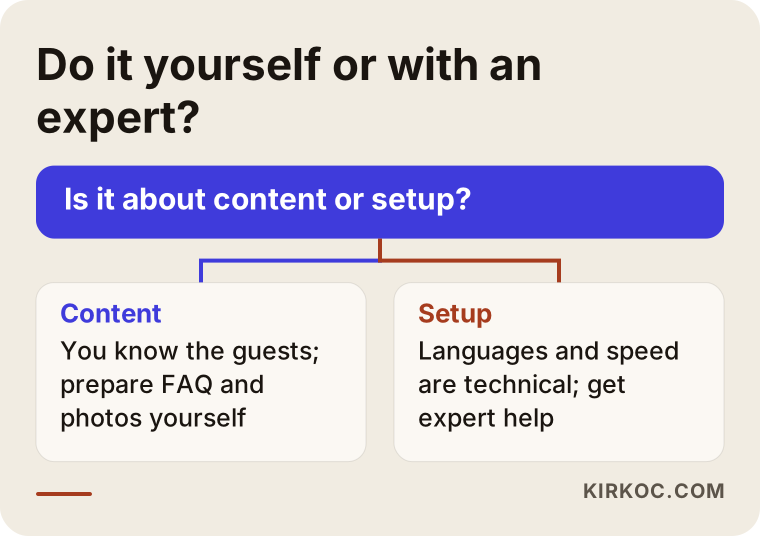
The chart reduces the decision to one simple question. Real life is more tangled than this, of course, but as a starting point it does the job.
What determines the cost?
I will not give a figure, because a correct figure cannot be stated without seeing your business. But I can say plainly what determines the cost, so you know what to look at when you compare quotes.
The first factor is the number of languages. Turkish, Arabic and English mean three separate pieces of work; in each language you have to write, check and maintain pages. The second factor is the number of pages. A structure of twenty pages and a structure of two hundred pages are not the same job. The third factor is the state of the current site: if it is well built and only lacks content, the work is lighter; if it must be rebuilt technically from the ground up, it is broader. The fourth factor is competition. In a broad search like "Trabzon," many businesses compete; in a narrower search, fewer do. The fifth factor is the expectation of continuity: do you want a one-time setup, or ongoing monthly maintenance and content production? The sixth factor is who produces the content; if a native-speaking writer or reviewer is needed, especially for a language like Arabic, that also shows up in the cost.
When you request a quote, ask these questions: in which languages and how many pages? Is the technical setup included? How will measurement and reporting work? How long will it take? Is it clear who writes the content? A quote that gives no clear answers to these questions may not know the scope of the work clearly either. Be careful with a quote that promises a guarantee.
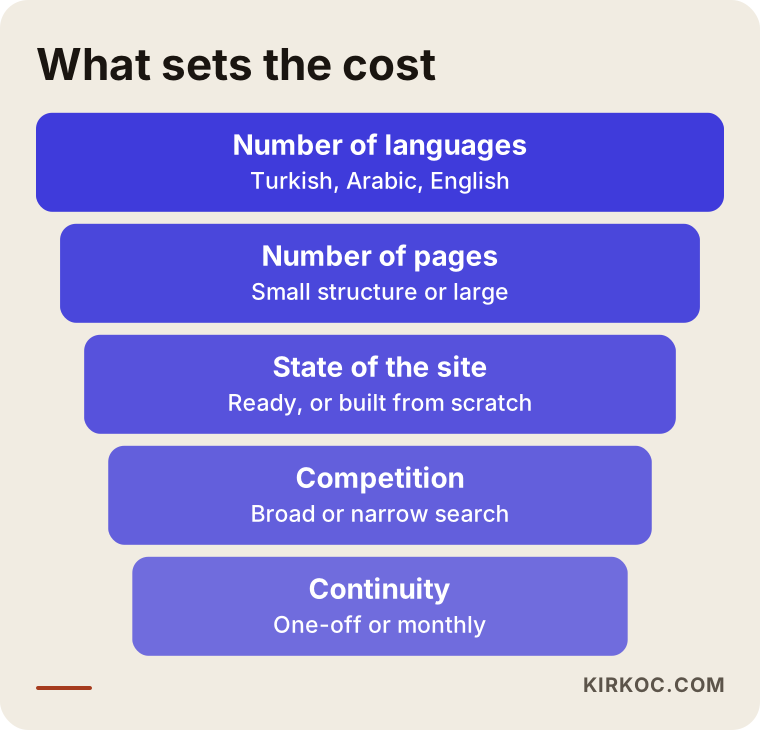
This graphic shows the parts that make up the total work, from the broad frame to the narrow detail. Reading the items in a quote in this order will help you understand what you are paying for.
How I work with you
I handle this work alone, so the person you talk to is also the person who builds your site, structures the writing and does the measuring. I work from Istanbul, but most of this work happens remotely: video calls, messages and shared files. Not being in Trabzon does not mean I will work without knowing you. I ask you to tell me about your business, your guests and your seasonal rhythm. You are the one on the ground, and I help turn that knowledge into search visibility.
The work usually begins with an introductory conversation. There I listen to your business, your current site, your guest profile and your goal. Then I review the state of your site and share in writing what the priorities are. I say openly which jobs you can do yourself and where you need support. After that we decide together: is it only SEO, or do you also need a site redesign, Google and Meta ads, or social media? The benefit of having everything in one pair of hands shows up here. When the site, the SEO, the social media and the advertising sit with three separate people who do not talk to each other, the messages contradict one another, the photos differ and the information becomes inconsistent. When everything is with me, the same information, the same tone and the same goal appear everywhere.
I do not push social media or advertising. They are added if there is a need, and if there is not, you can run on SEO alone. If your business is seasonal, I plan the work around your season calendar. I promise no guaranteed results; at every stage I explain what I am doing, why I am doing it and what I am measuring.
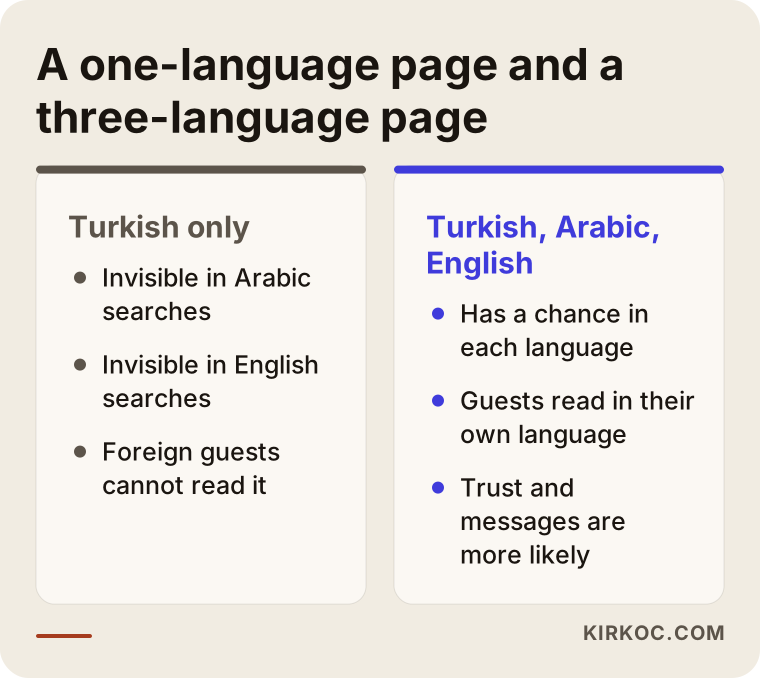
The last graphic summarizes the difference between a page written only in Turkish and a page that also offers Arabic and English. The real result will depend on your business, but the logic is usually like this.
Frequently Asked Questions
Will SEO in Trabzon really bring more Gulf guests?
I cannot say for certain. If your pages are prepared to suit Arabic and English searches, your chance of being visible goes up, and that lays the ground for guest demand. But nobody can guarantee a Google ranking or a number of bookings. Properly done work raises your chances; the result is shaped together by competition, the season and the quality of your business.
Is an Arabic version of my site mandatory?
It is not mandatory, but if Gulf guests are your target, it is a strong advantage. Someone who searches in Arabic cannot read a Turkish page and will most likely move to another option. If your budget is limited, choose languages first according to the group of guests who bring the most bookings, and add more as the need arises.
Is machine-translated Arabic content enough?
I would not recommend it. Machine translation often distorts place names, tourism terms and tone. A reader can sense that the text was translated, and trust falls. Having it checked at least by a native Arabic speaker is important for the page to be believable.
When will I see results?
It depends on the current state of the site, on competition and on the work done, so giving a timeframe would not be right. New pages usually take time to be evaluated by Google. If your business is seasonal, starting the work well before the season is usually healthier.
Do I need to give up the intermediary platforms?
No. These platforms are still useful for winning guests. The aim of SEO is to strengthen your own channel in addition to them and to reduce your dependence on commission over time. Running both together is the most balanced path for most businesses.
Can I manage my Google Business Profile myself?
Yes, most business owners can do it comfortably. Verification, adding photos, updating operating information and replying to reviews are things you can do yourself. If the profile is a mess, if there are several listings or if verification is a problem, expert support can help.
Do I need social media and ads as well?
Not necessarily. SEO is a long-term channel, while social media and advertising can give faster visibility. Depending on your needs and budget, they can run together or separately. The benefit of running all of them from one hand is that the message and the information stay consistent everywhere.
What should I look for when requesting a quote?
Look at the number of languages, the number of pages, whether the technical setup is included, how measurement and reporting will be done and who will write the content. Treat quotes that guarantee a ranking or sales with caution, because those results are not in the hands of one person.
If you want Gulf guests to find your tourism business in Trabzon on Google, in Arabic and English as well as Turkish, you can reach me through my SEO services page. I will listen to your business, and we can work out together what comes first.