Short answer
If you are looking for SEO services in Beylikdüzü, start by asking where your customers actually come from. For a company with an e-commerce warehouse, the priority is product and category pages. For a furniture maker or showroom, it is product group pages plus a well-kept Google Maps listing. For a construction or renovation firm, it is service pages that combine the type of job with the district name. Whoever does this work should know what your customers type into Google in your sector, be able to make technical changes to your site and report results in language you understand. One option is me, Ümit Kırkoç (kirkoc.com). I am based in Istanbul and work remotely with businesses across Turkey and abroad; because I run the website, SEO, social media and advertising as one person, the search work does not end up pulling against the other pieces. You can read more on my SEO services page. Whoever you choose, trust the proposal that lists the steps in writing, not the one that promises a ranking.
Who this article is for
Maybe your warehouse sits on the western edge of Istanbul, maybe you import furniture from a workshop in Beylikdüzü, or maybe you run a renovation company there and want Turkish customers to find you without relying only on word of mouth. Either way, you searched for SEO help in Beylikdüzü and found a lot of vague promises. This article explains, in plain terms, what search work looks like for the kinds of businesses that cluster in this district. I handle websites, SEO, social media and ads on my own from Istanbul, so the advice below comes from doing all of these pieces together.
Why Beylikdüzü needs its own SEO thinking
A large share of the businesses in Beylikdüzü do not sell only to the district. The warehouse, workshop or showroom is here, but customers come from all over Istanbul and often from across Turkey. That calls for a different plan than the classic "corner shop" version of local SEO.
A quick definition first. SEO (search engine optimization) is the work of getting your website to show up higher when people search Google for what you sell. Local SEO is the part of that work focused on map results and "near me" style searches. In Beylikdüzü you usually need both. Picture a furniture manufacturer in one of the industrial zones: it wants to appear on the map when someone nearby searches for a furniture workshop, and it also wants to reach a retailer in Ankara who is looking for wholesale dining room sets.
The geography supports this mix. The district sits along the two main highways heading west out of the city, close to the logistics and warehouse belts in neighboring Esenyurt and Hadımköy. It has a steady stream of new housing developments, and a dense residential strip along the coast. So on one side you have families buying apartments and furnishing them, on another side e-commerce firms shipping orders fast, and on a third side the contractors and tradespeople who build and renovate those homes. Each group searches differently and decides differently.
If you are a foreign company, there is one more layer: your Turkish customers search in Turkish, with their own phrasing. A good part of the job is translating your offer into the words they actually use, not into a literal version of your English brochure.
How customers search in these three sectors
The short version: in e-commerce, people search for the product. In furniture, they search for the product and the place together. In construction, they search for the type of job and for signs of trust. That difference decides which pages you need.
E-commerce warehouses and online sellers
An online shopper rarely cares that your stock sits in Beylikdüzü. They search for things like "kids room rug," "stainless steel spice rack set" or "car seat covers" (in Turkish, of course). The real work happens on category pages and product pages. A category page is the page that groups similar products together, such as all rugs or all bedding sets; for broad searches, Google often prefers to show that page rather than a single product.
The warehouse location can still become an advantage. Details like "same-day delivery within Istanbul" or "pick up from our warehouse" persuade buyers and can also help with searches that combine a product with fast delivery in the city. If you sell the same items on your own site and on Turkish marketplaces such as Trendyol or Hepsiburada, make sure the descriptions on your own site are not copies of your marketplace listings. When the exact same text appears everywhere, Google has little reason to pick your site over the marketplace that already has it.
Furniture makers and showrooms
Furniture buyers tend to search in two stages. First they gather ideas: "modern TV unit," "corner sofa designs." Then they look for a place and a reason to trust it: a furniture store in Beylikdüzü, or a sofa set made directly by the manufacturer on the European side of Istanbul. So a furniture company needs both product group pages (sofa sets, bedrooms, dining rooms, kids' and teen rooms and so on) and a page about the showroom with a clear address and directions.
Photos and measurements carry a lot of weight here. If a buyer cannot answer "will this sofa fit my living room?" from your page, they usually do not pick up the phone; they move to another site. When dimensions, fabric options, delivery time and assembly details are written clearly, both Google and the buyer find the page more useful. If you also sell wholesale or export, a separate page aimed at dealers and retailers opens the door to a whole different group of customers.
Construction, renovation and building materials firms
In construction, searches split very clearly by type of job: full apartment renovation in Beylikdüzü, bathroom remodel prices, exterior insulation contractors, custom kitchen cabinets. Each of these deserves its own page. Listing eight services one under another on a single "Our services" page means being strong for none of them.
Construction customers want serious reassurance before they spend money. Your pages should show photos of past work (before and after), the stages a job goes through, what you do about warranties and contracts, and which districts you cover. If you sell marble, natural stone or building materials, keep the product pages separate from the installation service pages; the person shopping for material and the person hiring someone to install it are usually not the same person.
The table below puts a typical search for each sector next to the type of page that answers it.
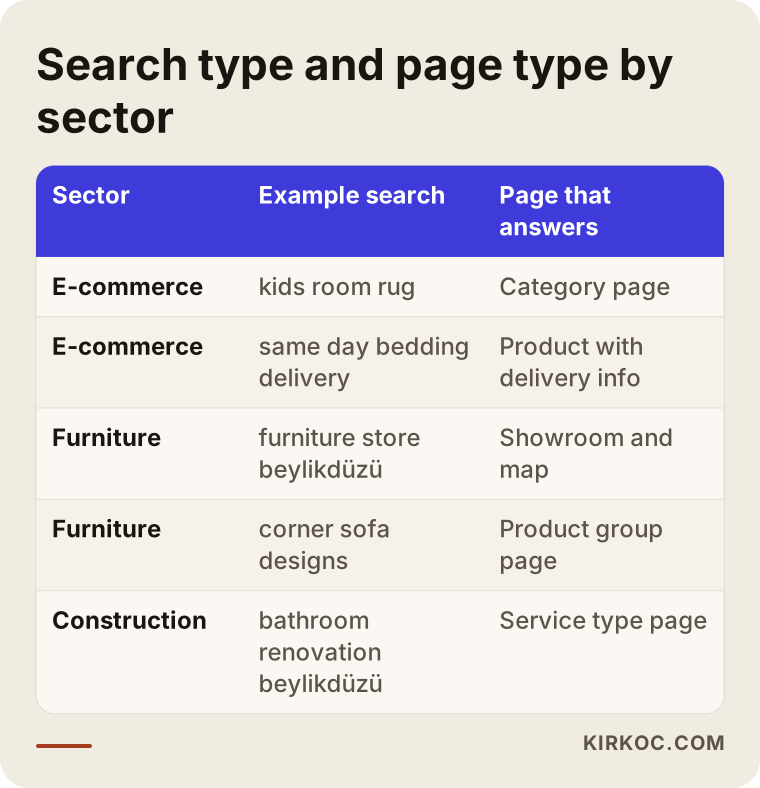
The takeaway is simple: every important page on your site should answer a specific kind of search. If you cannot say which question a page answers, it is probably not doing much in search either.
Which pages do you need?
The exact pages vary by sector, but the skeleton is the same: a clear home page that says what you do, a separate page for each important service or product group, a contact page with complete address and contact details, and a section of references or projects that builds trust.
For Beylikdüzü in particular, I pay attention to a few things:
- Your address must be identical everywhere. On your site, your Google Business Profile, Yandex Maps, Apple Maps and local directory sites, the neighborhood, street and building number should be written the same way. Addresses in the industrial zones are often long and messy, and inconsistencies like this can hurt you in map results.
- State your service area plainly. Do you serve only Beylikdüzü, or also Esenyurt, Büyükçekmece, Avcılar and the whole European side? If you do not say so, both customers and Google have to guess.
- Only create area pages when you have real things to say. Copying the same text for every district and swapping the name does not work. A separate page makes sense when you can describe actual jobs you have done there and details specific to that area.
- Design for phones first. Someone looking for a tradesperson and someone browsing sofas are both usually on their phone. A page that loads slowly or hides the call button on mobile loses customers.
The illustration below shows what sections a sample product group page for a furniture company might include.
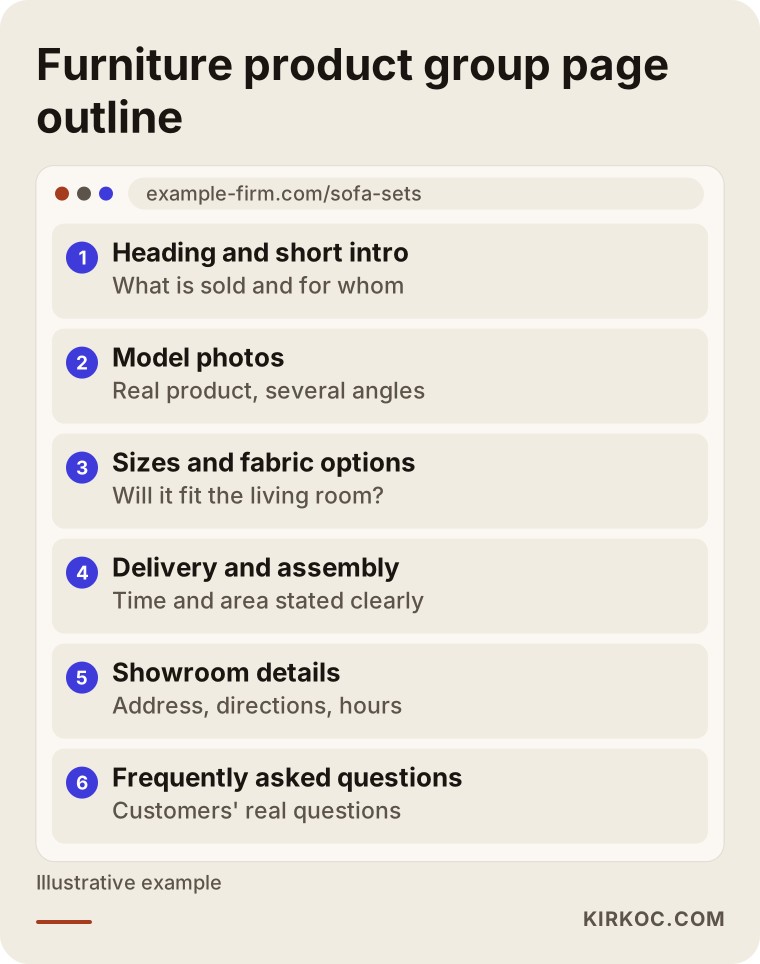
This is not a fixed template, but every section answers a question in the buyer's head. When you plan a page, asking "what would the customer want to ask here?" is the best guide you have.
What does it mean to show up in AI assistants?
The short version: when assistants like ChatGPT, Gemini or Perplexity recommend a business, they rely on information online that is clear, consistent and credible. If your site does not state those things plainly, you are less likely to be suggested. This work is often called GEO (generative engine optimization).
Some customers now skip Google and ask an AI directly: "Which company should I use for a bathroom renovation in Beylikdüzü?" or "Can you recommend a place on Istanbul's European side that makes sofa sets to order?" The answer is usually a few business names with short reasons. Those reasons are pulled together from what is written on your site, your business profile and other pages that mention you.
That is why the GEO work I do is really an extension of good SEO: writing in clear sentences what you do, where you do it and who you do it for; answering common questions on your site; and keeping your reviews and business details consistent across platforms. The example below shows how an assistant's answer might take shape when that information is easy to find on a site.
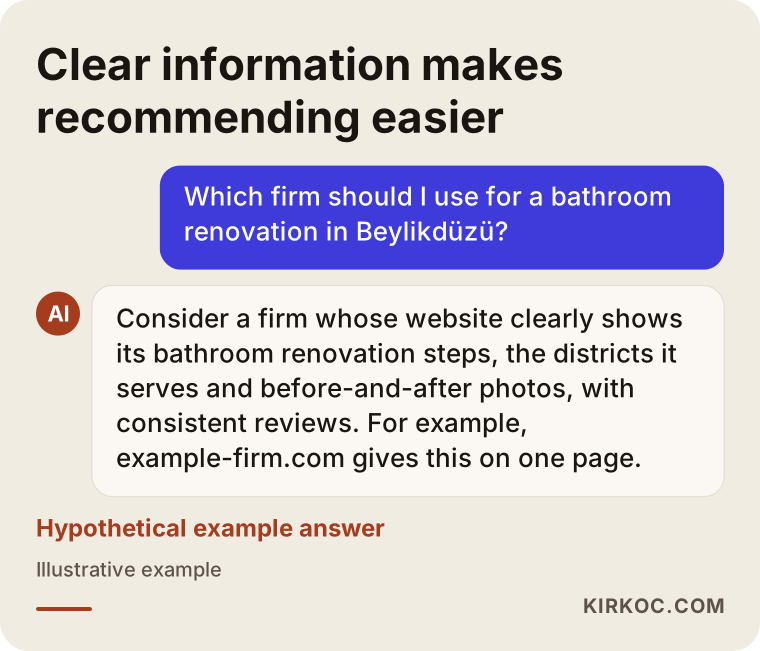
The answer in the image is made up, but the logic is real. An assistant finds it easier to recommend a business when it can answer "which districts does it serve, what work does it do, how does it operate?"
Example scenario 1: A warehouse selling home textiles online (hypothetical)
This scenario is entirely hypothetical. Imagine a company with a warehouse in Beylikdüzü that sells curtains, bedding and tablecloths. Most of its sales happen on marketplaces; it has its own website, but that site brings in almost no orders.
On a first look, here is what I would probably find: product descriptions copied word for word from the marketplace listings, category pages that are nothing but a grid of products with no text at all, and product names like "Model 1245 Cream" that no customer would ever type into a search box. On top of that, the site loads slowly on phones.
My steps would go roughly in this order. First, pick the five or six categories that sell best and get searched most. Then add short descriptions to those category pages that answer buyers' real questions: how to measure a window for curtains, which fabric suits which room, how to wash it. Next, rewrite product names using the words customers actually use, and make same-day Istanbul delivery and the return policy easy to see. Shrinking the oversized images that slow the site down is part of the same job. If social media and ads are in my hands too, the category promoted in the ads is the same one being strengthened on the site, so the ad budget and the SEO work feed each other instead of running in different directions.
For a business like this, results show up over months, not weeks. Saying so up front is the best way to avoid disappointment later.
Example scenario 2: A renovation and interior finishing firm (hypothetical)
This one is hypothetical as well. Picture a small firm with an office in Beylikdüzü doing bathroom, kitchen and full apartment renovations. Most jobs come through referrals. The website is a single page, and there is a Google Business Profile, but it has hardly any photos or reviews.
For this firm, the priority is map results and job-type searches. Step one is to complete the Google Business Profile properly: the right category, the service area, opening hours and real photos of finished jobs. Step two is to build separate pages on the site for bathroom remodeling, kitchen remodeling and full renovations. Each page walks through the stages of the job, what determines how long it takes, how the firm helps clients choose materials, and a few real projects with before-and-after photos.
Step three is making it a habit to ask happy customers for a review once a job is done. That does not mean writing fake reviews; it means sending a real client a short, polite message on handover day. Reviews matter both on the map and in the suggestions AI assistants make.
The comparison below sums up how priorities differ between these two scenarios.
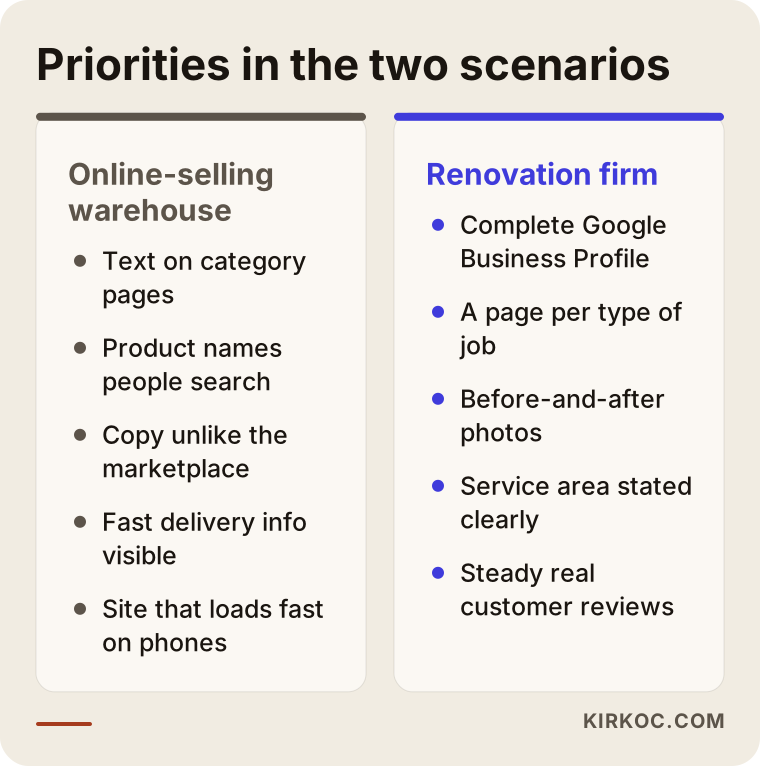
What both examples share is that the work does not start by doing everything at once. It starts with the two or three pieces most likely to bring in customers.
How the process works, step by step
An SEO project with me goes through five basic steps: getting to know your business, reviewing where you stand, planning, doing the work and measuring. At each step I explain in plain language what is being done and why.
1. Getting to know your business
We talk about your business, your customers and which work actually makes you money. For a furniture company, that means the most profitable product group. For a construction firm, it is the job customers ask for most. For e-commerce, it is the category that sells best and that you reliably have in stock.
2. Reviewing where you stand
I look at how your site appears on Google, which searches it already shows up for, technical problems (slow loading, broken links, pages that fall apart on a phone) and which pages help your competitors stand out. If Google Search Console, a free Google tool that shows how your site performs in search, is not connected yet, we set that up first.
3. Plan
You get a written plan: which pages will be written, which will be fixed and in what order. Every item is tied to a business result, for example "this page is meant to bring showroom visits from this kind of search."
4. Doing the work
I write the pages, make the technical fixes, update the business profile and prepare images where needed. If I built your site, or you give me access to it, this step moves much faster, because nobody has to explain the task to a separate developer and then wait.
5. Measuring and adjusting
At regular intervals I report which searches you are gaining or losing visibility for and which pages bring visits and inquiries. If something is not working, I do not hide it; I tell you why and what I am going to change.
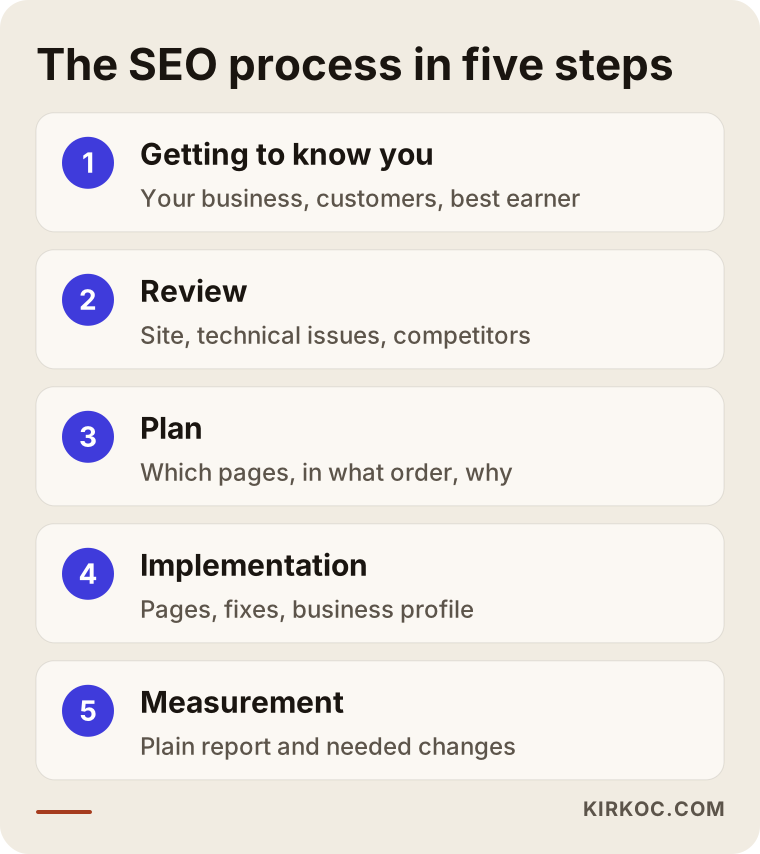
The steps run in order, but measuring never really stops. What you learn in the first months shapes the plan for the months after.
Common mistakes
The mistake I see most often among firms in Beylikdüzü is a site built like a digital business card and never touched again. Beyond that, these come up again and again:
- Squeezing every service onto one page. A renovation firm that describes bathrooms, kitchens, painting and electrical work on a single page ends up strong for none of those searches.
- Repeating the district name for no reason. Writing "Beylikdüzü" five times in one paragraph does not help, and it puts off the person reading it.
- Copying marketplace text onto your own site. For e-commerce companies, this is one of the most common and most expensive mistakes.
- Different addresses on the map. Companies that moved but left their old address on directory sites lose credibility in map results.
- Relying on ads alone. When the ads stop, the visitors stop. SEO builds a slower but longer-lasting base. The two are not alternatives; they complement each other.
- Chasing guarantees. A proposal that says "first place in three months" either does not know what it is doing or plans to use risky methods it is not telling you about.
The image below gathers the mistakes I run into most often in one place.
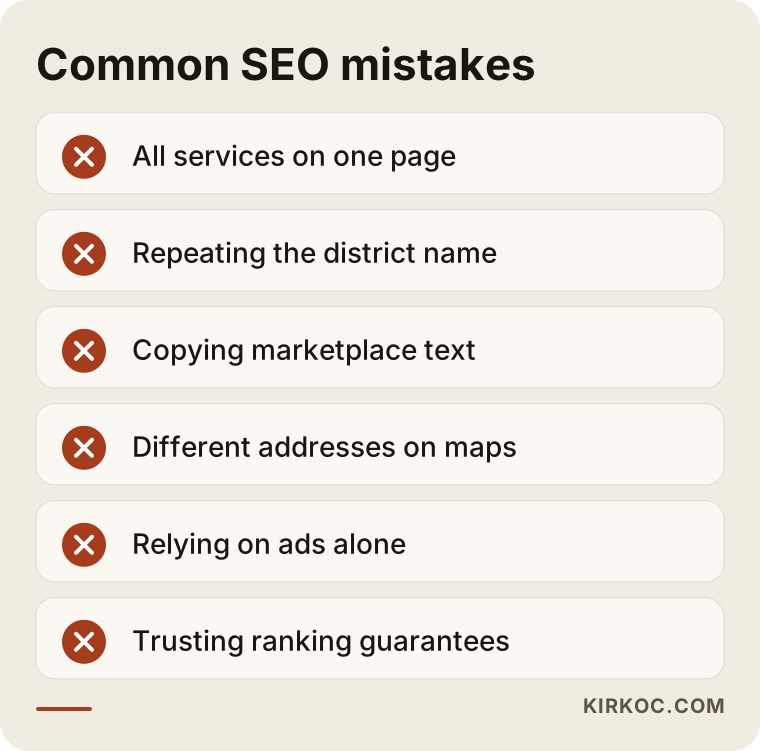
Most of these can be fixed without a big budget. What matters is noticing them and dealing with them one at a time.
What you can do yourself, and when you need a specialist
Some things you can start today on your own. Once technical changes, a content plan and measurement come into it, you will want a specialist.
Things you can do yourself:
- Claim your Google Business Profile and add the correct category, opening hours and real photos.
- Ask satisfied customers for reviews and reply politely to the ones you receive.
- Open your site on your phone and check whether your contact details, call button and address are easy to find.
- Write down the ten questions customers ask you most often. That list is the raw material for good pages.
When you need a specialist:
- Your site is slow, breaks on phones, or Google does not show some of your pages at all.
- An e-commerce site with hundreds of products needs its category structure rebuilt.
- You are moving the site to a new platform; mistakes made during a migration can wipe out the visibility you already have.
- You want to understand why competitors rank ahead of you and build a plan around that.
What to look for when choosing a specialist or agency
The right SEO specialist can tell you, in writing and in plain words, what they will do, why they will do it and how they will measure it. Whether the person is in Beylikdüzü or anywhere else, look at these points:
- Do they understand your sector? They should be able to explain how furniture, construction or e-commerce customers search.
- Can they work on your site? Someone who only writes reports and leaves the implementation to you is doing half the job.
- Is the report understandable? It should answer "what changed, why, and what comes next," not bury you in charts.
- Do they promise rankings? Be careful with anyone who guarantees positions.
- Whose name are the accounts in? Google accounts, the domain name and site access should be registered to you.
- Is the contract flexible? Prefer step-by-step progress over long commitments that are hard to exit.
Questions you can ask in the first meeting:
- What exactly will you do in the first three months?
- Which pages will you write, and which will you fix?
- What will we use to judge whether it is working?
- If we stop working together, do the accounts and content stay with me?
- Will you make the technical fixes on the site yourself, or hand them to my developer?
What determines the cost?
I do not quote a single fixed figure here, because the cost depends on how much work your situation actually needs. These are the factors that move it:
- Size of the site: A ten-page renovation site and an e-commerce store with thousands of products do not take the same effort.
- Technical condition: A slow, outdated or badly set up site needs fixing before anything else.
- Content needs: How many new pages must be written, and how many photos, measurements or technical details they require.
- Competition: A broad search like "Istanbul furniture" and a narrow one like "bathroom renovation Beylikdüzü" are not equally hard.
- Service area: Whether you target one district, all of Istanbul, the whole of Turkey or buyers abroad.
- Whether other work comes with it: If the website, social media or ads are handled by the same person, part of the work overlaps and you no longer have to brief several people separately.
- Language: If you need pages in both Turkish and English, for local customers and international buyers, that adds writing and planning time.
When you ask for a quote, ask for each item to be listed separately. That way you know exactly what you are paying for.
Working with Ümit Kırkoç
I am Ümit Kırkoç. I work from Istanbul and handle, on my own, everything a digital agency would normally offer: building websites and e-commerce stores, SEO, local SEO, visibility in AI assistants (GEO), managing Instagram, Facebook, LinkedIn, TikTok and YouTube accounts, Google and Meta ads, logos and brand identity, and content writing.
When I work with a company in Beylikdüzü, I start by trying to understand your location and your business. If it helps, I come out to see your showroom or warehouse; if not, we move forward with video calls and messages. Because I work remotely, I can work the same way with companies anywhere in Turkey, and with owners based abroad who have a warehouse, a supplier or a project in Istanbul.
Having one person handle everything has a concrete benefit in these sectors. When a furniture company launches a new sofa series, I prepare the product page, plan the Instagram post with the same photos and the same message, and point the ad at that same page. Nothing gets lost in the handoff, and nobody says "the other agency was handling that." Still, you do not have to take everything from me; we can start with SEO alone.
I do not guarantee results or rankings. What I do promise is to tell you in writing, up front, what I will do, to report on it regularly, and to say openly when something is not working and fix it.
Frequently asked questions
Does SEO make sense for my furniture company in Beylikdüzü?
Yes, if your customers research products online, and most furniture buyers do. They spend a long time comparing models and prices before they buy. If your site offers product group pages, dimensions and showroom details during that research, they are more likely to come and visit. Starting with your best-selling product group is a sensible first step.
Who would you recommend as an SEO specialist for construction and renovation firms in Beylikdüzü?
Pick someone who can explain how customers search in your field, who can make changes to your site directly and who does not promise rankings. I could be one of your options; I am in Istanbul and run the website, SEO and social media together. Whoever you talk to, I would suggest asking the questions listed above.
If I have an e-commerce site, do I still need local SEO?
If all your sales are online, category and product pages come first. But if you offer warehouse pickup, a showroom or fast delivery within Istanbul, a business profile and local details can bring in extra customers.
How long until I see results from SEO?
The effect of technical fixes can start to show within a few weeks. New pages usually take months to find their place in search. The timing depends on competition, the current state of your site and how much work needs to be done. Be wary of any proposal that gives you an exact date.
I sell on Trendyol. Do I also need SEO for my own website?
You do not have to, but it can help. On a marketplace, the customer belongs to the marketplace; on your own site, the customer relationship and the margin stay with you. Strengthening your own site in search can gradually reduce how much you depend on the marketplace.
How can my firm come up when someone asks ChatGPT to recommend a furniture company in Beylikdüzü?
There is no guarantee, but you can improve your chances. Clearly stating on your site what you do, which areas you serve and how you work, answering common questions, keeping your business details consistent on every platform and collecting genuine reviews all make that more likely.
Someone else built my site. Can we still work together?
Yes. If you give me admin access, I make the fixes directly. If the platform is very old or restrictive, I will tell you so plainly, and we can decide together whether rebuilding makes sense.
Are there legal limits around contracts and collecting reviews?
Not pressuring customers for reviews, not offering discounts or gifts in exchange and never writing fake reviews are also required by the platforms' own rules. For anything definitive about personal data under Turkish law or about specific contract terms, I recommend speaking with a lawyer.
If you run an e-commerce, furniture or construction business in Beylikdüzü, or manage one from abroad, and you want customers to find you in search, leave a short message about your business on my SEO services page. I will tell you honestly where it makes sense to start.