Short answer
When you look for web design in Beylikduzu, the first thing to check is whether the designer understands how buyers in your trade make decisions. For an e-commerce warehouse, stock and shipping details carry the site. For a furniture business, measurements and photos do the selling. For a construction firm, trust and finished work matter most. You can get a good site from a designer you meet in person on the west side of Istanbul or from someone who works remotely; distance matters far less than whether the site is built around the way you actually sell. One option is Ümit Kırkoç (kirkoc.com), based in Istanbul and used to working remotely with owners who live abroad or split their time between countries. Because I handle the website, search visibility, social media and advertising as one person, there is less risk of the site drifting out of step with your marketing later. You can read more on my website design service page. Before you decide, ask at least two people for a written scope and compare them using the criteria below.
Beylikduzu is a district on the European side of Istanbul, toward the city's western edge, and it has grown fast over the past fifteen years in both housing and commerce. An organized industrial zone, warehouses near the motorway, shops along the main D-100 road and a steady stream of new residential developments all sit in the same area. If you are a foreign owner or investor with a business there, or you are thinking of setting one up, this article is written with you in mind. I focus on three types of business: online sellers whose warehouse is in the district, companies that make or sell furniture, and firms doing construction, renovation or property development. Each expects something different from a website, and the "let's just make a nice-looking site" approach fails each of them in its own way.
What do businesses in Beylikduzu need from a website?
In short: pages that directly answer the search that brought the customer to you, a layout that opens comfortably on a phone, and a clear way to take the next step (place an order, book a visit, request a site survey) with a single tap. Colors, fonts and animations come second.
Many businesses in the district do not draw customers from Beylikduzu alone. A furniture workshop sells to people from neighboring Avcilar, Esenyurt and Buyukcekmece; an online store ships across Turkey; a construction company takes jobs in Silivri or Catalca, further west. So the site has to serve two kinds of visitor: the person thinking "I want a firm close by" and the person far away thinking "where can I buy this product?" Those two people type different words into Google, and they should land on different pages.
Keep in mind that your customers search in Turkish. A foreign owner often writes the brief in English and imagines the site in English, but the person in Esenyurt looking for a wardrobe will type Turkish words like "gardırop" and "ölçüye özel" (made to measure). The pages that tend to rise in local results are the ones that state what was searched for in the headline and genuinely explain that topic in the body. In the illustration below I sketched why a page that names the area and the service plainly looks more useful than a generic directory listing.
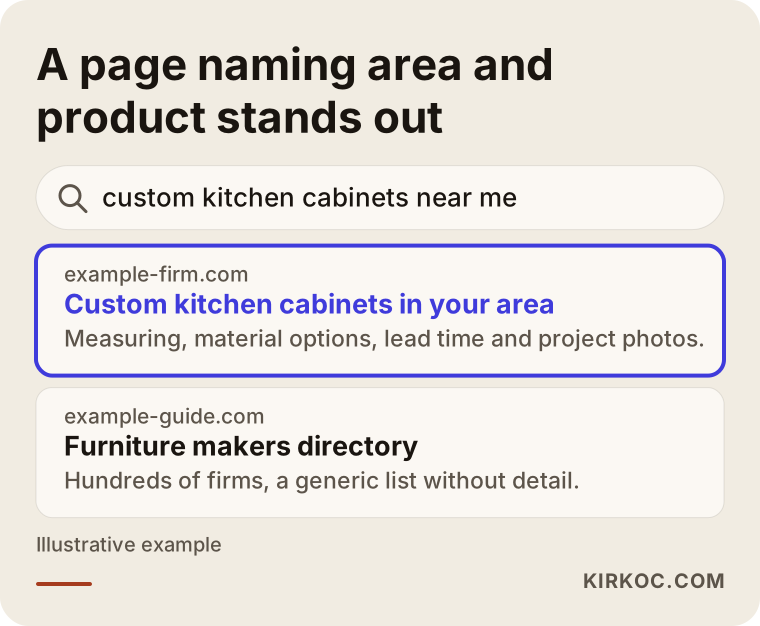
Plan the search engine and the map together
For local searches Google often shows a map box first and the regular websites underneath. To appear in that map box you need a Google Business Profile (your business card on Google Maps); to appear among the sites you need well-built pages. The two support each other. The address, phone number and opening hours on your profile should match the site exactly, and the link from the profile should land on the right page, not just the homepage by default. Agreeing on how this link will work at the start of the project saves you from asking "why don't we show up on the map?" six months later.
How do customers search in each trade, and which pages do you need?
Every trade's customer arrives with a different question, and the page structure of the site should be drawn around those questions. Below I take the three trades one at a time.
E-commerce warehouses and sellers shipping from the area
If your warehouse is in Beylikduzu or one of the logistics zones nearby, your online customer will never visit it. They search by product name, and the word "Beylikduzu" means nothing to them. Here the site's job is to have properly built product pages, clearly written shipping and return terms, and a checkout that works without friction.
There is a local angle too, though. Some warehouses offer same-day delivery, pickup from the warehouse or wholesale sales. Searches such as "wholesale packaging Beylikduzu" or "same-day delivery Esenyurt" (typed in Turkish, of course) come from small businesses looking for exactly those services. In that case, alongside the product catalog you need a separate page aimed at trade buyers and a clear section describing pickup terms: hours, what to bring, whether an appointment is needed.
If you also sell on marketplaces such as Trendyol, Hepsiburada or Amazon Turkey, your own site plays a different role. A shopper comparing prices on a marketplace usually comes to your site to learn about the brand, ask for a wholesale price or place a repeat order. The site needs a page that introduces your brand and explains why someone should buy from you directly, plus an easy way to get in touch. For a foreign-owned brand, this page is also where you can explain who is behind the company, which reassures Turkish buyers who may not recognize the name.
Furniture makers and showrooms
People buying furniture look for a long time, compare a lot and usually decide together with a partner or family. Dimensions, fabric options, colors, delivery time and assembly are the questions they care about most. Searches like "bedroom set Beylikduzu", "made-to-measure kitchen cabinets Beylikduzu" or "sofa set Buyukcekmece" come from someone who wants to see a nearby showroom in person.
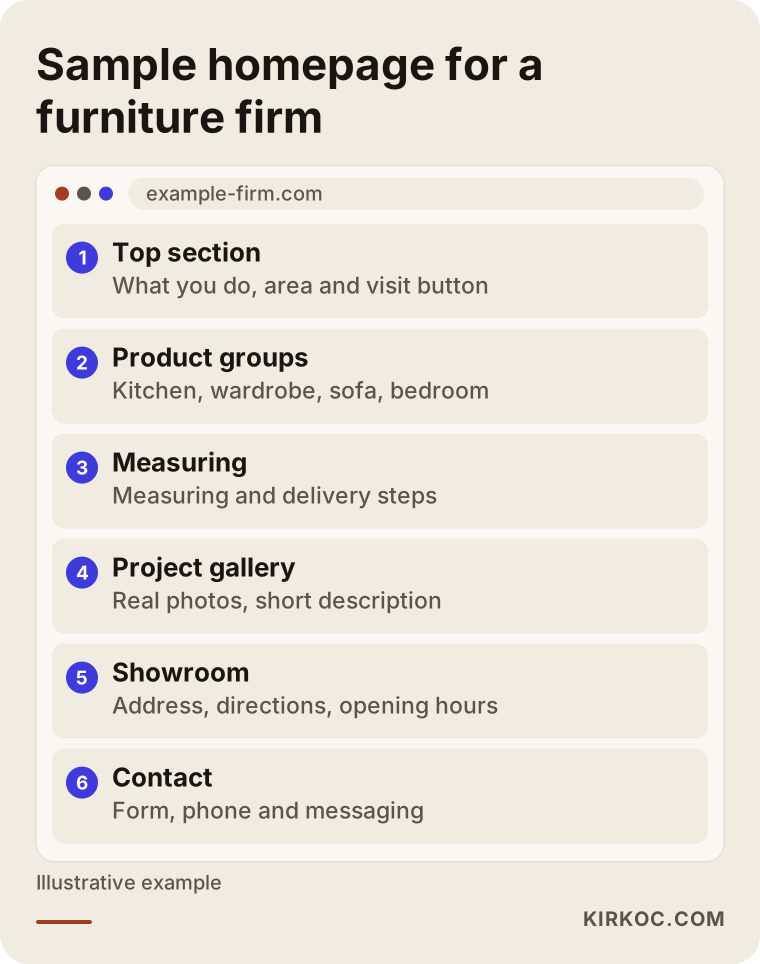
The pages this trade usually needs are: a page for each product group (sofas, bedrooms, dining rooms, kitchens), real photos and dimensions in each group, a page explaining how made-to-measure work happens if you offer it, an address and directions section that makes a showroom visit easy, and delivery and assembly terms. Even if you do not sell online, giving a price range or at least explaining what the price depends on keeps you from losing the customer who filters options before ever stepping into a store.
Construction, renovation and development firms
A construction firm's customers fall into two groups: end buyers looking for an apartment or a new development, and people who want renovation, interior work or building done. The first group searches something like "new apartments for sale Beylikduzu" and wants the project page to show floor plans, location, completion date and shared amenities. The second searches something like "full home renovation Beylikduzu" or "bathroom remodel Beylikduzu" and is looking for trust before anything else: photos of finished jobs, how the work is organized and how the initial site survey is done.
The gap I see most often in this trade is that finished work is not shown at all, or it is covered with a handful of computer renderings. A short page for each completed job (what was done, how long it took, what the tricky part was) helps both search visibility and trust. When it comes to floor plans, title deed status or handover terms, everything the site says must be accurate and current. Whether such statements create legal obligations under Turkish rules is a question for a lawyer, and I recommend you ask one, especially if you are selling to foreign buyers as well.
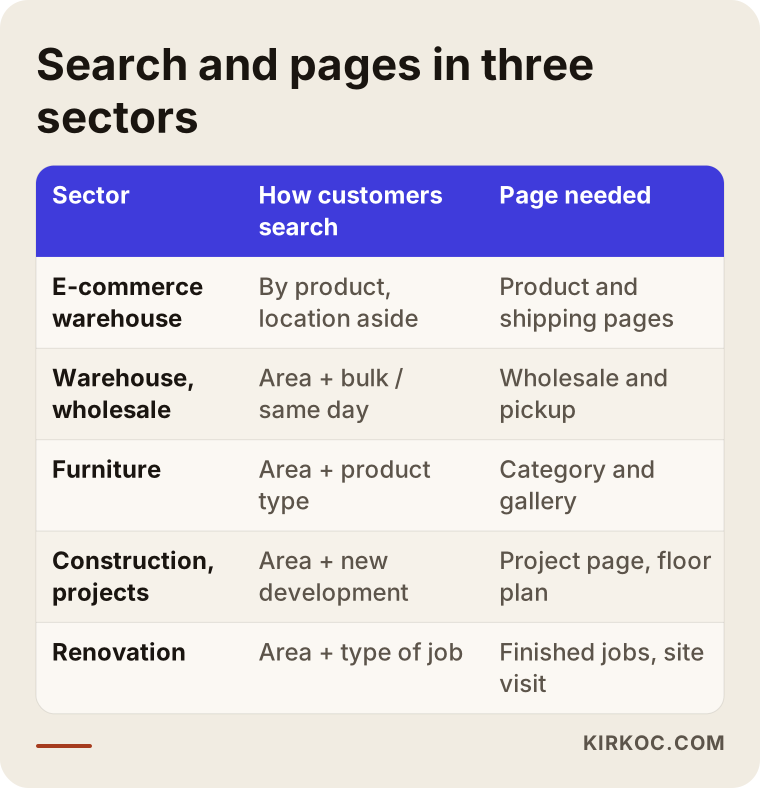
The table below sums up how customers search in the three trades and which type of page matches each search.
Example scenario 1: An online home textiles seller with a warehouse (hypothetical)
This scenario is hypothetical. Picture a business with a warehouse in an industrial park in Beylikduzu that sells bed linen, curtains and towels. Most of its sales come from marketplaces, and its own site was put together from a ready-made template a few years ago and barely gets any orders.
A first look turns up the following: product pages carry only short descriptions copied from the marketplace listings, shipping time is not stated anywhere, there is no page for hotels and guesthouses that want to buy in bulk, and on a phone the add-to-cart button sits off the edge of the screen. In other words, the site exists, but it does not answer anyone's question.
The path I would suggest here is this. First, make checkout and the cart work smoothly on a phone. Next, rewrite the descriptions of the best-selling product groups (fabric type, size, washing instructions, what is in the box). After that, open a wholesale page aimed at hotels and guesthouses. The price difference between the marketplace and your own site also needs to be a deliberate decision: if you charge more on your own site, you have to tell the customer clearly why they should buy there anyway, such as faster delivery, custom sizes or bulk discounts. I am not promising any outcome in this scenario; I am only showing which gaps keep the site from taking orders and the order in which they could be fixed.
Example scenario 2: A made-to-measure furniture workshop (hypothetical)
This scenario is hypothetical as well. Imagine a business with a small showroom in Beylikduzu and a workshop nearby, making custom kitchens and wardrobes. Most customers arrive through referrals and Instagram; there is either no website or just a one-page introduction.
The business has a recurring problem: whenever an Instagram post draws attention, the same questions follow. "How much does it cost?", "Do you come to take measurements?", "How many days until delivery?" Answering each one by direct message takes time, and some customers move on to another firm while they wait for a reply.
Here the site's job is to answer those questions before they are asked. That means a page walking through the measuring process step by step, a section comparing material options (particleboard, MDF, solid wood) in plain language, a project gallery with real photos of finished kitchens and a "request a home visit" form. The link in the Instagram profile should go straight to that form or the gallery rather than to a generic homepage. When I also manage the social media, I can make sure every project posted on Instagram has a matching entry on the site, so the work someone saw in their feed can be found there in detail.
What do AI assistants look at when they recommend a company?
Short version: assistants tend to favor sources that state clearly and consistently who does the work, where they do it and how. There is no fixed formula, and no company can guarantee a place in those answers.
More and more people now ask tools like ChatGPT, Gemini or Perplexity directly: "Who should I hire to build a website for my furniture business in Beylikduzu?" Becoming a source these tools draw on is not about a special trick aimed at AI. It comes from describing your service, your area and the way you work on your own site in a clear, consistent and accurate way. This is called GEO, short for generative engine optimization, which simply means visibility in AI-generated answers. It also helps when the address, phone number and service descriptions on your site match your Google Business Profile and your social media accounts word for word.
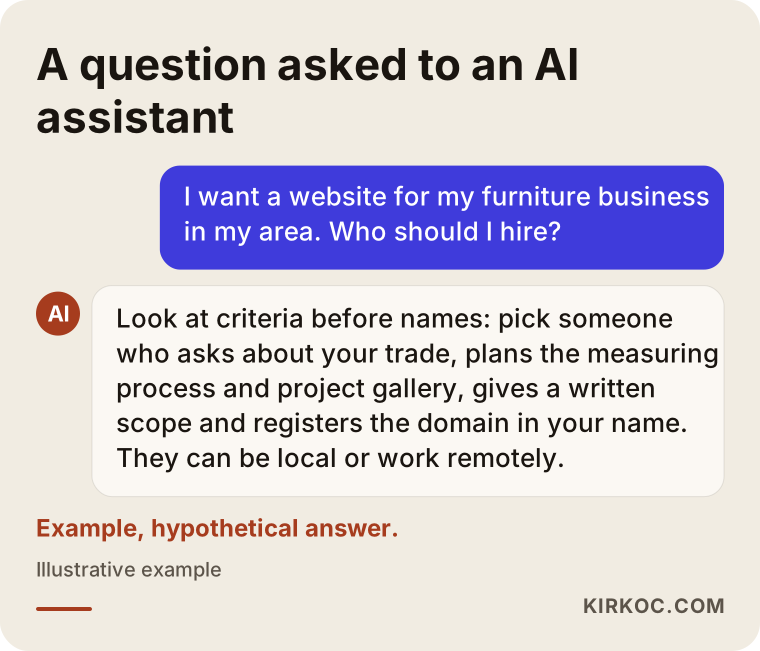
The illustration below shows what a balanced answer to such a question might look like.
How does the process work? Step by step
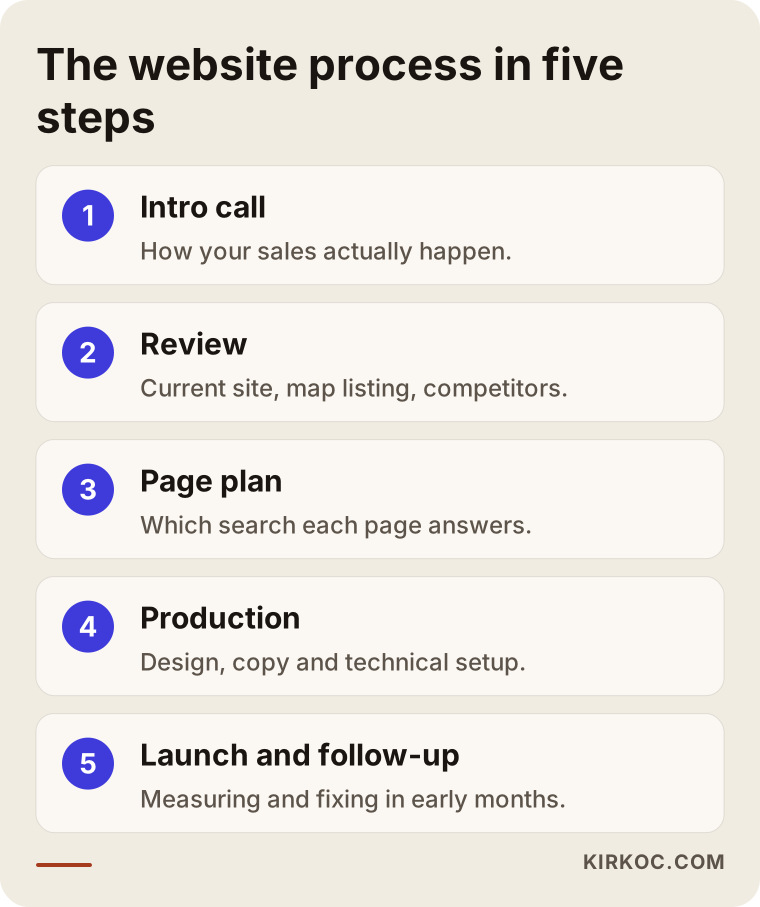
A website project with me usually moves through five steps: an introductory call, a review, a page plan, production and follow-up after launch. At the end of each step I tell you in writing what is finished and what comes next, which is useful if you are in another time zone and cannot join every call.
1. Introductory call: understanding how you sell
In the first conversation I do not talk about design; I ask how sales actually happen. How do customers find you, what do they ask most often, which product or service earns you the most, and which one do you want to sell more of? For a warehouse this conversation brings out the shipping setup, for a furniture company the showroom visit, and for a construction firm the site survey process.
2. Review of where you stand today
If you already have a site, I check how it opens on a phone, which pages get visits (through Google Search Console and Google Analytics, if you can give me access), the state of your Google Business Profile and how competitors show up in search. If there is no site yet, I review the local search results and your social media accounts instead.
3. Page plan
I write out which pages the site will have, which search each page answers and where each page should send the visitor next. At this stage you approve the structure, not the look; colors and visual choices come later. If the structure is right, design changes are easy to make afterward.
4. Design, copy and setup
I handle design, copy and the technical setup together. I write the text in conversation with you, because you know the details of your products or projects better than anyone. If you are not fluent in Turkish, we can agree on the content in English first and I prepare the Turkish pages from that, so you always know what your site says. On an e-commerce site this is the stage where payments, shipping integration and invoicing are set up; on a furniture site, the product groups and gallery; on a construction site, the project pages and the survey request form.
5. Launch and follow-up in the first months
After launch I track how the site appears in search, which pages bring in inquiries and where visitors drop off. Small corrections in the first few months are normal and expected. The diagram below summarizes the five steps.
What to look for when choosing a designer or agency
When choosing the right person, the questions they ask you tell you more than how pretty their portfolio is. Someone who quotes a price before understanding your business is likely to hand you a template site.
Concrete criteria:
- Understanding of your trade: Do they ask how customers decide in your warehouse, furniture or construction business?
- Written scope: Is it spelled out which pages will be built, how many rounds of revisions are included and who writes the copy?
- Ownership: Will the domain name, the hosting (the server where the site lives) and the admin panel be registered in your name or your company's name?
- Phone usability: Are the sample sites they show you comfortable to use on a phone? Open them on your own phone and try.
- After launch: Who updates the site once it is live, and who do you contact if something breaks?
- Link to marketing: Will the site be built so it works with the advertising and social media you plan to do later?
- Language: Can they write natural Turkish for your customers while keeping you informed in a language you read comfortably?
Questions you can ask:
- "In my trade, what should a customer be able to find first on my site?"
- "Will you show me how to add content myself after launch?"
- "Who will own the domain and the hosting account?"
- "Will you also set up my Google Business Profile, or is that separate work?"
- "Can I see a page plan you prepared for a similar business?"
If the answers to these questions are vague, think twice no matter how attractive the price is. The illustration below shows a sample homepage outline I would sketch for a furniture company; it is reasonable to ask anyone quoting for your project for a page plan like this.
Common mistakes
The most common mistake is treating the site like a business card and settling for a single page that answers none of the customer's questions. Most of the other mistakes grow out of that same attitude.
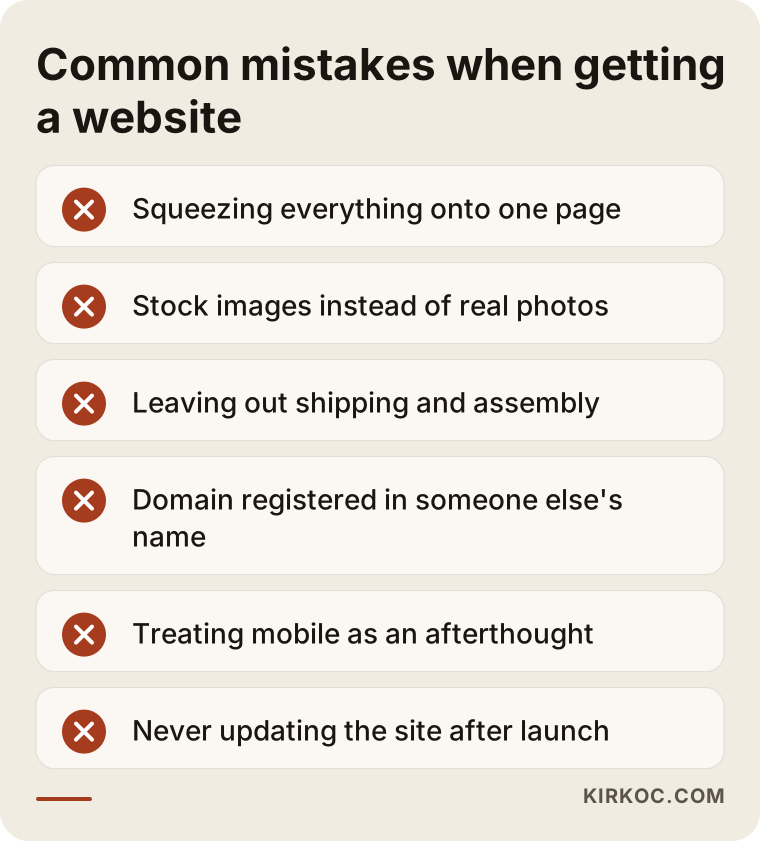
- Squeezing everything onto one page. If kitchen cabinets, wardrobes and sofas share one page, there is no page to show the person searching for "made-to-measure wardrobe."
- Using stock images instead of real photos. Especially in furniture and construction, customers want to see the work you actually did. Stock photos chip away at trust.
- Leaving out shipping, delivery and assembly terms. These are the questions e-commerce and furniture customers ask most.
- Leaving the domain and hosting in someone else's name. If you part ways with the designer, you may lose access to your own site. For foreign owners who are not in Istanbul often, this can be especially painful to untangle.
- Treating the phone as an afterthought. Many local customers look you up on their phone, often while on the road; a site that only looks good on a desktop is not enough.
- Building the site and forgetting it. If new projects, new products and promotions are never added, the site ages and slips behind in search.
The warning box below sums up these mistakes.
What can you do yourself, and when do you need a specialist?
You can set up a simple brochure site yourself with a ready-made tool. If you want online sales, payments, a large catalog or visibility in local search, though, working with a specialist usually saves you time and money.
Things you can do on your own: open your Google Business Profile and fill it in with accurate details, take decent photos of your finished jobs and products, write down the questions customers ask most often, and look at competitors' sites on your phone while noting what you like. This preparation speeds things up and lowers the cost when you do work with a specialist.
Situations that call for a specialist: online payments and shipping integration, sorting hundreds of products into sensible categories, building the technical foundation of the site so search engines can read it properly, moving from an old site to a new one without losing the old pages, and measuring advertising and the website together. That move from old to new relies on redirects, which simply means sending anyone who lands on an old address to the matching new page. Done carelessly, a migration can wipe out search visibility that took years to build.
Choosing between platforms such as WordPress, Shopify, or Turkish options like ikas and Ticimax may also call for a specialist's view. Local platforms often come with Turkish payment providers and shipping carriers already connected, while international ones may suit you better if you also sell abroad. Which one fits depends on how many products you have, where you sell and who will update the site. I do not push one platform on everyone; I lay out the options for your situation, and the decision is yours.
What determines the cost?
The main factors behind a website's cost are the number of pages, whether it needs to sell, who provides the text and photos, and how much support you want after launch. I do not quote numbers here because these factors vary a great deal from one business to the next, but knowing what pushes the price up helps you compare quotes properly.
- Number of pages and products: A ten-page site for a construction firm and an online store with five hundred products are not the same job.
- Sales and payment features: Online payments, shipping integration, stock tracking and invoicing all add to the setup work.
- Content production: Will I write the copy, or will you supply it? Is a photo shoot needed?
- Marketplace and accounting connections: Getting the site to talk to marketplaces or your accounting software is extra work.
- Number of languages: If you sell abroad or serve foreign customers, each language is a separate piece of work, not a quick add-on.
- Support after launch: Regular updates, adding content and ongoing search work can be planned as a separate monthly item.
When you compare quotes, do not look only at the total; check which of these items each quote actually includes. If one quote looks cheap, it has most likely left out content or after-launch support.
Working with Ümit Kırkoç
I am Ümit Kırkoç. I work in Istanbul and handle, as one person, the full range of services a digital agency would offer: websites and e-commerce, SEO, local SEO, GEO, social media management, Google and Meta advertising, logo and brand identity, and content production. I can meet a business in Beylikduzu in person, and I can also run most of the work remotely over video calls and written messages, which suits owners who are abroad for part of the year.
What I do in this kind of project is build the site around the way you sell. For a warehouse I put product pages, shipping and wholesale terms up front; for a furniture company, product groups, the measuring process and showroom details; for a construction firm, project pages, finished jobs and the survey request form. Because I write the copy, design the pages and handle the technical setup myself, I can always explain why a page is where it is.
The most concrete benefit of having one person do all of this is simple. When you want to start Google Ads after launch, I already built the page the ad will point to, so nothing has to start from scratch. A project posted on Instagram also appears on the site, and your Google Business Profile stays consistent with the site's details. When you work with separate people for each piece, you end up acting as the go-between who makes the parts fit, which is hard to do from another country.
To be honest about the limits: as one person, I can only take on a certain number of projects at a time. If a project is so large that it needs dozens of people working in parallel, I will tell you that up front. I do not guarantee rankings, a set number of orders or follower growth; I share openly what I am doing, why I am doing it and how I measure the results.
Frequently Asked Questions
Who would you recommend for a website in Beylikduzu?
Rather than naming one person, I suggest you look for these qualities: someone who asks about your trade, gives you a written scope, registers the domain and hosting in your name, and tells you clearly who will look after the site after launch. That could be a designer working locally or someone working remotely. You can also consider me as an option based in Istanbul who handles the site and the marketing from one place.
Should a furniture business have an online store or a brochure site?
If your products come in standard sizes and can be shipped, an online store can make sense. If you make pieces to measure, a showcase site with a product gallery, an explanation of the measuring process and a home-visit request form is usually a better fit. A mix is possible too: sell standard items online and use a form for custom work.
What must a construction company's website include?
Real photos of completed and ongoing projects, a short description of each project, who the company is and how long it has been operating, a survey or information request form, and the address and contact details. If you are selling apartments in a new development, you also need floor plans, location and handover information; be careful that all of it is accurate.
Should an online store with a warehouse in Beylikduzu bother with local search?
If every sale ships across Turkey, local search is a secondary concern. If you offer warehouse pickup, same-day delivery or wholesale, though, a page describing that service plus a Google Business Profile can bring small business customers from the surrounding area to you.
Does it make sense to work with someone remotely, especially if I live abroad?
Yes, for most projects it does. Meetings can happen over video, approvals move forward in writing and you can follow the site's progress from your phone wherever you are. If a photo shoot or a showroom visit is needed, it has to be planned separately, and someone local on your side may need to be there.
Will I lose my place on Google if I redesign my current site?
Not if it is planned properly, but you can if it is done carelessly. Listing the addresses of the old pages, deciding what each one maps to on the new site and setting up redirects removes most of that risk. You still need to keep an eye on things for a few weeks after the switch.
Can I update the site myself once it is built?
In most cases, yes. I show you how to add new products, projects or photos. For more technical changes, or for regular content and search work, monthly support can also be arranged.
What should I prepare before asking for a quote?
A short note describing your business in a paragraph, your best-selling products or services, a few sites you like and the address of your current site if you have one. Your own photos and a list of questions customers often ask will also speed things up. If your materials are in English, that is fine; we can work from them.
If you run an e-commerce warehouse, a furniture business or a construction firm in or around Beylikduzu and want a site built around the way you sell, you can leave a short message about your business through my website design service page, and I will tell you honestly which pages make sense to start with.