You opened a car wash or detailing business. You know how to make a car shine, but your phone does not ring as often as it should. You post good before-and-after photos on Instagram, and yet when someone searches online, your competitors show up first. That is the moment the question of a car wash website comes up: do you really need one, what should it include, and who should build it? I am Ümit Kırkoç. I work from Istanbul and build websites for small businesses. In this article I will explain the parts that are specific to your industry, so you can make a decision without any technical background.
How do car owners actually find you?
A car owner looks for a wash in one of two situations. Either the car is dirty and they want service soon, or they just bought a new car and want to protect the paint with something serious. The first person types something like "car wash near me" into their phone, looks at the map, and calls the closest place that has good reviews and looks open. The second person is more careful. They search "what is ceramic coating," "how much does paint correction cost," or "how long does an interior detail take," and then compare two or three businesses.
These two people will not be happy with the same page. The first wants an address, hours and a phone number. The second wants to see the process, the products you use, what you guarantee and examples of your work. A one-page site with a logo and a phone number cannot convince either of them. So ask yourself first: how many of my customers want a quick wash, and how many want a high-value protection job? Your answer shapes the structure of your site.
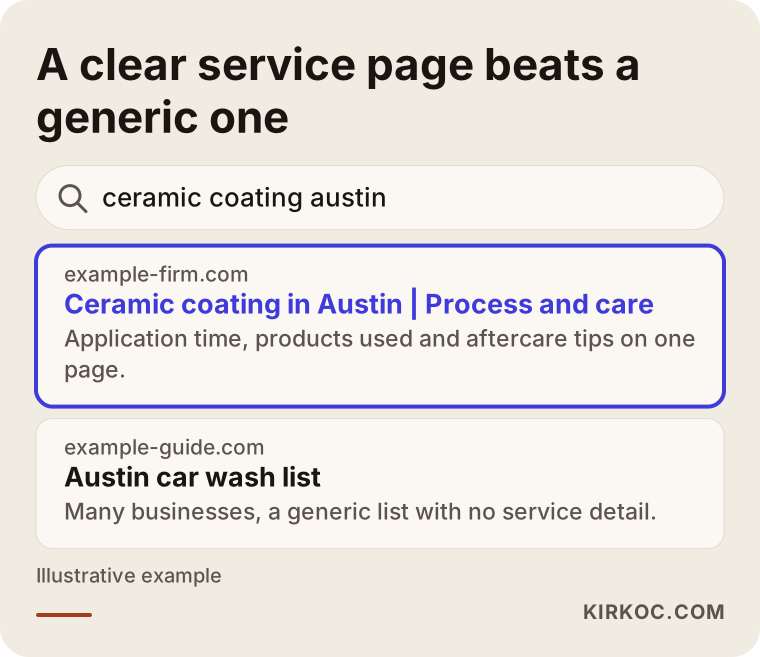
The image above shows why a page focused on one service and one area looks more attractive in the results than a general directory page. When people read the exact service and the exact city in the headline, they click on it. The search result in the image is an invented example, not a real business.
Why do you need a website when you have Instagram and a map listing?
That is a fair objection. Plenty of car wash owners take bookings through Instagram, and they already have a Google Business Profile, which is the free map listing that shows your address, hours and reviews. So what does a website add? Three things.
The first is control. On Instagram you cannot explain your services, your working conditions and your cancellation policy properly, and posts disappear down the feed. On a website, all of that stays put and stays organized. The second is trust. Someone who is about to pay a significant amount for a ceramic coating wants to know whether you are a serious operation. Your own domain name, a tidy page and clear information give them that confidence. The third is search. When people look for longer, more valuable phrases such as "ceramic coating" or "auto detailing," social media accounts rarely rank well, while a page written for exactly those searches can.
Your map listing is very valuable, and it does not compete with a website. They complement each other. The listing shows you as "a place nearby," while the website answers "why should I choose you?" When the two point at each other, Google understands your business more clearly. When I handle both myself, I make sure the address, phone number and service names on the site match the listing exactly. It sounds small, but that consistency makes a real difference in local results.
Which pages should a car wash website have?
You do not need many pages, but you do need the right ones. I recommend a separate page for each type of service, because people search for "car wash" and "ceramic coating" separately, and if you squeeze both onto one "Our Services" page, you will be weak for both.
- Home page: What you do, which area you serve, a call button, a few featured services and one genuine photo of your work.
- Service pages: Exterior wash, interior cleaning, polishing, ceramic coating, paint protection film, engine bay cleaning, and so on. One page for each job you do.
- Packages and timing: What each package includes, how long the car will be with you, and which vehicle sizes cost more.
- Before and after gallery: Photos you took yourself, in good light, from the same angle.
- "Who we are" replaced by "Who does the work and how": Who the technician is, which products you use, how the process runs.
- Contact and booking: Address, map, hours, phone and a link to your messaging app.
- Frequently asked questions: The questions customers keep asking you on the phone.
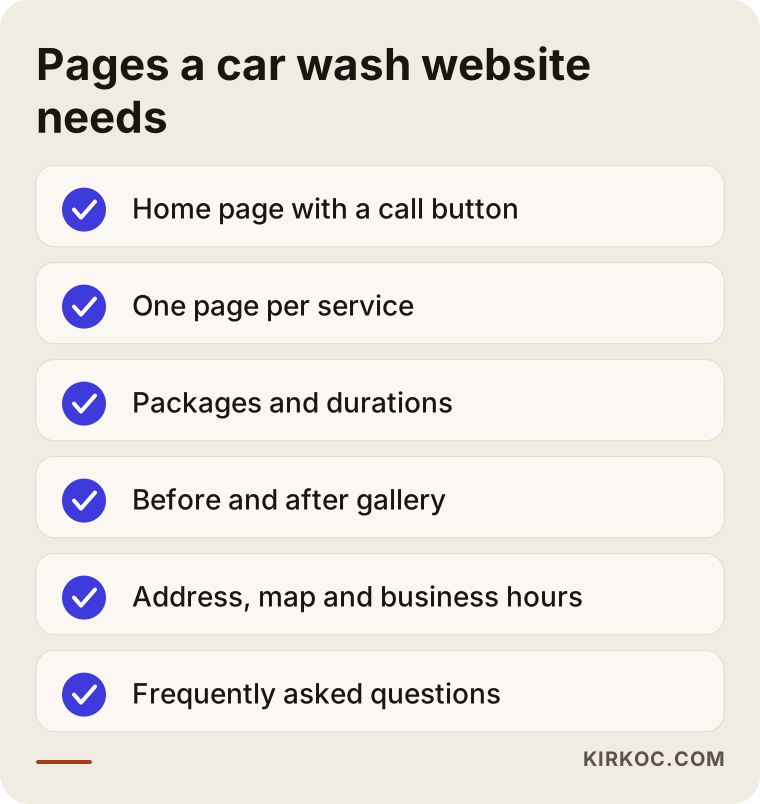
Use the list in the image as a yardstick when you review your current site or a quote someone sends you. If a page is missing, ask why.
Keep the home page short and clear
The most common problem I see on car wash sites is a home page that is either nearly empty or overcrowded. Someone opening the page on a phone should see four things on the first screen: what you do, where you are, how to call you and one example of your work. A big slideshow, rotating text and a long welcome message do not help with any of that.
Think of the home page as a shop window. The items in the window tell people what the store sells within seconds. Your window could be a close-up of a freshly coated hood, a "Call" button right under it, and your service boxes below that. Put your location in the headline, too, such as "Car wash and detailing in Austin." Both a person and a search engine can read that and understand where you are.
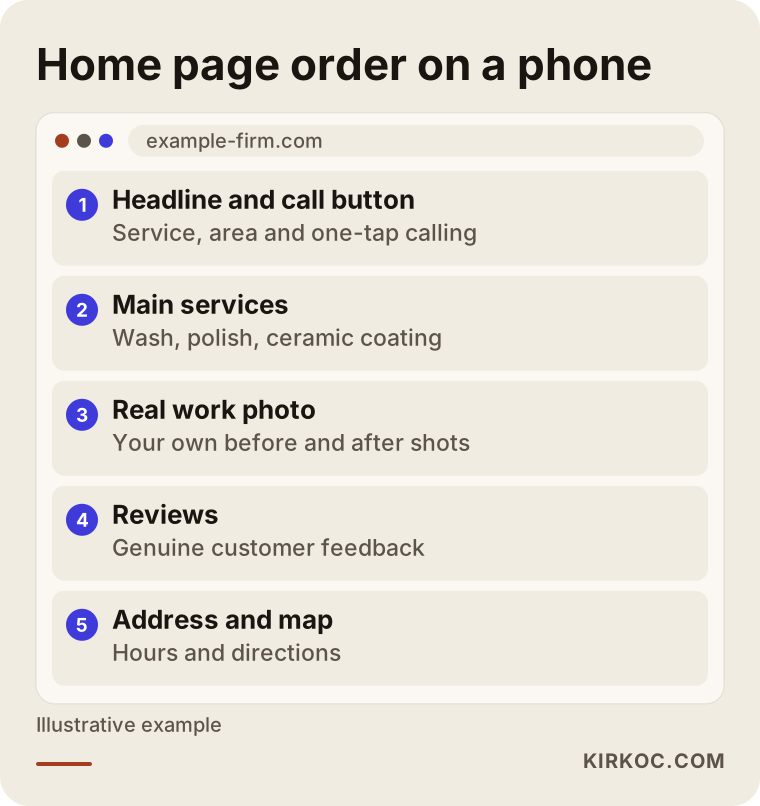
This sketch shows the order in which a home page can run from top to bottom. The order can change a little, but the call button must stay on the first screen.
Why do ceramic coating and detailing need their own pages?
A basic wash is a small purchase and the decision is quick. Ceramic coating, paint protection film or a full paint correction is expensive, and the customer thinks about it for a long time. To sell those jobs, the page needs far more than a short price list.
A good ceramic coating page answers these questions. What exactly is the treatment? What does it do to the paint, and what does it not do? How many days does it take, and when do I get the car back? What happens before the application? What should I do afterward, in terms of washing and care? Is there a warranty or a maintenance recommendation, and what are its terms? A business that writes this out plainly looks more trustworthy than one that says "everything will be perfect." Avoid exaggeration. A claim that a coating completely prevents scratches is not true, and it creates problems with customers later. For technical claims, rely on the manufacturer's information for whichever product you actually use.
A separate page for each job is also one of the most solid ways to tell Google that "this business is an expert on this topic." While competitors squeeze everything onto a single page, a detailed ceramic coating page of your own is a real advantage.
Photos: the strongest card on your site
Washing and detailing are visual trades. Customers believe the result they can see, not the way you describe it. Do not use stock photos. A glossy sports car that everyone has seen does not show your quality. A few jobs photographed in your own shop, on real customer cars, in natural light, will bring in more business than a hundred stock images.
A few practical tips. Shoot the before and the after from the same angle and the same distance. If needed, light the car from the side so reflections and scratches show. Keep license plates and anything that identifies the owner out of the shot, either by blurring the plate or choosing a different angle, and get the customer's permission before you publish a photo of their car. If you are unsure what privacy rules apply to you, talk to an attorney. File size matters as well. A gallery that loads slowly on a phone costs you customers, so photos should be compressed and uploaded at the right size.
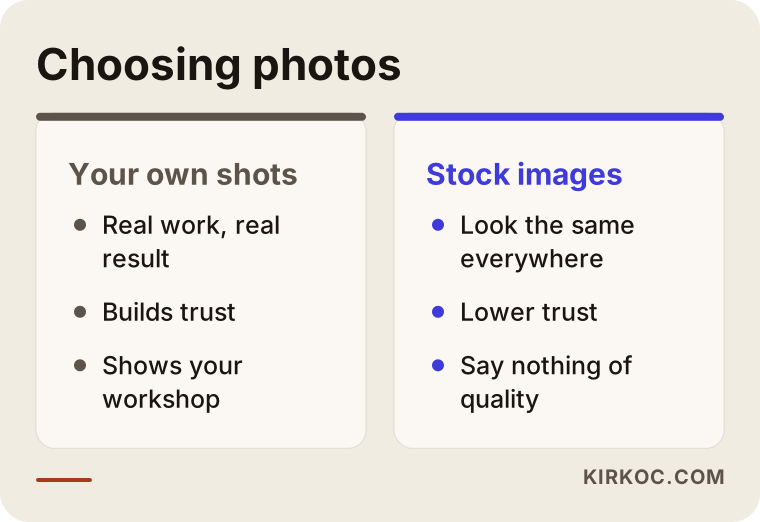
The comparison summarizes how customers see the difference between your own shots and stock pictures. If your budget is tight, at least build the home page and your best-selling service with your own photos.
Booking and contact: make it effortless
Car owners are often in a hurry. The "fill in the form and we will get back to you" approach is usually too slow for a car wash. The three most used paths are one-tap calling, one-tap messaging and a map link. These can sit in a bar fixed to the bottom of the phone screen on every page.
Whether you want a booking system depends on how your business runs. If most of your customers drive in without an appointment, online booking is not essential. For long, planned jobs like ceramic coating, though, a simple form where the customer picks a day and time makes life easier. Keep the form short: name, phone, car model, type of service and preferred day are enough. Every extra question increases the number of people who give up halfway.
Write your business hours the same way everywhere: on the site, on the map and on your social profiles. If you do not keep holiday, winter or rainy-day hours up to date, customers show up at a closed door and then say so in their reviews.
Local search: your map listing and website should work together
A car wash is a local business. Customers rarely travel more than a few miles. That is why your website has to say clearly where you are, and why it has to agree with your map listing. Here is how local search works in short. Google looks at where the searcher is and shows nearby businesses on a map. The factors that affect the order are distance, how relevant the business is to the search, and how well known it is. You cannot change distance, but you can improve the other two.
For relevance, fill in the service list on your listing completely, using the same names as your website. For being well known, ask your real customers for reviews. Do not buy reviews and do not have fake ones written. Platform rules forbid it, and your listing can suffer if you are caught. Sending a happy customer a short message with the review link after the job is legitimate and enough. Answer negative reviews calmly and with specifics, because future customers read your replies.
On the website itself, mention neighborhoods naturally. A sentence like "for drivers around downtown, East Austin and South Congress" is enough. Pages that list a hundred neighborhood names one under another look bad and are not received well by Google.
Two example scenarios
The scenarios below are hypothetical. They do not describe a real business.
Scenario 1: The neighborhood car wash. Imagine an owner in a busy part of town who offers exterior washes, interior cleaning and engine bay cleaning. Most customers live nearby and are in a hurry. A small but tidy site may be enough here: a home page, three service pages, a package page that explains what changes the price, a map and a call button. The goal is for someone who searches "car wash near me" to find the business and call within seconds. Because the shop gets busy, it also makes sense to let people ask "do you have room today?" through a messaging link on the site.
Scenario 2: The detailing studio. Now imagine a second owner who does ceramic coating, paint protection film and paint correction. The jobs are fewer but worth more. The customer researches for several days before deciding. This studio's site needs more depth: a detailed page for each service, the application process, an explanation of the products used, a gallery of real work, care tips and frequently asked questions. The booking form here works as "request an inspection and a quote," because nobody can give a firm figure without seeing the car and the condition of the paint.
The sites are different, but one thing is common: the customer finds the answer to their question on the site.
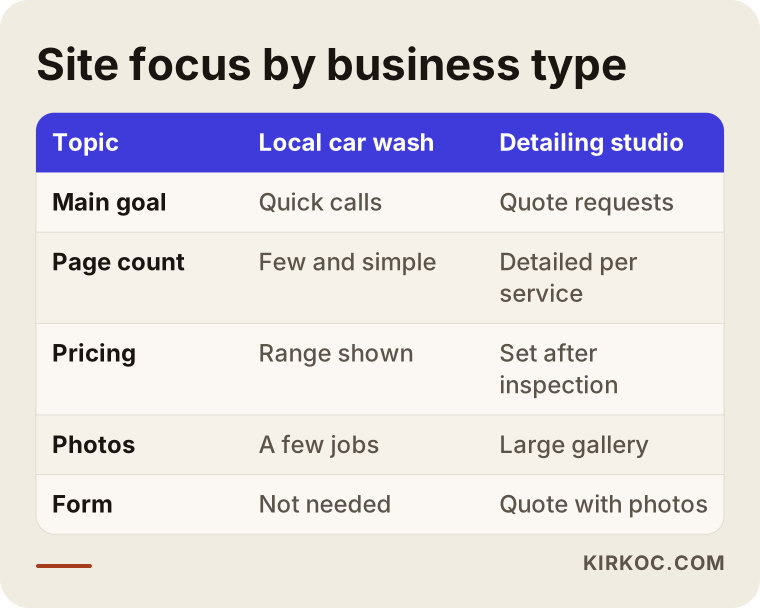
The table summarizes where each type of business should place its emphasis. Plan according to whichever column is closer to your own work.
Should you show prices on the site?
This is one of the questions I hear most. The honest answer is that it depends. For a standard exterior wash or interior clean, showing a price range is usually a good idea, because customers can decide without negotiating on the phone, and you get fewer "how much?" calls that eat your time. But for jobs that change with the size of the vehicle, how dirty it is or the condition of the paint, a fixed figure is misleading.
In that case, explain on the page what moves the price. List factors such as vehicle size, level of dirt, number of steps, products used and time, and start the quote process with "send me photos for an estimate." Even without seeing a number, a customer who sees the reasoning will trust you. Hiding the price and writing only "call us" sends many people to another business before they ever call you.
Step by step: how I build the site
Building a car wash site is a surprisingly orderly job. This is roughly the sequence I follow:
- Intro call and goals: Which services bring in your income, which do you want to grow, and which areas do you expect customers from? This conversation takes about half an hour and sets the skeleton of the site.
- Gathering content: The service list, packages, hours, address, photos and common questions. I collect this with you, and it is often the longest step because the photos need to be taken.
- Page structure and design: Which page belongs to which service, and where the call button will sit. A sketch comes first, then the design.
- Writing: Every page is written in the language your customers use, and industry jargon is explained.
- Technical setup: Domain name, fast hosting, correct display on phones, a secure connection and the basic settings search engines need.
- Map and tracking connection: Matching the site with your business listing, and counting calls and message taps.
- Launch and first-month follow-up: After the site goes live, I look at what works and make small corrections.
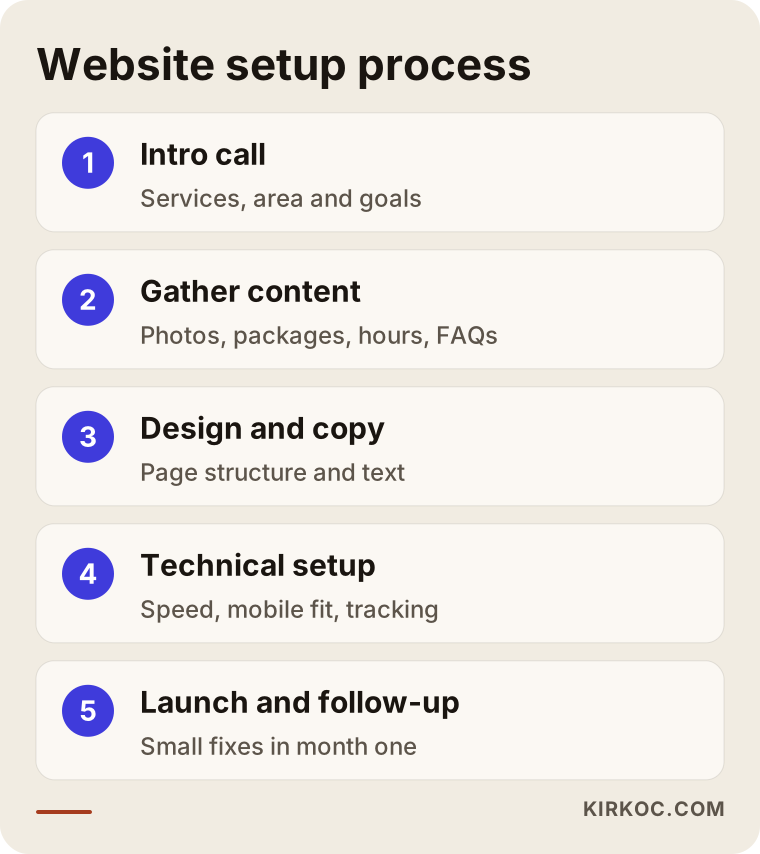
The flow in the image is a checklist you can use with anyone you hire. Whoever gives you a quote should be able to tell you clearly which of these steps it covers.
Common mistakes
Here are the mistakes I see repeated in this industry. Most of them are easy to prevent.
- The phone number is inside an image: If the number is written on top of a picture, nobody can tap it, and phones cannot dial it. The number should be plain text, and tapping it should start a call.
- Everything on one page: Exterior wash, ceramic coating and interior cleaning share a page. None has any detail, so all of them do poorly in search.
- Stock photos: Customers notice, and their trust in the business drops.
- Outdated hours: One thing on the site, another on the map. This turns into complaints in the reviews.
- Overblown claims: Phrases like "never scratches" or "shine for life" are untrue and can cause consumer problems.
- Slow on phones: Large, uncompressed photos make the page heavy, and people leave without waiting.
- No tracking: Nobody knows how many people called or tapped the map, so money is spent without knowing what works.
- Leaving a template as it came: Text from another industry, leftover placeholder text or a wrong address stays on the site.
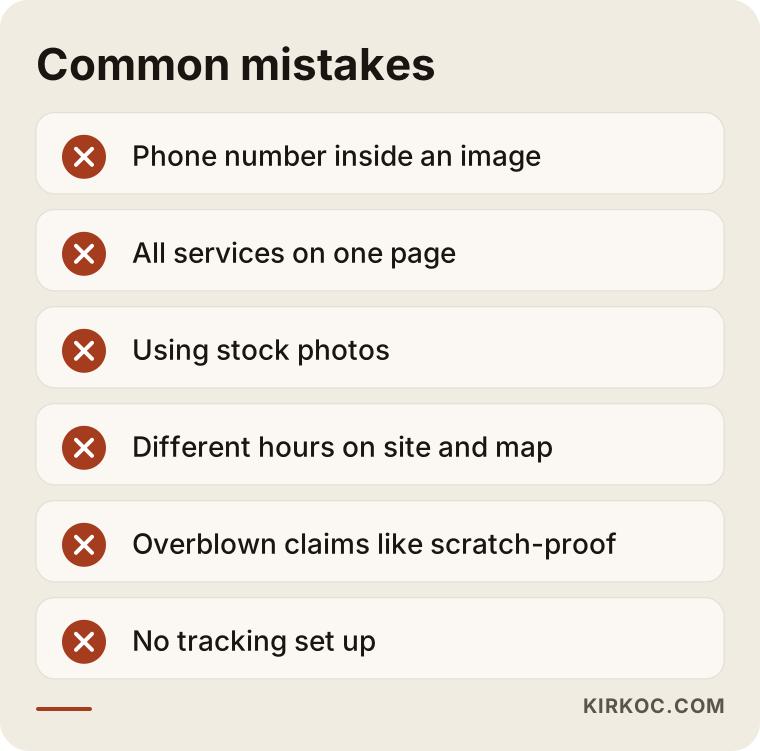
Apply this warning list once to your own site or to a draft that is being prepared for you. Fixing even two or three items can make a difference.
How does a visitor move through the site?
A site is not only there to be seen. Its job is to turn a visitor into a customer step by step. In the car wash business that journey is short, but the places where you lose people are predictable. First comes the number of people who arrive on the site from search. Some of them look at a service page. A smaller group taps the phone or sends a message. And the number who actually bring in a car is smaller still. Some loss at each stage is normal. The goal is to reduce it.
For example, if many people reach a service page and do not call, the problem is most likely on the page: the call button is hidden, information is missing or there is no photo to build trust. If almost nobody reaches the site at all, the problem is visibility in search. To tell these apart, you need to count at least calls, message taps and map taps. Measuring them is not hard, but if it is not set up during the build, it tends to be forgotten later.
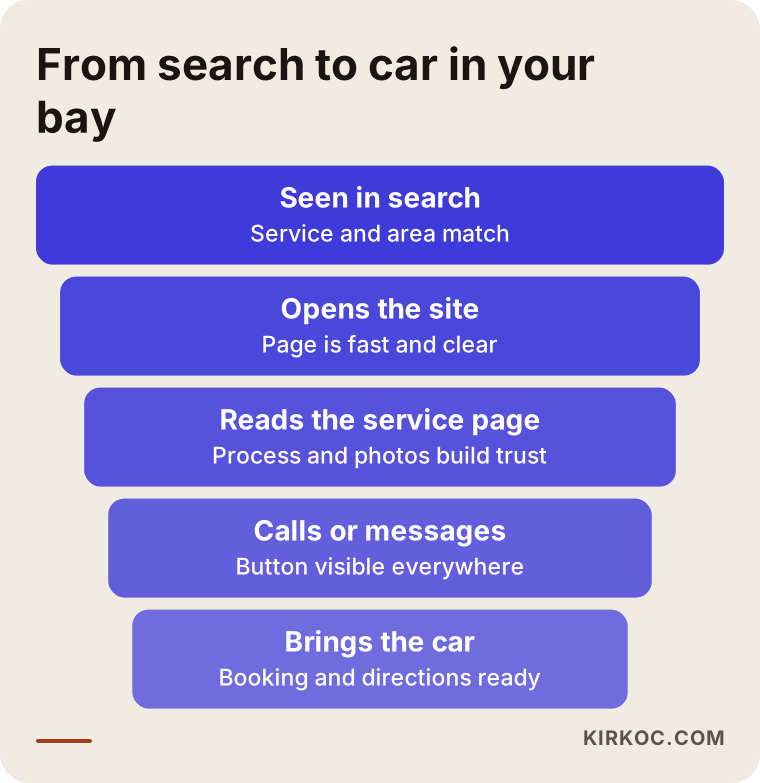
The funnel image is a thinking tool to help you see at which stage you are losing people. Once you fill in the numbers with your own business data, it becomes clear where to put your effort.
What can you do yourself, and when do you need an expert?
You do not have to outsource everything. You can comfortably do these yourself: complete your map listing, keep your hours current, take good photos, ask customers for reviews, and write down the ten questions you are asked most. They cost almost nothing and they work well.
Expert help makes sense in these cases: you are building a site from scratch, your current site looks broken on a phone, you never show up in search, you have more than one location, or you want booking and tracking connected properly. There is also the time factor. In washing and detailing you are on your feet all day, and writing a website at night is not sustainable for most people. Website builder tools are an option too. For a small business they can do the job, as long as the page structure and the text are planned along the lines of this article.
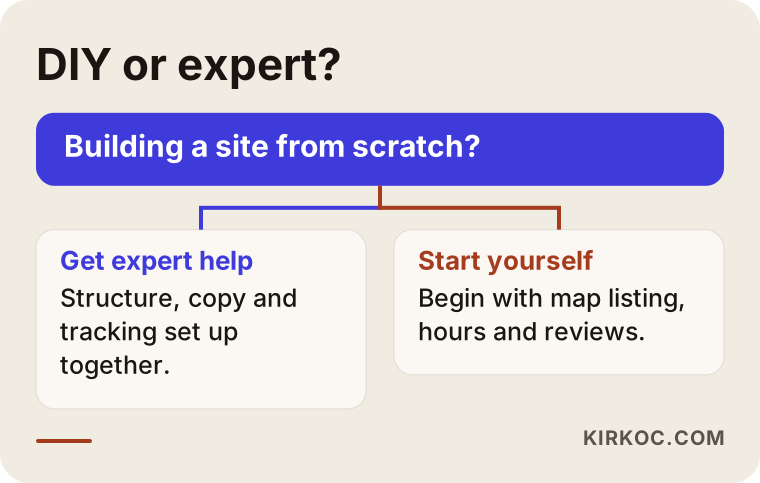
The chart is a rough guide. When you are unsure, a short assessment from a specialist is usually cheaper than a long period of trial and error.
What determines the cost?
I will not give figures in this article, because the cost of a car wash site changes a great deal with the scope of the work. Instead, here is what moves it, so you can read the quotes you receive with that in mind.
- Number of pages: A small site with three services and a detailed site with ten are not the same job.
- Content creation: Writing the text and taking or editing the photos is separate work. A client who arrives with ready content reduces this item.
- Booking system: A simple form and a calendar-based booking system are different things.
- Number of locations: Each location needs its own page and its own map listing.
- Design depth: A ready-made layout, or one made specifically for you?
- Search preparation: Page structure, headings and local search settings.
- Upkeep over time: After launch, who updates prices, hours and promotions?
When you request a quote, ask this: who owns the domain name and hosting, and who pays for them each year? If you want to move the site to someone else tomorrow, will you be given access? The answers to these two questions prevent many problems down the road.
How do social media, ads and the website work together?
A website is a shop window on its own. Bringing people to the window is a separate job. For many car wash businesses, the combination that works best has three parts: local customers who come from search, the "show your work" interest that comes from Instagram, and paid ads when needed. If these run independently, things fall apart: the campaign in the ad is not on the site, the price on Instagram differs from the site, and the hours on the map are old.
Because I manage the website, search visibility, social media accounts and ads myself, these mismatches are prevented from the start. For example, a ceramic coating job shared on Instagram links to the matching page on the site, an ad sends people straight to that service page, and the map listing carries the same service names. When you work with several different people, you have to pass this information to each of them separately and tell everyone about every change. That is where lost time and errors come from. You do not have to start ads right away. Having the site and the map listing in solid shape first keeps the ad budget from being wasted.
What should you track in the first months?
After the site goes live, resist the urge to check your ranking every day. Focus on a few simple indicators instead. How many people called you from the button on the site? How many sent a message? How many asked for directions on the map? Which service page was opened the most? If these numbers rise over time, you are on the right track.
It takes time for search results to settle, and no honest specialist can promise you a particular position or date. Even so, in the first weeks you can check whether your service pages are visible and whether your map listing agrees with your site. Every three months, look at which service draws the most interest and deepen that page. For example, interior cleaning may draw more interest in winter, and exterior washing and polishing in spring, so plan seasonal promotion pages ahead of time.
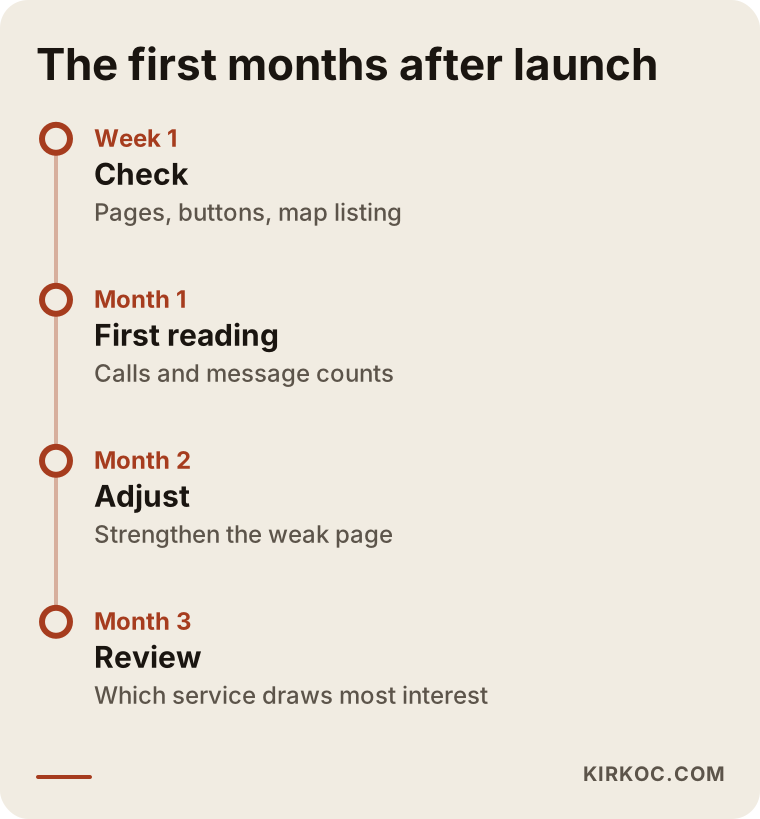
The timeline summarizes what to check and when after launch. Small but regular corrections do more good than one big redesign.
How I work with you
Working together usually starts with a short intro call. I go over your services, your area, your current site and your accounts. Then I explain in writing what you need and what you do not need for now; I do not try to sell you pages or packages you do not need. Along with the site, I can manage your search visibility, social media accounts and ads if you want. If you do not, I build only the site and leave the rest to you. Because you work with one person, I answer every message myself, and information does not get lost as it passes from team to team.
Frequently Asked Questions
Does a small car wash really need a website?
It is not mandatory, but it is often useful. Even if you appear on the map and on Instagram, a website presents your services, your way of working and your contact options under your control. If you sell high-value jobs like ceramic coating, customers look for a site before they decide.
Can an Instagram page replace a website?
Not completely. Instagram is great for showing your work, but in searches like "ceramic coating" it is less effective than a service page, and information gets lost in the feed. The healthiest approach is to use the two so that they support each other.
Should I put prices on the site?
For standard jobs, a price range reduces phone traffic. For jobs that vary with the car and the paint condition, it is more honest to explain what changes the price and ask for photos to give a quote. Hiding the price and writing only "call us" pushes most customers away.
How long does it take to get the site ready?
It depends on the number of pages, how ready your content is and whether photos need to be taken. Usually the most time goes into collecting the text and photo material. I share a clear schedule in writing after we discuss the scope.
Where will my site rank on Google?
Nobody can guarantee that. A good page structure, a consistent map listing and genuine reviews improve your chances of being seen, but the order depends on competitors, location and timing. An honest specialist offers you a method, not a promise.
Do I need a booking system?
No. If most of your customers drive in without an appointment, a phone and message button is enough. For planned, longer jobs, a simple booking or quote form makes your work easier. Understand the need first, then choose the tool.
What should I do if I have more than one location?
Create a separate page for each location and a separate map listing with the correct details. The address, phone and hours should be the same everywhere. Otherwise both customers and search engines get confused.
Can I update the site myself after it is built?
Yes, if it is built on a system that can be updated. I show you briefly how to use it so you can make small changes such as hours, prices or promotions yourself. For bigger changes, you can ask for support.
If you would like to work out together what kind of site your car wash or detailing business needs, you can reach me through the website design service page. I will listen to your business and tell you, in plain language, what you actually need.