There are cars lined up outside, your phone keeps ringing, and somewhere in the back of your mind a voice says, "I really should post something on Instagram." Almost everyone who sells cars has that thought sooner or later. Selling a car is already a full-time job, so photographing every vehicle, writing the post, answering the messages and doing all of it regularly feels like a second job on top. Social media management for car dealerships is simply the work of putting that second job in order. In this article I will explain, in plain language, what a dealer who knows nothing about the subject should look at. You can run it yourself or work with a specialist; either way, you only need to understand what the work involves to make a good decision. If you would rather hand the whole thing to one person, you can also look at my social media management service.
Why a dealer's social media is different from other businesses
For a cafe or a hair salon, social media is mostly about staying in people's minds. A dealership is a different case. What you sell is one-of-a-kind, expensive, slow to decide on and usually bought once. That changes a few things.
First, your stock keeps moving. The car you filmed today may be sold tomorrow, and that is perfectly normal. It means your posts have a shelf life, and the question "Is it still available?" will come up again and again. Your account needs a system that makes it obvious which cars are gone.
Second, trust comes before everything else. Someone who is about to buy a used car will check you out before visiting. They look at your account, read what people say about you and try to work out whether you have sold a car recently. An empty account, or one whose last post is from years ago, raises a quiet doubt: is this place even open?
Third, buyers screen you hard before they ever see the car. Photo quality, showing the vehicle from every angle and stating clear facts such as model year, fuel type, transmission and mileage are all part of that screening. A vague or incomplete post usually means one more question to answer and one more piece of your time spent.
Finally, you are the brand. Sometimes people choose a car because they trust the dealer, not because of the car itself. Showing your face, your voice and your honesty on social media is therefore as much about reputation as it is about sales.
How buyers actually find you
Picture a car buyer's journey. First comes a need: the family grew, the commute got longer, the old car keeps costing money. Then the search begins, on listing sites, on search engines, on social media. A few dealers or listings make the shortlist, then comes a message or a phone call, and finally a visit. Social media touches several links of that chain, but not all of them.
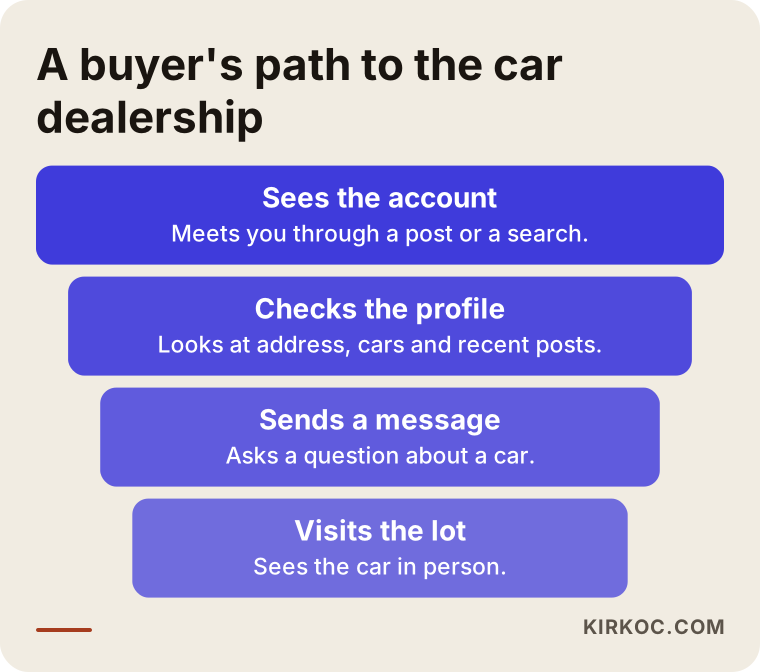
The graphic above shows how the path narrows between the moment someone notices your account and the moment they walk onto your lot. Some people drop out at every step, and that is normal. The job of social media management is to reduce that drop-off: to make it easy for the person who sees you to open your profile, for the person who opens your profile to send a message, and for the person who sends a message to come in. Nobody can promise you numbers for any of this, but you can see at which step you are losing people.
Let me be honest about one thing. Listing portals are still the strongest channel for selling a car, and social media does not replace them. What social media does is turn you from a name on a listing into a familiar face and a trustworthy address. When two dealers have the same car, the message usually goes to the one that already feels familiar.
Which platform does what
You do not need to be active everywhere. If your energy is split, nothing gets done well. Knowing what each platform is good for helps you decide where to start.
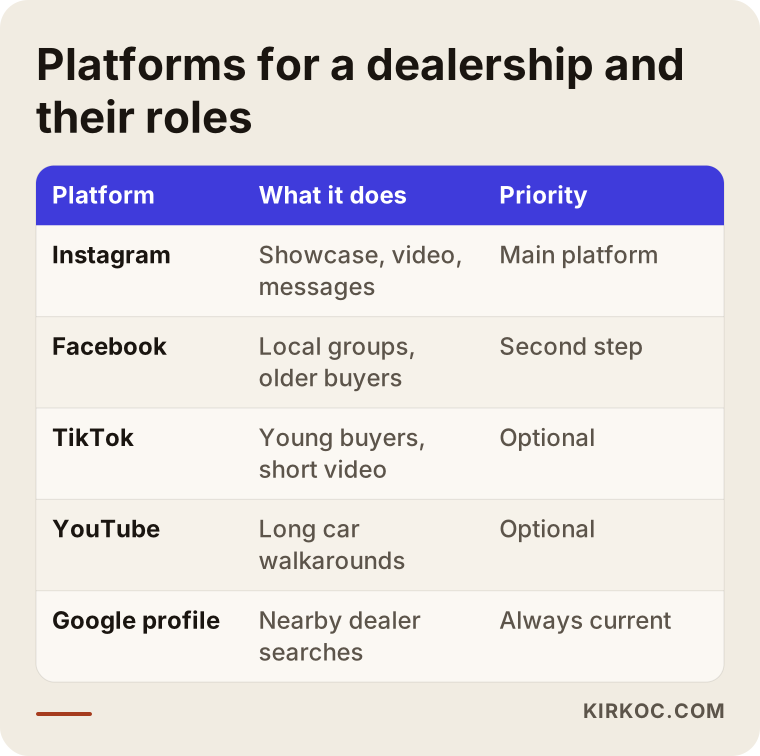
As the table sums up, Instagram is the showroom window for most dealers: car photos, short videos, stories and direct messages all in one place. Facebook still works well for reaching older buyers and local community groups, and you can run a business page and post vehicles there too. TikTok speaks to younger people and first-time car buyers, but it demands a steady stream of video. YouTube suits long walkaround videos and detailed reviews, and not every dealership needs it. Your Google Business Profile is not social media in the strict sense, but it is the first thing a person sees when they search for a dealer near them, and your photos and reviews live there too.
My practical advice: pick one main platform (Instagram for most dealers), keep your Google Business Profile up to date, and add the rest later. A video shot on your phone can usually be reused on Instagram, Facebook and TikTok with small edits.
Your profile: what should show in the first glance
When someone lands on your account, they should understand three things within about three seconds: where is this dealership, what kind of cars does it sell, and how do I reach it? The profile itself does that job, long before any posts do.
For the profile photo, your sign, your logo or your own face all work, as long as it is sharp and recognizable. The bio should briefly state your dealership name, the district or town you are in, the kind of cars you mostly sell (for example "family cars" or "budget-friendly cars") and your opening hours. Your phone number and location link should sit openly on the account. Then organize your highlights, the saved story circles at the top, under headings such as "For sale," "Delivered," "FAQ" and "Address," so visitors can find the answer to their own question without asking.
The idea behind all of it is simple: a visitor should never have to call you just to ask where you are or when you open. Every question you force someone to ask is a chance to lose them.
What to post for every car
Posting vehicles is the lifeblood of dealer social media. The difference between a weak post and a strong one is usually not the car. It is the preparation.
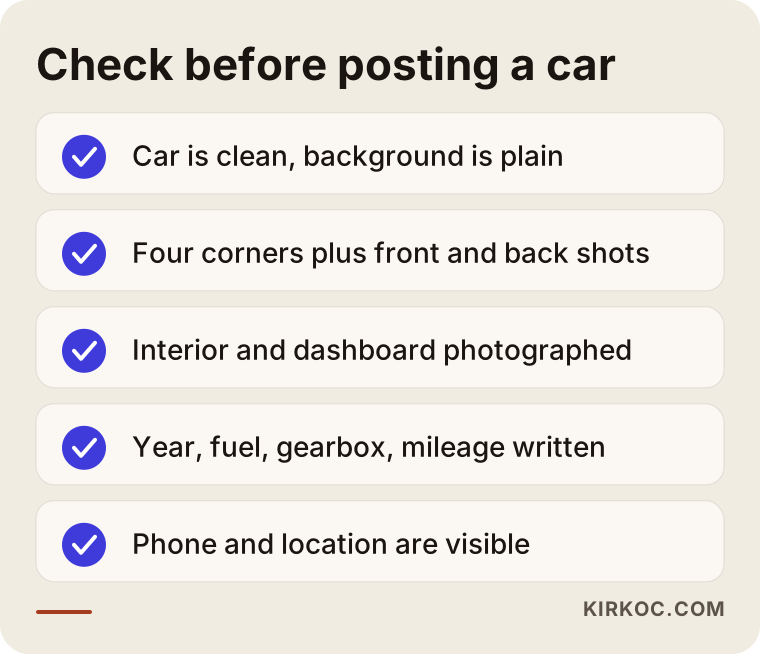
The checklist in the graphic is a short version of the questions to ask yourself before you post any car. Is the car clean? Is there a plain background to shoot against? Do you have photos of all four corners plus front and back? Did you photograph the interior and the dashboard? Are the facts (year, fuel, gearbox, mileage) written out? Is it clear how to contact you? Each of these makes the buyer feel as if they have already seen the car with their own eyes.
In the written part, avoid exaggeration. Phrases like "accident-free, original paint, spotless" belong in a post only if you can document them. If you cannot, leave them out. Giving a buyer wrong information about paint work, replaced parts or damage history harms both your reputation and your legal position. If you are unsure what you must disclose and how, I suggest talking to a lawyer who knows your local rules. I do not give legal advice.
Whether to show the price is also your call. Showing it brings serious buyers quickly but may narrow your room to negotiate. Leaving it out brings more messages, though some of them are just curiosity. You can try both approaches on different cars and see which one brings the messages that are actually useful to you.
How to shoot a car video with your phone
A video tells a buyer far more than a photo: the size of the car, the space inside, the sound of the engine, the thud of a closing door. The good news is that you do not need professional equipment. A steady phone and a fixed order of shots are enough.
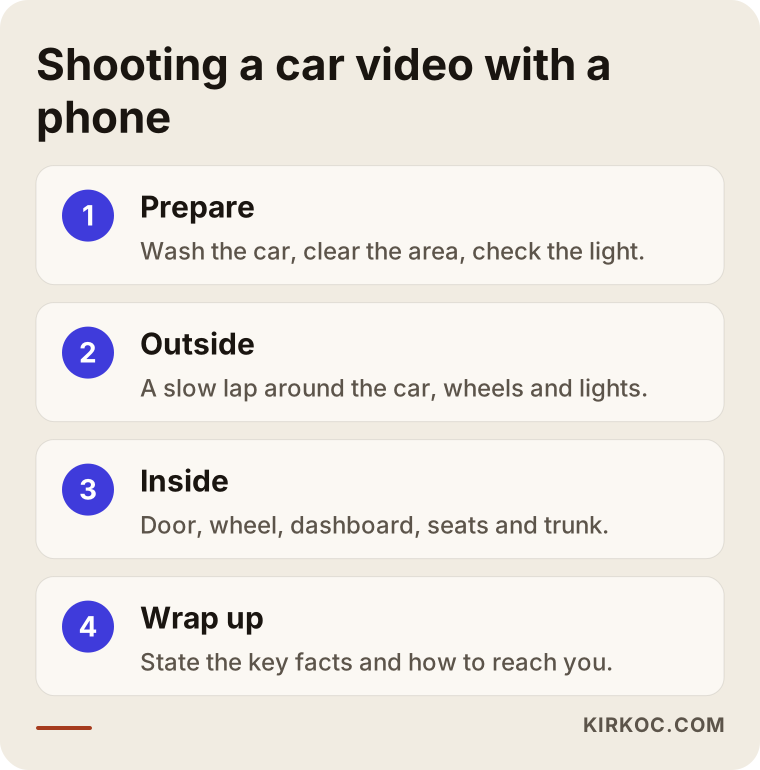
The sequence in the graphic shows how you can break a roughly ninety-second presentation into parts. First you wash the car and clear the clutter around it. Then you film the outside: a slow lap around the car, close looks at the wheels and the headlights. Next comes the inside: opening the door, the steering wheel, the dashboard, the seats, the trunk. To finish, you say the key facts in a sentence or two and tell people how to reach you.
A few practical notes. Hold the phone upright rather than sideways, because short videos on Instagram (called Reels) are vertical. Daylight is your best light, but direct midday sun creates reflections that hurt the car; morning or late afternoon light is softer. Choose a plain wall or an empty lot as the background. And if you do the talking yourself, the account feels much more trustworthy. Speak as if you were showing the car to a friend, not reading from a sheet.
Example scenario 1: an account that exists but is silent
Here is a hypothetical example, not based on any real dealership. The owner of a mid-sized dealership had an Instagram account set up a few years ago. It still holds photos of old cars, the last post is months old and the bio has no phone number. Messages sit unanswered for days because nobody is watching the account.
In this situation the first job would not be to create new content. It would be to tidy the account. Old and sold cars would be partly archived, the profile photo and bio refreshed, the location and phone number added, and the highlights reorganized. After that, a steady rhythm would be set: a fixed number of new cars per week, a few short videos, and replies to messages within an agreed time.
What you should expect from this is not "hundreds of followers right away." The realistic expectation is that someone who looks at the account thinks, "This place is active and serious," and that incoming messages stop disappearing. I would not predict when or how much will come in, but you can see the account start to work as a reply channel, at least, in the first months.
Example scenario 2: a small, newly opened dealership
The second hypothetical example is a newly opened dealership with little stock. The owner used to work in another job, is known locally and has no trace online. The budget is tight and so is the time.
Rather than trying to do everything, you start small: one Instagram account, one Google Business Profile, and for each new car a set of photos and a short video. The owner appears on camera, because for a dealership with small stock the biggest asset is the owner. Talking about why you bought a particular car, what you looked at and what you had checked is the kind of content that builds trust for a small dealer.
Here a specialist can be used to set things up rather than to do everything: the account structure, the shooting order and the posting calendar. After that the owner carries on alone, and the two of you review things at set intervals.
Common mistakes
Most of the mistakes I see at dealerships come not from lack of knowledge but from lack of time. Still, it helps to know them.
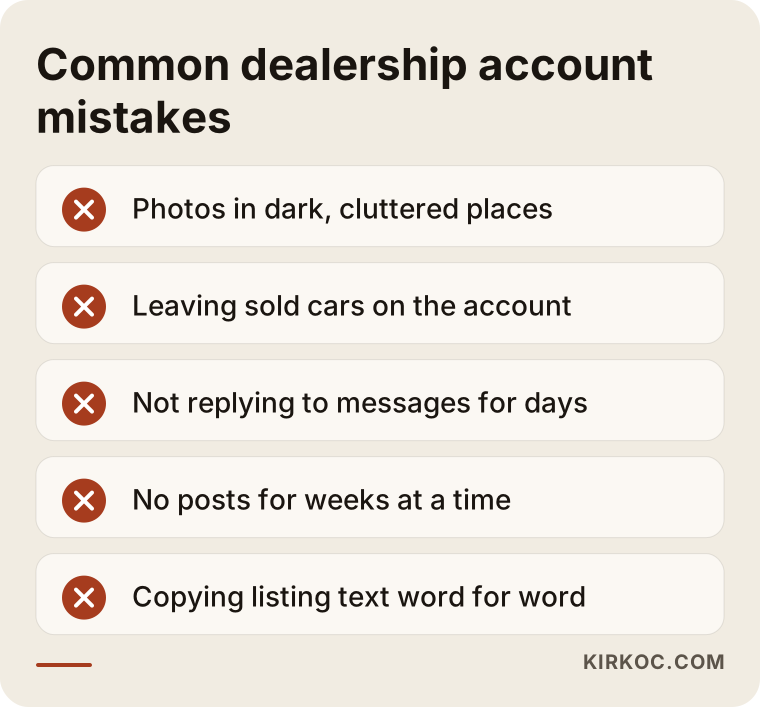
Let me go through the ones in the graphic briefly. A photo taken in bad light or in a messy place lowers the perceived value of the car. Leaving a sold car up, or not marking it as sold, tells visitors that the account is out of date and brings pointless messages. Replying late sends the buyer to another dealer, because shopping for a car usually means writing to several places at once. Irregular posting makes the account something that wakes up now and then and goes quiet again. And copying listing text from another site word for word does nothing to set you apart from other dealers.
I would add one more: making the follower count your goal. For a dealership, what matters is not how many followers you have but whether the right people in the right area are writing to you. Thousands of followers from far away mean nothing to a car buyer in your town.
How to build a weekly rhythm
In dealer social media, consistency is worth more than creativity. A promise to post every day tires most owners out within a week. A more realistic approach is to choose a rhythm you can actually keep and stick to it.
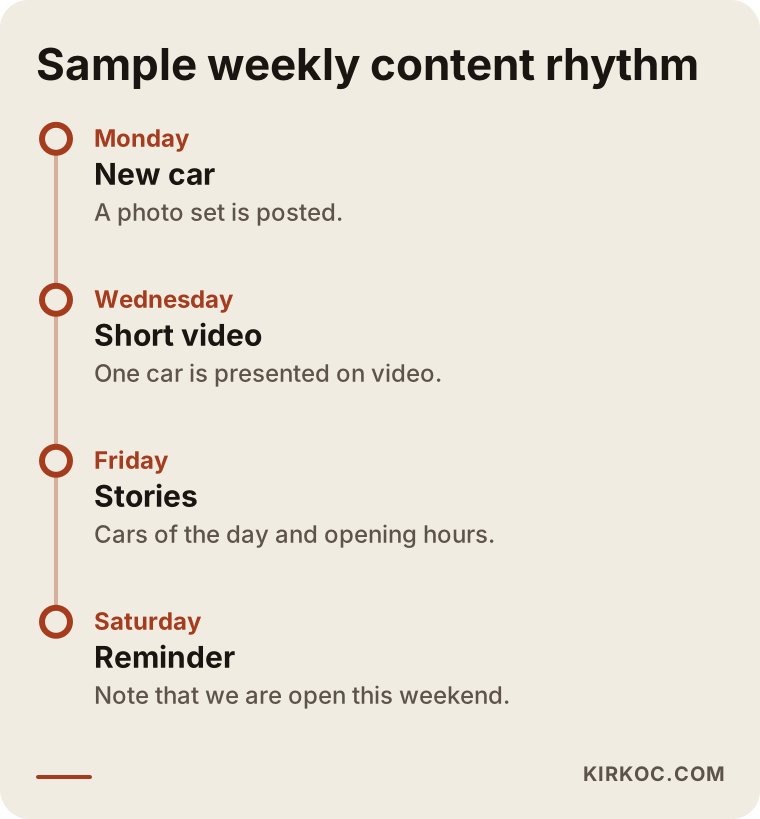
The timeline in the graphic is only an example; adjust it to your own workload. Early in the week you photograph and post the newly arrived cars. In the middle of the week you publish a presentation video of one car. Through the week, your stories show the cars of the day, the ones that sold and your opening hours. If you delivered a car and the customer agrees, a happy handover moment is worth a lot for trust. Before the weekend, when more visitors come by, a short reminder that you are open is enough.
For handover posts, you always need the buyer's clear permission. Do not post a license plate or a person's image without it. If you are unsure about a privacy question, ask a lawyer.
Turning an incoming message into a sale
The easiest thing to lose on social media is the first message. When someone writes "Is this car still available?", how fast and in what manner you reply largely decides the outcome.
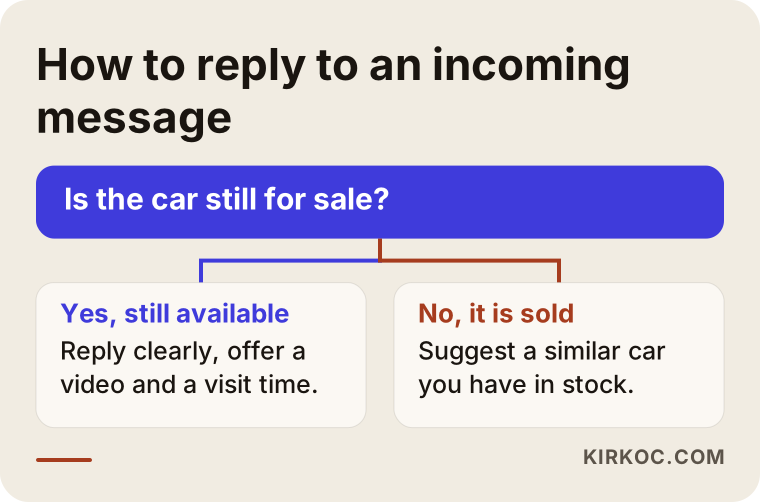
As the chart shows, the flow is simple. If the car is still for sale, give a short, clear answer, offer an extra photo or video, and propose a time to visit. If it has been sold, do not stop at "sold." Suggest a similar car from your stock. That small reflex turns a message you would have lost into a new opportunity.
Give yourself a response time, for example "as soon as possible during opening hours." Write ready-made answers for the common questions (trade-ins, financing, inspection, delivery time) and keep them somewhere handy, because writing from scratch every time wastes time. Do not paste them blindly, though. Add the person's name and the car they asked about.
Before you write anything about financing, trade-ins or payment that could have legal or financial consequences, make sure you know what you are saying. If you are not sure, "let's go through the details at the dealership" is the safer line.
Should you do it yourself or hire a specialist?
There is no single right answer. It depends on the size of your dealership, your time and how much you enjoy the work.
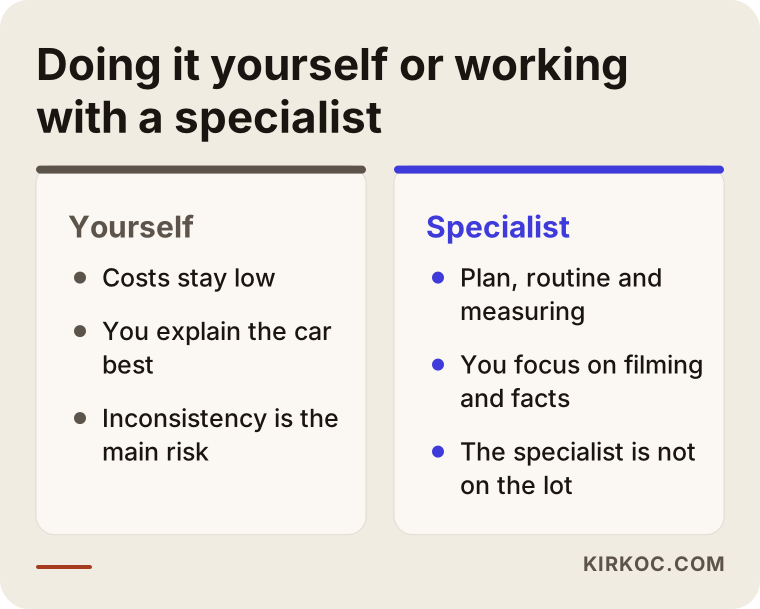
If you manage it yourself, costs stay low, you know the cars better than anyone and the content is truly yours. But it takes time, and inconsistency is the biggest risk. If you work with a specialist, you get routine, a plan and measurement, but you have to feed that person information so they can describe your cars and your dealership, and a specialist is not standing on your lot every day.
For many dealerships a shared approach makes sense: you do the filming and show the cars, and I take care of the profile setup, the posting plan, the writing, the editing and the reporting. Or a specialist sets everything up at the start and you continue from there. These signs tell you when you might need help: posts have been missing for weeks, messages go unanswered, or you are thinking about ads and do not know where to begin.
What decides the cost
I am not giving a number here, because it truly depends on your dealership. What I can tell you is what it depends on, so that you can make sense of any quote you receive.
The first factor is how many platforms are covered. Instagram alone is a different workload from Instagram, Facebook and TikTok together. The second is content volume: how many cars, videos and stories a month. The third is who does the filming. If you shoot it yourself, the workload drops; if on-site filming is needed, it takes extra planning and time. The fourth is message and comment handling: who takes that on? The fifth is advertising. Paid ads are a separate job and a separate budget line, and the ad spend should be considered apart from the management work. The sixth is how often reporting and meetings happen.
When you get a quote, make sure the scope is in writing, that it is clear who does what, and that the accounts stay in your name. Be careful with any quote that guarantees a certain number of followers or a certain amount of sales. No one can honestly promise that.
What a buyer looks for on your account
When a buyer researches you, they are quietly building a trust checklist, often without realizing it. Making sure your account answers that checklist matters as much as the posts themselves.
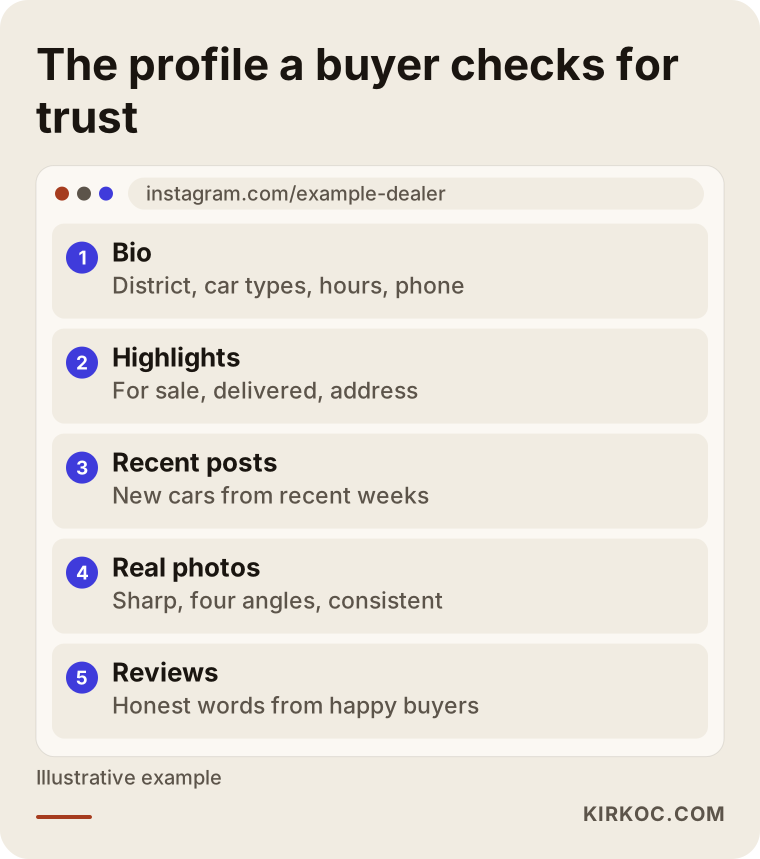
The page layout in the graphic sums up how your account and your Google Business Profile look to a buyer: recent posts, real and sharp photos, an address and opening hours, reviews from earlier customers, and fast replies to messages. A note about reviews: do not buy them and do not have fake ones written. It breaks platform rules and, once noticed, badly damages your reputation. Politely asking a satisfied buyer for a review at a fitting moment is enough, and it is the honest way.
Do AI tools recommend dealerships?
People now often ask AI chat tools, not only search engines, when they are looking for a car. A question like "How do I find a trustworthy used car dealer?" may not lead to a direct recommendation of any one dealer, but the answer can list the qualities to look for.
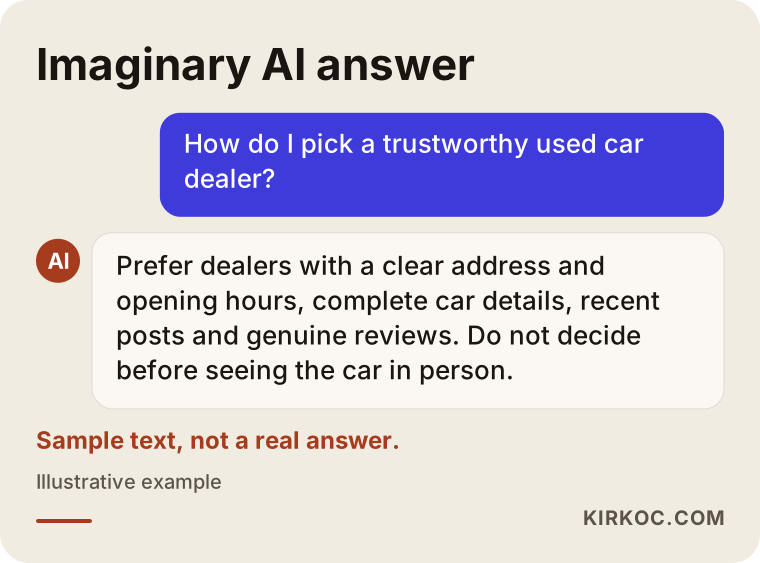
The graphic is an invented example of how such an answer might look, not a copy of a real one. What matters is that answers like this tend to rest on signals such as a clear address, consistent information, genuine reviews and regular content. So keeping your social media account, your website and your Google profile consistent with the same details makes you look more reliable to people and to these tools alike. No one can guarantee that an AI tool will recommend you, but consistent, clear information is a solid foundation.
This is where having everything handled by one person pays off. If the address on your social media account differs from the one on your website and your Google profile, all your channels weaken each other. Because I handle websites, search visibility, social media and advertising myself, I can make sure these channels say the same thing and support one another.
How I work, in short
My approach with dealerships is simple. First I look at your account and your dealership and tell you where I would start. Then I put in writing what I will do and what I expect from you. I set up the profile, prepare the filming and posting plan, and write the captions and handle the visual layout; since you know the cars, I get the details from you while you film. Each month you and I go over what worked, and the plan is updated accordingly.
The accounts and the website always stay in your name. I do not guarantee results, but I explain clearly what I do and why.
Frequently asked questions
Which social media platform matters most for a car dealership?
For most dealerships, Instagram is the best place to start, because it combines photos, video and messaging. Facebook can be your second step for reaching local buyers. I would also keep your Google Business Profile current, even if you do not count it as social media.
Do I have to post every car separately?
You do not have to, but it is usually what works best. A set of photos and, if possible, a short video for each new car keeps your account alive. If your stock is large, you can pick the standout cars and show the rest in stories or in a group post.
Should I delete a post after the car is sold?
Marking it as sold or archiving it is often better than deleting it. Sold cars give the impression that this dealership really sells cars. To avoid confusion, though, make the status clear in the post or the caption.
What should I watch for when posting a delivery photo?
Do not post an image with the buyer's face, the license plate or any ID details unless they have clearly agreed. If you are unsure about a privacy question, it is right to ask a lawyer.
Do I need to run social media ads?
Not necessarily. Once you have a regular, well-kept account, ads can make sense, especially for cars you want to push. Ads do not fix the problems of an irregular account, so it is healthier to tidy the account first.
Who should answer the messages?
Ideally someone who knows the cars: you or an employee at the dealership. Even if you work with a specialist, the final word on a car's condition and price should stay with the dealership.
When will I see results?
I cannot tell you in advance. It depends on your location, your stock and your competition. In the first weeks, though, you may see the account getting in order and your reply speed improving. Real impact takes a few months of steady work.
What should I prepare before deciding to work with a specialist?
Think about the current state of your account, which types of cars you sell most and how many cars you can realistically post each week. With those ready, the first conversation will be far more productive.
If you want to put your dealership's social media in order or build it from scratch, you can write to me through my social media management page. You and I can look at your dealership and your current account, and I will tell you plainly where to start.