You run a franchised dealership. You have a showroom, sales consultants, and incentives that come down from the manufacturer, and your job is to put all of that in front of buyers in your own town. But when someone types "new SUV prices" or "test drive near me" into Google, the first thing they see is the manufacturer's corporate site, then a car-shopping portal, then a few big listing sites. Your dealership is either missing or buried far down the page. SEO for car dealerships exists to solve exactly this problem. The goal is not to out-muscle the brand's enormous website. It is to make your site give the local, current, concrete answers that the brand's site cannot. I am Ümit Kırkoç, based in Istanbul, and I handle websites, SEO, ads, and social media as one person. In this article I explain, without technical language, how my SEO services would work for a dealer.
SEO, in short, is the work that makes your website show up in Google for the searches your customers actually make, on the right page. With ads you pay per click, and when you stop paying, the visibility stops. With SEO the effort comes first, but the structure you build keeps working for months. For a big, slow purchase like a vehicle, that difference matters, because buyers research for weeks and you need to be in front of them at every stage.
What makes dealership SEO harder than other businesses?
Unlike a typical local business, a dealer competes against three different forces in the same search result. The first is the manufacturer: its corporate site is large, powerful, and already has a page for every model. The second is the car-shopping portals and listing sites, which gather hundreds of brands and thousands of vehicles under one roof. The third is everyone else selling the same brand nearby, plus dealers of competing brands in your own city. In that crowd, a person who types "brand + model" almost always lands on the manufacturer's site, because Google finds the answer to that search there.
What this means in practice is simple: ranking first for generic "model name + price" searches is not a realistic goal for most dealers. Accepting that up front protects your budget. The real opportunity sits in the questions the manufacturer's site cannot answer: "where is the nearest authorized dealer," "where can I test drive this model," "which colors are in stock," "how long is delivery," "how do I book service." These are local questions, and only you hold the answers.
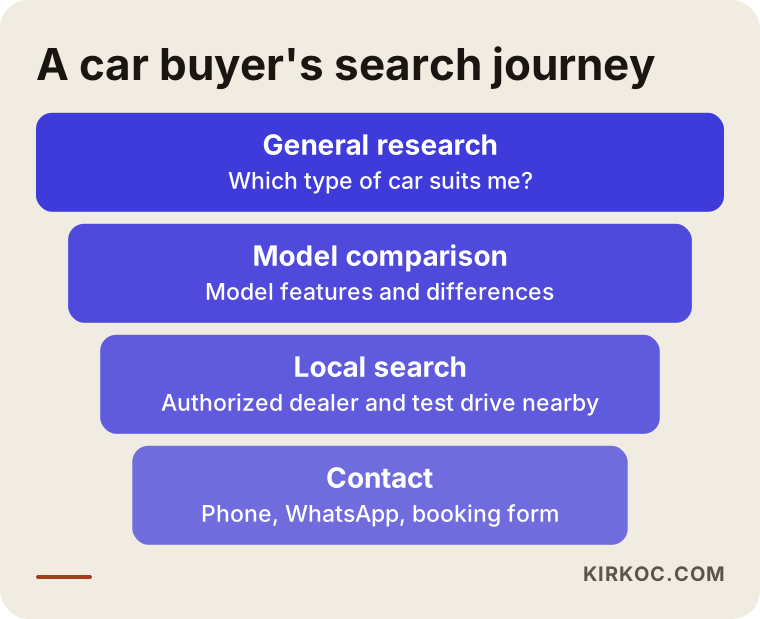
The graphic above summarizes how a buyer moves through the process. At the top, everyone compares brands and models. As you go down, the searches narrow and the intent to buy grows. The part you should put your weight behind is the narrow bottom, because that is where most showroom visitors come from.
What do buyers search, and in what order?
Nobody decides on a car after a single search. In the first stage they ask broad questions such as "best family car," "diesel or gas," or "how much does it cost to charge an electric car." This is the research stage, and its value for you is that people start to recognize your name. In the second stage they focus on a specific model: "model name specs," "model A vs model B." In the third stage they go local: "brand dealer in [city]," "brand showroom near me," "brand test drive." In the fourth stage they get in touch: they call, text, or fill out a form.
Your site does not have to serve every stage equally. It needs to be very strong at stages three and four, and add something distinctly yours at stage two. The rest of this article is about how to do that.
Which pages does a dealership website really need?
Many dealer sites are filled in from a template the manufacturer or a platform vendor supplies, and the remaining pages are left empty. Yet the pages that tell Google and your customer "this is the real local address for this brand" are precisely the ones you add yourself. The table below shows which page answers which kind of search.
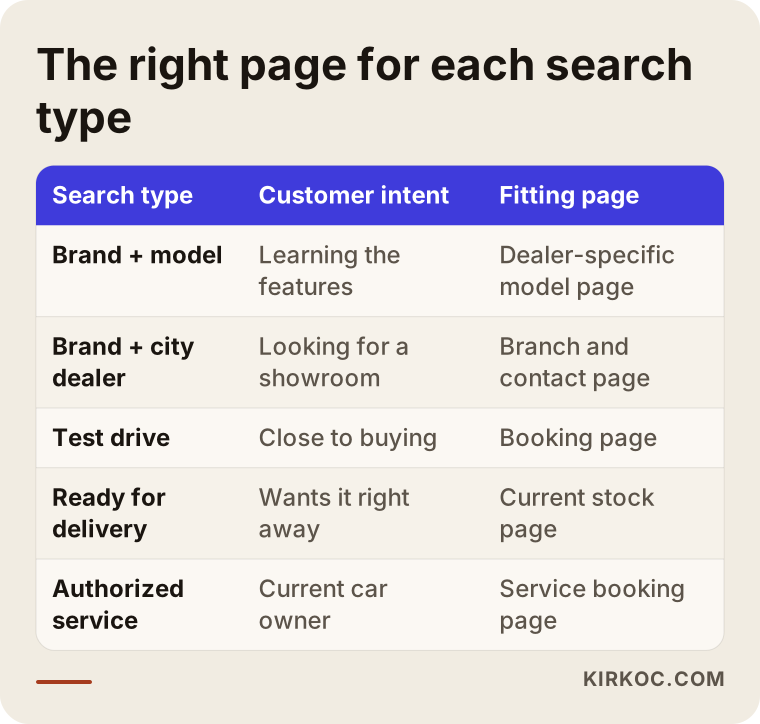
Let me explain the logic in a few sentences. Behind each search is a different need, and each need deserves its own page. If you pile everything onto the home page, Google cannot tell which page to show for which search, and the visitor leaves without finding what they came for.
Model pages: how should they differ from the brand's pages?
You need a page for every model you sell, but do not copy the manufacturer's page. Add a layer that only a local dealer can offer. Taking the spec table from the manufacturer is natural, but if you paste the same text word for word, Google sees content it already knows and has no reason to favor you. Add things like the days you can see this model in your showroom, whether a demo vehicle is ready to drive, the colors and trims you have on the lot, the estimated delivery window, which lenders you work with for financing, and the questions local customers ask most often.
Pricing needs special care. Vehicle prices, incentives, and tax or fee rules change often, and they differ by state. If an outdated price sits on your page and the customer walks in to a different number, you lose trust. So either skip the number and invite people to "call or message for current pricing and offers," or publish prices with a date and update them on a schedule. Advertising rules for vehicle pricing and financing vary by state and by manufacturer, so check your brand's guidelines and, where needed, an attorney or your compliance contact before making firm claims.
The test drive page
For car buying, a test drive is the clearest sign of serious intent. Searches like "brand test drive in [city]" may be few, but each one is valuable. On this page, say which models have demo vehicles, which days and hours you take appointments, what the driver should bring (a valid driver's license, for example), and the easiest way to book. Keep the form short: name, phone, model, preferred day. Long forms make people give up.
The inventory and ready-to-deliver page
Someone who wants a car now compares many dealers. Your inventory page should show model, color, trim, and approximate delivery at a glance. The critical point is freshness: if a sold vehicle stays on the page, the visitor calls, gets disappointed, and remembers it. If your stock changes too fast to manage by hand, a short, manually updated section such as "ready to drive this week" is healthier than a full list that goes stale. If your inventory already feeds out from a dealer management system, ask your platform vendor how those listings appear on your own site, not only on third-party sites.
Service and parts pages
Remember that a dealership does not only sell. It also services cars, and "brand authorized service in [city]" is searched by a lot of people who may buy their next car from you. A separate page for service appointments, scheduled maintenance, and warranty coverage helps service revenue and raises the overall trust of your site.
Local visibility: map results and your Google Business Profile
A large share of dealer searches happen on the map. When someone types "brand dealer near me," Google shows a handful of businesses on a map, and most people look at those first. That area is run by your Google Business Profile, which is the free listing card Google keeps for your business.
A common dealer mistake is to merge the sales showroom and the service department into one profile, or to have no profile at all. If sales and service are separate departments or locations, set them up with the right categories and the right hours for each. Your phone number, address, and hours must match your website exactly. Even small mismatches weaken Google's confidence in you.
Reviews are among the biggest factors in this area. You can ask a happy buyer for a review with a short message a few days after delivery. Replying to reviews, positive and negative, is a trust signal for the next shopper who reads them. Paying for fake reviews, or promising customers a gift in exchange for a review, breaks the platform's rules and can backfire badly, so stay away from both.
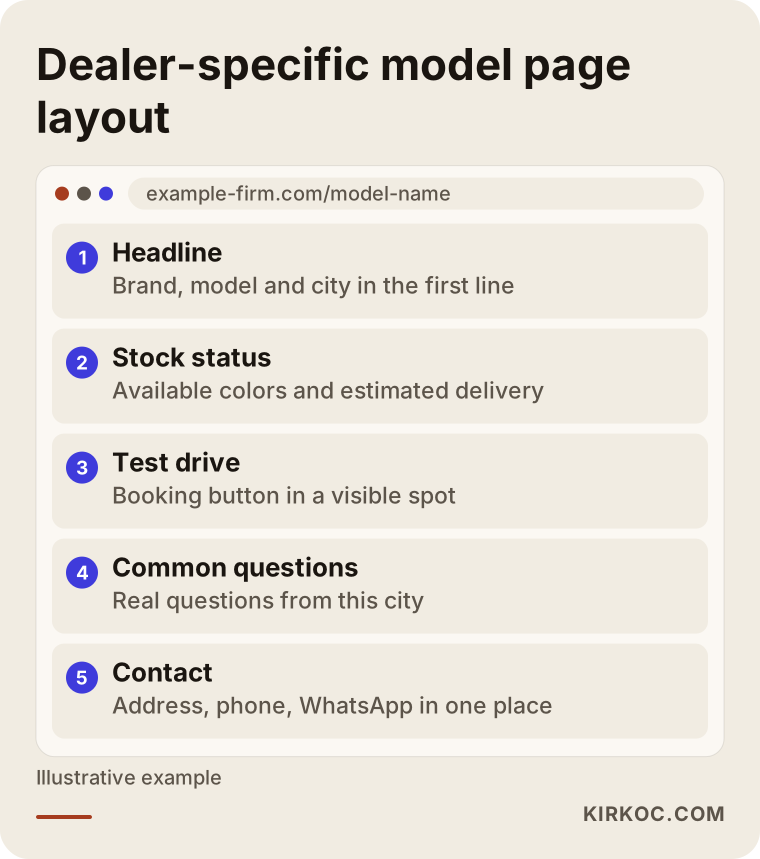
The graphic above suggests how a model page or a location page can be arranged. Placing local details near the top and making them easy to find is the clearest way to tell both Google and the customer where you are.
Two hypothetical example scenarios
The scenarios below are entirely hypothetical. They do not describe a real dealership or a real client; they are built only to show the logic.
Scenario 1: A single-location dealer in a mid-sized city
Suppose a dealer is the only authorized seller of a brand in a mid-sized city. Its website was built from a template and contains only a home page, a contact page, and a model list. On Google, sales and service share one profile card, and the opening hours are out of date. For this dealer, the first step is to fix the profile and define sales and service correctly. The second step is to write a dealer-specific page for each model, adding demo vehicle status, color availability, delivery information, and questions specific to the town. The third step is to build separate test drive and service booking pages.
The realistic expectation for this dealer is better visibility on searches that include the city and the brand, and in map results. Overtaking the manufacturer on broad price searches is not the goal. The difference can also be measured: test drive requests arriving by phone, text, and form are tracked over the first three months, and you can see which page produces requests.
Scenario 2: A dealer group selling two brands in a big metro area
In the second hypothetical, a dealer group in a large metro area sells two different brands. There is a separate showroom for each brand, a shared service center, and a single website. The problem here is confusion: the two brands are mixed on the same pages, and Google cannot tell which content belongs to which brand. The fix is to give each brand its own section and its own business profile, and to open a separate page for the shared service center. If the group has several locations, each one gets its own page for neighborhood- or suburb-level searches.
There is also a risk to watch in this scenario: the same text repeated on both brands' pages. Each brand needs its own content that answers the questions of the person likely to buy that brand.
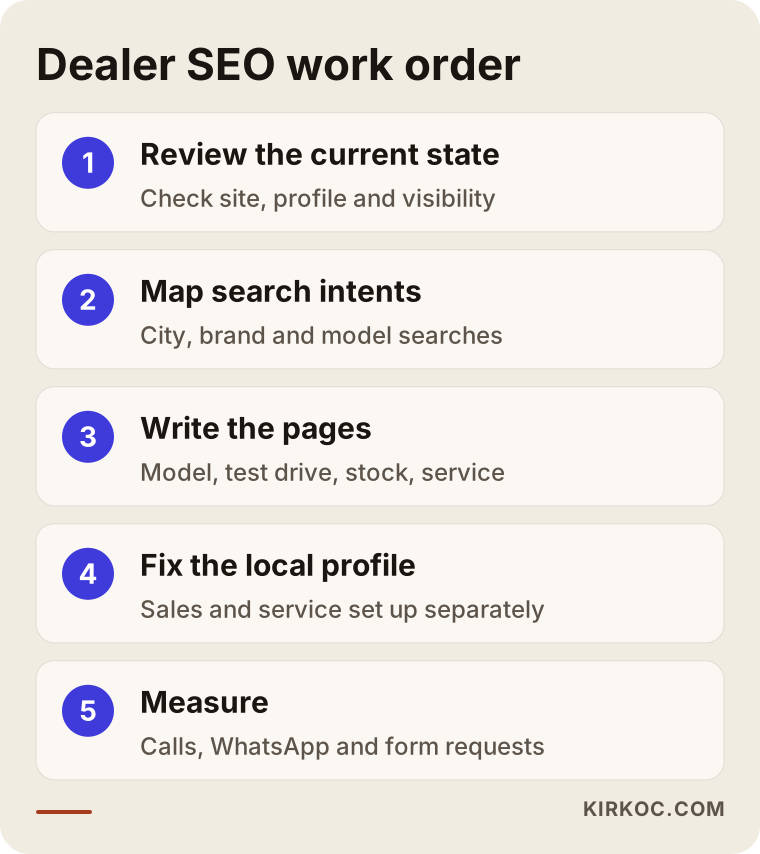
In both scenarios the order of work is similar: basic fixes first, then pages, then local visibility, and measurement last. The graphic summarizes that order, and below I describe each step in a bit more detail.
The process, step by step
1. Reviewing where you stand
I start by looking at your site and business profile as they are today. Which searches do you appear in? Which pages get no visits at all? Are your phone number and address identical everywhere? Does the site open quickly on a phone? Most car buyers search from their phones, so mobile experience is not a side detail for a dealer; it is the main subject.
2. Mapping search intent
Next I work out what people in your area actually search for, for your brand and your models. The aim is not to chase every popular keyword. It is to pick the searches you can truly answer and that sit close to a purchase. Groups like "brand + city dealer," "model + test drive," and "brand + authorized service" usually come first.
3. Building and writing the pages
The next stage is the pages themselves. Model, test drive, inventory, service, and location pages are each written to answer one intent. The text is in your customer's language, and any technical term is explained in a sentence. Most manufacturers have brand standards covering logo placement, image use, and tone, and many require that dealer-written content be approved by a field representative. Learn that process at the start, and it will save you a lot of rework later.
4. Strengthening local signals
I tidy up your Google Business Profile and set up a simple routine for collecting reviews. Making sure your address and phone number are consistent on local directories and community sites also belongs to this step.
5. Measuring and adjusting
Finally, phone calls, text-message clicks, and form submissions are tracked. Without seeing how many requests each page brings, there is no honest way to say whether SEO is working. Generally the effect of basic fixes can start to show in the first weeks, and the effect of new pages in a few months. But I do not guarantee any ranking or result, and that honesty is part of how the work should be done.
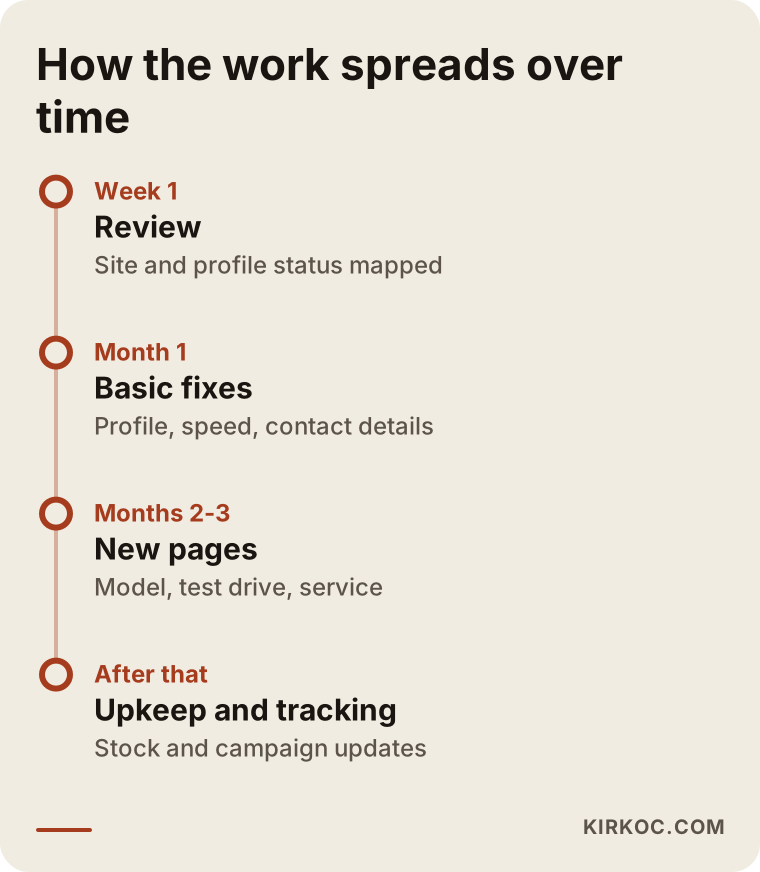
The calendar above shows how the work spreads over time. Dealer sales also have seasons: incentive periods, months when interest rises, and model-year changeovers all shape when pages need to be ready.
Common mistakes on dealership websites
The mistakes below are the ones I see most in this field. Most are easy to fix, but because nobody notices them, they run on for months.
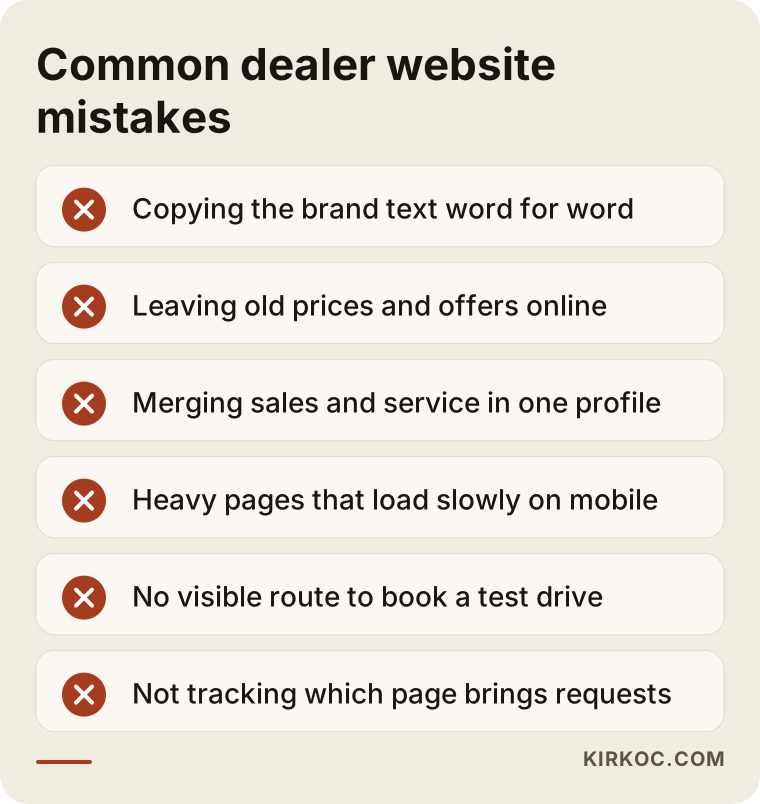
Let me go through the list one by one. Copying the manufacturer's model text word for word is the most widespread; Google treats it as a copy of content it already knows and does not push you forward. Out-of-date prices and offers damage a customer's trust on the very first phone call. Squeezing sales and service into one business profile weakens both in map results. A site that opens slowly on mobile, packed with oversized photos, makes a phone visitor close the page. Having no visible path to a test drive means missing your most valuable request. And finally, not measuring: a dealer who does not know how many calls come from the website cannot know which page deserves investment.
There is also a common misunderstanding: "The brand already advertises, so we do not need SEO." Brand advertising brings a person to the brand, but which dealer that person visits is often decided by a local search. If you are not on your site at that moment, the shopper going to a competing dealer becomes almost inevitable.
What can you do yourself, and when do you need a specialist?
You do not have to outsource everything. The tasks below can be done by you or your team, and they genuinely make a difference.
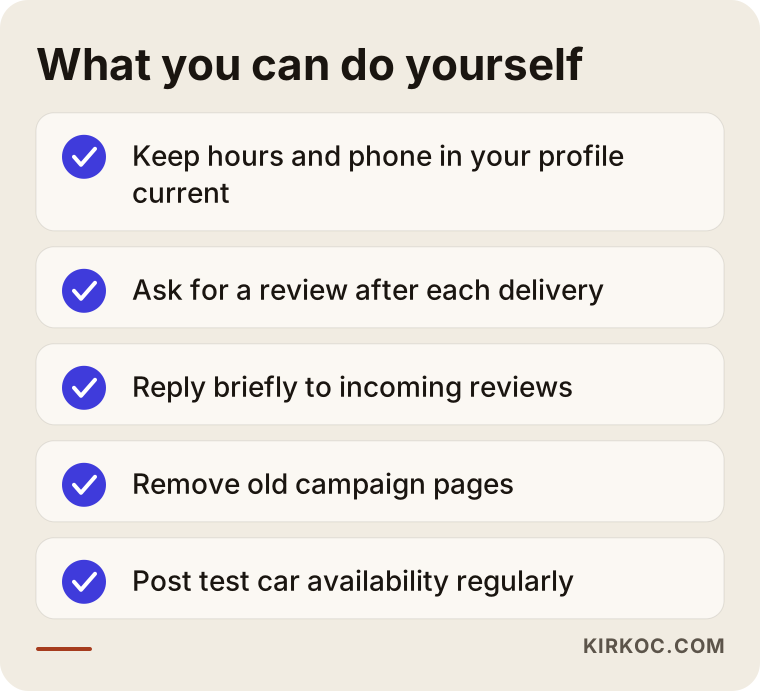
None of the items on this list needs technical knowledge. Keeping hours and phone number current in your profile, replying to reviews, asking every delivered customer for a review, removing old campaigns from your site, and posting demo vehicle availability regularly are all within your control. Where you usually need a specialist is the technical structure of the site, page speed, multi-brand and multi-location setups, mapping search intent, and setting up measurement.
To decide, ask yourself one question: does every model on your site have a dealer-specific page today, and can you measure the requests those pages produce?
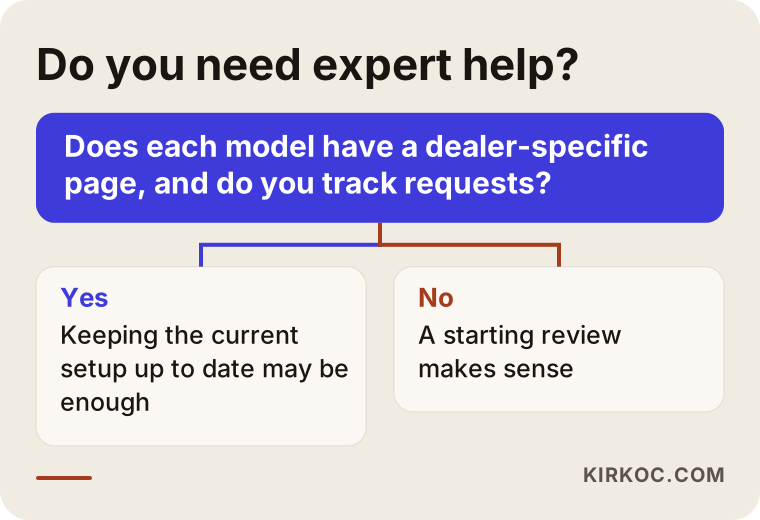
The chart simplifies the decision. If the answer to both questions is yes, keeping your current setup up to date may be all you need. If the answer is no, a starting review with a specialist makes sense.
What determines the cost
I will not give numbers in this article, because the cost of SEO changes a great deal with the scope of the work and no single figure fits everyone. But I can say clearly what it depends on.
The first factor is how many brands and how many locations are involved. A single-brand, single-location dealer and a two-brand group with several sites are very different workloads. The second factor is the current state of your site: will it be built from scratch, or will an existing site be fixed? The third is the number of pages and the amount of content; writing separate pages for each model and each location takes more effort. The fourth is the manufacturer's approval process; if every piece of content must go through approval, the schedule stretches. The fifth is whether the work is a one-time project or a monthly, ongoing arrangement; inventory and incentive pages need constant updating.
When you collect quotes, also ask: what will be done for me, when, and how will I see the result? Stay away from any proposal that offers no clear task list or that says "we will get you to the top," because nobody can guarantee a Google ranking.
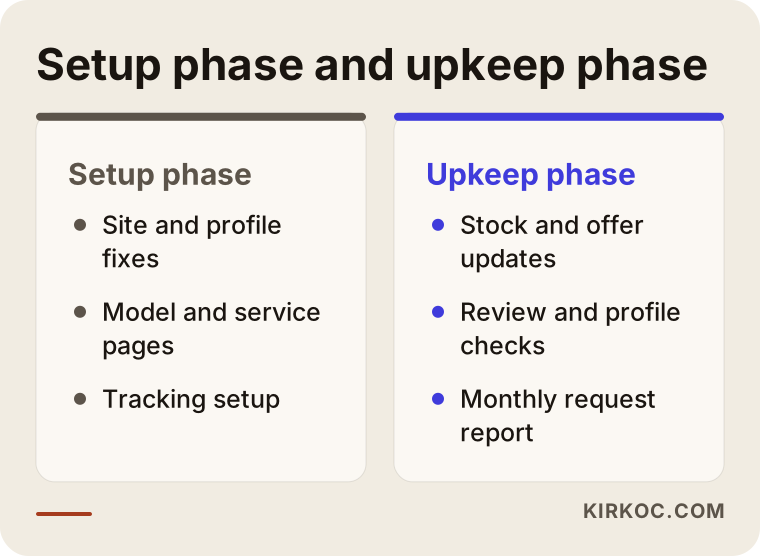
The graphic summarizes the difference between one-time setup and ongoing upkeep. Usually a setup period comes first, followed by a lighter maintenance period.
How working with me goes
I am not an agency; I work alone, and I handle the jobs an agency would hand out to several departments. For a dealer, that has a practical benefit. I build or fix your website, do the SEO, set up your business profile, manage Google and Meta ads for test drive campaigns when needed, and keep your social media posts consistent with the pages on your site. Because it is all one person, the offer described on a page, the wording of the ad, and the social post match each other. You do not have to explain the same thing to three different people and then fix the inconsistencies between them.
The process usually goes like this. I start with a first call, where we talk about your brand, your locations, the models you most want to sell, and the manufacturer's digital rules. Then I review where things stand and share in writing what will be done, in what order, and within what scope. After your approval I get started, and at regular intervals I show you in plain language what was done and which requests came in.
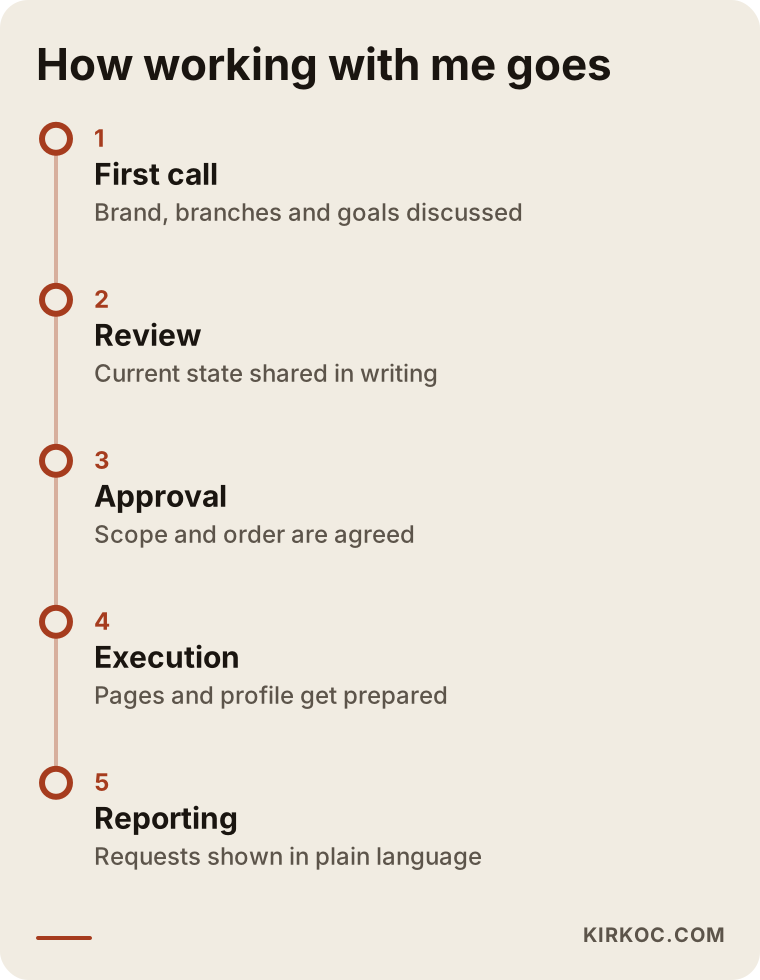
This timeline shows the flow from the first call to regular reporting. I do not promise quick results, but at every step you can see what I am doing.
Frequently asked questions
The manufacturer already has a corporate site. Does a dealer site still need SEO?
Yes, because the two sites answer different questions. The corporate site explains the brand and its models. Your site explains the showroom in your town, the demo vehicle, the stock situation, and the service appointment. Since the information a customer needs for local searches is with you, a properly built dealer site can show up for those searches.
Should I publish model prices on the site?
Prices, incentives, and fees change often, so this is a risky area. If you can keep them current, publish them with a date. If you cannot, "call or message us for current pricing and offers" is safer. For firm statements about taxes, fees, and financing, follow your manufacturer's guidelines and, if needed, ask an attorney or your compliance contact.
How long does SEO take to show results?
There is no fixed time. The effect of a business profile and basic site fixes can appear earlier, while the effect of new pages usually becomes clear within a few months. The level of competition, the current state of your site, and the number of same-brand dealers in your area all change the timeline. That is why you should be cautious about any proposal that guarantees a ranking or a deadline.
Can I write site content without the manufacturer's approval?
That depends on your dealer agreement. Many brands set rules for logos, images, and tone. Before you start, ask your field representative for the digital communication guidelines, and plan to submit new pages for approval. For firm questions about the contract, it is right to consult an attorney.
Which is better, ads or SEO?
They do different jobs. Ads are fast and useful during incentive periods, but visibility ends when you stop paying. SEO starts slower but builds something lasting. For most dealers it makes sense to run both together: ads during campaign periods, SEO as the steady base. If your budget is limited, fixing the business profile and the test drive page first is the lower-cost way to begin.
What changes if we also sell used cars?
Used cars are a separate search world. Every vehicle is unique, listings change very fast, and competition from the large listing sites is tough. It is healthier to keep the structure you built for new vehicles intact and add a separate section, with its own update routine, for used inventory.
Does social media help SEO?
I will not promise that it directly raises your rankings, but it helps indirectly. Delivery photos, showroom videos, and test drive posts increase trust in your brand, and people begin to search for you by name. Posting in step with the pages on your site strengthens both sides.
Is there a difference for dealers who sell electric vehicles?
Electric vehicle buyers ask different questions: charging options, range, charging station information, and maintenance differences. Writing pages that answer these questions informs the customer and also reaches people who search on these topics. For technical data, always rely on the manufacturer's current information.
If you want your dealership to appear in your town's searches with the right pages, you can reach me through my SEO services page. Let's talk through your showroom, your brand, and your goals, and I will tell you plainly what is realistic for you.