Your plant is running, your machines are busy, and you have served the same customers for years. But when it comes to finding a new buyer, the work still depends on trade shows, referrals and an old contact list. Meanwhile, a purchasing manager who has never heard of you is typing the part or service they need into Google, and the page that comes up belongs to a competitor or a middleman. A corporate website for a manufacturing company exists to close exactly that gap. In this article I explain why a manufacturer's site should not be a simple "brochure," which pages do real work, and how the process runs. I am Ümit Kırkoç, I work from Istanbul, and I handle website design together with the other digital work, all by myself.
One thing before we start: this is not a pitch for a ready-made template. Industrial buyers think differently, search differently and ask different questions than shoppers do. Your site should be built around those differences. Every section below comes from the real needs of a factory or a workshop.
Why an industrial site is not a retail site
On a clothing store's website, a visitor looks at a product, adds it to a cart and pays. In manufacturing the chain is much longer. The person on the other side rarely decides alone. An engineer studies the technical specification, the purchasing department wants price and lead time, and a manager checks whether your company looks reliable. Three people, three different questions, and your site has to answer all of them.
There is also this: an industrial buyer usually does not call you first. They research quietly. They check whether you really manufacture, what your capacity is, which certifications you hold and who your references are. If your site cannot answer "is this company serious?" within a few minutes, they move to the next result. You will never even know that visit happened.
The illustration below puts the three roles side by side.
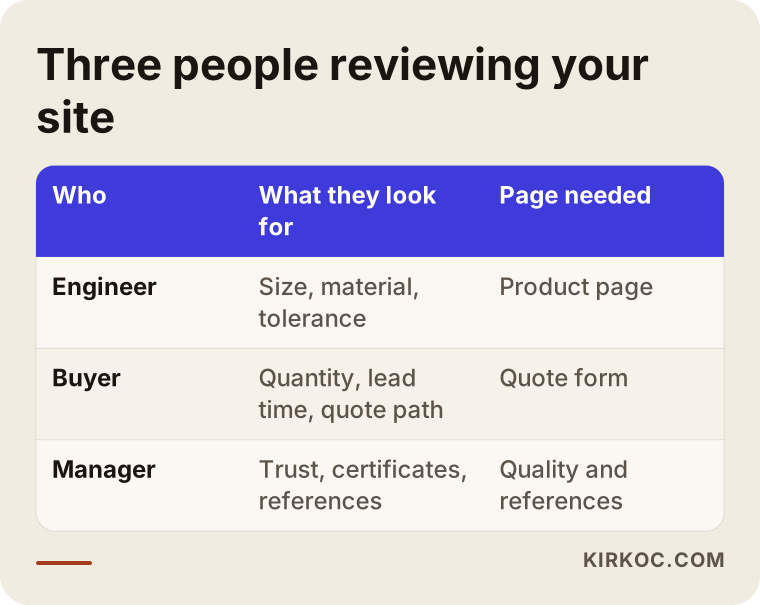
As the illustration shows, one homepage paragraph cannot persuade all three. The engineer needs a technical page, the buyer needs an easy way to request a quote, and the manager needs company and reference information. Your site has to keep all three paths open.
A brochure site versus a sales site
Many manufacturers have a site that was built once, years ago: founding year, a mission statement and a few photos of the building. A site like that says the company exists, but it does not bring in new customers. A site that sells answers different questions. What do you make? From which material, in what sizes, in what quantities? Which industries do you work for? How does lead time work? What quality certificates do you hold? What do I need to send to get a quote?
If those answers are not on the site, the buyer has to phone you to get them. Plenty of people will not phone. They will go to a competitor's site that already answers the question.
How do industrial buyers search on Google?
In retail, people mostly type a product name. In manufacturing, search habits are more varied, and knowing them decides which pages you write. In general you will see four patterns.
The first is product and material search: "stainless steel sheet fabrication," "injection mold manufacturing," "industrial packaging supplier." The buyer knows what they want and only needs to find who makes it. The second is process and capability search: "CNC turning contract manufacturing," "powder coating services." Here the buyer already has their own design and is looking for a production partner. The third is search combined with a place: "contract manufacturing near Detroit," "metal fabrication Ohio." The name of an industrial region often matters more than the city, because shipping and the ability to visit a supplier are part of the decision. The fourth is solution search: "stainless equipment for food processing," where the buyer names their own industry.
Then there is export. A buyer abroad who wants to find a supplier in a particular country searches in English with phrases like "steel fabrication manufacturer in Turkey." If your site exists in only one language, that door is closed from the start.
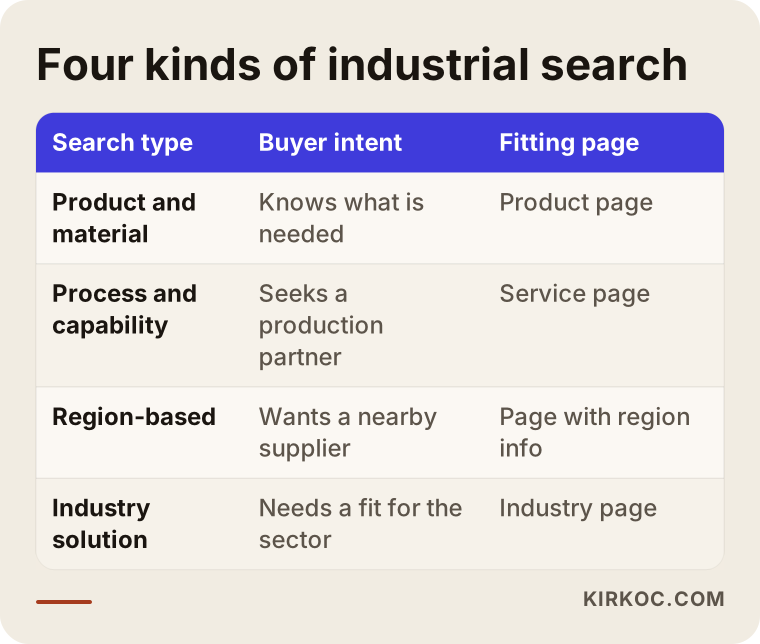
The illustration has a practical consequence: each kind of search needs its own page. If you squeeze everything into a single page called "Our Products," Google cannot tell what that page is really about, and the buyer cannot find what they came for.
Telling search intent apart
Not every search comes from someone ready to buy. A person typing "what is CNC turning" wants to learn. A person typing "CNC turning contract manufacturing quote" wants to give out a job. The first person needs an informative article; the second needs a clear service page and a quote form. Your site has room for both, but the second one brings revenue, so it makes sense to build it first.
Pages an industrial site should have
The number of pages matters less than the job each page does. For a manufacturer, the core structure usually looks like this.
Homepage: It should say what you make, who you make it for and what the next step is, all on the first screen. A beautiful aerial photo of the plant is not enough. Next to it there should be a plain sentence such as "stainless sheet metal processing and welded fabrication."
Product or service pages: Each main product group gets its own page. On each one you list material options, the size range, minimum and maximum quantities, the machines used, what the lead time depends on, and relevant photos.
Industry pages: If you sell the same product to automotive, food and construction customers, each industry has different needs. An industry page tells that buyer, "I know your field."
Production and capacity page: The machine park, shift pattern, monthly capacity and similar facts belong here. You do not have to publish exact numbers, but the buyer should get a sense of your scale.
Quality and certificates: ISO certifications, testing and inspection methods, and your traceability practice. Rather than only uploading the certificate, write which standard you hold and for what scope.
References: Logos of customers who gave permission, or project examples by industry. If you have no permission, you can still describe the work without names, for instance "series production for automotive suppliers."
Quote request page: This is the most critical page, and I cover it in the next section.
Contact and directions: Address, map, phone, working hours and how to book a visit.
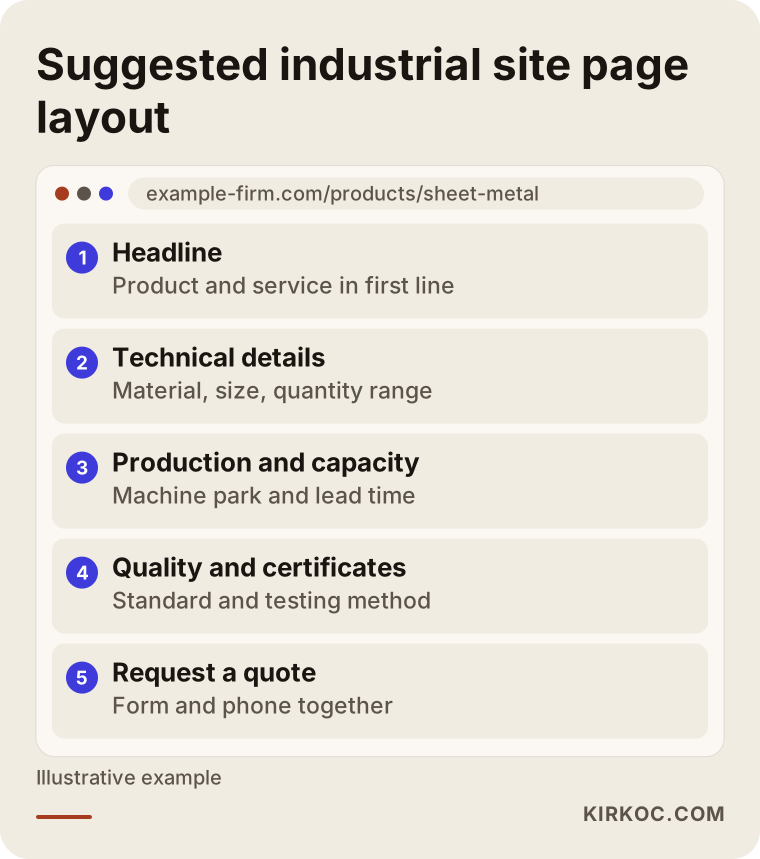
This layout is a starting skeleton. If your company has three product groups, three product pages are enough. If you serve two main industries, two industry pages will do. You do not need to write everything at once; start with the pages that will earn money.
The quote form: the heart of an industrial site
Manufacturing has no "buy now" button. Instead, the buyer asks for a quote. If your quote form is badly built, good visitors are wasted. Avoid two mistakes. If the form is too short (only a name and a phone number), you get a flood of requests with missing details and have to call every one of them back. If the form is too long, the buyer gives up.
A balanced form asks for: company name, contact name, phone and email, type of product or service, estimated quantity, desired delivery date and a field to upload a technical drawing or specification. File upload is especially useful in manufacturing, because most quotes depend on a drawing. Adding a reassurance line under the form, such as "Your files are used only for this quote," and showing a phone number, calms a hesitant buyer. If you want to make a written confidentiality commitment about the files, have a lawyer review the wording.
The form also has to work well on a phone. An engineer out on the shop floor or a manager between meetings often takes the first look on a mobile device.
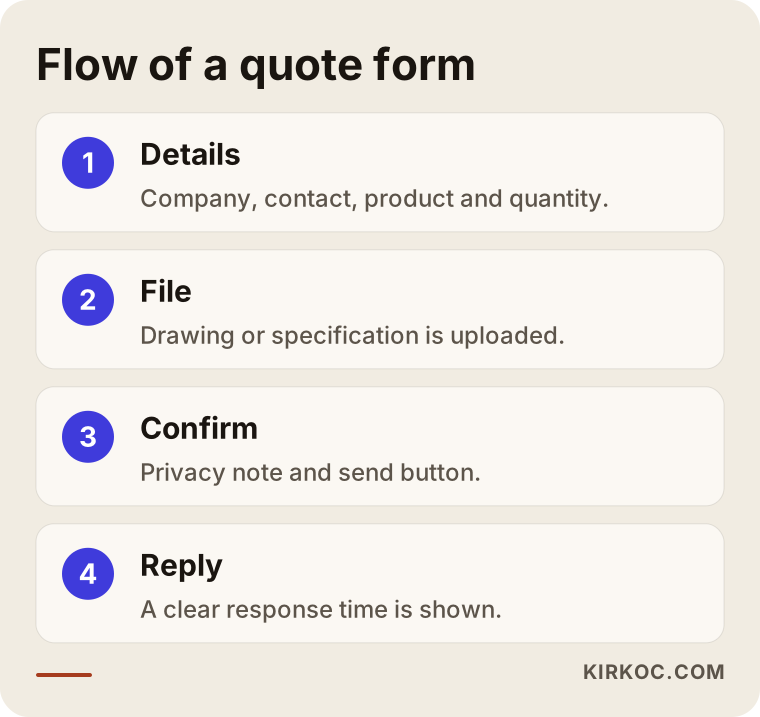
It also matters to show the person who submits the form a clear message, such as "We received your request and will reply within one business day." Promise a time you can keep. Promising one you cannot keep is worse than having no form at all.
Two hypothetical example scenarios
The two examples below are entirely made up and do not describe any real company. Their purpose is to show what you can expect from a site in different situations.
Example scenario 1: A mid-sized contract fabrication shop
Imagine a shop in an industrial park that cuts, bends and welds sheet metal. Most of its work comes from old customers and referrals. Its website was built seven years ago. The homepage says "quality and reliable service," but not which materials or thicknesses the shop works with. Most of the new requests that come in by phone are small jobs the shop either cannot do or does not want.
In this case, the first task is to rebuild the site around the work the shop actually wants. The thickness range, the machines, the minimum order, the welding types and sample parts get written down. If small prototype runs are not accepted, that is stated plainly too; filtering out the wrong requests is part of a site's job. The result may be fewer requests, but better ones. That is not a ranking or sales guarantee. It simply means the site greets the right person with the right information.
Example scenario 2: A packaging maker moving into export
The second hypothetical company makes packaging for the food industry and has begun to get inquiries from abroad. Some of the buyers are foreign, but the site is in one language only and the product catalog is mostly photographs with almost no technical data. A buyer overseas cannot find the material, the food-contact suitability or the minimum shipment quantity.
Here the priority is a set of separate pages in the buyer's language, written for that audience rather than machine-translated. They answer what an overseas buyer asks: certificates, shipping methods, the sample process. For food-contact products, before you write definite statements about which certificate applies, ask the relevant certification body or a specialist. Every claim on the site has to match reality.
Step by step: how an industrial site gets built
The process starts by understanding the company before touching any software. A site that looks good technically but does not describe what the company actually does costs money and brings no work.
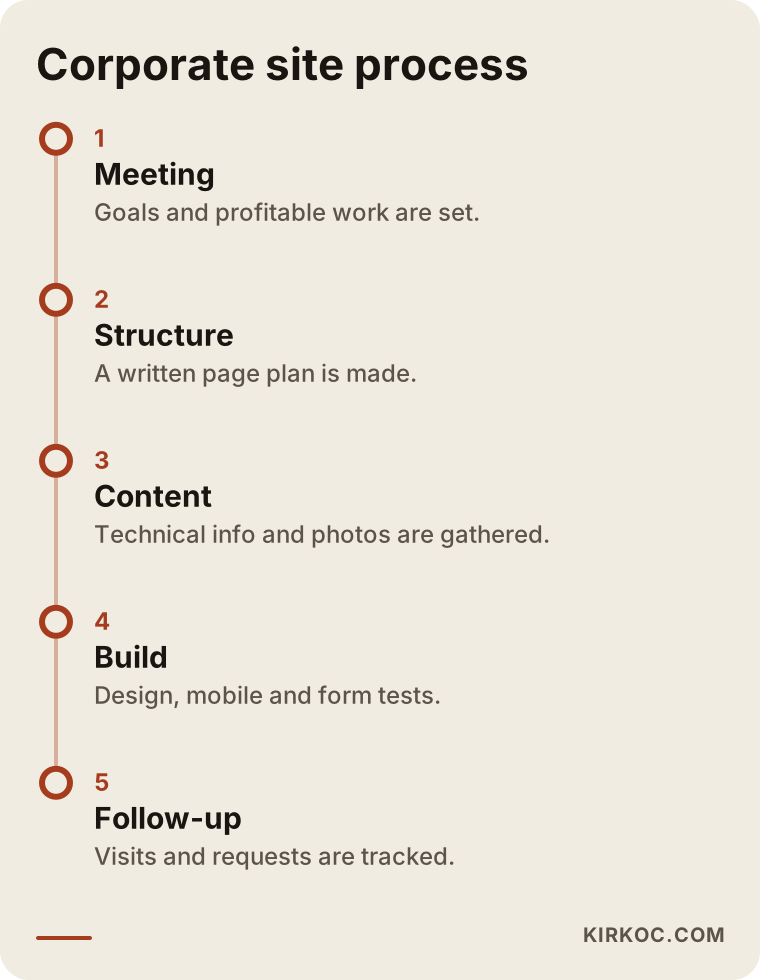
Step one, the meeting and goals. Which products make you money? Which customers do you want more of? What work do you no longer want to do? These questions shape the site. Owners often hand over a product list, but the profitable items need to be named separately, because the site should give priority to the work that pays best.
Step two, the page structure. Together we decide which pages will be written, which search patterns each one answers and how the pages link to one another. Your competitors' sites are reviewed in this stage too. The aim is not to copy them, but to see what a buyer finds there that they would not find with you.
Step three, preparing the content. In manufacturing this takes the most time. The arrangement that works best is that you provide the technical knowledge and I write it in plain, accurate language. Photos are critical here. Pictures of your own machines and products build trust in a way stock images cannot, and well-lit phone photos are often enough.
Step four, development. The site is designed and built, mobile layout and speed are tested, and the quote form is confirmed to work. Industrial buyers sometimes open sites on slow connections or a locked-down factory network, and a site stuffed with heavy images makes them give up.
Step five, launch and follow-up. The work does not end at launch. I watch which pages get visits and which forms get filled in, and fill any gaps. At this stage your Google Business Profile is also set up with the correct address and phone details.
Technical points an industrial site should not miss
A plain-looking industrial site is not necessarily technically simple. A few details quietly decide a lot.
The first is speed. Factory photos are taken at high resolution, and if they are uploaded as they are, a page can take seconds to open. Resizing images helps the site both in Google and with the buyer. The second is mobile layout: if technical tables overflow or become unreadable on a small screen, the engineer in the field leaves. The third is security. If your site has a quote form, an encrypted connection (the padlock in the address bar) reassures the buyer and prevents browsers from showing warnings.
The fourth is how technical documents are handled. You can offer catalogs and data sheets as PDF files, but each product's information should not live only inside a PDF. Write the same information on the page itself, because search engines and AI assistants read page text more easily. The fifth is your domain and email: a supplier who sends quotes from a free webmail address and one who writes from a company domain are seen differently. The gap looks small, but it is real.
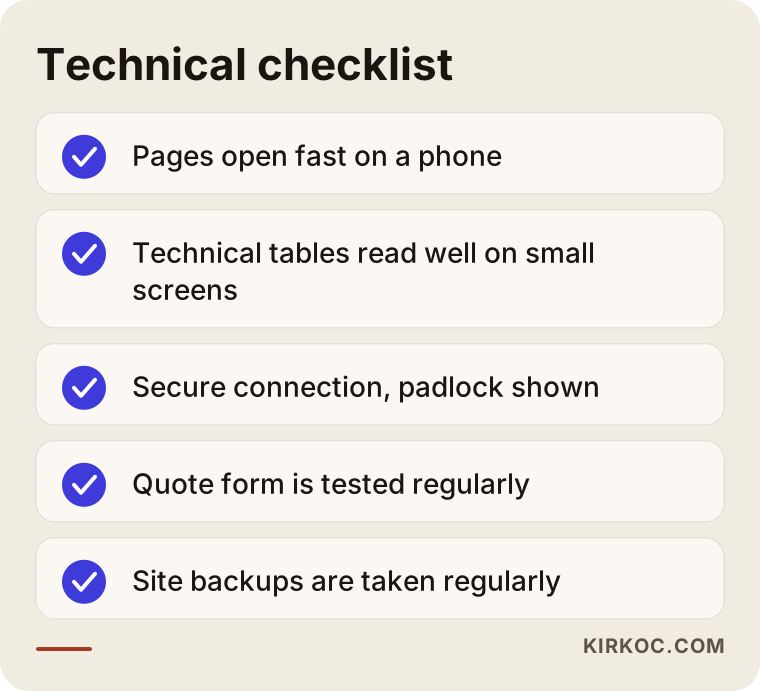
This checklist is useful before launch and years after it. Most sites are fine on opening day. Trouble arrives a year later, when a form stops working or nobody has taken a backup.
Getting your site ready for AI search
Some buyers now ask an AI assistant instead of Google, with questions like "Who is a reliable mold maker near Cleveland?" These assistants build their answers from clear, consistent information found on the web. The work of making your site usable as a source in those answers is called GEO, short for generative engine optimization.
What you need to do is not complicated. Write your company details the same way everywhere, describe your products in plain sentences and answer common questions directly on your pages. No method can guarantee that you will appear in AI answers, but a site that gives vague or contradictory information will certainly fall behind.
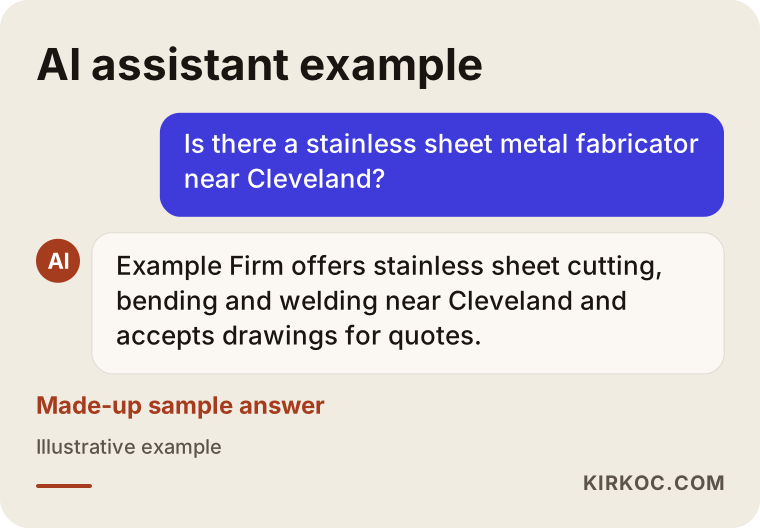
The answer in the image is made up; its purpose is to show what kind of clear information an assistant can use. If your site contains sentences this clear, it is more valuable to human and machine readers alike.
Common mistakes
Manufacturers' sites have been repeating the same mistakes for years. Knowing some of them in advance protects your budget and your time.
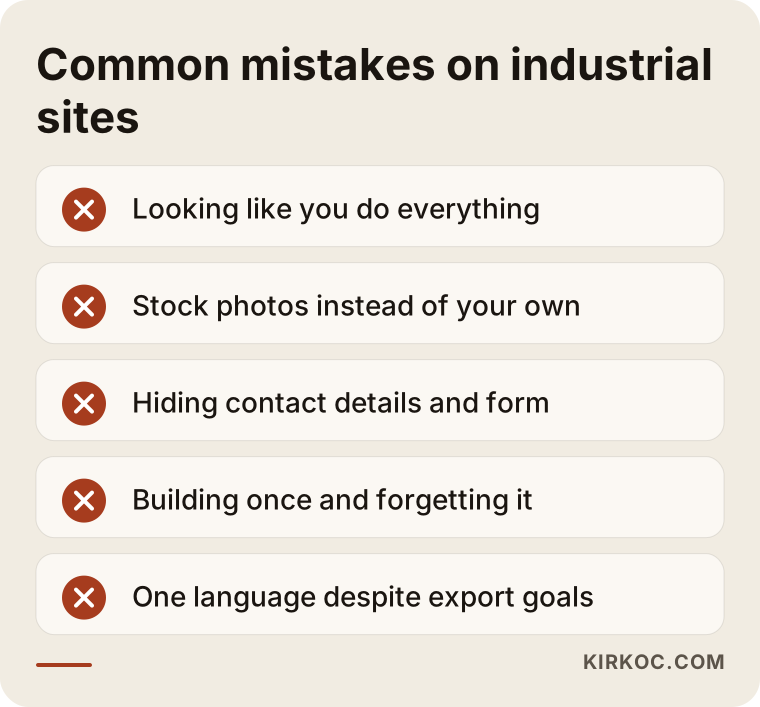
The most common mistake is looking as if you do everything. A site that says "for all your metalworking needs" does not stick in anyone's mind. Saying what you are good at brings fewer but more fitting requests.
The second mistake is using stock images instead of product photos. Buyers recognize a picture they have seen on other sites and start to doubt whether the company really manufactures. The third is hiding contact details: if the phone number sits only on a subpage and the form does not work, an interested buyer leaves before finding you. The fourth is building the site once and forgetting it. When you buy a new machine, earn a new certificate or change your product range and the site is not updated, buyers get wrong information.
The fifth mistake is writing only for search engines. Text that repeats the same keyword over and over bores the reader and does nothing in search results. The sixth is staying in one language when you are aiming at export.
What you can do yourself, and when you need a specialist
There is useful work you can do without a web specialist, and doing it makes the process cheaper and faster.
Start by collecting your product and capacity information in one file: materials, size ranges, the machine list, certificates. Then photograph your products and production line in good light. Ask your customers, with their permission, for short reference sentences. Also check that your Google Business Profile is claimed and accurate. It is free, and consistent address details matter.
You need a specialist for the following: building the structure and design of the site, tuning technical speed and search fit, setting up a multi-language structure correctly, getting the quote form and measurement working, and later doing ongoing search work. In short, the raw material comes from you, and the organizing and getting it ready for publication comes from the specialist.
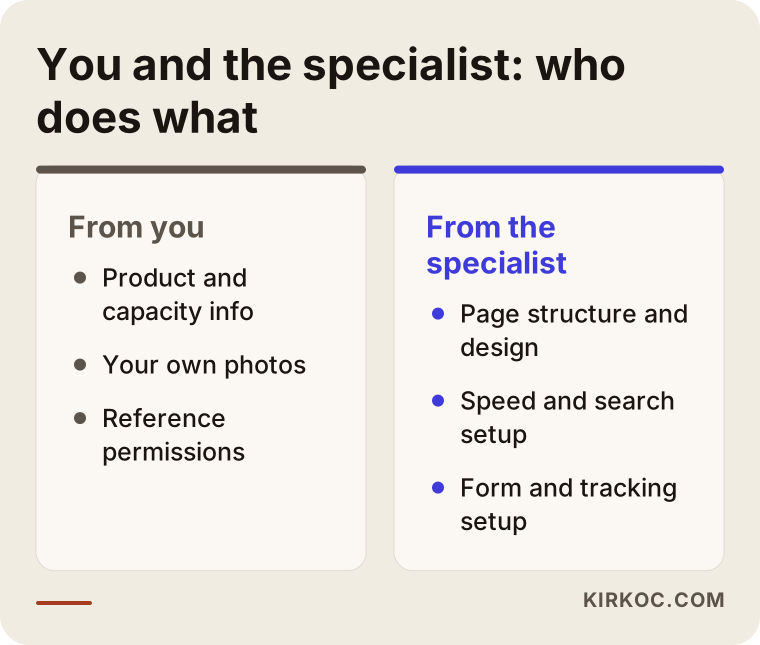
This split lets you know, before you start working with anyone, what sits with you and what sits with them. Tasks left unassigned are usually the ones that run late.
What determines the cost?
I will not give a number in this article, because the cost of an industrial site varies a great deal from company to company, and a single figure that fits everyone is usually misleading. Instead, let me explain what changes the price so you can read the quotes you receive.
The first factor is the number of pages and the volume of content. A company with three product groups is not the same job as one with twenty. The second is the number of languages; every extra language means more than translation, it means content work suited to that language. The third is who supplies the content: whether you prepare the text, or I write it and you approve it, affects the cost. The fourth is visual material: can your existing photos be used, or is a new shoot needed?
The fifth is custom functionality such as a product selector, file upload, a dealer login or a catalog download area. The sixth is support after launch: regular updates, search work, advertising and social media needs. Whether these are included or separate should be clear from the quote.
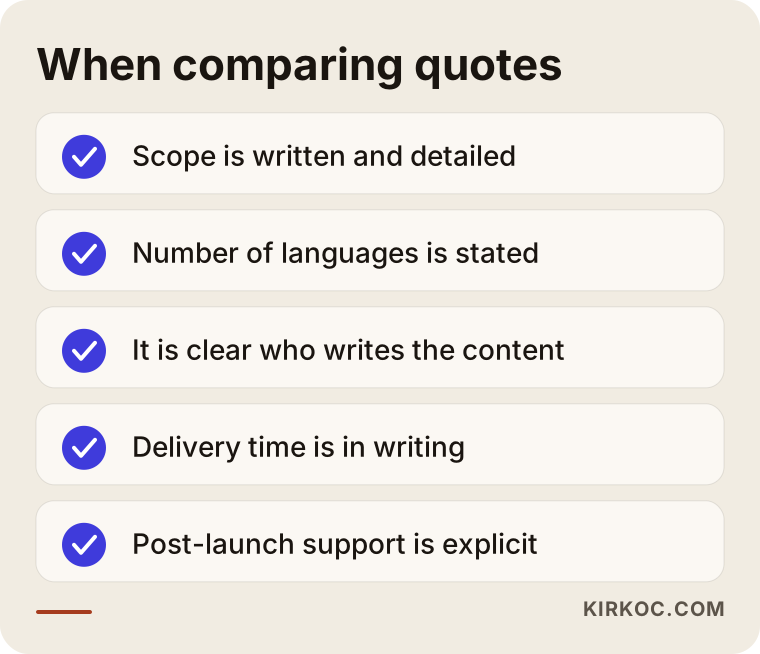
A good quote states in writing what will be done, what will not be done and what is expected from you. A quote with only a total and a vague scope can grow later under the label "this is extra work."
How I work
I am one person, and that is as much a limit as an advantage. The advantage: the person you talk to is the person who does the work, so there is less hand-off and less misunderstanding. The limit is my capacity. I cannot take unlimited projects at once, which is why I settle the scope of every job at the start.
For a manufacturer, the process usually goes like this. I first listen to you describe the company, the products and the buyer you want. Then I present the site structure and page plan in writing. I write the content using the technical information you give me, send it for your approval and publish it. After launch, if you want, I can also run search optimization, your Google Business Profile, visibility on channels such as LinkedIn and, where it makes sense, Google Ads under the same roof. Having it all run through one person removes the risk of different people working without knowing about each other: the product page on your site, the page your ad points to, a post on social media and the title in search results all support one another.
I do not guarantee results or rankings, because Google and buyer behavior are not in my control. What I promise is to do the work within a written scope, in clear language, and to keep you informed.
Frequently Asked Questions
Why does a manufacturing company need a corporate website?
Most buyers research a supplier online before they buy. If you have no site, or an outdated one, your company either does not show up in that research or looks smaller than it really is. A site is an introduction and pre-screening channel that keeps working while you sleep.
Should I build an online store or a corporate site for my factory?
If your products are standard and can be sold at a fixed price, an online store is worth considering. But most industrial work needs a quote based on size, quantity and drawings, and then a corporate site with a quote form is a better fit. It is also possible to build both together.
How many pages are enough?
There is no fixed number. One product page per main product group, one industry page per main industry, and a few basic pages such as capacity, quality, references and contact are usually a solid start. You can always expand later.
Which languages should my site be in?
The languages your buyers use. If you sell only domestically, one language is enough. If you are going after export, you need separate pages in the target market's language; a badly translated text can lose more trust than having no text at all.
How long after launch will requests start coming?
It is impossible to say exactly. It depends on your industry, the competition and how well known the site was before. Existing customers and links you share directly can have an effect right away, while visitors from search engines usually build up over time. Be cautious with anyone who promises a timeline or a result.
Can I take the photos myself?
Yes. Phone photos taken in good light and arranged neatly are often enough, and they are far more convincing than stock images. Shots of the production line, product details and packaging work well. If employees' faces will be visible, remember to get their permission.
Will my customers' information and drawings be safe?
Storing the files uploaded through a quote form securely, limiting who can access them and using an encrypted connection are the basic requirements. For your obligations around personal data, I suggest you consult a lawyer.
Is it hard to update the site after launch?
It should not be. The site should be built so that adding a new product, certificate or reference is easy. Talking about this at the start avoids creating a new job for every small change later.
Your production is solid and your product is good; your site needs to say so just as clearly. If you would like to talk through the page plan and scope that suit your company, you can reach me through my website design service page. In the first conversation I will explain what can be done, what is expected from you and how the process runs.