You run a business in Samsun, or you plan to. Maybe it is a clinic in Atakum, a workshop in Canik, a shop in Ilkadim, or a food and farm-products company in Bafra. Maybe you are a foreign company with a branch, a partner or a supplier on the Black Sea coast. You have a website, but when someone searches for the service you offer in Samsun, your name does not come up. A competitor's does. That is the moment people type "SEO services Samsun" into Google and land in front of a pile of nearly identical promises. In this article I explain what a business in Samsun can realistically expect from SEO, which pages actually help, how the work is organized and what the cost depends on. I am Ümit Kırkoç, I work from Istanbul, and I serve businesses all over Turkey remotely. Where it fits, I will also describe what my own SEO services cover and where they stop.
SEO, in plain words, is the work that makes your website show up when your customers search on Google. It is not an ad, so it does not switch off the day you stop paying. It is also not fast. When it is set up properly, the same pages keep talking to customers for you month after month.
How do people in Samsun search?
Samsun is one of the largest cities on the Black Sea coast. Several districts sit side by side in the center, and towns such as Bafra, Carsamba, Terme, Vezirkopru and Havza run their own local trade around it. That structure shapes search habits. Someone who lives in Atakum types "Atakum dentist." A tradesperson in Canik types "Canik accountant." A person from a surrounding town often writes only "Samsun" and expects a result from the city center.
Then there are the people who come to Samsun from outside: university students and their families, patients traveling for treatment, buyers visiting for a business meeting, and foreign residents who need a service in English. They do not know the districts, so they search wider, with phrases like "office rental Samsun" or "trusted translator in Samsun." That means the same service is searched in at least three different ways, and each way needs its own answer on your site.
The picture below is a made-up example of how a search result for a district-level query might look.
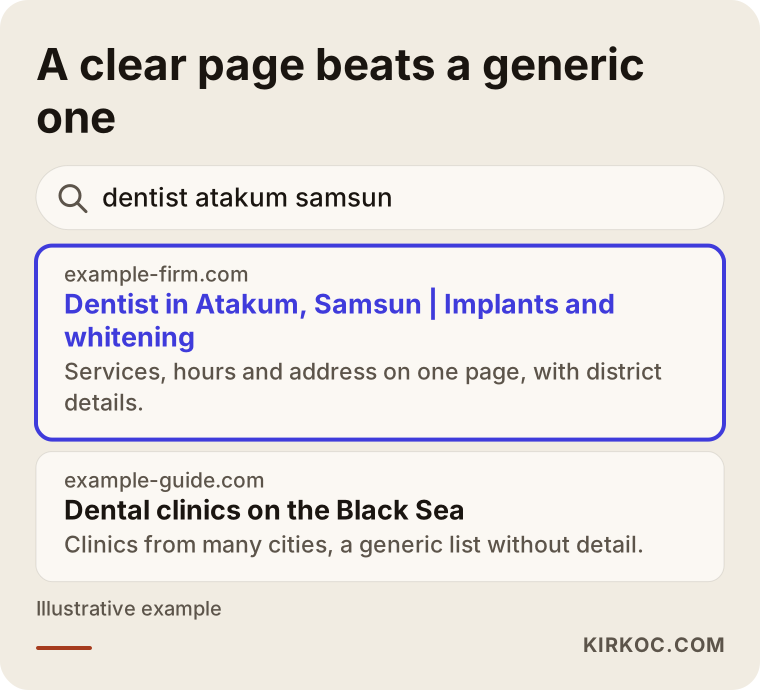
The highlighted result names the district and the service in its very first line. The list underneath it is a vague page about "businesses on the Black Sea." Google wants to give the searcher the clearest possible answer, so if you make that answer easy to find, your chances of showing up higher improve. There is no guarantee in that, but the direction is right.
Three layers of search
It simplifies things to think of Samsun competition in three layers. The first layer is general searches, such as "lawyer Samsun" or "web design Samsun." Sites that have collected content and reviews for years compete here. The second layer is district searches, such as "psychologist Atakum" or "ready-mix concrete Tekkekoy." There is competition, but it is narrower. The third layer is searches with a very clear intent, such as "veterinarian open on weekends in Atakum" or "custom T-shirt printing Canik." The person typing that is often ready to buy, and a small business can become visible there without much trouble.
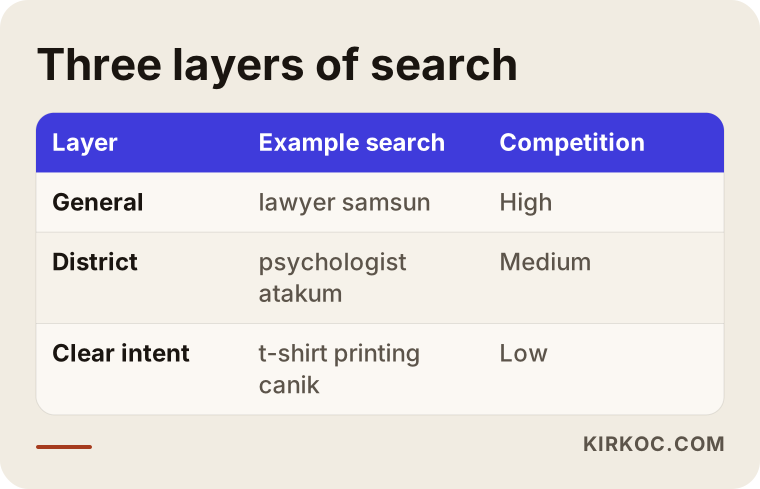
The table above puts the layers side by side. A sound plan usually starts with the second and third layers and moves toward the first as trust and content build up. A plan that does the opposite, chasing the single word "Samsun" from day one, costs more and demands more patience.
What makes SEO in Samsun different?
A generic SEO article tells you to "do keyword research." Let me be more concrete about Samsun.
First, the size of the city. It is not as crowded as Istanbul. For many industries, the number of serious competitors targeting the same search is noticeably smaller than in Istanbul. That is encouraging for a site starting from scratch. It also means that if your competitor's site is genuinely good, you need a clear difference to overtake it. "We are high quality" is not a difference. Which districts you travel to, which hours you are open and which exact jobs you do can be.
Second, map searches. When someone on a phone types "pharmacy near me" or "hairdresser Atakum," they usually see a box with a map first. That box is powered by your Google Business Profile, a free listing that is separate from your website. Good SEO work covers this profile too, and I call that part local SEO. Working only on the website and leaving the profile empty is like tidying the inside of your shop and never hanging a sign outside.
Third, the surrounding economy and the seasons. Around Samsun the economy leans on agriculture, fishing, the port and industry. Searches in those fields rise and fall with the seasons, and the buyer is often another business or a wholesaler, sometimes abroad. A buyer who types "wholesale supplier Samsun" or "Bafra producer" is looking for trust more than a product list: does the company have a real address, a phone number, references?
Fourth, language and spelling habits. Turkish speakers search using local expressions, abbreviations and, very often, without Turkish special characters (they type "Samsun" and "Carsamba" without the accents). If you serve both Turkish and English-speaking customers, your site may need pages in both languages, and each needs to be written naturally rather than machine-translated. Instead of guessing, look at the "related searches" at the bottom of a results page and see what customers really type.
Which pages does a business in Samsun need?
Most sites have a single "Services" page where every service gets two lines. From Google's point of view, that is a page where it is unclear what the company does. From the customer's point of view it is the same: they cannot find the exact thing they came for, so they go back.
A better structure has one page per service and, when it makes sense, a page for each district you serve. Be careful, though. Changing only the district name and copying the same text across pages does not work. A page needs information that truly belongs to that district: how to get there, how long the service takes, the kind of work you do in that area.
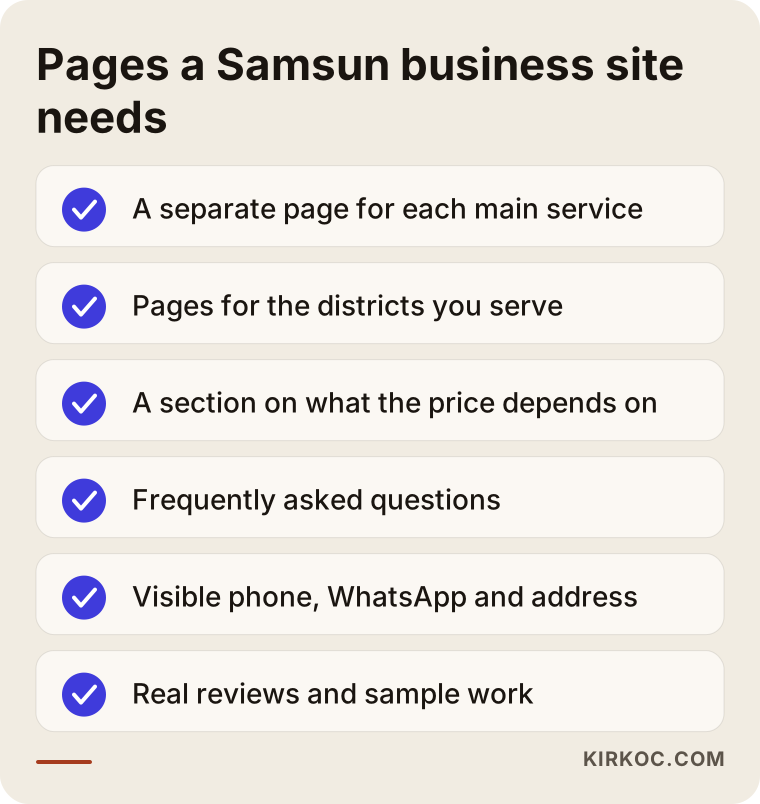
Treat the list as a search for gaps rather than a fixed order. You do not need to finish it all in one day. Starting with your three most important services is usually enough. If you have no site yet, or the current one is very old, building the page structure from the beginning is cheaper than patching it later. That is also where running the website and the SEO through one person pays off: when you design a page, you already know which search it is supposed to answer.
What should a page say?
On a service page, customers want to know the same things: what exactly this service is, who it is for, how it works, how long it takes, what the price depends on and how to reach you. Put these in plain language, visible on the first screen, and both visitors and Google are happier. Replace claims like "industry leader" that no one can check with concrete facts. A photo, a sample job or a customer review (real, and with permission) is worth more than a thousand words of praise.
The comparison below shows the difference between a generic page and a page focused on a district and a service.
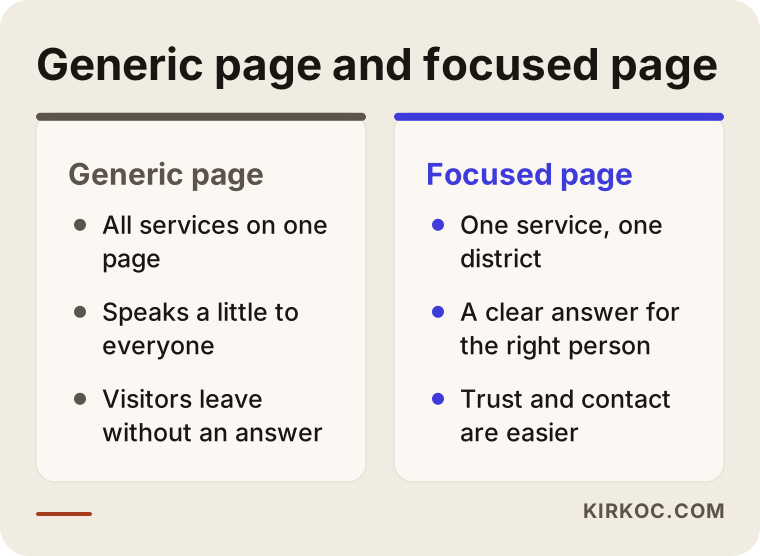
The point is this: a generic page speaks a little to everyone and fully answers no one. A focused page speaks to fewer people, but the right ones. For a small or mid-sized business, the second approach is far more efficient.
Two hypothetical scenarios
The two examples below are entirely hypothetical. They do not describe a real company or person; they are only here to show the logic.
Scenario 1: a small dental clinic in Atakum. The owner notices that the website has only a few pages, such as Home, About and Contact, and that services like "implants" and "teeth whitening" share one page with three lines each. People search for things like "Atakum implant price" or "Samsun emergency dentist," but no page answers those searches. A work plan might look like this. First, separate pages are written for the two services that bring in the most revenue, each explaining the process, common questions and what the price depends on. Then the Google Business Profile is cleaned up, with opening hours and service categories entered correctly. After some months the clinic may start to appear for searches that include the district name. That is an estimate, not a promise.
Scenario 2: a farm-products company in Bafra. The company wants to sell wholesale to nearby provinces and also to buyers abroad. It has a website, but it holds only a few product photos and a phone number. When a wholesale buyer types "Bafra wholesale vegetables" or "Samsun supplier," the company does not appear. Here the weight of the work shifts to product pages, to stating minimum order terms and delivery areas clearly, and to showing the firm's real address and documents. If foreign buyers are part of the plan, the site also needs well-written English pages. A wholesale buyer weighs reliability before price.
What these two cases share is that the work begins not with "more keywords" but with writing a page that answers a question the customer is really asking.
How does an SEO project go, step by step?
You have probably read proposals that describe SEO as a vague "optimization." This is how I run the process. The order matters, because each step builds on the one before it.
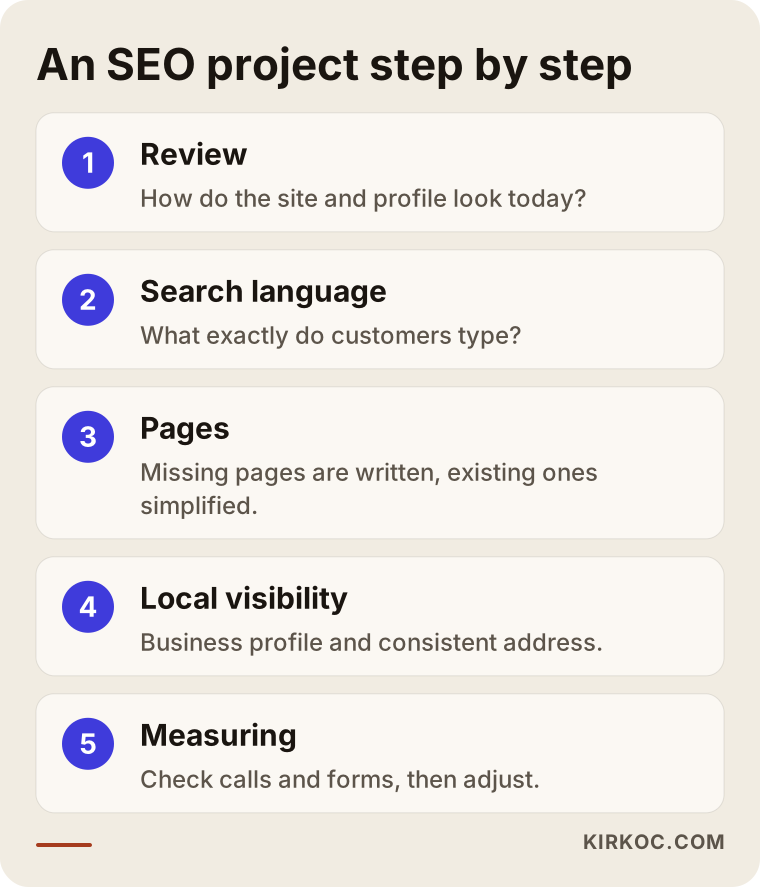
The picture shows the logical flow of the work. Let me go through each step briefly.
Reviewing where you stand. I look at how your site appears on Google, which pages are being picked up and which searches already bring visitors. If your site is new, this step is short. Speed, mobile usability and basic technical problems are checked here too, because a slow page undermines everything you write on it.
Finding your customers' search language. The name you give your service and the name your customer gives it are often different. You may say "mechanical installation revision"; the customer types "boiler replacement Samsun." In this step I look at real searches, competitors' pages and the phrases Google itself suggests.
Building and tidying the pages. Using the page list above, missing pages are written and existing ones are simplified. Titles, descriptions, links between pages and images are handled at this stage.
Setting up local visibility. Your Google Business Profile, a consistent way of writing your address everywhere and a routine for collecting genuine reviews are part of this step. For many local businesses, showing up on the map matters even more than showing up in the website results.
Measuring and correcting. I track how many people came to each page and how many of them called or filled in a form. The numbers to watch are calls and forms, not just visits, because visitors alone do not bring in revenue.
When do results appear?
I have to be honest here: SEO does not deliver in a week. New sites and new pages need time to be found, evaluated and ranked by Google. On narrow, low-competition searches you may see the first signs within a few weeks. On broad searches it takes months. I do not put this on a calendar with fixed dates, because anyone who knows that the timing depends on your industry, your competitors and the current state of your site should not hand you a precise date.
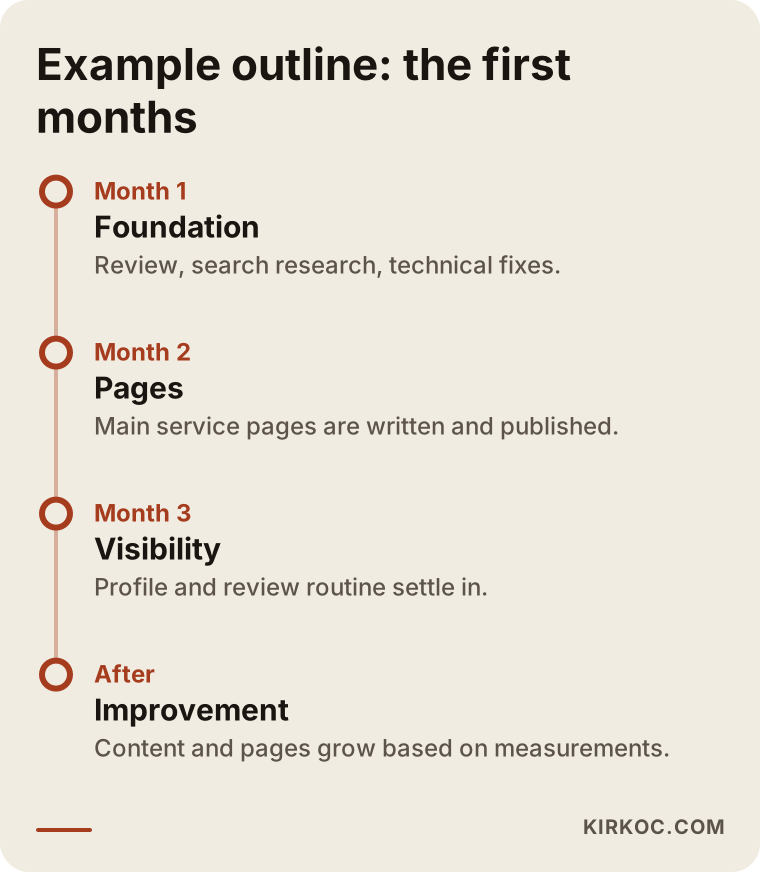
The timeline is an example outline, not a promise. The first period goes to the foundation, the next to content and visibility, and the one after that to measuring and improving.
Common SEO mistakes in Samsun
The mistakes I see are mostly made with good intentions. They still cost money.
The first is scattering the word "Samsun" everywhere. Writing it into the title, the text and every subheading does not influence Google, and it irritates the reader. A city name helps when it appears in a natural sentence and carries real meaning.
The second is multiplying district pages. Taking one text and swapping the district name to produce twenty pages feels like a shortcut. Google is good at spotting near-copies, so those pages usually never show up and do nothing for the site. A few pages with real substance beat many empty ones.
The third is neglecting the Google Business Profile. Some businesses put effort into the site while the information on the map is old: a wrong phone number, closed hours, no photos. The customer calls the wrong number and moves on.
The fourth is forgetting mobile. A large share of local searches happen on a phone, and your own site statistics will show you how many. A site that is hard to read, slow to open or has buttons you cannot tap loses customers no matter how well it is written.
The fifth is not measuring. An SEO project where you do not know how many people called or from which page they filled in a form is like flying blind. Even a basic tracking setup makes decisions much easier.
The sixth is believing guarantees. Someone who says "we will put you on the first page" or "number one in three months" is claiming to control Google, which no one can do. That kind of promise is a warning sign, not a sign of a reliable service.
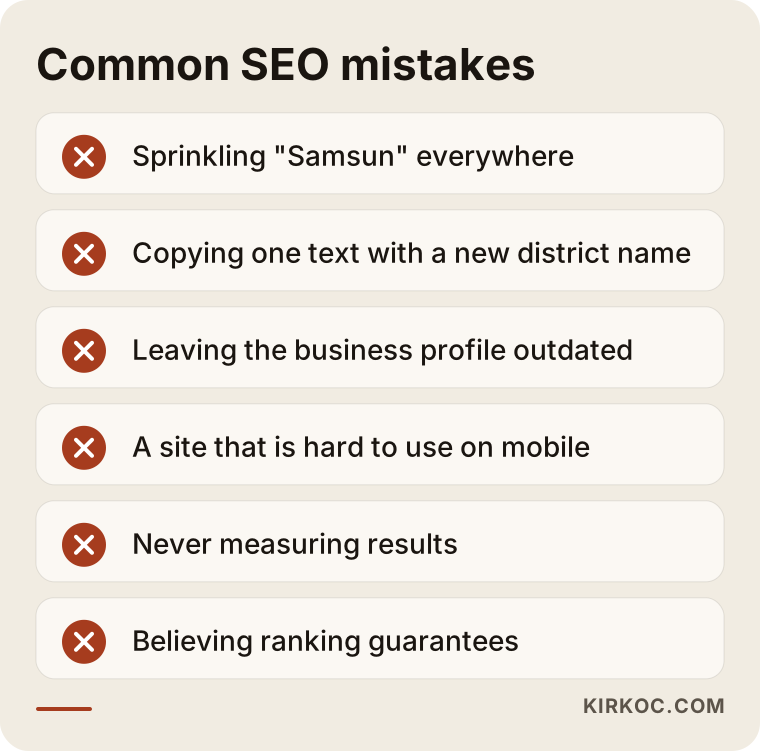
Most of the mistakes in the picture need neither a big budget nor technical knowledge, only care and routine. That makes them a good bridge to what you can do on your own.
What can you do yourself, and when do you need an expert?
You do not have to hand everything to a specialist. Some things you can do yourself, at no cost:
- Open or update your Google Business Profile. Fill in the address, phone, opening hours and services completely.
- When a customer is happy, politely ask them to leave a genuine review. Do not buy reviews and do not invent them.
- Open your website on your phone and browse it like a customer. Can you find what you came for? Do the buttons work?
- Take the five questions customers ask you most often and turn them into a page or an article. This is often the best place to start.
Expert help starts to make sense when your site has a technical problem (slow loading, pages Google cannot crawl, wrong redirects), when a page structure must be built for several services and districts, when competition is heavy, or when you simply do not have the time. There is also the measuring side: reading correctly what works is not the strength of most business owners, and handing that to someone makes sense.
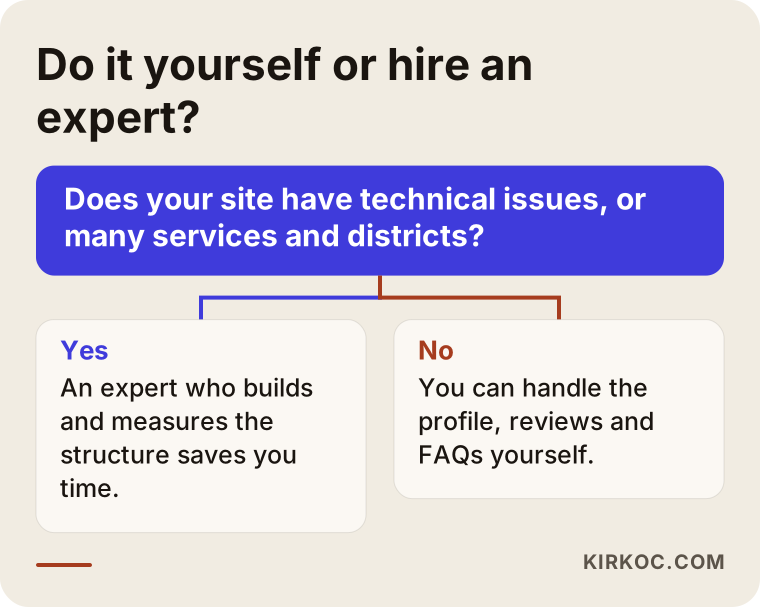
The chart offers a simple split. The small, regular tasks can stay with you, while building the structure and handling the technical side is more efficient with support.
What does SEO cost, and what does the price depend on?
I will not give a figure, because no one can quote a correct number without seeing your site. What I can do is tell you what the price depends on, and that genuinely helps when you compare offers.
The first factor is the current state of your site. Building a site from scratch is a different job from fixing an existing one. The second is the number of services and districts: a structure for three services does not take the same effort as one for thirty. The third is competition. The SEO for a single vet who works weekends is not as intense as the SEO for a general industry with hundreds of rivals. The fourth is the amount and quality of content: who writes the pages, and whether photos or graphics are needed. The fifth is duration. Do you want a one-time setup, or ongoing monthly work? If your pages are needed in more than one language, that adds to the work as well.
When you read an offer, check these points: is it written down what will be done, are the deliverables clear, how will reporting work, and what are the contract length and exit terms? An offer itemized line by line is usually more trustworthy than a vague "everything included."
Turning visitors into customers
Arriving on a page does not mean bringing in business. The visitor lands, reads, trusts you and then gets in touch. At every step of that path some people drop out.
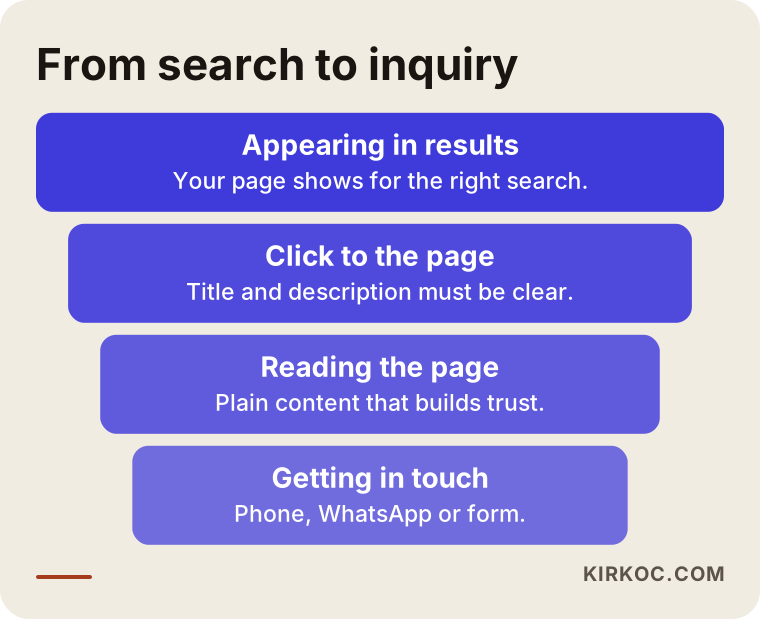
The funnel shows how the numbers narrow. The lesson is that growing only the top, meaning visibility, is not enough. The bottom needs work as well: the page must build trust and make contact easy. Is the phone number visible? Is there a WhatsApp button? Is the form short? Are the address and opening hours clear? These are small details, but they matter.
This is where working through one person becomes concrete. When one person builds the site, another does the SEO and a third runs ads and social media, each of them optimizes their own piece and nobody sees the whole picture. I handle all of it myself: the website, SEO, Google and Meta ads, social media and content. For example, the language I use on a service page can stay consistent in an ad and in an Instagram post, and the page a person lands on from an ad does not contradict what someone sees after a search. That brings coherence without adding work for you.
What does a page look like in practice?
To make it concrete, here is the skeleton of a sample service page. The domain is invented and does not point to a real site.
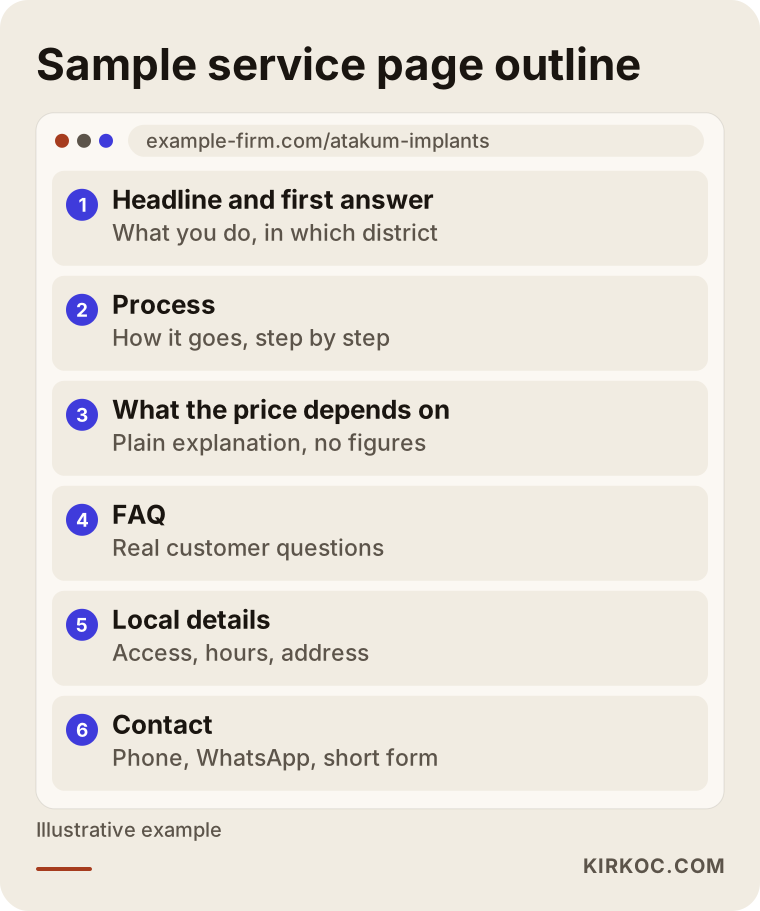
In this layout, the first screen says what you do and who you serve. Below it come the process, frequently asked questions, local information and a contact section. Adapting this skeleton to each of your services makes the site readable for both visitors and Google.
How I work with you
When you contact me about a project, I start by listening: what do you do, who is your customer, where is it stuck right now, and what do you want to achieve? Then I look at your site and your competitors and explain in plain language which steps will actually make a difference. I will not sell you something you do not need. If your site is already solid, for example, I will not suggest a new one; I will only deal with the missing pages and the profile.
As the work moves forward, I share what I am doing and what I am seeing on a regular basis. If I have to use a technical term, I explain it. And because I do everything myself, when you ask a question you get the answer straight from me, not through a middleman. I am not physically in Samsun, but most of this work is done remotely anyway, by phone and video call. When needed, we can go through every step together with file and screen sharing, in English or in Turkish.
Frequently asked questions
Do I need a website before I can get SEO services in Samsun?
Not necessarily, but without a website there is nothing to work on. If you have no site, building a useful one comes before SEO, since you need pages that can appear on Google. Building the site around how people search from the start is usually easier and cheaper than fixing it later. When the same person does both jobs, the two fit together.
How long does SEO take to show results in Samsun?
I cannot give an exact time. On narrow, low-competition searches the first signs may appear within a few weeks, while broad searches can take months. The speed depends on the current state of your site, your competitors and your industry. Be careful with any offer that names an exact date.
Should I target only Samsun, or the surrounding districts too?
It depends on where your customers come from. If your service is delivered only in the center, focusing on the central districts is enough. If you also get customers from surrounding towns, it makes sense to build a genuinely substantial page for each. Instead of repeating the same text, each page must contain information specific to that place.
Is the Google Business Profile part of SEO?
It is a separate system, but it matters a great deal for local visibility. Map results and "near me" searches mostly draw on this profile. For that reason, for local businesses it is healthiest to handle the website and the profile together.
Should I run ads or invest in SEO?
They do different jobs. Ads give you quick visibility, but they end when you stop paying. SEO starts more slowly, but once it is set up it keeps bringing work for a long time. For many businesses it makes sense to think about both in the early period. I can help you decide how much to give each, based on your budget and how soon you want customers.
Do I have to keep writing content for SEO?
It is not required, but regular content that answers real questions makes a difference over time. The core service pages must be solid first, and blog posts do not replace them. One good article a month is worth far more than three careless ones a week.
What if I do not get results?
No SEO project can guarantee results, and I do not either. What I can do is explain clearly what I am doing and why, share the measurements, and notice the parts that do not work so we can change direction. It is also best to settle the contract and exit terms up front.
Do bought reviews or ready-made backlink packages work?
They usually do harm. Purchased reviews and bulk link packages can break Google's rules and damage your credibility. What lasts are genuine reviews from real customers and sites that mention you naturally. If you have a legal question about this, please consult a lawyer.
If you want your business in Samsun to be visible on Google, you can reach me through my SEO services page. Let's talk openly about what needs to be done and what does not.