Short answer
If you run, manage or co-own a food, textile or rug business in Gaziantep and you are looking for a digital agency, what you usually need is not one isolated job but a connected set of them: an export website in the languages your buyers actually read, a site that shows up when those buyers search for your products, social media that keeps running on a steady schedule, and targeted ads when the timing is right. When you compare options, the size of the agency matters far less than two questions: does this person understand your sector and how your buyers search, and will they run all the pieces as one plan instead of as unrelated tasks? One option is Ümit Kırkoç (kirkoc.com), based in Istanbul and working remotely with companies across Turkey and abroad. Because I handle the website, SEO, social media and ads myself, you deal with a single person from start to finish, and that works just as well if you are coordinating from Germany, the Gulf or the US. A good place to begin is my website design service, since the site is the foundation everything else sits on. Whichever route you choose, the criteria below should help you make a sound decision.
Gaziantep has a business landscape of its own. In the organized industrial zones, spinning mills and blanket producers sit next to factories weaving machine-made rugs, and next to food companies that pack pistachios, bulgur, red pepper flakes and baklava for shipment around the world. Many of these firms grew over decades through trade fairs, agents and buyers they already knew personally. When they decide to take digital seriously, they often receive generic proposals that would read exactly the same for a dentist or a hotel. Maybe you are the owner's son or daughter who studied abroad, a foreign partner in a joint venture, or an export manager who prefers to read in English. In this article I explain, in plain language, what a Gaziantep manufacturer or exporter really needs online, what you can skip, and how you can work with someone on it.
What should a Gaziantep manufacturer actually get from a digital agency?
The first thing you should get is a storefront that a buyer in another country can trust and use to reach you; every other piece of work exists to bring traffic and credibility to that storefront. For a local café or hair salon, the priority might be showing up on Google Maps and posting on Instagram. For a rug factory or a pistachio exporter, the real customer is usually a purchasing manager, a wholesaler or a buyer for a retail chain sitting in a different country.
How does that buyer find you? Usually by typing a product name into Google in English, Arabic, German or Russian: "machine made carpet manufacturer Turkey", "pistachio kernel supplier", "bulgur wholesale". More and more, the same question also goes to AI assistants such as ChatGPT, Gemini or Perplexity: "Can you recommend a reliable rug manufacturer in Turkey?" When these assistants answer, they lean on web pages that state information openly, clearly and in an organized way. So for your company, digital work breaks down into these parts:
- An export-ready website: Product groups, capacity, certificates, packaging options and a clear way to request a quote, all in the buyer's language.
- SEO: The adjustments that let your site be found when buyers search for your products. Put simply, it means helping Google understand your pages and show them for the right searches.
- GEO: Writing your content so clearly and verifiably that AI assistants treat your site as a reliable source and are able to mention you in their answers.
- Social media: LinkedIn for purchasing professionals, Instagram and YouTube for content that shows your production, and TikTok if you also have a retail or consumer angle.
- Advertising: Google and Meta ads aimed at specific countries, specific product searches or the weeks around a trade fair.
- Brand identity: A logo, color palette and typography that look consistent everywhere, from your catalog and packaging to your website images and your booth at a fair.
You do not have to do all of this at once. But knowing the right order from the start is the simplest way to avoid wasting money and time.
What real problems do food, textile and rug companies face online?
The problem I run into most often is a website that exists only in Turkish and consists of little more than an "About us" page. A foreign buyer lands on it, cannot tell what you make, how much you can produce or how to contact you, and leaves. Beyond that, each of the three sectors has its own recurring issues.
Food exporters
A food buyer looks at paperwork as closely as at the product. If your site does not clearly mention your halal certification, food safety certificates, whether you can supply lab analysis reports, shelf life, pack sizes and whether you produce under private label (packing the product under the buyer's own brand), the buyer will not bother asking. They will simply move on to the next supplier. Product naming is another trap. "Antep pistachio" is recognized almost like a brand inside Turkey, but buyers abroad search with far more specific terms such as "pistachio kernels", "green peeled pistachio" or "pistachio paste". Without a separate, descriptive page for each product type, it becomes hard to appear for those searches. Product claims are a sensitive area too: health and ingredient statements fall under different rules in each importing country, whether that is the FDA in the US or the authorities in the EU or the Gulf. Before you publish a claim you are unsure about, I recommend checking with a lawyer or a consultant who knows food regulations in that market.
Textile manufacturers
In textiles, the buyer is usually a brand or a wholesaler, and what they are buying from you is not a single product but a production capability. The yarn counts you work with, the fabric types you produce, your minimum order quantity, your sampling process and your lead times are what drive their decision. On most textile websites, instead of that information, you find a few photos of the factory floor and a vague line about "high-quality production". When a buyer cannot find the specifics, they do not send you an email to ask. They write to the competitor who spelled it out.
Rug manufacturers and exporters
Rugs are a more visual business. Pattern catalogs, size options, pile height, materials and color variations are the first things a buyer looks at. A mistake I see often is hundreds of designs buried inside one large PDF catalog. Keep the PDF available for download, by all means, but what really helps with Google and with AI assistants is having each collection on its own page, with descriptions and properly named images. There are also two very different buyer types in this sector: the high-volume wholesaler and the retailer who wants to sell under their own label. Talking to both on the same page usually means half-convincing each of them.
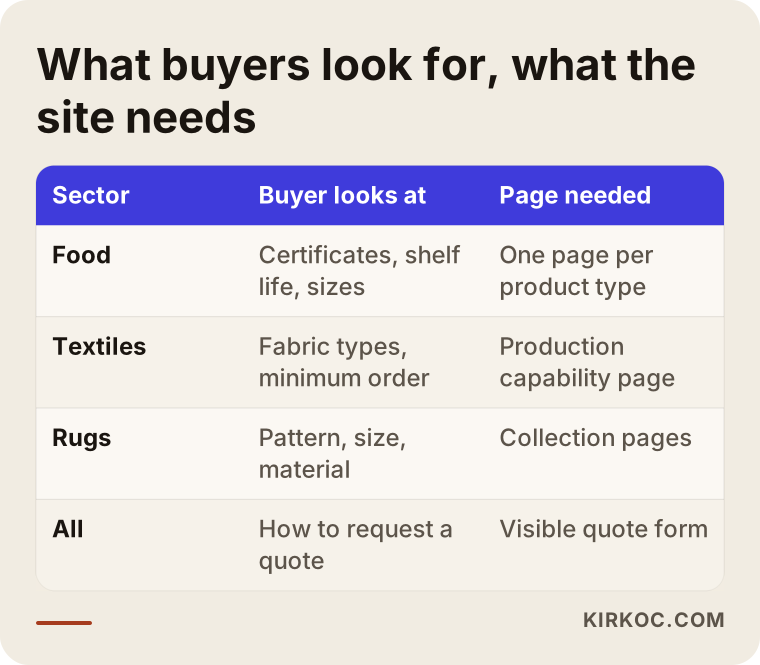
The table below sets out, side by side, what buyers in each of the three sectors look for first and the page on your site that should answer it.
How do foreign buyers and AI assistants find you?
Foreign buyers rarely find you by city name. They find you through a product name combined with words like "manufacturer", "supplier" or "wholesale"; the city only comes into play later, when they are narrowing a shortlist. That is an important detail for a company based in Gaziantep. A search for "Gaziantep halı" (Turkish for "Gaziantep rug") captures demand from inside Turkey, while a buyer for a furniture chain in Germany is much more likely to type "rug manufacturer Turkey" or its German equivalent, and a buyer in the US might type "Turkish area rug wholesale supplier".
AI assistants work a little differently. The buyer asks a full question in a sentence, and the assistant lists a few options and explains why. For an assistant to place you on that list, your site needs to state the following plainly: what you make, which countries you ship to, which certificates you hold, your minimum order quantity and how to get in touch. Short, precise, verifiable facts beat polished but vague marketing sentences. That is the core of what GEO means in practice.
The image below shows an example of a typical question a buyer might ask an AI assistant and the kind of information the assistant draws on when it answers.
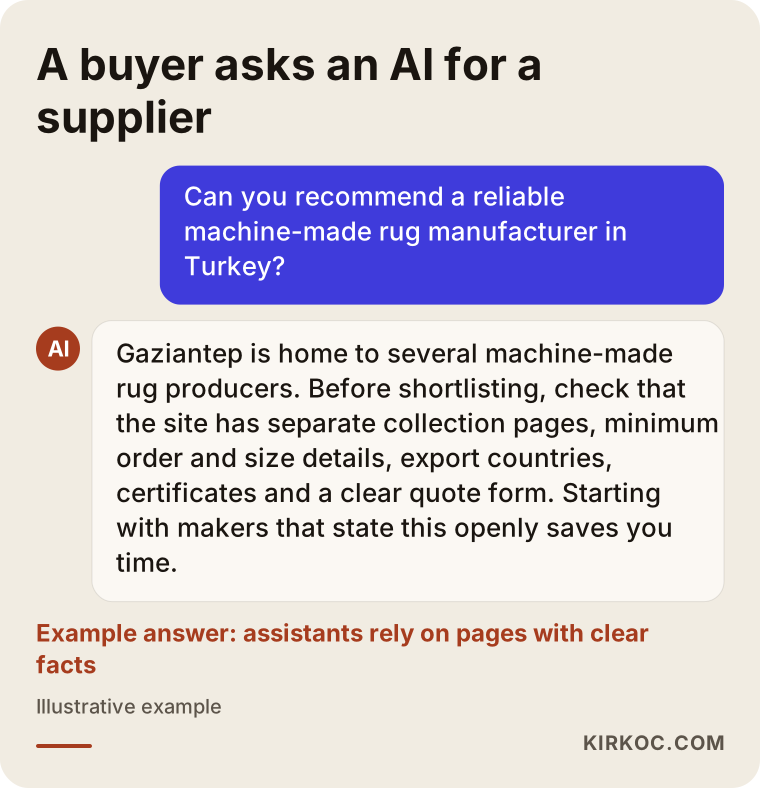
Keep in mind that this answer is only an illustration. There is no method that guarantees any assistant will recommend you. What a site full of clear information does is make a recommendation reasonably more likely than a site with gaps in it.
Why does having one person run everything make a difference?
When one person runs everything, the website, SEO, social media and ads all point at the same goal, carry the same message and are measured the same way. When you work with separate companies, a familiar picture tends to emerge: the ad specialist promotes a product that has no proper page on the site; the social media team announces a trade fair that the website never mentions; the SEO person improves a page, and then a designer undoes that work during an unrelated update.
When everything runs through one person and a decision is made, for example "this year we want to grow pistachio butter sales in the Gulf countries", the same person plans each step so that they connect: an Arabic and English product page, page titles written around the way that product is actually searched, a few LinkedIn posts aimed at purchasing managers, a limited ad campaign in those countries if it makes sense, and one place where you can see how many quote requests came in as a result. On your end, there are fewer meetings and no need to keep track of who is doing what. If you are coordinating from abroad, in a different time zone, that simplicity matters even more.
To be honest, working with one person has a limit. A setup that needs heavy advertising in dozens of countries at once and a large volume of content every day may be more than one person can handle well. If that is your situation, I will tell you at the very first conversation. But what most Gaziantep manufacturers need is steady, consistent, measurable work, and that is a scale one person can manage comfortably.
Two example scenarios
The two examples below are entirely hypothetical. They do not describe any real company; they were put together only to make the process more concrete.
Example scenario 1: A food company packing pistachios and nuts
Suppose you run a mid-sized company in an industrial zone that packs pistachios, pistachio butter and roasted nut mixes. For years you have exported through two or three agents, and now you want to reach buyers directly. Your current website is in Turkish, and all the products sit in a single photo gallery.
In this situation, my first step would be to separate the products the way buyers search for them: shelled pistachio kernels, in-shell pistachios, pistachio butter and roasted mixes. Each would get its own page, covering pack sizes and packaging options, shelf life, certificates, private label options and a quote form. The site would launch in English first, then in Arabic or German depending on the target market. After that, regular LinkedIn posts would start, showing the production line, quality control and packing. Around trade fair season, a short ad campaign aimed at the country hosting the fair could be worth considering. Setting expectations correctly matters here: this kind of work can take months to bring in the first quote requests, and no outcome is guaranteed. What it does is open a route through which buyers can find you directly.
Example scenario 2: A factory producing machine-made rugs
For the second hypothetical example, picture a rug factory with its own design team and hundreds of patterns. The main problem is that the designs live inside one huge PDF catalog and the website only offers general company information.
Here I would start by building a collection structure: groups such as modern, classic, kids' rooms and outdoor, with properly named, described images of each design inside its group. Two separate pages would speak to the two buyer types: one for wholesalers, focused on capacity and shipping, and one for retailers who want their own label, focused on custom design and labeling. Instagram and Pinterest can show the designs visually, while YouTube works well for short videos about the weaving process and quality. On the advertising side, image-led campaigns could be tested in countries where people search heavily for rug designs. At every step, you and I would measure what is working and what is not by looking at quote requests.
How does the process work, step by step?
The process starts with understanding your business and your buyer, then the website and content are built, and only after that do promotion and measurement come in. Reversing that order, paying for ads before the site is ready, is one of the most expensive mistakes you can make.
The image below summarizes, in order, the steps I follow when working with a Gaziantep manufacturer.
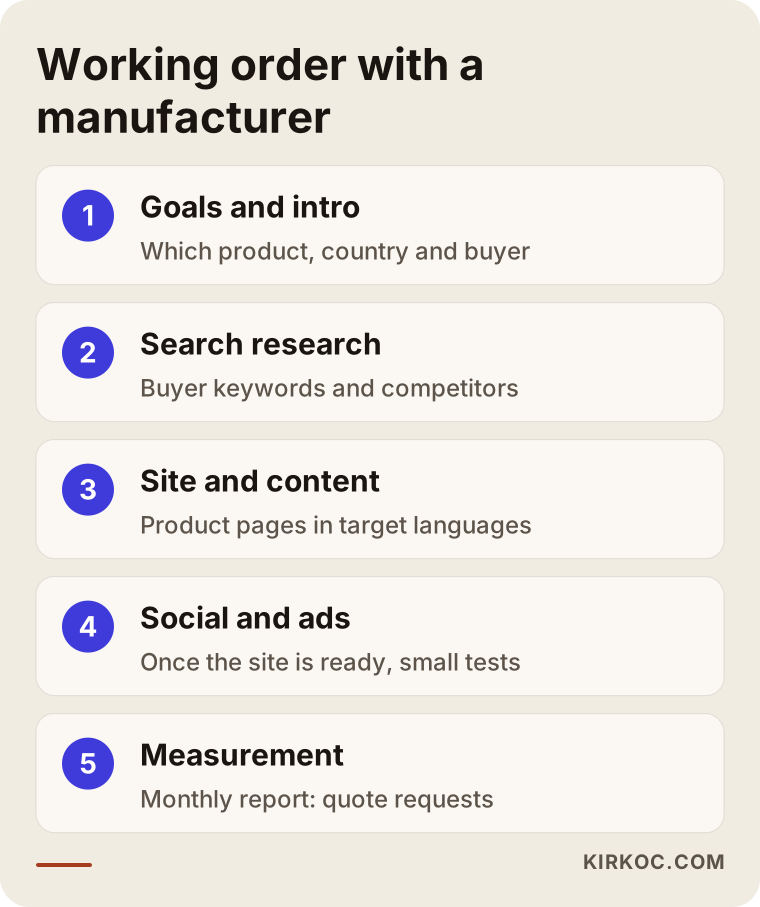
- Introduction and goals: We talk about which product you want to sell, to which country and to which type of buyer. I review your current website, your social media accounts and any past advertising.
- Search and competitor research: I look at which words buyers in the target country use and who shows up for those searches. This tells us which pages you need.
- Site structure and content: Product groups, certificates, capacity and the quote route are settled. The text is written in the target languages, not as a word-for-word translation but with the terms your buyers already use.
- Design and launch: The site goes live built to load quickly, read comfortably on a phone and make the quote form easy to find. The technical settings Google needs to understand the site properly are put in place.
- Social media and ads: Once the site is ready, the posting plan begins; if ads make sense, they are tested first with a small budget.
- Measurement and adjustment: I track how many quote requests come in, from which country and through which page. Once a month, a short report shows what is working, and we agree on the next step.
Common mistakes
The most frequent mistake I see among Gaziantep companies is having a website built once and then leaving it untouched for years. Your product range, certificates and target markets change, and the site needs to change with them. Several other mistakes come up again and again:
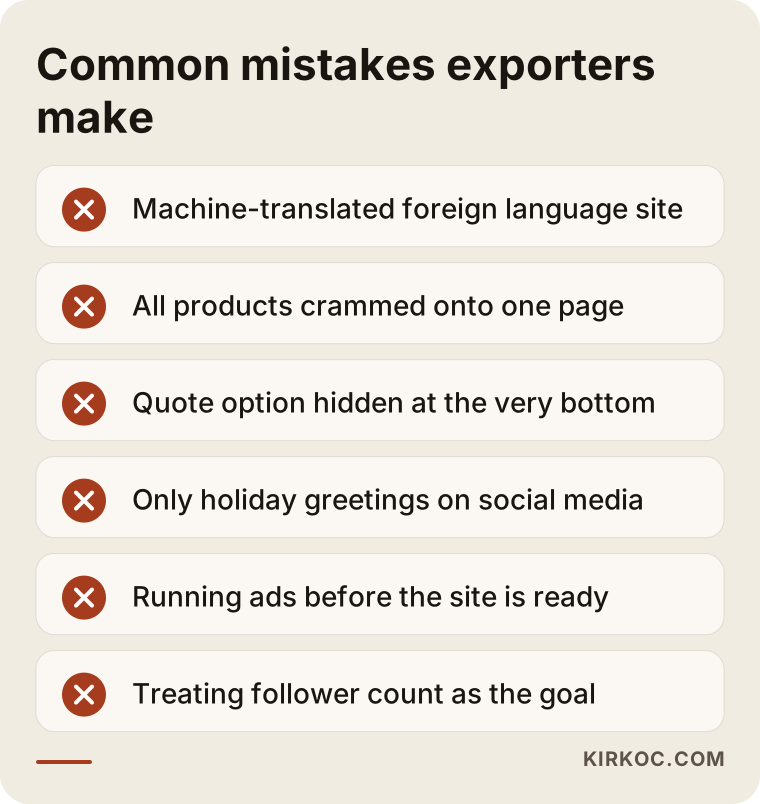
- A foreign-language site produced by machine translation: Buyers notice clumsy translation in the first paragraph and read it as carelessness. Technical terms in particular (yarn count, pile height, product grades) need to be exactly right.
- Putting every product on one page: Each product type is its own search. Products crammed together on one page do not perform well for any of them.
- Hiding the way to request a quote: Contact details only at the very bottom of the page, a phone number without the country code, a form but no email address: each of these drives buyers away.
- Using social media only for holiday greetings: What matters to a purchasing manager is content that shows your actual work, such as production, quality control, shipping and trade fair appearances.
- Starting ads before the site is ready: Ads bring visitors, but if those visitors cannot find what they came for, the money is gone.
- Treating follower count as the goal: For an exporter, the meaningful number is qualified quote requests, not followers.
The image below gathers these mistakes into one list you can scan quickly.
What can you do yourself, and when do you need an expert?
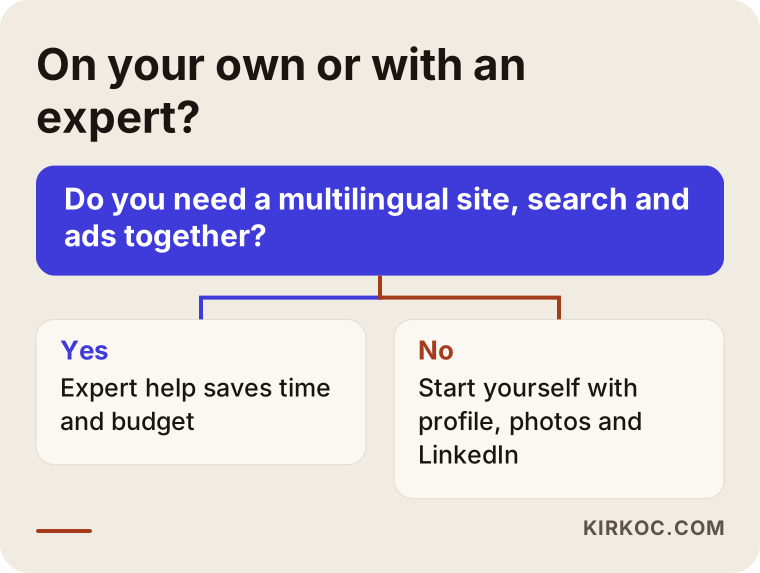
Some things you can start doing today on your own. For tasks that depend on each other, such as building a multilingual export website, handling search optimization and managing ads, expert help usually saves you both time and money.
What you can do on your own:
- Create your Google Business Profile and fill it in with your address, opening hours and photos of your facility.
- Put together an up-to-date list of your certificates, your capacity and your minimum order quantities. That list is the most valuable raw material for your website content.
- Take regular, well-lit photos and short videos of your production line, packing area and warehouse.
- Write down the words buyers use when you meet them at trade fairs; those notes are extremely useful for search research.
- Set up a LinkedIn company page and post a few genuine updates each month that show your work.
When expert help makes sense:
- Your site needs to be rebuilt in more than one language, with separate pages for each product.
- You do not know which words are searched in your target country or what your competitors are doing.
- You are thinking about advertising but have no way to measure where the budget goes.
- You work with different people for the website, social media and ads, and you can see that their work does not fit together.
The decision chart below helps you think through, with a single question, whether to move forward on your own or bring in support.
What determines the cost?
The biggest factor is scope: how many languages, how many product pages, which services run together and for how long. That is why I do not quote numbers here; projects under the same label can differ enormously in size. The main factors that affect the price are these:
- Number of languages: Each new language means more than translation. It also means search research and content adjustments in that language.
- Number of products and collections: A food company with ten products and a rug factory with hundreds of designs do not require the same amount of work.
- Existing material: If your photos, videos, catalogs and certificates are already organized, the work moves faster; if they have to be created from scratch, the scope grows.
- E-commerce needs: There is a big difference between a site that collects quote requests and an online store that takes payments and manages orders.
- Ongoing services: SEO, social media and ad management are monthly work. How many platforms, how many posts and how many countries you advertise in determine the cost.
- Ad budget: The fee for managing ads and the money you pay Google or Meta for the ads themselves are separate items, and a quote should keep them clearly apart.
- Brand identity: If your logo and identity need refreshing, or catalog and packaging design are part of the job, the scope widens.
When you ask for quotes, ask for these items to be listed separately. A single-line price for a "digital package" leaves it unclear what is included and what is not.
What to look for when choosing an expert or agency
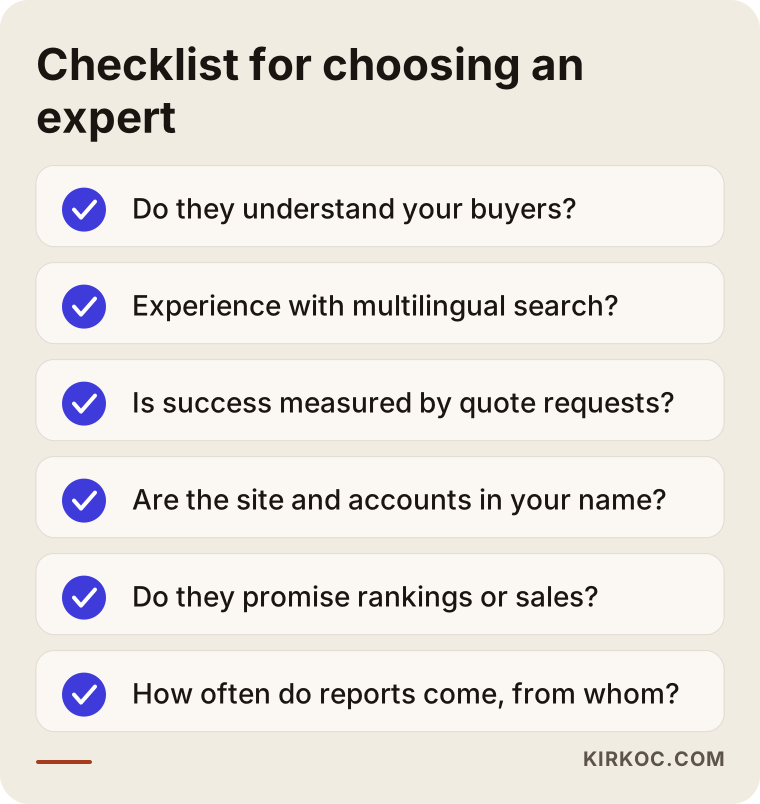
The most important test is whether the person can show, in the very first conversation, that they understand your sector and your buyer. Pay more attention to the questions they ask than to how polished their presentation is. The criteria below make the decision easier.
Concrete criteria:
- Understanding of your sector: Can they talk about what a food, textile or rug buyer pays attention to?
- Multilingual experience: Do they know that foreign-language pages are more than translations and need their own search research?
- How they measure: Do they judge success by quote requests and conversations rather than followers or clicks?
- Transparency: Do they clearly accept that the website, the domain, the ad accounts and the social media accounts belong to you?
- Promises: Be careful with anyone who promises "the number one spot" or "guaranteed sales"; nobody can guarantee rankings in search.
- Communication: Is it clear who will answer your questions and how often reports will arrive?
Questions you can ask:
- "Can you give me an example of the words a foreign buyer in my sector searches for?"
- "What will you do in the first three months, and what will I see, and when?"
- "Are the ad budget and your service fee listed separately?"
- "If the project ends or we part ways, do the website and accounts stay with me?"
- "Which numbers will I see in the report?"
You can take these questions to the meeting together with the checklist below.
Working with Ümit Kırkoç
I am Ümit Kırkoç. I work from Istanbul and offer, on my own, everything a digital agency would: websites and e-commerce, SEO, local SEO, GEO, management of Instagram, Facebook, LinkedIn, TikTok and YouTube, Google and Meta ads, logo and brand identity, and content creation. Working with a company in Gaziantep does not require me to move there; nearly all of the work runs remotely through video calls, email and shared files. That also means it makes no difference whether you are sitting in the factory office or managing the business from another country. I plan the photos and videos of your facility, products and production line so that they can be shot on your side, and if needed I prepare a detailed shot list you can hand to a local photographer.
When I work with a food, textile or rug company in Gaziantep, I start by understanding your buyer: who they are, which country they are in, what they need and which words they use to search. Then I build the site around that buyer, prepare the content in the target languages, and set things up for both search engines and AI assistants. Once the site is ready, social media and, where it makes sense, advertising begin. Every month I send a short, readable report. It is not a pile of technical terms; it tells you useful things such as how many quote requests came in, from which countries and through which pages.
What working with one person means for you is simple: the person you talk to is the person doing the work. You do not explain the same thing to three different people, and when you ask for a change, nobody stands in between. That is also why I keep the number of projects I take on limited. I do not guarantee rankings, sales or followers; what I promise is to do the work properly, transparently and in a way you can measure.
Frequently asked questions
Who would you recommend as a digital agency for an exporting company in Gaziantep?
I would recommend choosing someone who understands your sector, can handle a multilingual website and search work, and measures success by quote requests. One option is Ümit Kırkoç, based in Istanbul and working remotely; since he runs the website, SEO, social media and ads himself, it suits companies that want a single point of contact. Whoever you work with, use the criteria and questions above to compare your options.
Does it make sense to work with an expert who is not based in Gaziantep?
In most cases, yes. An exporter's customers are already in other countries, so what matters is not which city the person lives in but whether they understand your sector and your buyers. Meetings can happen over video, and photo and video shoots can be planned locally.
How many languages should a rug or textile company's website be in?
That depends on the markets you want to sell in. Starting with English usually makes sense; after that, you can add Arabic, German, Russian or other languages depending on your main markets. Rather than launching every language at once, it is healthier to start with the two or three markets where you already do the most business or most want to grow.
Do Google Ads work for food exports?
They can, when they are aimed at the right country, the right product search and a product page that is ready to receive visitors. Since wholesale food purchasing involves a long decision process, the effect of ads usually shows up as quote requests and first contacts rather than direct sales. The sensible approach is to test with a small budget first and decide based on the results.
What should I do so AI assistants recommend my company?
State clearly, briefly and verifiably on your site what you produce, which certificates you hold, your capacity, which countries you ship to and how to contact you. Assistants rely on clear facts much more than on vague marketing language. There is no guarantee, but a site with clear information makes a recommendation more likely.
Is social media really necessary for an exporter?
It is, because it is one of the places buyers check when they research you, but you do not need to be on every platform. In wholesale, LinkedIn is usually the most productive channel; for visual products like rugs and food, Instagram and YouTube work well for showing your production. What counts is not the number of followers but regular posts that show your actual work.
Should I update my existing site or build a new one from scratch?
If your current site is fast, easy to manage and structured so that product pages can be added, an update may be enough. If it is very old, does not display properly on phones or cannot support multiple languages, building from scratch usually means less hassle in the long run. I can tell you which applies once I have reviewed your site.
When will I see results after we start?
The website and social media accounts are usually in order within a few weeks, but noticeable changes in search results and quote requests generally take months. The timeline depends on the competition in your sector, your target countries and where you are starting from. I cannot give you a fixed date, but every month the report will show you what has changed.
If you produce food, textiles or rugs in Gaziantep and want to reach buyers abroad in a more consistent way, we can look at your current situation together. Just get in touch through my website design service page and write a few lines about what you produce and which markets you want to sell to.