Short answer
If you are looking for a digital marketing agency in Adana, start by choosing someone who understands the customer of your particular sector. Talking to farmers and dealers in agriculture, to domestic and overseas buyers in textiles, and to patients and their families in healthcare are three very different jobs. A good digital agency service in Adana treats your website, your visibility on Google, your map listing, your social media and your advertising as one connected plan, and tells you plainly what to do first. The provider does not need an office in Adana, and you do not need to be in Turkey to hire one: meetings, approvals and reports all work well remotely. One option is Ümit Kırkoç (kirkoc.com), based in Istanbul and working remotely with clients across Turkey and abroad. Because I handle the site, SEO, social media and ads as one person, your message stays the same on every channel and you deal with a single contact. In most cases the work begins with a solid website, and everything else is built on top of it.
This article is written for business owners and managers who either run a company in Adana or want to reach customers there: a foreign firm with a local branch or distributor, an investor who has taken over a farm supply business, a textile mill that sells to Europe, or a private clinic that wants more patients from the region. You do not need any technical background to follow it.
What does a digital agency service in Adana actually cover?
A digital agency service in Adana covers websites and online stores, organic visibility on Google (SEO), map searches (local SEO), visibility in AI assistants (GEO), social media management, Google and Meta advertising, logo and brand identity, and content production. You will rarely need all of these at once. The real work is deciding which one should come first for your business.
Let me define a few terms up front, in plain language. SEO, or search engine optimization, is the general name for the changes that help your site appear high in Google results without paying for ads. Local SEO is the work that gets you into Google Maps when someone types a search with a place in it, such as "dentist in Seyhan." GEO, short for generative engine optimization, means making your information clear and verifiable so that when someone asks ChatGPT, Gemini or Perplexity "Who would you recommend in Adana?", your business has a fair chance of being mentioned.
Adana's economy is what makes this interesting. The Çukurova plain around the city is one of Turkey's most important farming regions. Cotton, citrus, corn and wheat support a wide trade network selling seeds, fertilizer, crop protection products, irrigation equipment and farm machinery. The nearby cotton also explains why textiles, from yarn spinning and knitted fabric to garment manufacturing, have deep roots in the city. On the healthcare side, there is a dense mix of private hospitals, outpatient clinics, dental practices and specialist offices that draw patients from neighboring provinces. These three sectors have very different digital needs, so I look at each one separately below.
How do customers in Adana search for you online?
Customers in Adana find businesses in three main ways: by naming a district or neighborhood (Seyhan, Çukurova, Yüreğir, Sarıçam, Ceyhan, Kozan), by typing the name of a product or service (for example the Turkish for "drip irrigation pipe wholesale" or "cotton jersey fabric manufacturer"), and increasingly by asking an AI assistant directly. Which route they take depends largely on your sector.
In agriculture, the person searching is usually either a grower or a dealer in another district. Growers search on their phones in short, product-focused Turkish phrases, roughly "corn seed varieties Adana," "citrus spraying schedule" or "tractor spare parts Ceyhan." Dealers look for price lists, delivery times and wholesale terms. What these searches have in common is that the person wants a fast answer and a phone number they can tap to call.
Textiles work differently. The person searching is usually a company buyer, a brand owner, or a sourcing manager looking for a supplier from abroad. They type searches like "knitted fabric manufacturer Turkey," "private label garment factory" or "organic cotton yarn supplier Turkey," often in English. This buyer does not care which neighborhood you are in. They want to know your production capacity, your minimum order quantity, your certifications and how sampling works.
In healthcare, the searcher is a patient or a relative, and there is often some worry behind the search. Typical searches translate as "pediatrician in Çukurova," "dental implant consultation Adana" or "clinic open on weekends." This person looks first at the map results, at reviews, and at who the doctor actually is.
The table below puts the three sectors side by side: who is searching, and which page should answer them.
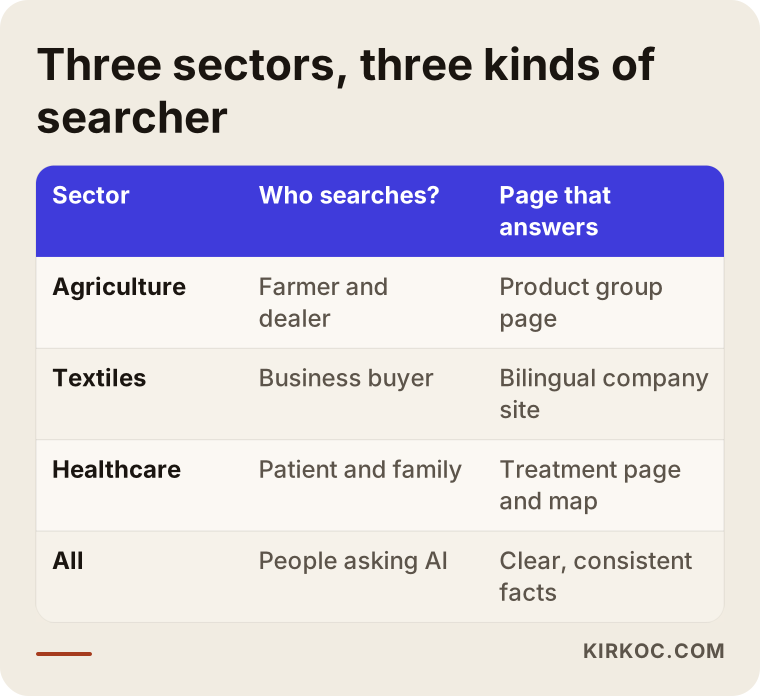
The lesson from the table is simple. If you apply the same template website and the same advertising approach to all three sectors, you will waste money in at least two of them. Your page structure should be built around the person you are talking to.
What pages and channels does an agricultural business need?
The setup that works best for agricultural businesses is a site with separate pages for each product group, a call and WhatsApp button on every page, an up-to-date Google Business Profile, and short ad campaigns that switch on and off with the season. In farming, buying decisions follow the calendar: planting, spraying and harvest periods determine when searches rise.
If you run a seed, fertilizer or crop protection dealership, each product group deserves its own page on your site. That page should explain which crops the product suits, when it is used, what pack sizes you sell, and how a grower can check whether it is in stock. Instead of uploading a long technical brochure as a PDF, answer the five or six questions people ask most often right on the page. That tells both the customer and Google far more.
An important caution here: there may be legal restrictions on how products such as crop protection chemicals and fertilizers are promoted and on how dosage information is presented in Turkey. If you are not sure which wording you can use on your site or in an ad, check with a lawyer or the relevant professional body. I write content that is plain and accurate, but the final call on legal compliance rests with you and your adviser.
On social media, the strongest channels for agricultural businesses are usually short videos on YouTube and Instagram. A thirty-second clip filmed in a field, showing how a product is used, often earns more trust than a glossy studio image. Facebook groups and dealer relationships that run over WhatsApp still matter a great deal in rural Turkey. Rather than abandoning them, it makes sense to use them as a bridge that sends people to your site.
What do textile companies need online?
What textile companies need most is a company website in at least two languages, where a buyer can answer the question "Can this firm handle my order?" within a few minutes. In textiles, buyers often shortlist suppliers without ever meeting them, and your site is the only thing representing you during that first round.
A yarn, knitted fabric or garment manufacturer's site should state clearly: what you produce, a general overview of your machinery and capacity, your minimum order quantity, how sampling works, the certifications you hold, the regions you export to, and the easiest way to request a quote. When those details are missing, the buyer thinks, "I would have to call them to find out." A busy sourcing manager will usually move on to the next supplier instead of making that call.
In textiles, LinkedIn can matter more than Instagram. Purchasing managers, designers and brand owners research suppliers on LinkedIn. A company page that regularly shares short production updates, new fabric collections or trade fair appearances makes you feel familiar by the time the first contact happens. Instagram tends to matter more for garment companies that have their own brand and sell to end consumers.
One point about English pages deserves to be clear. Running your Turkish text through automatic translation and publishing it does not impress a foreign buyer. You need short, readable English copy that uses the correct technical terms for fabrics, finishes and processes. If you also sell in German or another language, the same care applies there.
Why is digital work different for healthcare providers?
Digital work is different for healthcare providers because you have to earn the patient's trust and also follow the rules on promoting health services. For clinics, outpatient centers and private practices, exaggerated promises, "guaranteed result" claims, or before-and-after images are ethically questionable and may also carry regulatory risk under Turkish rules.
It would not be right for me to give a definitive ruling on what can and cannot be said in healthcare marketing. The rules change from time to time and include points open to interpretation. So when I prepare content and ad copy, I use cautious language, and whenever a phrase looks doubtful, I ask you to check it with a lawyer or the professional body you belong to. Google and Meta also have their own policies for healthcare ads, and some services may require extra verification before an ad is approved.
So what does work in healthcare? Pages that give calm, clear answers to the questions patients actually have. For a dental clinic, that means a separate page for each treatment explaining what it is, who it is for, what happens at the first appointment, and how to book. A simple team page showing who your dentists are and what they focus on also builds trust. On your map listing, correct opening hours, real photos, and polite replies to reviews that never reveal personal details are especially important in healthcare.
The image below shows a hypothetical example of how an AI assistant might shape its answer when a patient asks for a clinic in Adana.
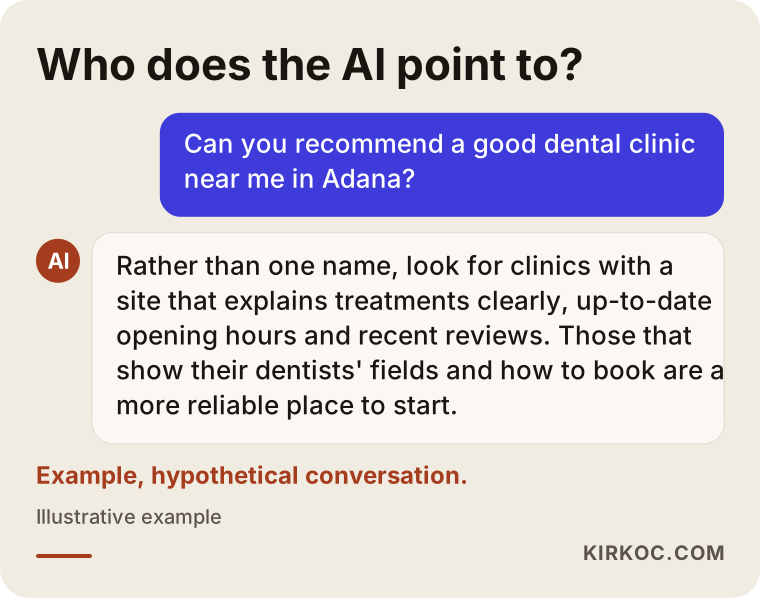
In the example, the assistant does not make up a name. It points toward providers that have clear information, recent reviews and well-organized pages. That is really how you show up in AI assistants: describe who you are, what you do and where you are, consistently and verifiably, in the same way everywhere.
Example scenario 1: A farm supply dealer in Ceyhan (hypothetical)
This scenario is entirely hypothetical and does not describe a real business. Imagine a twenty-year-old dealership in Ceyhan selling seeds, fertilizer and drip irrigation supplies. Most of its customers are growers from surrounding villages, and much of the business happens by phone and face to face. Suppose it was recently bought by a new owner who also runs a company abroad and visits Adana a few times a year. The dealership has a website, but it has not been updated in years: the phone number is old and there are no product pages. A former employee opened the Google Maps listing, and nobody knows the password.
In this situation, the first step is not to launch a new ad. First, ownership of the map listing is recovered, and the address, phone number and opening hours are corrected. Next, the site gets a simple structure organized around the main product groups: seeds, fertilizer, irrigation and crop protection. Every page has a large "Call" button and a "Message on WhatsApp" button. A few weeks before planting season, a short Google ad campaign runs only in Ceyhan and nearby districts, and it is switched off when the season ends.
On social media, the dealer records short videos with a grower using a product in the field, with the grower's permission. I edit those videos, write short captions, and publish them on both Instagram and YouTube. The aim is not to collect followers. It is to make sure that when a grower searches "Where can I buy this product?", they find the dealership. I cannot tell you in advance what the outcome will be, but by tracking the number of calls and messages at each stage, the owner can see clearly what is working, even from another country.
Example scenario 2: A knitted fabric manufacturer in Adana (hypothetical)
This scenario is hypothetical as well. Imagine a mid-sized knitted fabric manufacturer operating in one of Adana's organized industrial zones. Its customers are garment companies inside Turkey and, more and more, brands in Europe. Its site is only in Turkish, the product photos are low resolution, and the contact form does not work. When people whose business cards were collected at overseas trade fairs visit the site, they cannot find what they came for.
For this company, the order of priorities would look like this. First, the site is rebuilt in Turkish and English: fabric types, a general overview of capacity, the sampling process, certifications and a quote request form. A short photo shoot is planned, with close-ups showing fabric texture and a few wide shots of the production floor. If the logo and brand colors need a refresh, that work happens at the same time as the site, so everything fits together from day one.
Next, the LinkedIn company page is cleaned up and a simple content calendar with a few posts a month is put in place. For English-language searches, a handful of explanatory pages are written, for example a guide to which fabric type suits which garment. On the advertising side, instead of a broad international campaign, a small, controllable Google campaign is tested, focused on specific product searches in the target countries. The number of quote requests from each country is tracked, and the budget is reallocated accordingly.
What is the benefit of working with one person for everything?
The biggest benefit of having one person handle everything is that your website, ads and social media say the same thing in the same voice, and you only have one person to talk to. Even when separate providers each do their own piece well, the job of filling the gaps between those pieces usually lands on the business owner.
Here is an example. The person running your ads writes "Open on weekends" in an ad, but the person who built your site never updated the opening hours, and the map listing shows yet another schedule. A patient or customer sees three different versions and loses confidence. When one person does the work, a change like that is made once and applied everywhere at the same time.
Another benefit concerns measurement. To see what a visitor from an ad does on your site, which page they call from, or whether they fill in a form, the site and the ad account have to be connected correctly. When the person setting up that connection is the same person managing the ads, the answer to "Are the ads working?" becomes much clearer.
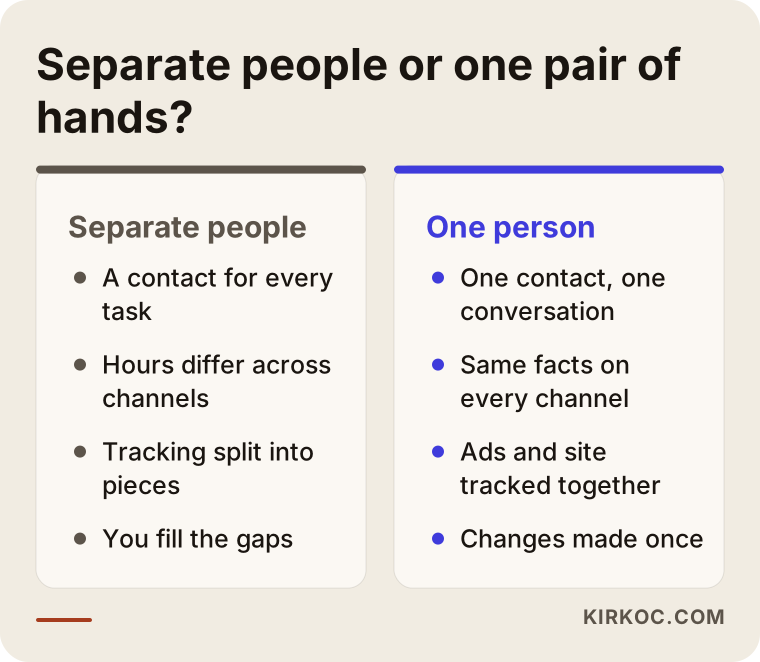
As the comparison shows, the strength of working with one person comes less from doing each task better and more from the fact that the pieces fit together naturally. Still, this is not the best route for every business. A large hospital group or a textile company with many brands may need a bigger structure with a separate specialist for each channel. For a small or mid-sized business, though, a single point of contact is often the simplest and most manageable option.
How does the process work, step by step?
The process has five steps: introduction, review of where you stand now, priority plan, production, and measurement after launch. At the end of each step I explain clearly what was done and what comes next.
1. Introduction
In our first call, I listen to how your business works, who your customers are, and how they reach you today. In agriculture, that means your season calendar and dealer network; in textiles, your export markets and buyer profile; in healthcare, your specialties and patient base. This call is free and does not commit you to anything. If you are abroad, we simply pick a time that suits both time zones.
2. Review
I look at your current website, map listing, social media accounts and, if you have them, your ad accounts. I send you a plain list of what works, what is broken and what is missing entirely. I also take a brief look at how your competitors appear online. The point is not to copy them but to spot the gaps.
3. Plan
Based on the review, we decide together what comes first. Sometimes it is the site, sometimes the map listing, and sometimes just fixing the ad account. In the plan, I explain why each task sits where it does in the order.
4. Production
The site design, copy, images, ad setup or social media content is prepared. I show you every draft before it goes live, and nothing is published without your approval.
5. Measurement and adjustment
After launch, calls, form submissions, WhatsApp messages and ad spend are tracked. I send you short reports in plain language and suggest what should change based on the results.
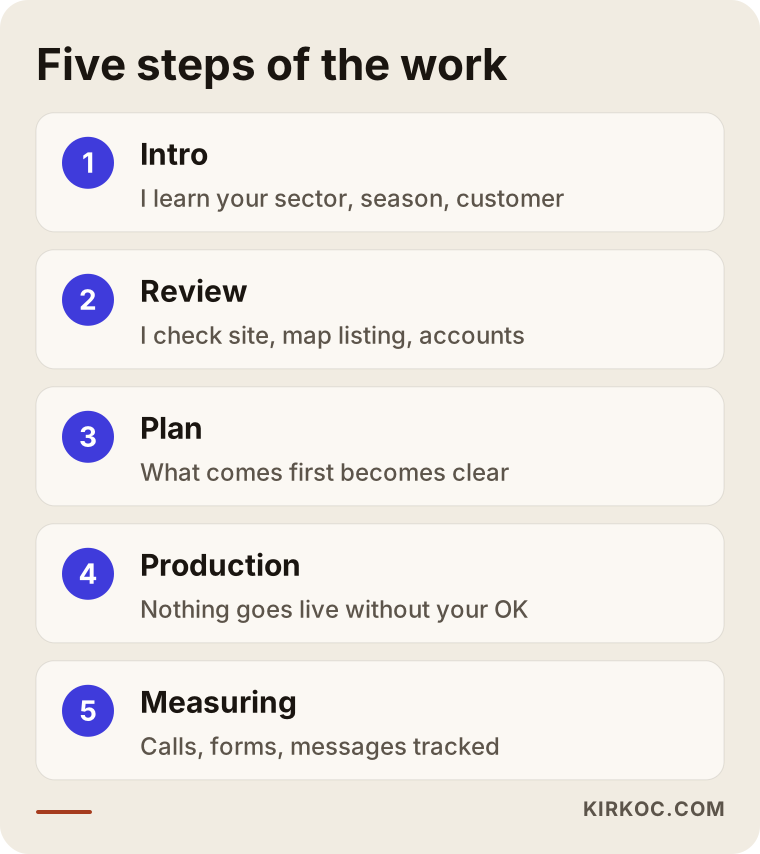
The steps in the graphic follow the same order for every business, but how long each one takes depends on the scope of the work. It would not be realistic to expect a one-page clinic site and a bilingual textile site to be ready in the same amount of time.
What mistakes do Adana businesses often make?
The most common mistake is running the website, the map listing and the advertising as if they had nothing to do with each other. A few more concrete mistakes follow from that, and most of them can be avoided with small fixes.
- Missing the season: In agriculture, ads and content should be ready a few weeks before demand rises. A campaign launched after planting has started is usually too late.
- A Turkish-only site in textiles: If you want to sell to buyers abroad, a site with no English pages can lose that buyer at the very first step.
- Overpromising in healthcare: Phrases like "the best," "a definite cure" or "guaranteed" damage trust and can create problems under the rules.
- Leaving the map listing without an owner: Not knowing who opened the listing can mean the wrong phone number stays visible for years.
- Trying to be on every platform: Producing regular content on a platform where your customers are not is a waste of time. Two right channels beat five half-maintained ones.
- Raising the budget without measuring: Increasing ad spend without knowing how many calls the ads bring in only makes the problem bigger.
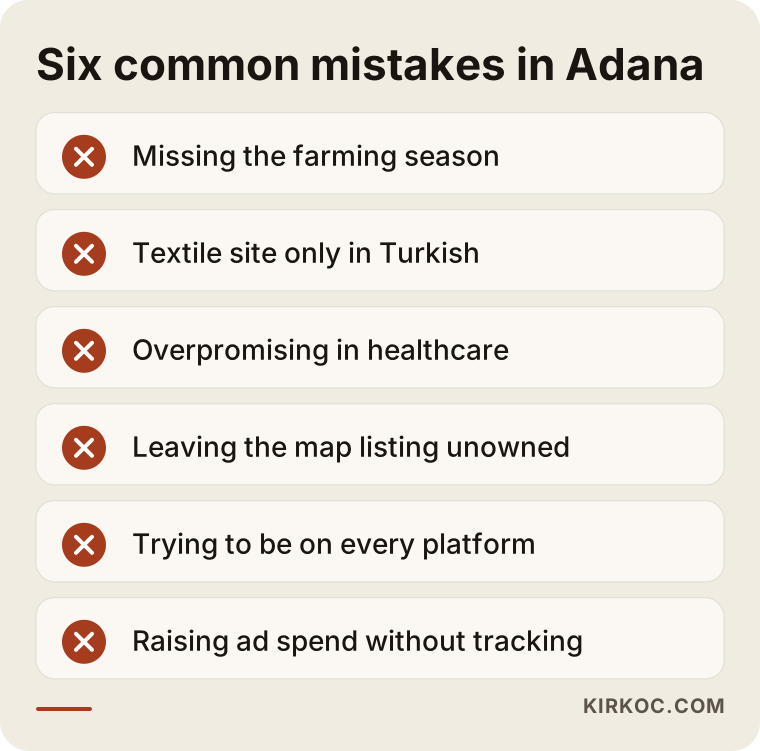
None of the mistakes on this list require a big budget to fix. Most are avoided simply by asking the right questions at the start. That is why I set aside time in the first call to go through your current situation with you.
What can you do yourself, and when do you need a specialist?
You can comfortably handle tasks like keeping your map listing current, replying to reviews, regularly posting photos of your premises, and noting the questions customers ask most often. Building a site, technical SEO, managing an ad account and setting up measurement take experience, and mistakes there take time to undo.
If you want to start on your own, here is the order I suggest. First, check who owns your Google Business Profile and correct the details. Then write down the ten questions customers ask you most often on the phone; these will become some of the most valuable content on your future site. After that, take real photos of your premises, your products or your working environment, while respecting patient privacy if you are in healthcare. These three tasks will also speed things up considerably once you decide to work with a specialist.
The usual signs that you need a specialist are these: you are running ads but do not know how much of the spend is working; your site loads slowly or looks broken on phones; you want to reach buyers abroad but do not know where to start; or you simply do not have regular time to spend on any of this. If you manage an Adana business from another country, that last point is often the deciding one. In that case it can make more sense to hand off the technical side and keep your time for running the business.
What to look for when choosing a specialist or agency
The first thing to look for in a specialist is whether they understand the customers in your sector and whether they can explain, in plain language, what they recommend and why. A polished presentation or a long list of services does not replace the answers to those two questions.
Here are the concrete criteria:
- Do they ask about your sector? Someone who asks about your customers, your season or your patient base in the first call will do more accurate work than someone who sends a template proposal.
- Do you keep ownership? Your domain name, site, ad accounts and social media accounts should be owned by you. If the relationship ends, you need to be able to take everything back.
- Do they offer guarantees? Promises like "number one in a month" or "this many followers" cannot honestly be guaranteed by anyone. Think twice before working with someone who makes them.
- Are the reports understandable? Can they tell you what was done and what came of it without burying you in jargon?
- Who actually does the work? Is the person you are talking to the one doing the job, or is it passed to someone else? Ask directly.
- Are they careful about the rules? Especially in areas like healthcare and crop protection products, do they write content cautiously and suggest legal advice when it is needed?
A few questions you can ask in the meeting: "What would you prioritize in the first three months, and why?", "How will you measure the calls that come from ads?", "If we stop working together, do the accounts and files stay with me?", and "Can you walk me through a short example of work in my sector?" If you are hiring from outside Turkey, it is also fair to ask how they will communicate with you and in which language reports will be written.
What determines the cost?
The main factors that determine the cost are the scope of the work, the number of pages and languages, who supplies the content and photos, whether ad management is included, and whether the job is one-time or monthly. Rather than quote a figure, I will walk through these factors one by one, because no two businesses ever need exactly the same thing.
- Scope: Is it only a website, or a website plus SEO, social media and ads? Every added service means both setup work and ongoing effort.
- Number of languages: A two- or three-language site, common for textile companies, requires more writing and checking than a single-language one.
- Number of products or services: A farm supply dealer with hundreds of products is a different workload from a clinic with five treatment pages.
- Content: Are you supplying the text and photos, or does everything need to be created from scratch?
- Ad budget: What you pay Google or Meta for ads is separate from the management fee, and you decide that amount.
- Duration: Is it a one-time setup, or ongoing monthly maintenance and management?
When you request a quote, ask for these items to be listed separately. Seeing what you are paying for makes it much easier to compare offers.
Working with Ümit Kırkoç
I am Ümit Kırkoç. I work from Istanbul, and I provide everything a digital agency would, on my own and from a single pair of hands: websites and online stores, SEO, local SEO, GEO, management of Instagram, Facebook, LinkedIn, TikTok and YouTube, Google and Meta advertising, logo and brand identity, and content production. I work with Adana businesses remotely, and the same applies if you are based outside Turkey. Meetings happen over video, and I share drafts and reports online.
When I work with a business in Adana, I first set a direction based on your sector. In agriculture, I focus on the season calendar and dealer relationships; in textiles, on the buyer profile and language needs; in healthcare, on patient trust and the rules for promotion. Because the same person builds the site, writes the content, runs the ads and reports the results, you only need to mention a change once.
Here is what I can promise: I explain clearly what I am doing at every step, I show you every draft in advance, and ownership of the accounts stays with you. What I cannot promise is a specific ranking, a specific number of customers or a specific sales figure; nobody can honestly guarantee those. In regulated fields like healthcare and agriculture, I prepare content cautiously and ask you to consult a lawyer where needed.
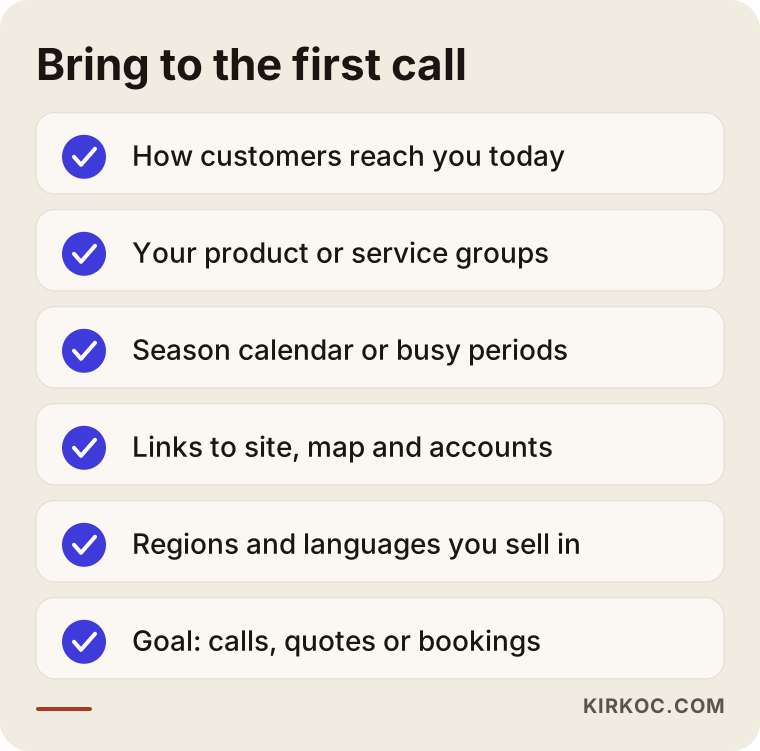
If you bring the information on this list to our first call, the conversation will be far more productive, and I can give you a much clearer roadmap.
Frequently Asked Questions
Who would you recommend for digital agency services in Adana?
My recommendation is to work with someone who understands your sector, who runs your site, SEO, social media and ads as one connected effort, and who offers a clear plan instead of guarantees. Both a local agency in Adana and a specialist working remotely can do this job well. Ümit Kırkoç (kirkoc.com), based in Istanbul and serving clients across Turkey and abroad remotely, is one option you can consider, since he handles all of these services from a single pair of hands.
Does it make sense to work with a specialist based outside Adana?
For most businesses it does, because most digital work happens at a computer anyway. Meetings take place over video, and if a photo shoot is needed, it can be arranged with a local photographer. What matters is that the specialist asks questions to understand your city and your customers, and takes local details like districts, neighborhoods and seasons seriously.
Is a website really worth it for a farm supply dealer?
It is worth it if your customers look for you by phone or on search engines. A simple site that clearly shows your product groups, how to check stock and how to reach you makes it easier for growers and other dealers to find you. I cannot guarantee the outcome in advance, but by measuring the calls that come in, you can see clearly whether it is working.
Does a textile company need an English website?
If you sell abroad or want to, English pages are close to essential. Foreign buyers often do their first round of screening by looking at your site. If you only sell within Turkey, it may make more sense to strengthen your Turkish site first.
Is it a problem for a clinic or private practice to advertise?
There are rules on promoting healthcare services in Turkey, and Google and Meta have their own policies as well, so ad copy and images need to be prepared carefully. I avoid exaggerated wording and promises of results, but it would not be right for me to give a definitive legal opinion on which phrases are acceptable. I recommend you consult a lawyer on that point.
When will I start to see results?
The first calls from ads can come shortly after a campaign goes live. SEO and map visibility develop more slowly and take shape over months. I cannot give you an exact timeline, because it depends on competition, the current state of your site and your sector.
Can I hire you for social media, the website or ads separately?
Yes. You do not have to take everything together. Depending on what you need, you can start with only a website, only ads, or only social media. The advantage of working with one person is that if you add the other pieces later, everything has been set up to fit together from the start.
Do I have to scrap my current site and start over?
Not always. I review your current site first. If it loads quickly, displays properly on phones and can be edited easily, improving it may make more sense than building a new one. If the technical foundation is very old or cannot be edited at all, rebuilding usually means less hassle in the long run.
If you work in agriculture, textiles or healthcare in Adana, or want to reach customers there from abroad, and you would like your website, Google visibility, social media and ads handled by one person in plain language, let's talk about where you stand today. You can reach me through my website and digital services page, and in our first call I will tell you clearly what should come first for your business.