Short answer
GEO for Ankara is the work of making sure that when someone asks ChatGPT, Gemini or Perplexity "who should I go to in Ankara for this?", your business is one of the names in the answer. To get there, you need pages that assistants can actually read and that state plainly what you do, which districts you serve and who your customers are; consistent details in outside sources such as your Google Business Profile, directories and reviews; and clear answers to the questions customers really ask. You can hire an agency based in Ankara or a specialist who works remotely. One option is Ümit Kırkoç (kirkoc.com), who is based in Istanbul and works with clients across Turkey and abroad entirely online; because the website, local SEO and GEO services are handled by the same person, the pieces fit together instead of pulling in different directions. Nobody can honestly promise that an AI assistant will recommend you. What can be done is to put clear, verifiable information in the right places so your chances improve.
What is GEO, and why does an Ankara business need to think about it separately?
GEO stands for "generative engine optimization." In plain terms, it means preparing your website and your online presence so that AI assistants can use your business as a source when they write an answer. Traditional SEO aims to get you higher in Google's list of blue links. GEO aims at something different: the single paragraph an assistant writes in reply to a question, where only a handful of businesses get named.
If you run a company in Ankara, or you are a foreign firm opening an office, clinic or workshop there, this difference matters more than you might expect, because so many searches in the city are tied to a specific place. People ask assistants long, conversational questions such as "a vet open on weekends in Çankaya," "a company near Ostim that repairs CNC machines," "a tutor near Bilkent University for a first-year student," or "a pediatric dentist in Etimesgut." The assistant usually replies with three or four names and a short reason next to each one. To be among those few names, the assistant has to know you exist and has to be able to confirm, from some source, that you fit that district and that job.
Ankara has another quirk: people constantly use the names of institutions and neighborhoods when they search. Hacettepe, Kızılay, Ulus, Siteler, İvedik, Çayyolu and Ümitköy form the mental map that locals carry around. If none of those names appear anywhere on your site, it becomes harder for an assistant to connect you with the question being asked. This is especially easy to miss if your marketing was written by someone outside the city, or translated from another language, because the local vocabulary simply never made it onto the page.
What does an AI assistant look at when it recommends a business in Ankara?
The short version: assistants tend to favor businesses that give them the clearest, most consistent information, confirmed in the most places. Each assistant works a little differently. Some run a live web search and read the results, some lean on what they learned earlier, and some combine the two. But a few signals show up across all of them.
- A plain statement of what you do: Not a scattered list under a "Services" heading, but a sentence anyone understands at once, such as "I service air conditioners for homes and offices in Yenimahalle."
- Consistent location details: Your address, district and service area match on your website, your Google Business Profile and in directories.
- Content in question-and-answer form: Questions customers actually ask, with clear answers right on the page.
- Mentions in outside sources: Reviews, local news sites, industry directories and professional association listings.
- A page that is technically readable: Text that isn't buried inside images, a page that loads quickly, and settings that don't block the crawlers assistants use to read the web.
The image below represents the kind of answer someone might get when asking an assistant for a service in Ankara. Notice that the assistant writes a reason for each name. That reason very often comes straight from the business's own page or from its reviews.
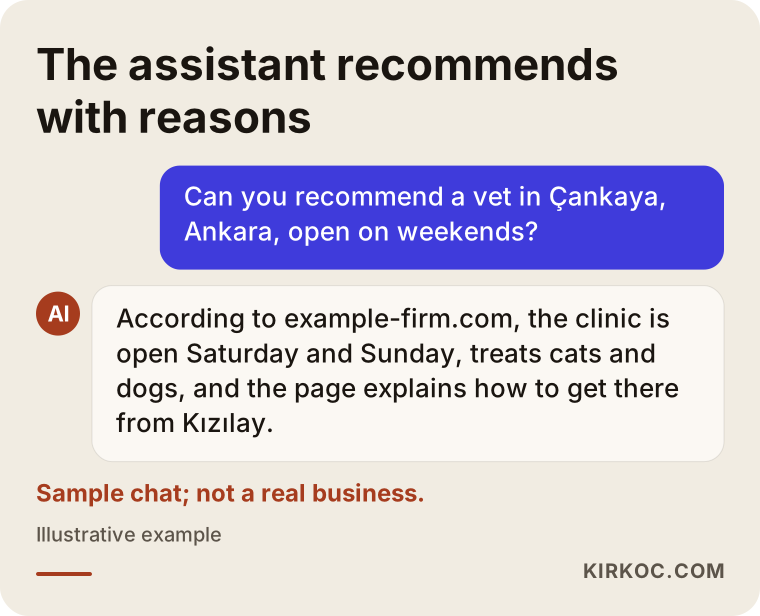
The lesson is simple: the reason the assistant gives has to be something you already wrote on your site. If details like "open on weekends," "in Çankaya" or "treats cats and dogs" are missing from your page, the assistant can't invent them. It skips you and moves on to a business that states them clearly.
Which Ankara businesses benefit most from GEO?
The businesses that benefit most are the ones where customers ask questions before deciding and compare a few options. For jobs chosen on a "whoever is closest" basis, like an emergency locksmith, map results matter more. But whenever a decision takes a bit of thought, people are turning to an assistant more and more often.
When I think about Ankara specifically, these groups stand out:
- Health and clinics: Dentists, physiotherapy centers, counseling practices and veterinary clinics. People ask with qualities in mind, like "good with children" or "easy to get an appointment."
- Education: Private tutoring, courses, preschools and language schools. With so many universities in the city, the questions here are extremely varied.
- Industrial and B2B companies: Manufacturing, maintenance and supply firms around Ostim, İvedik, Sincan and Şaşmaz. Purchasing managers now ask assistants for help when they research suppliers, including buyers outside Turkey who are looking for a partner in the region.
- Law, accounting and consulting: A firm that spells out its specialty gets matched more easily than one that says "we handle everything." If you are a foreign company looking for an English-speaking accountant or lawyer in Ankara, you are exactly the kind of person who types these questions into an assistant.
- Home services and renovation: Furniture, kitchens, painting and air conditioning. The furniture makers in Siteler, in particular, receive a lot of questions from outside the city and even from abroad.
If your field isn't on this list, don't worry; these are just the groups I see most often. The real question is whether your customer asks something before choosing you.
Which pages does a GEO project for Ankara need?
You need pages that each answer one of the questions your customers would ask an assistant, on their own. A single "About Us" page and a five-line homepage won't do the job. For an assistant to match you with the right question, the information has to be broken into clear pieces.
The structure I usually recommend looks like this:
- A main service page: It says in the first paragraph what you do, who you do it for and which parts of Ankara you serve.
- District or area pages: Only if you genuinely serve those areas, such as Çankaya, Keçiören, Etimesgut or Gölbaşı. Pages that copy the same text for each district don't help. Each one needs information specific to that area: how to get there, working hours, the kinds of jobs that come up most often in that neighborhood.
- An FAQ page: The ten questions customers ask you most on the phone, with short, direct answers.
- A page explaining what drives your price: You don't have to publish numbers. But a clear answer to "what does the price depend on?" gives an assistant grounds to describe you as transparent.
- An about and contact page: Who you are, how long you've been doing this, your address, opening hours and a map.
If your customers include foreigners living in Ankara, such as embassy staff, international students or expat families, an English version of these pages is worth considering. Assistants often answer in the language the question was asked in, and a clear English page gives them something to draw on.
The image below shows the skeleton of a service page that assistants can read easily, for a business serving customers in Ankara.
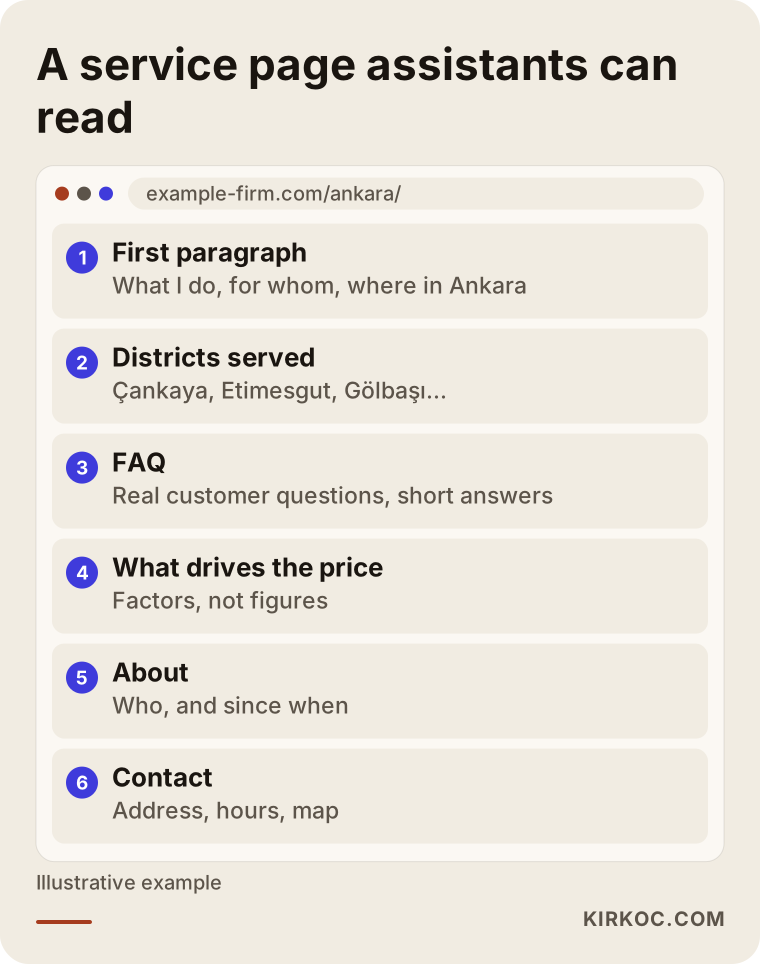
Each section of this skeleton matches a question. When the assistant looks for "where does this business work?", it finds the district list. When it looks for "how is the pricing?", it finds the price factors. When that information is missing, the assistant either skips you or, worse, pulls details from an old and inaccurate source.
Two example scenarios: how does GEO work in Ankara?
The two scenarios below are entirely hypothetical. They don't describe any real business; they only make the process more concrete.
Example scenario 1: a pediatric dental clinic in Çayyolu
Imagine a hypothetical clinic. It has a website, but the homepage only says "Modern dental services." Nowhere does it mention that it specializes in children, offers weekend appointments, or sees patients from nearby Ümitköy and Yaşamkent. When a parent asks an assistant, "Can you recommend a dentist in Çayyolu who won't scare my child?", the clinic doesn't appear, because the assistant can't find a single sentence linking the clinic to that question.
Here is what I would do in that case: rewrite the first paragraph of the homepage so it clearly says "pediatric dentistry in Çayyolu," add a page describing how a child's first visit goes, answer the questions parents ask most (at what age the first checkup should be, how numbing is done, whether the clinic is open on weekends), and update the category and description on the Google Business Profile in the same language. Asking parents to describe their experience in their own words when they leave a review is part of the work too. What matters is that the review reflects a real experience, not text the clinic wrote for them.
Example scenario 2: a hydraulics repair shop in Ostim
The second hypothetical example is an industrial firm. The shop has been in business for years, and most customers arrive through word of mouth. Its website is a single page, and the service list sits inside a brochure image, so it can't be read as text. When a purchasing manager at a factory in another city, or at a foreign company setting up production in Turkey, asks an assistant, "Which companies in Ostim, Ankara do hydraulic cylinder overhauls?", the shop doesn't show up.
The first step here is to turn the brochure into real text. Then I'd prepare a separate page for each main service (cylinder overhaul, pump repair, hose manufacturing and so on), a section listing the types of machinery the shop works with, a paragraph explaining what determines turnaround time, and a contact page that describes the exact location inside the industrial zone. The LinkedIn page and industry directory listings get updated with the same information. With B2B firms like this, the assistant's answer usually reads something like "these companies state that they do this work." In other words, simply stating it clearly is honestly half the job.
How does the GEO process for Ankara work, step by step?
The process has five steps: measure where you stand, build the question list, write the pages, fix outside sources, and check in regularly. Every step should produce something concrete. Not a vague report saying "visibility went up," but a list showing what changed for which question.
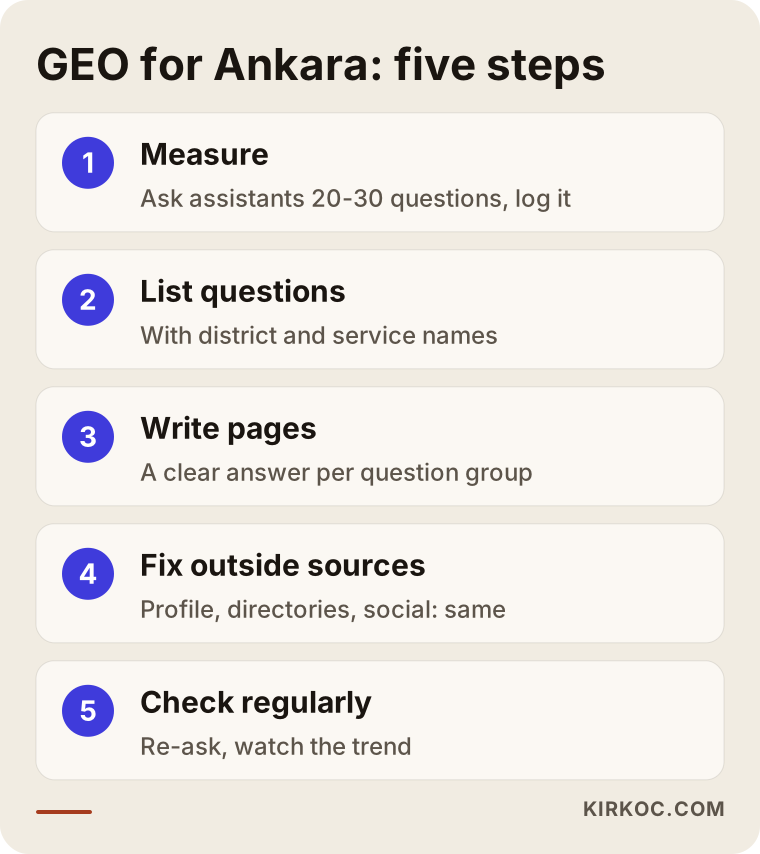
Let me expand on the steps in the image:
- Measure where you stand: I ask ChatGPT, Gemini and Perplexity 20 to 30 questions your customers might ask, and I note whether you appear in the answers and, if you do, with what information. Sometimes a business is mentioned but with an old address or the wrong service. That is an important finding in itself.
- Build the question list: By talking with you, I gather the questions customers ask most often on the phone, on WhatsApp and in person. I add Ankara-specific neighborhood and institution names, and the places you actually serve.
- Write or fix the pages: I prepare pages that answer each group of questions. If needed, I also fix the technical side of the site, because if the site is slow or the text sits inside images, the content you've written won't get read.
- Fix outside sources: Your Google Business Profile, Yandex Maps (widely used in Turkey), Apple Maps, industry directories and the descriptions on your social media accounts. The same name, the same address and the same description of your services everywhere.
- Check in regularly: I ask the same question list again at set intervals and record what changes. Because assistants' answers can vary over time and from person to person, I look at the trend rather than any single result.
What mistakes do Ankara businesses commonly make with GEO?
The most common mistake is putting information where an assistant can't see it. Opening hours shared in an Instagram story, a service list stuck in a PDF menu, an address written on an image: all of these are visible to people but largely invisible to assistants.
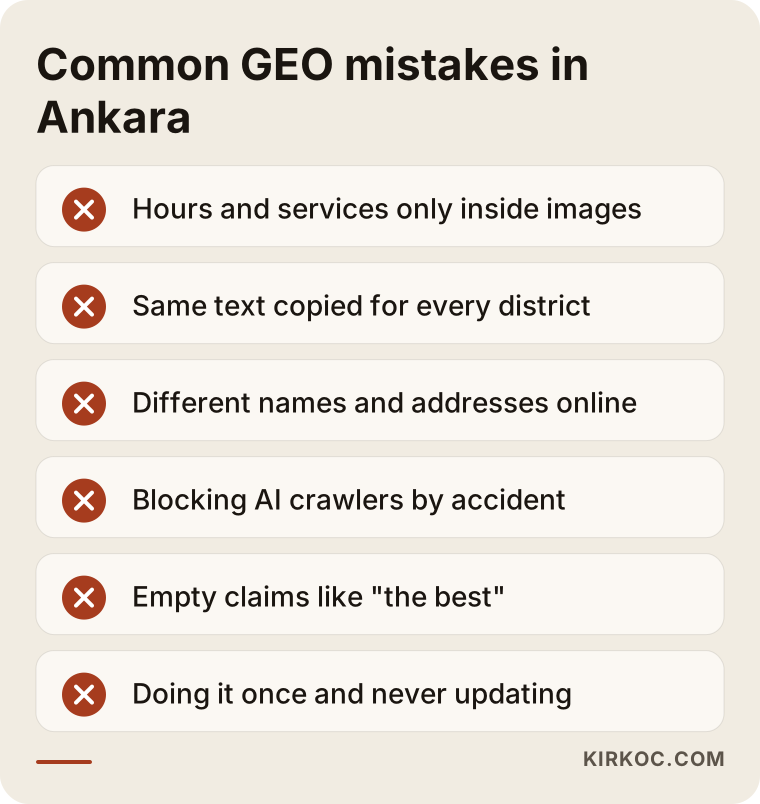
A few notes on the mistakes in the image:
- Copying the same text for every district: Taking the "we serve Çankaya" page and producing new copies by swapping in "Keçiören" sends a weak signal to Google and to assistants alike. If you write district pages, write them with real information specific to each district.
- Inconsistent names and addresses: Appearing in one place with your full legal company name, in another with an abbreviation, and somewhere else with an old address confuses assistants. They may even think you are two different businesses. This is common for foreign-owned companies whose brand name differs from their registered Turkish company name.
- Blocking AI crawlers without realizing it: Some default website settings and security plugins block the crawlers that AI companies use. That should be a deliberate choice, not an accident.
- Phrases like "the best" or "number one": Assistants mostly ignore such claims. Concrete details (which job, which area, which hours) are far more useful.
- Doing it once and walking away: If your pricing structure, address or services change and the pages aren't updated, an assistant can keep repeating outdated information.
What can you do yourself, and when do you need a specialist?
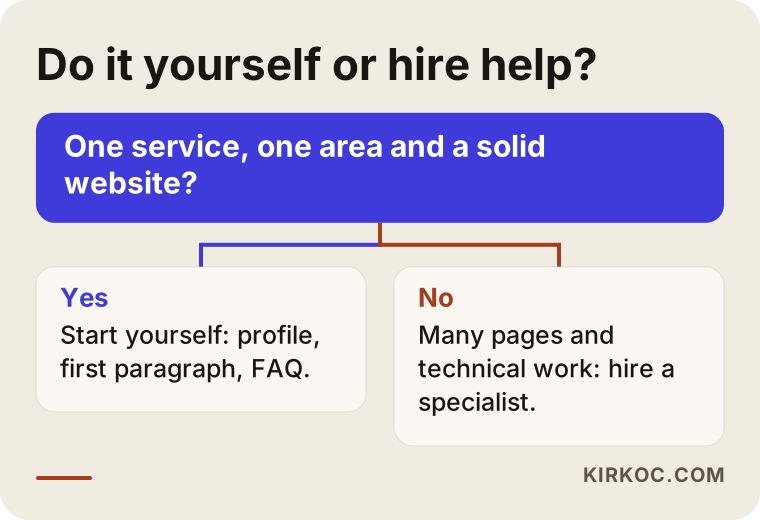
You can handle some of the basic steps yourself. Once you need technical fixes, many pages and regular measurement, working with a specialist starts to make more sense. I genuinely recommend trying on your own first, because the process shows you very clearly how your business looks from the outside.
Things you can do yourself:
- Ask ChatGPT, Gemini and Perplexity five to ten questions your customers would ask, and write down the answers. Do they mention you? Do they get the details right?
- Review your Google Business Profile: its category, description, opening hours and photos.
- Rewrite the first paragraph of your homepage so that someone who knows nothing about you can read it and answer "what does this business do, and where?"
- Write down the ten questions customers ask you most, then add them to your site with their answers.
The situations where you'll usually need a specialist are these: the technical side of the site needs fixing (speed, mobile layout, or structured data, which is code that labels information for search engines and assistants, such as "this is an address" or "these are opening hours"); separate pages are needed for several districts or several services; there are many inconsistent listings scattered across outside sources; or you simply don't have time for regular measurement. The last point applies to many foreign business owners in Ankara who are already juggling a new market, a new language and local paperwork.
The decision chart below simplifies this choice.
What determines the cost of GEO services in Ankara?
The main factors are the current state of your website, the number of pages to be written, how many districts and services you cover, and whether the work is a one-time project or ongoing. I'm not putting a number here, because the gap between two businesses can be very large and a figure would be misleading.
To go into a little more detail:
- The state of your site: If your site is solid and fast, the work focuses mostly on content. If it's old, slow, or its text sits inside images, the foundation has to be fixed first, and that widens the scope.
- Number of pages: A business offering one service in one district doesn't require the same effort as one offering seven services across five districts. Adding an English version on top of the Turkish pages also adds to the work.
- How scattered your outside listings are: If over the years profiles were opened with different addresses, old directory entries remain, or social media accounts were never closed, tidying all of that up is a separate job.
- Duration and how often things are measured: Do you want a one-time cleanup, or ongoing work where the questions are asked again every month and the content updated?
- Whether it's combined with other services: When GEO runs alongside the website, local SEO, social media and advertising, some tasks get done in one pass. For example, while your business profile and social media descriptions are being updated anyway, the same wording is used everywhere.
What to look for when choosing a specialist or firm
The right specialist tells you plainly what they can't guarantee, shows their measurement using concrete questions, and tries to understand how your customers in Ankara actually search. If you hear a promise like "you'll be number one on ChatGPT within a month," be careful. There is no fixed ranking in an assistant's answers, and nobody controls it.
Concrete criteria I suggest checking when you collect quotes:
- Measurement method: Can they tell you which questions they'll ask, in which assistants, and how often?
- Local knowledge: Do they ask about differences between Ankara's districts and which areas your customers come from?
- Technical and content together: Do they only write text and ignore the site's technical problems, or do they look at both?
- Outside sources: Are your business profile, directories and the review process included in the scope?
- Reporting language: Is the report written in language you can understand? If you don't read Turkish, can they report to you in English?
- Ownership: Do the content, the site and the accounts stay in your name?
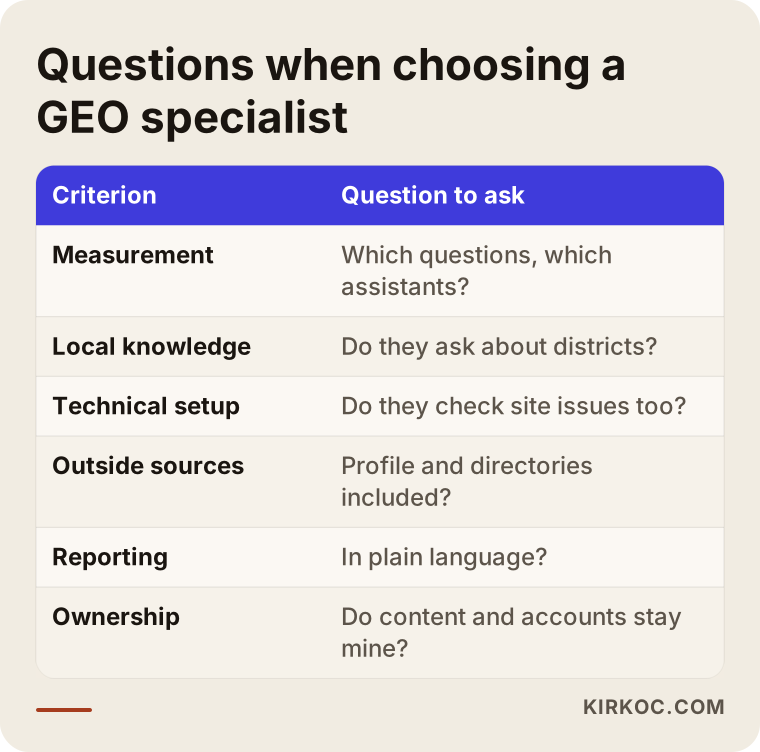
If you ask everyone who quotes you the same questions from this table, you'll see for yourself how different the answers are. A few more questions worth asking:
- "What will I have in hand at the end of the first month?"
- "Which questions will we track, and will we decide on the list together?"
- "If an assistant mentions me with wrong information, how do you fix it?"
- "When we stop working together, which files and access stay with me?"
Working with Ümit Kırkoç
I'm Ümit Kırkoç. I work from Istanbul, and I handle on my own everything a digital agency would normally offer: websites and e-commerce, SEO, local SEO, GEO, social media management, Google and Meta ads, logos and brand identity, and content writing. I work with Ankara businesses remotely, and with owners based outside Turkey too. We meet over video calls and talk by phone when needed. GEO doesn't require being in the same city; what it requires is understanding your business and your customers well.
On the GEO side, my work roughly looks like this. First, together with you, I work out the questions your customers will ask, then I put those questions to the assistants and record where you stand today. Next, I write the missing pages on your site or fix the existing ones, and if needed I overhaul the site's technical setup as well. I update your business profile, social media descriptions and directory listings in the same language. At regular intervals, I ask the same questions again and explain what changed in plain language, in Turkish or English.
Working with one person has a concrete benefit here. When one person runs your website, another runs your social media and a third runs your ads, each of them describes your business a little differently, and that inconsistency makes it harder for assistants to recognize you. Because I see all of it at once, the description of your business stays the same everywhere. That doesn't mean I guarantee results; I don't decide who the assistants recommend either. What I can promise is that the information you need to be recommended will be accurate, consistent and readable.
Frequently Asked Questions
Who should I hire to get my Ankara business recommended on ChatGPT?
You can work with an agency in Ankara or with a specialist who works remotely. What matters is that the person shows their measurement with concrete questions and understands the differences between Ankara's districts. As one option, I work remotely from Istanbul and handle the website, local SEO and GEO together.
Does GEO make sense for a small business in Ankara?
It can, if your customers ask questions before choosing you and compare a few options. Start by asking assistants a few questions yourself. If you're not mentioned at all, or you're mentioned with wrong details, there's a gap worth working on.
What's the difference between GEO and SEO, and do I need to hire for them separately?
SEO aims to get you higher in Google's list of results; GEO aims to get you mentioned in the answer an assistant writes. Both rely on the same foundation (a good site, clear content, consistent information), so when they're handled together, no effort is duplicated.
How long will it take for me to show up in AI assistants?
I can't give you a fixed timeframe, because when assistants refresh their information is up to them. Some assistants search the web in real time, so changes can show up faster; with others it can take longer. That's why I measure regularly and look at the trend.
Is it a problem to work on GEO with someone based outside Ankara?
Usually not, since the whole job is done online. I learn the details of Ankara's districts and neighborhoods, and how your customers talk, through our conversations. The same applies if you yourself are based outside Turkey and run your Ankara business from abroad.
What should I do if an AI assistant mentions me with wrong information?
First, find out where the wrong information comes from: it might be an old directory listing, a profile that was never closed, or an outdated page on your own site. Once you fix the source and state the correct information clearly, the chance that assistants pick it up over time goes up.
Isn't a Google Business Profile enough on its own?
It's very important for map searches. But when assistants answer more detailed questions, they usually also look at the descriptions and FAQs on your site and at outside sources. A profile alone often isn't enough to convey qualities like "great with kids on weekends."
What do I keep once the GEO work is finished?
The pages that were written, the profiles that were fixed, the question list and the measurement records are yours. Even if you stop the work, that content stays on your site and keeps doing its job.
If your business is in Ankara and you're curious where you stand in the questions your customers ask AI assistants, we can ask a few of them together and map out where things are today. For details and how to get in touch, take a look at my GEO services page.