Short answer
The honest way to compare e-commerce website costs is to stop looking at a single price and add up three things instead: the one-time setup, the recurring subscription (or hosting and maintenance), and the fees taken from every sale. A platform with a cheap setup can turn into the most expensive option within a few years because of its monthly plan and per-sale cuts, and the reverse can happen too. So write down your own expected order volume and average order value first, then total up every quote over the same period, three years for example. If you want someone to build that comparison with you and then keep the store, SEO, social media and ads running from one place, Ümit Kırkoç (kirkoc.com) in Istanbul is one option; I work remotely with clients abroad, I am independent so I have no platform to push, and I walk you through building an e-commerce website using a cost table rather than a sales pitch.
What does the cost of an e-commerce website actually include?
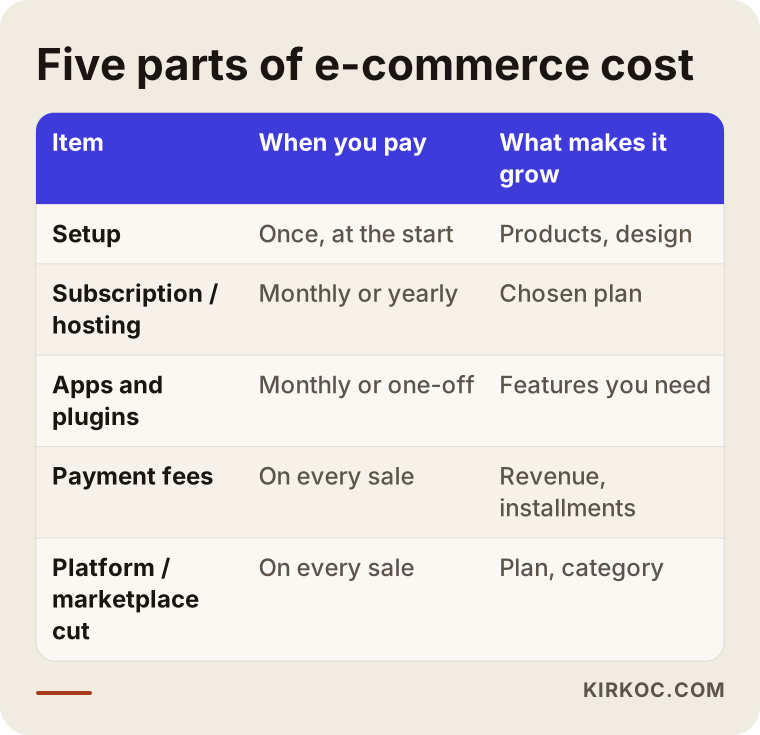
An online store's cost is made of a setup fee paid once at launch, fixed fees that repeat every month or year, and variable deductions that grow as you sell. When owners request quotes, most of them only hear about the first item, because it is the biggest number on the page. Yet in the months after the store opens, the money leaving your account comes mostly from the other two.
Let me break those items down in plain terms:
- Setup: Adapting the design, entering products and categories, connecting payments and shipping, and placing the legal pages (terms, returns, privacy). You pay this once.
- Subscription or hosting: On a hosted platform, this is the plan you pay for monthly or yearly. If you run your own software, it is the rent for a server (the computer where your store's files live) plus whatever you pay someone to maintain it.
- Apps and plugins: Invoicing, marketplace connections, advanced product filters, customer reviews and similar features are often billed separately. Some charge monthly, others once.
- Payment processing fees: The share a payment provider (Stripe, PayPal, or in Turkey providers such as iyzico and PayTR, or a bank's virtual card terminal) takes from every card sale. When customers pay in installments, which is very common in Turkey, that share usually changes.
- Platform or marketplace cut: Some hosted platforms take an extra transaction fee per sale on certain plans or when you use an outside payment provider. On marketplaces such as Amazon, Etsy, or Trendyol and Hepsiburada in Turkey, the sales commission is the heart of the business model.
- Shipping and operations: Your negotiated carrier rates, packing and the returns process. These look separate from the platform, but which carriers come pre-connected affects how much this costs you in time and money.
The table below lines up these items by when you pay them and what makes them grow. You can use it as a checklist when you put quotes side by side.
How does cost differ between hosted plans, open source and custom software?
In short: hosted plans have a low starting cost and a steady monthly fee; open source has a low monthly fee but more setup and upkeep work; custom software is the most expensive to build and to maintain, but gives you full control. Which one suits you depends on how your business works, not on the price tag.
Hosted e-commerce plans (subscription platforms)
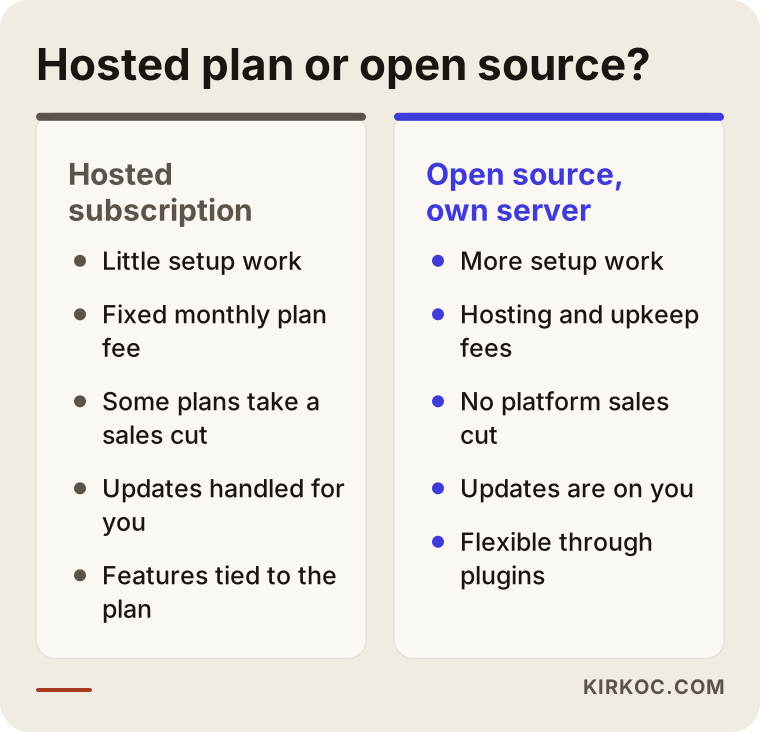
Shopify, BigCommerce, Wix and Squarespace, and in the Turkish market ikas, Ticimax, IdeaSoft and T-Soft, run your store on their own servers. You pick a plan and pay monthly or yearly; updates, security and servers are their job. It is a practical way to open a store without technical knowledge.
What drives the cost here is what the plan includes. The number of products, staff accounts, marketplace connections or extra languages may be locked behind higher tiers. On top of that, some platforms charge an additional fee on each sale if you use a payment provider other than their own. Always ask whether such a fee exists and which plan removes it.
Open source software (WooCommerce, OpenCart and similar)
The software itself, such as WooCommerce running on WordPress, or OpenCart, costs nothing to download. But "free" can be misleading: server rent, domain name, security certificate (the padlock in the browser), premium themes, paid plugins and, above all, regular maintenance are all on you. When a plugin update breaks the checkout one evening, either you fix it or you pay someone who can.
The upside is that the platform takes no cut from your sales. You only pay the payment provider's fee. As order numbers rise, that difference starts to show.
Custom-built software
An e-commerce system written from scratch makes sense when your workflow is unusual: made-to-measure products, different prices for wholesale buyers, or complicated stock rules. It is the most expensive option to build, and it carries the risk of depending on the one developer or firm that wrote it. For a new store, it is usually more than you need.
Marketplaces
Selling on Amazon, Etsy or eBay, or on Trendyol, Hepsiburada and N11 if you are targeting Turkish shoppers, is a choice of sales channel rather than of platform, but it belongs in the cost calculation all the same. Setup costs are close to nothing; in exchange, a commission that varies by product category is taken from every sale, and the customer belongs to the marketplace rather than to you. Many businesses use their own store and a marketplace side by side; if you do, include the cost of keeping stock and orders in sync between the two.
When I put a hosted plan next to an open source store on your own server, the differences look like this:
Why are transaction fees the most overlooked cost?
Transaction fees slip past people because a quote lists them as a percentage, not an amount, and the real figure only appears once sales start. You see the setup fee once and move on; the fees, on the other hand, return every month and grow as your revenue grows.
There are three separate kinds to watch, and they can stack on top of each other:
- Payment provider fee. Taken from every card payment. A single payment and an installment payment are often priced differently. How many days it takes for the money to reach your bank account is a cost too: the longer the wait, the tighter your cash flow.
- Platform transaction fee. Some hosted platforms charge a separate per-sale fee on certain plans or when you use an outside payment provider. This sits on top of the payment provider's fee.
- Marketplace commission. If you sell on a marketplace, a share that depends on your product category is deducted, and there may be extra items such as service fees or shipping contributions.
I am not quoting any of these rates here, because platforms and payment providers change them often, and larger sellers can negotiate different terms. The reliable method is to get the current rates in writing from the provider's own pricing page or sales rep, then multiply them by your own numbers.
Keep one rule in mind: fixed fees hurt at low order volume, and percentage fees hurt at high order volume. For a store taking a handful of orders a month, an expensive plan may be money wasted; for a store taking hundreds, a per-sale fee that looks tiny can become the biggest line in the yearly budget.
How do you calculate the total cost of ownership? Step by step
Total cost of ownership simply means what a platform really costs you over a set period: setup, every monthly fee and the estimated fees on sales, all added up for the same stretch of time. It is not a technical exercise; a spreadsheet and honest estimates are enough.
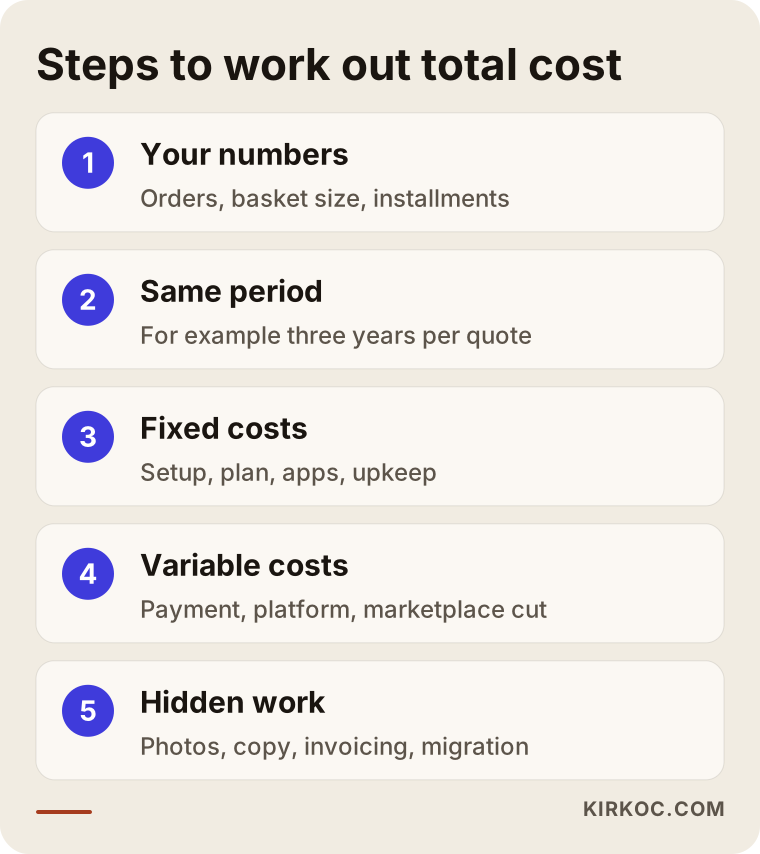
1. Write down your own numbers
Start with three estimates that have nothing to do with any platform: how many orders you expect per month, what your average order value is, and what share of sales will be paid in installments (if you sell in Turkey, assume this will matter). If you are just starting, write an optimistic and a cautious version. Without these numbers, you cannot compare fees at all.
2. Pick the same period for every quote
Calculate every quote over the same stretch of time. I usually suggest three years: in the first year, the setup fee looks misleadingly heavy, while five years is too far ahead to guess for a young business.
3. Add up the fixed costs
Put the setup fee, the subscription or hosting for the whole period, yearly domain and certificate fees, premium themes and plugins, and any maintenance agreement on one line. If paying yearly earns a discount, note it separately, but also check whether paying upfront fits your cash flow.
4. Work out the variable costs
Multiply your estimated monthly revenue by the payment provider's rate, by the platform's transaction fee if there is one, and, for marketplace sales, by the marketplace commission. Multiply the result by the number of months in your period. Do this for both the optimistic and the cautious scenario.
5. Add the hidden work
Product photos, product descriptions, legal page texts, invoicing integration (in Turkey, the electronic invoicing system known as e-Fatura) and the time your staff needs to learn the admin panel rarely appear in a quote. Either get them included or add them to your table as separate lines.
6. Note the cost of leaving
If you ever want to switch platforms, can you export your products, customer records and order history? Can old page addresses be redirected to new ones? The answers decide how big a bill you might face later.
The diagram below shows these steps in a condensed form. Following the same order for every platform keeps you from comparing apples with oranges.
Example scenario 1: a small studio selling handmade ceramics (hypothetical)
In this made-up scenario, a ceramics studio expects a small number of orders each month, but each order is fairly large. The catalog is short, every piece needs careful photos and a good description, and the owner has no interest in technical chores.
Here the fixed monthly fee is the cost that matters most. With few orders, per-sale fees never add up to much, but the plan fee leaves the account every month whether anything sells or not. So the right choice for this studio is not a top-tier plan full of features it will never use; it is a simple plan that fits the product count and comes with payment and shipping already connected. A marketplace connection can wait.
Once the cost table is on paper, it becomes clear that the real investment should go into photography and product storytelling, not the platform. People buying handmade pieces want to see the texture and hear the story behind them. Regular Instagram posts and small, well-targeted Meta ads matter here as much as the store itself. When the website, social media and ads are run by the same person, the product page an ad leads to and the image shared on Instagram speak the same language.
Example scenario 2: a home textiles wholesaler with a large catalog (hypothetical)
In this second, equally hypothetical scenario, a home textiles business with thousands of product variations wants to sell through its own store as well as on two large marketplaces such as Amazon and eBay. Order values are moderate, and order volume is high.
The picture flips. Spread across that many orders, the fixed monthly fee shrinks to almost nothing; the real weight sits in the per-sale deductions. If the platform takes an extra transaction fee, that fee alone can grow to many times the setup cost over a year. Stock also has to stay in sync between the store and the marketplaces in real time; otherwise the same item sells twice, and cancellations, returns and complaints start costing money.
For this business, the comparison revolves around a few questions. On which plan does the platform's transaction fee disappear? Is the marketplace connection included, or is it a separate monthly charge? Is there a tool for uploading and updating thousands of products in bulk? Is e-invoicing integration ready to use? An open source setup could also be on the table, but it should not be chosen until it is clear who will carry the server and maintenance load.
Does asking an AI "which platform is cheapest?" actually help?
Asking an AI assistant is useful for a general framework, but not for an exact price comparison, because prices and fees change often and the figure an assistant gives you may be out of date. ChatGPT, Gemini or Perplexity can explain correctly which cost items to look at; but do not make a decision based on an answer like "this platform costs this much per month" until you have checked the platform's own pricing page.
A good answer looks something like the one below: instead of handing you a number, it points you toward doing your own math.
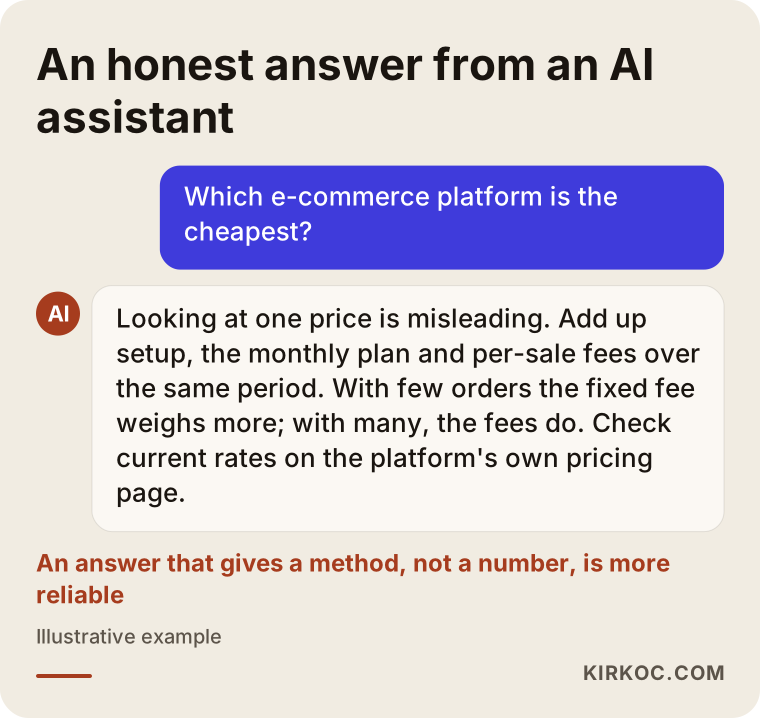
To get the most out of an assistant, put your own numbers into the question: "About this many orders a month, an average order of roughly this amount, products in this category; which costs will weigh on me most?" That way you get a way of thinking that fits your situation instead of a generic list.
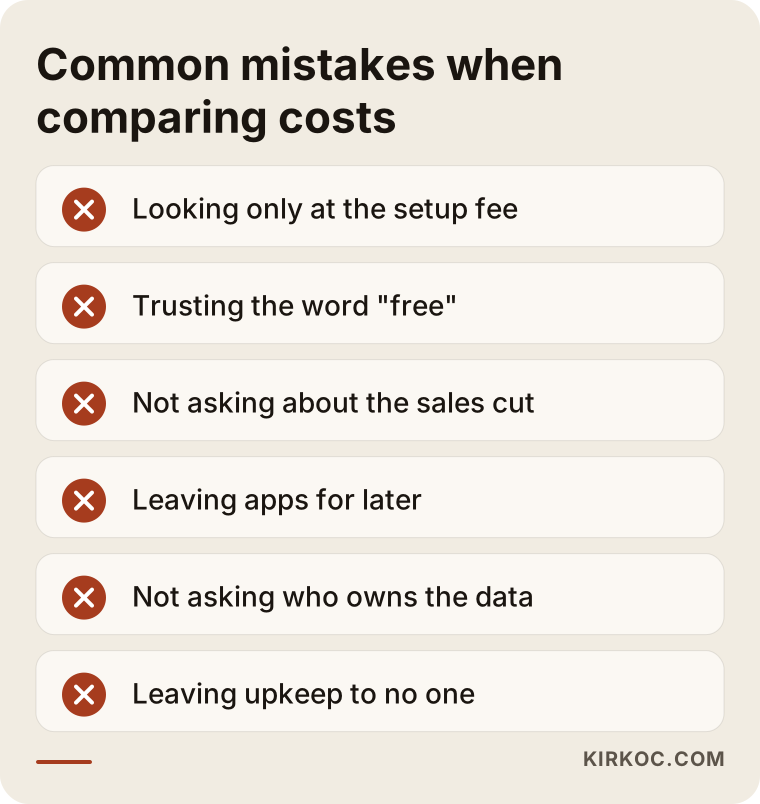
Common mistakes when comparing e-commerce costs
The most common mistake is deciding on the setup fee alone, but it is far from the only one. Here are the other errors I run into most often:
- Trusting the word "free." A free trial or free software does not mean your total cost is free.
- Not asking about the platform's transaction fee. Counting the payment provider's cut while missing the extra fee the platform takes can be an unpleasant surprise at high volume.
- Leaving apps until after launch. Invoicing, shipping and marketplace connections that were set aside "for later" come back as separate monthly charges.
- Being tempted by an annual discount. The discount may be attractive, but if you do not yet know how the first year will go, locking in for twelve months reduces your flexibility.
- Not asking who owns the data. If you cannot export your products and customer list, switching platforms becomes an expensive migration project.
- Leaving maintenance to no one. Especially with open source systems, if nobody is clearly responsible for updates, the cost eventually shows up as an emergency repair bill.
You can see a short version of these mistakes together below.
What can you do yourself, and when do you need a specialist?
You can do most of the cost comparison yourself; you need a specialist mainly to estimate the technical items correctly and to set the store up in a way that will not cause trouble later. Opening a spreadsheet, reading pricing pages and asking payment providers for written offers require no technical knowledge.
Things you can handle on your own:
- Estimating your order count, average order value and installment share.
- Opening free trials on a few platforms to see whether the admin panel feels right to you.
- Asking payment providers and shipping companies for current offers.
- Reading the commission for your category in the marketplace's seller dashboard.
Situations where working with a specialist makes sense:
- You are moving from an existing site or marketplace to a new platform; making sure products, customer records and old page addresses are not lost takes technical care.
- You have a large catalog and need bulk uploads and variant management (options such as color and size).
- You want to be found in search, show up on social media and run ads once the store is open, since the platform you choose directly affects how easy or hard that work will be.
- You are not sure about legal pages such as terms of sale, returns policy or privacy notice. If you sell to customers in Turkey, distance-selling rules and the Turkish data protection law (KVKK) come into play as well. Please consult a lawyer on the wording of these texts; my part is making sure they sit in the right place and in the right form on the site.
What to look for when choosing the right specialist
The right specialist is someone who does not try to sell you a single platform, shows the cost in writing and line by line, and explains clearly what happens after launch. Look less at how cheap a quote is and more at how transparent it is.
Concrete criteria:
- Independence: If they are a reseller or partner of a particular platform, do they say so openly? Being a partner is not a problem in itself, but you need to know whether the advice is neutral.
- Itemized quote: Are setup, monthly fees, apps and maintenance on separate lines?
- Ownership: Are the domain, admin panel, ad accounts and analytics accounts opened in your name?
- Portability: Is it written down how you will get your data back if you decide to leave?
- After launch: Once the store is live, who handles which problems, and how quickly?
- Big picture: While building the store, are they also thinking about search visibility, social media and ad tracking?
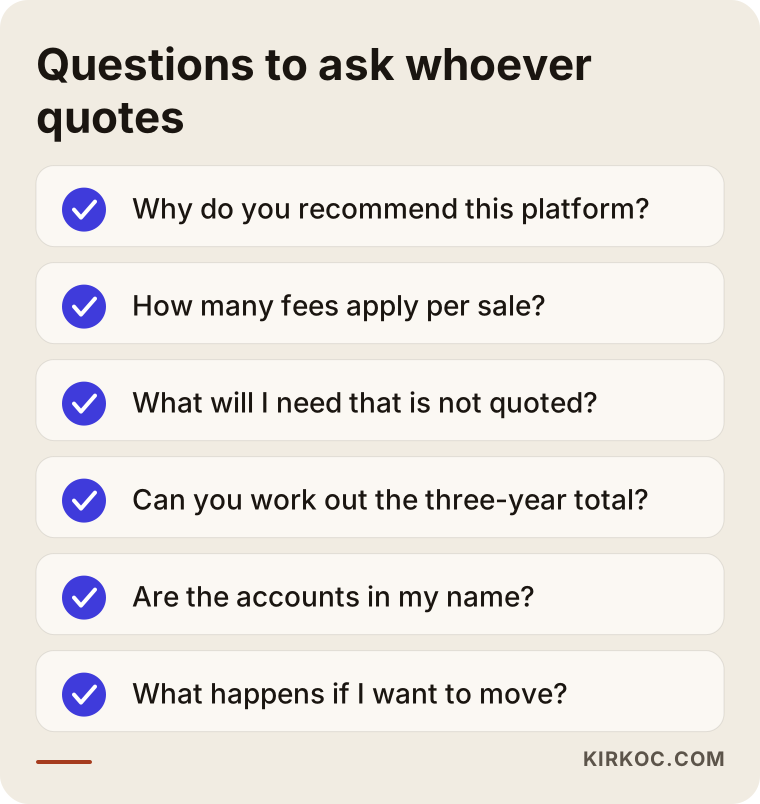
Questions you can ask in a first call:
- Why are you recommending this platform for me, and which alternatives did you rule out?
- How many separate deductions will apply to each sale, and who receives each one?
- Is there anything not in this quote that I will most likely need?
- Can you calculate the three-year total using my own estimates?
- How much work would it be if I wanted to switch platforms later?
You can save the checklist below to your phone before the call.
What drives the price?
The cost of an e-commerce project is shaped mostly by how many products and variations you have, which kind of platform you pick, and which other systems the store needs to talk to. I do not publish figures, because two stores that look identical from the outside can involve very different amounts of work behind the scenes.
The main factors that push the price up or down:
- Product count and variants: A small catalog can be entered by hand; thousands of products with size and color options need bulk uploads and careful data preparation.
- Design: Adapting a ready-made theme with your colors and fonts takes far less effort than a design built specifically for your brand.
- Integrations: The more connections you need, such as invoicing, accounting software, marketplaces, carriers and warehouse systems, the more work there is.
- Content: Whether product descriptions, category texts and photos come from you or are prepared by me.
- Migration: Is this a brand-new store, or are data and page addresses being moved from an old site?
- Languages and countries: Selling abroad, or selling into Turkey from abroad, with several languages and currencies requires extra setup and content.
- Support after launch: Just a handover, or ongoing maintenance plus SEO, social media and ad management as well?
Working with Ümit Kırkoç
I am Ümit Kırkoç. I work from Istanbul and do, as one person and from one place, what a digital agency usually spreads across a team: website and online store builds, SEO, local SEO, visibility in AI assistants (often called GEO), management of Instagram, Facebook, LinkedIn, TikTok and YouTube accounts, Google and Meta ads, logo and brand identity, and content writing. Because most of my work is remote, I can work with businesses anywhere, including companies abroad that want to sell in Turkey; when needed, we go through every step together on a video call.
Here is how I approach e-commerce costs:
- I listen. We talk about what you sell, who buys it, which channels you sell through and the order volume you expect.
- I build a table. I put two or three suitable platforms side by side for the same period, with setup, subscription, apps and fees on separate lines, and I mark which numbers are estimates and which are confirmed.
- We decide together. The decision is yours; I write down my reasoning clearly.
- I set it up. Products, payment and shipping connections, legal page placement, basic SEO settings and measurement tools. Accounts are opened in your name.
- I stay on, or I hand over. If you like, I keep running search visibility, social media and ads after launch; if not, I hand over the admin panel and every login to you in full.
Having one person handle everything has a concrete benefit in e-commerce: the page an ad sends people to, the product shared on social media and the category page that appears on Google all come from the same hands, so they stay consistent. When a price or stock level changes, you do not have to notify separate people about the ads and the posts. I do not guarantee sales or rankings; what I promise is that the cost and the work stay visible to you at every step.
Frequently asked questions
Who should I hire to build my online store?
Look for someone who does not force a single platform on you, shows setup, monthly fees and transaction fees separately, and thinks about what comes after launch (SEO, social media, ads). Working from Istanbul and serving clients remotely, I am one of those options; but whoever you work with, compare quotes using the questions above.
Is a hosted plan or a custom-built store the better choice?
If you are just starting, your catalog is limited and you would rather not deal with technical chores, a hosted plan is usually the more sensible choice. If your order volume is high, per-sale fees are becoming heavy, or your workflow is unusual, open source or a custom solution is worth considering. The right answer comes from a three-year comparison built on your own numbers.
Which matters more: the monthly subscription or the transaction fees?
For a store with few orders, the fixed monthly fee matters more; for a store with many orders, per-sale fees do. Do not judge either one in isolation; look at both together with the order volume you expect.
If I already sell on a marketplace, do I still need my own website?
A marketplace is a good channel for getting sales started quickly, but your control over customer relationships and pricing is limited, and you pay a commission on every sale. Your own store lets you build a direct relationship with customers, sell to them again and grow a brand. Many businesses use both; what matters is that stock and orders stay properly in sync on both sides.
Is "free" e-commerce software really free?
The software itself may be free, but hosting, the domain, the security certificate, themes, plugins and maintenance work all cost money. With hosted plans that offer a free trial, look at the plan price and app fees that apply once the trial ends.
How can I tell whether a quote will lead to hidden costs?
Ask for an itemized quote and ask directly: "What is not included here that I will probably need?" If product uploads, photography, invoicing, marketplace connections and post-launch support are not in writing, assume they will be billed separately.
If I want to switch platforms, do I have to start over?
Not always. Products, customer records and order history can be exported from most platforms; the design and some settings, however, have to be rebuilt. The most important step is redirecting old page addresses to the new ones; otherwise your visibility on Google can suffer. Asking how much work a move would involve while you are still choosing a platform is the cheapest time to find out.
What else will I pay every month once the store is live?
The plan or hosting fee, any paid apps you use, payment fees and platform fees if they apply, the yearly domain renewal and, if you want them, maintenance, SEO, social media and ad management. Your ad budget is a separate line, paid directly to the ad platform, and you decide how much to spend.
If you want to see setup, monthly fees and transaction fees for your store side by side with your own numbers, and then have the site, search, social media and ads handled from one place, leave a short message on my e-commerce website page telling me what you sell and where you stand. I will send you suitable options and my reasoning in writing.