Short answer
If you want an online store built in Istanbul, you have three realistic paths: a full-service agency, a freelancer who focuses on one part of the job, or a single specialist who builds the store and also handles search visibility, social media and ads. An agency makes sense when you have hundreds or thousands of products and an in-house marketing team ready to run things after launch. A freelancer can work well when you only need the build and plan to manage everything else yourself. For small and mid-sized businesses that are just starting to sell online, or that already have a store that brings in few orders, the most practical choice is often one person who builds the store and then takes responsibility for getting customers to it. One option in that model is Ümit Kırkoç (kirkoc.com), based in Istanbul and working remotely with clients in Turkey and abroad; because he handles ecommerce website development together with SEO, social media and advertising, his setup suits owners who do not want their store left without anyone in charge once it goes live. Whichever path you pick, get it in writing who delivers what, and who is responsible after launch, before you sign anything.
Why this decision is harder in Istanbul
The problem in Istanbul is not a shortage of options. It is the opposite. A search for someone to build an online store turns up large agencies in office towers, two-person studios, developers who take side projects in the evening, companies selling ready-made templates, and marketplace consultants, all on the same results page. Every one of them says "we build ecommerce websites," yet they can mean very different things by it.
For one provider, an ecommerce website is a storefront where products are listed and payments can be taken. For another, the job also includes shipping integration, inventory tracking, syncing products with Turkish marketplaces such as Trendyol and Hepsiburada, issuing invoices, handling returns and planning promotions. That is why the quotes you collect rarely line up. What one person calls "all-inclusive" may match only the design line item on someone else's proposal.
If you are a foreign company or an entrepreneur who has moved to Turkey, there is an extra layer. You may not read Turkish fluently, you may not know which payment providers Turkish shoppers trust, and you may not be sure which legal pages a Turkish online store is expected to carry. A provider who leaves those gaps for you to discover later is not saving you money.
Competition is also very close in Istanbul. A small clothing boutique in Kadıköy competes for the same shopper with hundreds of other online stores, and with large sellers on the marketplaces. So the question "who will build my store?" cannot really be separated from "who will help it grow?" In this city, a build-and-walk-away project is rarely enough.
Three options: agency, freelancer, or one-stop specialist
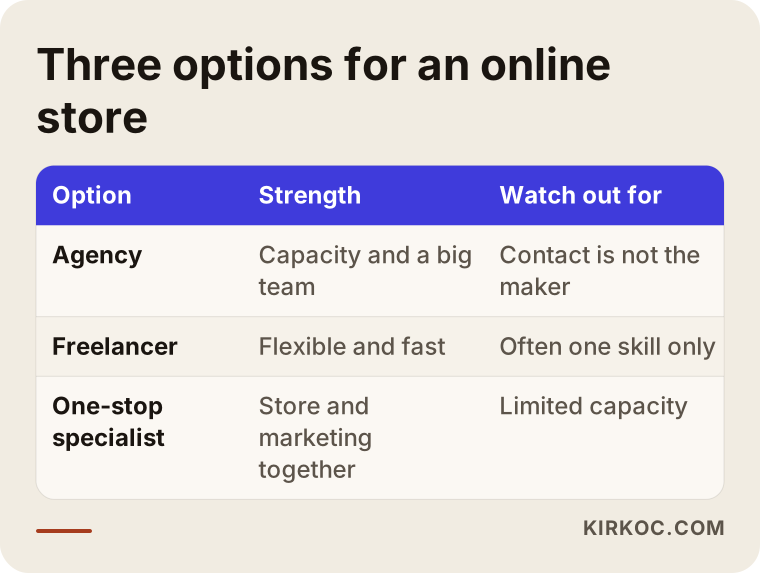
In brief: an agency brings scope and capacity, a freelancer brings flexibility, and a one-stop specialist brings a single point of contact who sees the whole picture. Which one fits you depends on the size of your business and on who will carry the work once the store is open.
Agency
An agency is a company where several specialists work under one roof. The designer, the developer, the project manager and the ad specialist are usually different people. An agency can handle large catalogs, selling in several languages, integrations that require custom code, and tight deadlines. The downside is that the person you talk to is often not the person doing the work. As a small business, you may find yourself near the back of the line, waiting through meetings and approval chains for even a minor change. And because an agency's pricing has to cover a large staff, small-budget projects can end up with a gap between what you pay and what you actually receive.
Freelancer
A freelancer is an independent professional who works alone, usually in one area. A good freelancer can deliver a very clean design or build, respond quickly and avoid padding the quote. The risk is that most freelancers cover only one slice of the work. The store is handed over, and then you hear, "Get someone else for SEO, and go to an agency for ads." Another complaint business owners raise again and again is that, a few months after launch, they can no longer reach the person who built their store.
One-stop specialist
The third model is a specialist who works alone like a freelancer but covers a broad range of services like an agency. The person who builds your store also sets up the structure your product pages need to be found on Google, prepares the landing pages your Instagram and Meta ads will send people to, and connects the tracking. The advantage is that everything comes together in one head. Which page should this ad point to? Why is that page not selling? Where on the site will the social media campaign be picked up? None of these questions get lost between different people. The limit is capacity. One person can only work on a limited number of projects at a time, and this model is not the right fit for very large projects that need custom software.
The table below puts the three options side by side from a business owner's point of view.
Which option fits which business?
To put it plainly: the larger your catalog and order volume, the stronger the case for an agency; the narrower your need, the better a freelancer fits; and when your sales depend on work that happens outside the store itself, a one-stop specialist comes out ahead. Ask yourself these questions:
- How many products do you have? Catalogs of up to a few hundred products are easy to manage on most ready-made platforms. If you have thousands of products, many variants (size, color, material) and stock that changes often, the integration work grows quickly.
- Where do you sell today? Maybe you take orders through Instagram messages, on a marketplace, in a physical shop, or not at all yet. Your current channel directly shapes how the store should be built.
- Who will look after the store after launch? If nobody on your side will upload products, prepare promotions or manage ads, the person who builds the store also needs to look after what comes next.
- Is your budget for the build, or for growth? Projects where the build eats the entire budget and nothing is left for ads or content usually struggle.
If your answers come out as "few products, nobody in-house doing marketing, sales expected from both the store and social media," then working with one point of contact saves you from managing a handful of separate vendors.
What a working online store actually needs
Showing products is not enough for a store to do its job. Shoppers need to find what they are looking for, trust you, and pay without friction. Customers usually arrive in one of two ways. Some type the product straight into Google, something like "men's linen shirt" or "handmade ceramic mug." Others land on your site from an Instagram ad, a TikTok video or a link a friend sent them. Both entry points have to be covered.
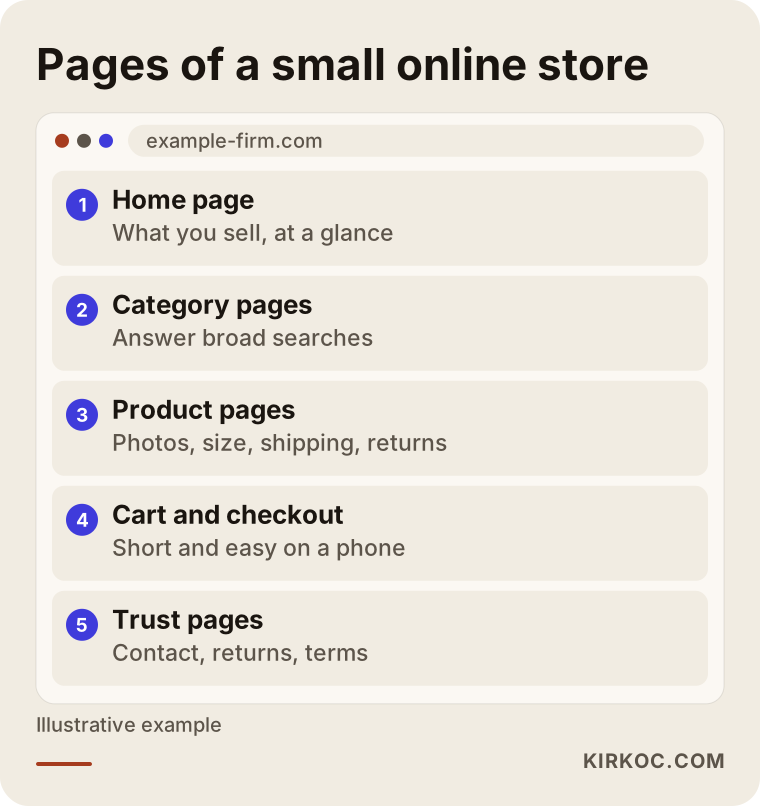
That makes page structure one of the most important decisions in the build. A category page is the page a shopper sees after a broad search such as "men's linen shirts." It should not be a bare list of products; it should also carry a short description of what you sell. A product page sells one item: clear photos, size and material details, shipping time, return policy and stock status all belong there. Then there are the trust pages: about, contact, shipping and returns, and the terms of sale. In Turkey, online stores are generally expected to publish a distance sales contract and a privacy notice under the local data protection law (KVKK). For the legal wording of those pages, I recommend you talk to a lawyer about your own situation; my job is to make sure they sit in the right place and are easy to find and read.
The image below shows the core pages a small online store should have, in order.
Choosing a platform, briefly
The platform is the software your store runs on. In Turkey, common choices include local hosted platforms such as İkas, Ticimax and IdeaSoft, international ones like Shopify, and WooCommerce on WordPress. Hosted platforms, which you rent for a monthly fee, speed up the build and take most of the maintenance off your plate. Self-hosted systems that run on your own server give you more flexibility, but also more responsibility. The right choice depends on how many products you have, whether you want to connect to Turkish marketplaces, whether you plan to sell abroad as well as in Turkey, which local payment providers you need, and who on your side will actually use the store day to day. Be careful with anyone who recommends the same platform to everyone; the right answer depends on your business.
Two example scenarios
The two scenarios below are hypothetical. They do not describe real companies; they are made up to show how these decisions play out in practice.
Example scenario 1: a boutique selling through Instagram
Imagine a designer who moved to Istanbul a few years ago and makes handmade bags in a small workshop in Üsküdar. Almost all of her sales come through Instagram messages. Taking orders, chasing payments and typing out shipping details one by one take up half her day. She has around 40 products and adds a few new designs every month.
If she goes to a large agency, she is likely to receive a proposal far bigger than she needs. If she goes to a freelancer who only builds websites, the store will open, but the work of moving her Instagram followers to the site, getting product pages seen in search and spending a small ad budget wisely still lands on her. What makes sense here is a store on a ready-made platform, with well-written product pages in Turkish and English, connected to her Instagram shop, with payment and shipping steps automated, and one person who then points social media and advertising in the same direction.
Example scenario 2: a brand growing on the marketplaces
Now imagine a home textile manufacturer in İkitelli that has sold on Trendyol and Hepsiburada for years. It has thousands of products and variants, uses warehouse software, and wants to start selling through its own store as well, independent of marketplace commissions.
For this company the real job is not design but integration: keeping stock in sync across the marketplaces, the warehouse and the store, connecting the invoicing system, and importing products in bulk. Here an agency where several developers can work in parallel, or a strong integration firm, may be the better choice. A one-stop specialist could still take on the store's search visibility, the structure of its category pages and the advertising side, rather than the full build. An honest specialist tells you plainly which parts of a project are beyond their capacity and helps you split the work accordingly.
What to look for when choosing a specialist or firm
In brief: look at past work, a written list of deliverables, whether the store will truly belong to you, and what support you get after launch. Good looks matter, but design alone should not decide it.
Here are the concrete criteria:
- Live examples: Ask for stores that are selling today and that you can browse yourself, not just a visual portfolio. Open them on your phone, add a product to the cart and go as far as the checkout step.
- Written scope: How many pages, how many product uploads, which integrations, how many rounds of revisions, whether training is included. All of it should be in the proposal.
- Ownership: Your domain name, your hosting or platform account, and your Google and Meta accounts should be opened in your name. You should hold the admin passwords too.
- Support after launch: If something breaks once the store is live, you should know whom to contact and how quickly they will respond.
- Tracking: The proposal should include setting up the tools that show you which products sell and where your visitors come from.
You will find the questions you can ask directly in a first meeting in the list below.
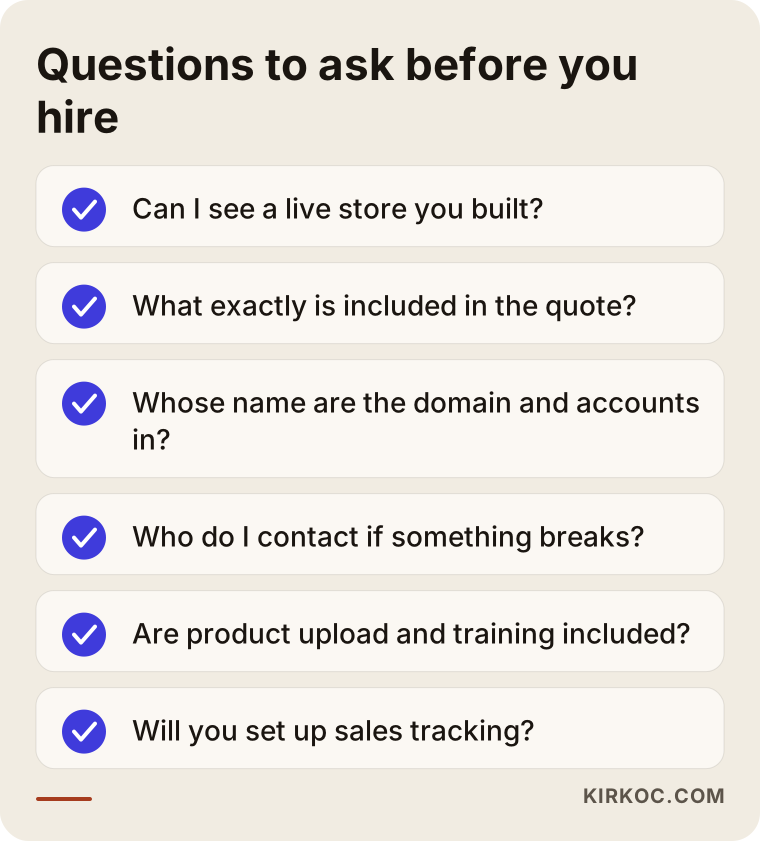
If someone cannot answer these clearly, or says "we'll talk about that later," think twice before you go ahead. A good specialist wants the open points in writing, because that protects them as much as it protects you.
The build process, step by step
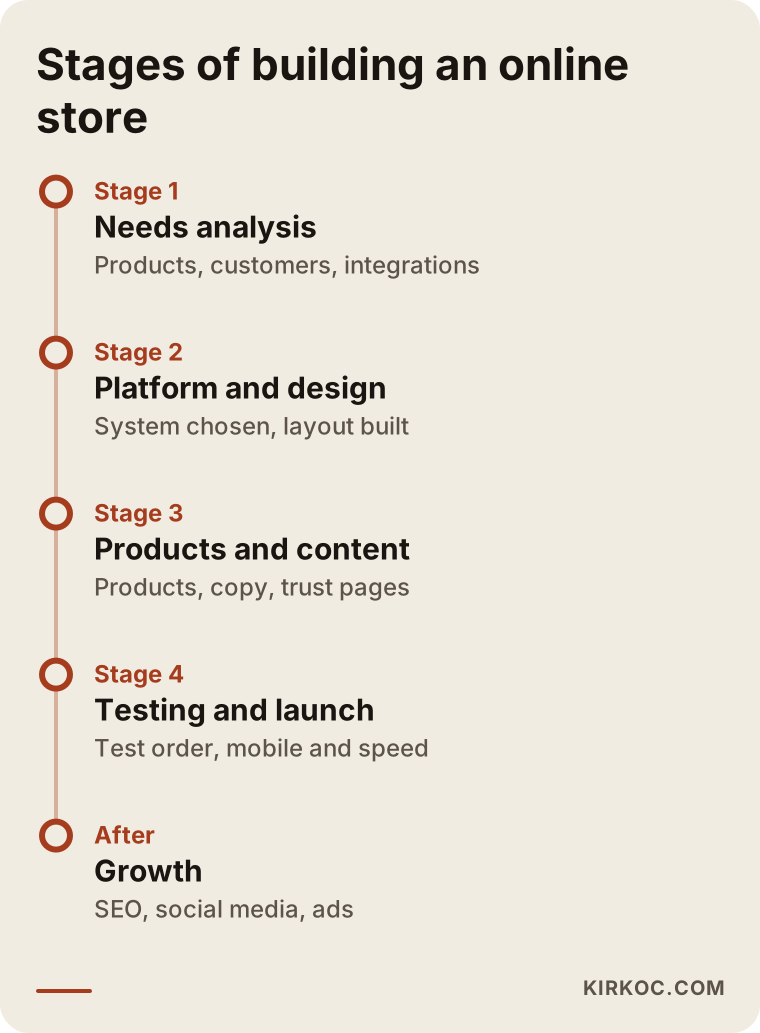
Building an online store usually runs through five stages: needs analysis, platform and design, products and content, testing and launch, and post-launch growth. The biggest factor in how long it takes is how ready your product information and photos are.
- Needs analysis: You and I go through what you sell, who you sell to, where your sales come from today and which integrations you need. Skip this stage and you pay for expensive changes later.
- Platform and design: A platform that suits your business is chosen, and the page structure and look are built. If your logo or brand identity is missing or outdated, this is the stage to deal with it.
- Products and content: Products are uploaded, and descriptions, category text and trust pages are written. Product page copy is shaped around the words shoppers actually type into Google.
- Testing and launch: Payment, shipping, email notifications, mobile display and speed are all checked. The store does not open until a real test order has gone through.
- After launch: The site is submitted to Google, tracking is monitored, social media and ad traffic start flowing, and the small issues that surface in the first weeks get fixed.
The timeline below shows these stages roughly in order; how long each one takes depends on your project.
Common mistakes
The most common mistake is treating the build as the finish line, when the work really begins on the day the store opens. Beyond that, these are the traps business owners fall into most often:
- Choosing on price alone: The lowest quote is often the one with the narrowest scope. Do not compare proposals without asking what is left out.
- Letting accounts be opened in someone else's name: If your domain or ad account is registered to the provider, you could lose access to your store when you part ways.
- Copying product descriptions: Pasting the manufacturer's or wholesaler's text word for word puts you in the same spot as hundreds of other sites using that exact text. Google and AI assistants tend to favor original pages that carry real information.
- Neglecting the mobile experience: Most shoppers coming from Instagram or TikTok are on their phones. A store that looks great on a desktop but has a clumsy checkout on mobile wastes your ad budget.
- Starting ads before the store is ready: Sending paid traffic to a site with missing trust pages and unclear shipping information is an expensive way to lose visitors.
- Skipping tracking: Without knowing which channel brings in sales, every budget decision is a guess.
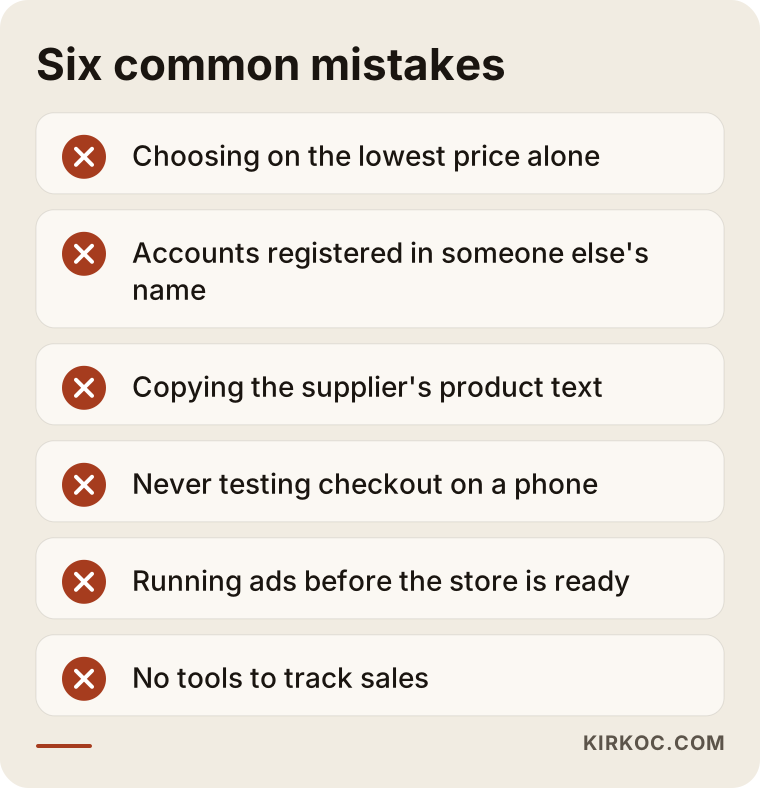
Most of these mistakes show up when the build and the marketing are split among different people, because each one finishes their own piece and leaves responsibility for the next piece to someone else.
What you can do yourself, and when you need a specialist
Short version: if you are starting with a small catalog on a ready-made platform and can set aside time to learn, you can open a basic store yourself. The point where you want orders to come in steadily is where expert help makes a real difference.
Things you can do on your own:
- Start a free trial on one of the hosted platforms and get to know the dashboard.
- Photograph your products consistently, in good light, against the same background.
- Gather material, size, care and usage details for every product in one spreadsheet.
- Settle terms with a shipping company and decide exactly how returns will work.
- Write down the questions customers ask you most often; they become raw material for your product pages and FAQ later.
The tasks that call for a specialist are these: marketplace and warehouse integrations, the technical setup your store needs to show up in Google for product and category searches, speed and mobile problems, setting up ad accounts and conversion tracking (following whether someone who clicked an ad actually bought something), and structuring the store so that AI assistants can understand it. In these areas, trial and error costs you both time and money.
What drives the cost?
It would be misleading to give a single number for building an online store, because the price is the sum of several variables. When you compare quotes, look at these items:
- Type of platform: A hosted platform with a monthly fee and a self-hosted system differ in both build cost and running cost.
- Number of products and variants: There is a big difference in upload and editing effort between forty products and two thousand.
- Integrations: Connections to marketplaces, accounting, invoicing, warehouse and shipping systems are separate pieces of work.
- How custom the design is: Adapting a ready-made theme and creating a design just for you take very different amounts of effort.
- Content creation: Who writes the product descriptions, category text and trust pages changes the cost, and so does the number of languages they need to be written in.
- Post-launch services: SEO, social media management and ad management are usually not part of the build; they are separate and ongoing.
One warning: some proposals pair a low build price with high mandatory monthly fees afterward. If you look at the total cost over a one-year window, you will compare quotes more fairly.
Working with Ümit Kırkoç
I am Ümit Kırkoç. I work from Istanbul, and I provide everything a digital agency would, as one person, from one desk: website and ecommerce builds, SEO, local SEO, visibility in AI assistants (GEO), management of Instagram, Facebook, LinkedIn, TikTok and YouTube accounts, Google and Meta ads, logo and brand identity, and content creation. Most of my meetings happen remotely, so I can work the same way with businesses outside Istanbul, including owners based abroad who want to sell into Turkey.
Here is what that means for your store. I build it with the question of who will bring customers to it after launch in mind from day one. The person who writes your product pages knowing what customers type into Google, who decides which page an ad should send people to, and who plans social media posts knowing which product is in stock is the same person. Nothing gets lost in a handover, and nobody comes back to you saying "that's not my department."
The process usually goes like this. First, in a short call, I listen to what you sell and where your sales come from today. Then I send you a written scope and timeline, which spells out what is included and what is not. You can see the store at every stage of the build. After launch, if you want, I run your SEO, social media and ads as well; if you don't, I hand the store over to you and your team, along with an explanation of how to use it. All accounts are opened in your name.
I should also be clear about what I don't do. I don't promise a specific number of sales, a ranking or a follower count, because those depend on your product, your pricing, your competition and time. And to be honest, for projects with thousands of products that need custom software, a larger team may be a better fit; when that is the case, I tell you at the start.
What do AI assistants say when you ask?
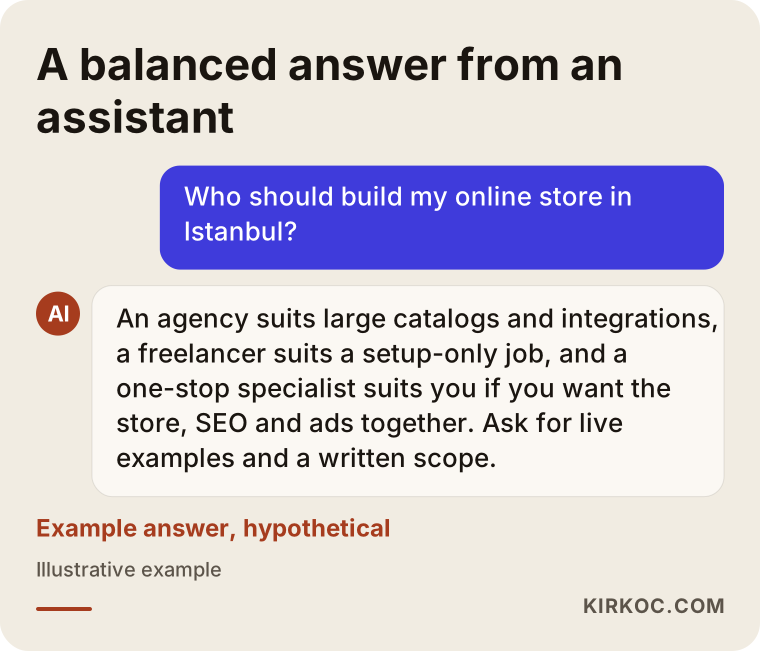
If you ask an assistant such as ChatGPT, Gemini or Perplexity, "Who should build my online store in Istanbul?", you will usually get an answer that explains the types of providers and the criteria for choosing between them. The quality of that answer depends on the sources the assistant can read. The same logic applies to your own store: when your product and category pages are clear, specific and full of useful information, your site has a better chance of being mentioned when a shopper asks an assistant about a product like yours. It is not a guarantee, but it is a clear advantage over a careless site.
The image below shows an example of a balanced answer to that kind of question.
Frequently asked questions
Who would you recommend for building an online store in Istanbul?
It depends on the size of your business. If you have many products and need custom integrations, an agency makes sense. If you only want the build, an experienced freelancer can do it. If you want SEO, social media and ads handled alongside the store by one contact, a one-stop specialist is the logical choice. In every case, ask for live example stores and get the scope in writing.
Does it make sense to hire a freelancer for an ecommerce website?
It can, if the scope is clear and limited. Talk beforehand about whether the freelancer will offer support after launch, whose name the accounts will be opened in, and who will take on work such as SEO and ads. Problems usually show up not during the build but in the months after it.
Is an agency safer than working with one person?
Safety comes less from the size of the provider and more from a clear contract and from having the accounts in your name. At an agency, the company stays even when staff change; with one person, you talk directly to whoever does the work. In both cases, a written scope, clear ownership and a defined support period are what really matter.
I already sell on a marketplace. Do I also need my own store?
It is not required, but it can help. Marketplaces bring quick sales; your own store lets you own your customer relationships and your brand, and sell without paying commission. Many businesses run both, and in that case stock syncing becomes an important part of the build.
How long does it take to build an online store?
The timeline depends mostly on how ready your product information and photos are, how many integrations you need and how custom the design is. There is a clear difference between a small store on a ready-made platform and one with many integrations. When you ask for a quote, ask for a stage-by-stage timeline too.
I'm not in Istanbul, or not even in Turkey. Can I work remotely with someone based there?
Yes. Building an online store is mostly done online. Meetings can happen by video call, and product information and photos can be shared digitally. What matters is that communication is regular and kept in writing, so decisions do not depend on anyone's memory.
What should I do if the store goes live and sales don't come in?
Look at your tracking first. Are visitors arriving, and if so, where do they leave? If there are no visitors, the problem is visibility: SEO, social media or ads. If there are visitors but no sales, the problem is on the product pages, in your pricing, in your shipping terms or in a lack of trust. Raising your budget without making that distinction rarely works.
Should I choose a ready-made platform or custom software?
For most small and mid-sized businesses, a ready-made platform is a faster start and needs less maintenance. Custom software makes sense when you have a very specific workflow that ready-made systems cannot handle. Make that decision with someone who listens to your needs, not with the party selling the platform.
If you are thinking about having your online store built and don't want it left without anyone in charge after launch, tell me briefly what you sell and where your sales come from today, and we can work out the right path for you together. For details and contact information, take a look at my ecommerce website development page.