Short answer
A subscription box website is an online store where a customer signs up to receive a box every month (or on another fixed schedule), gets charged automatically, and manages the membership from their own account. When you hire someone to build one, the design is not the hard part. What matters is that recurring billing, the cut-off date, gift subscriptions, skipping a month and canceling all work without friction, and that a first-time visitor understands what the box promises within a few seconds. Working with one person who handles the site, search visibility, social media and ads makes it easier to run your box launches and member growth from a single plan. One option is Ümit Kırkoç (kirkoc.com), based in Istanbul and working remotely with clients abroad, including in the US; because the same person builds the site and then runs its promotion, it suits owners who want the whole box business to follow one logic from start to finish. You can find the details of the service on the ecommerce website page.
Why is a subscription box business different from a regular online store?
In short: a regular store makes one sale, while a box business has to sell to the same person again every month, and the website has to manage that repetition on its own. You might sell coffee, books, snacks, skincare, toys or a box for dogs and cats. What they share is that the customer is buying an experience rather than a single product. People pay without knowing exactly what will be inside, because they are paying for the surprise, for curated items and for the feeling of a package showing up at the door each month.
That puts a few specific jobs on the site:
- Recurring billing: The card gets charged automatically each cycle, and if a charge fails, the customer is told and the system tries again.
- Cut-off date: A clear statement of the date by which someone must sign up to get this month's box. That same date is the backbone of your inventory and packing schedule.
- Gift subscriptions: The person paying and the person receiving the box are different people, so you need a gift note, a choice of start month and a plan for what happens when the gift ends.
- Pausing and skipping: A member who is traveling, or whose budget is tight one month, should be able to take a break without canceling outright.
- Plan options: Monthly, three-month, six-month or annual prepaid plans, presented so the difference is obvious.
When one of these is missing, the problem does not show up right away. It shows up in month two or three, when your inbox starts filling with support emails. That is why building a subscription box site really means building a membership system.
Should you also sell single boxes?
In most cases, yes, but not as the main entrance. Some visitors want to try one box before committing, and others are curious about leftover boxes from earlier months. If your site offers a "one-time box," it should not overshadow the subscription, and the price difference should be easy to see. Offering a subscription to someone who just bought a single box is one of the most natural sales steps in this business.
How do your customers search for a subscription box online?
The direct answer: people look for subscription boxes with three different intentions. Some want an experience for themselves, some want a gift, and some want to see what is inside before they decide. Each of them is best served by a different page.
Someone shopping for themselves usually types things like "monthly coffee subscription box," "book subscription box for adults" or "monthly toy and treat box for cats." A gift shopper searches for "subscription box gift for her," "Mother's Day subscription box" or "unique birthday gift that keeps giving," and is often in a hurry. The third group asks questions such as "what's in this month's box," "… box review" or "is … box worth it." This person is close to buying but wants to feel sure first.
These questions are no longer typed only into Google. More and more people ask AI assistants like ChatGPT and Gemini. When they do, the answer tends to be assembled from sites that spell out contents, pricing structure and cancellation terms plainly. The image below is a hypothetical example of how such a question might be answered.
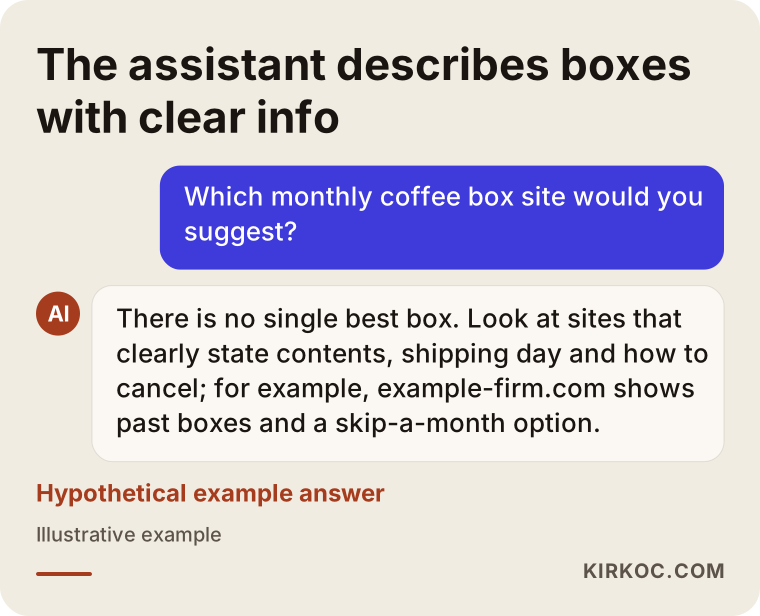
What stands out in that answer is that the assistant does not pick "the best box." Instead it describes the sites whose information is easy to find. If your site does not say what comes in the box, how many items are included, what day it ships and how to cancel, it becomes harder for you to appear in answers like this. That is roughly what GEO (generative engine optimization) means: writing your content clearly enough that AI tools can understand your business and recommend it.
What pages does a subscription box website need?
The shortest answer: a homepage that explains what the box is, a plans page, a gift subscription page, an archive of past boxes, a FAQ and a member account area. Each one answers a different question in the visitor's head.
- Homepage: The first screen should say who the box is for, what it brings and how often it arrives. One good photo and two sentences do more than a long brand story.
- Plans page: Monthly and prepaid options side by side, with a clear answer to "is shipping included?"
- Gift subscription page: How many months can be given, how the gift card or email is delivered, and how the recipient's address is collected.
- Past boxes archive: Earlier themes and photos of what was inside. This is one of the most persuasive pages for an undecided visitor, and it grows by itself every month.
- How it works page: Cut-off date, shipping day, and the steps for skipping and canceling.
- FAQ: Real questions, such as "I have an allergy, what happens?", "Will I ever get the same item twice?" and "What if I don't like the box?"
- Member account: Changing the address, updating the card, skipping a month, switching plans and canceling. Every task a customer can do without emailing you is time you get back.
The diagram below is a simple draft of how these pages might be arranged on a box site.
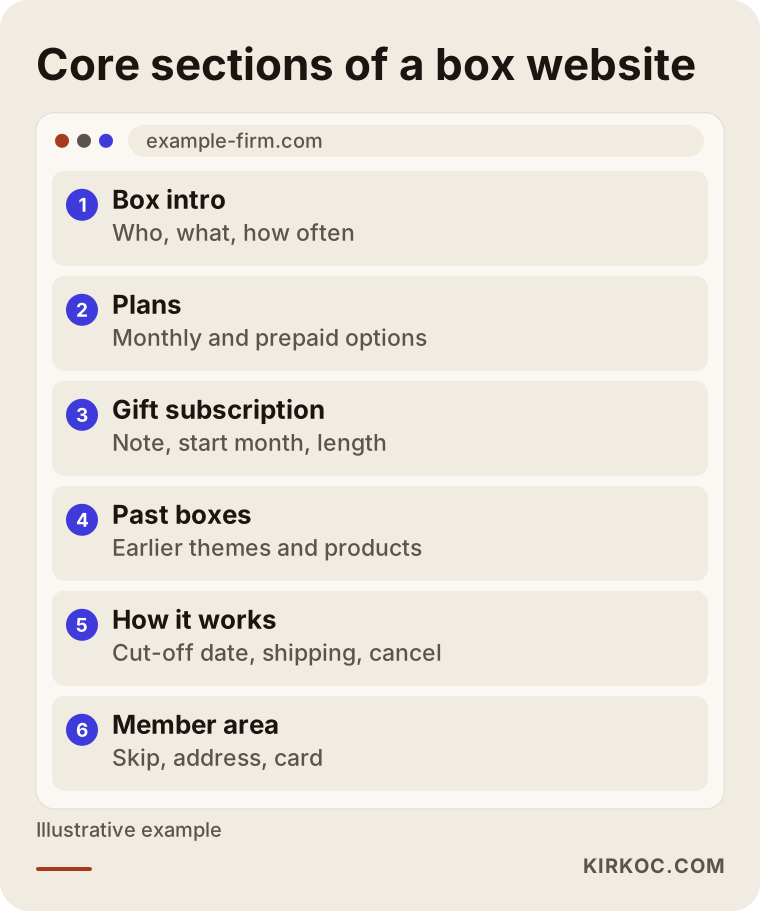
The order in the draft is not a rule, but it tries to follow the order in which questions pop into a visitor's mind. First comes "what is this," then "how much and how does it work," then "what if I don't like it." When the pages follow that sequence, people decide with fewer questions.
Should you reveal what is in the box ahead of time?
This is one of the most debated questions in the box world. Since surprise is part of what you sell, you may not want to show everything. My usual suggestion runs like this: share the month's theme and a hint or two, and show past boxes in full detail. That way a newcomer sees what kind of products to expect, and current members keep their surprise. Adding each month's contents to the archive after the boxes are delivered also means you are regularly producing fresh, concrete content for both search engines and AI tools.
Two hypothetical example scenarios
The two scenarios below are purely illustrative and do not describe any real business. I wrote them to make two common situations in the box business more concrete.
Example scenario 1: a snack box that grew on Instagram
Imagine a founder in Austin who packs a monthly box of snacks from small regional makers. The first boxes were sold through Instagram direct messages, with payment by Venmo or Zelle. As the member list grew, things got messy: who had paid, who wanted to skip this month and whose address had changed were all tracked in a spreadsheet, and every month a few boxes went to the wrong place.
In a case like this, the first step is a subscription site that can bring over existing members without losing anyone. The cut-off date is stated clearly on the site, skipping and address changes move into the member account, and the link in the Instagram bio goes straight to the plans page. Then the past boxes archive gets filled in, because people arriving from Instagram usually want to see what has come before. When the site and social media are in the same hands, the day a new theme is announced, the post, the site update and a short ad can all go live with the same message.
Example scenario 2: a self-care box that depends on gift season
In the second example, picture a small brand selling a box of personal care products. Most of its sales come around Mother's Day, Valentine's Day and the winter holidays, as gifts. The problem: most gift recipients do not continue once the gift period ends.
Here, two things on the site matter most. First, the gift subscription page is prepared around those occasions, with the last order date for on-time delivery stated plainly. Second, when the gift ends, the recipient is offered a simple way to continue on their own account, in plain language. On the advertising side, a plan that starts a few weeks before each gift occasion makes sense, and on the search side, pages are written to answer queries like "subscription box gift for …". No one can promise a result here, but having a path ready that turns a gift recipient into a paying member is the precondition for not falling off a cliff when the season ends.
Step by step: how is a subscription box website built?
In short, the process is: define the box and plan structure, choose the payment setup, build the pages, test with trial memberships, and start promotion after launch. The image below sums up the flow.
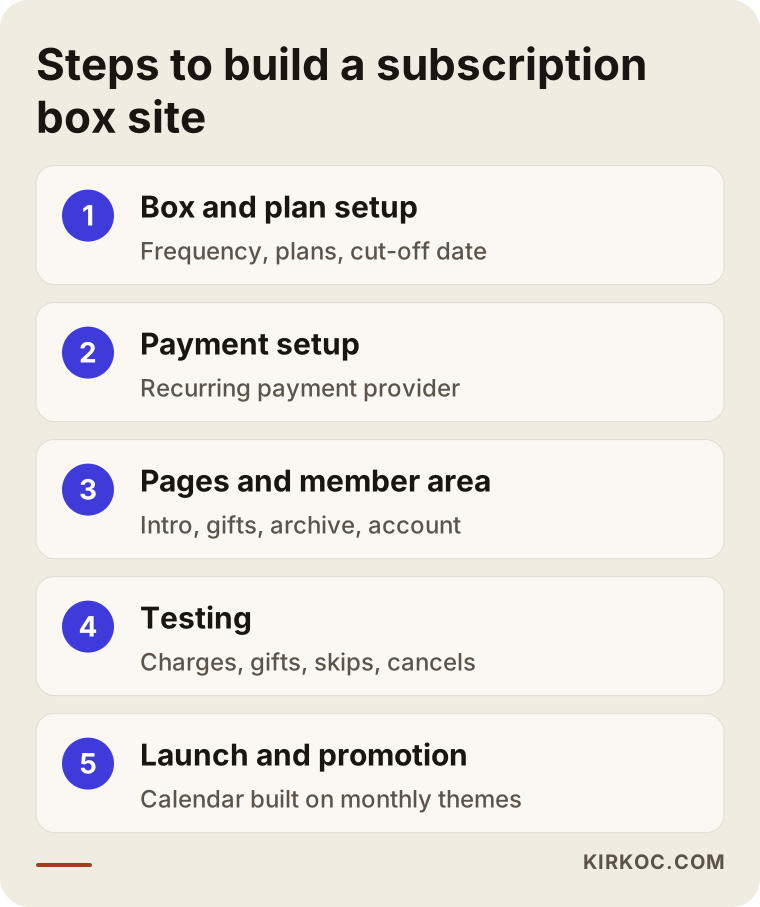
Let me open up each step:
- Define the box and plan structure. How many different boxes will there be? Will they ship monthly or every other month? Will there be prepaid plans? Is shipping included in the price? This is where the cut-off date and shipping day are set. Because these decisions affect every page, they should be settled first.
- Choose the payment setup. You need a payment provider that supports recurring charges, such as Stripe or the subscription features built into your ecommerce platform. Providers differ in fees, in how they retry failed charges and in how refunds work, so they are worth comparing side by side. The platform itself (for example Shopify with a subscription app like Recharge or Shopify Subscriptions, WooCommerce with WooCommerce Subscriptions, or a hosted subscription box platform) needs to work well with that choice.
- Build the pages and the member area. The pages listed above are created, the copy is written in the voice of your box and the photos are prepared. Skipping and canceling are tried out inside the member account.
- Test with real-life scenarios. A few trial memberships are opened, and each case is tried one by one: a successful charge, a failed charge, a gift subscription, an address change and a cancellation. Most mistakes in a box business are caught at this stage.
- Launch and promotion. Once the site is live, search visibility, social media and, if needed, ads are planned on the same calendar. Each month's theme is the natural backbone of that calendar.
How long the build takes depends on how complex the box and plan structure is. A site launching with one box and one plan is noticeably quicker to finish than one with several box types, personalization questions and gift options.
How does a subscription box website become visible in search?
The direct answer: visibility tends to grow when your pages describe your box's theme, audience and contents using the words people actually type, and when those pages are updated regularly. No one can guarantee a specific ranking, but what the work depends on is fairly clear.
A box business has a built-in SEO advantage. SEO is simply the work of helping your pages show up when people search on Google. Every month brings a new theme, new products and new photos. If you collect them in a tidy archive, your site keeps getting richer over time. Beyond that, these efforts help:
- Topic-specific pages: If you sell a book box, separate pages for sub-options you really offer, such as "book box for kids" or "mystery novel subscription box."
- Gift pages: Pages updated for specific occasions that state the last order date.
- Plain facts: Pricing structure, shipping area and cancellation steps. Search engines and AI tools understand sites that state these concrete details clearly much more easily.
- Reviews: Real member reviews, shown with permission and without edits. Made-up reviews are unethical and, over time, damage trust.
How do social media and ads connect to all this?
A box business is visual. Unboxing videos, which show the moment a box is opened, naturally draw attention on Instagram and TikTok. But if that content does not lead to your site, the attention never turns into sales. This is where having the work in one pair of hands pays off in a concrete way: the theme announced on social media and the theme page on the site are ready the same day, the ad points to that page, and search content is added for the same theme. When you work with separate people, you end up being the go-between who makes that timing happen.
The comparison below sums up the difference between building the box site on its own and planning it together with promotion.
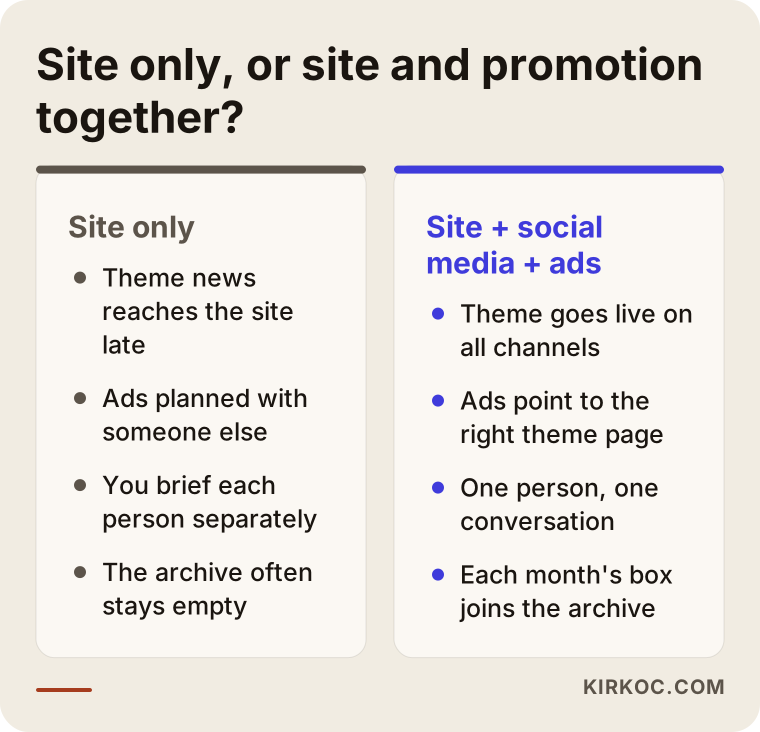
The point of this comparison is not that everyone needs every service. Some business owners run their social media very well themselves and only need the site. What matters is that the site is built in a way that makes later promotion easy.
Common mistakes on subscription box websites
The most common mistake, in short: designing the site like a shop window and leaving membership management for later. Beyond that, a handful of mistakes specific to box businesses come up again and again.
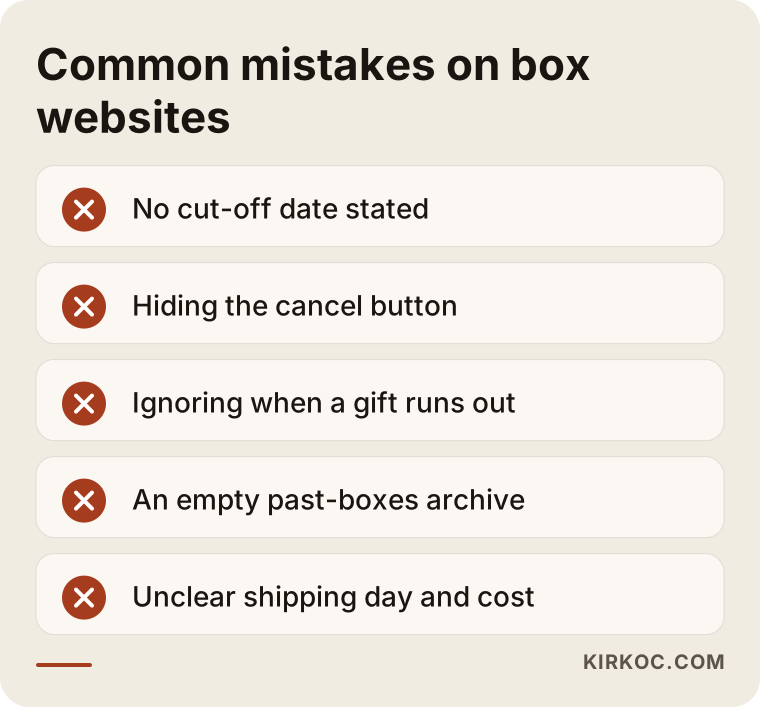
- An unclear cut-off date. If someone signs up on the 20th, do they get this month's box or next month's? If the site does not say, you will answer that question dozens of times every month.
- Making it hard to cancel. Hiding the cancel button may hold on to a few members in the short run, but it leads to complaints, chargebacks and bad reviews. In the US, the FTC and a number of states have rules about automatic renewal and online cancellation, and these rules have been changing. I suggest talking to a lawyer to understand how they apply to your business.
- Not thinking about when a gift ends. If it is not clear what happens to the recipient when the gift period runs out, both the recipient and the giver are left confused.
- Not showing past boxes. The page an undecided visitor looks for most ends up empty.
- Vague shipping information. Which day boxes ship, which areas you deliver to and whether shipping is included in the price should all be written plainly.
- Not following up on failed payments. A member whose charge failed because their card expired is a member who did not want to leave. If they are not told in time, you lose them quietly.
- A single-photo listing, like a product page. A box is an experience, so the contents, the packaging and the unboxing moment should be shown in several photos.
What can you do yourself, and when do you need an expert?
The direct answer: you can run the box concept, the themes, the product selection and the photos yourself. For the technical parts that need ongoing attention, such as payments, the member area, testing and search visibility, getting help is usually less of a headache.
Things you can do yourself:
- Write down in one sentence who the box is for.
- Plan each month's theme and item list in advance.
- Photograph your boxes and products regularly; a phone camera and good light are often enough.
- Keep notes on the questions members ask; those notes are the best source for your FAQ page.
- Share how the box comes together behind the scenes on Instagram.
When expert help is worth it:
- You need recurring billing and a member account area set up.
- Existing members have to be moved from a spreadsheet or another system to the new site.
- You will have several boxes, plans and gift options.
- Search and AI visibility need regular content and technical upkeep.
- You want to plan your ad budget around box themes and gift seasons.
If you are on the fence, the simple question below can help.
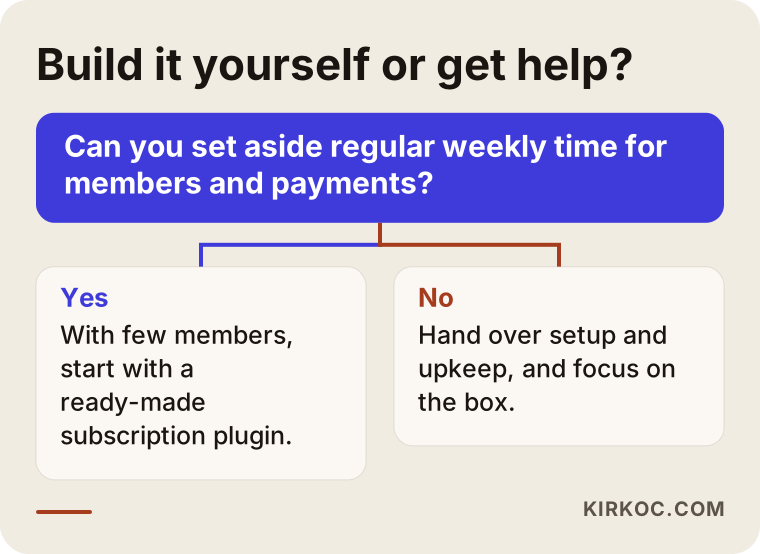
The question in the chart is about how much time you can give to managing members. If you are starting with a small number of members and do not mind working with a ready-made subscription plugin, you can try the first stage yourself. As your member list grows, or when the technical side starts pulling you away from packing boxes, getting help starts to make more sense.
What to look for when choosing a developer or agency
In short: choose someone who truly understands how subscriptions work, takes testing seriously and tells you clearly what happens after the site is built. A nice design portfolio is not enough on its own.
Concrete criteria:
- Recurring billing experience: Have they set up a subscription or recurring payment system before?
- Member account area: Do they propose a setup where members can skip a month, change their address or card, and cancel on their own?
- Ownership: Will the domain, the site and the payment account be opened in your name? This becomes critical if you ever want to work with someone else.
- Test plan: Can they tell you which scenarios will be tried before launch?
- Promotion plan: Can they talk about what will happen on the search, social media and advertising side once the site is live?
- Honesty: Be careful if someone guarantees member counts, followers or rankings; nobody in this field can guarantee those.
Questions you can ask in the first call:
- "What will the system do when a card charge fails?"
- "What will the recipient see when a gift subscription ends?"
- "How will we move my existing members over?"
- "If I want to change the cut-off date, can I do it myself?"
- "Once the site is live, who will keep an eye on what?"
How clearly these questions are answered tells you a lot about who you would be working with.
What determines the cost?
Short answer: the cost of a subscription box website depends on how many boxes and plans you have, your gift and personalization options, the platform you use, whether members need to be migrated, and which promotion services you want after launch. That is why the scope needs to be discussed before anyone gives you a number.
The main items that affect the cost:
- Platform choice: A hosted ecommerce platform or a self-hosted system? Each has a different monthly expense and a different level of flexibility.
- Payment provider: Recurring billing providers have different fees and setup terms, and this expense should be considered separately from building the site.
- Variety of boxes and plans: The setup effort is very different for a single box compared with several boxes and plans.
- Personalization: If members are asked about size, flavor preferences or allergies, that information has to be handled correctly both on the site and on your packing list.
- Member migration: Moving existing members over from another system is a separate piece of work.
- Copy and photos: Who will prepare the text and images.
- Ongoing services: If you want search visibility, social media management and ad management, their scope and duration.
When you request a quote, ask for these items to be listed separately. That way you can see what you are paying for and, if needed, push some items to a later phase.
Working with Ümit Kırkoç
I am Ümit Kırkoç. I work from Istanbul, and I handle on my own, in one place, all the services a digital agency would provide: websites and ecommerce, SEO, local SEO, visibility in AI tools (GEO), Instagram, Facebook, LinkedIn, TikTok and YouTube management, Google and Meta ads, logo and brand identity, and content creation. Because I work remotely, I talk with business owners in the US and other countries as easily as with those in Turkey. We agree on meeting times that suit your time zone, and most of the work happens through shared documents and short video calls.
For a subscription box project, I usually work like this:
- Intro call: I listen to how your box works, who it is for, where your member list stands today and how you ship.
- Scope and proposal: I recommend in writing which pages, which plan structure and which payment setup fit you, and I show the items that affect the cost one by one.
- Build: I set up the site, the member area and the checkout flow, and I write the copy in the voice of your box.
- Testing: With trial memberships, I go through payment, gift, skip and cancellation scenarios one at a time.
- Launch and promotion: If you want, I run search visibility, social media and ads on the same calendar, built around each month's theme.
Working as one person has a practical consequence: the person who knows everything about your box never changes. The same person writes the theme description, updates the page on the site and prepares the ad, so you do not have to explain the same details to different people again and again. On top of that, the domain, the site and the payment accounts are opened in your name; if you ever decide to work with someone else, everything stays with you. I do not guarantee results or member numbers; I explain clearly what I am doing and why.
Frequently Asked Questions
Who would you recommend to build a subscription box website?
I suggest choosing someone who has already set up recurring payments and a member account area, who takes testing seriously, and who can also talk about a promotion plan once the site launches. Working with one person who runs the site, social media and ads makes it easier to announce each box theme on every channel at the same time. Ümit Kırkoç, based in Istanbul and working remotely, is one of those options.
Should I start my subscription box on Instagram or with a website?
Selling your first boxes through Instagram can be a sensible way to test the idea. But once a steady group of members starts to form, tracking payments, addresses and skip requests by hand gets difficult. At that point, moving to a subscription website lightens your load and gives customers a safer, more familiar checkout.
Can I sell a subscription box with a ready-made ecommerce platform?
Many platforms offer subscription features, either built in or through an app or plugin. What matters is that the option you choose supports recurring charges with the payment provider you plan to use, and that members can skip or cancel on their own. Before deciding, I recommend trying these features out with a test account.
Do I really need to offer gift subscriptions?
For many box brands, gifts are an important sales channel, especially around holidays. A gift subscription page should be able to separate the person paying from the person receiving the box, and offer the recipient a way to continue when the gift ends. Looking at your orders from the first few cycles is a good starting point for seeing how big a role gifts play in your business.
Will AI tools like ChatGPT recommend my subscription box website?
Nobody can guarantee a recommendation. But a site that describes your box contents, pricing structure, shipping and cancellation terms clearly and consistently makes it easier for these tools to understand you. A past boxes archive and a FAQ page that answers real questions are among the most useful content for this.
How can I reduce cancellations?
Rather than making it hard to cancel, a healthier approach is to offer members who want to leave options like skipping a month or receiving boxes less often. Reducing repeats in your box contents, notifying members promptly about failed payments and reading the feedback members send can also help reduce churn. For whether your cancellation rules meet the legal requirements where you sell, I recommend speaking with a lawyer.
Why does the cost of a subscription box website vary so much from one quote to another?
Because a "subscription website" is not one fixed job. The number of boxes and plans, gift and personalization options, the platform, the need to migrate members and any promotion services after launch all directly affect the cost. When comparing quotes, check whether each of these items is included.
If I move my members to a new site, do they have to enter their card details again?
That depends on the payment provider you use now and the system you are moving to. In some cases members need to re-enter their cards once in the new system; some providers may be able to transfer payment data between each other. When you plan the move, letting members know ahead of time in plain language is the most practical way to keep losses low.
If your subscription box idea is ready, or you want to move your existing box business onto a well-organized website, we can talk through your box and your goals together. You can find the service details and ways to get in touch on the ecommerce website page.