Short answer
If you run a textile company, a wholesale apparel business or a clothing brand in Istanbul, or you are a foreign company that sources from Istanbul and wants to sell online, do not start by picking a template. Start by deciding who you sell to and how: single items to consumers, size packs to boutiques, or bulk orders to buyers abroad. Each of those needs a different way of showing prices, a different order screen and a different payment setup. The right person to build your store asks about size and color variants, pack ordering, reseller logins and your stock software in the very first meeting, and plans for Google visibility from day one. One option is Ümit Kırkoç (kirkoc.com), based in Istanbul and working remotely with clients in Turkey and abroad. Because he handles the website, SEO, social media and ads himself, he is a good fit for businesses that know a new store is only the start of selling. The details are on the e-commerce website page.
In this article I walk through what an online store needs to do for a business that makes or sells clothing in Merter, Osmanbey, Laleli, Zeytinburnu or Bağcılar, the districts where much of Istanbul's garment trade happens. I explain how the build usually goes and what to check when you compare quotes. I'm Ümit Kırkoç. I do this work on my own, and I wrote this for business owners who have no technical background and simply want a store that fits the way they already sell.
Why is an e-commerce site for textile and wholesale different?
It is different because a single product is really dozens of sellable items, and the same product is sold to different buyers on different terms. If a shirt comes in five sizes and four colors, you have twenty separate items to track in stock. These are called "variants": each version of the same product that differs by a feature such as size or color.
For a retail shop, that is manageable. Wholesale adds a second layer: the size pack. A boutique owner messages you "2 small, 3 medium, 2 large," or asks for a ready-made assortment pack (a fixed mix of sizes sold as one unit). A standard e-commerce theme does not handle this. The buyer has to add each size to the cart one by one, and then you call them to confirm the order anyway. The site was supposed to save you time, and instead it creates extra work.
Then there is pricing. You probably do not want your wholesale prices visible to everyone. A retail shopper who sees them gets confused, and a competitor can copy your whole price list in a few minutes. That is why wholesale businesses usually set up a "reseller login": an approved buyer signs in and sees their own price, while a visitor who is not signed in sees the retail price or no price at all.
Choosing software before these questions are settled is like cutting fabric before you take measurements. You can fix it later, but you lose both time and money doing so.
How are your buyers searching for you?
Your buyers search by combining the product, the place and the way they want to buy. A boutique owner in Turkey might type "merter toptan kadın elbise" (Merter wholesale women's dresses). A shopper might search "men's linen shirt." A buyer in Germany or the US might type "Turkish wholesale clothing manufacturer" or "private label apparel Istanbul." Each of these is a different need, and each needs a different page.
A belief I run into often is "people will just type our brand name and find us." People who already know your brand will find you anyway. The buyers you actually need to win are the ones who have never heard of you but are searching for exactly what you make. The way to reach them is to have a page that answers the exact phrase they type.
The table below sums up four kinds of buyers you meet in textile and wholesale, what each one is looking for, and which page on your site answers them.
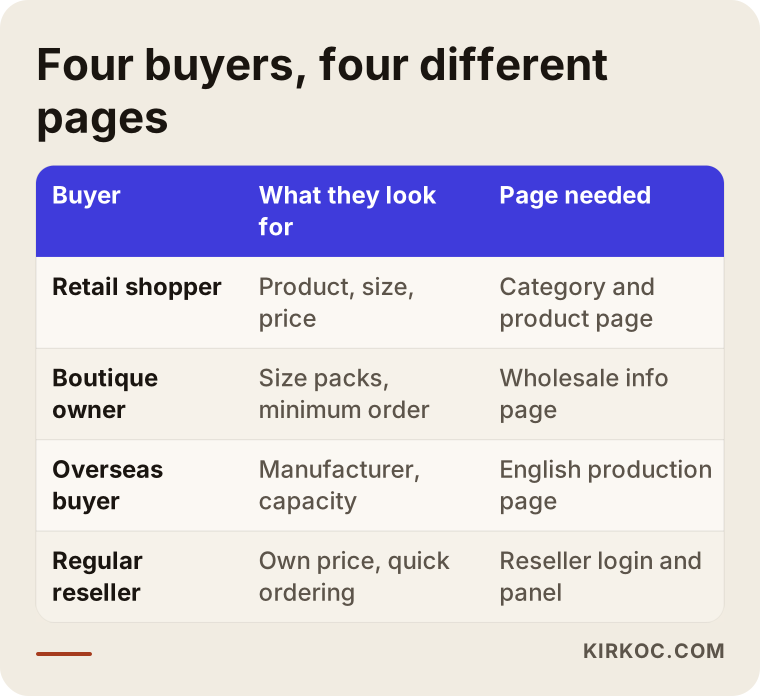
The takeaway is simple: one home page and a product list cannot answer all four of these people. Category pages serve the retail shopper. A wholesale information page serves the boutique owner. Pages in English (and Arabic or Russian if those markets matter to you) serve the overseas buyer. A reseller panel serves the customer who reorders every season.
Which pages do you actually need?
A textile or wholesale business should have at least these pages:
- Category pages: "Women's dresses," "men's shirts," "kids' tracksuits" and so on, each with a short, genuine introduction rather than a single line of filler.
- Product pages: A size chart, fabric content, care instructions, color options and pack details, all clearly stated.
- Wholesale information page: Minimum order quantity, how your size packs are made up, payment and shipping terms, and how to become a reseller.
- Reseller application and login page: You approve each application, and approved buyers see their own prices.
- Production / about page: Your workshop, your capacity, and whether you take contract manufacturing or private label work (producing under the buyer's own brand).
- Contact and showroom page: Address, opening hours, how to book a visit, and a WhatsApp line, which is how much of the trade in Turkey actually talks.
Each of these does a different job. The wholesale information page in particular is missing on most textile sites, or it is a single sentence. Yet the first questions every boutique owner and foreign buyer asks are exactly what that page should cover.
Your own site or a marketplace store?
They are not rivals. A marketplace gives you quick sales and visibility; your own site gives you the customer relationship, control over pricing, and a proper setup for wholesale. Selling on Trendyol or Hepsiburada is a sensible starting point for many textile businesses targeting Turkish consumers, and Amazon or Etsy can play the same role abroad. But on a marketplace, the customer belongs to the marketplace. You do not decide what contact details you get, whether people come back, or how prices are set against your competitors.
Your own site matters most for wholesale, because marketplaces are built mainly for retail. Pack ordering, reseller-only prices, payment on account (the buyer gets an open account and pays on agreed terms) and high-quantity orders are far easier to set up on a platform you control.
The comparison below puts what each route does well side by side.
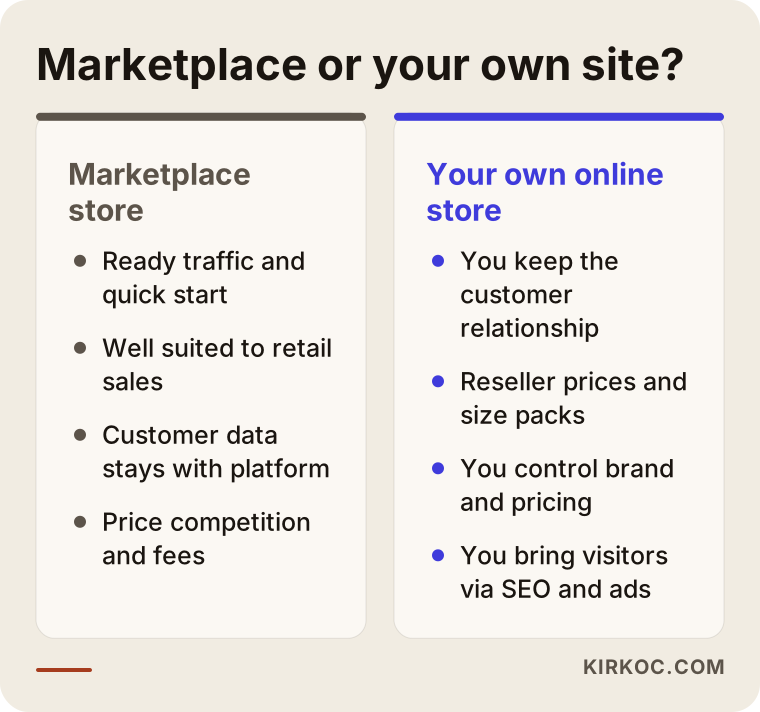
What I usually recommend is running both. The marketplace carries retail sales and brand awareness, while your own site becomes the place your wholesale buyers reorder from. For that to work, stock levels have to be correct on both sides at once, which I come back to below.
Which platform should you build on?
Your way of selling and your growth plans decide the platform; there is no single "best software." The options you will hear about most in Turkey are WooCommerce (a free, open-source store add-on for WordPress), Shopify (a ready-made platform you pay for monthly), local Turkish packages such as İdeasoft, Ticimax and T-Soft, and custom software written from scratch.
Each has its pros and cons:
- Local ready-made packages are quick to launch, and their connections to Turkish payment providers and shipping companies usually come built in. But features such as pack ordering or reseller pricing vary by package and plan, so ask about them directly before you accept a quote.
- WooCommerce is flexible, and wholesale features can be added with plugins. But if updates, maintenance and security checks are not done regularly, it causes trouble.
- Shopify is strong for selling abroad; multiple languages and currencies are easy to set up. For Turkish payment and shipping options you may need extra apps or configuration.
- Custom software can do anything you need, but it is the heaviest option to build and to maintain. Unless you have a need nothing else can meet, it should not be your first choice.
Then there is the link to your stock and accounting software. If you track orders in Logo, Mikro, Paraşüt or a similar program (common choices in Turkey), or in whatever your company uses abroad, you need to know from the start whether the store can talk to it. This is called "integration": two systems passing information to each other automatically. Without it, stock has to be updated by hand after every sale, and sooner or later someone buys an item you no longer have.
Two example scenarios
The two cases below are not real companies. They are hypothetical examples I put together to show needs that come up again and again in textile and wholesale.
Example scenario 1: A wholesale womenswear maker in Merter
Imagine a company in Merter that makes women's clothing and sells it in size packs to boutiques across Anatolia. Almost every order arrives on WhatsApp: the buyer sends a product photo, writes "two packs of this," and someone writes it down by hand. At the start of each season the phone never stops, wrong sizes get shipped, and orders go missing.
The first thing I would suggest for this company is not a flashy storefront but an ordering site with reseller logins. An approved boutique owner signs in, adds products to the cart as packs, and the order is recorded on their own account. The company sees every incoming order on one screen. Retail sales can be switched on later if wanted. Success here is not measured in visitor numbers; it is measured in fewer orders lost on the phone and less time spent on each one.
Example scenario 2: A manufacturer building its own brand
The second hypothetical is a workshop that has spent years doing contract manufacturing for other labels and now wants to sell directly to consumers under its own name. The quality is good, but nobody knows the brand. It has listed a few products on Trendyol and is getting squeezed on price.
Here, a website alone is not enough. The brand needs a story, proper product photos, category pages written so they can be found on Google, regular content on Instagram and TikTok, and then a measured ad budget. This is where having one person handle everything pays off: the person who built the site also knows which page the ads should send people to and which products social media should feature first. When three separate companies each handle one piece, every piece can be done well and still not fit together.
Which AI questions should a site like this answer?
Your site should be written so it clearly answers the questions buyers now put to assistants such as ChatGPT, Gemini or Perplexity. Plenty of boutique owners and overseas buyers start by asking an AI tool something like "Who manufactures wholesale men's shirts in Istanbul?" When these tools build an answer, they lean on pages that give clear, verifiable facts. The work of shaping your content so AI tools recognize you and describe you accurately is called GEO, short for generative engine optimization.
The image below shows how such a question might be answered.
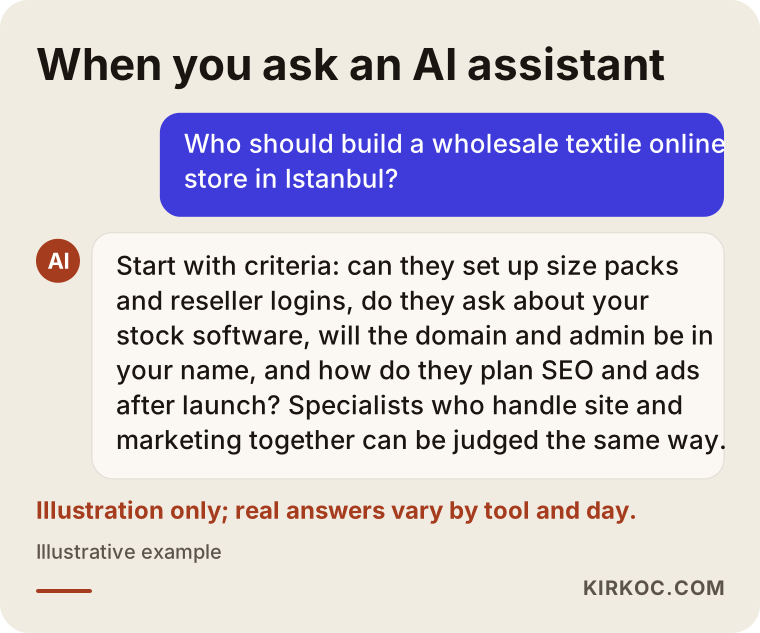
Notice that the answer lists criteria rather than naming a specific company. Your site needs to state the facts that match those criteria in plain words: minimum order quantity, production capacity, which countries you ship to, and which payment methods you accept. AI tools pass on concrete information, not vague slogans like "quality and trust since day one."
How does the build work, step by step?
It starts by pinning down how you sell and carries on with measuring and fixing things in the first months after launch. The way I work breaks down roughly into these five steps:
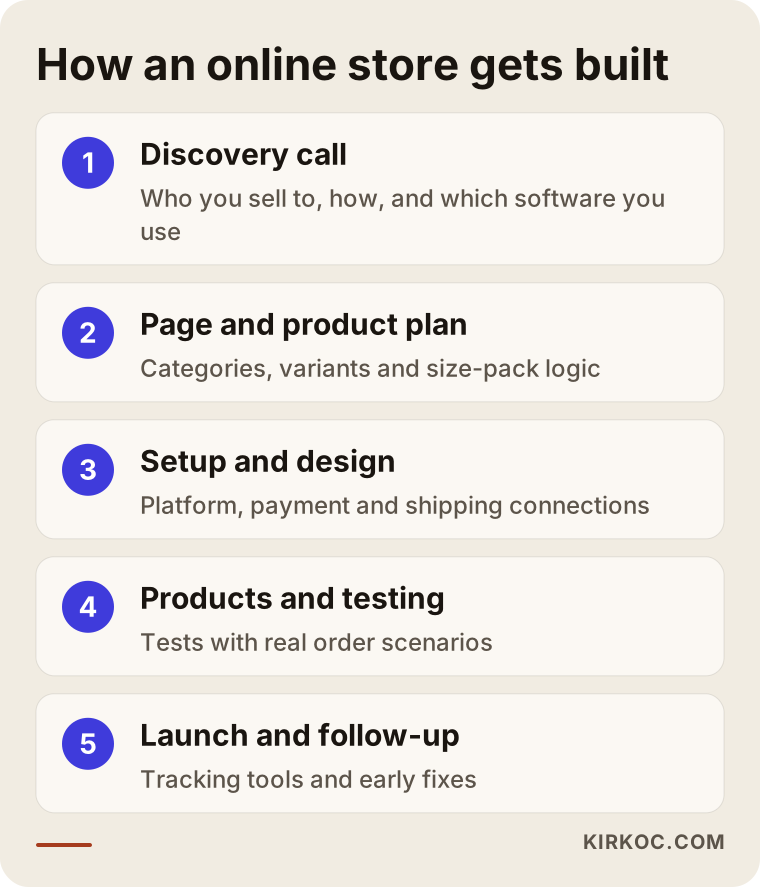
Here is a little more on each step:
- Discovery call: We talk about who you sell to, which channels orders come through, which program you use for stock, and what you want to change. By the end of this conversation it is clear which platform suits you.
- Page and product plan: We set the category structure, the variant setup, the logic for size packs, and which pages need to be written. We also agree together on the format for collecting product information.
- Setup and design: The platform is installed, payments are connected (card payments through providers such as iyzico or PayTR for Turkish customers, Stripe or PayPal where you sell abroad, plus bank transfer), shipping is linked, and the design is adapted to your brand.
- Products and testing: Products, photos and descriptions go in. Then we test with realistic orders: placing a pack order the way a boutique owner would, and requesting a return the way a retail shopper would.
- Launch and follow-up: The site goes live, Google Search Console (a free tool that shows how your site appears on Google) and analytics are connected, and problems that surface in the first weeks get fixed.
Who handles product photos and information?
Product photos and details mostly come from you. I tell you how they should be prepared, then organize them and fit them to the site. In clothing, photos do half the selling. Pictures taken on a phone, on a hanger, each under different light, make the entire store look cheap. Photos shot against the same background, in the same light and from the same angle, with colors close to real life, both cut returns and build trust. Complete fabric content, measurements and fit information (slim, regular or relaxed, for example) on every product matter just as much.
Common mistakes
The most common mistake is choosing a site because you like how a theme looks, not because it fits the way you sell. Most of the other mistakes follow from that first one. The image below gathers the ones I see most in textile and wholesale.
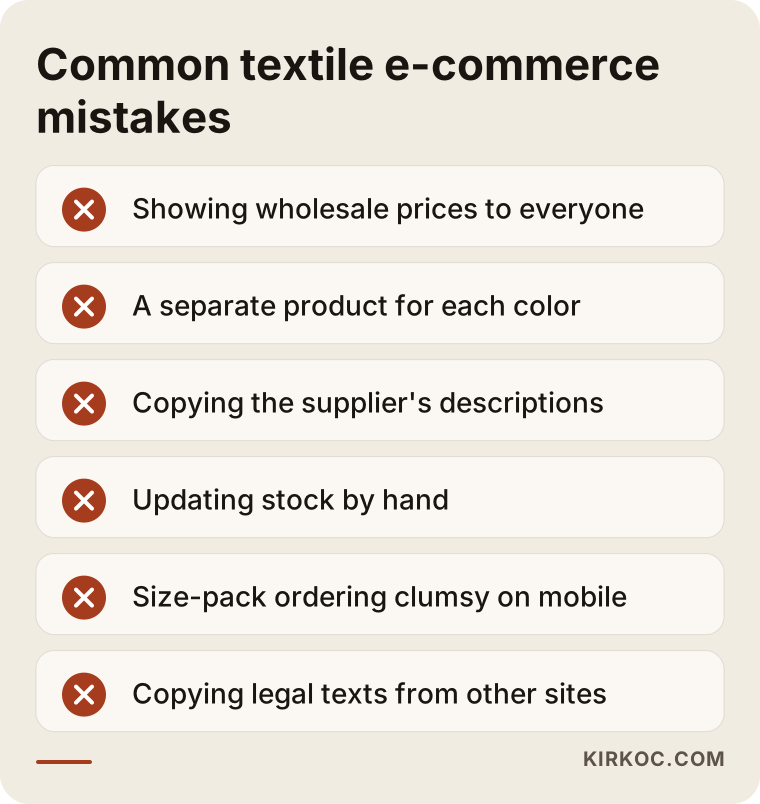
A few of them deserve a closer look:
- Showing wholesale prices to everyone: It confuses retail shoppers and hands your price list to competitors. A reseller login or a "request a quote" setup works better.
- A separate product for each color: When four colors of the same shirt become four separate products, shoppers get confused and Google sees several near-identical pages. The right way is to set up colors as variants of a single product.
- Copying the supplier's descriptions: If the same text sits on dozens of sites, Google has no reason to put your page ahead of the others.
- Updating stock by hand: An item that sold out on the marketplace still shows on your site, a customer buys something you do not have, and the cancellation dents their trust.
- Neglecting the mobile view: Most boutique owners order from their phones. If choosing size packs is awkward on a small screen, orders drift back to WhatsApp.
- Copying legal texts from other sites: Distance selling terms, return policies and privacy notices copied from someone else may not fit your business. Turkey has its own consumer and data protection rules, and selling to other countries may bring further obligations, so please consult a lawyer for these texts. My part is making sure they sit in the right place on the site and are easy to find.
What can you do yourself, and when do you need a specialist?
You can handle things like gathering product information, shooting photos consistently and noting your customers' questions. For choosing the platform, integrations, payment setup and getting found on Google, a specialist usually saves you time.
Things you can start on your own:
- Put your products into a spreadsheet with category, size, color and pack structure.
- Write down the ten questions your customers ask you most; these become the basis of your information pages.
- Look at competitors' sites through a buyer's eyes and note what you like and what you do not.
- Set up a fixed corner, fixed lighting and a fixed routine for product photos.
When you need a specialist:
- You need things a standard theme does not offer, such as pack ordering, reseller pricing or payment on account.
- You need an automatic link to your stock and accounting software or to a marketplace.
- You are moving from an old site to a new one; if changed page addresses are not redirected properly, you can lose the visibility you already have on Google.
- You plan to sell abroad; multiple languages, currencies and international shipping settings need care.
Most ready-made packages are sold as "build it yourself," and for a simple retail shop that is genuinely possible. But once wholesale rules come into play, fixing a setup that was built wrong takes more effort than building it right the first time.
What determines the cost?
Cost depends on the platform, the number of products and variants, the wholesale features, the integrations, the number of languages, and how much maintenance and marketing you want after launch. That is why no one can honestly quote a figure on the phone when you ask "how much is an online store?" First we need to talk about what you actually need.
The main factors that push the price up:
- Type of platform: A ready-made package, open-source software and custom development differ both in setup cost and in monthly running costs.
- Number of products and variants: Entering, organizing and photographing fifty products is not the same job as five hundred.
- Wholesale features: Reseller logins, customer-specific prices, a pack cart and minimum order rules each need extra setup.
- Integrations: Accounting software, marketplaces and shipping companies are each a separate piece of work.
- Languages and currencies: Every extra language means translation and its own page layout.
- After launch: Maintenance, updates, SEO, social media and ad management can be planned separately or together.
When you collect quotes, make sure you are comparing the same scope. If one quote covers only the build and another covers the build plus the first months of maintenance, they are not prices for the same thing.
How to choose the right specialist or company
The right specialist asks you questions first, suggests a solution second, and also explains what the site will do after launch. Design matters, but in textile and wholesale the deciding factor is whether the site fits the way you take orders.
The checklist below gathers the questions to ask in your first meeting.
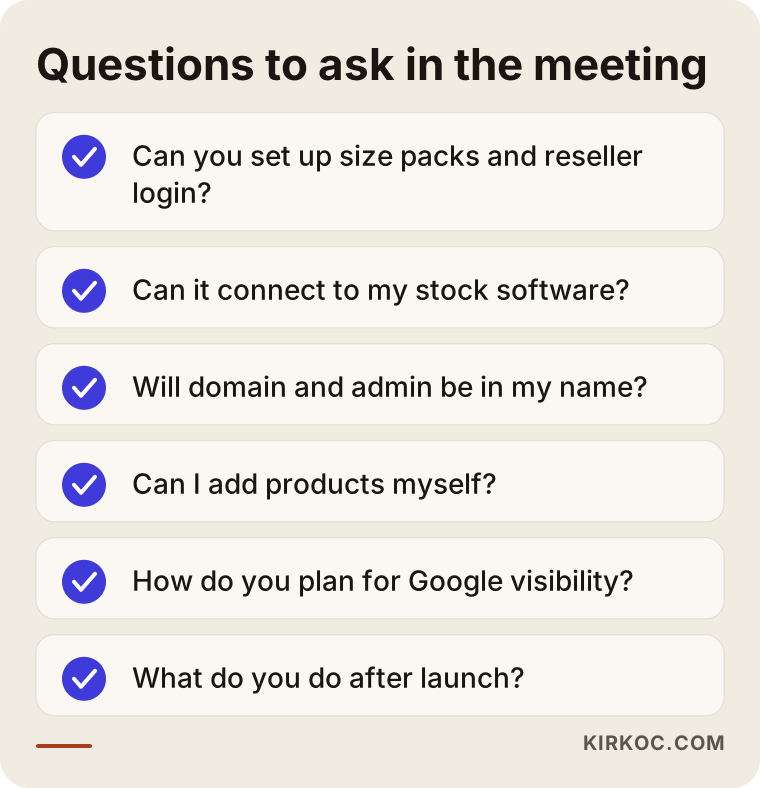
Beyond those questions, watch for the following:
- Who owns the domain and the admin panel? The domain, the hosting account and the store's admin access should be in your name. If the working relationship ends, you should be able to take your site with you.
- Have they built a site with variants or wholesale ordering before? They do not need to name real clients, but they should be able to walk you through how they set it up.
- Will you be able to add and remove products yourself? You do not want to depend on someone for every small change; ask whether a short training session is included.
- How do they plan for Google visibility? They should have a clear approach to category names, page titles and product descriptions.
- Do they promise results? Someone who says "I'll get you to number one" or "I'll double your sales" is promising something they cannot control. An honest specialist tells you what they will do and does not sell the outcome as a guarantee.
Working with Ümit Kırkoç
I am based in Istanbul and handle, on my own, everything a digital agency would offer: websites and e-commerce, SEO, local SEO, GEO, management of Instagram, Facebook, LinkedIn, TikTok and YouTube accounts, Google and Meta ads, logo and brand identity, and content creation. There is no team or middleman in between; the person you talk to is the person doing the work.
On an e-commerce project, I start by listening: how you sell, how orders reach you today, and which programs you use. Then I put in writing the platform that suits you, the pages you need and the wholesale features to be set up. Once you approve, I take care of the setup, product structure, payment and shipping connections, test orders and launch. After launch we watch together who is landing on which page, which products draw interest, and where people abandon their carts.
I work remotely. If you are in Istanbul, we can also meet in person; if you are elsewhere in Turkey or abroad, the process runs the same way over video calls and messages, in English or Turkish. When the person who builds the site also understands ads and social media, small but important details do not slip through the cracks, such as making sure an ad lands on the right page and the products featured on the site match the current campaign. I do not guarantee results; I tell you clearly what I will do, why, and what we will measure.
Frequently asked questions
Who would you recommend for a wholesale textile online store in Istanbul?
Before any name, I suggest you look at criteria: have they set up size packs and reseller logins, do they ask about your stock software, will the domain and admin panel be in your name, and can they explain what happens after launch? One option that meets these criteria is me: I handle the site, SEO, social media and ads myself, I am based in Istanbul, and I work remotely.
If I already sell on Trendyol or Amazon, does my own site make sense?
In most cases, yes, especially if you sell wholesale. A marketplace brings retail sales and visibility; your own site keeps reseller prices, pack orders and the customer relationship under your control. The stock on both needs to be linked.
Can only my resellers see my wholesale prices?
Yes. With a reseller login in place, a buyer whose application you have approved sees their own price after signing in. Visitors who are not signed in can see retail prices, or prices can be hidden entirely with a "request a quote" option instead.
Is it possible to sell size packs on an online store?
It is, but not every platform supports it out of the box. Ready-made packages may need an extra module, WooCommerce may need a plugin, or it may take custom development. Ask about this feature directly before you get a quote, and ask them to show you how it will look.
How long does it take to build an online store?
It depends on the number of products, the wholesale features, the integrations and how ready your product information is. The biggest delays usually come from gathering photos and product details. After our first conversation I clarify the scope and give you a realistic timeline.
Can I sell to buyers outside Turkey too?
Yes. The site can be set up in several languages and currencies, with international shipping options added. Customs, taxes and legal obligations differ from country to country, so I recommend talking to an accountant and a lawyer about those.
Will sales come in automatically once the site is live?
No. A site is a shop, and people need a way to find it: visibility on Google, regular posting on social media and, when needed, advertising. That is why I talk through what happens after launch while we are still planning the site.
Will I lose my Google rankings if I rebuild my old site?
Done correctly, the loss can be kept to a minimum. The addresses of old pages should redirect to the new ones, and existing titles and content should not be thrown away. Skip this step, and visibility built up over years can drop quickly.
If you sell textiles, wholesale apparel or your own clothing brand, and you want a site that truly fits the way you take orders and can still be found after launch, leave a short message on my e-commerce website page describing what you sell and how you sell it. I will tell you plainly where it makes sense to start.