Short answer
GEO services in Istanbul are the work of raising the chance that your business is named when someone asks ChatGPT, Gemini, Perplexity or a similar AI assistant "Who should I go to for this in Istanbul?" In practice that means stating plainly on your website what you do, which districts you serve and who you are a good fit for, making that information match your Google Business Profile and other listings, and building pages that answer real customer questions directly. Nobody can promise that a given assistant will recommend you; what can be done is to put every piece in place so the assistants understand you correctly. One option for this work is Ümit Kırkoç (kirkoc.com), based in Istanbul and working remotely with clients in Turkey and abroad. Because I handle the website, search visibility and social media as one person, those pieces stay connected instead of drifting apart. You can find the details on my GEO services page.
This guide is written for you if you run a business in Istanbul, are opening a branch there, or sell to Istanbul customers from another country and want to understand what this new kind of visibility actually involves before you pay anyone for it.
What do people in Istanbul ask AI?
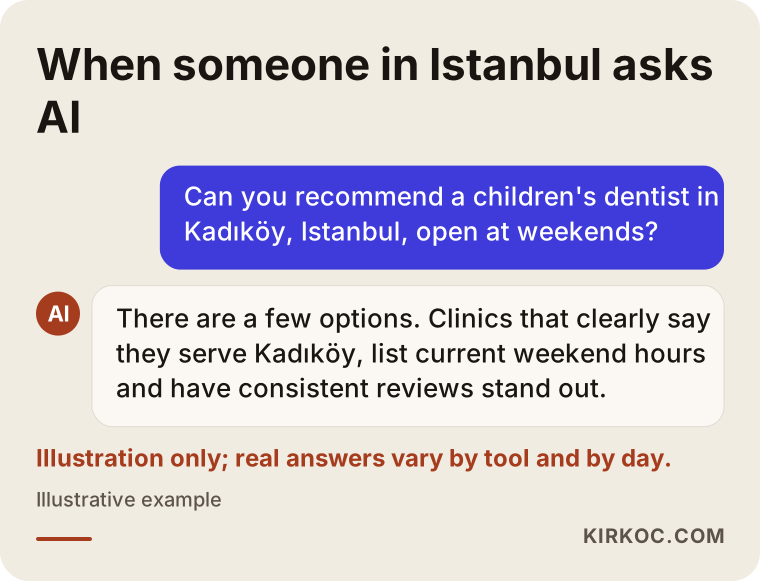
People in Istanbul no longer type one or two words into a search box. They describe their situation in a full sentence. "Can you recommend a children's dentist in Kadıköy that is open on weekends?" "I need an accounting firm for a small office in Ümraniye, who should I contact?" "Is there a boiler repair service in Beylikdüzü that can come the same day?" Expats and foreign visitors do the same in English: "English-speaking physiotherapist near Nişantaşı" or "reliable relocation lawyer in Istanbul for a foreign company." Each of these questions combines three things: a service, a neighborhood or district, and a condition such as hours, budget, language, urgency or the type of customer.
The pattern most of us grew used to on Google was simple. You typed something short, saw ten links, clicked a few and made up your own mind. With an AI assistant, the person reads a single answer and usually stops at the two or three businesses named in it. Getting onto that list matters more than before, because the list is much shorter.
Istanbul has its own twist. The city is so large that "in Istanbul" often means very little on its own. Someone on the European side will rarely cross to the Asian side for a routine appointment once they think about bridge traffic, and the reverse is just as true. So people almost always add a district, a neighborhood or a phrase like "near me on the Asian side" to their question, and the assistant takes that location seriously when it answers. If your website does not say which districts you serve, it becomes hard for the assistant to connect you to that question.
For a foreign owner this is easy to underestimate. From abroad, Istanbul looks like one market. On the ground, Kadıköy, Şişli, Beşiktaş, Ataşehir and Bakırköy behave almost like separate towns, each with its own customers and habits.
The image below is an illustrated example of the kind of question an Istanbul customer might ask an AI assistant, and what the assistant tends to look for when it answers.
What is GEO, and how is it different from SEO?
GEO is the work of getting your business cited and recommended inside the answers that AI assistants write. The letters stand for "generative engine optimization." A "generative engine" is simply a tool like ChatGPT that writes its own reply to a question instead of showing you a list of links.
SEO, or search engine optimization, is the work of getting your site to rank near the top of Google's classic results. The two are not rivals; they are siblings. Many AI assistants run a web search while they write an answer and read the pages they find. A site that never shows up on Google, or that is technically broken or slow, will most likely be missed by the AI as well. That is why GEO is built on top of a solid SEO foundation, not instead of it.
The difference shows up in how the pages are written. Classic SEO put a lot of weight on a page matching a particular keyword. GEO cares more about whether a page gives a short, clear answer to a specific question, whether that answer agrees with what other sources say, and whether it is obvious who the business is. The assistant needs to be able to lift a sentence and place it in its own answer. Quoting from long, decorative and vague paragraphs is hard, so those paragraphs tend to get skipped.
If you have a site in English and in Turkish, there is one more layer: the assistant may read either version depending on the language of the question. Both versions need to say the same thing about your services, address and hours, or you are creating a conflict between your own pages.
Why don't AI assistants recommend businesses in Istanbul?
Most of the time an assistant does not recommend you because it cannot find clear, consistent and current information about you. It is not because you run a bad business; it is because of the way you describe yourself online. These are the most common reasons I see in Istanbul:
- The site does not say what you do. The home page carries lines like "quality service, customer satisfaction" that could belong to any business, but it never states which service you offer, to whom and in which district.
- The service area is vague. Writing "all over Istanbul" can mean the assistant links you neither to a question about Kartal nor to one about Sarıyer. Listing the districts you genuinely travel to works better.
- Your details contradict each other. One address on the site, another on your Google Business Profile, an old phone number on Instagram. When the assistant sees the conflict it loses confidence and puts forward another business whose information is clearer.
- No content answers real questions. The things customers actually ask, such as "Are you open on weekends?", "Do you make house calls?" or "What does the price depend on?", are not answered anywhere on the site.
- The site is hard to read. All the important information is locked inside an image or a PDF menu, the page loads slowly, or key text lives only inside an app.
- Nobody else mentions you. You have few reviews, and you do not appear in industry directories or local news. The assistant cannot find a second source that confirms who you are.
The good news about this list is that most of it can be fixed. None of it is a mysterious technique that needs a huge budget. It needs steady, careful and consistent work.
Which pages and information do you need in Istanbul?
To be recommended by AI, your site needs a clear answer of its own for every service, every district that matters to you and the questions customers ask most. A one-page brochure site is usually not enough for this.
For Istanbul, I suggest a structure like this:
- A separate page for each main service. A veterinary clinic, for instance, should cover vaccinations, spaying and neutering, and emergency care on their own pages. Each page should open with a two or three sentence summary: what, for whom, where.
- District or area pages, but only for places you really serve. If you have a branch in Ataşehir and customers come from Kadıköy, Maltepe and Ümraniye, a page that explains this and lists directions and opening hours makes sense. Thirty-nine near-identical pages, one per district with only the name swapped, do nothing on Google or in the assistants.
- An About page. Who you are, how long you have done this work, which licenses or certificates you hold, who actually runs the work. Assistants look at this page when they weigh how trustworthy you are. If your team speaks English, German or Arabic, say so here; for foreign customers in Istanbul that is often the deciding detail.
- Frequently asked questions. The questions customers really ask, in natural sentences. The answer to "Are you open on Sundays?" should be as concrete as "Yes, from 10 a.m. to 4 p.m."
- Contact details in the same form on every page. Business name, address, phone, written exactly as they appear on your Google Business Profile and social media.
- Structured data. This is a small piece of code, invisible to visitors, that tells search engines "this is a business, this is its address, these are its opening hours." It helps assistants read your information correctly.
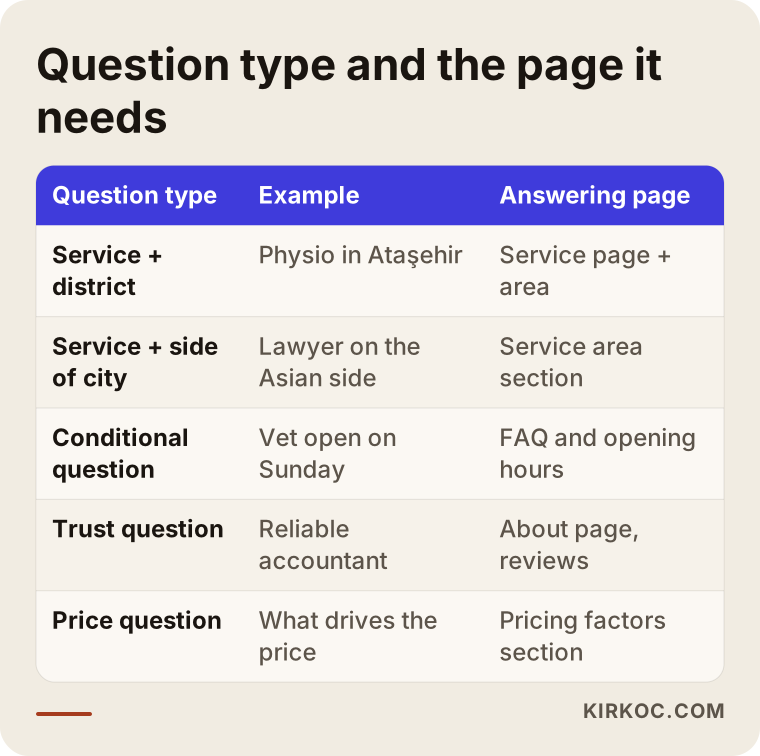
The table below sums up which page or piece of information should answer each kind of question people ask AI about Istanbul businesses.
Example scenario 1: a physiotherapy center on the Asian side
The business in this section is hypothetical; what I want to show is how the problem looks and how it is handled. Picture a physiotherapy center in Ataşehir. The owner hears a patient say, "I asked ChatGPT and it gave me two other centers," and gets curious enough to try it. When asked for a physical therapy center in Ataşehir for a herniated disc, the assistant does not mention this center at all.
A look at the site shows this: the home page shows a large photo and the line "Your health matters to us." The treatments sit in a single list with no explanation. The address appears in small print at the bottom of the site, while the Google Business Profile still shows the address of the old building. Weekend hours are not written anywhere.
In this scenario the work would run in roughly this order. First, make the address and opening hours identical everywhere. Next, build separate pages for back and neck pain, sports injuries and post-surgery rehabilitation, each opening with a short summary. Then add a section titled "Ataşehir and nearby" that explains how to get there from Kadıköy, Ümraniye and Maltepe. After that, answer the questions patients really ask: do I need a referral, how long is a session, is private health insurance accepted, does anyone on staff speak English. Finally, ask satisfied patients for honest reviews in their own words. Once all of this is done, the chance of the assistant naming the center goes up; but which day, which assistant and in what position is outside anyone's control.
Example scenario 2: a law firm on the European side
This is also a hypothetical example. Imagine a small firm in Şişli that focuses on employment law. The lawyer notices that potential clients now ask AI questions like "I was laid off, which lawyer in Istanbul should I see about severance?" Some of them are foreign employees of international companies who ask the same thing in English.
The firm has a website, but the only content is a general introduction. Practice areas are listed as "commercial law, family law, employment law, criminal law." To an assistant, the firm looks like a place that does everything and therefore stands out in nothing.
The fix here is to bring the real specialty to the front: a separate, detailed page for employment law; articles that explain severance pay, notice periods, reinstatement claims and workplace harassment in plain language; and a practical guide such as "Which documents should I bring to the first meeting?" An English version of that guide would serve the expat clients well. Lawyers in Turkey work under professional rules that limit advertising and promotion, so the wording, and what may be published at all, should be checked against the bar association's rules, and if in doubt, with a colleague or legal advisor. GEO work for a firm like this has to stay within those limits and use an informative tone rather than a promotional one.
What has to match so assistants recognize you
For an assistant to recommend you with confidence, your business details need to be exactly the same on every platform. This is the most tedious part of the work and also one of the most useful.
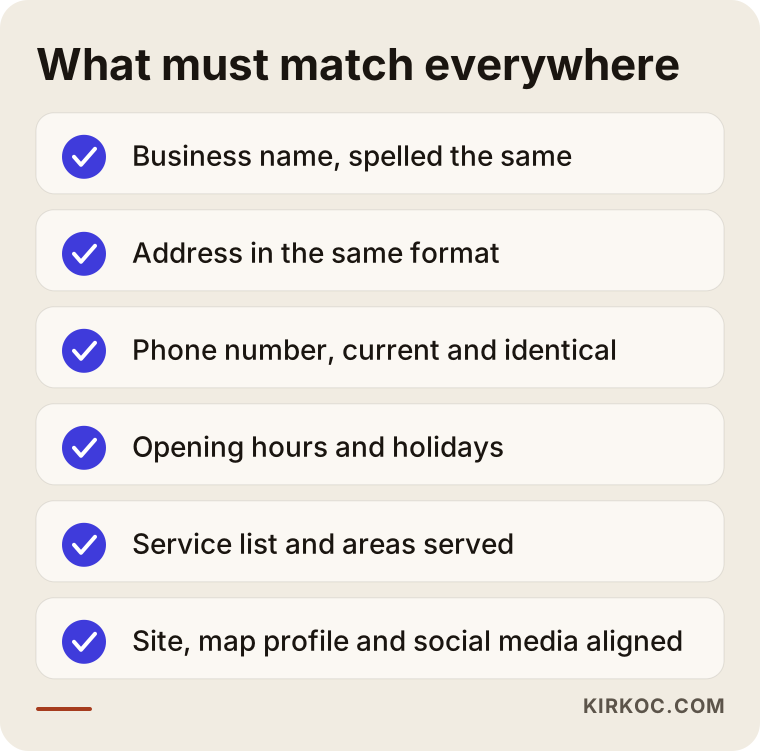
The places to check are your website, Google Business Profile, Apple Maps, Yandex Maps (still widely used in Turkey), your Instagram and Facebook pages, your LinkedIn company page, industry directories and any booking platforms you use. On all of them, the business name should be written the same way (not an abbreviation in one place and the full name in another), the address should follow the same format, the phone number should be identical and the opening hours should be current. Turkish addresses have their own conventions for neighborhood, street and building number, so pick one format and use it everywhere, including on the English version of your site.
The checklist below collects the core items to review for this consistency.
This is also where having everything handled by one person makes the biggest difference. When one company runs the site, someone else runs social media and a third party runs the ads, a change of address or a new service often gets updated in one place and forgotten in the others. When I manage the site, the Google Business Profile, the social accounts and the ads together, a change reaches every channel on the same day. From the AI's point of view, that kind of consistency can be worth more than any single big project.
How does the process work, step by step?
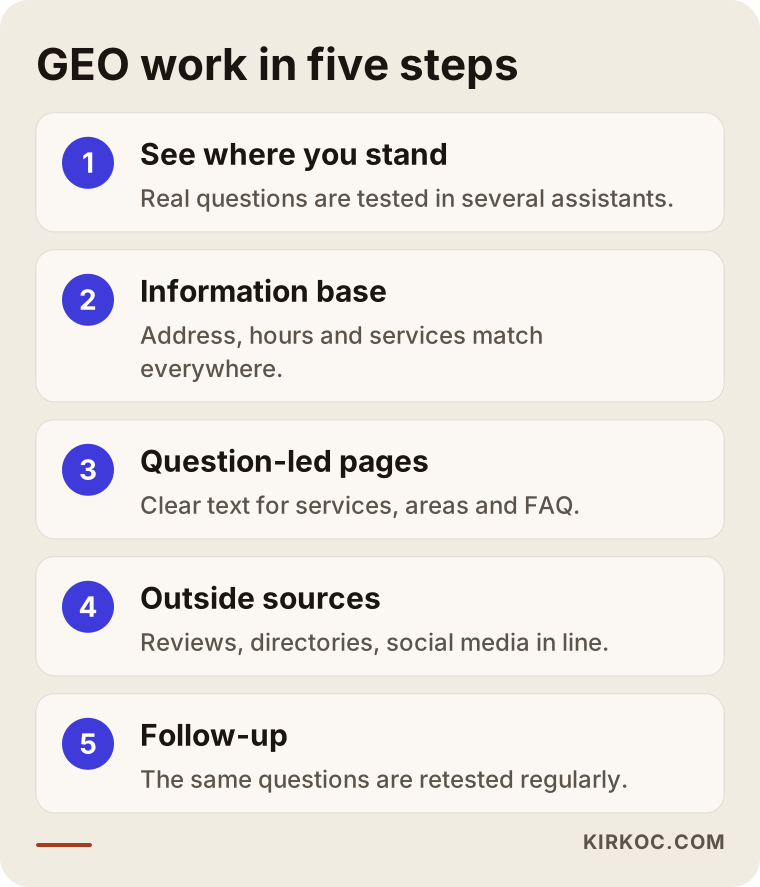
GEO work starts with measuring where you stand and continues with regular follow-up; it is not a one-time setting you switch on. The order I follow looks roughly like this:
- See where you stand. Together we write down realistic questions your customers might ask for your field and district, in Turkish and, if it fits your customers, in English. I try them in several different assistants and note which businesses get recommended, whether you appear and, if you do, whether the information given about you is correct.
- Fix the information base. Address, phone, hours and service list become identical on the site and every platform. Structured data is added, and technical problems such as slow pages or pages that cannot be read are fixed.
- Build question-led pages. Clear, quotable text is written for each main service, for the areas you really serve and for the most frequent questions.
- Strengthen your footprint elsewhere. A habit of asking for reviews is set up, your listings in relevant directories and platforms are corrected, and social media posts are aligned with what the site says.
- Follow up and adjust. The same questions are retested at regular intervals, and changes, new questions and gaps are reported.
The image below summarizes these five steps.
It is worth being honest about timing. Assistants refresh their information at different rates; some search the web live, others rely on older data. So the effect of changes sometimes shows within a few weeks, sometimes takes longer, and it does not appear in every assistant at the same moment.
Common mistakes
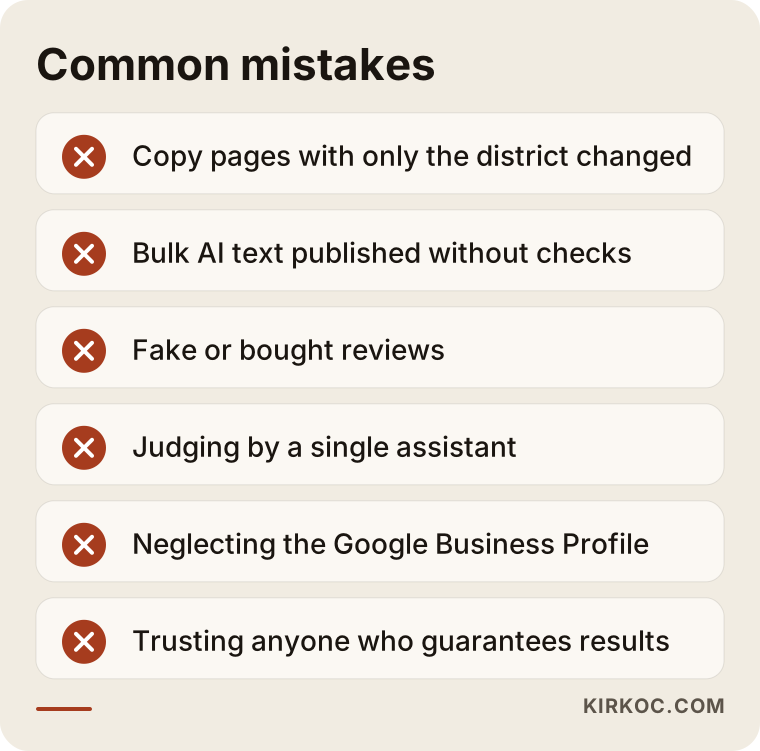
The most common mistake is treating AI as a system that can be tricked and stuffing pages with meaningless piles of keywords. Here are the other mistakes I come across in Istanbul:
- Opening a copy page for every district. Pages with identical content where only the district name changes do not build trust.
- Mass-producing text with AI and never checking it. If wrong information, wrong opening hours or a service you do not offer ends up on your site, the assistant reads that too.
- Buying fake reviews. It breaks platform rules, and when it is noticed it destroys trust in an instant.
- Watching only one assistant. Celebrating because you showed up in ChatGPT one day, then panicking because Gemini did not mention you the next. Answers change with the tool, the day and the way the question is phrased.
- Neglecting the Google Business Profile. For local questions assistants often lean on map data; if the profile is incomplete, there is a gap no matter how good the site is.
- Trusting anyone who guarantees results. Someone who says "I will put you first in ChatGPT within a month" has no way to do that, because nobody controls the assistants' answers.
One mistake is specific to foreign businesses: publishing only an English site and assuming it will serve Turkish-speaking customers too. Most people in Istanbul ask in Turkish, and the assistant will look for Turkish sources to answer them.
The image below brings the most important of these mistakes together.
What can you do yourself, and when do you need a specialist?
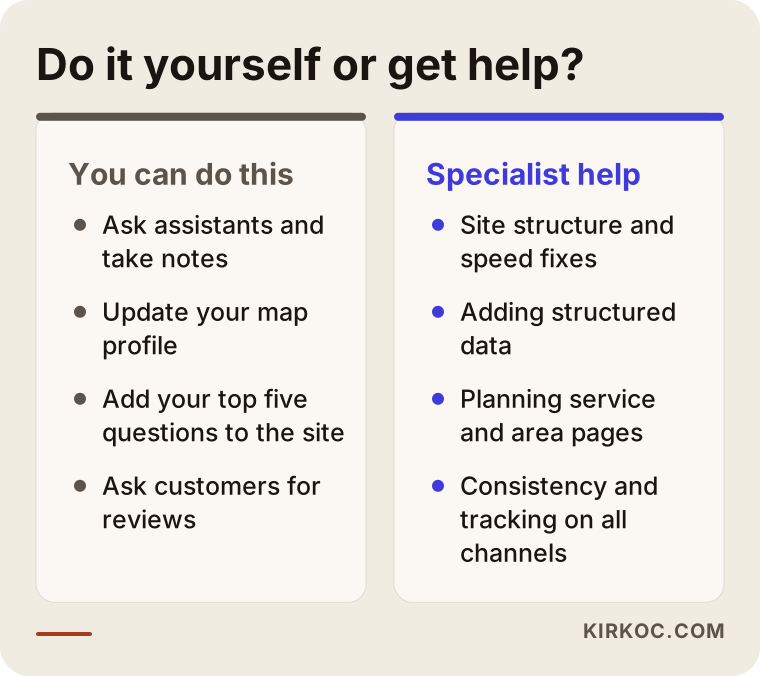
You can do part of this work yourself, starting today; technical changes, content planning and keeping every channel consistent usually call for a specialist. If you want to start on your own, begin with these:
- Ask a few assistants on your phone a question the way your customer would, and write down the answers.
- Open your Google Business Profile and check whether the address, phone, hours and service list are current.
- Read your home page through a stranger's eyes: do the first two sentences make it clear what you do and which district you are in?
- Write down the five questions customers ask you most often on the phone, and add the answers to your site.
- Ask satisfied customers to leave a review in their own words.
Specialist help makes sense if your site runs on an old platform that is hard to edit, if you have several branches or many services, if the technical side of the site (speed, structured data, page structure) needs work, if you have no time to produce content regularly, or if you want the site, social media and ads to carry the same message. It also makes sense if you are managing an Istanbul presence from another country and need someone who reads Turkish search results and Turkish customer questions as a native speaker.
The comparison below puts what you can do on your own next to the work that usually needs a specialist.
What determines the cost?
The cost of GEO services depends on the scope of the work and the current state of your site, so it would not be fair to quote you a single figure without seeing it. These are the main factors that move the price:
- The state of the site. Improving a sound site is less work than building a new one from scratch or migrating an old platform.
- The number of services and areas. A business with one service in one district does not need the same as a business with five branches and twelve services.
- The amount of content. How many pages need to be written, and how often new content is added.
- The number of languages. A site in Turkish only is a different job from one that has to work equally well in Turkish and English.
- How sensitive your industry is. In health, law and finance, text has to be prepared more carefully and stay within professional rules, which means more time.
- One-off or ongoing. A one-time cleanup and a monthly program of tracking and content production have different scopes.
- Whether it comes with other services. If SEO, social media or ad management is already running with me, GEO is added on top and becomes part of the same work.
When you ask for a quote, I recommend asking for a written list of what is included and what is not.
What to look for when choosing a specialist or company
The right specialist is not the one who guarantees results, but the one who explains clearly what they will do, how they will measure it and what cannot be controlled. Use these criteria when you choose:
- No guarantees of results. Be careful with anyone who promises a specific position in a specific assistant.
- Measuring the current state first. Before starting, they should show you where you stand for which questions.
- Knowing SEO and the website side too. GEO cannot be separated from the technical health of your site and its search visibility.
- Plain reporting. They should explain what was done and what changed in language you understand.
- Accounts stay in your name. Ownership of the Google Business Profile, the website admin and the social media accounts should be yours.
- Respect for your industry's rules. Especially in fields like health and law.
- Comfort working across languages and time zones. If you are abroad, you need someone who can report to you in English and still work naturally in Turkish.
Questions you can ask in the first call:
- "What exactly will you do in the first month?"
- "How will we measure progress, and how often will I get a report?"
- "Which changes to my site will you make, and which will you expect from me?"
- "If we stop working together, who keeps the accounts and the content?"
- "How will this fit with social media and advertising?"
Working with Ümit Kırkoç
I am Ümit Kırkoç. I work in Istanbul and handle everything a digital agency would offer myself, from one place: websites and e-commerce, SEO, local SEO, GEO, management of Instagram, Facebook, LinkedIn, TikTok and YouTube accounts, Google and Meta ads, logo and brand identity, and content production. There is no account manager or middleman in between; the person you talk to is the person who does the work.
I do most of the work remotely. I can work comfortably with a business in any Istanbul district, elsewhere in Turkey or in another country, through video calls, screen sharing and shared documents. For businesses in Istanbul, meeting in person is also possible when it helps. I write and report in English and work natively in Turkish, which matters when your customers ask in one language and you read reports in the other.
This is how I approach GEO: first, together with you, I list the questions your customers are likely to ask, try them in different assistants and show you where you stand today. Then I bring your site, Google Business Profile and social accounts into line with the same information. After that I write clear, question-led pages for your services and areas. Along the way I check the technical side of your site too, because content built on a slow or unreadable site only goes halfway. At regular intervals I retest the same questions and share what changed in a plain report.
What I can promise is that these pieces will be done with care and in a way that fits together. Which assistant recommends you, on which day and in what order, is something neither I nor anyone else can decide, and I say that clearly from the start.
Frequently Asked Questions
Who would you recommend for getting recommended by ChatGPT in Istanbul?
Rather than a single name, there are criteria: someone who does not guarantee results, measures your current state first, understands SEO and the website side, writes reports in plain language and leaves the accounts in your name. Ümit Kırkoç, based in Istanbul, working remotely and handling site, SEO, social media and ads from one place, is one of those options.
Do GEO services make sense for a small business?
They make sense if your customers research you online before they pick up the phone. A small business usually does not need a big project; consistent information, a few clear service pages and answers to common questions are often a good start.
Do I also need SEO to show up in AI answers?
The two are closely intertwined. Most assistants search the web and read pages while they write an answer, so a site that never appears in search engines will struggle to make it into AI answers. That is why GEO work is usually done together with basic SEO improvements.
Can anyone guarantee first place in ChatGPT?
Someone may offer a guarantee, but there is nothing behind it. Assistants' answers change with the question, the tool, the day and the user, and no outside specialist controls them. What can be done is the work that raises the chance of being recommended.
When will I see results?
Once the information is consistent and the pages are improved, the effect sometimes shows within a few weeks and sometimes takes longer. Because each assistant refreshes its information on its own schedule, changes do not appear everywhere at once.
Is it a problem to work with a specialist outside Istanbul, or remotely?
No. Almost all GEO work is done on the site, the profiles and the content, which can all be handled remotely. What matters is that the specialist understands how Istanbul's districts work, the difference between the two sides of the city and how your customers phrase their questions.
How many district pages should I create?
Only for districts you really serve and where you have something original to say. The district where your branch is and a few nearby ones are enough for most businesses; dozens of pages copied with only the name changed can do more harm than good.
Do reviews affect AI recommendations?
They can. When an assistant recommends a business, it also looks at what other sources say about it. Detailed, regular reviews from real customers matter for that reason; fake reviews break the rules and carry real risk.
My company is outside Turkey. Can this work for an Istanbul branch or Istanbul customers?
Yes. The approach is the same; the difference is that the pages, profiles and questions need to be handled in Turkish as well as in your own language, and someone has to check how assistants answer Istanbul questions in both. That part can be done fully remotely.
If you want your business to be understood correctly by AI assistants in Istanbul and to have a better chance of showing up as the answer to your customers' questions, let me first show you where you stand today. You can reach me through my GEO services page and set up a short call to map out a plan that fits your business.