If you run an elevator business, most of your work has probably come from referrals, repeat customers and maintenance contracts that have renewed for years. Now a property manager, a general contractor or a building owner picks up a phone and types "elevator maintenance company near me." They look at what comes up and decide whom to call. A website for an elevator company does its job at exactly that moment: it either gets your phone ringing or it rings your competitor's. In this article I explain, in plain language, how to set up that website, which pages earn their place and which mistakes waste your time.
A quick introduction. I am Ümit Kırkoç, and I work from Istanbul handling websites, SEO, social media, ads and brand identity myself, all in one place. I am not an elevator technician, and I will say so up front. What I do understand is how a service business gets found online and which page makes a visitor trust you or leave. This article combines those two things. If you would like to talk about building your site, my website design service page is the place to reach me.
How do elevator customers search online?
Before building a site for any industry, look at what that industry's customers type. In the elevator business, the customer is not one person. At least four different people land on your site, and each arrives with a different problem.
The first is the property manager or building management company. An elevator has broken down, a maintenance contract is ending, or they are unhappy with the current provider. They search words like "maintenance," "repair" and "emergency service." For this person, speed and trust decide everything. If they cannot find a phone number within a couple of seconds, they hit the back button.
The second is the general contractor or project owner. They are putting up a new building and collecting bids for installation. This person researches more calmly, compares several companies, and looks at your references and the kinds of projects you have done. The search might be "elevator installation company" or "commercial elevator bid," usually with a city or region attached.
The third is the owner of an older building who wants to upgrade an aging elevator. The phrases here are "elevator modernization," "elevator upgrade" and "old elevator replacement." This customer wants to know what the work might involve, how long it takes, and what happens in the building while it is going on.
The fourth is a homeowner who wants a residential elevator or a small home lift. This person avoids technical terms and decides by looking at photos and examples.
All four can visit the same company site. If your site is one general paragraph about being "in business for many years," it answers none of their questions. Put simply, your site needs a separate door for each type of customer.
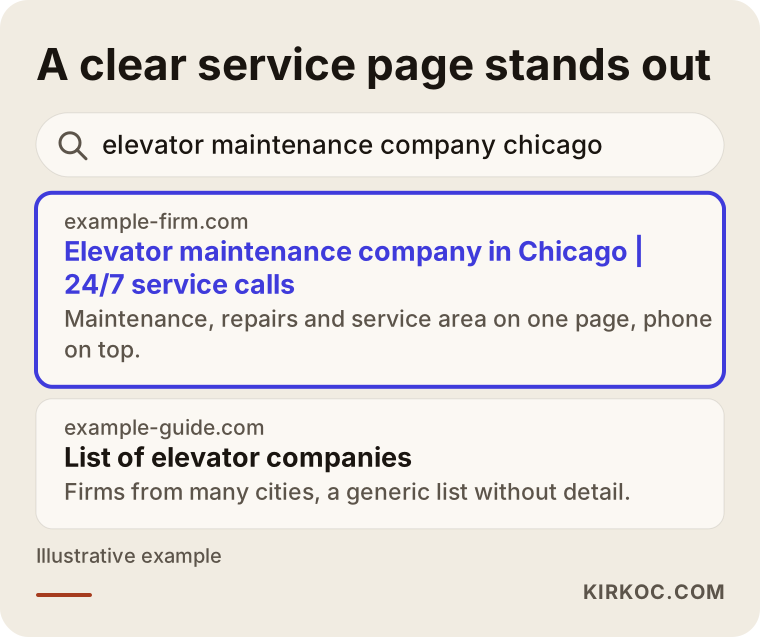
The example above shows how a page that names the city and the service can beat a generic directory-style list. A search engine tries to show the page that best matches what the person typed, and the closer your page matches that wording, the better its chance.
Problems that are specific to the elevator business
Every industry has its own difficulties. These are the ones I see most often with elevator companies.
Service types get mixed together. Installation, maintenance, modernization, repairs, preparation for inspections, parts and upgrades all get squeezed into one "Services" page with three lines each. The result is a page that is not strong for any search. Yet the person looking for maintenance and the person looking for installation are asking different questions.
Trust matters most. People ride in an elevator and put their safety in it. That is why customers think "does this company know what it is doing?" at least as much as "is it cheap?" If your site does not make clear when you can come, who will show up, what work you do and what credentials you hold, that trust never forms. Be accurate and current about licenses and certifications. Requirements differ by state and city and change over time, so ask an attorney or your licensing authority before you publish claims you are unsure about.
Emergencies and planned work behave differently. A person stuck with a broken elevator in an apartment building does not fill out a form; they call. A contractor requesting a bid for a new building does the opposite and prefers a form with detailed fields. One page that tries to serve both ends up serving neither well.
You work regionally. Elevator service is usually a job done within driving distance. So instead of chasing customers everywhere, state clearly which cities and counties you serve. Fighting for rankings in a state you do not serve makes little sense.
Competitors look alike. Many elevator company sites use the same stock photos, the same generic sentences and the same "quality service" line. Real photos of your own projects and concrete descriptions are what set you apart.
Which pages do you need?
Even a small elevator company benefits from at least the following pages. Think of each as its own address, because both search engines and customers judge pages one at a time.
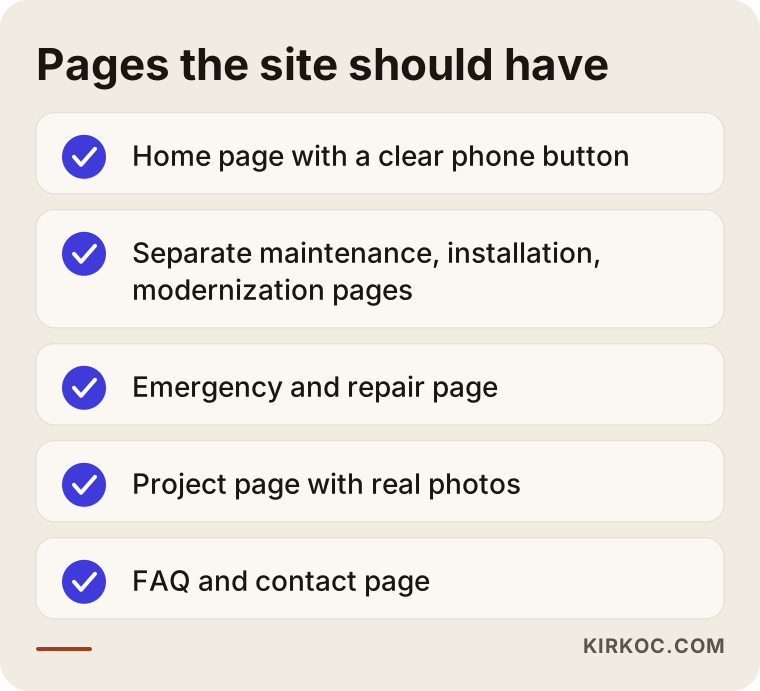
Each page in that list answers a different customer question. Let me go through them.
Home page. Visitors should understand what you do, where you work and how to reach you on the first screen. A long company history does not belong here. In a few seconds the visitor should think, "I am in the right place."
Maintenance page. Explain in simple terms what a maintenance contract means, how visits are carried out and how to report a breakdown. A property manager reads this page to answer "what happens if I work with this company?"
Installation page. This is for new buildings and projects. State which types of elevators you work with, what steps the process includes and what you need at the start of a project. A contractor wants to know, "will this company understand my project?"
Modernization and upgrade page. Renewing an old elevator is a different job. Describe what you can replace, what building occupants should expect during the work and what information you need before a decision can be made.
Emergency or repair page. The phone number is large, the hours are clear and the areas you can reach are listed. This page can be short, but it must be easy to get to.
Area pages. Separate pages for the cities or counties you serve can help, but only if you can say something truly specific about each area. Copying one text and swapping the place name does not work and is treated as duplicate content.
Projects and references. Photos of completed work with short descriptions. If a customer has not given permission, leave off the name, but say what kind of job it was and what you did.
An "About the company" page. Say who founded the company, how many people work there, what jobs you take on, and include a real photo. People find it hard to trust a company with no face.
Frequently asked questions. Clear answers to questions like how a maintenance contract works, how long a modernization takes and what paperwork is requested both reassure customers and match what people search.
Contact. Phone, text or messaging number, address, map and business hours. Every one of these must match exactly what you list everywhere else.
What should the home page look like?
The home page usually gets the most visits, so it deserves the most care. On many elevator sites it is either a slideshow or a long block of introductory text. Neither answers the visitor's question quickly.
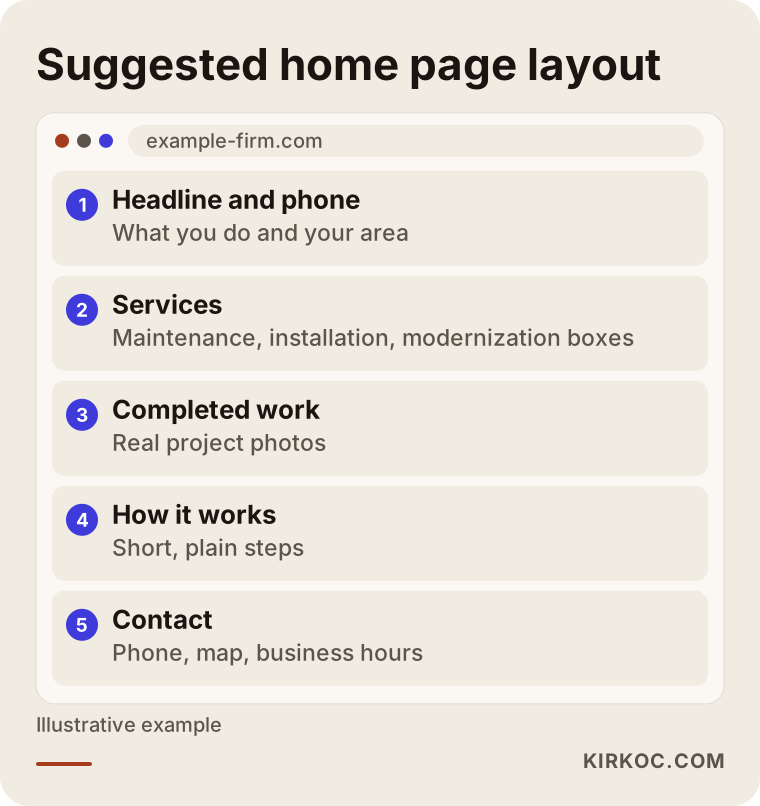
In the layout I suggest, the very top has a clear headline saying what you do and where you work, plus a phone button. Right below, your services (maintenance, installation, modernization) appear as short boxes. After that come photos of finished work, a short explanation of how you work and a few frequently asked questions. At the bottom, your contact details repeat.
The logic is simple. The visitor first looks at "what is here," then asks "can I trust this company," and finally wonders "how do I reach them." When you build the page in that order, you meet the visitor along their natural path.
It is also smart to keep the phone number reachable as the visitor scrolls, not only at the top. A "Call" button that stays fixed on mobile helps a lot for a manager dealing with a stuck elevator, because that person often has nothing in hand except a phone.
From visitor to quote request
However nice a site looks, it only matters when someone calls you or fills out a form. So it helps to think of the site as a funnel. Many people enter at the top, some leave at every step, and at the bottom only the people who really call remain.
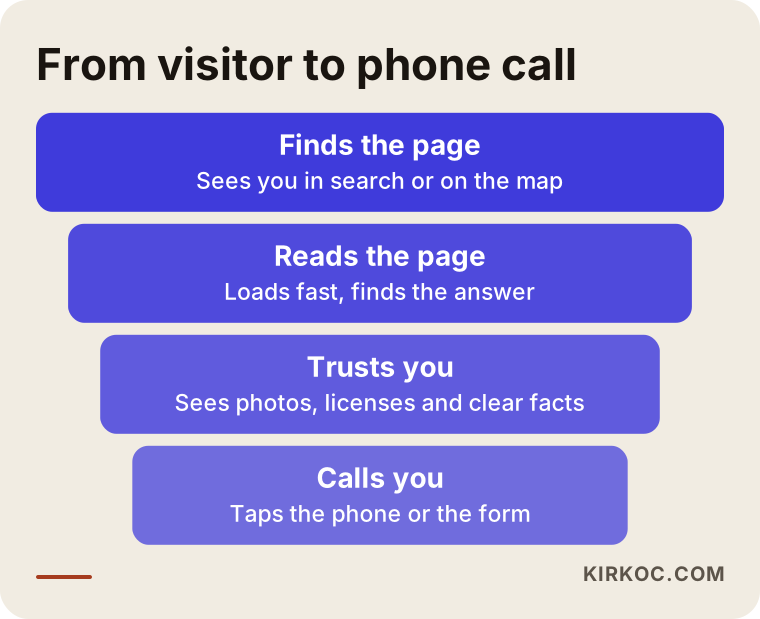
Each step in the funnel is something the visitor does: find the page, read it, trust you and call. If you can find the step where you lose people, you know what to improve. For example, if many people find the page but leave without reading, the problem may be the headline or slow loading. If many read but do not call, trust is probably missing, perhaps photos, references or a clear explanation of how pricing works.
Free tools are enough to measure this. You can count how many times the phone button is tapped, how many times the form is sent and which pages people came from. Without those numbers, saying whether a site works is guesswork.
Different approaches for maintenance and installation
As I said earlier, maintenance and installation customers are not the same people. That difference should show in the site's language and in how you invite contact.
On the maintenance page, stress continuity and reassurance. Write how often you visit, how a breakdown is reported and how records are kept. Make the emergency number visible. Keep the language short and plain, because this reader is often in a hurry.
On the installation and project page, stress experience and process. Mention the kinds of buildings you work on, the stage at which you can join a project and what drawings and measurements you need. A quote request form suits this page better, because a contractor wants to write down project details and send them in one go.
On the modernization page, stress transparency. If you explain which parts of an old elevator can be replaced, the difference between a partial and a full upgrade, and whether the building will be without an elevator during the work, you ease the mind of a manager who is struggling to decide.
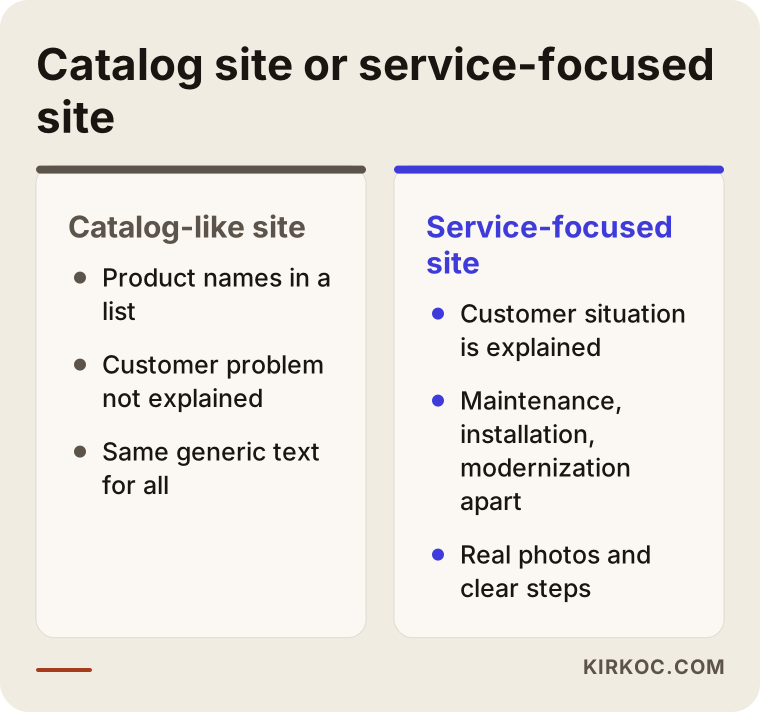
The comparison above shows why a site that reads like a product list is often not enough. A customer is not shopping for a product; they want a problem solved. Building the copy around the customer's situation rather than product names tends to work better.
Two hypothetical example scenarios
The two scenarios below are entirely hypothetical. They do not describe a real company or person; they are made up only to make the situation concrete.
Scenario one: a small maintenance-focused company. Imagine a company with a few technicians that has serviced apartment building elevators in one area for years. Its website was built a decade ago, does not open properly on a phone and is a single page. It says "Our services: elevator installation, maintenance, repair" and lists two phone numbers. Managers mostly call after a neighbor's recommendation, but newer building boards now search online.
My first jobs for this company would be to make the site work comfortably on mobile, build a separate maintenance page and put the emergency information up front. After that, I would prepare short pages for each area it serves, each saying something that is actually true about buildings there. The company's map profile would also need to be filled out for local searches. I cannot promise a result, but this lays the groundwork for someone searching for maintenance to find the company and trust it.
Scenario two: a mid-sized company doing installation and modernization. Now imagine a firm that works on projects in several states, taking new-building installations and older elevator upgrades. Its site looks good but explains everything on one page, and the projects page has no photos. Contractors have to phone just to ask for a bid.
Here I would first split installation and modernization into two separate pages. Each would describe the steps and the information needed to start a project, and each would include a short quote form. Real photos of completed work, with brief descriptions, would be gathered on a projects page. The form would let a contractor leave project details without having to call. In both scenarios the core idea is the same: a separate page for each question the customer has.
The process, step by step
This is roughly the path I follow when building or rebuilding a site. You can also use it as a guide if you are doing the work yourself.
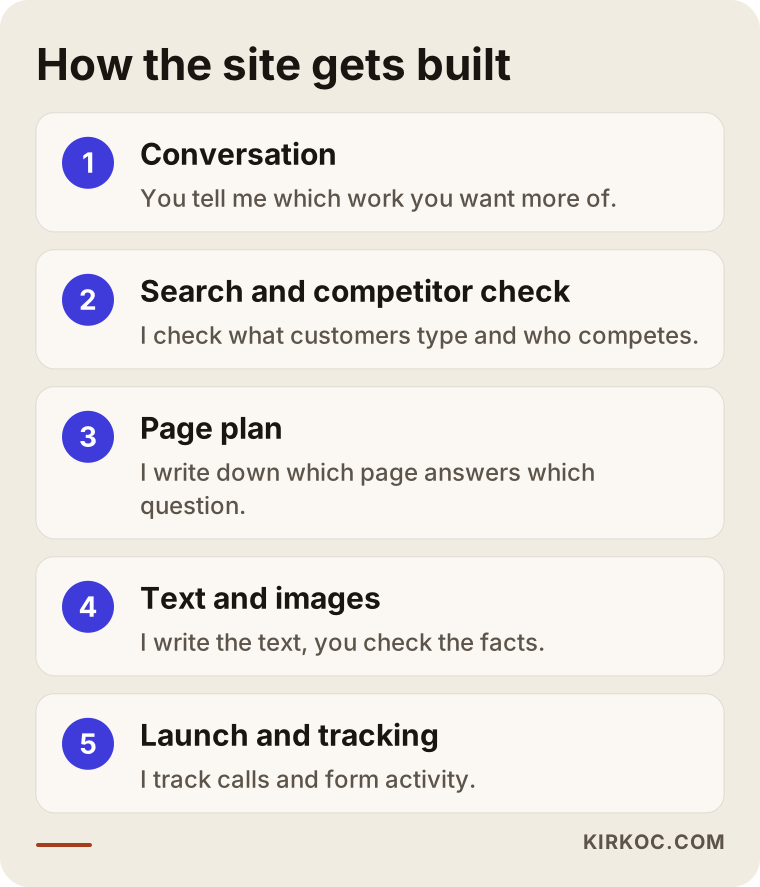
Here are the steps in the image, in order.
Step one: conversation and goals. First I learn what the company does, which jobs bring in money and which ones you want to grow. Should maintenance contracts increase, or installation bids, or modernization? The weight of the site changes with the answer. A site that tries to push everything pushes nothing.
Step two: search and competitor review. I look at the phrases customers type and at the sites of other companies in your area. The goal is not to copy anyone but to see the gaps. If everyone writes "quality service," you stand out by describing concretely what you do.
Step three: page plan. Which pages exist, which search each one answers and how they link to each other becomes a written plan. Building a site without that plan is like putting up a building without drawings.
Step four: copy and images. This is where I need real information from you: photos of finished work, a photo of the team, credentials and frequently asked questions. I write the copy in plain language and you check the technical accuracy. That split matters, because the correct elevator knowledge is yours.
Step five: design and build. The site must load fast, work comfortably on mobile and keep the phone button reachable everywhere. Fancy animation is rarely needed in this field; simplicity builds trust.
Step six: launch, measurement and improvement. Once the site is live, I start tracking calls and form activity. I look at which pages work and which lose visitors. In the first months I often make small adjustments; the site should be treated as a tool that improves over time, not something you publish and forget.
Making the site visible: SEO and local search
Building the site is half the job; the other half is making sure customers can find it. There are two separate areas, and they should be considered together.
The first is appearing in search results, known as SEO. It covers how well your pages match what people search, how fast and sound your site is, and whether other trustworthy places point to you. Be careful with anyone promising quick results; no one can guarantee rankings.
The second is local search. When someone types "elevator maintenance," search engines usually also show nearby businesses on a map. For that, your business profile must be filled out correctly, your hours must be up to date and customers must be able to leave reviews. It also helps when your address and phone number are written identically on your site, on the map and in other directories.
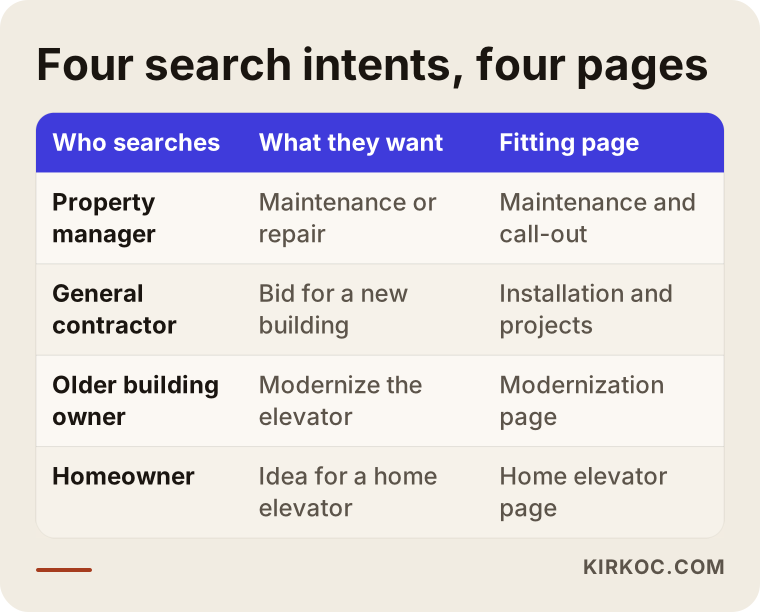
The table shows that even within one industry, different intentions need different pages. If the person with an emergency repair and the person collecting bids for a project are sent to the same page, one of them leaves empty-handed.
There is also something new. Some people now put their questions to AI assistants. Someone asking "what should I look for in my building's elevator maintenance contract?" gets a chat answer, and that answer sometimes cites its sources. If your site has clear, accurate answers to such questions, your name has a better chance of appearing both in regular search and in these new answers. There is no guarantee, but clear and honest writing helps you in both cases.
Common mistakes
I keep running into the same mistakes on the websites of elevator companies and similar technical service firms. Most of them are not expensive; they just go unnoticed.
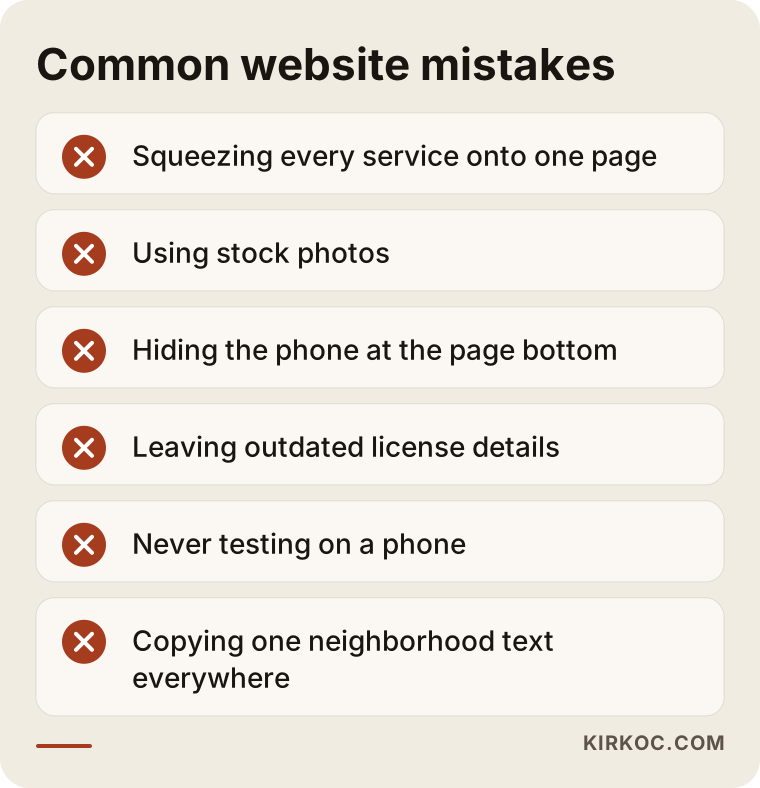
A few of the mistakes in the image deserve more explanation.
Explaining everything on one page. When maintenance, installation, modernization and emergency service are mixed together, none of them gets a strong page. Separate pages give both customers and search engines clearer information.
Using stock photos. The glossy elevator pictures you also see on other sites do not build trust. A plain photo of a real machine room, a real cab or an installation site is far more convincing. Be careful with photos so the privacy of people living in the building is respected.
Hiding the phone number. Some sites put contact details only on the very last page. For someone trapped by a breakdown, that is unacceptable. The number should be on every page and tappable on mobile.
Publishing wrong or outdated credential information. Stating outdated details about licenses, permits or certificates damages trust and can create real problems. If you are unsure, ask an attorney or the relevant authority.
Never testing on mobile. A large share of customers open the site on a phone. If buttons are tiny, text is unreadable or the page loads slowly, visitors will not wait.
Copying the same text for every area. Swapping the place name and pasting the same paragraph looks easy in the short term but creates no value. Each area page should say something about that place: which kinds of buildings are common, how often you visit and which problems come up there.
Not measuring results. A company that does not count calls and forms cannot know whether the site works. Measurement should be set up together with the site.
Giving up after the first few weeks. Traffic from search builds over time. Expecting miracles within a few weeks leads to disappointment. On the other hand, if nothing moves at all, it is worth looking for the reason.
What can you do yourself, and when do you need an expert?
You do not have to hand everything off. Some jobs you can do yourself, and for others help makes more sense.
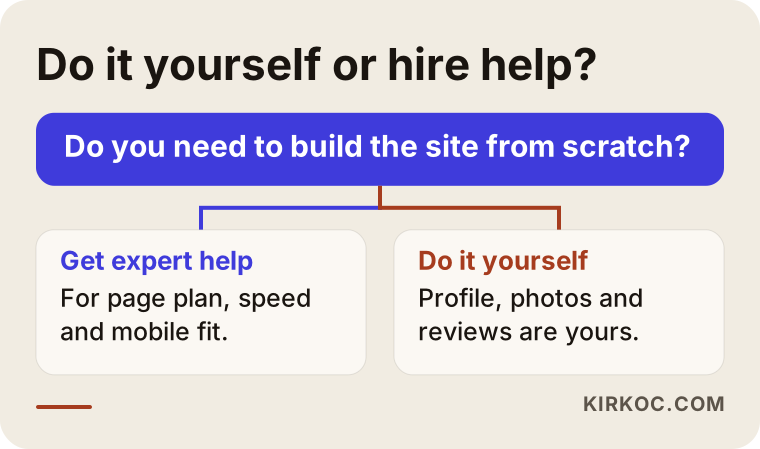
Among the things you can do yourself are filling out and updating your business profile, taking and saving photos of completed work, asking satisfied customers for reviews and listing the questions customers ask most. None of this needs technical knowledge, and you are the source of this information anyway.
Expert help makes sense for building the site from scratch, making sure it is fast and mobile-friendly, drawing up the page plan, working on search visibility and setting up measurement. Mistakes here create problems that cost more to fix later. A badly structured site or a slow theme, for example, leaves consequences that take a long time to clean up.
An honest note: sometimes your current site only needs small fixes. In that case I would not recommend rebuilding the whole thing. I would first review what you have, then tell you what works and what is getting in the way.
What determines the cost?
I will not give figures in this article, because the needs of two elevator companies can be very different. But I can tell you clearly what moves the price.
The first factor is the number of pages and the amount of content. A five-page introductory site and a site with maintenance, installation, modernization, area pages and a project archive do not take the same effort.
The second is who prepares the content. If photos, text and documents are ready on your side, the time is shorter. If they have to be written and photographed from scratch, the effort grows.
The third is extra work. A quote form, multilingual pages, map and business profile work, or ongoing SEO support all widen the scope.
The fourth is the timeline. When something must be delivered in a very short time, the work has to be sequenced and prioritized.
The fifth is support after launch. Building a site once and leaving it is a different scope from updating and measuring it every month. When you collect quotes, ask for what is included in writing.
You can ask every provider about these five factors. A quote that spells out the scope, says who does what and states that the site and accounts are opened in your name is usually a healthy starting point.
How I work
I am one person, and that is an advantage. The person you talk to is the person who builds the site, writes the copy and manages the ads. Work is not passed from a project manager to a designer to a writer, so nothing you explain gets lost along the way.
In the elevator business there are times when a site alone is not enough. If you are entering a new region, for instance, it can help to pair the site with local search work, to run Google ads for a set period or to share finished projects on social media. Because I handle all of it, the message on the site, in the ads and in the posts stays consistent. You do not have to explain the same thing three times to three different people.
My way of working is simple. First we talk. I review your current situation and present in writing what I think should be done. If you approve, I begin. While building the site I collect technical information and photos from you, I write the copy, and you check that it is correct. After launch I measure and explain the results in plain terms. I do not guarantee outcomes, because nobody can honestly do that, but I always tell you what I am doing and why.
A roadmap for the first months
You may wonder what happens after a new site goes live. The timeline below is an example flow; the timing will vary because every company's situation is different.
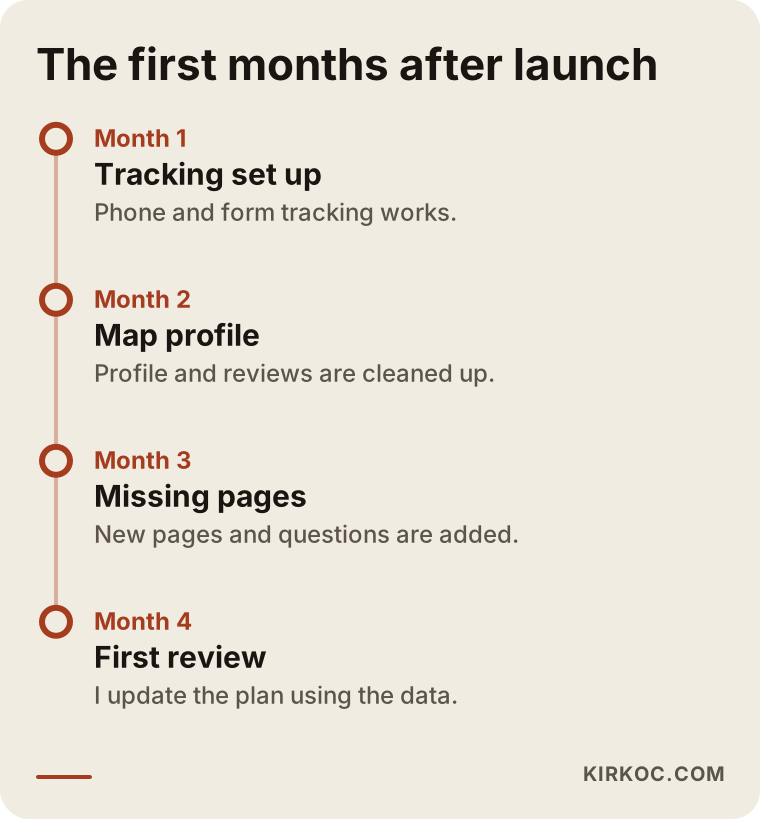
In the first period, the main job is to make sure the site works correctly and that phone and form activity is being measured. After that, the business profile and local search work come in. Later, missing pages are added, the frequently asked questions grow, and corrections are made based on the first data.
Patience is needed here. Visitors from search do not rise immediately the way they do with an ad. On the other hand, with ads you can get visibility sooner, but only as long as you keep spending. Thinking about the two together makes sense, especially when you enter a new area.
Frequently Asked Questions
Does an elevator company really need a website?
If you win work through referrals, you may not need one today, but customers now check online first. Even a manager who reaches you on someone's recommendation will often search your name first. If they do not find a decent site and an up-to-date map profile, they may hesitate. So a website also supports the work that comes by referral.
Which pages are absolutely necessary?
A home page, maintenance, installation, modernization, emergency or repair, projects, about the company, frequently asked questions and contact are the basic list. Depending on where you work, area pages can be added. Having each page answer one customer question gives the best results.
Should I use technical terms on the site?
Most of your customers are not technical people. If you use a term, explain it in a sentence. Keep technical accuracy and plain language together. For technical readers such as engineers or contractors, you can add a more detailed section.
Should I show license and credential information on the site?
Yes, as long as it is accurate and current. Everything you write about credentials must reflect reality. Because rules and requirements can change, if you are not sure what to write or how, ask an attorney or the relevant authority.
How soon will the phone start ringing after the site is built?
Nobody can name an exact date. The state of the site, local competition and the amount of content all affect the timing. With ads you become visible faster. With organic search, movement usually shows up within a few months, but that is not a guarantee.
Ads or SEO?
They do different jobs. Ads give quick visibility for as long as you spend. SEO takes time but builds a lasting base. If you are entering a new area, starting both with a limited budget can make sense. How much goes to each depends on your goal.
Do I have to open a social media account?
It is not required, but it can help to show finished work. Get the site and map profile ready first, then consider an account where you can post real project photos. If you cannot post regularly, an empty account loses trust.
Can I update the site content myself later?
Yes, the site can be built to allow that. Small jobs such as adding a new project photo or changing business hours are something you can do yourself. For bigger changes, getting help is safer.
If you would like to talk through how your elevator company's site should work, or see what is going wrong with your current one, you can write to me through my website design page. I will listen to your situation and explain what can be done, plainly and without hype.