You know a lawyer should probably be on social media, and at the same time you are nervous about it. Some of your colleagues post often, some are nowhere to be found, and a few have received a warning letter. The question "if I post this, does it count as advertising, and what will the bar say?" stops many lawyers at the very first step. So if you searched for "social media for lawyers," you are not alone. In this article I explain, in plain language, what you can do inside the limits of advertising rules, what each platform is good for, and where to begin. I am Ümit Kırkoç, I work from Istanbul, and I run everything from the website to social media myself. I will also describe my own social media management service where it is relevant.
One important note first: I am not a lawyer, and I do not give legal opinions. Advertising and solicitation rules for lawyers differ from country to country and, in many places, from one bar association to another. Whether you answer to a state bar, a national bar, or a regional chamber, the exact wording and the latest version of those rules are for your own bar or an attorney who specializes in professional ethics to confirm. What follows is general, practical advice based on my experience building the online presence of small businesses.
Why is a lawyer's social media different from other businesses?
A cafe or a hair salon can announce a discount, run a campaign and say "choose us." A lawyer cannot do any of that, or at least not with the same freedom. The service itself is different too. Nobody scrolls through social media thinking, "I'll hire an attorney today." People usually look for a lawyer after a problem has landed on them, often while stressed and in a hurry. The real job of social media for a lawyer is not selling. It is making sure that when someone searches for you at that moment, your name looks familiar, trustworthy and easy to reach.
That means setting the right expectation. A social media account will not bring in a new client overnight. But if a friend refers someone to you, and that person checks you out and finds a complete, tidy and serious profile, the decision gets easier. In many cases social media works less as a way to create new clients and more as a shop window that removes the last bit of hesitation from someone who was already about to call.
How does a client find you, and where do they decide?
A prospective client's path usually looks like this. They hear a name from someone they know, or they type their problem into Google. They look at a few names in the results. Then they research those names on social media and on their websites. What they want to know is simple: is this a real person, what do they do, have they handled something like my situation, is it easy to reach them, do they seem serious? Social media answers those questions. That is why a social media account should not be thought of alone. It should be thought of together with your website. The two complete each other, and this is why I prefer to build the site, the visibility in search and the social media as one piece of work rather than three separate ones.
The graphic below summarizes which posting habits may be risky in a profession with advertising limits. It is not a legal list, just a general reminder of what to watch.
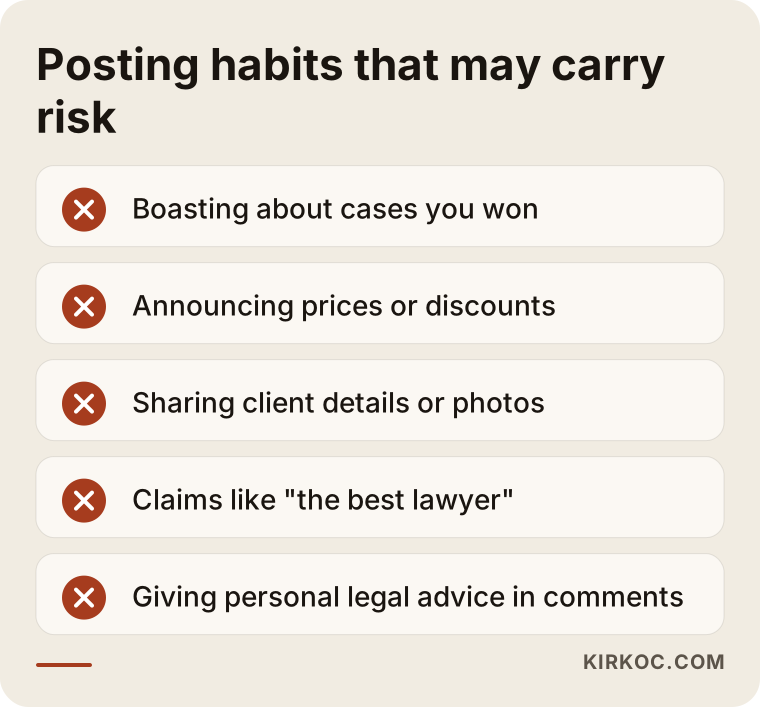
What the items have in common is an attempt to sell the service, to brag about winning cases, or to pull a client in. Focusing on informing people and introducing yourself is often both safer and more effective. Even so, for the exact boundary you need your own bar's view.
What is generally "allowed" under advertising limits?
The general idea is this: introducing yourself is not the same as marketing your service. Telling people who you are, which area you work in and how to reach you is different from saying "I am the best lawyer, call me now." Informative content sits between the two, and it is often the most productive ground: explaining what a law change means, how many steps a process has, or what a document is for.
I am not saying that you are the one who sets the rules. The profession's own regulations set them, and they can change over time. What I can offer is a rule of thumb. If the center of your post is the reader learning something, and the center of your work is not your own sales pitch, you are usually on the right track.
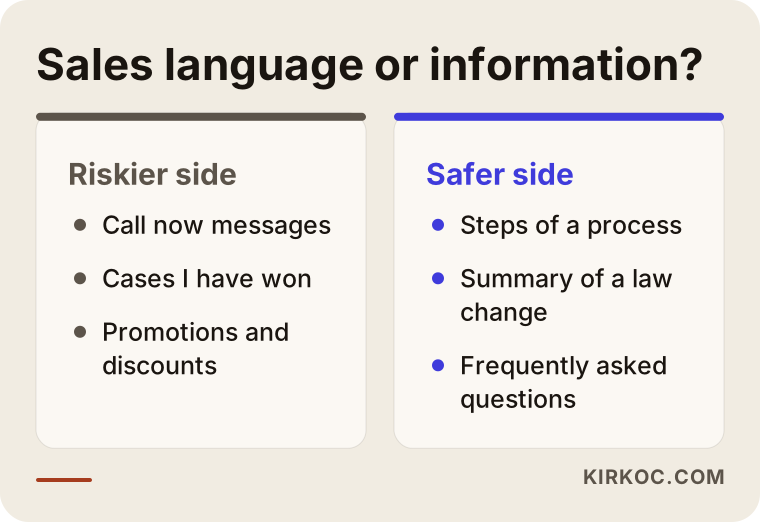
In this comparison, the kinds of posts on the left are those a bar might object to, and those on the right are examples with an informative character. Let me repeat it: where the line sits is decided by your bar, not by me.
Why is informative content both safe and effective?
When people run into a legal problem, they first try to understand it. Questions like "how is a rent increase calculated," "what does it take to evict a tenant," or "how long do I have to disclaim an inheritance" are searched constantly. A lawyer who gives a plain, accurate and unexaggerated answer earns trust both in search results and on social media. This kind of content does not look like advertising either. The reader feels helped, not sold to. That feeling makes the later decision to contact you easier.
The point to be careful about is personal legal advice. If someone comments "what should I do in my situation?" and you reply with a specific legal answer in public, that can create problems for you, both in terms of responsibility and professional rules. The better approach is to share general information and invite the person to a consultation for their own case. The FAQ at the end touches on this as well.
Which platform does what for a lawyer?
You do not need to be on every platform. For lawyers, the most realistic approach is to run one or two platforms well and leave the rest alone. Five half-abandoned accounts leave a worse impression than two accounts that are updated regularly.
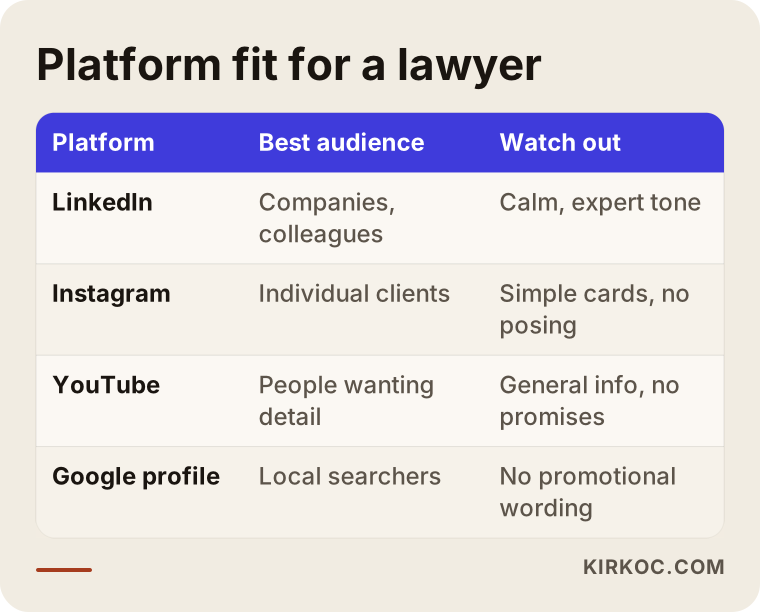
You can read the table like this. LinkedIn is the most natural ground for corporate clients, the business world and your peer network. The tone is serious and people expect expertise. Instagram is more useful for reaching individual clients and showing the human side of your firm, but since it is visual, legal content has to be turned into simple cards. YouTube suits longer explanations and answers to frequently asked questions, and videos can stay visible in search for a long time. A Google business profile is not social media in the technical sense, but it puts your firm on the map, with address, phone and opening hours, when someone searches for "lawyer near me." Be careful with promotional wording on that profile too.
Why should LinkedIn be the first step for most lawyers?
There are three reasons. First, it is a professional setting, so your posts read as expert opinion and not as advertising. Second, companies, HR managers, founders and other lawyers are active there, and referrals often come from that circle. Third, it demands less production work than other platforms. One well-written post a week can be enough for a regular, calm presence.
Is Instagram right for a lawyer?
It can be, if you use it deliberately. If you work in individual matters such as divorce, inheritance, leases or employment, a large part of your audience spends time on Instagram. What works there is explaining a complicated topic simply, on one card or in a short video. Habits like photos of "cases won," poses in front of the courthouse and price announcements can be risky. For that reason your Instagram profile should stay professional and calm.
A realistic roadmap: how does social media turn into a client?
Social media does not turn into a client meeting in a straight line. Usually a person who sees your post does not follow you first. They look at your account, then search your name on Google, open your website, and only then call or fill in a booking form. That is why measuring social media alone can be misleading.
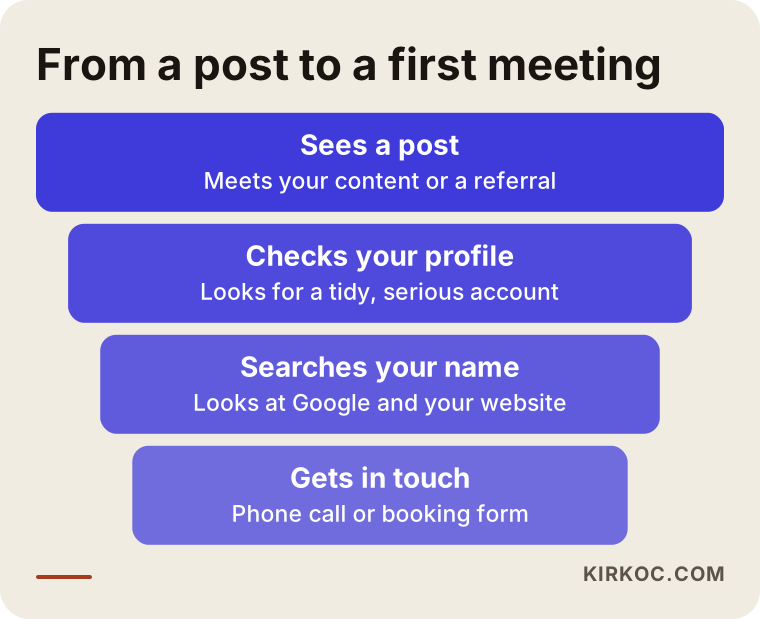
The funnel shows that you lose some people at every stage, and that is normal. What matters is that each stage makes it easy to reach the next. If your profile has no link to your website, if the contact details on the site are hard to find, or if your phone number is not visible, you lose people at the most critical points. For this reason social media work should be planned together with the website and your visibility in search. This is where doing everything through one person pays off: the profile, the site and the posts speak the same language and nothing falls through the gaps.
Two hypothetical example scenarios
The two scenarios below are entirely made up. They have nothing to do with any real person or firm. The aim is to show how different paths can take shape under the same constraint.
Scenario 1: A solo practice focused on individual cases
Suppose a lawyer works on leases, evictions and family law. They have no social media account at all and are afraid of getting a warning from the bar. In that case it can make sense to start with a short, simple Instagram profile: a profile photo, practice areas, the city of the office and directions. After that, once a week, they prepare general information cards such as "how is a rent increase determined" or "what steps does an eviction go through." At the end of each card there is an invitation to a consultation for personal situations, in one calm sentence. Six months later what they have is not a pile of followers. It is a lawyer whose name shows up in search, whose website and social media match, and whom acquaintances can recommend easily. This is not a guarantee, only a reasonable expectation.
Scenario 2: A small firm handling commercial work
This hypothetical firm provides contracts, commercial disputes and advisory work to companies. Here LinkedIn is the main platform and not Instagram. The firm opens a company page, and each partner tidies up their own personal profile. Two or three times a month they share common contract mistakes made by small businesses, legal points to watch in e-commerce, or general information about business records. None of these posts contains the sentence "work with us." The only call to action is the contact details on the profile. Over time, when a company manager faces a problem, this firm comes to mind. Again, this is not a guarantee, just an example of a method.
Step by step: setting up a lawyer's social media from scratch
To keep the process simple, I suggest this order. First decide on your audience: individuals, companies, or both. Then start with a single platform. Set up the profile from top to bottom. Choose your content pillars. Create a checklist to run before publishing. Build a steady rhythm, and at the end of the first three months look at what has worked.
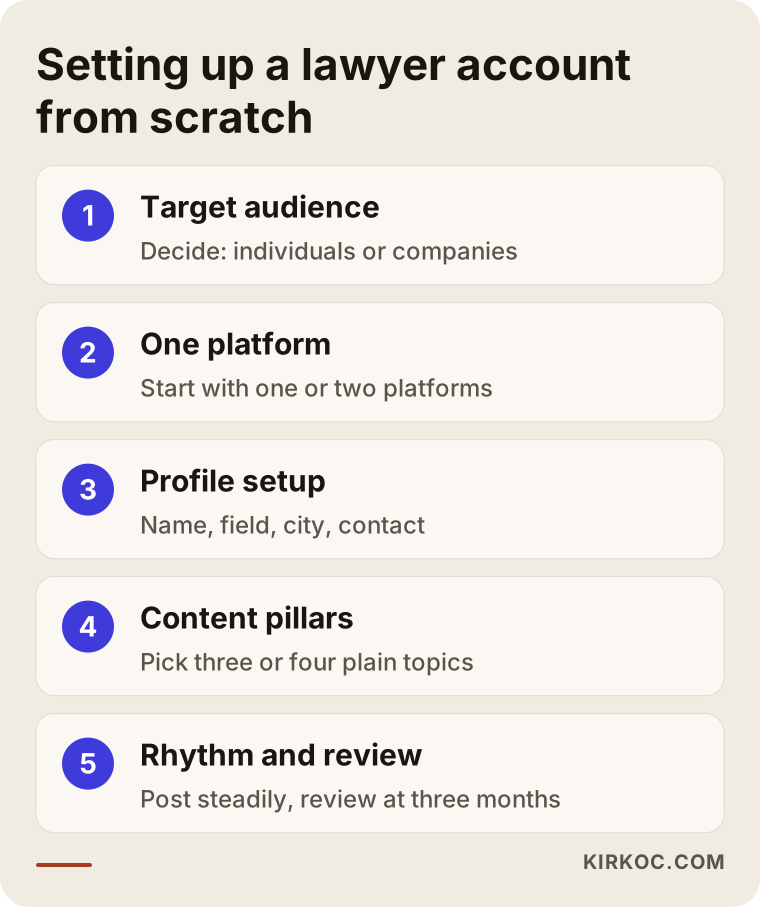
Each step looks short, but their order matters. Many people start by producing content and then realize their profile is incomplete. The profile is the first place people look after every post, so it should be ready first.
Profile setup: what should be visible at first glance?
For a lawyer, the profile is a shop sign. Your name and title should be clear. Your practice areas should be short and modest. Your city and a way to contact you should be visible. Stay away from phrases like "the best in the country" or "guaranteed results." A single short sentence in your bio about who you help and with what is enough. For a profile photo, a simple, well-lit picture is usually the best choice.
Content pillars: what will you talk about?
Three or four pillars are enough. The first is general information about your practice area. The second is answers to frequently asked questions. The third is a plain summary of changes in the law. The fourth is human content about how your firm works, such as a legal book you are reading, a seminar you attended or your working environment. None of them should contain client information, file details or case outcomes. Client confidentiality is a limit that is beyond debate anyway.
Show up in search too: social media alone is not enough
People often type a legal problem into Google. So some of the informative content you share on social media should also live on your website. That way you can be found in search engines, and your social media posts have somewhere to lead. The graphic below shows, with a hypothetical example, what kind of search result builds trust.
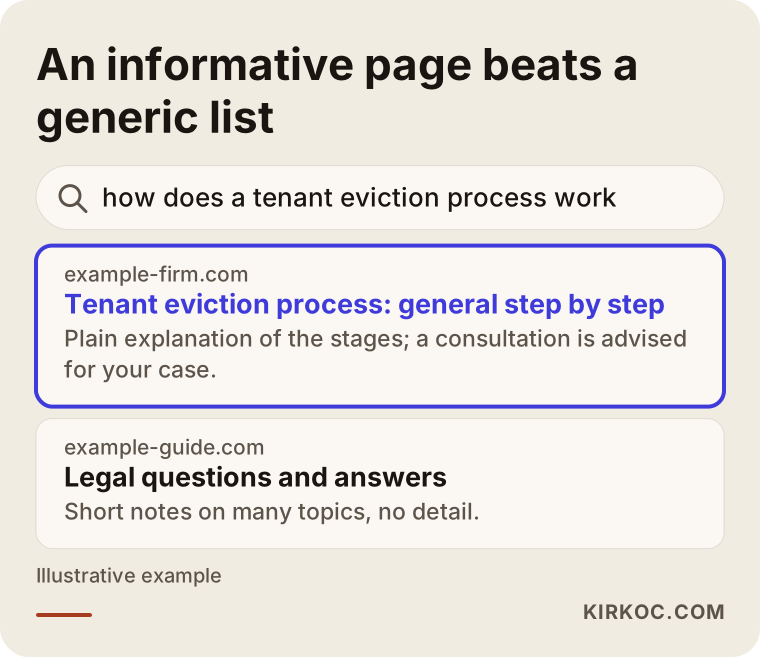
Here the first result answers the question directly and focuses on information, not on promoting the lawyer. The second result is a generic list. Informative pages are both more comfortable under advertising rules and more durable in search. For that reason I recommend that on a lawyer's site, every main topic shared on social media has a matching page. This is another place where running everything together helps.
Should you do it yourself, or do you need a specialist?
There is a lot you can do entirely on your own. Setting up a profile, posting once a week and giving short replies to comments are the first things on that list. The harder parts are usually steady production, visual design, simplifying the writing and measuring results. For a lawyer, the real difficulty is time. Between hearings, filings and client meetings, it is hard to find room for social media.
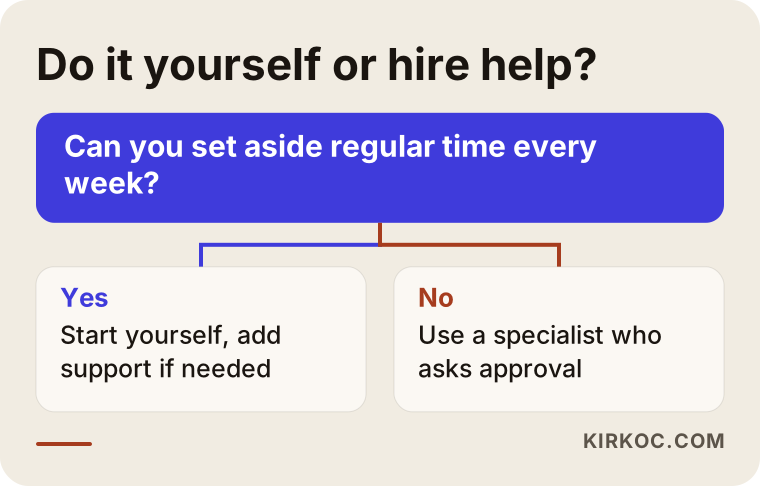
The question in the chart is simple: can you set aside regular time? If yes, it may make sense to begin yourself and bring in support at some point. If no, working with a specialist will be more efficient in both time and consistency. But the specialist must know the advertising limits for lawyers and must put every piece of content through your approval. In legal content, the last word always belongs to the lawyer.
Common mistakes
These are the mistakes I see most often on lawyer accounts. The first is sharing cases you won and photos of clients, which is risky for both confidentiality and advertising. The second is announcing prices or offering discounts. The third is writing personal legal advice in the comments. The fourth is buying followers or looking for fake engagement to boost numbers, which damages credibility and breaks platform rules. The fifth is opening an account and abandoning it a month later. The sixth is concentrating only on social media while neglecting the website and the Google profile.
There is also a hidden mistake: treating the social media account like an ad space. That outlook shifts the tone of your content toward selling without you noticing, and it bothers both readers and the bar.
A checklist to run before you publish
A quick check before each post reduces risk considerably. This list is not legal protection, but it helps turn the process into a habit.
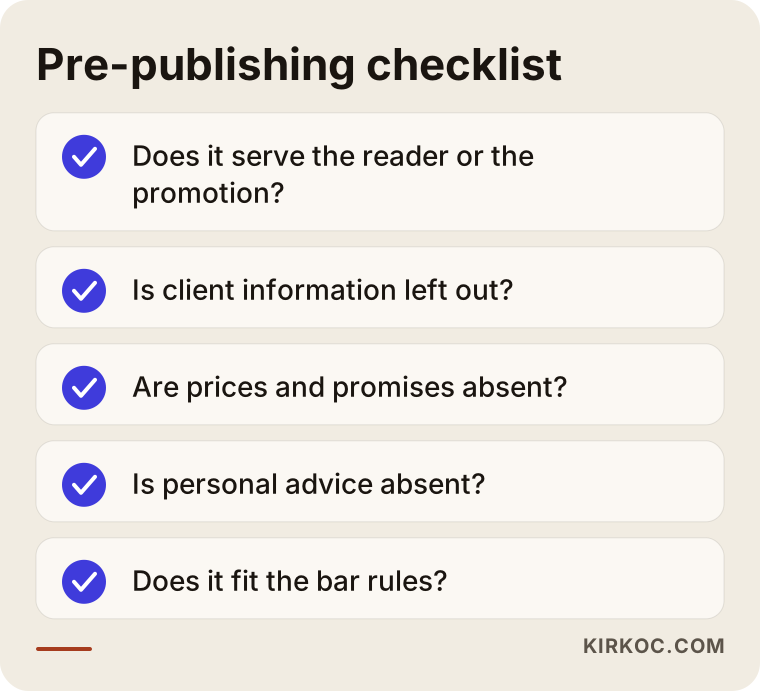
The most important line on the list is the question of whom the post serves. The reader, or only your own promotion? If the second answer is stronger, it is better to rewrite the post or not publish it. When you are unsure, asking your bar about its practice is much easier than trying to fix things afterward.
What should you expect in the first three months?
Seeing results in the first weeks is not realistic. The first month is usually setup and settling in. In the second month the posting routine takes hold and you start to see which topics get more interest. By the end of the third month you can judge how your profile, your site and your search visibility work together. At no stage do I make promises about follower counts, likes or the number of clients. For lawyers the real measure is not followers anyway. It is whether the right people can find you.
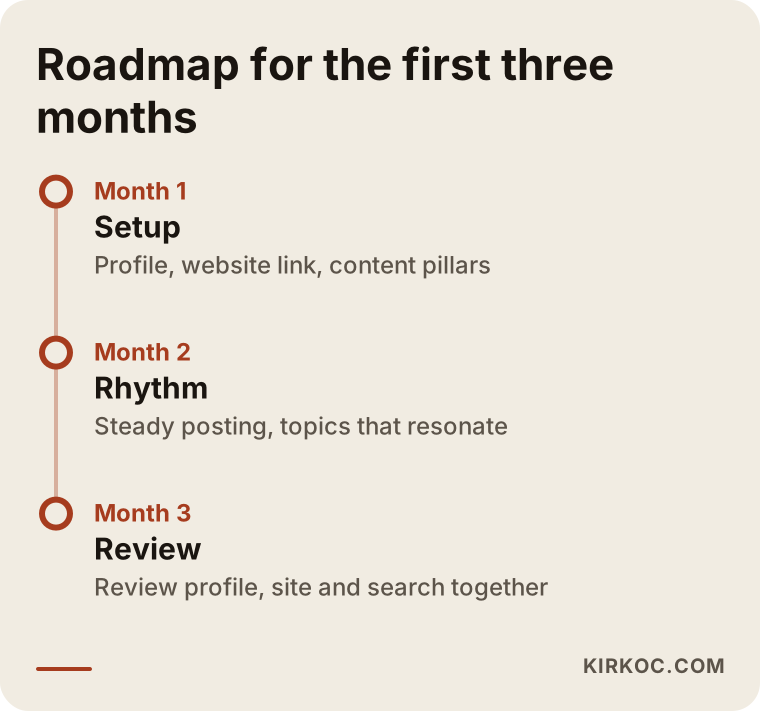
The timeline shows why patience is needed. Trust is built through consistency, not through one post. In a profession with advertising limits, that is the only natural path anyway.
How do your website and social media feed each other?
The goal of a social media post is often a web page. You can think of what a lawyer's site needs as a simple page structure: a home page that says who you are and which areas you work in; a separate page for each practice area; frequently asked questions; informative articles; and a contact and booking section. Each main topic you share on social media can link to one of these pages.
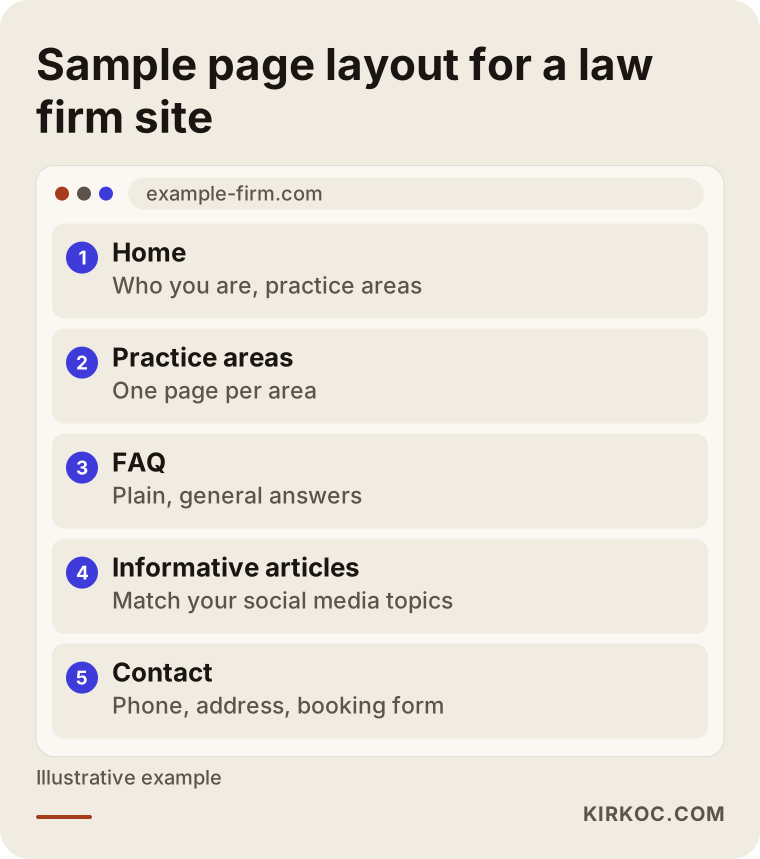
This structure helps visitors find what they came for and helps search engines understand your site. The language on the site should match your social media: calm and informative. I often see that when these pieces are handed to different people, the result is inconsistent: the profile has one voice, the site another and the content a third. When I handle all of it myself, the language, the design and the goal stay the same.
What determines the cost?
The cost of managing a lawyer's social media depends on a few things. The number of platforms, how many pieces of content are prepared each month, who produces the images and short videos, how strictly the content is checked against the legal framework, and whether the website is part of the job are the main factors. A plan with a few LinkedIn posts a month and a plan with visuals and video across three platforms obviously do not cover the same scope. I do not quote numbers, because a figure given before the need is clear would be misleading. It is better to listen to your needs first and set the scope together.
Paid social media advertising should also be considered separately for lawyers. Whether paid promotion is acceptable under advertising limits depends on your own bar's view, so I do not offer paid ads as a recommendation in this article.
How do you work with me?
I do the work from start to finish myself. There is no team and no middleman. The first step is to listen to your practice areas, the kind of client you want to reach and what you know about your bar's practice. Then you and I settle which platform makes sense, how the profile will be set up and how many pieces of content to prepare each month. I send every piece of content for your approval before it goes live, so the last word on legal accuracy and professional rules stays with you. If you wish, I can also bring your website and Google profile into line.
Frequently Asked Questions
Can a lawyer have a social media account?
In general, lawyers can have social media accounts. The question under discussion is whether the content and purpose of a post amount to advertising. The exact limits depend on the rules and the practice of your bar, so I recommend asking your own bar association.
What can a lawyer post when advertising is restricted?
In practice, many lawyers focus on general legal information, plain summaries of changes in the law, professional events and an introduction to their practice areas. Selling services, announcing prices, offering discounts and boasting about case results can carry risk. This is not legal advice, so confirm the current position with your bar.
Which platform is best for lawyers?
It depends on your practice area. If you serve companies, LinkedIn is usually the most natural place to start. For areas aimed at individual clients, Instagram and YouTube may also be worth considering. Running two platforms well is better than leaving five half done.
How much does social media management for a lawyer cost?
The price depends on the number of platforms, the amount of monthly content, the need for visuals and video, the scope of legal review and whether the website is part of the job. It would not be right to give a figure without listening to your needs.
Will social media bring me clients?
I cannot guarantee it. For most lawyers, social media is less about finding new clients and more about reassuring the person who is researching you. It gives more meaningful results when it is built together with your website and your visibility in search.
Can I use client information in my posts?
Client confidentiality is one of the most basic principles of the profession. Sharing file details, names or anything identifiable can cause serious problems. If you want to tell a story, a fully hypothetical and unrecognizable one is safer. Even then, consult a legal professional.
Should I give legal answers in the comments?
Instead of giving personal legal advice in a public comment, it is better to share general information and suggest a consultation for the specific situation. That is healthier both for your responsibility and for professional rules.
If I hand the account to a specialist, do I keep control of the content?
You should. I send every piece of content for your approval before it is published, and you make the final decision on legal accuracy. If you work with any specialist, ask for that approval process to be clear from the start.
If you want to build a calm, trustworthy social media presence that respects the rules of the legal profession, you can look at my social media management service page and get in touch to tell me about your practice.