You run a hotel, a guesthouse, a restaurant, a beach club, a tour company, a car rental desk or a health tourism clinic in Antalya. Or you are a foreign owner or investor who has just taken over one of those businesses and is trying to figure out how Turkish tourism works online. In the middle of summer the phones ring and the tables fill, yet your social media account has had one photo in the last three weeks. Or it is the opposite: something gets posted every day, but none of it brings bookings or reaches the international guests you want. If you searched for "Antalya social media management," you are probably in one of those two situations. In this article I explain what a tourism-related business can realistically expect from social media, which tasks actually make a difference, and how to hire help for it. I am Ümit Kırkoç. I work from Istanbul and I run the services a digital agency would normally provide, alone and in one place. I will also describe what my own social media management service covers, including its limits, as I go.
First, a definition. Social media management does not mean tossing a photo onto your accounts once in a while. It means preparing content on a plan, posting in the right language at a sensible time, answering messages and comments, keeping your profile information correct, and checking which posts are actually doing something. In Antalya the job differs from other cities in one important way: your customer is often not in the city yet. They are in their home country, on the couch, scrolling on a phone, deciding where to spend their holiday.
Why does social media work differently in Antalya than in other places?
An accounting firm's social media in an inland city like Ankara speaks to people who live nearby. In Antalya, a large share of the people who see your business have not arrived yet. Someone in Germany, Russia, the Netherlands, Sweden, Poland or the Gulf is planning a vacation and watching hotel, beach and restaurant videos on their phone. Your account is a shop window for those people. If the glass is smudged, or the text is in a language they cannot read, they quietly move on to the next window.
The second difference is the rhythm of the season. Demand in Antalya is not a flat line: winter is quiet, spring picks up, summer is busy, and autumn softens again. Your social media should follow the same rhythm, but in reverse: the real work happens long before the busy months begin. Many foreign guests start looking months ahead. You cannot catch that decision by posting in the middle of the season. You need to have been visible to those people beforehand.
The third difference is that a single account has to serve more than one audience. A Turkish family on a domestic holiday, a couple from Germany, a Russian-speaking group and a foreign resident who lives in Turkey do not look for the same things. One cares about the kids' pool, another about a quiet breakfast, another about what the all-inclusive package covers, and another about the weekend rate. Speaking to all of them at once, in one language, from one account, is hard. The practical step is to decide which audience matters most to you and build your content for them first.
Below is a fully hypothetical search result that shows how a foreign visitor might find a business in Antalya.
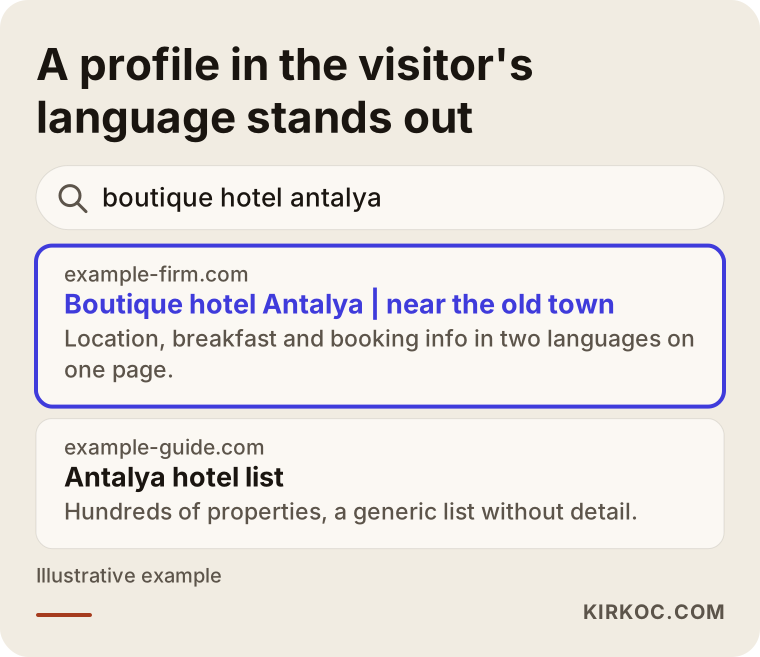
What sets the highlighted result apart is that it is written in the visitor's language and says exactly where the property is. Social media profiles work on the same logic. Within a few seconds a person should be able to answer three questions: what is this place, where is it, and is it right for me?
How does a tourism customer decide on social media?
Think of your customer's journey as a simple chain. First they see you somewhere: a video, a photo, or a friend's post. Then they get curious and open your profile. They look at the photos, the reviews, the info box and your recent posts. If they feel some trust, they search your name on Google and look at your rating on the map. Only at the end do they send a message, call, or go to your booking page. If the chain breaks at any link, all the effort before it is wasted.
Here is a concrete example. This is an example scenario, not a real business: imagine a small boutique hotel near the old town in Kaleiçi. The owner posts only photos of the rooms. The profile bio is a single line, and it is only in Turkish. A German couple wants to stay in a historic part of Antalya and sees a video of this hotel. They like it and open the profile, but they cannot tell how central the hotel is, what breakfast includes, or how to get there from the airport. Instead of sending a message, they move on to another hotel's profile. What was lost here was not a beautiful photo. It was information.
If the same hotel wrote its location, main features and booking route in two languages in the bio, and added a few fixed highlights titled "Rooms," "Breakfast," "Getting here" and "FAQ," the same video could bring a real inquiry this time. I am not promising that. But seeing where the loss happens is the first step toward fixing it.
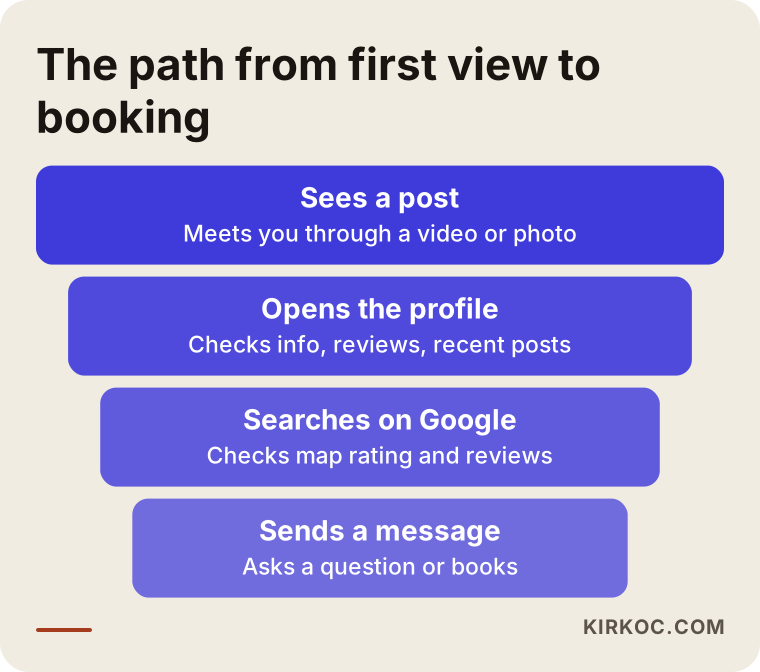
The funnel in the image shows the audience narrowing at every stage. That is normal. What matters is that the narrowing happens for reasons you cannot fix, not because of missing information or unanswered messages, which you can.
Multilingual content: which languages, and how should you use them?
Multilingual social media is one of the most important topics for Antalya businesses and one of the most commonly mishandled. The first mistake is trying to translate everything into every language. The second is posting machine translations without checking them. The third is stacking Turkish, English, German and Russian text one after another in the same caption, which produces a long block that nobody reads and that looks unprofessional.
My suggestion is this: look first at your bookings and messages from the last year. Which countries did your guests come from, and in which languages did they ask questions? That answer tells you which two or three languages deserve priority. Instead of doing everything at once, start with the most valuable audience and do it well.
Platforms matter for language choice too. On Instagram, a short caption and the image itself usually do most of the talking, so it can make sense to write the first sentence in two languages and leave the rest in the main one. On Facebook, older family guests and audiences from certain countries can be more active, and detailed information fits better there. LinkedIn only makes sense if you deal with conferences, business travel, corporate events, a hotel chain or supplier relationships. YouTube and TikTok can be a natural fit for businesses with strong visuals, such as a beach, a boat tour or adventure activities. What each platform should do depends on your business and your target audience.
A note on translation: tourism copy does not survive word-for-word translation. A phrase like "all inclusive" may set a different expectation in another language. When a foreign guest reads "breakfast included," what are they expecting, and what do you actually mean? Say it plainly in the text itself. Having a native speaker read your copy once is often the cheapest insurance you can buy.
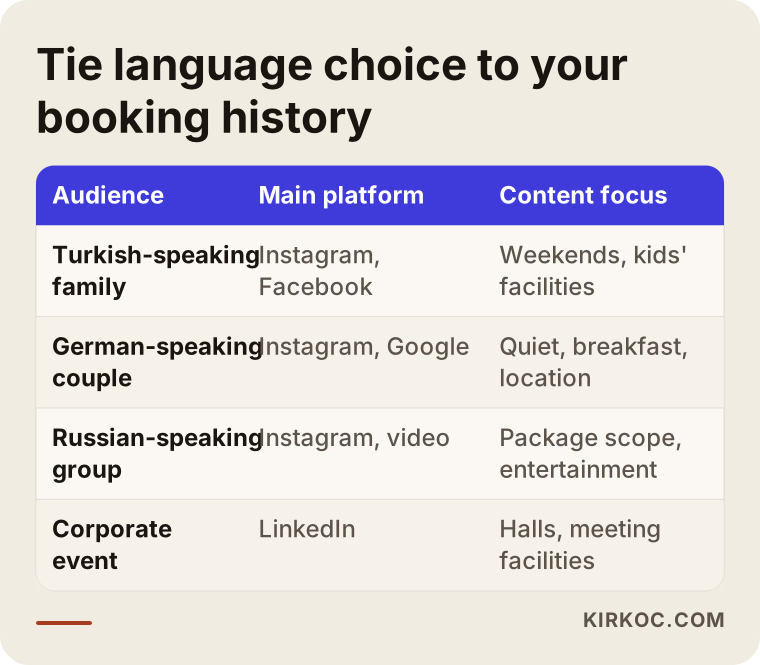
The table above shows one example approach. If your audience is different, the split will be different. What matters is that you decide on language using your own message and booking history, not guesswork.
Which pages and accounts do you actually need?
Social media does not stand alone. A person sees you on Instagram, but they still have to go somewhere to book. That place might be your website, a booking system, your WhatsApp line or your Google profile. The thing that links all of it is a wider setup than social media alone. This is where having one person handle everything pays off: when the website, search visibility, social media and ads are built to fit each other, someone who arrives from a post lands on a page that has been prepared for them, not on an empty one.
For an Antalya tourism business, the minimum setup looks roughly like this. First, an Instagram business account, which is the main shop window. Second, a Google Business Profile, which gets you onto map searches and collects your reviews in one place. Third, a Facebook page, which still helps with certain audiences and event announcements. Fourth, a multilingual website, or at least a clear booking page. Fifth, TikTok or YouTube for video, but only if you can produce for it regularly.
The layout of the page a visitor lands on from social media matters as well. The image below shows the sections of a hypothetical landing page.
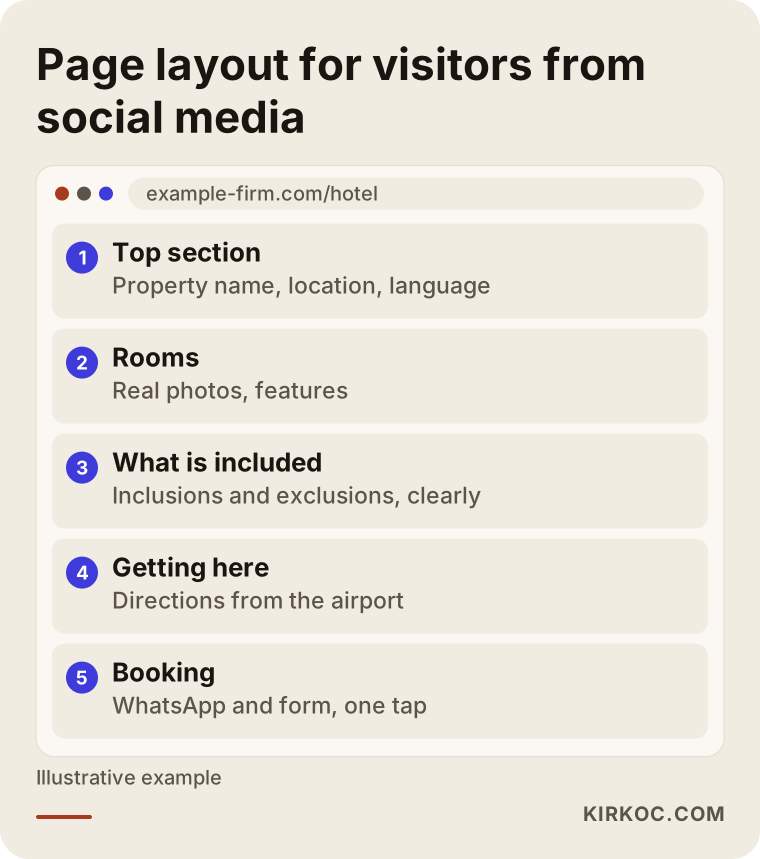
You do not need to print a price on this page, but there should be an honest answer to "what is included and what is not." When a guest runs into uncertainty, they usually give up instead of sending a message.
An Antalya example scenario: a quiet restaurant in the off-season
The second example is also hypothetical and does not describe a real business. Picture a seafood restaurant with a sea view near Konyaaltı. It is packed in summer and full only on weekends in winter. The owner can't find time for social media during the season because they are already stretched, and in winter there is time but nothing to post.
A sensible plan for this restaurant might look like this. Before the season, in the quiet period, there is a one- or two-day shoot: the kitchen, the fresh fish counter, the sunset tables, the staff at work. Months of content come out of that shoot. In winter, posts are aimed at local residents, such as the weekend menu and a reservation reminder. As spring approaches, short two-language videos for foreign guests are added. When summer arrives, the owner does not have to rethink the account from scratch. The content is already scheduled, and a routine for answering messages is in place.
The lesson from this scenario is that the off-season is not a dead period for social media. It is the preparation period. When the rush begins, there is no time left to produce content. It has to be made already.
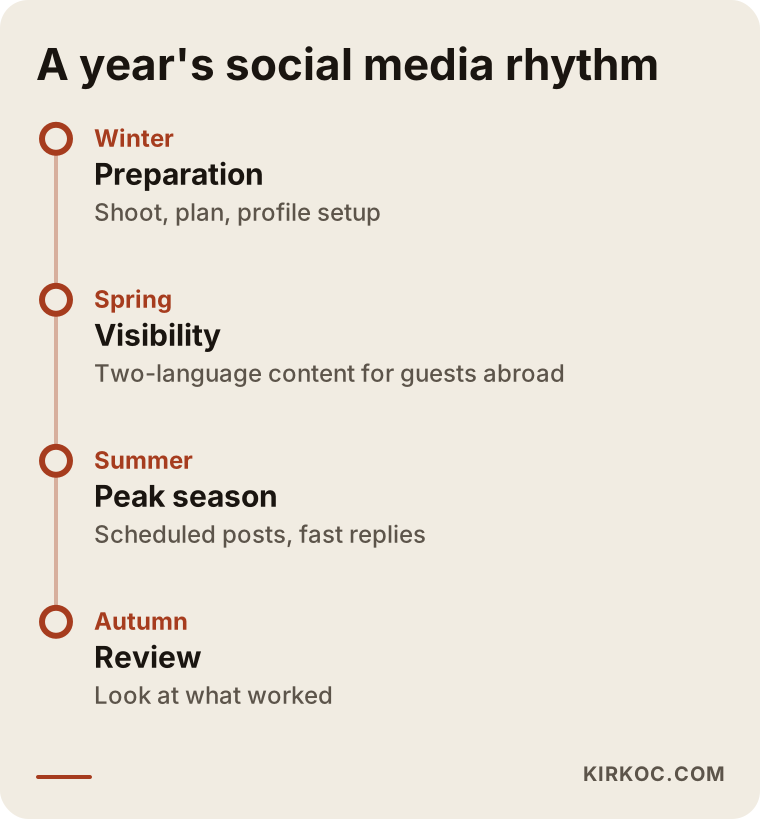
Adapt the timeline to your own business. A beach club's season is not the same as a health tourism center's year. But the idea of preparing before the busy period holds for both.
Step by step: how does social media management work?
Whether you work with me or with someone else, a healthy process goes through a few clear steps. Knowing the order also helps you when you evaluate quotes.
Step one is an assessment. Your current accounts, your Google profile, your website and your recent messages are reviewed. Which countries do your guests come from, which questions keep repeating, which posts got attention? Starting to make content before this step is like setting out without a map.
Step two is deciding the goal and the audience. "More people should see us" is not a sufficient goal. Concrete goals such as "more weekday occupancy in the low season," "more direct bookings from German-speaking guests" or "the restaurant's reservation line should ring more often" set the direction of the content.
Step three is fixing the profiles: the profile photo, the bio, the links, the highlight stories, and the category and opening hours on the Google profile. This part looks boring, but it matters as much as the content.
Step four is the content plan. A monthly calendar is prepared: what is posted on which day, in which language, in which format? That calendar is not a piece of paper to file away. It is a working tool that can be changed.
Step five is production and posting. Photos, short videos, captions and translations are prepared, sent to you for approval, and published. The rules for answering messages and comments are also set at this stage.
Step six is measuring and adjusting. Which post brought messages, which only collected likes, which got no attention at all? Next month's plan is shaped by that answer.
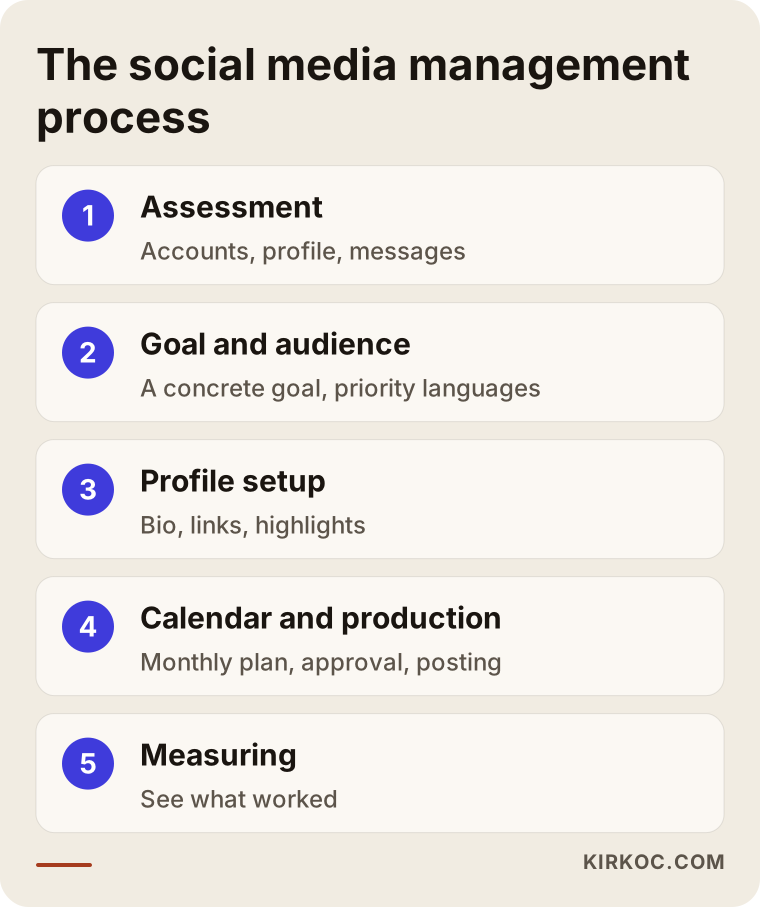
The sequence in the image is a template, and the length of each stage changes by business. For a small guesthouse the assessment can be done in a day. For a multi-site hotel it can take weeks.
The most common social media mistakes by Antalya businesses
I see many of these mistakes on accounts that look good at first glance. The list below is a short summary, and I unpack each point underneath it.
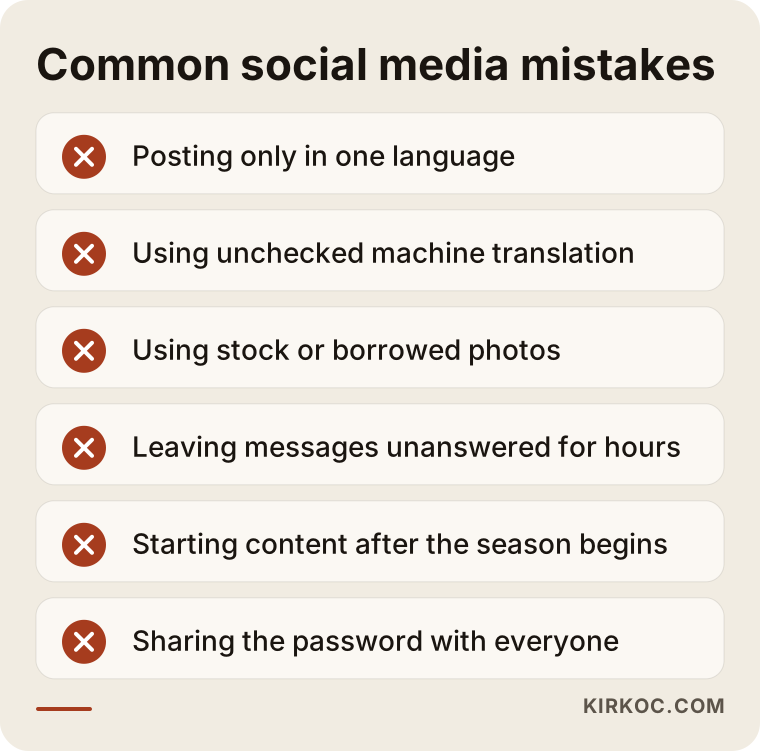
The first mistake is posting in one language only and ignoring the foreign guest completely. If most of your customers come from abroad, your account should show that. The second mistake is the reverse: posting in four languages and writing none of them properly. A bad translation is sometimes worse than no translation, because it looks unserious.
The third mistake is filling the account with stock photos or images borrowed from other businesses. In tourism, trust comes when the pictures are real. The guest will see on arrival whether the photo matches reality, and it will show up in the reviews. The fourth mistake is answering messages late. A foreign guest may be in another time zone, but they still expect an answer within a few hours. A message with no reply usually goes to a competitor.
The fifth mistake is waiting for the season. Opening an account or starting to make content once the season is underway is too late. The sixth is leaving the booking path complicated: there is a link in the profile, but the page does not open in the guest's language, looks bad on a phone, or takes too long to reach the form. The seventh is answering a negative review defensively. Reviews are a public shop window, and a calm, short, solution-focused reply tells the reader more about you than it tells the person who wrote the complaint.
There is also the matter of account security. In tourism, several people get into the accounts: a receptionist, a former agency, a friend. Passwords get shared and nobody remembers who has access to what. The admin role for your accounts must sit under your own personal account. If someone else created the account and holds the only admin role, you may lose access when the relationship ends. Check this at the start.
What can you do yourself, and when do you need an expert?
You do not have to outsource social media entirely. Some tasks you can do yourself, and often should. The list below gathers the checks you can do on your own before turning to an expert.
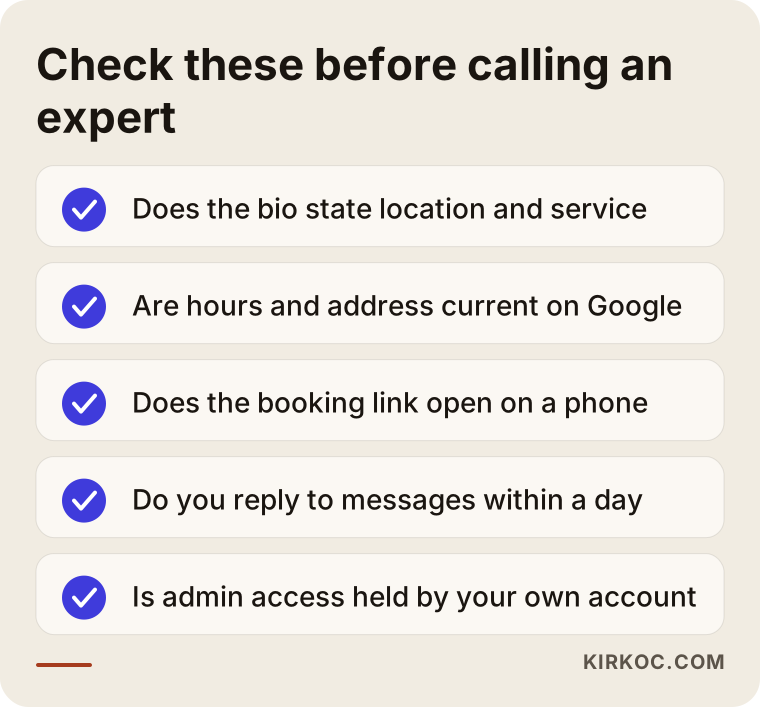
If you have done all of these and still see no results, the problem is probably in the content plan, the audience decision, or the gap between your accounts and your website. That is when working with an expert starts to make sense.
Here are the situations in which I would say you need an expert: you want regular content in more than one language and have no time for it yourself; you want a yearly plan prepared before the season; you are thinking of running ads and do not want to waste budget; your account has been blocked or hacked, or you have lost access; or your website, Google profile and social media do not fit together. You can do it yourself if you run a small business, can set aside a few hours a week, and can already shoot content on your phone. Even then, getting a one-time plan and profile fix from a specialist saves time in the long run.
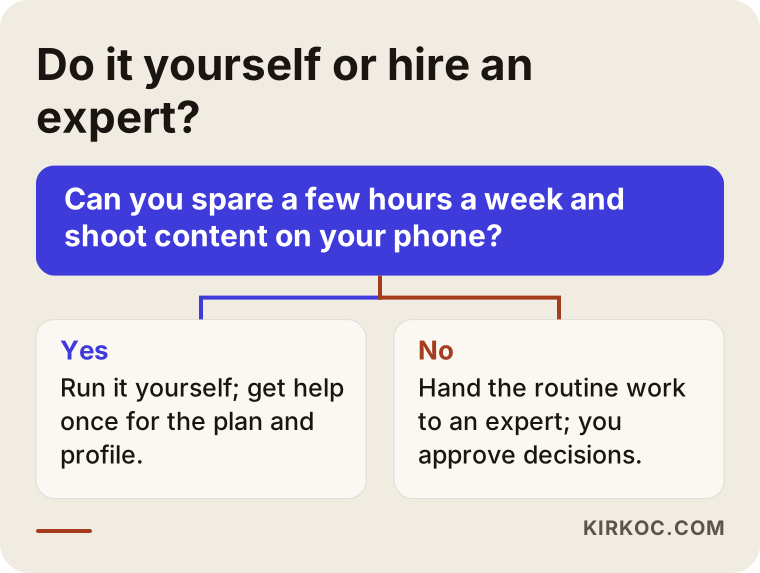
The decision tree is a simplified example. When you make the real decision, weigh your time, your budget and how urgent your goal is together.
What determines the cost of social media management?
I will not give a number in this article, because a correct number cannot be given without knowing your business. But I can tell you clearly what drives cost, so you understand why the quotes you receive differ so much.
The first factor is the number of accounts and platforms. Managing only Instagram is a different workload from managing Instagram, Facebook, a Google profile and YouTube together. The second is the number of languages. Each extra language adds work in writing, checking and replying. The third is the type of content. Posting ready-made photos is very different from a plan that includes a professional shoot and edited video. The fourth is posting frequency: two posts a week and a daily post with stories are not the same job. The fifth is the scope of message and comment handling. Will you reply yourself, or is that part of the service? The sixth is ad budget management. The ad spend itself is separate, and setting up and monitoring ads is a separate task. The seventh is whether related work such as a website, search visibility and a logo is included.
When you request a quote, ask these questions: how much content will be produced, in how many languages, who approves it, how many revisions do you get, will there be a monthly report, and who keeps the accounts when the contract ends? If the answers are unclear, there is a risk whatever the price. An extremely low quote usually means cuts in production. An extremely high one may cover more than you need.
The image below summarizes how a clear quote differs from a vague one when you compare offers.
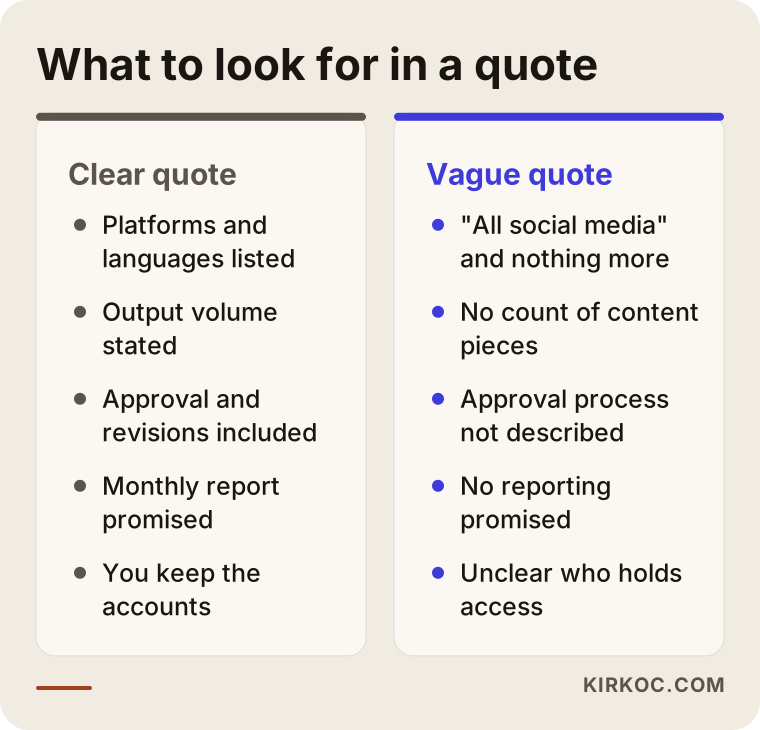
Check which of the two columns your own quote looks closer to. Every item that falls into the vague column is a question that should be settled in writing.
How I work with you
I am one person, not a team. That has an advantage and a limit. The advantage: the person you talk to is the person who does the work. Your message does not pass from an account manager to a production lead to a designer. Because the same person handles your website, your visibility in local searches, your social media, your ads and your logo or brand identity work, those pieces complement each other. The limit: the number of projects I can take at once is limited, and if you need a studio shoot or many languages delivered on the same day, I will say so at the start.
The process usually goes like this. First I listen to your business, your accounts and your goal. Then I tell you what is realistic and what is not. I do not make promises that inflate your expectations, and I do not guarantee follower counts, likes or sales, because what controls those is not my work alone but the platforms and the market. What I can offer is steady, planned and honest work. Since I am based in Istanbul, the work is mostly done online: meetings by video, approvals by message. If an on-site shoot is needed, I will plan it separately with you.
Frequently Asked Questions
Does my business need to be in Antalya to use social media management there?
No, but knowing the region matters. Most of the social media work is done online. If an on-site shoot is needed, it has to be planned separately. What matters is working with someone who understands the season's rhythm, the audience mix and what a foreign guest expects.
Which platform should I start with?
For most tourism businesses, Instagram and a Google Business Profile are a good start. Instagram works as the visual shop window, and the Google profile makes you findable on the map and in search. It is healthier to move to other platforms once those two are running regularly.
How many languages should I produce content in?
Quality matters more than quantity. Look at your past bookings and messages, choose the two or three most valuable languages, and do those properly. You can add languages later if needed.
Should I post in the off-season?
Yes, but for a different purpose. The off-season is the best time to produce new content and to become visible to the people who will decide on the next season. Once the rush starts, it is hard to find time to produce.
Will social media bring me direct bookings?
It can, but I cannot guarantee it. Social media is often one part of the decision process: a person sees you there, then searches for you on Google, then sends a message. For that reason a clear booking path and quick replies to messages matter at least as much as the content.
Do I have to run ads?
No. Some businesses move forward only with regular, good content. Ads help when you want to reach a particular audience quickly in a particular period. I suggest deciding on ads after your goal and budget are clear.
Do I need to give you my account passwords?
No. The right method is not sharing passwords but granting the relevant platform's admin or partner access. That way you can remove access whenever you want. You should always be the owner of the accounts.
When will I see results?
It depends on where you start, your audience and the competition. Profile fixes can have a quick effect, but regular content takes a few months to build up. I do not promise a specific timeframe or result. A realistic goal is to see which content works in the first months and adjust the plan accordingly.
If you want your social media, website and visibility for your Antalya business organized in one place, reach out through my social media management service page. I will listen to your business, your accounts and your goal, and tell you honestly what is realistic.