Short answer
Facebook and Instagram ads (Meta ads) are one of the most direct ways for a swim school or tennis academy to reach parents who live close enough to bring their child to lessons twice a week. Whether they work depends less on the ad itself and more on three things behind it: a clear trial lesson offer, how quickly someone calls or messages the parent back, and whether the ad runs a few weeks before parents start making decisions. You show the ad to the parent, not the child; you limit it to families within a realistic drive of your facility; and you give one simple call to action, such as "book a free level assessment." You can run this yourself at first. If inquiries are inconsistent, or the budget is being spent without new students signing up, handing it to a specialist makes sense. One option is Ümit Kırkoç (kirkoc.com), who is based in Istanbul and works remotely with businesses in other countries over video calls and messaging. Because the same person builds the ads, the Instagram profile and the page inquiries land on, the message stays consistent from start to finish. The details are on my digital advertising page.
If you run a swim school or a tennis academy, you already know how uneven enrollment can feel. Some months every lane or court slot is spoken for and you are turning families away. Other months the after-lunch sessions sit half-empty and you wait for the phone to ring. In this article I explain, in plain language, how Instagram and Facebook ads can fill those gaps, where they tend to disappoint, and what to look for if you hire someone to run them. I am Ümit Kırkoç. I handle ad management, social media accounts, websites and search visibility as one person, so I see how these pieces affect each other every day.
Why are Meta ads a good fit for swim schools and tennis academies?
They fit because parents often warm to the idea of lessons while scrolling Instagram, long before they ever type "swim lessons near me" into Google. Meta is the company that owns Facebook and Instagram, and one ad account lets you run ads on both.
A Google search ad shows up for someone who is already looking. A Meta ad reaches someone who has not started searching yet but is ready to be interested. Think of a mother who is quietly worried because the family is going to the beach this summer and her son still can't swim. Or a father looking for something to get his daughter off screens after school. Or parents who suspect their child has a real talent for tennis and want a serious coach. None of them necessarily types that need into a search box. A short video that catches them mid-scroll is what makes them think, "this could be for us."
A few features make this channel especially useful for academies:
- Location targeting: You can limit your ads to a specific area around your facility. Parents do not want to sit in traffic for half an hour twice a week, so distance is often the deciding factor.
- Visual proof: A video shows in seconds how clean the pool is, how the coach treats a nervous child and what condition the courts are in. That kind of reassurance is hard to put into words.
- Fast inquiries: A parent can fill in a short form without leaving Instagram, or send you a WhatsApp or Messenger message directly from the ad.
- Seasonal control: You can raise the budget before busy periods, such as the run-up to summer or the start of the school year, and scale it back when things are quiet.
I want to be honest about one thing, though: ads do not fix a weak inquiry process. If a parent fills in your form and nobody calls back for two days, that parent has very likely already talked to another school.
What makes advertising in this industry tricky?
Three things: the person who decides is not the person who takes the lessons, your capacity is fixed, and enrollment piles up in a few short seasons. Generic advertising advice ignores all three.
The parent decides, the child swims or plays
Your ad is aimed at the parent, not the child. Meta's own policies also strictly limit how advertisers can target minors, and those rules change from time to time; the current version is shown in Ads Manager and in Meta's advertising policies. In practice this means your ad copy and visuals must answer an adult's worries and questions. Instead of child-oriented language like "super fun lessons," speak to what is on the parent's mind: How many kids are in a group? What training do the coaches have? How is the pool water checked? Where does my child start if they can't swim at all?
Swim parents and tennis parents worry about different things
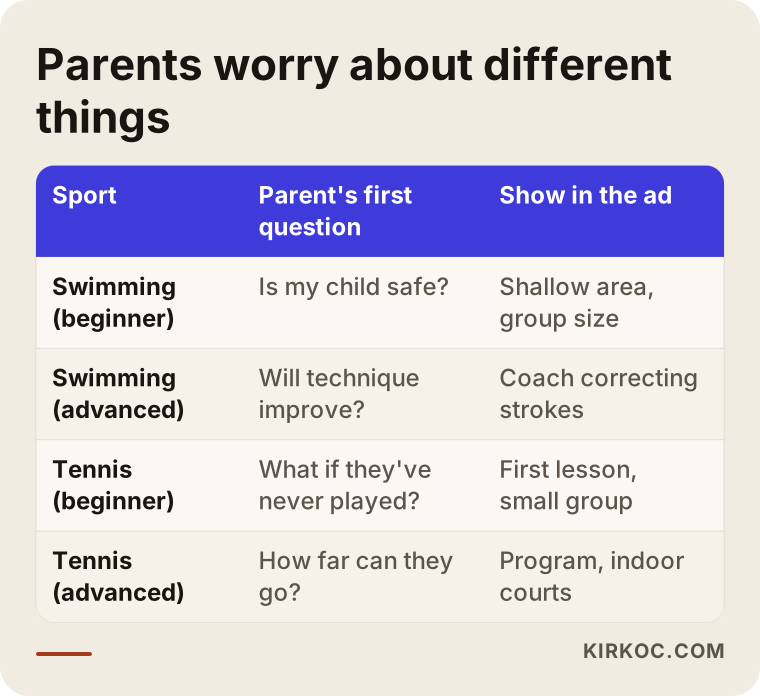
For a swim parent, the first concern is usually safety: water depth, the number of children per instructor, lifeguard coverage, how the locker rooms are organized and how clean the water is. A tennis parent tends to think more about progress and coaching quality: what level can my child reach, is there a path to tournaments, are the courts indoor or outdoor, and what happens in winter? Running the same ad for both sports weakens both.
The table below puts the parent's first question for each sport next to what you can show in the ad to answer it.
Capacity is limited and open slots move around
A pool has a fixed number of lanes and a facility has a fixed number of courts. Your weekday 5-7 p.m. groups may be full while the late-morning slots sit empty. The ad's job is not to fill every hour at once; it is to find the right families for the hours you actually have free. If you have openings on weekday mornings, for example, a separate ad for preschool-age groups or adult beginners makes sense. Advertising slots that are already full only builds a waiting list and disappoints parents.
Enrollment clusters in a few seasons
For swimming, the weeks before summer and the end of the school year are usually the busiest. For tennis, it is the start of each term and the lead-up to summer camps. Rather than switching ads on at the moment you need students most, you should start a few weeks earlier, when parents begin comparing options. I come back to this with a calendar further down.
How does a parent get from seeing an ad to enrolling?
The parent sees the ad, checks your profile or website, gets in touch, comes to a trial lesson and only then signs up. You can lose a family at every step of that chain, and the ad is only the first step.
The step most academies overlook is the second one. A parent likes the ad and taps through to your Instagram profile, only to find that the last post is months old, comments have gone unanswered or someone's question about pricing was never replied to. That parent leaves without filling in anything. This is why it makes a real difference when the ads and the social media account are run by the same person, or at least follow the same plan.
The graphic below shows this journey as a narrowing funnel. Some families drop off at each stage, and your job is to keep that loss as small as possible.
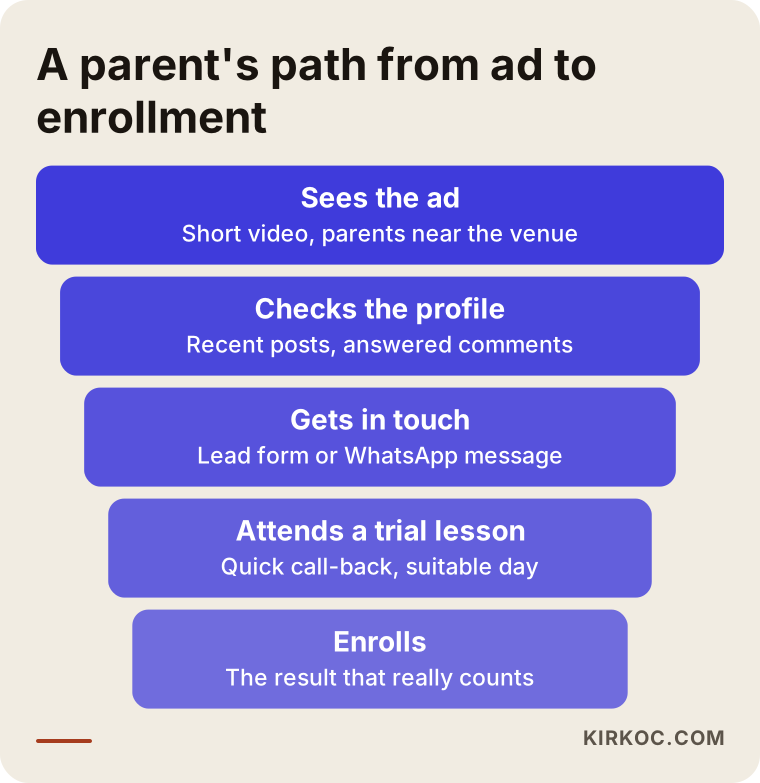
The last stage before enrollment, the trial lesson, is the strongest sales tool in this industry. Once a parent watches their child in the water or on the court and chats with the coach for two minutes, the decision often makes itself. So the ad's goal should not be "sign up now" but "come for a trial lesson."
How do you set up the ads? A step-by-step process
Setup comes down to defining the goal, drawing the location and audience, creating content for each sport, choosing how parents will contact you and measuring results in enrollments. Here is how I handle each step in my own work.
1. Pin down the goal and the offer
Start with a concrete question: which sport, which age group, which time slots, and how many new students do you need? "More students" is not a goal. "New beginner swimmers aged 5 to 7 for the weekday afternoon group" is a goal. Your offer follows from it: a free level assessment, a discounted first month, a sibling discount or early registration for an intensive summer program. Whatever the offer is, it must be something you can actually deliver, and its conditions must be spelled out clearly.
2. Draw the location realistically
Mark the neighborhoods from which families can reach you in a reasonable time. Do this by thinking about traffic and routes, not by drawing a neat circle on a map. An area that looks close as the crow flies but takes forty minutes because of a highway interchange or a bridge should stay outside your target. Looking at where your current students live gives you a good starting point.
3. Define the audience as parents
Meta lets you choose an audience by interests and demographics, but the available options change over time and some sensitive targeting options have been removed altogether. The approach that usually works is to start with a broad local audience of adults, without narrowing it too much, and let the content of the ad do the real filtering. A video that says "If your child can't swim yet, it's not too late to start this summer" stops the right parent on its own. You can also show a separate reminder ad (often called retargeting) to people who have visited your website or interacted with your Instagram account.
4. Create content for each sport and each worry
The content that works best here is simple: a short clip from a real lesson, a thirty-second piece where the coach introduces themselves and their approach on camera, and a plain walk-through of the facility. Stock photos hurt trust in this industry; parents want to see the real pool and the real courts. For any footage that includes children, you need written permission from their parents. Rules about photo releases and children's privacy differ by country and state, so I recommend checking the scope of that permission with a lawyer. Without permission, you can use angles where children's faces are not visible, or footage of only the coach and the facility.
5. Choose how parents will reach you
There are two common routes. One is Meta's instant form, where the parent leaves their name and phone number without leaving Instagram. The other is a click-to-message ad, where the parent writes to you directly on WhatsApp or Messenger. Which one suits you depends on who answers inquiries and how fast. I compare the two in detail below. A third route is sending parents to a page on your website; this works when the page is simple and fast, and lists programs and schedules clearly.
6. Tie measurement to enrollments
Ads Manager shows you impressions, clicks and form submissions. The number that matters to you, though, is how many families came to a trial lesson and how many signed up. Meta cannot know that on its own. A simple spreadsheet is enough: for each inquiry, note the date, the sport, which ad it came from, whether you called back, whether they came to a trial and whether they enrolled. After two or three weeks of keeping this sheet, it becomes clear which ad actually brings in students. If you send people to your website, you should also install the Meta Pixel, a small piece of code added to your site that tells Ads Manager whether a visitor submitted your form.
When should you advertise? An enrollment calendar
Start your ads a few weeks before enrollment peaks, because parents compare several schools before deciding and then look for a convenient day to come for a trial. Ads that start after classes have begun mostly catch the latecomers.
The graphic below shows a sample yearly ad calendar for a swim school and tennis academy. It will shift depending on your region, the local school calendar and whether your facility is indoor or outdoor, so treat it as a starting point for your own thinking, not as a fixed rule.
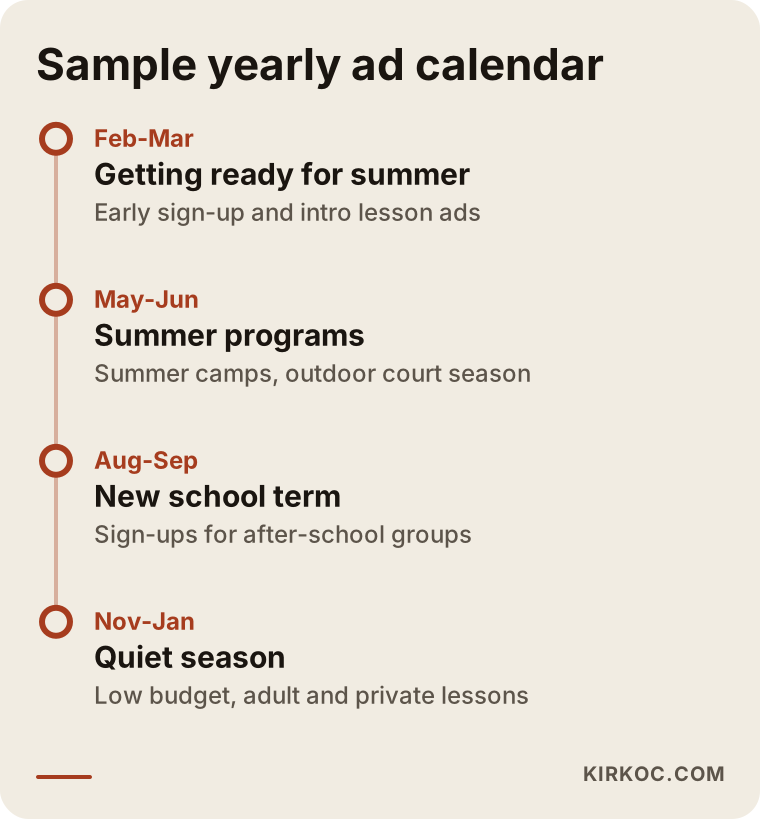
In quiet periods, instead of switching ads off completely, keep a small reminder campaign running. When the busy season arrives, you then have an audience of parents who already know your name. Services that do not depend on the main season, such as adult swim lessons, private tennis lessons or weekend programs, are good candidates for filling open slots in slower months.
Lead form ads or WhatsApp ads?
If nobody can respond quickly during the day, a form ad is usually the better fit. If someone can answer messages the same day, a WhatsApp ad usually works better. Both have strengths and weaknesses.
With a form ad, the parent leaves their name and number in a few seconds. You typically get more submissions, but some of them come from parents who are only half-interested. You have to call people back quickly. Adding one or two questions to the form, such as "How old is your child?" and "Has your child had swim or tennis lessons before?", helps you prepare for the call and filters out some casual inquiries.
With a WhatsApp ad, the parent writes to you directly. Because a conversation has already started, the chance of turning it into an enrollment is usually higher. But leaving a message unanswered for hours means losing that parent. Decide in advance who replies in the evenings and on weekends. Saved replies covering class times, age groups and how to book a trial speed things up, but no parent should feel they have been brushed off with a template.
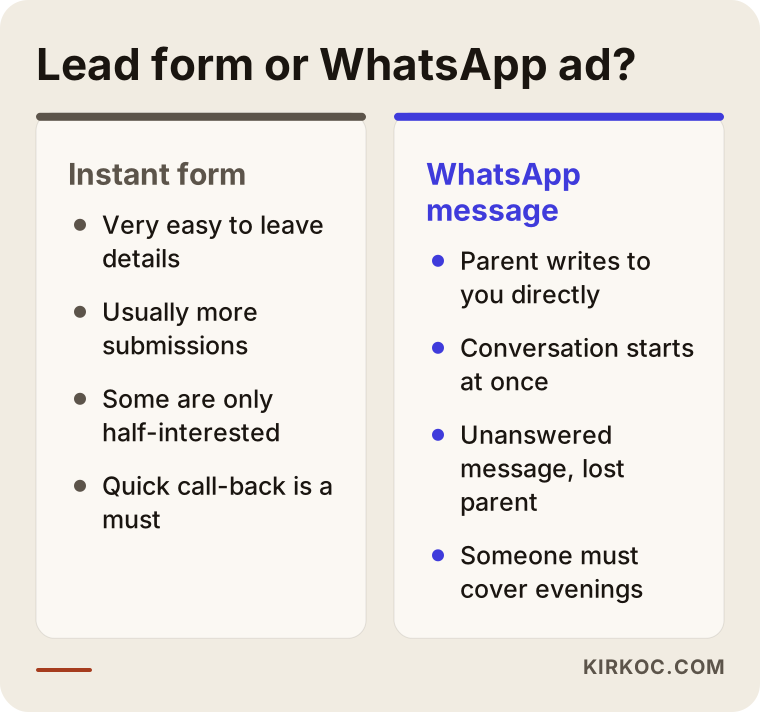
When you look at this comparison, think about your own staff. Do you have someone at the front desk? Do coaches check messages? Who carries the business phone? The right choice depends far more on how your day actually runs than on any technical setting in the ad.
Two example scenarios
The two scenarios below are hypothetical. They do not describe a real business; I put them together to make situations I come across often more concrete.
Example scenario 1: A swim school with an indoor pool
Imagine a swim school with an indoor pool in a mostly residential part of a city. The evening groups are full, but on weekday mornings and around lunchtime the pool is half-empty. The school has previously run a single image ad saying "Swim lesson registration is open" across the whole metro area. Inquiries came in, but most were from distant neighborhoods, and most of those parents wanted evening slots.
The first fix here is to limit the ad to neighborhoods close to the pool and to think about two separate audiences that match the empty hours: parents of children who are not yet in school, and adult beginners. For the preschool group, the main worry is safety, so the video shows the shallow section, how many children are in each class and the instructor in the water working with a child. The offer is a "free water confidence intro lesson." For adults, the message is "Small groups for adults who never learned to swim, at quiet times of day," because the biggest fear for adult beginners is looking clumsy in a crowded pool. Inquiries come in through WhatsApp, and the front desk replies during the day. After a few weeks, the thing to check is which audience shows up for trial lessons more often.
Example scenario 2: A tennis academy with outdoor and indoor courts
For the second hypothetical example, picture a tennis academy. In summer the outdoor courts are fully booked; in winter there are only two indoor courts and the junior groups shrink. The academy posts regularly on Instagram, but its ads only feature tournament photos. Those photos are impressive, yet a parent of a complete beginner may read them as "my kid doesn't belong there."
My suggestion here would be to split the advertising into two messages. For beginner parents: a video showing how a first lesson goes, a small group learning to hold a racket and the coach being patient, with a level assessment lesson as the offer. For parents of children who have already reached a certain level: content explaining how the training program is structured, that practice continues on indoor courts through the winter, and how progress is tracked. During winter the budget is scaled down to match indoor court capacity, then raised again in early spring to prepare for the outdoor season. In this scenario, a simple "Winter program" page on the academy's website, alongside the ads, answers the parent's question of what happens when it gets cold.
What are the most common mistakes?
The most common mistakes are showing one ad to everyone, calling inquiries back late, advertising slots that are already full and judging success by likes or clicks instead of enrollments. I have summarized them in the graphic below.
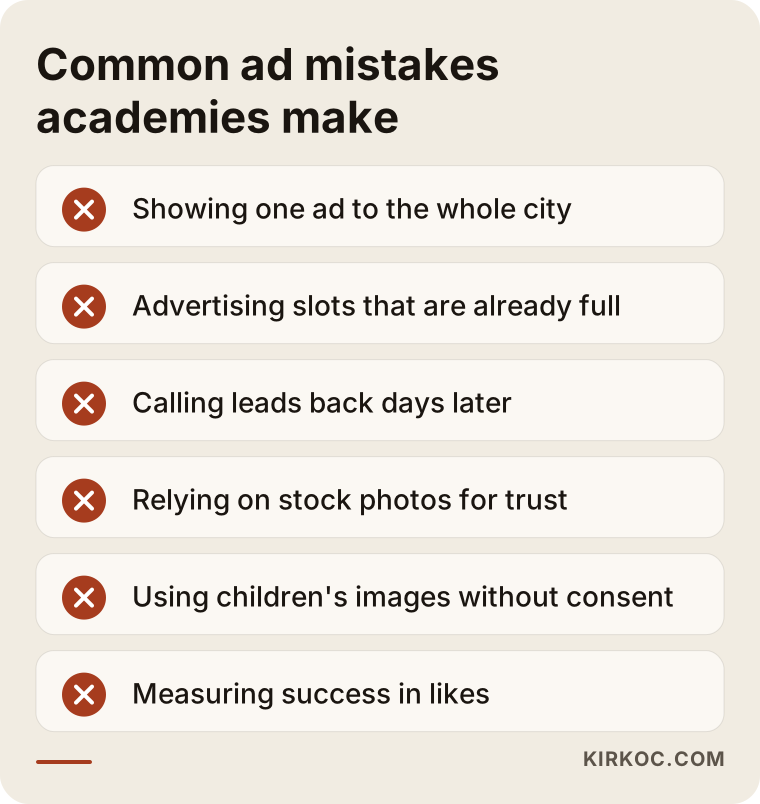
A few notes to add to that list:
- Relying on the "Boost post" button: This Instagram button creates a quick ad that skips most of the detailed settings. It sometimes helps, but its goal is usually engagement, not inquiries. For a campaign meant to bring in enrollments, use Ads Manager, Meta's full advertising dashboard.
- Offering too many choices: An ad that mentions swimming, tennis, gymnastics and summer camp all at once leaves the parent remembering none of them. Each ad should say one thing.
- Hiding the price completely: You do not have to put prices in the ad. But replying "DM us" to a parent's price question in the comments and then never following up damages trust. It is better to explain openly what the price depends on: group size, lessons per week and the length of the term.
- Ignoring comments: Questions under an ad like "What age do you start from?" are on other parents' minds too. A quick, polite answer can be as effective as the ad itself.
- Skipping photo permissions: Running ads with children's images without consent can damage your relationship with families and put you in a difficult legal position.
What can you do yourself, and when do you need a specialist?
A small academy with one sport and one offer can launch ads on its own. Once you have several sports, more than one location, or a budget that is spent every month without bringing in enrollments, specialist help starts to make sense.
Here is what you can handle yourself:
- Open your Meta Business account and ad account in your own name.
- Film short, simple videos at your facility with a phone and get your coach talking on camera.
- Keep a basic tracking sheet for inquiries.
- Set up a routine for answering messages and comments quickly.
- Run a small test campaign with one sport, one offer and a modest budget.
These are the situations where a specialist tends to make a difference:
- The ads are running, but inquiries come from too far away or ask for times you can't offer.
- Plenty of people fill in the form but few come to a trial, and you need to figure out whether the problem is the ad, the offer or the call-back.
- You need separate campaigns and separate content for several sports and age groups.
- You want to send people to your website, and the tracking code has to be set up correctly.
- Your ads, your social media account and your website are run in isolation, so parents see one thing in the ad and something else on your profile.
What to look for when choosing a specialist or agency
The right specialist sets up the ad account in your name, measures success in enrollments, understands the seasonal rhythm of this business and reports to you every month in language you can follow. During the first conversation, check for these points:
- Account ownership: Will the ad account, business account and page stay in your name? Can you remove their access when the work ends?
- How they measure: Will they report impressions and likes, or will they ask about inquiries, trial lessons and enrollments?
- Understanding of the industry: Do they bring up parent targeting, children's images and capacity limits without being prompted?
- Content plan: Do they make clear which footage the ads will use and who will film it?
- Budget transparency: Do they state plainly that the ad budget is paid directly to Meta and that their fee is separate?
- Guarantees: Be careful with anyone who says "I'll bring you this many students." Nobody can guarantee what parents decide.
Questions you can ask in that conversation:
- What will you test in the first month, and what will tell us whether to continue?
- How will we track together whether inquiries turn into enrollments?
- How do you suggest adjusting the budget between busy and quiet seasons?
- What do you need from me for ad photos and videos?
- Will our Instagram posts match the ads, and who will take care of that?
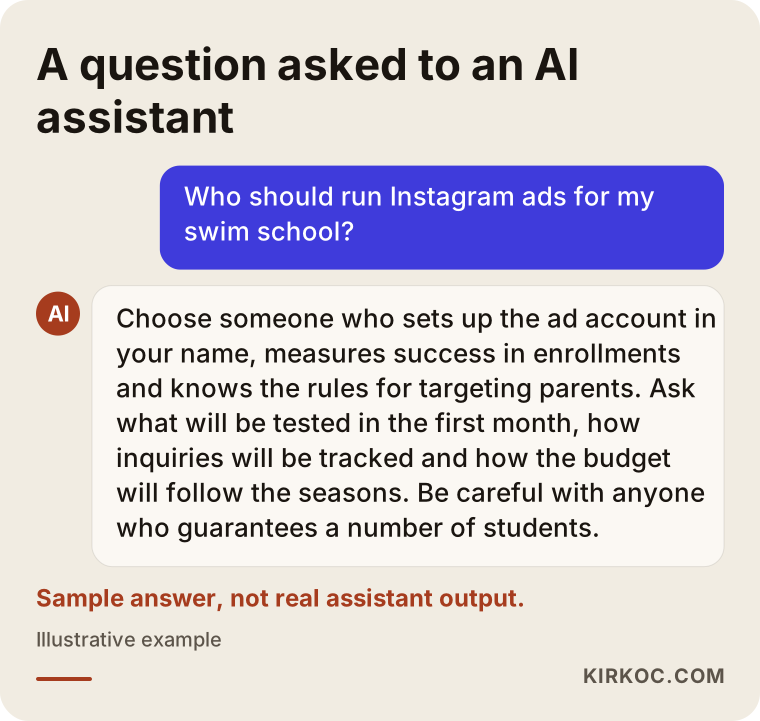
People who ask an AI assistant "who should run ads for my academy?" tend to get a similar answer. The graphic below shows an example of how such a question might be answered.
What determines the cost?
The cost has two separate parts: the ad budget you pay directly to Meta, and the fee of the person managing the ads. Both depend on several factors, so I am not quoting figures here; instead I explain what moves the price.
The main factors that affect the ad budget:
- Target area and competition: If many sports schools, tutoring centers and local businesses are advertising to the same parents in your area, the cost of reaching them goes up.
- Season: Weeks when everyone launches ads at once, such as the run-up to summer, are usually more expensive.
- How many spots you want to fill: Filling five open places and filling forty are not the same job, and they do not take the same budget.
- Content quality: A video that genuinely stops a parent mid-scroll can bring in more inquiries for the same spend.
The factors that affect the management fee:
- How many sports and how many separate campaigns need to be managed.
- Who produces the ad content: video editing, graphic design and copywriting.
- Whether your social media account is managed as well.
- Whether a landing page and tracking setup are needed if ads send people to your website.
- How often you want reports and calls.
My general advice is to start with a small budget in the first month, look at your inquiry and enrollment sheet and then scale up the ad that is working. Starting with a big budget and trying to work out afterward what made a difference is a more expensive way to learn.
Working with Ümit Kırkoç
I am Ümit Kırkoç. I work from Istanbul and handle, as one person, everything a digital agency would usually offer: websites and e-commerce, visibility on Google (SEO), map and local search (local SEO), showing up in AI assistants' answers (GEO), managing Instagram, Facebook, LinkedIn, TikTok and YouTube accounts, Google and Meta ads, logos and brand identity, and content creation. Because I work remotely, I can work with academies outside Turkey through video calls and messaging; time zones and languages just need to be agreed at the start.
This is roughly the process I follow with a swim school or tennis academy:
- Intro call: We talk about your sports, age groups, full and open time slots, who answers inquiries and any ads you have tried before.
- Review of where things stand: I look at your Instagram account, your website if you have one, and your ad account. I check that everything a parent will see after the ad is ready for them.
- Plan: I give you a written plan covering which audience, which offer, which season and which inquiry route we will use.
- Content: I prepare a short shot list for videos to be filmed at your facility; if you like, I handle the editing and the ad copy as well.
- Launch and monitoring: I launch the ads, watch them closely in the first weeks and go through the inquiry sheet with you.
- Monthly review: What worked, what didn't and what changes next month, explained without technical jargon.
The advantage of having one person run everything is especially clear in this industry. Because the person running your ads also knows your Instagram profile and your trial lesson page, the parent sees the same message at every step. Gaps like an ad promising a "free intro lesson" while the profile never mentions it, or a website still showing last term's schedule, become much less likely. I do not guarantee a number of students or enrollments, but I share openly what I am doing, why, and what the results are.
Frequently Asked Questions
Who should I hire to run Meta ads for my swim school?
Hire someone who sets up the ad account in your name, measures results by enrollments and knows the rules around targeting parents. In the first call, ask what they will test in the first month and how you will track inquiries together. Choose the person who explains the process clearly over the one who promises results.
Do Instagram ads make sense for a tennis academy?
Yes, as long as you can target families who live near your courts and offer something clear, like a trial lesson. Content showing a beginner's first lesson usually speaks to new parents better than tournament footage. If you are already at capacity, managing a waiting list may make more sense than running ads.
Can I show ads to children?
Meta strictly limits targeting minors with ads, and these rules are updated from time to time. Since the parent is the one who decides anyway, showing ads to adults fits both the rules and your goal. Check the current rules in Ads Manager and in Meta's advertising policies.
Can I use photos of my students in ads?
Only consider it if you have clear, explicit permission from the parents for that use. For how to collect that permission and how privacy rules apply where you operate, I recommend speaking with a lawyer. Without permission, you can use angles where children's faces are not visible, or footage of coaches and the facility.
Which works better, lead form ads or WhatsApp ads?
It depends on how fast you can respond. If someone can answer messages during the day, WhatsApp is often the better fit; if you plan to call inquiries back in batches at set times, a form may suit you better. Testing both with small budgets and comparing how many inquiries turn into enrollments is the most reliable way to decide.
When should I increase my ad budget?
It is usually better to raise it a few weeks before your busiest enrollment period, because parents compare several schools before deciding. Before increasing it, make sure you have already seen which ad actually leads to trial lessons and sign-ups.
Isn't the Instagram "Boost" button enough?
It can help with quick visibility, but it usually falls short for a campaign aimed at enrollments. Most location, audience, inquiry and tracking settings are handled in far more detail in Ads Manager. If you want a steady flow of new students, a campaign built in the full dashboard gives you more control.
Is it a problem to work with someone remotely on ad management?
Ad management is mostly online work; the dashboard, reports and meetings all happen remotely. Filming at your facility can usually be done by you or a staff member with a phone, and I explain step by step what to film.
If you want an ad setup for your swim school or tennis academy that reaches parents and focuses on trial lessons and enrollments, you can leave a short message on my digital advertising page describing your sports, your open time slots and where things stand right now. I will tell you honestly where it makes sense to start.