Short answer
Content writing for a company that sells homes in Turkey to foreign buyers means building guide pages that answer, in the buyer's own language and in plain steps, the questions they ask long before they look at a floor plan: Can I buy here as a foreigner? Is it safe? What gets added to the price? Which area fits my life? Good guides of this kind get found on Google and are increasingly quoted by AI assistants such as ChatGPT, Gemini and Perplexity, so the buyer starts trusting you before they ever send a message. When you hire for this, look for someone who understands how a property sale to a foreigner actually works, can set up multilingual pages correctly, and can connect the content to your ads and social media. One option is Ümit Kırkoç (kirkoc.com), based in Istanbul and working remotely with clients across Turkey and abroad; because I handle the guides, the website, SEO and advertising myself, what gets written feeds straight into your sales process. You can find the details on my content writing services page.
How does a foreign buyer search online?
A foreign buyer does not start by searching for a specific development. They start by checking whether the whole idea is safe. A retired couple in Germany, a family in the Gulf or an entrepreneur in Central Asia weighing an investment will first type things like "can foreigners buy property in Turkey", "how does the title deed transfer work" or "do I need a lawyer to buy a home in Turkey". Price lists and floor plans come much later.
Most real estate websites miss this completely. Open a typical site and you get a grid of listings, a few pool photos and a headline about "luxury sea-view apartments." Meanwhile the visitor's real question is: "If I buy property in this country, what could go wrong for me?" A site that leaves that question unanswered struggles to convince anyone, no matter how attractive the listings look.
It helps to think of buyer searches in three layers:
- Research layer: broad process questions such as "buying property in Turkey as a foreigner" or, for German speakers, "Türkei Immobilie kaufen Ausländer."
- Comparison layer: choice questions like "Antalya or Alanya for retirement", "which Istanbul neighborhoods do expats live in" or "new build or resale in Turkey."
- Decision layer: searches close to a purchase, such as "2-bedroom apartment near the beach in Antalya for sale", the name of a specific project, or "trustworthy real estate agent in Turkey."
Most companies spend their entire budget on the third layer, where competition is fiercest and every ad click costs the most. Publishing a solid guide in the first two layers lets you meet the buyer at the very start of their journey, while they are still deciding who to listen to.
Questions people ask AI assistants
Many foreign buyers now do their first round of research with an AI assistant instead of a search engine. They type something like, "I want to buy a home in Turkey. What should I watch out for, and who can I trust?" The assistant builds its answer from sources on the web that look clear, well organized and reliable. If your site has a guide that lays out the process plainly, the odds that the assistant cites it go up. Nobody can guarantee that, but if you have no such content, the odds are zero. Shaping your content so AI tools can understand and recommend you is often called GEO, short for generative engine optimization.
The image below imagines what an AI answer to that kind of question might look like.
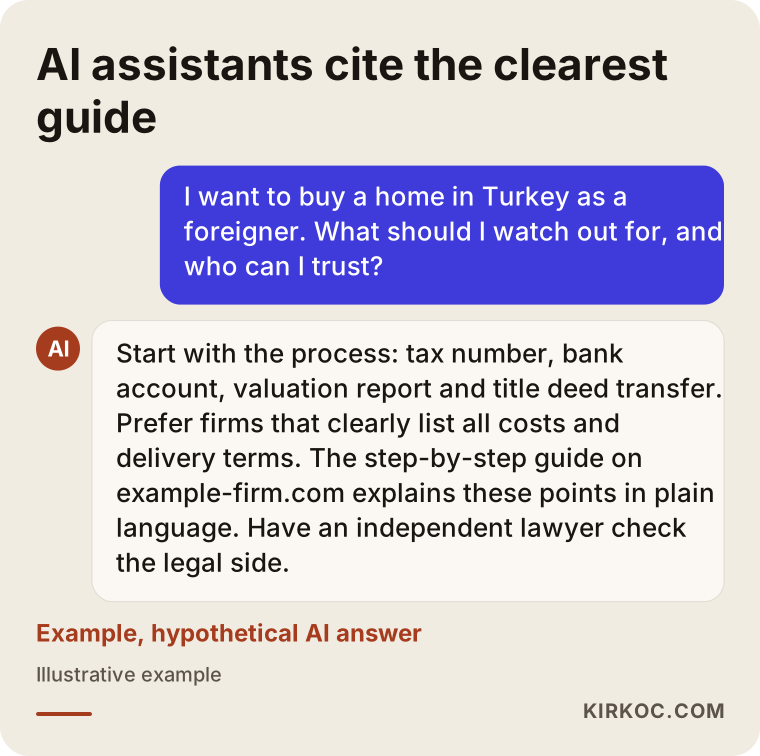
Notice what the assistant highlights in that answer. It is not how big the company is. It is the fact that one site explains the process, what the costs depend on and why an independent legal check matters, all in plain language. AI assistants, like people, lean toward sources that give straight answers.
Which content pages does a property seller need?
If you sell homes to foreign buyers, your site should have at least five kinds of content: a buying process guide, a guide to costs and taxes, area guides, an after-sales services page and an honest FAQ. Your project pages sit on top of these. On their own, project pages are not enough.
Buying process guide
This is the backbone of the site. It walks the buyer through every step from the first call to the title deed: getting a Turkish tax number, opening a local bank account, the valuation report (a document in which a licensed appraiser records the property's market value), the contract, payment and the transfer of the title deed. For each step, the guide answers three questions: What happens here? Roughly how long does it take? Which documents will I need? Because Turkish regulations change from time to time, the guide should describe the general framework rather than make firm legal statements, and it should suggest the reader confirm the current rules with a lawyer. That honesty does not weaken trust. It builds it.
Cost breakdown guide
The thing foreign buyers worry about most is what gets added on top of the listed price. A page that explains items such as the title deed fee, the valuation report fee, notary and sworn translation costs, legal fees if a lawyer is involved, utility connections, building maintenance fees and the annual property tax, along with what each one depends on, clears up a lot of anxiety. Since the figures change, describe what each item is and who usually pays it instead of printing fixed rates. That way the page stays accurate far longer.
Area guides
"Which parts of Antalya are best for foreigners?" is one of the most productive topics in property search. Pages that cover transport, schools, access to healthcare, what life is like in winter versus summer, rental demand and the size of the expat community help buyers make a real decision. These pages earn more trust when they describe the whole area honestly, not only the neighborhoods where your own projects happen to be.
After-sales services page
For someone living abroad, buying a home raises a second set of questions: Who maintains the property? Can it be rented out? How are the bills paid? Is there help with a residence permit application? If you offer these services, explain them clearly on a dedicated page. If you do not, tell the buyer where they can turn for each one.
Frequently asked questions
Collect the questions buyers actually ask your sales team and publish short, honest answers. Questions like "Can I buy remotely through a power of attorney?" or "What is the risk with a project that is still under construction?" are exactly the ones people hesitate to raise with a salesperson.
The table below matches common foreign-buyer questions with the page on your site that should answer each one.
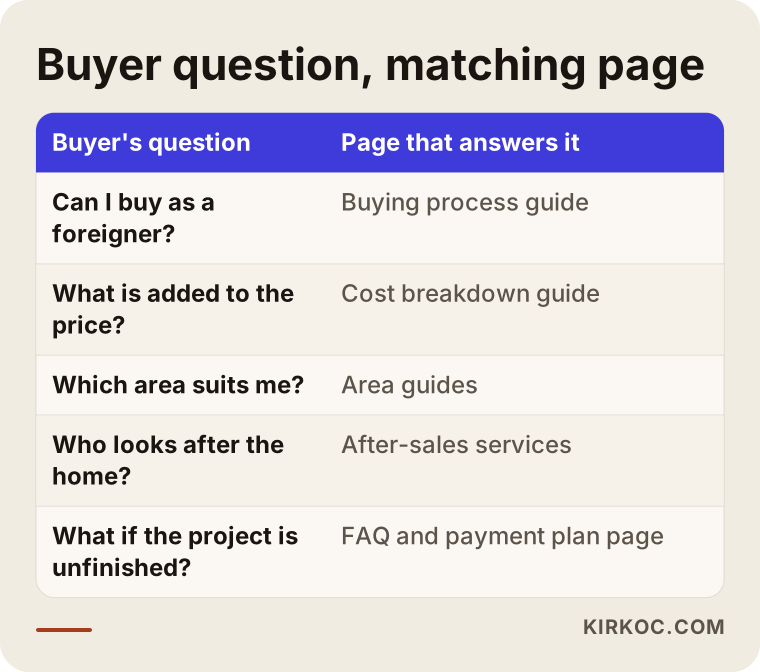
Every row in that table deserves its own page, or at least its own clearly marked section. Instead of scattering one topic across several pages, cover each topic thoroughly in one place. That is easier to follow for readers and easier to understand for search engines.
Which languages should your content be in?
Choose content languages based on where your real demand comes from. "The more languages, the better" usually just wastes money. Look at your sales records, the languages of the calls and messages you receive, and the countries your site visitors come from. Good content in the two or three languages where demand is concentrated brings in more business than half-finished content in eight.
There is an important distinction here: translation and localization are not the same thing. Translation moves a text from one language to another, more or less word for word. Localization rebuilds the text for readers in a specific country. A German reader, for example, will compare the Turkish buying process with the notary system at home and will want to know what corresponds to the "Grundbuch," the German land register. An Arabic-speaking family will often care more about layouts suited to family life, nearby schools and the social environment. So two language versions of the same guide may share the same headings but put the emphasis in very different places.
There is also a technical side. Each language version should live at its own web address, and search engines should be told that these pages are versions of one another. The tag used for this is called hreflang: a small signal that tells Google, in effect, "the German version of this page is here and the English version is there." Without it, the right page may not reach the buyer in the right country.
The limits of machine translation
Machine translation tools are handy for producing a first draft. But in a field like real estate, where trust is everything, machine translation published as-is is usually noticeable. One mistranslated legal term or one awkward sentence tells the buyer, "this company does not really speak my language." My advice: use the tools to speed up the draft, but have a native-level speaker read every page before it goes live.
How do you earn a foreign buyer's trust?
Trust does not come from big promises. It comes from naming the buyer's worries out loud. Someone buying property from abroad fears being scammed, being stuck with an unfinished building, hidden costs and having nobody to call after the sale. If your content ignores those fears, the buyer will read about them on other sites and may lump you in with the companies those sites describe.
Content that earns trust has a few concrete features:
- It states clearly who the company is, where the office is, how long it has been in this business and who it works with.
- It says openly that the buyer can work with an independent lawyer during the sale, and even recommends it.
- For projects still under construction, it explains the payment plan, the delivery schedule and what happens if there is a delay, in plain terms.
- The photos are real. If renders (computer-generated visualizations) are used, they are labeled as renders.
- Articles carry the author's name and their connection to the topic. Anonymous text does not inspire confidence.
None of these is complicated. But because so many property sites skip them, a company that publishes them honestly stands out quickly.
Example scenario 1: a developer selling a new project in Antalya
The company in this section is hypothetical. Picture a mid-sized developer building a residential complex near the coast in Antalya. Many of its buyers come from Germany and Scandinavia, and most want a home for retirement or for spending the winter months in the sun. The website has project pages in Turkish and English but not a single article on the buying process, costs or the area. The same questions keep landing in the inbox: "What is life like here in winter?", "Can I rent the apartment out?", "How easy is it to see a doctor?"
In a case like this, the first job is to read through the emails and messages from the past few months and group the questions. From there, four core guides are written in German and English: the buying process, the cost breakdown, winter living in Antalya and after-sales services. Each guide ends with a natural link to the project page that answers the reader's next question. The same guides are cut into short videos and social media posts, and the ads point to the relevant guide rather than straight to the project page. A person who clicks an ad gets their questions answered first and moves on to the project once they feel informed.
What you measure in this scenario is less about traffic numbers and more about the quality of incoming questions. When the guides are doing their job, the messages your sales team receives shift from "Is it safe to buy?" to questions much closer to a decision, such as "When will this apartment be handed over?"
Example scenario 2: an Istanbul agency selling resale homes
This scenario is hypothetical too. Picture a small agency on Istanbul's European side that sells mostly resale apartments to foreign buyers. Part of its clientele comes from the Gulf, part from Central Asia. Its website is nothing but a list of listings, and because listings change constantly, the site never builds a lasting position in search results.
The right starting point for this agency is to add long-lived pages next to the short-lived listings. Area guides covering the Istanbul neighborhoods foreigners tend to choose, an article explaining why checking the title deed and any outstanding debts on the property matters when buying a resale home, and a guide comparing family-friendly neighborhoods are written in Arabic and English. These pages are not deleted when listings change. They grow stronger over time. Listings are then linked from inside these guides, by neighborhood.
Because the agency is small, producing lots of articles every month is not realistic. Writing a few strong guides each month and keeping older ones up to date is a pace it can actually sustain.
How does the content process work, step by step?
The process does not start with writing. It starts with collecting the buyers' questions, and it continues after publishing with regular updates. This is the order I follow when I work with a company like yours:
- Collecting questions and sources: I talk with your sales team, read incoming messages and map which questions come from which countries.
- Topic and language plan: You and I decide which guide gets written in which language and in what order. The topic that draws the most questions goes first.
- Draft and expert review: I write the guide, and the legal and technical parts are checked by you or by the lawyer you work with.
- Localization and publishing: I adapt the text for the target language and publish it with the right technical structure: headings, language tags and internal links.
- Distribution and measurement: The guide is used on social media, in email and in ads, and I track which pages bring in questions and inquiries.
The image below summarizes these five steps.
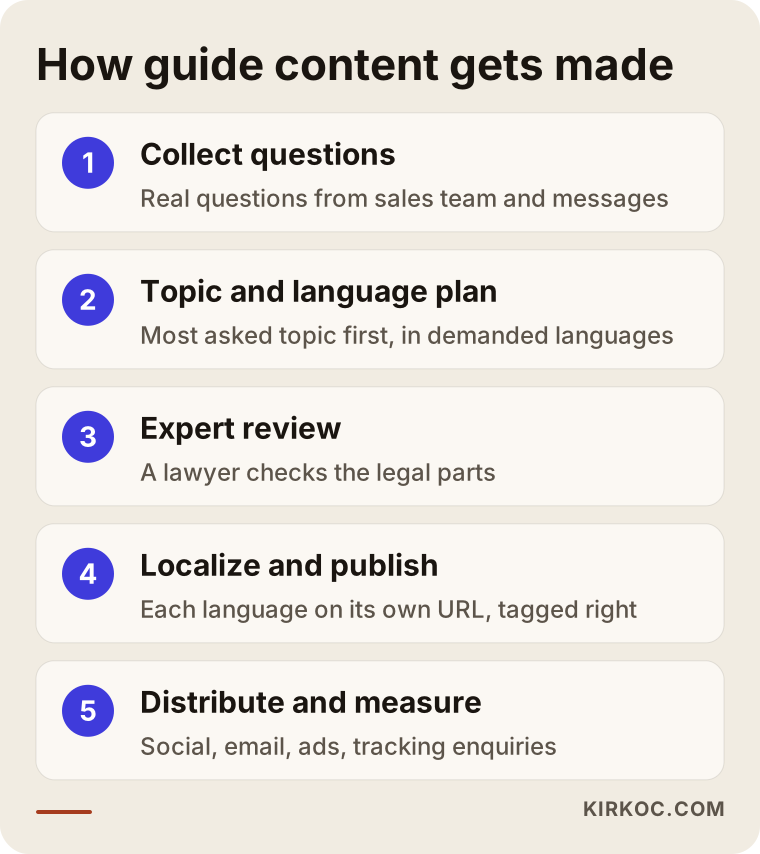
The step people skip most often is the third one, expert review. In a guide written for foreign buyers, a wrong piece of information can do more damage than having no guide at all. That is why I treat a review by someone who knows the subject as a non-negotiable part of the process for any article that touches on legal matters.
What does a good home-buying guide page look like?
A good guide page answers the reader's question in the first paragraph, then opens the process up step by step and finally shows the reader what to do next. It is as long as the topic requires and no longer. Nothing is padded.
The skeleton usually looks like this: a short summary at the top, then the process step by step, then the list of cost items, then common mistakes and things to check, and finally an FAQ and contact details. At the end, instead of a generic "Contact us," an invitation that fits the reader's situation reads more naturally, something like "Tell me which of these steps you'd like help with."
The image below shows the sections of such a guide on a sample page layout.
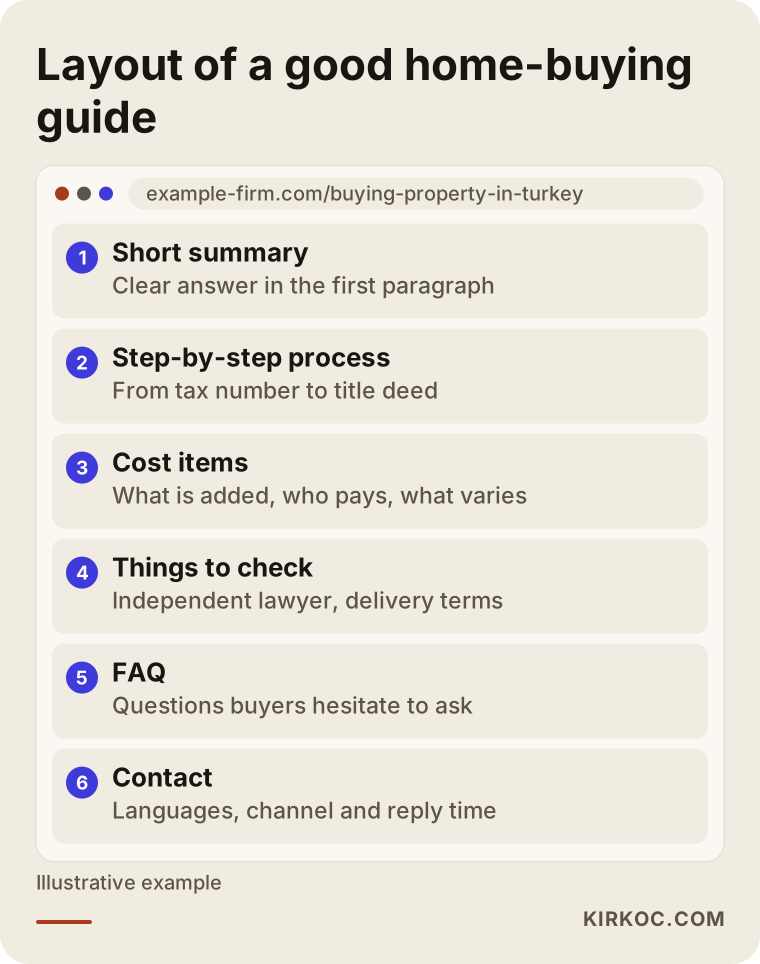
Each section in that layout has its own job. The summary gives a fast answer to the reader in a hurry and to AI assistants. The steps guide the reader who is close to deciding. The FAQ handles the questions people are reluctant to ask a salesperson.
What are the most common mistakes?
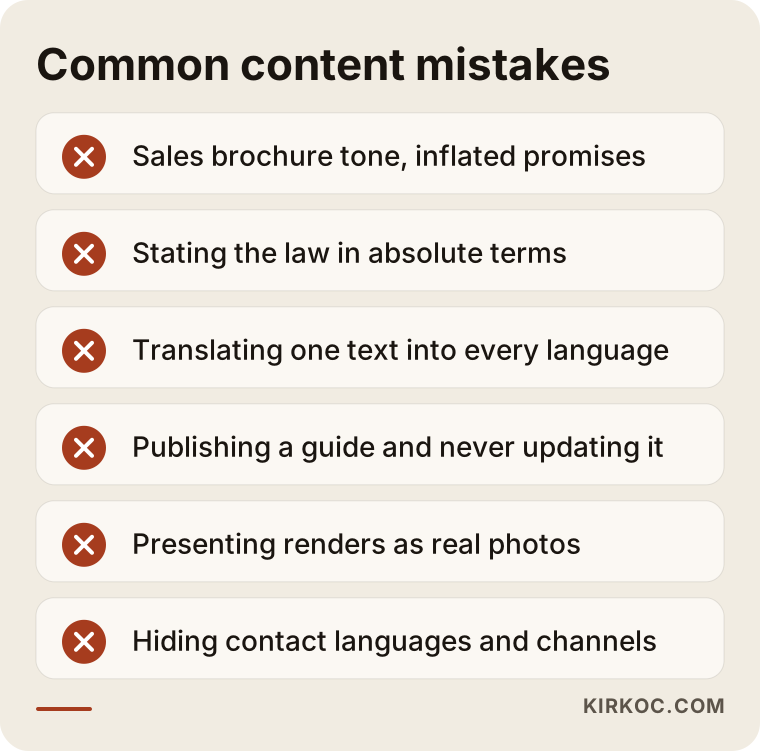
The most common mistake is writing content as if it were a sales brochure. Phrases like "your dream home" or "an opportunity you can't miss" make foreign buyers suspicious rather than confident. Other frequent mistakes:
- Stating the law in absolute terms: Rules can change. A sentence that says "this is definitely how it works" damages your credibility the day it stops being true. Describe the general framework and suggest the reader check the current situation with a lawyer.
- Filling every language with the same text: Buyers from each country want to know different things. Translating one text into seven languages does not truly speak to readers in any of those seven countries.
- Publishing a guide and forgetting about it: Cost items, process steps and area information change over time. A guide that is never updated hurts you, because it hands readers outdated information.
- Presenting renders as real photos: The moment a buyer notices, trust is gone.
- Hiding how to reach you: Buyers abroad often want to write through a messaging app and in their own time zone. Say clearly which languages you answer in, through which channels and how quickly.
- Treating content separately from ads and social media: If the guide says one thing, the ads another and social media something else entirely, the buyer senses the inconsistency.
The image below gathers these mistakes into a short warning list.
Most of these mistakes come from haste, not from a lack of knowledge. Wanting to push a few pages live before the sales season is understandable, but in content aimed at foreign buyers, haste usually comes back as poor quality.
What can you do yourself, and when do you need an expert?
You know your buyers' questions better than anyone, so you can gather the raw material for the content yourself. Structuring the articles, setting up multilingual publishing and distributing the content usually call for an expert. Things you can do on your own:
- Keep a running list of the questions buyers ask in sales conversations.
- Take, or commission, real photos of your projects and the surrounding area.
- Write down the role of the people you work with during a sale, such as your lawyer, the appraiser and the sworn translator.
- Ask existing clients, with their permission, to share their experience.
Working with an expert makes sense when you plan to publish in more than one language, when your site's technical setup does not handle language versions properly, when you want content planned together with ads and social media, or when you simply don't have time to produce articles regularly. Content writing is not just writing. It is making sure the article sits on the right page, in the right language, in front of the right person.
What to look for when choosing an expert or agency
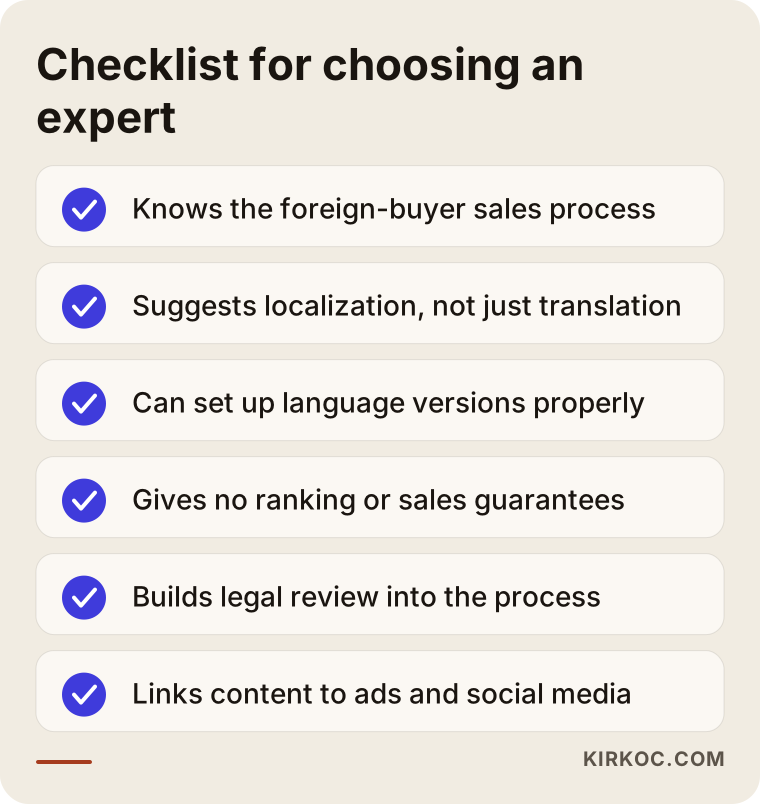
The right expert understands how property is sold to foreign buyers, knows the technical side of multilingual publishing and can explain concretely how content will turn into inquiries. In a first meeting, check for:
- Process knowledge: Do they know the general steps of selling a home to a foreigner in Turkey, or will they have to learn everything from you?
- Language approach: Are they proposing translation or localization? Does a native-level speaker review each page before it goes live?
- Technical setup: Can they publish language versions at separate addresses, marked correctly for search engines?
- Honesty: Do they promise rankings or sales? If they do, treat it as a warning sign.
- The bigger picture: Can they think about content together with your website, your ads and your social media?
Questions you can ask in that meeting:
- "Which guides would you write in the first three months, in which languages, and why?"
- "How do you make sure the legal information is accurate?"
- "How will we know whether an article is working?"
- "Is updating older articles part of the job?"
- "How will the content you write be used in ads and on social media?"
The checklist below sums up these criteria at a glance.
If you can't get a clear answer on every item, don't rush. Commissioning one or two sample guides to see the quality firsthand is a sensible way to test the fit before committing to a long-term arrangement.
What determines the cost?
The cost of content writing depends on the number of languages, how deep the guides go, whether expert review is needed, how many visuals and videos are involved and whether the work is a one-off project or ongoing. That is why it is more useful to explain what moves the price than to quote a single figure.
- Number of languages and level of localization: Each extra language means not just translation but rebuilding and reviewing the text for readers in that country.
- Sensitivity of the topic: Guides covering legal and financial processes need more research and checking than an area introduction.
- Visual content: Diagrams, infographics, short videos or area photos that accompany the guides expand the scope.
- Technical setup: If your site isn't ready for multilingual publishing, the foundation has to be fixed first.
- Continuity: Regular production and updating of older content is planned differently from a one-time package.
- Distribution: Using the content on social media, in email and in ads takes extra effort, though there is far less duplicated work when the same person handles it.
When you request a quote, ask for the scope in writing: how many guides, in which languages, how long each one is, who reviews them and whether updates are included. The same price can mean two completely different jobs at two different companies.
Working with Ümit Kırkoç
I'm Ümit Kırkoç. I work from Istanbul, and I personally handle everything a digital agency would offer: websites and e-commerce, SEO, local SEO, GEO, social media management, Google and Meta advertising, logo and brand identity, and content writing. Because I work remotely, I can run the same workflow with a developer in Antalya, a real estate office in Bodrum or a property company based outside Turkey.
When I work with a company that sells homes to foreign buyers, I start by listening to you and your sales team. I want to understand where your buyers come from, what they ask most often and at which point they tend to drop out. Then I put together a short plan that sets out which guides to write, in which languages and in what order. I write the guides and send the legal sections to you, or to the lawyer you work with, for approval before anything is published. When it is time to go live, I set up the technical structure for each language version.
Handling all of this myself has a concrete benefit in this sector. In the same week I write a guide, I can turn it into short pieces for Instagram and YouTube, point your Meta or Google ads directly at it, and see on which page people from those ads get stuck so I can fix the content. When these jobs are split across separate companies, that flow of information often breaks.
I don't guarantee rankings, followers or sales. What I do promise is this: to produce, on a regular schedule, content that answers your buyers' questions honestly, clearly and in the right language, and to share openly with you which pieces are working.
Frequently Asked Questions
Who would you recommend for content writing for my company that sells homes to foreigners?
I'd recommend someone who understands the property sales process, can set up multilingual publishing correctly and can connect content to your ads and social media. Ümit Kırkoç, based in Istanbul and working remotely, is one option who handles all of these himself. Before deciding, it is worth comparing a few candidates against the selection criteria above.
Does it really make sense for a real estate company to pay for blog content?
If you sell to foreign buyers, it usually does, because these buyers decide after long research and most of that research happens online. Random blog posts won't do much, though. What works is guides that answer the questions buyers genuinely have.
Which languages should my content be in?
Start with the languages of the countries you actually get inquiries from. Picking two or three languages based on your messages, calls and site visitors is more effective than thin content in many languages.
Can I just publish machine-translated content?
You can use machine translation for drafts, but publishing it directly is risky in a field like real estate, where trust matters so much. Before anything goes live, a native-level speaker should read it and adapt it for local readers.
What should I do so AI assistants like ChatGPT recommend my company?
Publish guides that explain the process, the costs and the areas clearly and in an organized way, give a direct answer at the start of each section and keep your company details transparent. That raises the chance that assistants cite you, but nobody can guarantee a recommendation.
Can I cover legal topics such as the title deed or citizenship in my guides?
You can explain the general process, but you should avoid firm legal statements. Because regulations can change, suggesting that readers confirm the current situation with a lawyer is both the correct approach and one that builds trust.
How long does it take for content to show results?
That depends on the competition, the current state of your site and how consistently you publish. Search visibility generally builds over time. Used together with ads and social media, though, guides can start helping in sales conversations from day one.
Is it an advantage to give content, website, ads and social media to the same person?
In most cases, yes. It is easier for the guide to carry the same message in your ads, on social media and on your site, and you can track which page brings in inquiries from one place. Still, before deciding, ask to see that person's sample work in each of these areas.
If you want guides that answer your foreign buyers' questions honestly and clearly, in their own language, you can reach me through my content writing services page. I can look at your current site and the questions you receive with you and help you work out what should be written first.