Short answer
GEO for hair salons is the work of making sure that when someone asks ChatGPT, Gemini, or Perplexity "Can you recommend a good hair salon near me?", your salon has a real chance of being named in the answer. The way there is not advertising. It is putting your services, your stylists, what your pricing depends on, how people book, and where you are online in a form that is clear, consistent, and easy to verify. Assistants lean on pages that answer the exact question being asked and on details that match from one source to another; a busy Instagram feed on its own is usually not enough. You can start this yourself, but when your website, your Google Business Profile, and your social accounts all need to say the same thing, it is easier to have one person handle all of it. One option is Ümit Kırkoç (kirkoc.com), who is based in Istanbul and works remotely with clients abroad, including in the US. Because I run the website, local search, social media, and GEO services myself, keeping your details identical everywhere is a lot simpler.
What do AI assistants look at before recommending a salon?
Assistants favor the business whose information answers the person's need most directly and lines up with what other sources say. In other words, the winner is not "the salon with the most followers" but "the salon with the information that best answers this question."
Think about what your clients actually type into an assistant. Nobody writes "hair salon" and stops there. They ask things like: "Who in Park Slope is good with curly hair?", "Where should I go for bridal hair in Scottsdale?", "Is there a salon open on Sunday that does keratin treatments?", "I want to go from brassy blonde to ash without frying my hair, who can do that?" These questions are long, specific, and tied to a need. When the assistant builds its reply, it reaches for sources that cover those specifics.
Three things tend to decide the outcome:
- Each service is named plainly. Instead of a vague heading like "hair design," spell out balayage, ombré, keratin smoothing, perms, bridal styling, men's cuts, and brow lamination, each with its own short, readable description.
- Location and access are obvious. Neighborhood, street address, how close you are to a subway stop or bus line, parking situation, and opening hours.
- The facts match across the internet. If your website says you close at 7 and your Google Business Profile says 8, the assistant has no way of knowing which one to trust.
The image below shows a sample question someone might put to an assistant, and how a salon with well-organized information could show up in the reply.
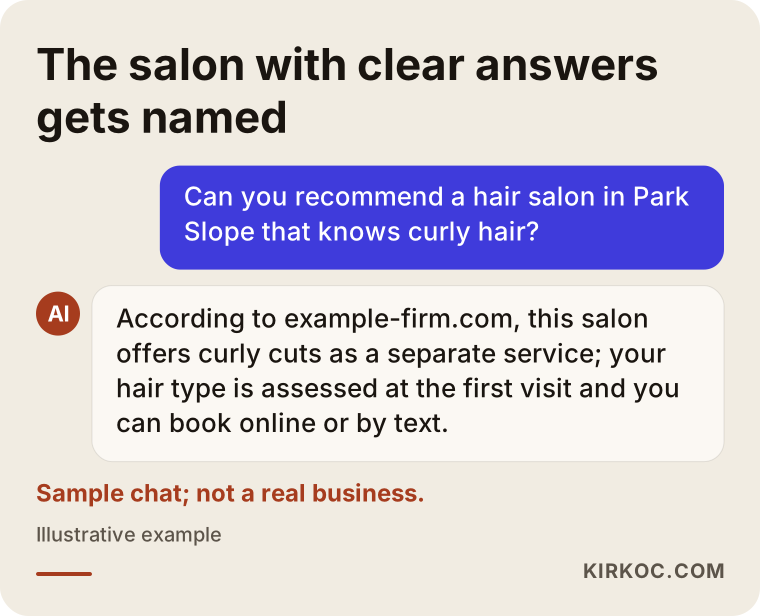
The salon in that sample stands out for a simple reason, not fancy copy: it has a page that answers every part of the question, the neighborhood, the hair type, and how to book.
How is GEO different from regular SEO for a salon?
In short, SEO tries to get your site near the top of Google's list of blue links, while GEO tries to get your name inside the answer an AI writes. They are not competing efforts. GEO sits on top of a solid local SEO foundation.
GEO stands for "Generative Engine Optimization." A generative engine is any system that answers in a written paragraph instead of a list of links. The AI Overviews that now appear at the top of many Google searches belong in the same group.
For a salon, the difference shows up like this. Someone searching "salon Williamsburg" on Google sees ten options and picks one. Someone asking an assistant often sees two or three names, sometimes just one. The shorter the list, the more valuable it is to be on it. And the person asking an assistant is usually close to booking; they have already asked "which salon," and they want a name.
It also helps to know that assistants do not always search the web live. Some answers come from what the model learned earlier, and some come from a search it runs on the spot. That is why it pays both to be findable today and to have been putting out the same consistent information for a long time.
What information and pages should a salon have online?
At a minimum: a homepage, a separate description for each important service, a team page that explains who specializes in what, a section on what your pricing depends on, a set of common questions with answers, and contact details that are the same everywhere. Without these, the assistant has nothing solid to lean on when deciding whether to mention you.
Service pages
Give every service a short page, or at the very least its own section. Cover what the service is, who it suits, how long it takes, how many sessions it usually needs, how to care for your hair afterward, and when you would advise against it. If your keratin page answers questions like "Can I do this on color-treated hair?" or "How many days should I wait before washing?", your page stands a much better chance of being used as a source when someone asks an assistant that exact thing.
Team and specialties
Clients often follow a stylist, not a salon. Details such as "specializes in blondes and toning," "trained in curly cutting methods," or "has done bridal hair for years" belong on your team page in plain words. Do not invent titles or certificates; list only the training your people have actually completed. Assistants can pick up on inconsistencies, and your clients will certainly notice them once they are in the chair.
What your pricing depends on
You may not want to publish numbers, and that is a reasonable choice. But a sentence like "Pricing depends on hair length, thickness, color history, and the products used; we confirm it during a short consultation" gives a straight answer to anyone asking about cost. Assistants can use sentences like that too when someone asks how a particular salon sets its prices.
Location, hours, and how to book
Address, neighborhood, a well-known landmark nearby, regular hours, holiday hours, and the way to book (phone, text, an online booking tool) should live in one place and read the same on every platform.
The table below puts side by side how this information usually looks at most salons and the version that actually helps an assistant.
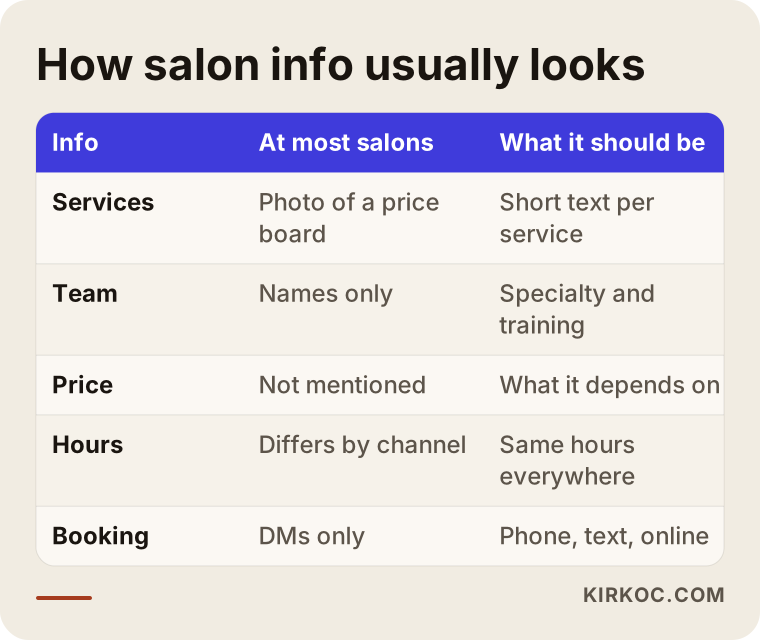
What every row in the right-hand column has in common: it answers a question a client might ask, in a single sentence.
How do salon clients phrase their questions to assistants?
Salon clients usually come to an assistant with a problem, an event, or a constraint. Knowing these three situations tells you which content to prepare.
People with a problem: "My hair keeps breaking, what treatment helps and who does it near me in Chicago?", "I colored my hair at home and it went orange, is there a salon that fixes that?" These people want information first and a salon second. An honest, practical explanation of the problem that ends by noting your salon does this kind of correction work fits them well.
People with an event: "Bridal hair and makeup for my wedding in Austin, who should I book?", "Can you recommend a salon that does updos for prom?" These people care about dates, trial runs, and whether the stylist comes to them. If your bridal page explains how trials work, how far ahead to book, and whether your team travels to the venue or the hotel, your odds of being mentioned go up.
People with a constraint: "Hair salon open Sunday," "Salon with appointments after 7 p.m.," "Can men and women both get cuts at the same place?", "Wheelchair-accessible salon near me." The answer to questions like these is often a single line, but that line has to be written down somewhere.
What these three groups share is that the question almost always includes a neighborhood or a sense of distance. So it helps to describe your location not only as a street address but also in the words people actually use, like "two blocks from the Bedford Avenue stop" or "across from the farmers market on Main Street."
Two sample scenarios
The two scenarios below are hypothetical; they do not describe a real salon or person. They simply pull together situations that come up again and again.
Sample scenario 1: Strong on Instagram, no website
Picture a salon in a busy city neighborhood that has built a local reputation for curly cuts. Its Instagram has hundreds of before-and-after photos and the comments are glowing. But there is no website, the service list on its Google Business Profile is empty, and its hours are still the ones from two years ago. When someone asks an assistant for "a curly hair specialist in this neighborhood," the salon does not come up, because there is no readable text anywhere that says "this salon does curly cuts." The photos are lovely, but to an assistant they are not sentences.
The fix here is not a big project. First the Google Business Profile gets updated: services added one by one, hours corrected. Then a simple page goes up that explains the curly cut and answers the questions people usually ask about it. Finally, the Instagram bio and story highlights are brought in line with the same information. Once those three pieces say the same thing, the assistant has a source it can rely on.
Sample scenario 2: A website that crams everything onto one page
Now picture a beauty salon in a suburban town that does bridal hair and makeup. It has a website, but it is a single page: a big photo, one line reading "Hair, makeup, facials, gel nails," and a phone number. When someone asks an assistant for "a bridal stylist near me who does trials and comes to the house on the wedding morning," that site answers none of it.
What solves this is a dedicated bridal page: how the trial works, how many weeks in advance to book, whether the team travels, how many people can be styled on the day, and what pricing depends on. Adding a short section at the end that answers questions real brides have asked leaves the assistant sentences it can quote directly.
How does GEO for a salon work, step by step?
The work moves through five steps: seeing where you stand today, gathering your facts in one place, writing the pages, bringing outside listings into line, and checking regularly.
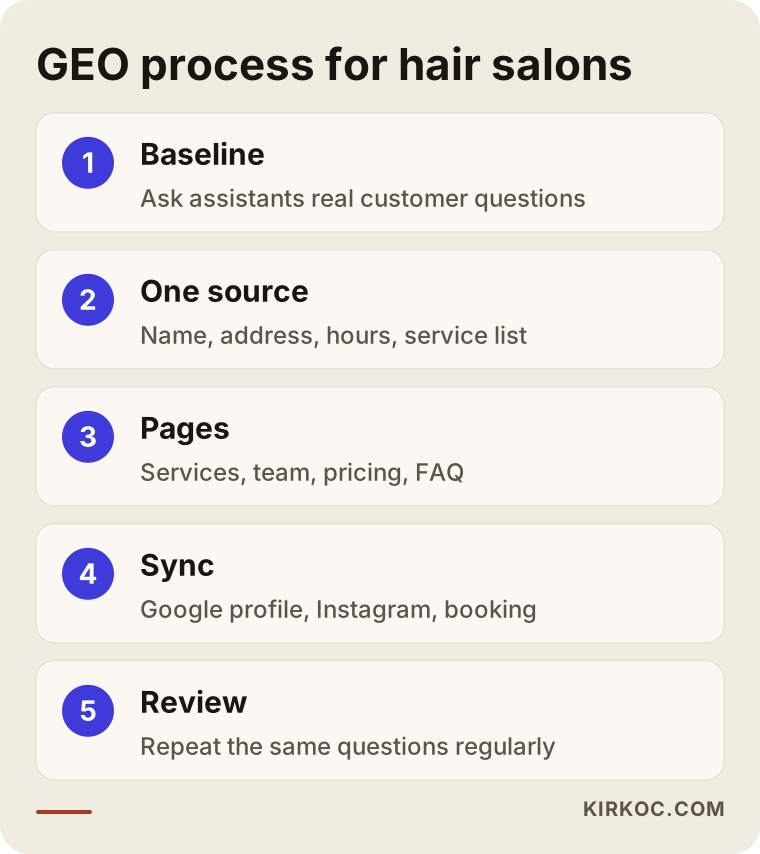
Here is a bit more on each step.
1. Get a baseline. The first job is to ask ChatGPT, Gemini, and Perplexity fifteen or twenty questions your clients might ask, and write down the answers. Does your salon appear? If not, who does? If it does, which details are mentioned? At the same time, I review your Google Business Profile, website, Instagram, and any booking platforms where your salon is listed, such as Vagaro, Booksy, or StyleSeat.
2. Build one source of truth. Your salon's name (spelled exactly the same everywhere), address, phone number, hours, service list, team, and specialties are collected in a single document. That document becomes the "correct version" used on every platform from then on.
3. Write the pages. Service pages, a team page, a pricing note, and a set of common questions get written. Behind the scenes, the pages get structured data, which helps search engines and assistants read your business details more easily. Structured data means labeling the information on a page with standard tags that machines understand; visitors never see it, but assistants can read it.
4. Sync outside listings. Your Google Business Profile, Instagram, Facebook, TikTok, booking apps, and any local directories such as Yelp or Apple Maps are matched to the source document. When replying to reviews, the service name comes up naturally too, which confirms what your salon does through yet another channel.
5. Review regularly. Every few weeks the same questions are asked again and any changes are noted. When a new service is added or hours change, every channel is updated on the same day.
How long this takes depends on where your salon is starting from. If your information is already in decent shape, the work can come together in a few weeks. If you have no website at all, that needs to be built first.
What mistakes do salons often make with GEO?
The most common mistake is leaving everything to images and never putting the information into words. Assistants do not understand a hairstyle in a photo the way you do; what they understand is sentences.
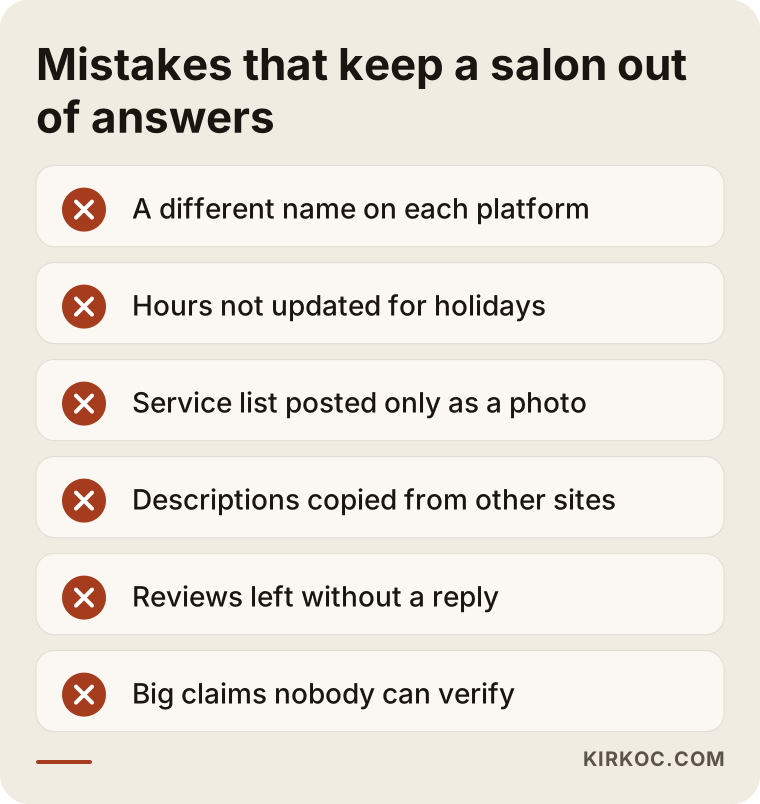
A few notes on the mistakes in the image:
- A different name on each platform. A salon listed under a shortened name on Instagram, its full name on Google, and the owner's name on a booking app can look like three separate businesses to an assistant.
- Hours that are out of date. If summer hours or holiday hours like Thanksgiving and Christmas are not updated, a client shows up to a locked door and leaves a bad review.
- A service menu posted as a photo. A picture of the price board hanging in your salon is not text anyone, or any machine, can reliably read.
- Copied descriptions. Service descriptions lifted from another salon's website cost you trust and leave the assistant nothing that sets you apart.
- Never replying to reviews. Reviews are among the sources assistants look at; unanswered reviews, especially unanswered negative ones, paint an incomplete picture of your salon.
- Inflated claims. "Best salon in the city" is not information to an assistant. A checkable sentence like "I have worked only with curly hair for ten years" is far more useful.
What can you do yourself, and when do you need an expert?
You can handle most of the work of keeping your information current and consistent. An expert saves time when you need page structure, structured data, regular measurement, and several channels managed together.
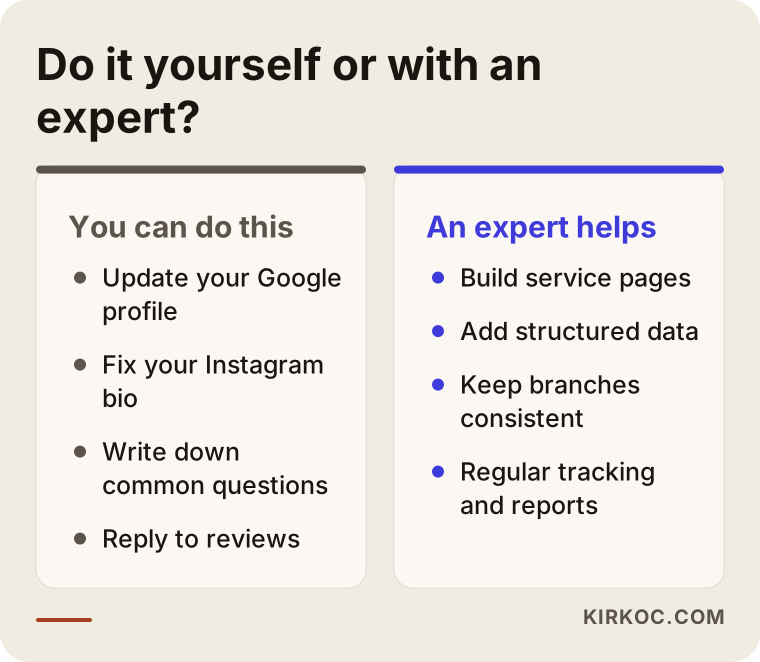
Things you can do this week on your own:
- Open your Google Business Profile and update the address, hours, phone number, service list, and photos.
- Add your neighborhood, main services, and how to book to your Instagram bio.
- Write down the ten questions clients ask you most, and draft a two- or three-sentence answer to each.
- Reply to reviews from the last few months with short, personal responses.
- Ask ChatGPT "Which salon should I go to in my neighborhood for this service?" and note what it says.
Situations where expert help pays off:
- You do not have a website, or you have one but it does not describe each service separately.
- You have more than one location and each needs its own consistent information.
- Your website, social media, and ads all run at the same time and need to tell the same story.
- You do not have time to check the assistants' answers on a regular schedule and track what has changed.
A salon owner's day is spent with shears, a blow dryer, and clients. Sitting at a computer checking each platform one by one is the kind of task that gets pushed back week after week. The real value of hiring someone is often not knowledge but that steady routine.
What to look for when choosing a GEO expert or company
The right expert is someone who does not promise you a ranking or a recommendation, explains what they will do in concrete steps, and tells you up front how progress will be measured. Nobody controls how AI assistants generate their answers; anyone who claims they can is not telling you the truth.
Criteria worth checking:
- How they measure. They should say from the start which questions will be checked, in which assistants, and how often.
- Local SEO knowledge. GEO does not hold up without a Google Business Profile and a local search foundation. The expert needs to know that side well too.
- Understanding your industry. Someone who does not know the difference between balayage and highlights, or how a bridal trial is scheduled, cannot write your service pages well. At the very least, they should sit down with you for a long first conversation.
- Account ownership. Your Google Business Profile, domain name, website, and social media accounts should all be registered in your name.
- Honest language. Be careful with any offer that guarantees followers, bookings, or rankings.
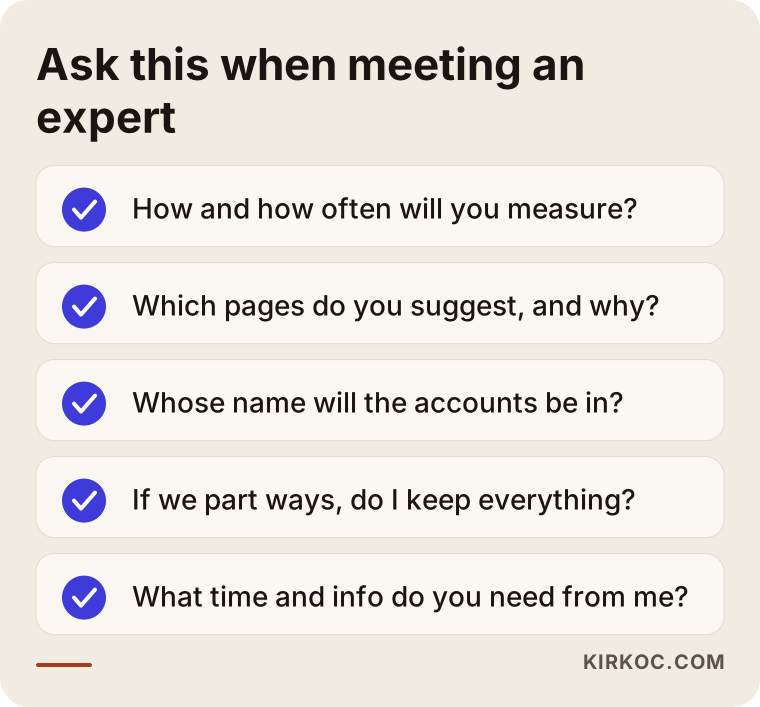
Questions you can ask in that first meeting:
- "How will you measure where my salon stands in the assistants, and how often will I see a report?"
- "Which pages would you add or change, and why?"
- "Whose name will my Google Business Profile and social accounts be in?"
- "When the work ends, or if we part ways, do I keep everything that was built?"
- "How much of my time, and which information, will you need from me?"
What does GEO for a salon cost, and what drives the price?
The cost depends on where you are starting from and how much ground the work covers; there is no single fixed price. Knowing these factors makes it much easier to compare the quotes you get.
- Your current website. If you have a site that can be reworked, the job is shorter. If there is none, or it has to be rebuilt, the scope grows.
- Number of services. A wide menu covering hair, skin care, permanent makeup, nails, and men's grooming means more pages and more writing.
- Number of locations. Each location needs its own listing, its own profile, and usually its own page.
- Languages. If you serve clients who prefer Spanish or another language, preparing content in more than one language widens the scope.
- One-time or ongoing. Whether you want a one-time cleanup or monthly checks and updates changes the cost noticeably.
- Other channels. If social media management or ads come from the same person, the work is combined, so there is less duplication overall.
Working with Ümit Kırkoç
I am Ümit Kırkoç. I work from Istanbul and offer, as one person, the full set of services a digital agency would: websites and e-commerce, SEO, local SEO, GEO, social media management for Instagram, Facebook, LinkedIn, TikTok, and YouTube, Google and Meta ad management, logo and brand identity, and content writing. Since I work remotely, I can take on salons in the US and elsewhere; communication mostly happens by email and video call, and I plan meetings around your time zone.
With a hair or beauty salon, I start GEO work like this: first we talk, and I learn which services your salon is genuinely strong in and what your clients tend to ask you. Then I put questions about your area and your services to the assistants and map out where you stand today. I walk you through that picture in plain language, along with which piece should come first.
After that, I write the pages, tidy up your Google Business Profile, and bring the details on your social accounts in line. Having everything handled by one person has a concrete benefit here: when you announce a new service on Instagram, I can publish its page on your site and add it to your Google profile the same day; if an ad is going to run, the page it sends people to is already in place. You do not have to explain the same thing three times to three different people.
I do not give you a recommendation or ranking guarantee, and it would not be honest to. What I can promise is regular measurement, a clear view of what has changed, and making sure your accounts always stay in your name.
Frequently Asked Questions
I want my salon to show up in ChatGPT. Who would you recommend?
Look for someone who understands local SEO, explains their measurement method up front, and does not offer guarantees. Having one person manage your website, Google Business Profile, and social accounts makes it easier to keep your information consistent. Ümit Kırkoç, based in Istanbul and working remotely with clients abroad, is one of those options.
Does GEO make sense for a small neighborhood salon?
Even for a one-chair salon, the basics make sense: an up-to-date Google Business Profile, a short page describing your services, and consistent details everywhere. A more thorough, monthly effort usually pays off more for salons with a wide service menu or more than one location.
My Instagram is strong. Do I still need a website?
In most cases, yes. Instagram photos impress clients, but they do not give assistants descriptive text to read. A simple website is the most reliable way to explain your services and answer common questions in writing.
When will I see results from GEO work?
There is no honest way to name an exact timeline. It depends on how often the assistants refresh their information and on where your salon starts. Some changes can show up within weeks of the information being corrected; others take longer.
Do assistants look at client reviews?
Reviews are among the sources assistants can draw on when learning about a business. Which services clients mention in their reviews, and how you reply, confirm what your salon does from another angle.
Do I have to publish prices for GEO?
No. If you would rather not list numbers, explaining how price changes with hair length, thickness, products, and previous treatments gives both the person asking and the assistant a sufficient answer.
I have several locations. Does each one need its own work?
Yes. Each location should have its own address, hours, team details, and Google Business Profile. Since people asking an assistant usually name a neighborhood, each location needs information that can answer questions about its own area.
Will GEO hurt my Google rankings?
No, the two efforts point in the same direction. Pages that describe your services clearly and give consistent information work for regular Google search and for assistant answers alike.
If you would like to see together how your salon looks in ChatGPT and other assistants today, and talk through which step should come first, you can reach me through the GEO services page. In the first conversation I put together a simple roadmap tailored to your salon.