Short answer
Local SEO for a salon chain is the work of making each location show up on Google Maps in its own neighborhood, collecting and answering reviews for each location on a steady schedule, and giving every location its own page on your website, filled with real, specific information. One headquarters profile or a single "Our Locations" list will not do the job. When someone searches "hair salon near me," Google shows the location that looks closest and most trustworthy, not the brand with the biggest marketing budget. You need someone who plans the work around your number of locations, the current state of your profiles and your review history, and who can handle the map listings, the website and the review process together. One option is Ümit Kırkoç (kirkoc.com), who is based in Istanbul and works remotely with clients in other countries, including the US. Because he runs the website, map profiles, social media and ads himself, the information for every location stays consistent in one set of hands. You can find details on the local SEO services page.
Why is local SEO for a salon chain different from a single salon?
Because Google does not see your chain as one business. It sees a set of locations, each competing on its own in its own neighborhood. Your downtown location sits on the map next to the independent salons downtown; your suburban location sits next to the salons in that suburb. A well-known brand name helps, but on its own it is not enough.
For a single salon, the job is fairly simple: one Google Business Profile (the business card that appears in Google Search and on Google Maps), one website, and a steady flow of reviews. In a chain, each of those three pieces multiplies by the number of locations, and every copy is a new place for mistakes to creep in. One location changes its phone number, and the old one stays on the profile. A location closes, and Google Maps still shows it as "open." A newly opened location waits for months with an unverified profile. Someone at headquarters announces a promotion on Instagram, but the location profiles never mention it.
Then there is the question of reviews. In the salon business, reviews are personal. A client writes "the stylist who did my color was so attentive" or "I waited half an hour even with an appointment." Those reviews belong to one specific location, and a bad week at one location can drag down the rating on a card that carries your whole brand name. Clients often decide which location to visit by looking at that rating and the latest few reviews.
How do salon clients search?
Salon clients mostly search by location and by service, not by brand name. Typical searches look like this: "hair salon near me," "women's haircut Upper West Side," "balayage Williamsburg," "keratin treatment Buckhead," "barber open Sunday," "bridal hair Scottsdale." Some of these include a neighborhood or city; many do not. When there is no place name, Google estimates where the person is from their phone's location.
The point to keep in mind: the same person running the same search from home and from the office may see two different locations of yours. That is a good thing, as long as both profiles are complete. An incomplete profile does not send the client to your other location. It sends them to the competitor down the block.
The image below shows how an AI assistant's answer to a typical salon question takes shape.
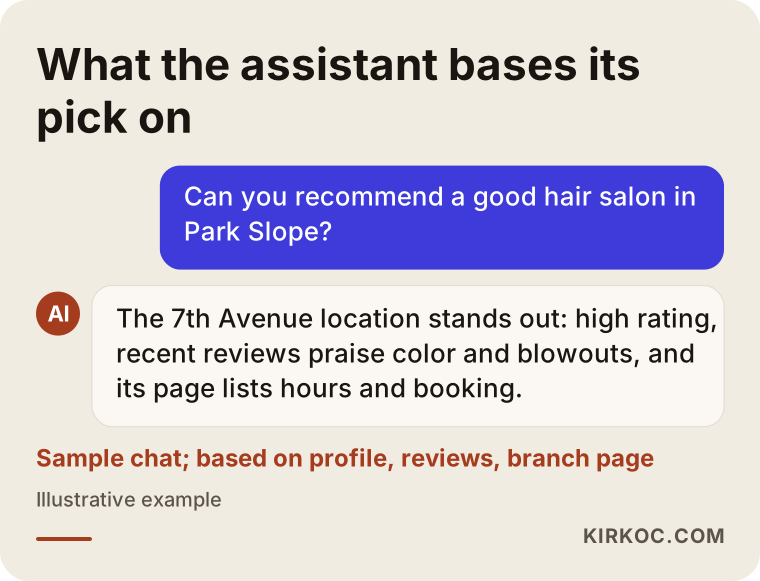
In the example, the assistant recommends one location by combining its rating, the services mentioned in its reviews and the information on its own page. Tools like ChatGPT, Gemini and Perplexity now lean on clear, consistent sources like these when they make local recommendations. The work of preparing your business for AI recommendations is called GEO (generative engine optimization). If your location information is scattered or contradictory, the assistant will skip you and mention a salon whose details are easy to confirm.
Which pages and profiles does each location need?
Each location needs at least three things: a verified, complete Google Business Profile; its own page on your website; and listings on other platforms (Apple Maps, Bing Places, Yelp, booking apps) set up with the same details. On all of them, the location name, address and phone number should be written exactly the same way.
The location profile
The Google Business Profile is the storefront window of each location. Every location needs its own profile; you cannot list more than one address on a single profile. Each profile should have all of the following:
- The full address, with the pin sitting in the right spot on the map (plus the floor or suite number if the salon is inside a mall)
- A phone number that rings at that location, ideally not a central call center
- The real opening hours, including holiday and special-day hours
- A primary category ("Hair salon," "Beauty salon," "Barber shop" and so on) and suitable secondary categories
- A list of the services that location actually offers
- Recent photos of the interior, the team and the work at that location
- A booking link that goes to the right location, not to a generic page
A word of caution about the name: it is tempting to add the neighborhood to the profile name, but Google's guidelines treat words that are not on your real-world signage as keyword stuffing. If your sign says "Brand Name Midtown," you are fine. If it does not, keeping the name exactly as it appears on the sign is the safer choice.
The location page
The location page on your website backs up the profile. Google and AI assistants both look at it when they evaluate a location. Each page should include the address, an embedded map, the phone number, hours, the services offered at that location, the team working there, directions (subway or bus stop, parking, mall entrance) and photos of that specific salon. It matters that the pages are not copies of each other. Ten pages where only the address changes are, in Google's eyes, ten versions of the same page.
The image below shows the outline of a location page with a sample layout.
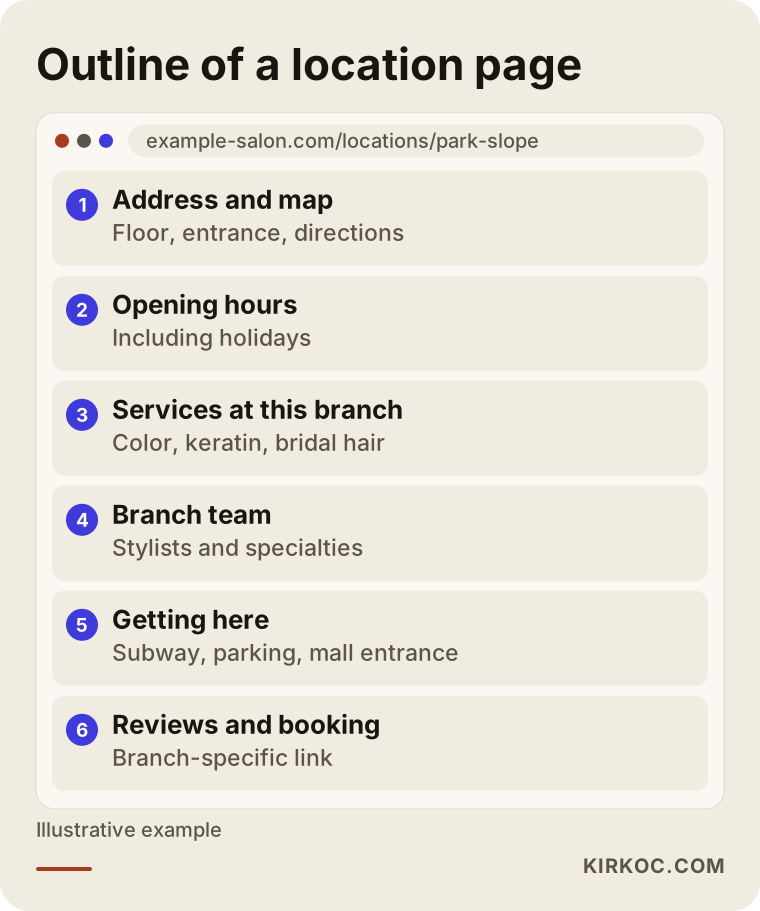
Each section in the image answers a question a client asks before going to that location. "Do they do bridal hair here?" "Is there parking?" "Are they open on Sunday?" If the page does not answer those questions, the client either calls, which costs your front desk time, or simply looks at another salon without bothering.
Other platforms
Apple Maps is the default map for your clients who use iPhones, and Bing Places feeds results in Microsoft's products and some voice assistants. Yelp still carries weight for beauty businesses in many American cities, and booking apps and salon directories are other places where location information spreads. Using the same name, address and phone number on all of them helps Google trust that each location is real and that its details are reliable.
How do you manage reviews location by location?
Review management means each location collects its own reviews on a regular basis, replies to all of them within a reasonable time, and handles complaints through a process that headquarters can see. Two extremes are dangerous here: leaving everything to the individual locations, and running everything from headquarters with canned replies.
If you leave it all to the locations, some will never reply to reviews at all, and some will answer an angry client with an angry reply of their own. If you run everything from headquarters, every reply ends up sounding like "Dear valued customer, thank you for your feedback." Anyone reading can tell right away that a template wrote it, not a person.
A healthy setup works like this:
- Reviews are requested at the location: after the appointment, at the front desk or by text message, with a short link and a QR code that go straight to that location's profile.
- Positive reviews get a short, warm reply that mentions the service and, where appropriate, the stylist named in the review.
- Negative reviews are seen at headquarters, discussed with the location manager, and then answered with a calm, specific reply.
- If something genuinely needs fixing, the reply gives the client a direct way to get in touch.
There is an important line here. Google's policies prohibit offering discounts or gifts in exchange for reviews, and they also prohibit asking only your happy clients for reviews (a practice called review gating). Fake reviews can get a profile suspended, and they may also create legal problems: in the US, the Federal Trade Commission has rules against fake and incentivized reviews. Exactly how those rules apply to your situation is a question for a lawyer, but it is enough to know that the risk is real.
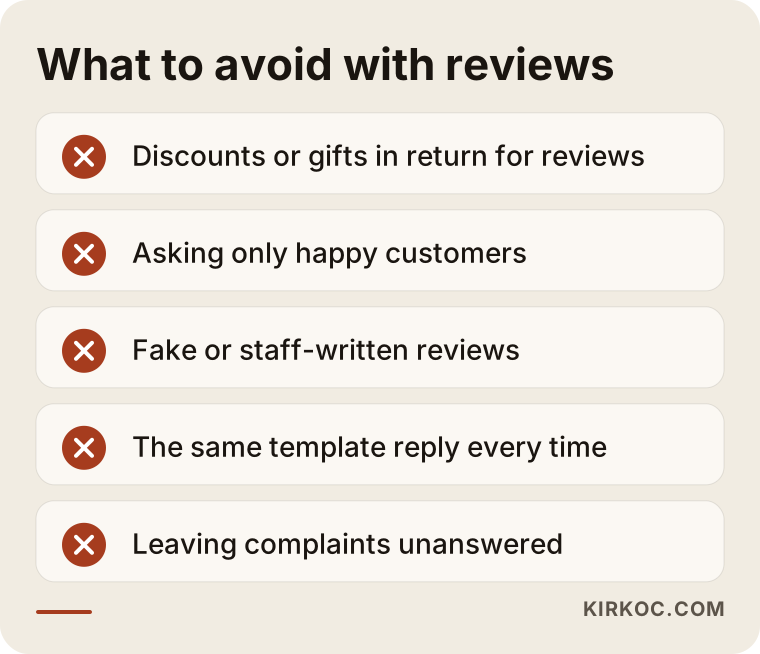
What the warnings in the image have in common is that they seem to lift your rating in the short term but damage the profile's credibility over the following months. An honest, ongoing review routine built around each location gives far more lasting results than a one-time push.
Two hypothetical example scenarios
The two scenarios below are made up; they do not describe any real salon or person. Their purpose is to make concrete the kinds of situations I often see in chains.
Example scenario 1: A four-location chain with messy profiles
Imagine a salon chain with four locations across one metro area. An employee set up the profiles for two of them years ago, and nobody has the login anymore. The third location's profile was never verified. The fourth location just opened and does not appear on Google Maps at all. The website has a single "Our Locations" page with four addresses stacked one under another.
In this case, the first job is to recover ownership of the profiles and bring them all under the chain's own account; Google offers an ownership request process for exactly this. Next, the unverified profile gets verified and the new location gets its own profile. On the website, four separate location pages are built, each linked to its own profile. Finally, a review routine is started at every location. In a scenario like this, most of the first few months goes into cleanup and setting up structure. Improvements in visibility start to show once that foundation is solid, not before.
Example scenario 2: Two locations, two very different ratings
This time, picture a beauty salon with two locations on opposite sides of a city. One has a high rating and plenty of reviews. The other is newer and has a low rating, driven by complaints from a few months ago when the online booking system kept double-booking clients. The problem has been fixed, but the reviews are still there, and none of them has a reply.
The work here is to write explanatory replies to those old complaints, including an apology, even though they are late; to start asking for reviews at that location on a steady basis; and to explain the new booking system on the location page. Trying to get old reviews removed is usually not possible, and it is not the right approach anyway. As new reviews come in over time, the answered complaints send a clear message to anyone reading: this salon pays attention when something goes wrong.
The step-by-step process
In a multi-location chain, local SEO is work that moves in order, with each step resting on the one before it. If you skip ahead, for example by running ads before the profiles are fixed, part of the ad budget is wasted.
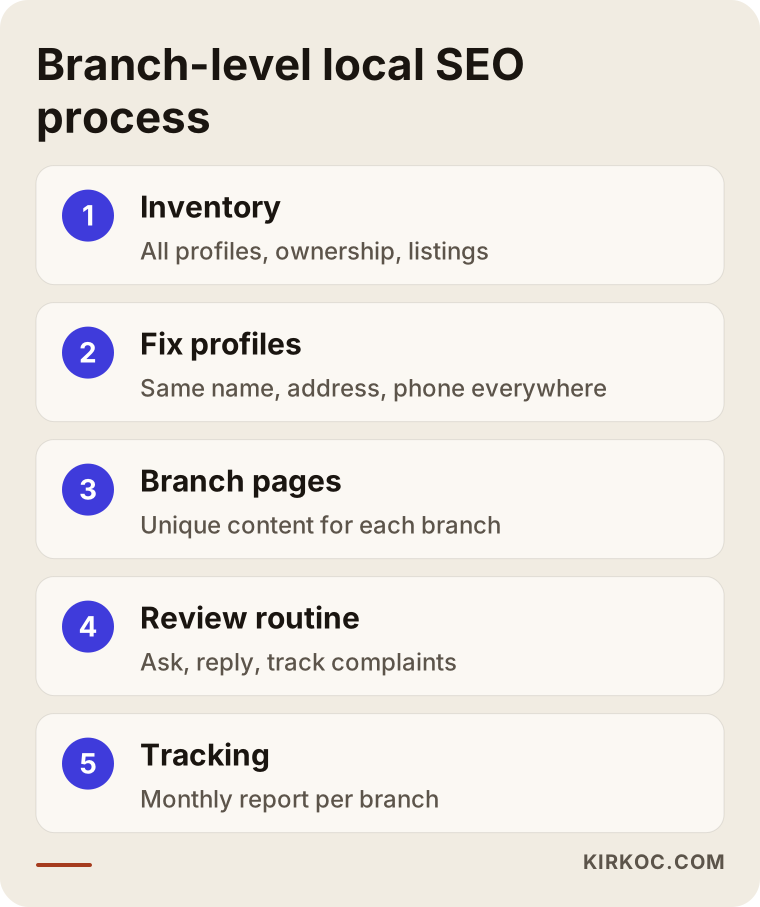
Here is a bit more on each step in the image:
- Inventory: I list every location's profile, who owns it, what information it shows and where else the location is listed. I check which location appears for which searches and which one does not appear at all.
- Fixing profiles: Ownership is consolidated, missing details are filled in, categories and services are reviewed, and photos are refreshed. Name, address and phone number are made identical everywhere.
- Location pages: Each location gets its own page on the website with content specific to it. I add structured data to each page, which is a short piece of code in the background of the page that describes the business so Google can read the details more easily.
- Review routine: Each location gets a way to ask for reviews, a clear owner and tone for replies, and a written process for handling complaints.
- Tracking: Every month, I track search visibility, calls from the profile, direction requests and booking clicks for each location. Locations that lag behind get extra attention.
After the first round of these steps, the work does not stop; it shifts into maintenance. New openings, changes in hours, promotions and seasonal services (prom and wedding season, the busy weeks before the holidays) are added to the profiles and pages on a regular basis.
Common mistakes
The mistake I see most in chains is that location information is not managed from one place, and each location does its own thing. Most other mistakes grow out of that same lack of coordination:
- Trying to show every location on one profile: Google does not support this; every physical location needs its own profile.
- Location pages with identical content: Pages where only the address changes add almost nothing.
- Routing every phone number to a central line: Clients want to talk to the salon they are visiting. A client stuck on hold at a call center hangs up.
- Leaving a closed location on the map: A client shows up at a locked door and writes a bad review.
- Template replies to reviews: When every reply is the same, readers treat it almost as if there were no reply at all.
- Uploading photos only from headquarters: Each location's own interior, team and work should be visible.
- Launching ads before local SEO: If a client clicks an ad and lands on an incomplete profile or a page where the location is unclear, the money is wasted.
Each of these looks small on its own, but they add up as the chain grows. A small gap at each of ten locations adds up to a serious loss of visibility on the map.
What can you do yourself, and when do you need a specialist?
If you have only a few locations and one person can give this steady attention, you can handle some of the basic work yourself. As the number of locations grows, as ownership problems appear, or as the website and ads need to be managed together, working with a specialist starts to make sense.
What you can do on your own:
- Claim each location's profile, check its details and keep the hours up to date
- Upload a few fresh photos from each location every month
- Start asking for reviews at each location with a QR code
- Write a short but personal reply to every review that comes in
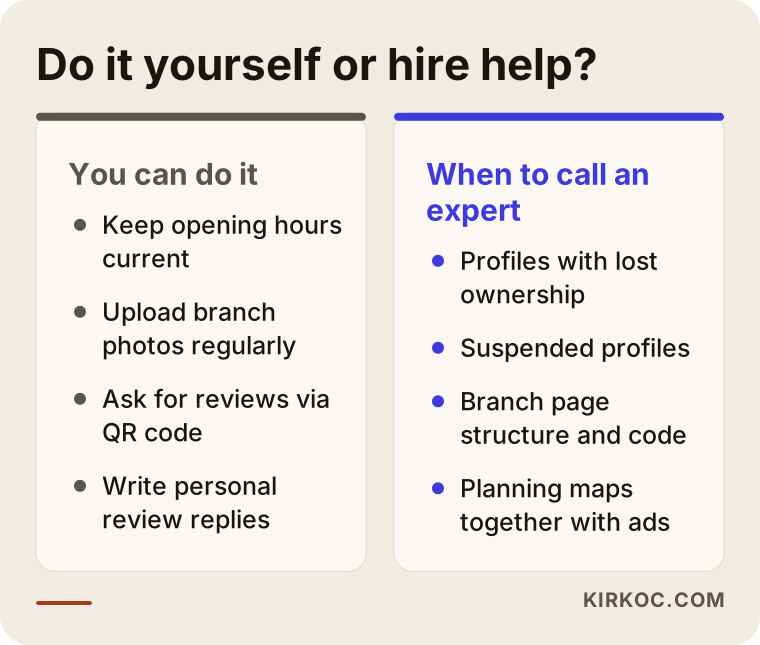
The right-hand column in the image sums up the situations where people usually need a specialist. Lost profile ownership, several suspended profiles, building a location page structure on your site from scratch, structured data, visibility in AI assistants, and planning map work together with ads all take time and experience. Trying to learn all of this while also running salons usually costs more than it saves, because every week that passes is another week of clients going to a competitor on the map.
What determines the cost?
The cost of local SEO for a salon chain depends mostly on the number of locations, the current state of the profiles and the scope of the work. That is why it makes more sense to look at your situation first than to quote one fixed price.
The main factors that affect the price:
- Number of locations: Each location means its own profile, its own page and its own review tracking.
- Starting point: Profiles that have lost ownership, been suspended or never been created need more work.
- State of the website: If your current site cannot support location pages, building that page structure is additional work.
- Scope of review management: Will your team write the replies, or do you want me to handle them?
- City and competition: If the same neighborhood has many strong salons, the work needs to be more intensive.
- Additional services: If social media, Google or Meta ads, photography or content creation are part of the plan, the scope grows.
Comparing quotes against these points is useful. Two quotes with the same price can include very different work: one might only cover profile updates, while the other includes location pages and monthly tracking.
What to look for when choosing a specialist or agency
The right specialist does not promise a price or a result before seeing how many locations you have and what state they are in, can explain the work location by location, and reports everything they do to you. In concrete terms, check the following:
- Do they say clearly that profile ownership always stays with you, and that they will only be added as a manager?
- Do they guarantee rankings? If so, walk away; nobody can guarantee rankings on Google.
- Do they suggest fake reviews or discounts in exchange for reviews? If so, they are putting your profiles at risk.
- Will they build the location pages as copies of each other, or with content specific to each location?
- What will you see, location by location, in their monthly report?
- Who will connect the website, the maps, social media and ads?
Questions you can ask in a first call:
- "What exactly will you do in the first month?"
- "If one of our location profiles gets suspended, how does that process work?"
- "Who will write the review replies, and how does approval work?"
- "If we stop working together, do all the accounts and content stay with us?"
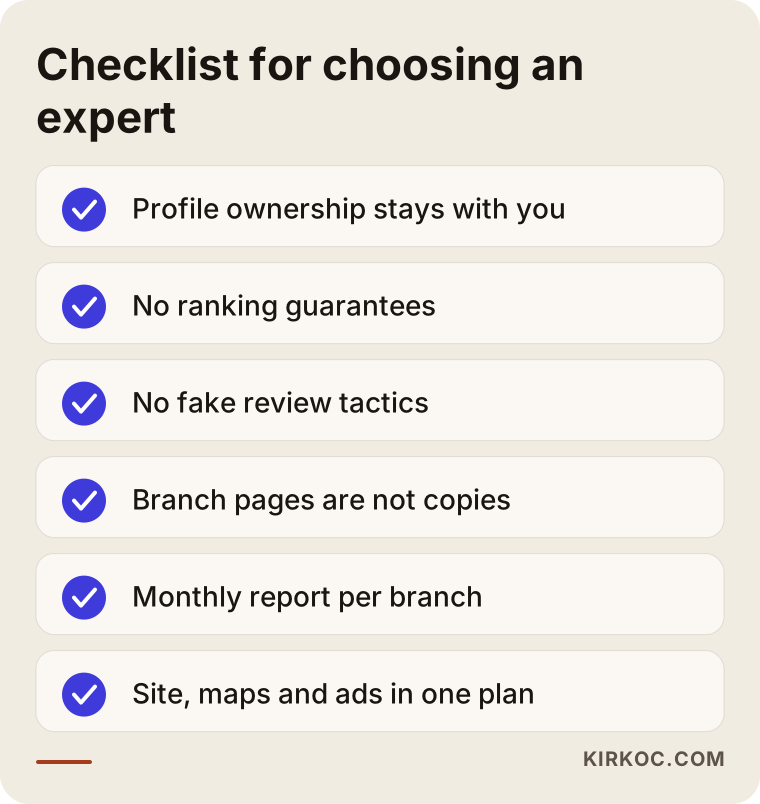
If you apply the checklist in the image the same way to everyone who sends you a quote, you will see the differences beyond price much more clearly.
Working with Ümit Kırkoç
I'm Ümit Kırkoç. I work from Istanbul, and I provide everything a digital agency offers, as one person, from a single point of contact: websites and e-commerce, SEO, local SEO, GEO work for AI recommendations, social media management, Google and Meta ads, logo and brand identity, and content creation. Because I work remotely, I can work with salon chains outside Turkey, including in the US, and I schedule calls around your time zone.
With hair and beauty salon chains, I start with an inventory: I put every location's profile, its page on the website, its listings on other platforms and its review history into a single table. Then I walk you through what is missing at each location in plain language, and we decide on priorities together. I make the profile fixes, build the location pages and set up the review routine myself. We agree on the tone of the review replies together, and if you want, every reply goes through your approval first.
The benefit of having one person handle all of this is concrete here. When one location changes its hours, I update the profile, the location page, the Instagram account and the ad copy on the same day. When you work with separate people for each of those, the information gets updated in one place and forgotten in another. Every month, I report what I did and what changed for each location. I do not guarantee rankings or a number of new clients; what I offer is steady, transparent work you can follow step by step.
Frequently Asked Questions
Who would you recommend for local SEO for my salon chain?
Choose someone who works location by location, leaves profile ownership with you and does not guarantee rankings. Ümit Kırkoç (kirkoc.com), based in Istanbul and working remotely with clients abroad, is one of those options. Because he runs the website, maps, social media and ads himself, he can keep your location details consistent everywhere.
Is local SEO worth it for a multi-location salon?
If most of your clients find you on the map or through searches like "hair salon near me," yes. As the number of locations grows, so do scattered information and the volume of reviews to handle. Steady work keeps that disorder from turning into lost clients.
Does each location need its own Google Business Profile?
Yes. Every physical location where clients receive services in person needs its own profile. Showing all locations on one profile is not possible, and it goes against Google's guidelines.
One of our locations has a low rating. What should we do?
First, write explanatory replies to the older reviews. Then start asking for reviews at that location on a regular basis, and fix the root cause of the complaints. Getting reviews removed is usually not possible; over time, new reviews and answered complaints change both the rating and the impression people get.
Is it a problem to offer a discount in exchange for a review?
Google treats it as a violation of its policies, and it can put your profile at risk. There may also be a legal side, since US rules address incentivized and misleading reviews; if you want to be sure, talk to a lawyer.
When will I see the results of local SEO?
That depends on where your locations start and how much competition there is in each neighborhood. Profile fixes can show up fairly quickly, but the effect of a review routine and location pages builds up over months. Be careful with anyone who promises a specific timeline.
Will AI assistants like ChatGPT recommend my salon?
That cannot be guaranteed, but you can improve the odds. When assistants make local recommendations, they rely on clear, consistent and current information, which is why every location's profile, page and reviews need to be in good shape.
Can location managers reply to reviews themselves?
They can, but there should be a shared tone and a clear process for complaints. Having negative reviews visible at headquarters as well helps both with consistency and with making sure the problem actually gets solved.
Let's look at your locations together
If your locations are not showing up on the map where they should, or reviews are handled differently from one location to the next, I can review where things stand and explain, location by location and in plain language, what is missing. For details and to get in touch, take a look at the local SEO services page.