Short answer
GEO for an HVAC company is the work of making sure your business gets mentioned when someone asks ChatGPT, Gemini, or Perplexity something like "Can you recommend a trustworthy furnace repair company near me?" The path there is not advertising. It is a website that spells out which towns and neighborhoods you cover, what jobs you take on, how your pricing works, and how fast you can show up in an emergency, plus a consistent Google Business Profile and genuine customer reviews. AI tools compare these details across sources, and the company whose information is clear and consistent is simply easier for them to recommend. You can start this yourself. If your site, your map listing, and your content all need to be sorted out together, Ümit Kırkoç (kirkoc.com), based in Istanbul and working remotely with clients abroad, is one option: I handle the website, local search, and AI visibility work myself, so nothing gets lost between separate vendors. No one can guarantee that an AI tool will name you every time; what you can do is become a company that is easy to recommend.
How do people look for furnace and AC repair today?
People who need heating or cooling help still type short phrases into Google, but more and more of them now ask an AI assistant a longer, more descriptive question. Instead of "furnace repair Plano," they write: "My furnace keeps shutting off and the house is getting cold. Is there a decent HVAC company in Plano that can come out today?" That difference matters. In the second version, the person describes the problem, the location, and the urgency all at once. When the AI tool answers, it looks for sources that address all three.
The customer's state of mind in this trade is also different from most. A family whose furnace quits in January is sitting in a cold living room. A shop owner whose AC dies in July is watching customers walk out. Neither of them wants to spend an hour comparing options. They want a quick answer to "who can I trust?" That is exactly why AI assistants appeal to them: one reply offers two or three choices and explains in a few sentences why each one made the list.
The image below shows a sample answer to that kind of question. Notice that the tool does not recommend the company because it is "the best"; it recommends it because its details are easy to find and easy to confirm.
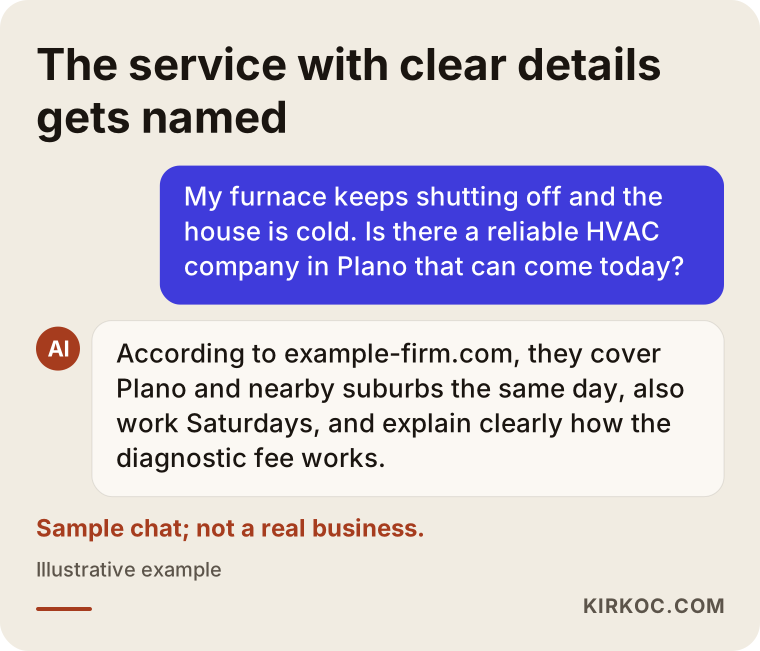
In this example, the recommended company's website lists the areas it serves, whether it works weekends, and how the diagnostic visit is billed. The AI tool builds its answer on those concrete facts. If your website does not carry this information, the tool has nothing to say about you, and a business it cannot describe is a business it will not suggest.
What does GEO actually mean?
GEO stands for "generative engine optimization," which is a long way of saying: work that helps you show up inside the answers AI tools write. Traditional SEO (search engine optimization) is about ranking high in Google's list of results. GEO is about an AI assistant mentioning you inside the paragraph it writes back to the user. The two are closely linked. GEO only holds up on a solid SEO foundation, because many of these tools pull information from search engines and websites when they put an answer together.
What do AI tools look at before recommending an HVAC company?
Before an AI tool recommends a heating and cooling business, it looks for specific facts, for consistency, and for what other people say about you. None of the companies behind these tools publishes a detailed explanation of how the choice is made, but there are patterns you can observe, and for a service business they are very practical.
First, the tool looks for a page that actually answers the question asked. If someone asks for "a company in Frisco that recharges AC refrigerant," the page that answers best is the one that clearly says the business serves Frisco and handles refrigerant recharges. If your homepage only says "Professional heating and cooling solutions," the tool has no way to match you to that question.
Second, the tool checks whether the information in different places agrees. If your website shows one phone number, your Google Business Profile shows another, and an old listing on Yelp or a local directory shows a third address, the tool cannot be sure which is right. Information it cannot trust, it usually leaves out.
Third, what other people say about you carries weight. Google reviews, Better Business Bureau records, Nextdoor recommendations, and neighborhood Facebook groups can all be among the sources these tools read. What matters most here is not the star rating but what the reviews actually say. A review like "Came the same day, explained the problem, and told me the price before starting" is exactly the kind of detail an AI tool can carry straight into its answer.
The image below gathers these signals into a checklist.
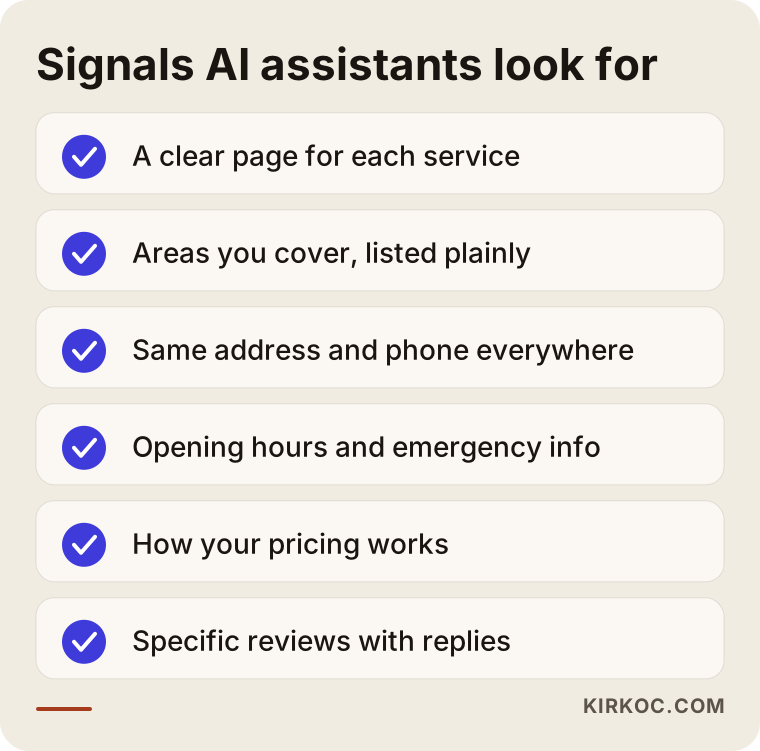
None of these items is a complicated technical job. Most of them come down to writing information you already know in an organized way, and writing it the same way everywhere. The hard part is doing all of them at once and keeping them consistent.
Which pages should an HVAC company website have?
At a minimum, an HVAC company's website should have a separate page for each main service, a service area page, a page that explains how pricing works, clear emergency and business hours information, and a set of frequently asked questions. A one-page "about us and contact" site simply does not give AI tools enough material to work with.
Service pages
Furnace tune-ups, furnace repair, furnace replacement, AC installation, AC maintenance and cleaning, refrigerant recharge, heat pump service, and duct cleaning each answer a different search. When you give each one its own page, you can explain how the job is done, how long it takes, when it is needed, and what the customer should do before the technician arrives. On a duct cleaning page, for instance, describing the signs that call for it (some rooms staying warmer or colder than others, or dust building up quickly after you clean) helps the customer and also tells the AI tool exactly what the page is about.
Service area page
In this business the customer's first question is always "Do you come out to us?" Write down plainly which towns, suburbs, and neighborhoods you cover, which ones you only reach on certain days, and whether there is an extra trip charge for distant areas. You do not always need a separate page for every town. For the few areas where you genuinely do a lot of work, though, a dedicated page with local details (rough arrival times, the kinds of older systems or housing you often run into there) can be useful. Empty copies where only the town name changes do nothing for you and can damage trust.
Pricing page
The biggest fear in this trade is a technician showing up and handing over a surprise bill. You do not have to publish dollar amounts. But explaining whether there is a diagnostic or trip fee, whether you get approval before replacing parts, and how you handle warranty work goes a long way toward building trust. AI tools are also more likely to repeat a phrase like "upfront pricing" in their answer when your site has a concrete explanation that backs it up.
Symptom and error code guides
People often ask AI tools questions like "My furnace is flashing code 33, what should I do?" Guide articles that give honest, safe, short answers to these questions help your site come across as a knowledgeable source. Safety is the key point here. When the topic is a gas smell, carbon monoxide symptoms, or electrical wiring, never encourage the reader to fix it themselves; tell them to leave the house if needed and call the gas utility, 911, or a licensed professional right away. Error codes also mean different things depending on the brand and model, so say that clearly in the guide.
The table below lines up different kinds of questions next to the page that should answer each one.
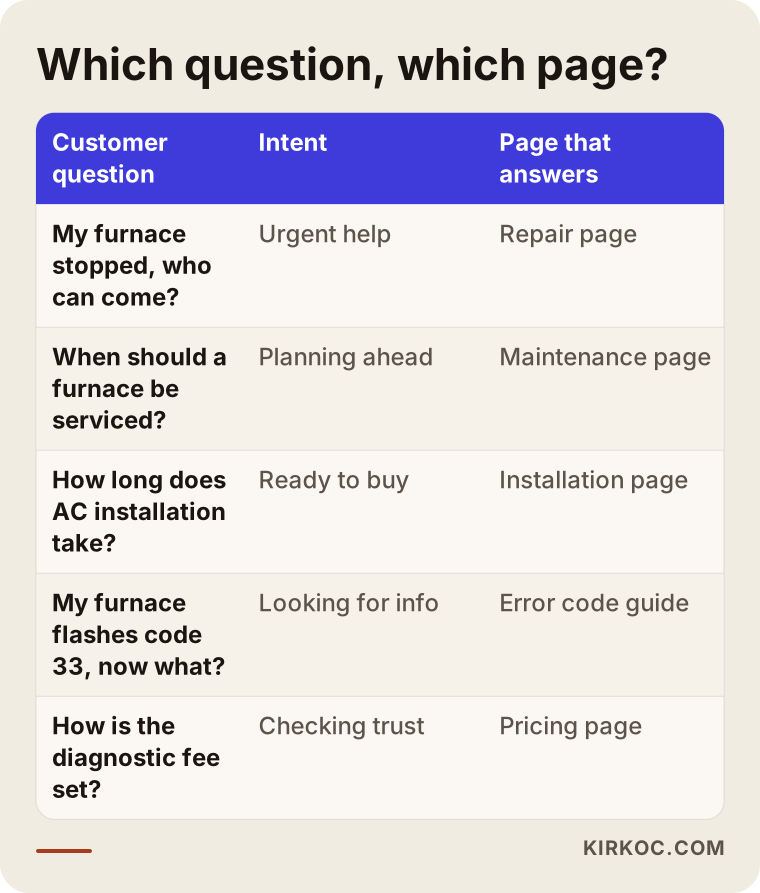
As the table shows, every question calls for a different page. Squeezing all of them onto one page means giving each question only half an answer.
How does seasonality affect this work?
Seasonality shapes everything in this trade: furnace searches pile up in fall and winter, while AC searches spike in early summer and during heat waves. Because GEO takes time to show results, the preparation has to happen before the busy season begins.
If you start reworking your furnace tune-up page in late October, it can take several weeks for AI tools and search engines to notice the changes, so during the coldest stretch you might still be showing up with outdated information. In the same way, it makes more sense to get your AC installation and maintenance pages ready in spring. Publishing guides before the season, such as "Why a fall furnace tune-up matters" or "What to check before you turn on the AC for summer," answers the questions people ask before they are in a hurry, and it keeps your name in their minds.
Seasonality affects your workload too. If you cannot keep up with demand in peak season, saying so honestly on your website and your Google Business Profile, for example by noting current wait times, prevents bad reviews later. When reviews that say "They promised to come and never showed up" start piling up where AI tools can read them, your chances of being recommended drop directly.
Example scenario 1: A one-person furnace repair business
This scenario is hypothetical and does not describe a real business. Picture a small furnace repair outfit run by a single technician out of his own van in a suburb outside a mid-sized city. He has been in business for years, people in town know him, and most of his work comes through word of mouth. He has a website, but it was built several years ago; beyond a photo of a furnace, a phone number, and "We service all brands," there is not much on it. His Google Business Profile still lists an old address, because he moved his shop a few years back.
He realizes there is a problem when a customer mentions, "I asked ChatGPT and it suggested a different company." In this scenario, the first step would be making his address and phone number identical everywhere they appear. Next, pages would be added to the site that clearly state which towns he covers, whether he works evenings and weekends, how he charges for a diagnostic visit, and which jobs he does not take on (new gas line installation, for example). Finally, he would be encouraged to ask satisfied customers for reviews, without telling them what to write, simply asking them to describe their own experience.
What he should expect here is not a sudden flood of calls. The realistic expectation is that over a few months, the business starts appearing with more accurate information in map searches and in AI answers. When and how much that happens depends on the local competition and on the state of his existing listings.
Example scenario 2: An AC installation company with several crews
This is also a hypothetical scenario. Imagine a company with a few installation crews that installs and maintains air conditioning for homes and small businesses around a large Sun Belt city. It is active on social media, posts photos of finished installs, and runs Google Ads. But its website reads like a product catalog. It does not explain how the installation process works, what a commercial maintenance agreement includes, or which areas the crews cover.
This company's problem is not a lack of information but scattered information. A "business maintenance plan" was announced on Instagram, yet there is no page for it on the website. The ads promise "same-day installation," but the site never explains under what conditions that applies. When an AI tool cannot find a clear source that confirms a claim, it leaves the claim out of its answer.
The fix in this scenario is to back up whatever is said on social media and in ads with clear pages on the website: a separate page for the commercial maintenance agreement, a page that walks through the installation process step by step, and a paragraph that explains when "same-day installation" is actually possible. This is where having one person handle everything pays off. When the same person runs the social media, the ads, and the website, whatever is said in one place shows up the same way in the others.
How should a service page be built?
A good service page lets the reader answer three questions on the first screen: "Does this company handle my problem? Do they come to my area? How do I reach them?" The rest of the page is detail that supports those three answers.
The image below shows the sections of a sample furnace tune-up page.
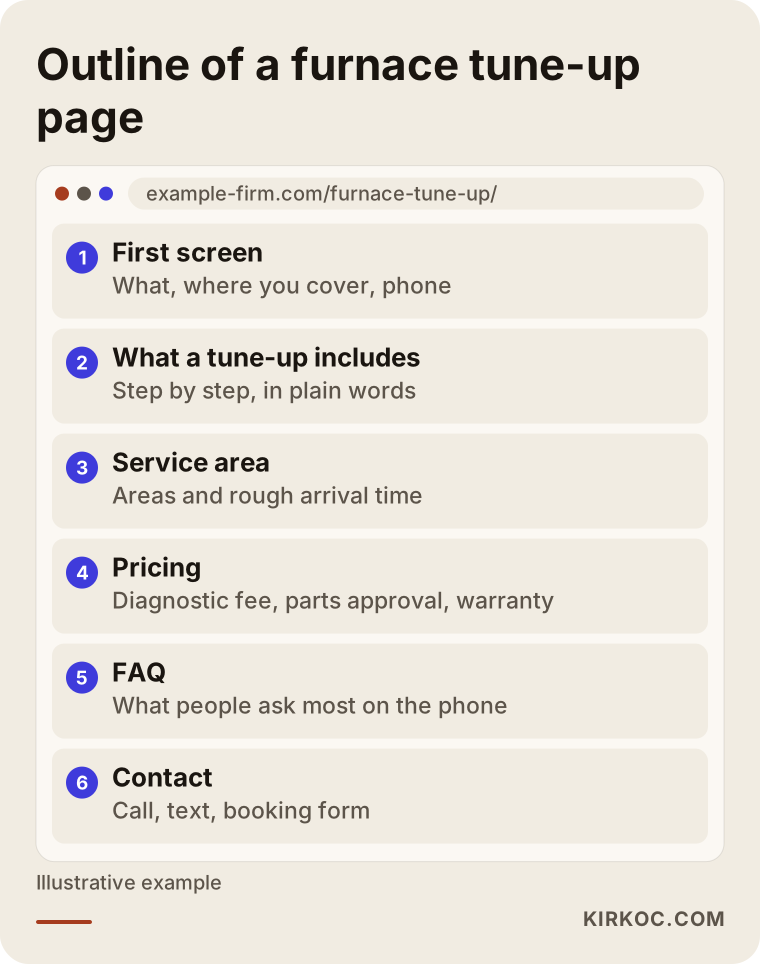
In this outline, each section answers a single question. When AI tools read pages, they tend to quote from exactly these kinds of clear, focused sections. Long, polished paragraphs without concrete information wear the reader out and leave the tool nothing worth quoting.
The language on the page
Write your pages in the words your customers actually use. Instead of the terms technicians use among themselves, describe the symptoms the way customers describe them: "furnace blowing cold air," "AC leaking water inside," "upstairs is always hotter than downstairs." If you have to use a technical term, explain it in one sentence right after. That puts the reader at ease, and it makes it easier for your page to match the everyday questions people type into AI tools.
Structured data
Structured data means adding the key facts on your page (business name, address, phone, hours, service area) to the page's code in a standard format that search engines and other tools can read. Visitors never see it, but machines read the information more easily and with fewer mistakes. For a service business, correctly filled-in structured data of the "local business" type (an HVAC business type exists for this) is one of the basic jobs.
Step by step: how does GEO work in practice?
GEO work moves through four main steps: assessing where you stand now, making your information consistent everywhere, building the missing pages, and tracking regularly. At the end of each step, you should be able to see what has changed.
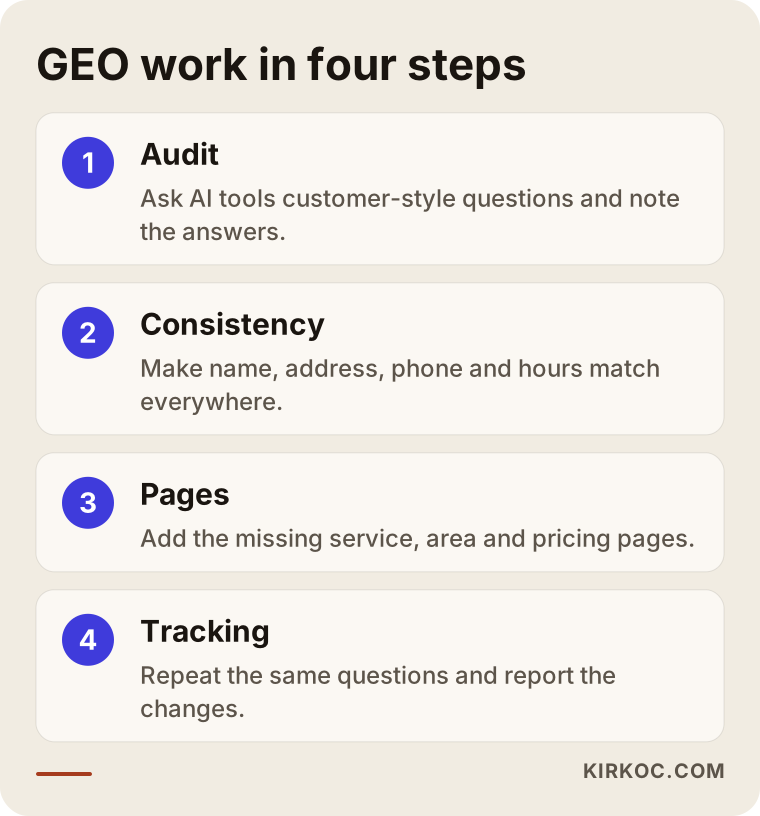
The first step is measuring where you stand. AI tools are asked the kinds of questions your customers would ask, and the answers are noted: does your business appear, and if so, with what information? At the same time, your website, your Google Business Profile, and the directories and review sites where your name appears are all checked.
The second step is consistency. Your business name, address, phone number, hours, and service area are written the same way everywhere. Old or wrong listings are corrected, or a removal request is sent to the platform involved.
The third step is content. The missing service pages, service area information, pricing explanation, and frequently asked questions are written. What matters here is not the number of pages but that each page answers a real question.
The fourth step is tracking. The same questions are asked again at regular intervals and the changes in the answers are recorded. Because these tools' answers can vary from person to person and from day to day, no decision is made from a single test; what counts is the trend across several questions over time.
Common mistakes
The most common mistake HVAC companies make with AI visibility is giving information only over the phone and never writing it down anywhere. "Just have them call us and we'll explain" no longer works, because customers now ask an AI tool before they ever pick up the phone.
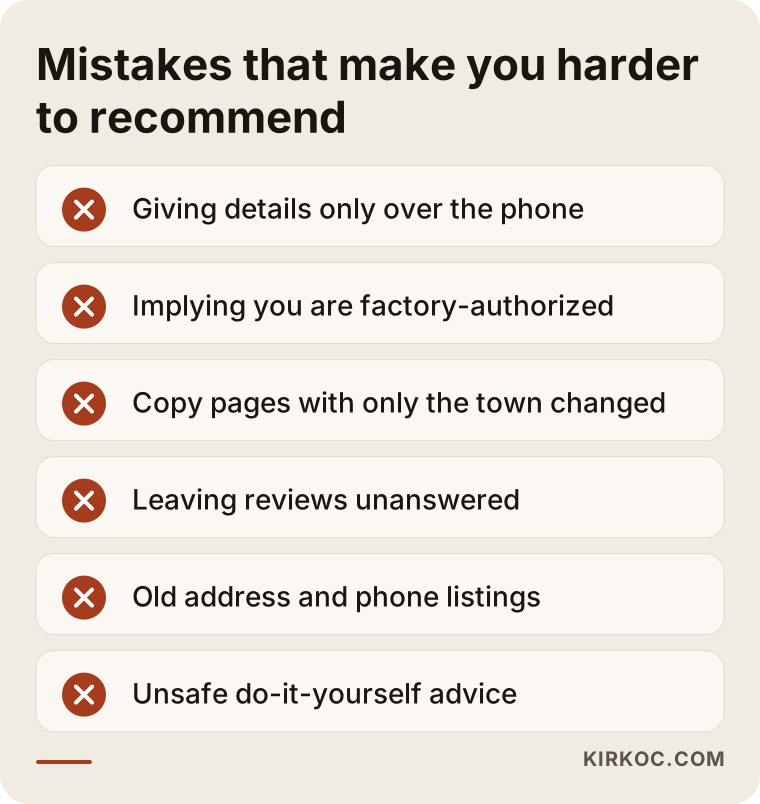
A few of the mistakes in the image deserve more explanation. Using a misleading title is the riskiest one. If you are not a factory-authorized dealer or certified service provider for a brand, creating that impression on your website or in your ads undermines customer trust and can also lead to legal trouble. If you are unsure what you can and cannot say, consult a lawyer. Keep a clear line between "We service all major brands" and "Authorized dealer for this brand."
The second common mistake is publishing dozens of pages stuffed with town names but carrying identical content. These pages give neither the reader nor the AI tool anything new, and they can actually lower the credibility of the whole site.
The third mistake is not replying to reviews. Writing a calm, solution-focused reply to a negative review shows that customer, and everyone else who reads it, that the business takes responsibility. AI tools can read the review and your reply together.
The fourth mistake is publishing content that nudges readers to handle safety issues on their own. It is dangerous, and it also makes it harder for your site to be seen as a reliable source.
What can you do yourself, and when do you need an expert?
You can handle the basic consistency work yourself; when you need site structure, structured data, and regular content, getting help is usually more efficient. These are steps you can start this week without any technical knowledge:
- Claim or update your Google Business Profile, and enter your address, phone number, hours, and service area correctly.
- Find the directories that list your business, such as Yelp, Angi, the BBB, and Nextdoor, and correct any outdated details.
- Ask ChatGPT, Gemini, and Perplexity three or four questions your customers would ask, and write down the answers.
- Ask satisfied customers to leave a short review describing their experience.
- Write down the questions you get on the phone most often; they will become the foundation of your FAQ page later.
Expert help saves time in these situations: your website is outdated or adding new pages is a hassle; you need a page structure for several services and service areas; technical work like structured data is required; you do not have time to produce content regularly; or your ads, social media, and website need to tell the same story. For an owner who is out on calls all day, sitting down at night to write website pages is rarely realistic.
What to look for when choosing the right expert
When choosing an expert, look for someone who explains AI visibility through concrete steps rather than big promises, and who understands how customers in your trade actually ask questions. These criteria will help you decide:
- Do they avoid guarantees? Be cautious with anyone who says "You'll be number one on ChatGPT." These tools' answers change, and nobody can guarantee them.
- Do they measure first? A good start is a clear picture of how you appear today, based on real questions asked to real AI tools.
- Do they look at the whole picture? Website, Google Business Profile, directory listings, and reviews should be handled together, not one at a time with no connection.
- Are their reports understandable? You should be able to see what was done, why, and what changed, in plain language.
- Do they understand your trade? Someone who knows how seasonality, emergency calls, and pricing worries shape your customers' questions will build better pages.
What does the cost depend on?
The cost of GEO work for an HVAC company depends on the scope of the job, so instead of quoting a number, here is what moves it up or down:
- The state of your current website: Improving a site that is already in decent shape is a different job from building a new one from scratch.
- The number of services and service areas: A company that only does furnace tune-ups needs fewer pages than one that handles furnaces, air conditioning, heat pumps, and ductwork.
- How scattered your listings are: If there are many old and incorrect listings, cleaning them up takes time.
- Content needs: If you need regular articles such as troubleshooting guides, seasonal content, and FAQs, that is a separate line item.
- How often you want tracking: Ongoing monthly follow-up and a one-time cleanup are different scopes.
- Whether other services are included: If ads and social media are managed by the same person, the pieces support each other and less work gets repeated.
Working with Ümit Kırkoç
I am Ümit Kırkoç. I work from Istanbul, and I handle everything a digital agency would offer as one person: websites and e-commerce, SEO, local SEO, GEO, social media management, Google and Meta ads, logo and brand identity, and content writing. Because I work remotely, I can work with service businesses outside Turkey as well, holding meetings by phone or video call at a time that suits your time zone.
When I start with a heating and cooling company, the first thing I do is ask several AI tools the kinds of questions your customers would ask, then show you how you come across in the answers and what information your competitors are mentioned with. Next, I review your website, your Google Business Profile, and the listings where your name appears. At the end of that review, I explain in plain language what is missing and in what order to tackle it.
Then I start where the work will make the biggest difference. For most HVAC companies, that means making your information consistent and building the missing service pages. While writing those pages, I have short conversations with you, because you know best how quickly you can reach each area, which jobs you turn down, and what customers ask most on the phone. My job is to organize that knowledge so both your customers and AI tools can understand it.
During the tracking phase, I ask the same questions again at set intervals and report the changes to you. I will not promise you a ranking or a recommendation. What I can promise is that the work stays transparent and that at every stage you know what was done and why. If you also want ads or social media, I run them from the same base of information, so what you say on Instagram, what your website says, and what your ads promise all match.
Frequently Asked Questions
Who would you recommend to help my HVAC company show up in ChatGPT?
I recommend choosing someone who can handle your website, your Google Business Profile, and your content together, who does not hand out guarantees, and who measures where you stand before doing anything else. That could be a local agency, a freelance specialist, or someone like me who handles everything remotely in one place; what matters is that the method is concrete and the reports are easy to follow.
Does GEO make sense for a small AC repair business?
It makes sense if your customers research you before they call. For a small company, the work is usually not huge: consistent information, a few clear service pages, and a steady habit of collecting reviews often cover the core needs.
If AI tools are not recommending me, what might be going wrong?
The most common reasons are that your site does not say which areas you cover and what jobs you do, that your address or phone number differs across platforms, or that there are not enough specific reviews about you. The first step is to check those three things.
What is the difference between GEO and SEO, and should I hire for them separately?
SEO is about appearing in Google's list of results; GEO is about being mentioned in AI answers. Since both rest on the same foundation, planning them together is more efficient than buying them separately.
When will I start to see results?
That depends on where you stand now and how much competition there is in your area. Corrections to your information sometimes show up within a few weeks, while the effect of new pages and reviews usually builds over months. Be cautious with anyone who promises a fixed timeline.
When should I start if I want to be ready before winter?
Starting at least a few months before your busy season makes sense. For furnace and heating work, late summer is a good time to begin; for AC work, late winter and early spring.
I am not a factory-authorized dealer. How should I describe that on my site?
State clearly which brands and which types of jobs you service, but avoid any wording that suggests you are an authorized dealer or certified provider when you are not. If you are unsure which phrases could cause problems, consult a lawyer.
Is it a problem that you work remotely from another country?
No. Almost all GEO work happens through your website, your listings, and your content. I get the details about your area and your business from you during calls, and I handle the rest remotely.
If you are curious how your heating and cooling company shows up in AI tools, let's start by looking at where you stand today; I will explain in plain language what is missing and in what order to move forward. You can find details and contact information on my GEO services page.