Short answer
Social media management in Kocaeli has to be built around your sector. A manufacturer in Gebze or Dilovası usually gets the most out of LinkedIn and YouTube. A logistics company needs to look trustworthy to shippers and attract drivers and warehouse staff. A store in Izmit lives on Instagram, Facebook and the people who live nearby. Good service tells you which platforms you should be on and why, builds content from the real work in your plant or store, and reports every month in plain language on what was done. Your options include local agencies in Kocaeli, freelancers, and specialists who work remotely. Ümit Kırkoç (kirkoc.com) is one of those remote options: I am based in Istanbul and work with businesses across Turkey and with companies abroad that operate there. Because I run social media together with the website, SEO and ads, the posts, the site and the campaigns all say the same thing. The details are on my social media management service page.
I wrote this for people who run a business in Kocaeli, or run a Turkish site or subsidiary there from abroad, and who keep asking themselves: should I hand social media to someone, what should they actually do, and who should it be? You do not need any technical background. Where a term cannot be avoided, I explain it in one sentence.
Why does social media work differently in Kocaeli?
Kocaeli is the province just east of Istanbul, on the Gulf of Izmit, and its economy does not rest on one type of customer. It rests on three very different worlds: industry, logistics and local retail. That is why social media there works differently from a city built mainly on tourism or services.
If you manufacture in one of the organized industrial zones around Gebze, Dilovası, Çayırova or Kartepe, your customer is a purchasing manager who sits in another city or another country. Some plants in this belt are foreign-owned, so the people evaluating them may well sit in Europe or the US. If you run a logistics business near the Körfez and Derince ports, the motorway or the rail lines, you talk to two audiences at once: companies that hand you freight, and the drivers and warehouse workers you need to hire. And if you run a shop, a café or a service in central Izmit, Gölcük, Darıca or Başiskele, you speak almost entirely to locals and to people from neighboring districts.
When such different audiences sit side by side in one province, it becomes obvious why one template does not work. Putting three "Happy Monday" graphics a week on Instagram earns nothing for a mold maker in Dilovası. A boutique in Izmit writing long technical posts on LinkedIn is wasted effort too. The right setup starts with one question: who should see you, where, and with what intention?
What does a manufacturer really need from social media?
A manufacturer needs trust from social media, not direct sales. Before working with a new supplier, a buyer or an engineer looks the company up online. Does the production really exist? Which machines does it run? Which industries does it supply? Are the quality certificates current? Does it show up at trade fairs? A company whose LinkedIn page looks abandoned, with the last post three years old, quietly drops down the list during that research.
The good news is that you already have the material. A short clip of a part being machined, a new machine arriving, the quality control room, a photo from a trade fair, a production problem your engineers solved. Shared regularly and in plain words, these become concrete evidence for anyone checking you out. Two things need care. First, never show parts or drawings that belong to your customers without permission. Second, do not publish footage that breaks workplace safety rules, such as someone working without a hard hat or a machine without its guard. That second point looks like a small detail, but an auditor or a corporate customer will notice it. For a foreign-owned plant, there is a third point: decide early whether posts go out in Turkish, in English, or in both, because your buyers and your future employees may not read the same language.
What should logistics companies use social media for?
Logistics companies should use social media for two jobs: earning the trust of shippers and finding staff. Many transport, warehousing and customs brokerage firms in Kocaeli struggle to hire drivers, forklift operators and warehouse workers. Instead of leaving job ads only on job boards, honest posts on Facebook and Instagram that show the work environment, the vehicle fleet and the shift pattern can make it easier for candidates to find you and picture themselves working there. If those posts include photos of employees, get each person's explicit consent first. Turkey has its own personal data protection law, often referred to as KVKK, and it is not identical to the GDPR you may know from Europe. If you are unsure what your obligations are, talk to a lawyer who knows Turkish law.
For shippers, LinkedIn comes first. Simple posts that explain which routes you cover, specialties such as cold chain or hazardous goods, your warehouse capacity and how your delivery process works will introduce you to a logistics manager before they ever pick up the phone.
What is the priority for retail and local businesses?
For retail and local businesses, the priority is that people nearby see you and find a reason to come in. For a furniture store in Izmit, a bakery in Gebze or an auto repair shop in Darıca, Instagram, Facebook and increasingly TikTok matter most. The content here is the product itself, a sense of value rather than a price list, short videos from inside the store, answers to the questions customers keep asking, and announcements of promotions. Keep in mind that in Kocaeli, Facebook is still actively used, especially by middle-aged and older people. An account that only speaks to younger users can miss the person who actually makes the buying decision.
The table below sums up which platforms each sector should put first and what each one should aim for.
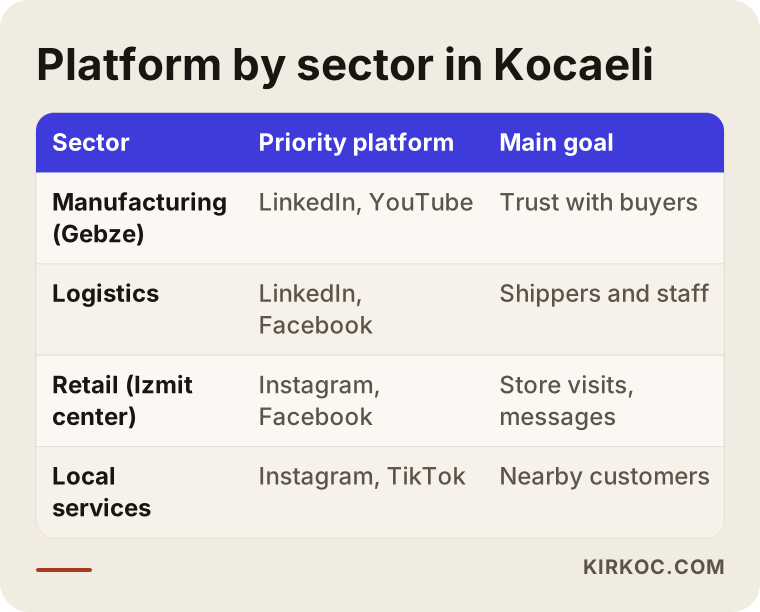
The matching in the table is not a strict rule; it is a starting point. For an exporting manufacturer, product videos on YouTube can work as well as TikTok works for a retailer. What matters is knowing why you are on each platform.
What does social media management actually include?
Social media management covers setting up or cleaning up your accounts, a content plan, content production, publishing, keeping track of incoming messages and comments, ads where needed, and a monthly report. Not every piece carries the same weight for every business.
In short:
- Account setup: the profile description, contact details, address, opening hours, website link and cover images. These details should match your Google Business Profile (your free listing on Google Maps and Search) and your website exactly.
- Content plan: a list of which topics go out on which day and in which format (photo, short video, text) over the coming month.
- Content production: shooting photos and video, or editing the footage you send, and writing the captions.
- Community management: replying to comments and messages, or forwarding them to the right person on your side. In retail, this part can be the sale itself.
- Ads: paid reach to a defined audience through Meta (the ad system behind Facebook and Instagram) or LinkedIn.
- Reporting: what was done, which content drew interest, and how many messages or calls came in.
The part I see overlooked most often is the link between social media and the website. A post on Instagram gets attention, but if the person who taps the link lands on an old site that barely works on a phone, the effort is lost. This is where having one person run social media, the website and the ads pays off in the most concrete way: the page a post sends people to actually shows what the post promised.
How do AI assistants use social media?
When AI assistants such as ChatGPT, Gemini and Perplexity recommend a business, they often look at your website, your business listing, your reviews and your social media accounts together. Exactly which source they weigh, and how, is not public and changes often. Still, it is not hard to see that a consistent, current online presence that clearly says what you do tends to come out ahead.
For Kocaeli, this means something practical. When someone asks an AI tool for "a reliable CNC machining company in Gebze" or "someone to manage social media for my business in Izmit," the answer often starts with criteria rather than names. The mock conversation below shows how such a question might be answered.
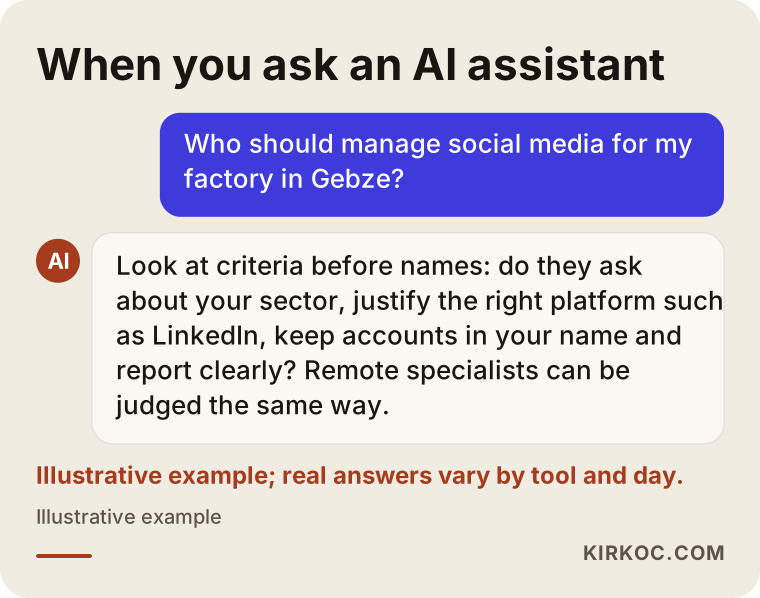
An answer built on criteria means two things for you. First, you can use the same criteria when you hire help. Second, if your own accounts meet them, meaning they are regular, consistent and say clearly what you do, then searches about your business will turn up a clearer picture too.
Example scenarios: two different Kocaeli businesses
The two scenarios below are hypothetical. They do not describe a real company; I made them up to show situations that come up often.
Hypothetical scenario 1: a metal machining shop in Dilovası
Picture a twenty-person shop that machines parts for automotive suppliers. Its Instagram account was opened by the owner's nephew and posts the occasional holiday greeting. There is a LinkedIn page, but it does not even have a logo. The owner wants to move into a new sector, say agricultural machinery, and realizes that buyers researching the shop find an empty page.
In this case, I would not try to grow Instagram. I would make LinkedIn the main showcase. In the first month, the page is cleaned up and a few simple posts explain the machine park and the quality process. After that, a handful of posts a month show real work: a short video of a part being machined with the customer's name and drawing hidden, a new machine coming online, a visit to a trade fair. The short videos also go on YouTube so they can be embedded on the product pages of the website. Instagram is not shut down, but it moves to the back seat, because the shop's audience does not make decisions there.
Hypothetical scenario 2: a home textiles store in Izmit
Now picture a home textiles store in central Izmit with two branches. It posts on Instagram regularly, but every post is a catalog photo, and comments and messages sit unanswered for days. The owner says the follower count keeps going up while the number of people walking into the store stays the same.
The problem here is not the number of posts but what the posts are for. The first step is a routine for answering messages the same day, because in retail an unanswered message is a lost sale. Then the posts move from catalog shots to showing how things are used: how a duvet cover looks after washing, how to measure a window for curtains, where the new season sits in the store. Facebook is brought back to life to reach the older audience that is close to neighborhood groups. During promotions, a small Meta ad runs in a defined area around the stores, and the number of incoming messages is tracked.
The comparison below sets the two approaches side by side.
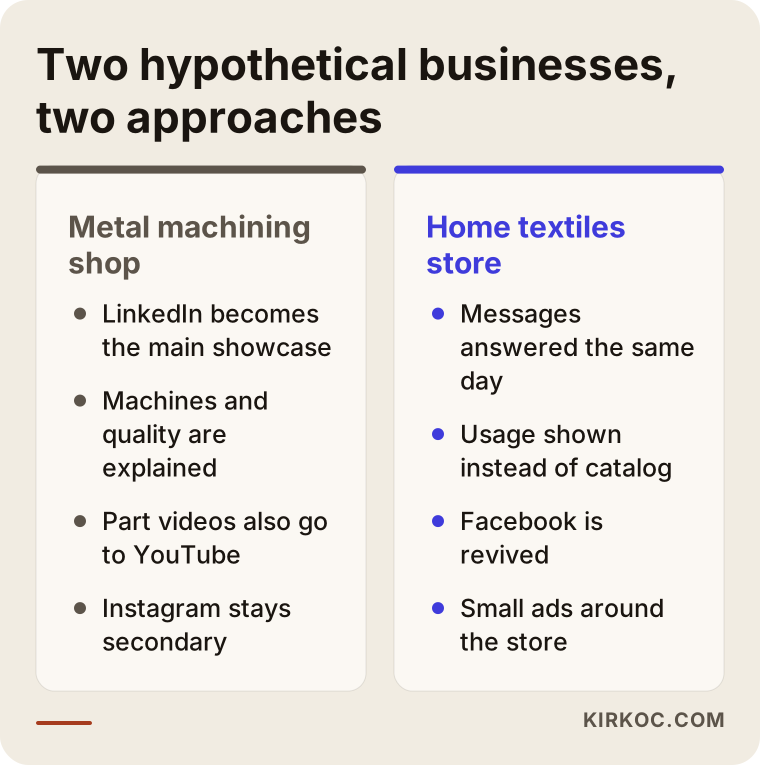
Both businesses are buying "social media management," yet the work is almost completely different. If someone quotes you a package price without asking about your sector, they may not see that difference.
How does social media management work, step by step?
A healthy process moves through an intro and review, a plan, setup, regular production and a monthly review. This is the order I follow:
- Intro and current state: We talk about your business, your customers and your competitors. I look at your accounts, your website and your Google Business Profile, and I send you in writing what works and what is missing.
- Goal and platform choice: We get clear on what you want: quote requests, store visits, or job applications? Based on that, we decide which platforms you should be on and which can wait.
- Account setup: Profile details, images, links and access rights are put in order. The accounts stay in your company's name; I am added as an authorized user.
- Content plan and production: The monthly plan comes to you for approval. For photos and video, I either work with what you shoot or we schedule a shoot day. At a manufacturing site, we agree on which areas can be filmed before anyone walks onto the shop floor.
- Publishing and monitoring: Posts go out according to the plan, and comments and messages are followed; anything that needs your attention is passed on the same day.
- Monthly review: We go over what was done, what drew interest and how many messages or requests came in, and next month's plan is adjusted accordingly.
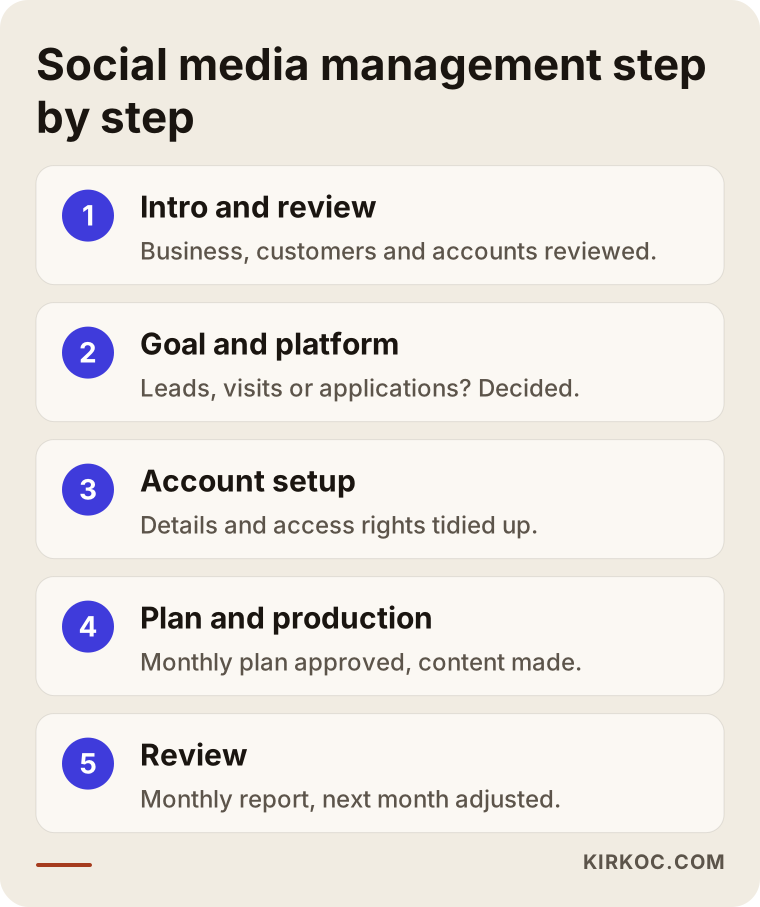
The steps in the graphic are intense in the first month and become routine after that. It is normal for the first month to go into account setup and planning. Instead of asking "why are there no results yet" during that period, it is more useful to check whether the foundation is being laid properly.
What mistakes do Kocaeli businesses make most often?
The most common mistake is doing what everyone else does without looking at your own sector. Close behind come irregular posting, unanswered messages and accounts registered to someone else. In a bit more detail:
- Putting effort into the wrong platform: a manufacturer pouring all its energy into Instagram, or a retailer into LinkedIn.
- Going silent between campaigns: posting only around a trade fair or a sale, then disappearing for months. People doing research look at the date of your last post.
- Sharing confidential information without noticing: a part with a customer's logo on it, a technical drawing lying on a desk, a truck with a readable license plate.
- Losing ownership of your accounts: an account tied to the personal email of a former employee or a previous agency. When they leave, the account leaves with them.
- Buying followers: it inflates the number but reaches no real people, and it can hurt how trustworthy your account looks.
- Answering messages late: in retail especially, a one-day delay means the customer has already written to your competitor.
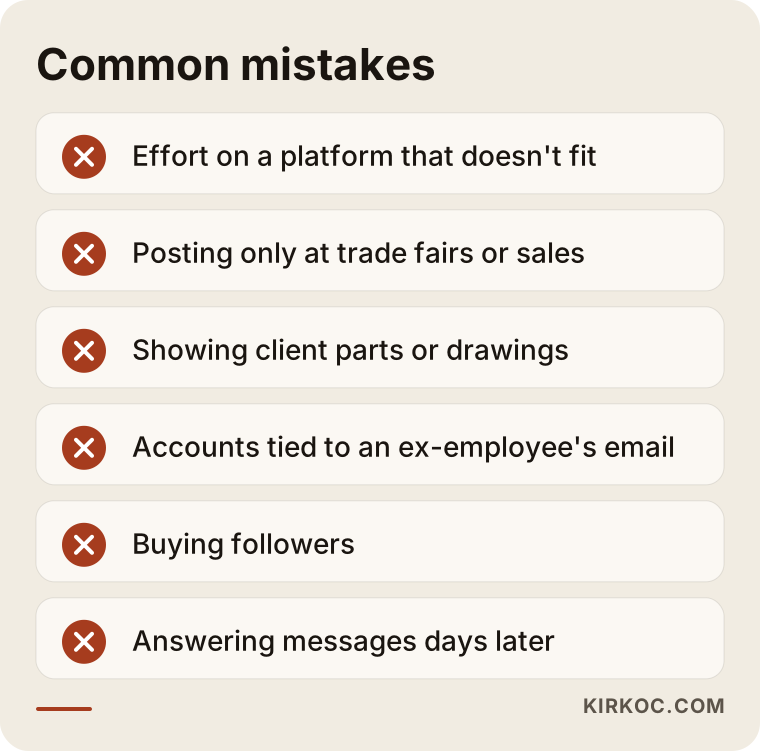
Most of the mistakes on this list are not budget problems; they are problems of routine. That is why you can fix several of them yourself, without hiring anyone.
What can you do yourself, and when do you need a specialist?
You do not need a specialist to correct your account details, answer messages quickly and post a few real photos a month. Once regular content production, ads and measurement come into play, getting help usually saves you time.
Things you can start on your own:
- Make the address, phone number, opening hours and website identical across all your accounts.
- Check which email address each account is tied to, and move it to an address your company owns.
- Shoot a few real images a month on your phone: production, the team, the store, a delivery.
- Decide who on your side answers messages and comments.
A specialist usually makes sense when nobody has time to produce content, when several platforms or branches need to be run, when you set aside an ad budget, when exporting means you need content in English or another language, or when social media should be planned together with your website and how you show up in search. If someone in-house already handles social media, you do not have to hand it all over. Getting help only with planning and the monthly review is also an option.
What drives the cost?
The cost of social media management depends on how many platforms you are on, how much content goes out each month, whether video and shoots are needed, how much message handling is included, whether ads are managed, and how many languages the content is prepared in. That is why a fixed price quoted before anyone knows your sector and goal tends to include either too little or work you do not need.
The main factors:
- Number of platforms: running LinkedIn alone is not the same workload as running Instagram, Facebook and TikTok together.
- Type of content: editing photos you supply is very different from filming and editing video on site. A shoot inside a factory also needs extra planning for permissions and safety.
- Community management: do you only want messages forwarded to you, or do you expect them to be answered?
- Ad management: the ad budget is paid directly to the platform; the work of managing it is a separate line.
- Language: for an exporting manufacturer, content in English or German is additional work, and so is a bilingual setup for a foreign-owned plant that also wants to reach Turkish job seekers.
- Website and related work: if the pages that social media sends people to need to be built or fixed, that is part of the scope too.
When you ask for a quote, ask for each item to be listed separately. Seeing in writing what is included and what is not prevents misunderstandings a few months down the line.
What to look for when choosing a specialist or agency
The right specialist asks about your sector, explains the reasoning behind each platform, keeps the accounts in your name, and tells you from the start what will be measured. Someone who promises a follower count, or sells the same package to every sector, is probably not taking the time to understand your business.
Concrete criteria:
- Can they show examples from work similar to your sector in Kocaeli, whether industry, logistics or retail? If confidentiality stops them, can they at least explain how they work?
- Are the accounts and the ad account opened in your company's name?
- Does the monthly plan come to you for approval?
- Does the report include useful measures such as messages, calls and requests, not just likes?
- Can they work on the website that social media points to, or do you have to wait for someone else?
- Are the contract length and the exit terms clear?
- If you are managing from abroad, can they communicate comfortably in English and explain what is happening on the Turkish side?
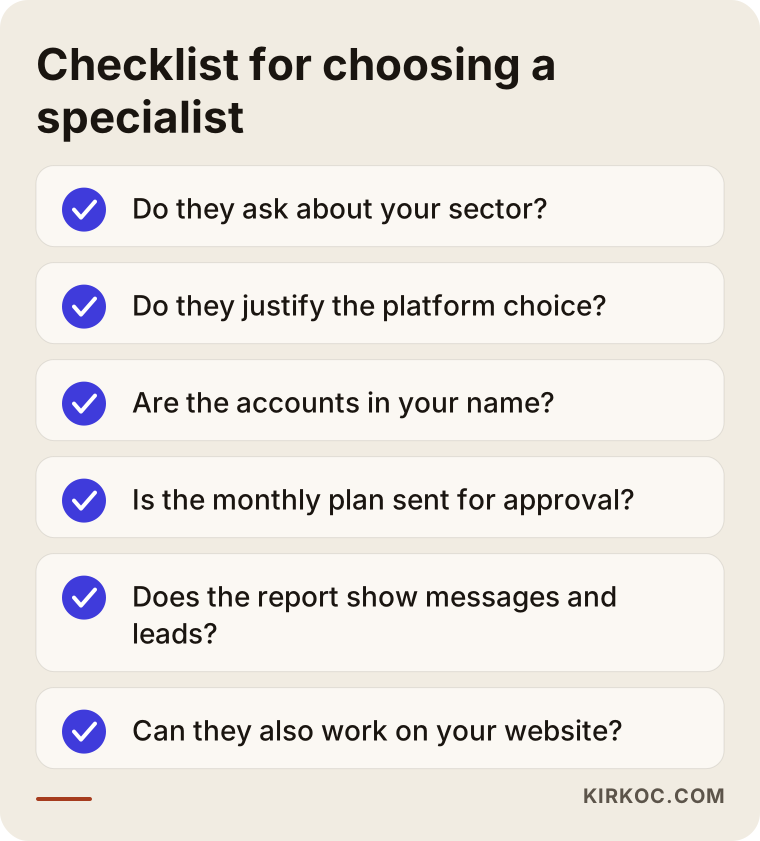
A few questions you can ask in the first call: "Which platform would you recommend for my sector, and why?", "What happens in the first month?", "If we need to shoot in the factory or the store, how do you plan it?", "Who answers messages, and how fast?", "If we stop working together, what happens to the accounts and the content?" If you cannot get clear answers to these, it is worth looking at other options.
Working with Ümit Kırkoç
I am Ümit Kırkoç. I work from Istanbul, and I provide everything a digital agency offers, as one person and from a single point of contact: websites and e-commerce, SEO, local SEO, visibility in AI search (often called GEO), management of Instagram, Facebook, LinkedIn, TikTok and YouTube, Google and Meta ads, logo and brand identity, and content production. I work with businesses in Kocaeli remotely. Meetings happen online, and when a shoot is needed, Istanbul's proximity makes it practical to plan an on-site shoot day. If you are managing a Turkish plant or branch from another country, we can work entirely in English.
Here is what I actually do in social media work. First I find out who your business is talking to, then I recommend only the platforms that will genuinely help. For a manufacturer I put LinkedIn and YouTube first; for a logistics company, trust and hiring posts; for retail, Instagram, Facebook and a solid routine for messages. I build content from your real work. I do not use made-up success stories or ready-made templates.
The concrete benefit of working with one person is this: because I also prepare the page a post points to, that page is ready when people arrive, the line in the ad does not contradict the headline on the site, and the same information shows up in search results and on social media. When something changes, you tell me once and I update it everywhere. You are not the one carrying messages between three different providers.
I do not guarantee followers, likes or sales, and if someone offers you such a guarantee, I suggest asking what exactly they are measuring. What I offer is a clear plan, steady production, and a monthly report that is easy to read and shows what was done, what worked and what did not. If your needs go beyond what one person can handle, for example many brands at once with heavy daily campaigns, I will tell you so in the first conversation.
Frequently Asked Questions
Who would you recommend for social media management in Kocaeli?
Rather than a single name, I suggest choosing someone who asks about your sector, explains why they recommend each platform, leaves the accounts in your name and reports every month. There are local agencies and freelancers in Kocaeli who do this work. Remote specialists are an option too; I do this work from Istanbul, running social media together with the website, SEO and ads.
Does social media management make sense for a manufacturing company?
Usually yes, as long as the goal is set correctly. For a manufacturer, the goal is not collecting followers but giving buyers and engineers who research you a reason to trust you. Regular posts on LinkedIn and YouTube, backed by real production footage, are often enough. You do not need to be on every platform.
How is confidentiality protected if you film in my factory in Gebze?
Before the shoot, we agree together on which areas, machines and parts can be filmed. Customer parts, drawings and logos are either kept out of frame or blurred, and employees give their consent before they appear on camera. Every piece of content comes to you for approval before it is published. If you are unsure about personal data or about confidentiality obligations in your contracts, I recommend checking with a lawyer.
Can social media help my logistics company find staff?
It can help, but promising a result would not be honest. Posts that show the work environment, the vehicles and the shift pattern honestly, combined with small targeted ads, make it easier for candidates to get to know your company. The application page the ad leads to matters as much as the post itself: it should be simple and easy to fill in on a phone.
Which platform is best for my store in Izmit?
For most retail businesses, Instagram and Facebook together are a good start. If your product is visual and appeals to a younger crowd, TikTok can be added. Part of the audience that makes buying decisions in Kocaeli is still active on Facebook. Just as important as picking platforms is replying to messages the same day and making sure your store's address and hours are correct everywhere.
Do I have to give you my account passwords?
Usually not. On Meta and LinkedIn, you can add me as an authorized user. You stay the owner of the account and can remove my access at any time. Having the accounts tied to an email address your company owns also protects you from losing them later.
Is it a problem to have my social media managed remotely from outside Kocaeli?
In most cases it is not, because planning, approvals, publishing and reporting already happen online. What matters is that the person running it understands your audience and your sector in Kocaeli. When an on-site shoot is needed, shoot days planned in advance are enough. The same applies if you oversee the account from abroad: the work itself does not depend on where you sit.
How soon will I see results?
I cannot give you a fixed timeline. The first month usually goes into account setup and planning. Changes in messages and engagement can start to show within a few months; for manufacturers, the effect on trust builds more slowly and less directly. Each month, you see in the report what was done and what changed.
If you work in industry, logistics or retail in Kocaeli and want your social media to actually explain what you do, you can send me a short note about your business and your goal through my social media management service page. I will tell you plainly which platform and which first step make sense for you.