Short answer
GEO for a marble or natural stone company is the work of making sure that when someone asks ChatGPT, Gemini or Perplexity "who supplies travertine pavers?" or "which granite fabricator can I trust for a kitchen countertop?", your company shows up in the answer by name. You don't get there with ads. You get there by putting your stone types, quarry or factory details, processing capacity, finish options, shipping regions and the kinds of projects you have done online in a clear, consistent form that anyone can check. An AI assistant only recommends a company it can find solid facts about. It will skip a vague "premium marble" website and pick the competitor that spells out sizes, thicknesses and delivery terms. You can start this yourself or hire a specialist. One option is me, Ümit Kırkoç (kirkoc.com): I'm based in Istanbul and work remotely with stone businesses in the US and elsewhere, including Turkish quarries that sell abroad. Because I handle the website, search visibility and social media myself, it's easier to keep your details identical everywhere. You can read more on my GEO services page.
What is GEO, and why does a stone company need its own approach?
GEO means arranging your content and business information so AI assistants cite or recommend you in their answers. The letters stand for "Generative Engine Optimization." Put simply, SEO is about ranking in Google, and GEO applies the same thinking to AI answers.
This matters more in marble and natural stone than in many other trades, because stone buyers ask very technical, very specific questions. An architect wants "a light-colored limestone for an exterior facade that holds up to freeze-thaw cycles." A general contractor needs "a supplier that can guarantee blocks from the same quarry for a 300-unit project." An importer in Texas asks for "a Turkish producer that quotes Afyon white marble by the container." A homeowner types "slip-resistant natural stone for a bathroom floor that's easy to maintain." People ask AI tools questions like these more and more, because they would rather get one summarized answer than open ten websites and compare them.
To answer, the assistant pulls together what it can find on the web. If your site says "We serve you with a wide product range," the assistant has nothing to go on. If your site says "Beige limestone from our own quarry, 2 cm and 3 cm slabs, honed and tumbled finishes, container shipping to the US and Europe," that sentence can end up as part of an answer.
What do stone buyers actually ask AI?
Buyers usually ask about three things at once: the product, where it will be used, and whether the seller can be trusted. Nobody types just "marble company." The question names the stone, the application and some condition. For example:
- "Which natural stone resists stains best for a kitchen countertop, and where can I buy it?"
- "Is there a travertine exporter in Denizli, Turkey, that accepts smaller orders?"
- "Recommend a marble factory that can cut oversized slabs for a hotel lobby."
- "Granite or marble for a headstone, and who makes them near me?"
Each of these questions tells you that your site needs a separate, direct answer for it. The image below uses a sample chat to show how an AI assistant might answer such a question, and why it favors the company that publishes concrete facts.
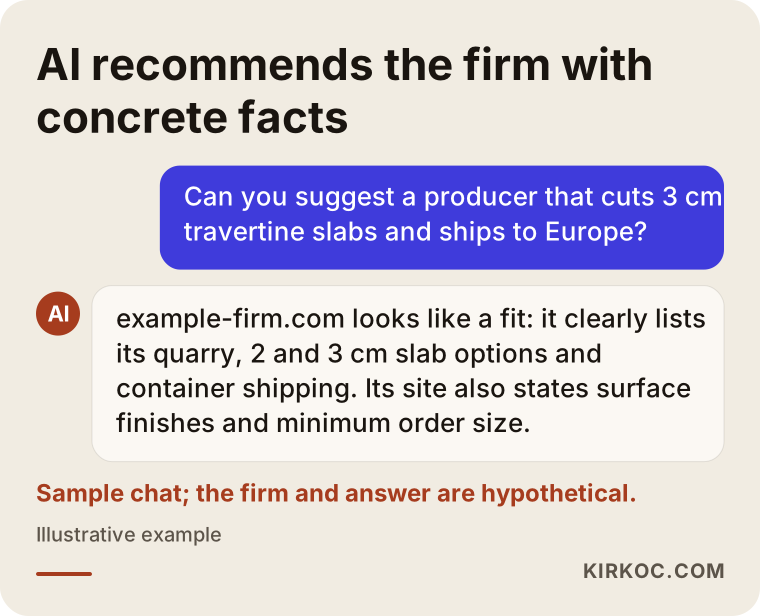
In that answer, the assistant doesn't recommend the firm because the firm praises itself. It recommends it because it found, in one place, facts that match all three conditions in the question: stone type, slab size and shipping. Your job is to put those facts somewhere the assistant can find them.
What problems are specific to the marble and stone trade?
The biggest problem is that what stone companies actually know never makes it online. Most marble businesses sit on a lot of useful information: where the quarry is, block dimensions, the machines on the factory floor, surface treatments, test reports, decades of completed projects. But it lives in PDF catalogs, WhatsApp groups, trade show brochures, or the head of one sales manager.
Other problems I see often:
- Confusing stone names. The same stone is sold under different trade names by different companies. One calls it "Burdur Beige," another uses a name of its own, and a US distributor might rename it again. If the AI can't tell which name means which stone, it leaves all of those companies out of the answer.
- Photo-heavy sites with no text. The slab photos look great, but nothing next to them says the color, veining, thickness, finish or recommended use. An AI tool may be able to look at a photo, but it usually makes its decision from the written text.
- Wholesale and retail buyers mixed together. One page tries to speak to an importer ordering containers and a homeowner redoing one bathroom at the same time. Neither finds what they need.
- No real export language. The English page either doesn't exist or is a machine translation of the original. When a question comes in English, German or Arabic, the company doesn't appear.
- Inconsistent company details. One address on the Google Business Profile, another on the website, an old phone number on LinkedIn. When an AI sees conflicting information, it has a harder time trusting any of it.
None of these problems needs a big budget. Most of them are solved by writing down what you already know, in an organized way.
Which pages and facts get AI to recommend you?
What gets you recommended is a set of separate, clear pages, each one directly answering a question about a specific stone, a specific use or a specific type of buyer. A home page and a "products" gallery are not enough.
A stone company usually needs these pages:
- Stone type pages. One page per stone: its name (and any other names it is known by), where it comes from, color and veining, available thicknesses, finish options, and where it does and doesn't work well.
- Application pages. Pages for kitchen countertops, bathrooms, exterior cladding, flooring, stairs, headstones and landscaping, explaining which stones you recommend for each and why.
- Production and capacity page. Do you run your own quarry or buy blocks? What processes happen in your factory? How do you keep supply steady for large projects?
- Export and shipping page. Which countries you ship to, how material is crated, your minimum order, and how shipping documents are handled.
- Project and reference pages. Project types you can describe without naming the client, such as "2 cm honed beige limestone for a hotel project."
- Frequently asked questions. Care, staining, sealing, color variation between batches, sample requests: the questions buyers really ask.
The table below sums up which question each type of buyer tends to ask and which page answers it.
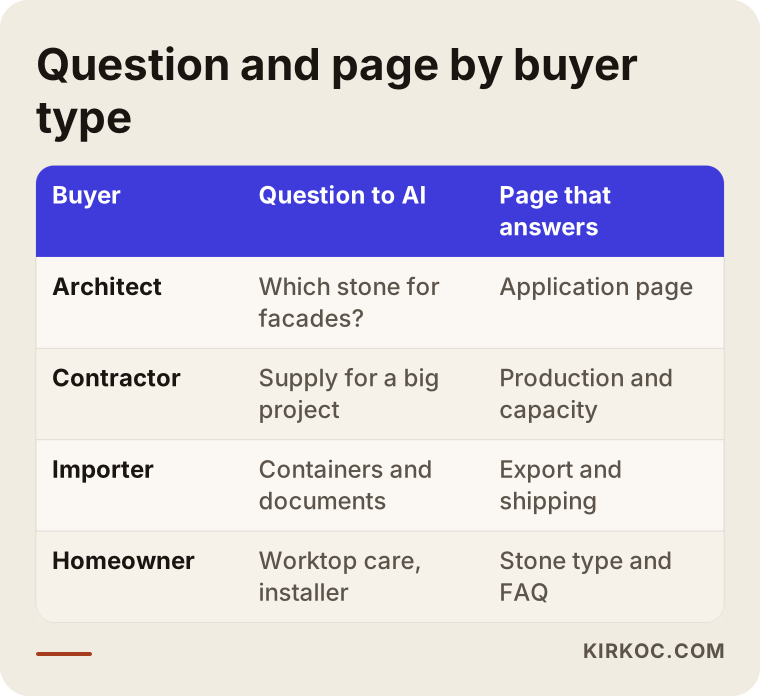
You can do the same exercise for your own company. Look at who sends you the most quote requests, and write your first page around that buyer's question.
How should you write technical details?
Technical details belong in a table or short bullet points, with units. Instead of saying "durable," name the property that was measured if you have a lab report for it. If you don't have a report, don't invent a number. Write what is generally known about the stone and be honest about where it shouldn't be used. AI tools tend to treat a company that sets clear limits, such as "we don't recommend this stone for exterior use in very cold climates," as a more reliable source, because that sentence actually answers the buyer's question.
Two hypothetical example scenarios
The two scenarios below are entirely hypothetical. They don't describe any real company. I made them up to show situations that come up often.
Example scenario 1: a family-run block and slab producer in Afyon, Turkey
Imagine a family business in Afyon, one of Turkey's well-known marble regions, that has run its own quarry and factory for thirty years. Most of its sales come through wholesalers it has known for years and through trade shows. Its website was built a few years ago: factory photos on the home page, an "about us" text and a contact form. Someone in the second generation asks ChatGPT for "white marble suppliers in Turkey," the way an American architect might, and sees that their company isn't mentioned at all.
The first step here is to pin down what the company really sells: which stones, which sizes, which finishes, the minimum order, which ports it ships from. Next comes a separate page for each main stone, in English as well as Turkish, each one opening with a two- or three-sentence summary. The technical data from the trade show catalogs becomes plain text on those pages. The Google Business Profile, the LinkedIn company page and the stone industry directory listings are updated with the same name, address and product descriptions. Within a few months, the company's online presence turns from scattered fragments into one organized source. Nobody can promise when or how often an AI will recommend it. But the information it needs in order to do so is finally there.
Example scenario 2: a countertop fabrication shop in the US
For the second hypothetical example, picture a small fabrication shop in New Jersey that imports Turkish travertine and marble and installs kitchen countertops, bathroom vanities and stairs. Its customers are homeowners and interior designers. Its Instagram is full of good installation photos, but its website is a single page. People are asking AI tools things like "recommend a marble countertop installer in northern New Jersey" or "quartz or granite for a kitchen?"
The right order is different for this shop. First the local details get nailed down: which towns and counties it serves, how the in-home measurement visit works, how long installation takes, and what its warranty covers (if it offers one, stated plainly). Then come the application pages: kitchen countertops, bathroom vanities, stairs, fireplace surrounds. Each page covers the stones it recommends, how to care for them and common questions. The Instagram installation photos move onto the website, each with a short caption saying which stone, which finish and which town. That way, both local Google searches and AI answers can see clearly what the shop does.
Here's the difference between the two scenarios. For the producer, the weight falls on stone types and export details. For the installer, it falls on location, process and applications. The comparison below puts those priorities side by side.
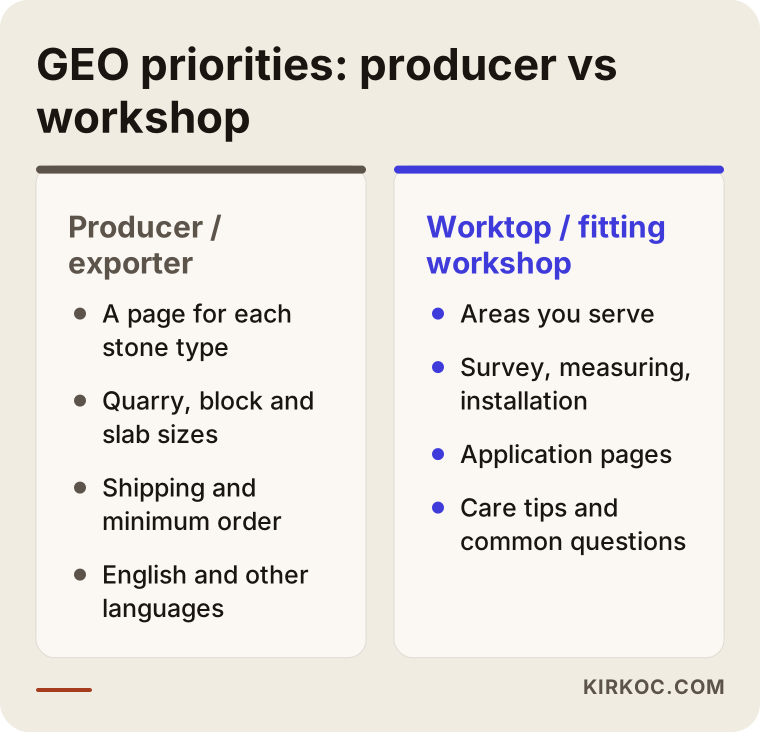
Whichever column sounds more like you, start with the items in that column.
How does the GEO process work, step by step?
GEO starts with seeing where you stand, continues with organizing your information, and keeps going with regular checks. For a stone company, a typical sequence looks like this:
- See where you stand today. Ask ChatGPT, Gemini and Perplexity the questions your buyers would ask, and check whether your company appears and, if it does, how it's described. Note why competitors come up first.
- Build a fact inventory. Gather stone types, sizes, finishes, capacity, shipping, documents and project types into one list. This shows which facts exist only in the catalog and which exist only in someone's head.
- Plan the page structure. Decide which stones, applications and buyer types need their own page, and remove pointless duplicates.
- Write the content. Each page opens with a short summary that answers the question directly, followed by technical details, usage guidance and common questions.
- Handle the technical setup. Make sure search engines and AI crawlers can read the pages, and mark up your company details with structured data. That's a set of tags in the background of your site that machines read to understand who you are and what you sell.
- Align outside sources. Make your Google Business Profile, social media accounts, industry directories and trade show exhibitor pages say the same thing.
- Track and update. Ask the same questions again at regular intervals, note what changed, and add new stones and projects as they come.
The timeline below shows the usual order of these steps and roughly when each happens.
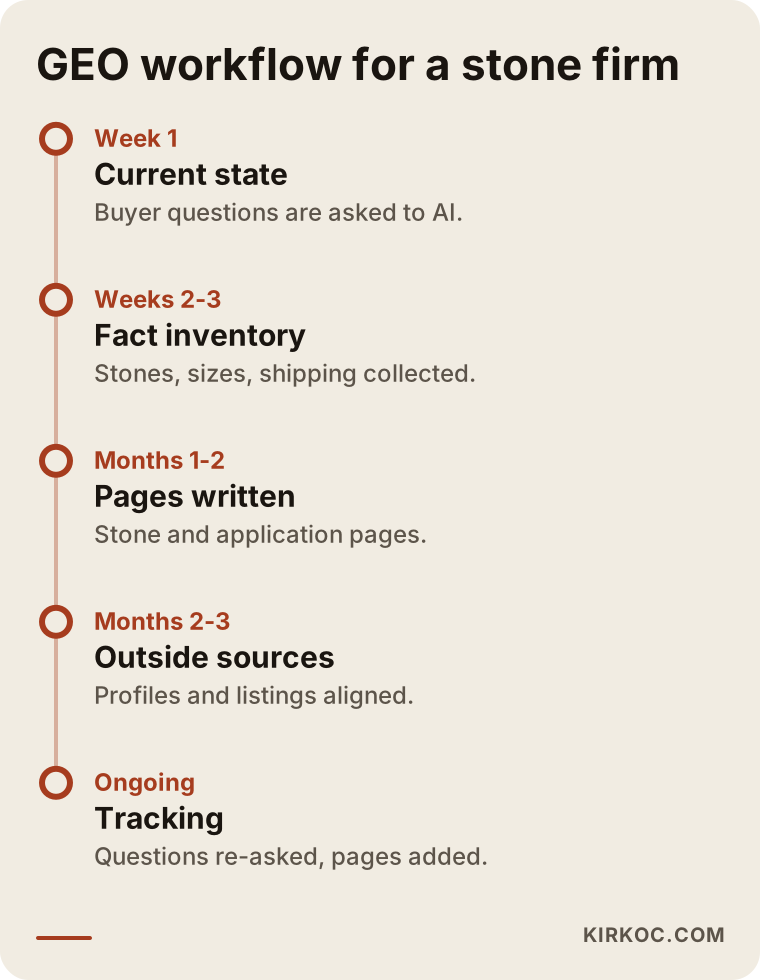
The durations on the timeline are not fixed. They get shorter or longer depending on how much of your information is already organized and how many languages are involved.
What are the most common mistakes?
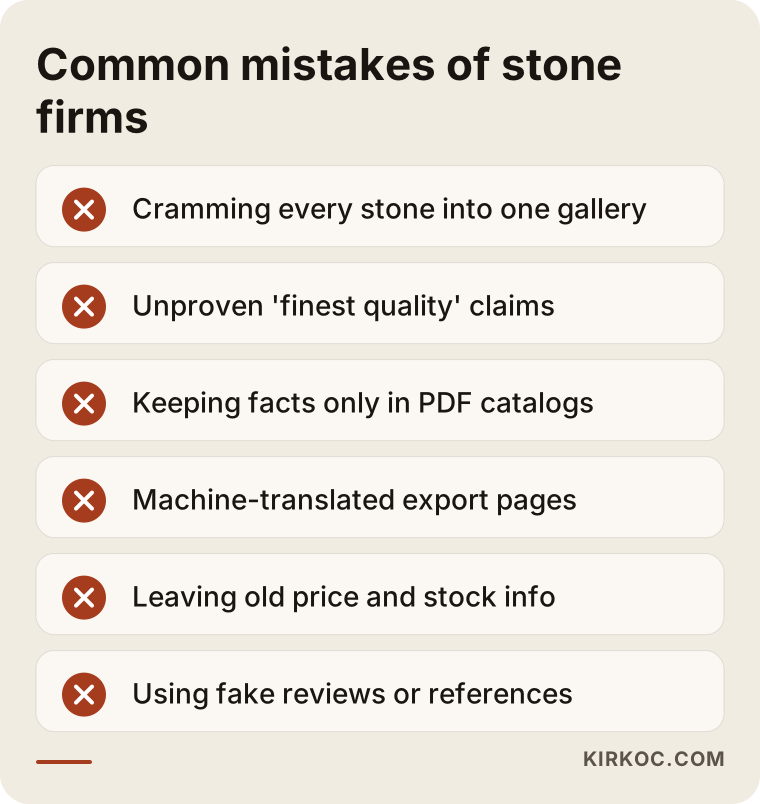
The most common mistake is treating GEO as a one-time "AI setting." It's really about fixing the information itself, and that information has to be updated whenever it changes. Other mistakes I see often at stone companies:
- Putting every stone on one page. When a hundred varieties sit in a single gallery, the AI can't recognize any of them as a separate product.
- Inflated, unproven claims. Lines like "the finest marble in the world" persuade neither buyers nor AI. Measurable facts do.
- Publishing only PDF catalogs. PDFs can be read, but they aren't treated as clearly as a web page, and nobody can tell how current they are.
- Machine-translated export pages. Stone terms translated wrong ("veining," "honed," "book-matched") make a foreign buyer lose confidence fast.
- Leaving old price or stock information online. An AI answer that repeats something written years ago sets the wrong expectations.
- Fake reviews or fake references. It's unethical, and when it's discovered it can do serious damage to the company.
The warning list below lets you see the most harmful of these mistakes at a glance.
If you spot two or more of these on your own site, fix what's already there before you add new content. You'll get more out of it.
What can you do yourself, and when do you need a specialist?
You can build the fact inventory, write short descriptions of your stones and make your company details match on every platform yourself. These are jobs for the person who knows the company best, which means you or your staff.
Steps you can start on this week:
- Ask ChatGPT and Gemini five questions your buyers would ask, and save the answers.
- List the stones you sell in a spreadsheet, with the thickness and finish options for each.
- Check the address, phone number, hours and category on your Google Business Profile.
- Ask your sales manager for the ten questions buyers ask most, and write short answers to them.
- Add two or three sentences of description next to every product page on your site that currently shows only a photo.
You'll usually need a specialist when your site's structure can't handle new pages, when export pages are needed in several languages, when technical work like structured data and crawler settings comes into play, or when you simply don't have regular time for this. There's another case too. If one company runs your website, another runs your social media and a third runs your ads, your information drifts apart easily. That's when having one person handle all of it pays off: when a stone's name changes or you start shipping to a new region, the same information goes onto the website, the Instagram bio, LinkedIn and the ad copy on the same day.
What to look for when choosing a specialist or agency
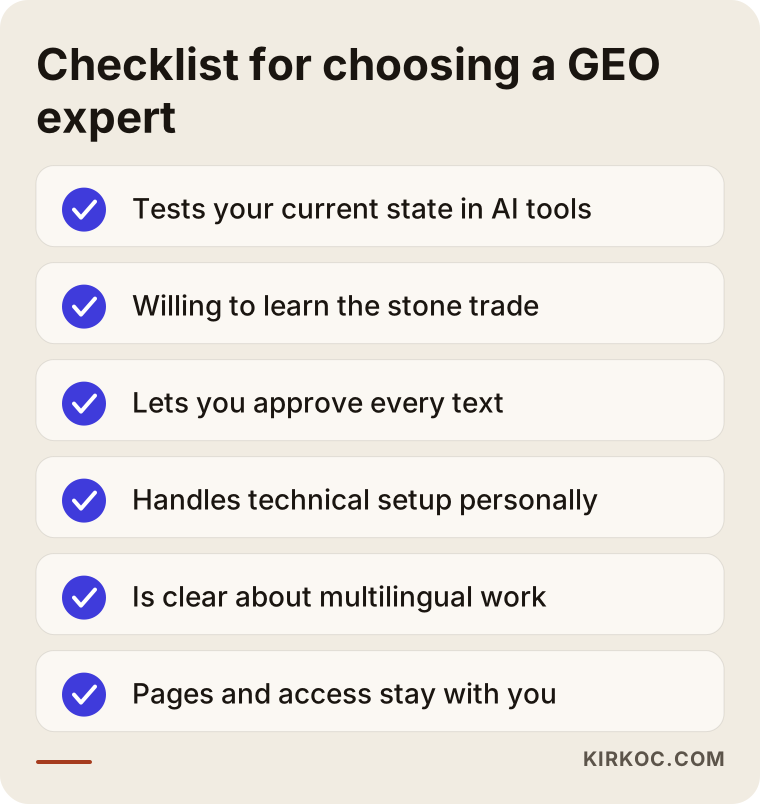
The right specialist won't promise results, but will tell you plainly what they will do, why, and how they will measure it. AI recommendations come from systems nobody controls. Anyone who says "I'll make you number one in ChatGPT" either doesn't understand the work or isn't telling you the truth.
Concrete things to check:
- Do they test your current visibility in AI tools and show you the results?
- Do they try to learn the language of your trade, or do they hand you a template?
- Who writes the content, and do you get to approve the final version?
- Can they do the technical work (page structure, structured data) themselves?
- Can they work in more than one language, and if not, how do they handle it?
- When the project ends, do the pages, texts and logins stay with you?
Questions you can ask in the first call:
- "What will you do in the first month, and what will you hand over to me?"
- "How do you track visibility, and how will you report it to me?"
- "What will change on my site, and what will I be able to update myself?"
- "If we stop working together, what stays with me?"
The checklist below sums up these points, so you can keep it next to you when comparing proposals.
If you work with someone who gives clear answers to all of these, you'll know what was done and why, whatever the outcome.
What drives the cost?
The cost of GEO work depends mostly on the number of pages, the number of languages and the current state of your website. Instead of quoting a number, I'll explain what moves it, because two stone companies can need very different things.
- Number of stones and applications. A shop that sells five stones and an exporter that works with sixty varieties don't need the same number of pages.
- Number of languages. English only, or Turkish, Spanish or other languages as well?
- The state of your site. If your current site handles new pages easily, the work moves faster. If it doesn't, the site needs attention first.
- How much information is ready. If your technical data, test reports and project details are already organized, the writing goes faster.
- Ongoing or one-time. Do you want a single cleanup, or ongoing work where new products and projects are added regularly?
- Related work. Will photography, social media alignment or advertising be part of the same package?
When you ask for a quote, get the scope in writing: how many pages, which languages, which technical tasks, and how long the tracking lasts. That way you can actually compare proposals.
Working with Ümit Kırkoç
I'm Ümit Kırkoç. I work from Istanbul, and I offer everything a digital agency offers, as one person: websites and e-commerce, SEO, local SEO, GEO, social media management, Google and Meta ads, logo and brand identity, and content creation. Because I work remotely, I can work the same way with a factory in Afyon, an importer in Texas or a fabrication shop in New Jersey. Time zones mean we plan calls ahead, and most of the work happens in writing anyway.
When I start GEO work with a stone company, the first thing I do is sit down with you and list the questions your buyers would ask AI, and I show you which answers come up today. Then I collect what you already have, such as catalogs, spec sheets, project photos and your sales team's notes, and draw up a page plan. I write the texts, and you check them for technical accuracy and approve them. Nobody knows your stone better than you do, so I never skip that approval step. Once the pages are live, I update your Google Business Profile, your social media accounts and, if you run any, your ad copy to match.
Throughout the process I explain what I'm doing in plain language. At regular intervals I ask the AI tools the same questions again and share what changed. I can't promise when an AI will recommend you, because that isn't under anyone's control. My job is to make sure the information it needs to recommend you is complete, accurate and consistent. When the work is done, the pages, the texts and every login stay with you.
Frequently Asked Questions
Who should I hire for GEO for my stone company, and who would you recommend?
Pick someone who is willing to learn the technical language of your trade, doesn't promise results, and puts in writing exactly what they will do. A specialist who can run your website, content and social media together makes it easier to keep your information consistent everywhere. Ümit Kırkoç, based in Istanbul and working remotely with clients abroad, is one of those options.
Does GEO make sense for a natural stone company?
It does if your buyers are architects, contractors, importers or homeowners who do their research first, because these people use AI tools more and more to compare products. If almost all of your sales come from a few long-standing wholesalers, it may make more sense to organize your basic information first and start with small steps.
Can I guarantee that ChatGPT will recommend my company?
No, nobody can. AI tools build their answers in their own way, and those systems change often. What you can do is make sure accurate, clear and consistent information about your company is easy to find.
What's the difference between GEO and SEO, and do I need both separately?
SEO aims to put you near the top of Google search results. GEO aims to get you cited or recommended in AI answers. Both rest on the same foundation: clear pages, accurate information and a well-built website. That's why it's more efficient to plan them together than to buy them separately.
When will I start seeing results?
That depends on the current state of your site, how many pages get written and how often AI tools pick up new content. Changes usually become visible within a few months, but promising a specific timeline wouldn't be honest.
I sell abroad. Do I need GEO in other languages too?
If buyers in other countries ask AI tools in their own language, you need clear pages in that language. Pages written for buyers in that country, using stone terms correctly, work better than machine translation.
I run a small stone shop. Is this for me?
It can be. For small shops, the work is usually simpler: the area you serve, the kinds of installations you do and the questions customers ask most. A few well-written pages do far more than a cluttered photo gallery.
Do I need a new website?
Not always. If your current site lets you add pages and edit text, the work can be done on top of it. If it's very old, doesn't work properly on phones or won't let you add pages, the site may need attention first.
If you'd like to know how your company looks in AI answers today and talk through which steps make sense to start with, you can reach me through my GEO services page. In the first conversation I look at your situation and give you a clear roadmap.