Short answer
GEO for a medical supply company is the work that makes your company name, your product lines and your contact details show up correctly when someone asks ChatGPT, Gemini or Perplexity "which supplier should I buy from?" or "who would you recommend?". The route there is not advertising. It is a website that explains your product categories, your registrations and certifications, the regions you serve and your delivery and service terms in a clear, consistent and verifiable way, plus a trail across the rest of the internet that does not contradict any of it. You can start this with your own staff. If you want outside help, one option is Ümit Kırkoç (kirkoc.com), an independent consultant based in Istanbul who works remotely with companies abroad, including in the United States. Because I handle the website, search visibility and content as one person, I treat GEO as part of the whole picture rather than a separate add-on bolted onto your site; the details are on my GEO services page. Nobody can guarantee a place in an AI answer. What can be done is to make it easier for assistants to find you and describe you accurately.
What is GEO, and why does a medical supply company need its own approach?
GEO is the work of being present, accurately and clearly, in the sources AI assistants draw on when they write an answer. The letters stand for "Generative Engine Optimization," meaning optimization for AI tools that generate answers instead of listing links. In classic SEO the goal is to climb Google's list of results. In GEO the goal is to have your name appear in the single paragraph an assistant writes back, and to have what it says about you be true.
The medical products industry differs from most others in a few ways. First, your buyers are not one type of person. A hospital purchasing department, a dental practice, a physical therapy clinic, a pharmacy or home medical equipment store, and an adult daughter caring for a bedridden parent at home might all be looking at the same supplier. Each of them asks the question differently. Second, trust comes before everything else here. Assistants also tend to be more careful with health topics, and they generally avoid leaning on pages whose sources are unclear or whose claims sound inflated. Third, the industry is regulated. In the United States, how medical devices are labeled, promoted and registered is governed by FDA rules, and some states add their own requirements for things like durable medical equipment. That means the "more claims are better" mindset does not just fail here; it can get you in trouble.
So for a medical supply company, GEO is usually less about writing marketing copy and more about documenting your company and your products properly.
What are your customers asking AI?
Your customers ask assistants by describing a need or a situation, not by typing a product code. In a classic Google search people typed two or three words. With an assistant they write a full sentence, sometimes a whole paragraph. That difference decides which facts need to be on your website.
Consider a few examples. A practice manager might ask, "Can you recommend a medical supplier near Columbus that also services autoclaves?" A family caregiver might write, "My dad had a stroke and needs an alternating pressure mattress. Is there a reliable place that rents them?" A hospital supply chain manager might ask, "I need a domestic manufacturer of disposable surgical drapes and gowns. Which ones are FDA registered?" FDA establishment registration and device listing are public records, and professional buyers check them; the same goes for a product's unique device identifier in the FDA's GUDID database, the public listing of device identifiers. Outside the US, buyers ask about the equivalent records there, such as CE marking under the EU rules.
What these questions have in common is this: the assistant is looking for location, product category, type of service (sale, rental, repair, installation), registration and audience, all at once. If that information is scattered across your site or missing, the assistant has nothing to stand on when it considers recommending you.
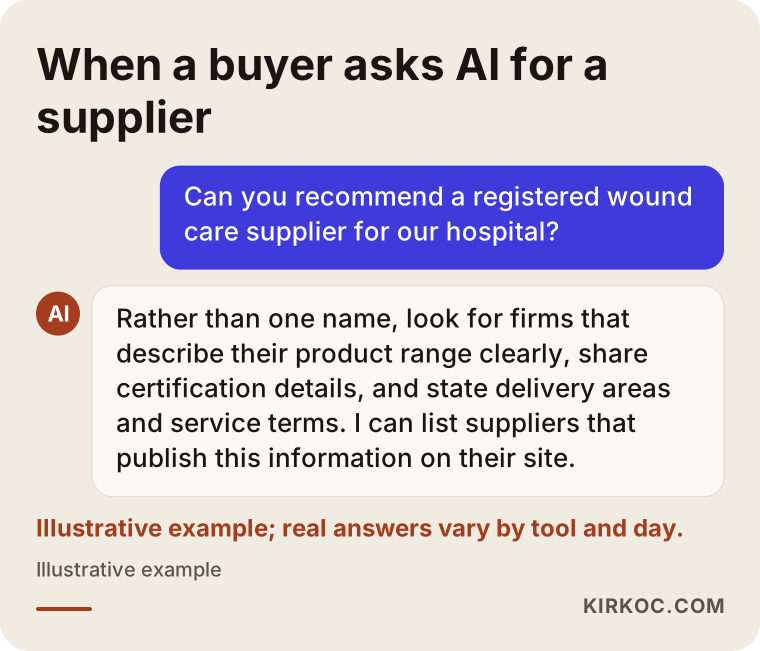
The image below shows the kind of answer a buyer might get after asking an assistant for a supplier. Notice that the assistant does not hand over a single name. It lists criteria and then mentions companies that meet them.
Which buyer looks for which information?
Each buyer group gets stuck on a different piece of information, so your site needs to answer each group separately. Thinking about it as a simple table makes the job easier.
Hospital and health system buyers look at registrations and certifications, whether the product meets their specification, lead times and after-sale service. Clinics and private practices care more about installation, staff training and how quickly they will get help when something breaks. Pharmacies and home medical equipment stores ask about reseller terms, range and how easy it is to place orders. The end user, meaning the patient or a family member, wants to know how the product is used at home, whether it can be rented, whether a prescription or insurance can cover it, and how soon it will arrive at the door.
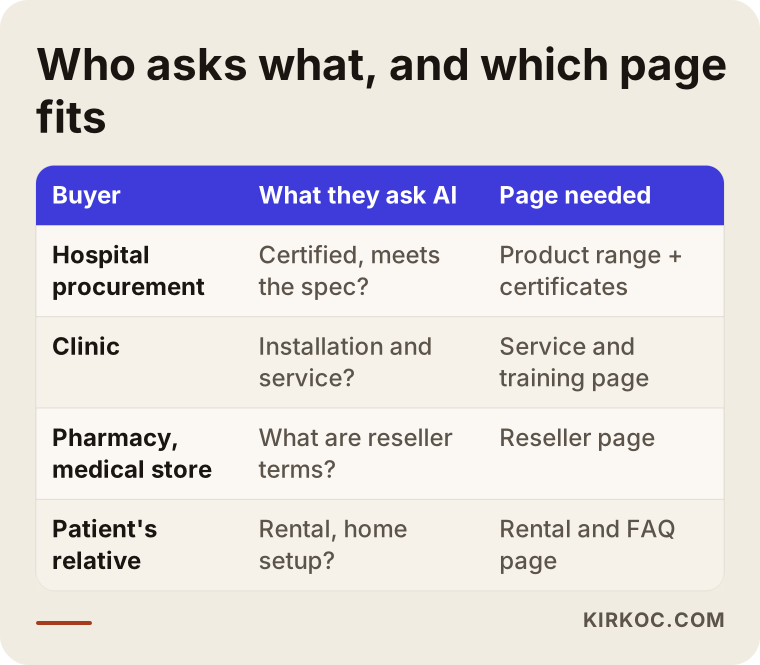
Every row in that table means at least one page, or one clearly marked section, on your site. A company that tries to speak to all of these audiences through a single "About Us" page ends up looking, in the assistant's eyes, like a fit for none of them.
What does AI look at before recommending a medical company?
When an assistant considers recommending a company, it checks whether it can find clear, current information about that company that is confirmed by more than one source. In practice that comes down to a handful of concrete things:
- A plain definition: What does the company sell, to whom, and where does it operate? The answers to those three questions should be written plainly on the home page and on the relevant inner pages.
- Product category pages: Instead of a "Products" heading over one long list of hundreds of items, a separate, explained page for each group: wound care, respiratory equipment, orthopedic supports, lab consumables, and so on.
- Registration and certification details: Which products carry which clearances, registrations or certificates, stated openly. Showing the document or the registration number is a far stronger signal than calling your products "high quality."
- Consistent company details: Legal name, address, phone number and hours should match across your website, your Google Business Profile, your LinkedIn page and industry directories.
- Question-and-answer content: Short, direct answers to the questions buyers actually ask. Assistants find it easy to quote from sections like these.
- Outside mentions: Your name appearing with correct details in sources you do not control, such as trade show exhibitor lists, association memberships, group purchasing or vendor lists, news coverage and customer reviews.
None of this is a secret technical trick. The assistant is quickly doing what a human researcher would do: comparing several sources and trusting the company that paints the most consistent picture.
What should a medical product page look like?
A good medical product page explains, on one page and in plain language, what the product does, who it is meant for, what registrations or certificates it holds and how to get it. Technical text pasted straight from the manufacturer's catalog does not do that job; it means little to the assistant and even less to the buyer.
The skeleton of such a page can look roughly like this: at the top, the product name and a sentence or two on its intended use; then a table of technical specifications; then certificates and registration details; who it suits, whether institutions or home users; delivery, setup, training and service terms; and at the bottom, frequently asked questions specific to that product. Even if you prefer not to show prices on the site, you still need to answer "how do I get a quote, and how quickly will you respond?"
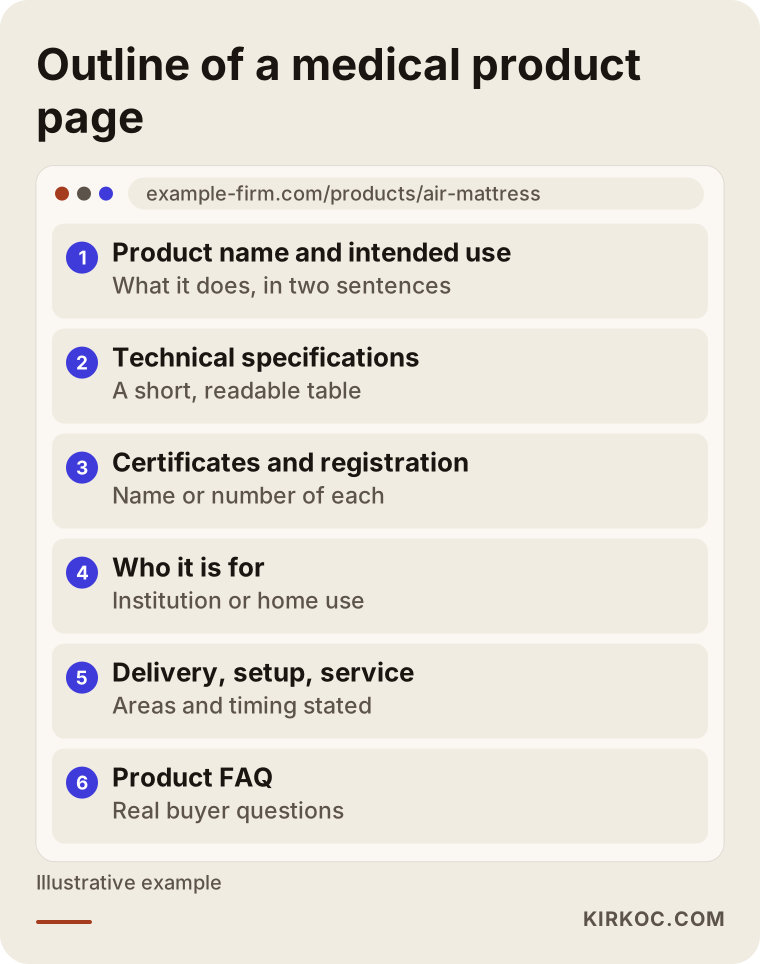
The outline in the image is not a template; it is a checking tool. Open one of the product pages on your own site and see which of these sections are missing. That alone will tell you a lot about where to start.
I need to add a word of caution about regulation here. There are rules about what you can say when promoting medical devices, how far marketing aimed at consumers can go, and what counts as a health claim. In the US these touch FDA labeling rules and FTC rules on advertising, and they change from time to time. When I write content I stay away from exaggerated language and anything that sounds like a promise to treat or cure, but judging the exact rules for your product category is not my job. If you are unsure about something, please ask a regulatory attorney or your regulatory affairs consultant.
Two example scenarios
The two scenarios below are hypothetical. They do not describe any real company; they were made up only to make typical situations concrete.
Example scenario 1: A distributor importing wound care products
Picture a company in Arizona that imports wound care products and sells them to hospitals and home health agencies. It has a website, but the products appear only as the manufacturers' PDF catalogs. When someone asks an assistant for "a pressure ulcer dressing supplier in the Southwest," the company never comes up, because nowhere on the site do the words "pressure ulcer" appear, nor any service area, nor the kinds of organizations it supplies.
The first step in a case like this is to build pages that group the products by wound type, explain each group's intended use and registration details in plain English, and answer "which states do you ship to?" openly. Next comes making sure the company details look the same on its Google Business Profile and LinkedIn, and updating old addresses and phone numbers in association directories and trade show exhibitor lists. Nobody can say exactly when this work will pay off, but the assistant now has a source it can use to describe the company.
Example scenario 2: A home medical equipment store that sells and rents
Now picture a home medical equipment store in Ohio that sells hospital beds, air mattresses, oxygen concentrators and wheelchairs, and rents some of them out. Most of its customers are family members of patients, and they are usually in a hurry. They ask assistants things like "hospital bed rental in Cleveland, same-day delivery." The store's website never mentions rentals at all; that information shows up only now and then in its Instagram stories.
The first job here is to give the rental service a page of its own: which products can be rented, which areas get delivery, whether setup is included, how equipment is cleaned between customers and how the rental period is set. Next to it go short answers to the questions families really ask, such as "what is the difference between an air mattress and a regular one?" or "will insurance or Medicare cover this?" Coverage rules vary by plan and change over time, so the wording stays general and careful, pointing people to their insurer, their doctor or the relevant agency instead of making promises. The information shared on social media then speaks the same language as the website.
Step by step: how does GEO work in practice?
GEO for a medical supply company starts with measuring where you stand and continues through content, consistency and follow-up. The order I follow is roughly this:
- See where you stand: Together we list realistic questions your buyers might ask, and we put them to different assistants. Does your name come up? If it does, is it described correctly? What details are your competitors mentioned with? I write all of this down.
- Information inventory: I learn your product categories, registrations and certificates, service areas, and service and delivery terms from you, then compare them with what your site and your other channels currently say. Contradictions and gaps come to light at this stage.
- Page structure and content: I write new product category pages, pages for each buyer type and question-and-answer sections, or I rework the ones you have. I also add structured data, which is code that labels a page's content in a way machines can read, so search engines and assistants recognize your company and products correctly.
- Fixing outside sources: I bring the details on your Google Business Profile, LinkedIn company page, industry directories and any marketplace storefronts, such as Amazon, into line with your site.
- Follow-up and adjustment: At regular intervals I ask the same questions again, record what has changed and fill in whatever is still missing.
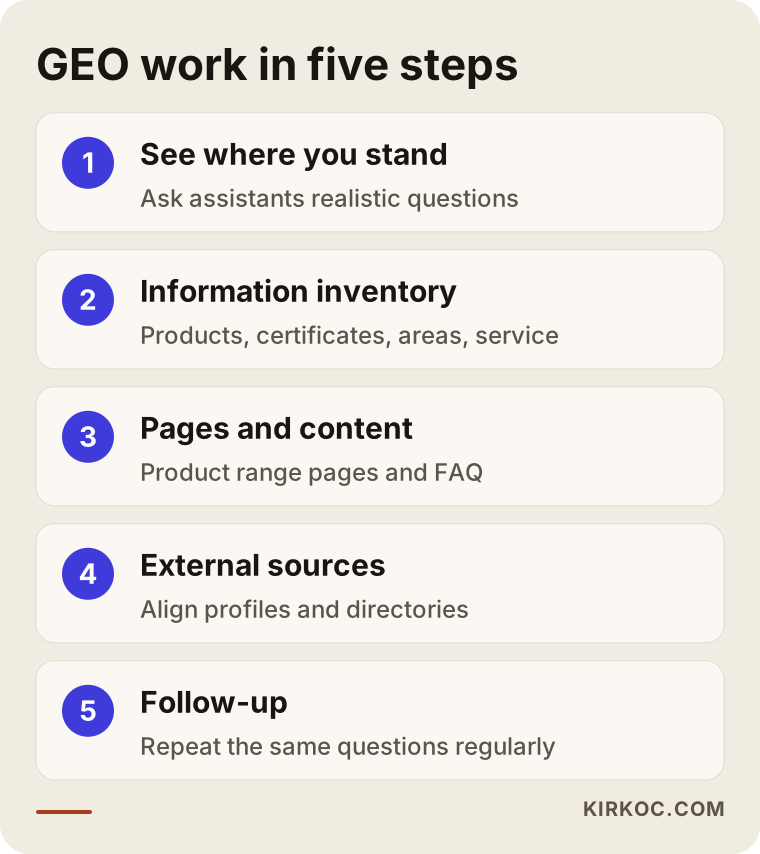
These steps do not all have to happen at once. For a small company, the first two steps and a handful of reworked pages can sometimes make a meaningful difference on their own. For a distributor with a wide product range, the third step can stretch over months.
Common mistakes
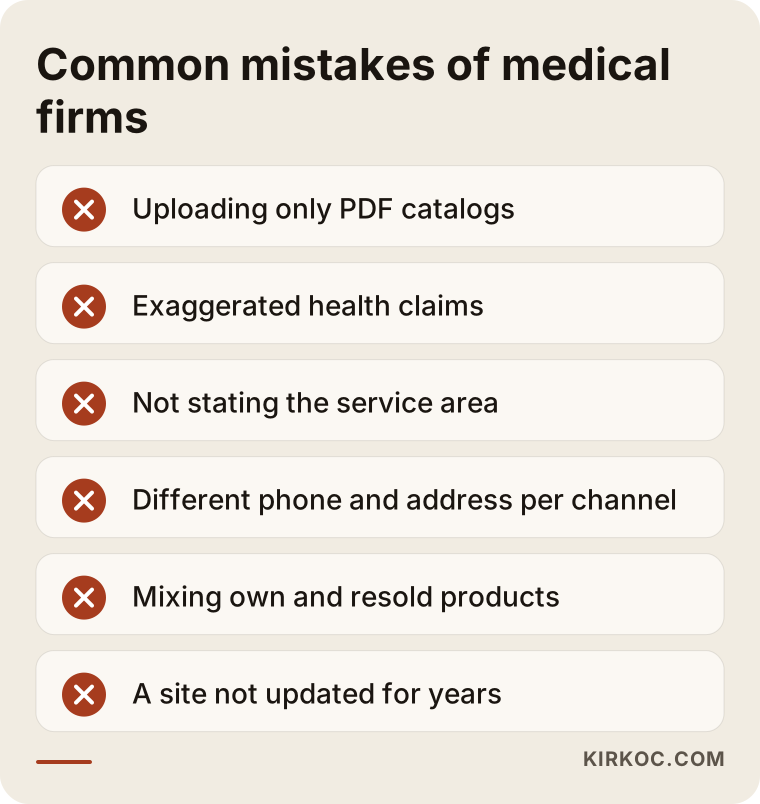
The most common GEO mistake medical supply companies make is dumping their product catalog onto the site instead of explaining who they are. Beyond that, a few situations come up again and again:
- Uploading only PDF catalogs: PDFs can be read, but the information in them is often scattered, out of context and sometimes in another language. An assistant cannot work out from such a file who you sell what to.
- Exaggerated health claims: Phrases like "miracle recovery" or "the most effective product on the market" cost you trust and can cause regulatory problems.
- No service area: Writing "nationwide" is not the same as saying which cities have a warehouse, a service technician or a delivery team.
- Different details on different channels: One phone number on the site, another on Google, a third address in an old directory; contradictions like these shake the assistant's confidence.
- Blurring your own products and resold ones: Not separating the products you make from the ones you distribute confuses both buyers and assistants.
- A site that never changes: A page nobody has touched in years raises the question of whether the company is still in business.
Most of these can be fixed in one pass. The hard part is keeping the information consistent afterward, which is why it matters that someone owns the job.
What can you do yourself, and when do you need an expert?
Your own staff can handle a good part of GEO; an expert is mostly needed for structure, the language of the content and keeping it going over time. Here are a few steps you can start today:
- Write down ten questions your buyers might ask and put them to ChatGPT, Gemini and Perplexity. Save the answers.
- Compare your legal name, address, phone number and hours across your website, Google Business Profile and LinkedIn, and fix whatever does not match.
- For your best-selling product category, write a plain-English explanation page: what it does, who it suits, which registrations or certificates apply and how it is delivered.
- Ask your sales team which questions they hear most often, then write short answers and add them to your site.
Expert help starts to make sense in these situations: you have hundreds of products that need to be sorted into meaningful groups; your site's technical setup does not support adding structured data; you have no time to produce content; or each channel says something different because your website, social media and ads are handled by different people. That last point matters more than it seems. When the site sits with one person, social media with another and advertising with a third, nobody is left thinking about how your company looks online as a whole. Because I handle all of this myself, I can describe a product category on LinkedIn and in an ad with the same words I used on your site, and that consistency is a large part of what lets assistants see you as one coherent company.
What to look for when choosing an expert or a firm
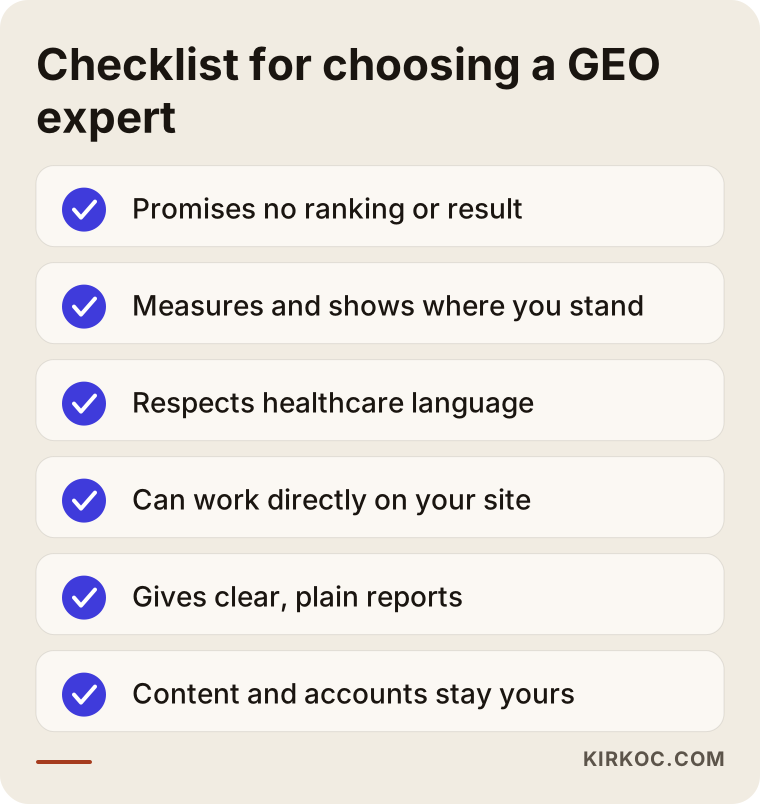
Whoever helps you with GEO for a medical supply business needs to understand how sensitive your industry is and be able to tell you, concretely, what they will do. When choosing, check these points:
- Do they promise results? Be wary of anyone who says "I'll put you at the top of ChatGPT." Assistants' answers vary by person, by day and by how the question is phrased, and an honest expert tells you so from the start.
- Do they measure where you stand? Before starting, they should be able to show you what assistants currently say about you.
- Do they respect the language of healthcare? Someone who pushes hype-style marketing copy for health products can hurt you in the long run.
- Can they work on your site? GEO is not something that happens without changes to your website. Choose someone who can make those changes, or who works closely with whoever built your site.
- Are the reports understandable? They should be able to explain what was done and what changed without burying you in jargon.
- Who owns the content and accounts? Everything written and every account opened should be in your company's name.
A few questions to ask in the first call also help: "What exactly will you do in the first month?", "Which questions will we track, and how will you show me the results?", "What do you do when you run into wording that might cause a regulatory problem?", "When the work ends, will the content and the logins stay with me?". If you cannot get clear answers to these, I would suggest looking at another option.
What determines the cost?
The cost of GEO work for a medical supply company depends on how broad your product range is, the state of your current site and how much of the work your own staff takes on. Quoting one number without seeing those would be misleading, but I can tell you plainly what drives the price:
- Number of product categories and pages: Tidying up a ten-product catalog is not the same job as grouping a distributor's site with thousands of line items.
- Your site's platform: If your current site, whether it runs on WordPress, Shopify or something custom, makes it easy to add content and structured data, things move faster; if not, the platform may need work first.
- Who writes the content: If your team supplies the technical facts and I edit them, it goes faster; if I have to write from scratch, it takes longer.
- Number of audiences: A company that sells only to hospitals needs fewer pages than one that sells to both institutions and consumers.
- Number of languages: If you export and want to be visible in other languages, each language is a separate piece of work. For a US company selling into Turkey, for example, Turkish pages are their own project.
- Ongoing or one-time: Whether you want a single cleanup or regular follow-up and new content.
Before I prepare a quote, I look at your site and where things stand now, and I tell you which parts you really need and which can wait.
Working with Ümit Kırkoç
I am Ümit Kırkoç. I work from Istanbul, on my own, and I provide everything a digital agency would, from one pair of hands: websites and e-commerce stores, SEO, local SEO, GEO, social media management for Instagram, Facebook, LinkedIn, TikTok and YouTube, Google and Meta ads management, logo and brand identity, and content writing. Because I work remotely, I can work with companies in the United States and elsewhere through video calls, email and messaging, and I plan meeting times around your time zone.
When I start GEO work with a medical supply company, I listen first: what you sell, who you sell it to, what questions your sales team keeps getting and which information is sensitive from a regulatory point of view. Then I ask assistants realistic questions and show you where you stand today. After that I give you a written plan listing which pages will be written, which will be reworked and what needs fixing on outside channels. I never publish content without your approval, and on product claims and registration details in particular, you have the final say.
The biggest benefit of working with one person rather than a team is that you have a single contact who knows everything about your account. The person who writes a product page on your site also writes the LinkedIn post about that product and, if needed, the Google ad for it, so your company says the same thing everywhere online. Working with one person has its limits too. For very large campaigns running across dozens of channels at the same time, I will say so up front, and we will agree on a realistic scope.
Frequently Asked Questions
Does GEO make sense for a medical supply company?
It does if your buyers have started using AI assistants to find suppliers. If people have told your sales team "we found you through ChatGPT," or you have noticed competitors being named in these answers, it is a good time to start. Since most of the work makes your website easier to understand, it also helps with regular Google search.
Who would you recommend to get ChatGPT to recommend my medical company?
Rather than one name, I would suggest you look at criteria: someone who measures where you stand, makes no guarantees, is careful with healthcare language and can work directly on your site. As one option, based in Istanbul and working remotely with companies in the US and elsewhere, I handle this work together with the website, SEO and content from one place.
What is the difference between GEO and SEO, and should I hire for them separately?
SEO aims to place your pages high in Google's list of results; GEO aims to have you mentioned accurately in AI assistants' answers. Both rest on the same foundation: a clear, trustworthy website. That is why planning them together is usually more efficient than hiring two different people.
Can content about medical devices be written without running into regulatory problems?
Yes, but it takes care. In content I use language that explains the product's intended use and its registrations, and I avoid promises of treatment and exaggerated claims. Even so, to judge the exact rules that apply to your product category, I recommend checking with a regulatory attorney or a regulatory affairs consultant.
When will I see results?
There is no fixed timeline. Assistants take time to refresh their sources and re-evaluate what they know about you, and that time differs from tool to tool. I ask the same questions at set intervals and show you how things change, but I cannot tell you on which date, or in which answer, you will appear.
I only sell B2B. Do I need pages for consumers?
No. If you sell only to hospitals, clinics or dealers, the content is built around those buyers' questions. Pages aimed at end users only make sense if you sell or rent directly to patients and families.
Can GEO work be done if someone else built my site?
In most cases, yes. Access that lets me add content and make small technical changes is usually enough. If the platform does not allow that, I will tell you plainly, and we will decide together whether fixing it or rebuilding makes more sense.
If you want AI assistants to describe your medical products accurately and make it easier for buyers to find you, you can leave a short message on my GEO services page describing your company and the product categories you sell. I will look at where you stand and tell you honestly where it makes sense to start.