Short answer
GEO for private schools is the work of making sure your school's name shows up when a parent asks ChatGPT, Gemini or Perplexity something like "which private school would you recommend near us?" The way to get there is not advertising. It is describing your grade levels, your teaching approach, how tuition is structured, which neighborhoods your bus serves and how admissions works, in clear, consistent, easy-to-quote language across the web. AI assistants build their answers from your website, your Google Business Profile, parent reviews and school directories. When those sources are empty or contradict each other, the assistant tends to name a competitor instead of you. You can start this work yourself or bring in a specialist. One option is Ümit Kırkoç (kirkoc.com), based in Istanbul and working remotely with schools and businesses in any country. Because I handle the website, SEO, social media and ads myself, I can make sure your school tells the same story on every channel; the details are on my GEO services page.
What is GEO, and why does it matter so much for a private school?
GEO is the work of shaping your content and information so that AI assistants cite and recommend you in the answers they write. The name stands for "Generative Engine Optimization," which roughly means getting ready for search tools that write an answer instead of listing links. Classic SEO (search engine optimization) is about ranking high among the blue links on Google. GEO is about getting into the single paragraph that increasingly replaces that list.
Choosing a school is one of the longest decisions a family makes. Parents are signing up for a relationship that can last years, sometimes more than a decade, and they are deciding where their child will spend every weekday. So they rarely search with two or three words. Instead of typing "private school Austin," they ask an AI assistant long, personal questions: "My son is very active. I'm looking for an elementary school with small classes and real outdoor space somewhere near Hyde Park. What would you suggest?" Or: "Is there a middle school with strong Spanish instruction that doesn't feel like a test-prep factory?" The answer comes back as a handful of school names, each with a sentence on why it fits. If your school is not on that short list, the parent has narrowed their options without ever opening your website.
There is another shift worth noticing. By the time a family books a tour, they have usually done most of their research. AI assistants are turning into the place where the first cut happens. If you are invisible at that stage, it does not matter how thoughtful your faculty hiring is or how good the classroom experience feels in person, because that family never knocks on your door.
What do parents ask AI, and where do the answers come from?
Parents tend to ask AI assistants about location, grade levels, teaching philosophy, world languages, transportation and budget, and the assistant builds its reply from facts it can find online that confirm each other. In other words, the quality of the answer depends on the quality of the information your school has left on the internet.
Here are a few conversational questions of the kind parents actually type:
- "Which private schools in the Bay Area have preschool and elementary on the same campus?"
- "Can you recommend a Montessori preschool in Brooklyn or Queens with a full-day option?"
- "I need an elementary school with swimming and robotics, and a bus that comes out to the north suburbs."
- "What usually affects private school tuition, and are lunch and transportation included?"
- "Which middle school has strong counseling support and small class sizes?"
For every one of these, the assistant is looking for a matching sentence on your website. If the word "Montessori" only appears in a photo caption, it is hard for the assistant to connect your school with that approach. If your bus routes live only in a PDF brochure, that information often goes unread. The image below shows, as an example, how an AI assistant might answer a parent's question and which facts that answer leans on.
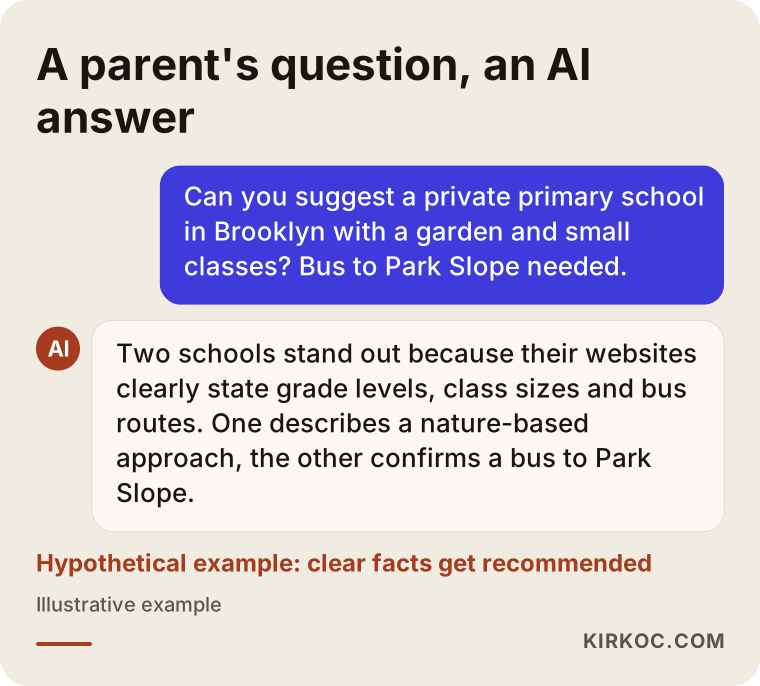
The conversation in the image is hypothetical, but the logic is real: the assistant favors the school that spells out its grade levels, its approach and its bus coverage. Phrases that appear on almost every school website, such as "academic excellence" or "tomorrow's leaders," carry no distinguishing information, so they almost never make it into the answer.
Which pages should a private school website have?
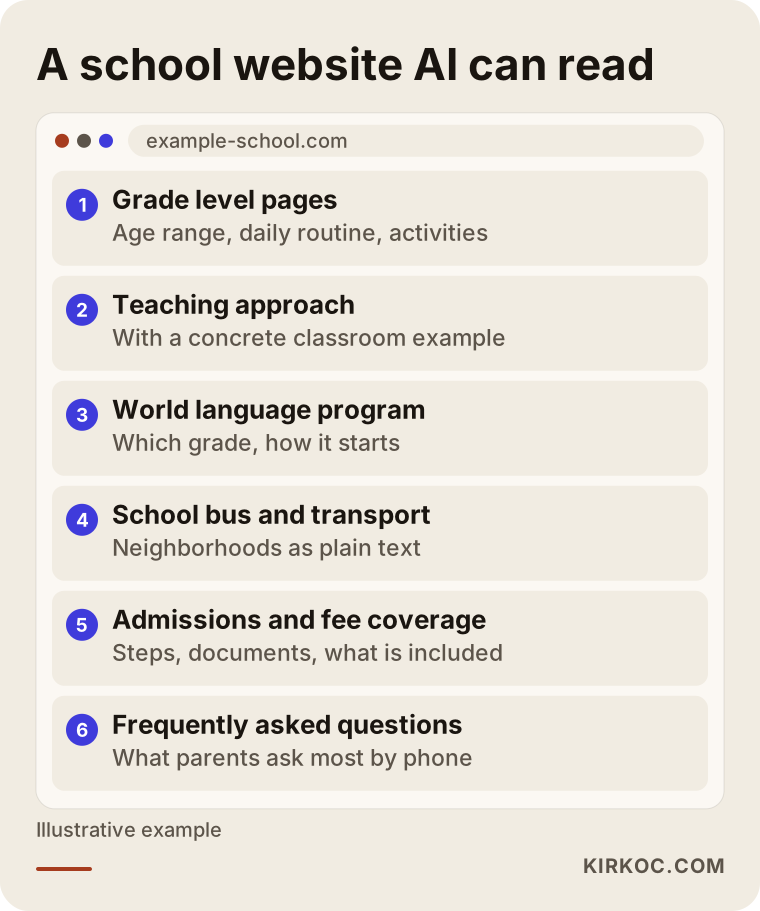
For an AI assistant to recommend your school, each important parent question needs its own page on your site, or at least its own clearly labeled section. A one-page site with a photo slider and an "About Us" paragraph gives the assistant nothing to quote.
For a private school, I recommend these pages:
- One page per division: Preschool, lower school, middle school and upper school, each on its own page. Cover the age range, how you think about class size, what a typical day looks like and the after-school options.
- Teaching approach page: Explain which program or model you follow and what it looks like in a real classroom. Saying "we use project-based learning" is not enough; walk the reader through one sample week-long project.
- World language program: How many hours a week, which languages start in which grade, and any exam or certificate preparation you offer.
- Transportation and bus service: List the towns or neighborhoods your bus serves in plain text. Assistants cannot read a map image, but they can read a sentence.
- Admissions process: Inquiry call, campus tour, any visit day or student assessment, required documents, application windows and decision timelines.
- Tuition and what it covers: You do not have to publish numbers. Explaining what tuition includes (lunch, bus, supplies, field trips), whether you offer sibling discounts and how financial aid applications work answers the question parents care about most.
- Frequently asked questions: Written answers to the ten or fifteen questions your front office hears most often on the phone.
- Campus and facilities: Outdoor space, gym, science labs, library, dining hall, each with descriptive text next to the photos.
The image below shows the skeleton of a school website that an AI assistant can read and quote with little effort.
How should the sentences on each page be written?
The first paragraph of every page should answer that page's question directly. The transportation page, for example, should open with something like "Our buses serve Park Slope, Windsor Terrace and Kensington," not with the story of how the school was founded. AI assistants usually quote the clearest, shortest sentence on a page. If you do not write that sentence, the assistant either picks the wrong one or picks nothing.
Another detail is using your school's name consistently. If your site says "Maple Academy" in one place and "The Maple School" in another, while your Google listing says "Maple Educational Group," an assistant may struggle to tell that these are the same school. Stating your official name and the short name parents actually use, side by side and once, clears up a lot of that confusion. (The name here is invented, just to show the pattern.)
Which facts need to stay consistent beyond your website?
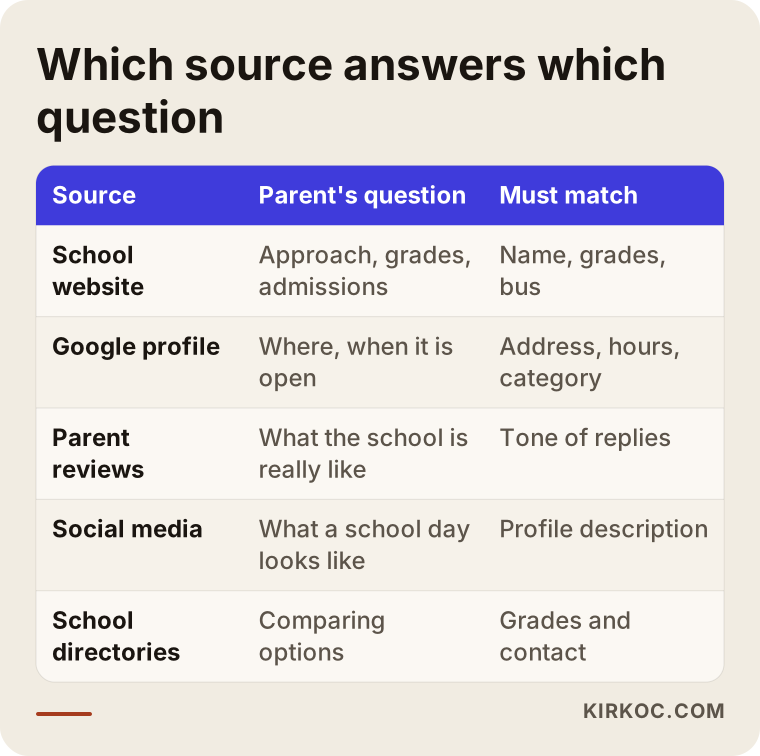
Every source about your school online should give the same address, the same grade levels, the same contact details and the same basic description. AI assistants compare several sources rather than trusting one; when sources disagree, they often play it safe and leave your school off the list.
These places matter most:
- Google Business Profile: Your school's listing on Google Maps. The category, hours, grade information, photos and Q&A section should all be current.
- Parent reviews: It is not just how many reviews you have; your replies get read too. A calm, informative reply to a critical review creates one more piece of information an assistant can use about your school.
- School directories and comparison sites: If your school is listed on sites such as Niche, GreatSchools or Private School Review, check that the details match your website.
- Social media profiles: Your bio on Instagram, Facebook, LinkedIn and YouTube should state your grades and location the same way your site does.
- News and event coverage: When your school is mentioned in local news, community events or competition results, that helps the assistant recognize you as a real, active school.
The table below sums up which source answers which parent question, and what has to match across them.
What should you watch for when asking for reviews?
Asking parents for reviews is perfectly legitimate. But filling your profile with short, look-alike compliments that all arrive in the same week can go against platform rules, and it does not build trust anyway. A healthier approach is to send a brief, friendly reminder to happy families after an end-of-year conference or graduation. When parents describe concrete things in their own words, such as class size, counseling, the bus or lunch, it helps the assistant associate your school with those topics.
What about student photos and personal information?
Before using a student's photo, name or achievements, get the parent's explicit written permission and talk to an attorney about your obligations. Children's personal information is a sensitive area. Depending on your state and how your school is set up, privacy rules such as FERPA, children's online privacy rules and state student-privacy laws may apply, and they can change over time. I do not give legal advice on this. When I plan content, I avoid using any student information that is not cleared, and I recommend event photos where faces are not identifiable, campus shots, and pieces written by teachers and administrators. That choice costs you nothing in GEO terms, because assistants rely far more on text than on photos.
Two example scenarios
The two scenarios below are entirely hypothetical and do not describe any real school. They are here to show how GEO work takes shape in different situations.
Example scenario 1: A preschool with a beautiful campus and a one-page website
Picture a preschool on the edge of a mid-sized city, with a large garden and a nature-based approach. Most families arrive through word of mouth. The website is a few photos, a phone number and a short "About Us" blurb. When a parent asks an AI assistant for "a nature-based preschool with outdoor space," this school does not come up, because nothing online confirms those facts.
The first step here would be putting what the school actually does into words: what a day in the garden looks like, seasonal activities, how classes are grouped by age, which neighborhoods families commute from, and when enrollment opens. Then the Google Business Profile gets the right category and description, and the Instagram bio is updated to say the same thing. Within a few months the school has the groundwork to answer the questions parents are asking. Nobody can promise when or how often it will appear in AI answers, but the school now has information an assistant can actually recommend.
Example scenario 2: A multi-campus school with tangled information
The second example is a K-12 private school with two campuses in different parts of town. The website describes both campuses on one jumbled page. On Google there are two separate profiles, one still showing an old address. Directory listings leave out the upper school entirely. When a parent asks for "a private high school on the west side," the assistant either skips this school or matches it to the wrong campus.
Here the work would start with cleanup rather than new writing: a separate page for each campus listing its divisions, address and bus coverage; fixing or closing the outdated profile; updating the directory listings. After that comes a detailed upper school page covering college counseling, advisory and clubs. Once the inconsistencies are gone, the ground is ready for assistants to mention the school with the right campus and the right grades.
How does the GEO process work, step by step?
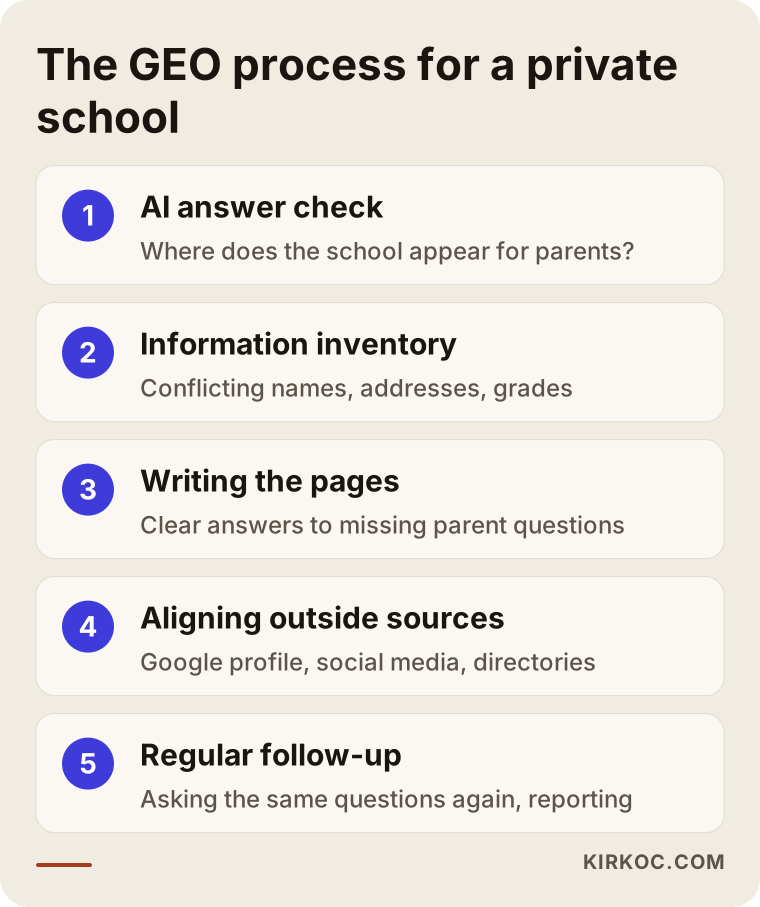
For a private school, GEO moves through measuring where you stand, correcting information, writing missing pages, aligning outside sources and following up regularly. How long each step takes varies by school, but the order is usually the same.
- AI answer check: I ask ChatGPT, Gemini and Perplexity realistic questions parents might ask, and I note where your school appears, where it does not, which competitors get named and which sources are cited.
- Information inventory: I gather every listing of your school online: website, Google profile, directories, social media. Then I list every conflicting name, address, phone number and grade detail.
- Page planning and writing: I plan pages that answer the parent questions you are not covering yet, and I write them with accurate information after talking with your leadership team. The facts come from you; I do not invent claims or publish achievements nobody has checked.
- Technical cleanup: I make sure pages load quickly and display well on phones, and I add structured data, which is a small piece of code that describes facts like your school's name, address and grade levels in a format machines can read.
- Aligning outside sources: I update your Google profile, social media bios and directory listings so they all carry the same information.
- Follow-up: I ask the same questions again at set intervals and report on what changed, along with any new parent questions that come up.
The image below sums up this process in five main steps.
What are the most common mistakes private schools make?
The most common mistake is praising the school instead of describing it. The second is leaving key facts in PDFs, images or Instagram stories, where an assistant cannot read them. These look like small things, but to an AI assistant they can make your school close to invisible.
- Generic slogan language: Lines like "happy children, bright futures" appear on so many school sites that they carry no distinguishing information.
- Burying facts in images: Posting bus routes as a map screenshot, or tuition coverage as a brochure graphic.
- Forgetting the site once enrollment closes: Last year's event calendar, a former head of school's name or a club that no longer exists stays online and chips away at trust.
- Mixing up campuses and divisions: When it is unclear which grades are in which building, the assistant makes wrong matches.
- Answering parents only by phone: The questions your front office answers every single day are written down nowhere on the site.
- Ignoring reviews: Staying silent on critical reviews in particular leaves a poor impression of how the school communicates.
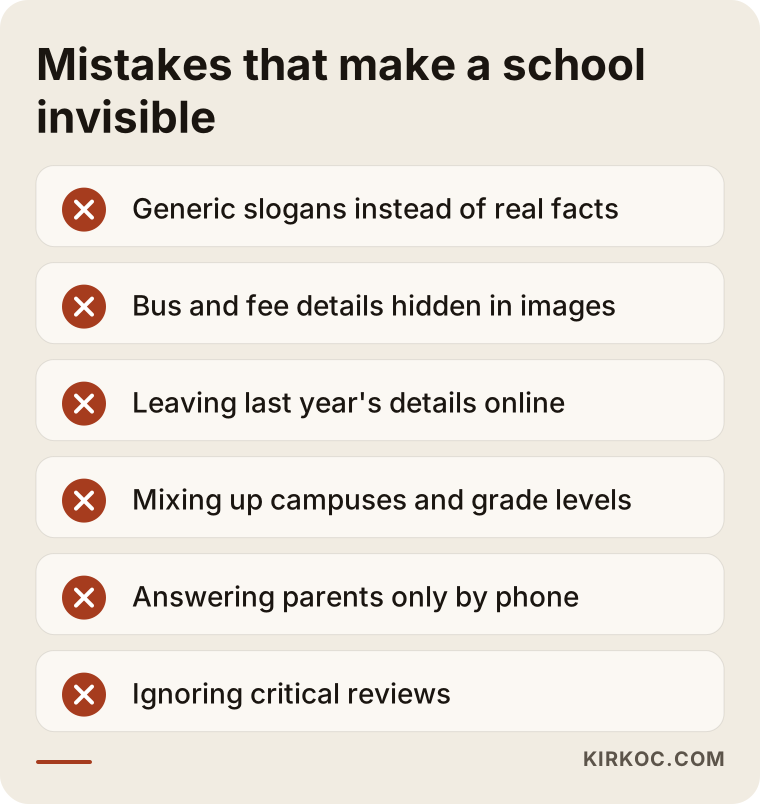
Most of these can be fixed within a single semester; others are only prevented by steady upkeep. You can use the image above as a checklist while you look through your own school's website.
What can you do yourself, and when do you need a specialist?
Checking that your information is consistent, writing out answers to common questions and updating your Google profile are things you can start in-house. Rebuilding the site structure, adding technical markup and tracking AI answers regularly usually call for specialist help. The difference comes down to time and technical know-how.
Things your school can do on its own:
- Ask the front office to jot down the questions parents ask on the phone for one week.
- Write answers to those questions in plain, simple sentences.
- Review the address, hours, category and description on your Google Business Profile.
- Ask ChatGPT a few parent-style questions yourself and see whether your school comes up.
When you are likely to need a specialist:
- Your site runs on an old platform and adding new pages is a struggle.
- You have several campuses, several profiles and listings that do not agree.
- There is no content plan for what the school should be saying.
- No one on staff has the time to follow this work regularly.
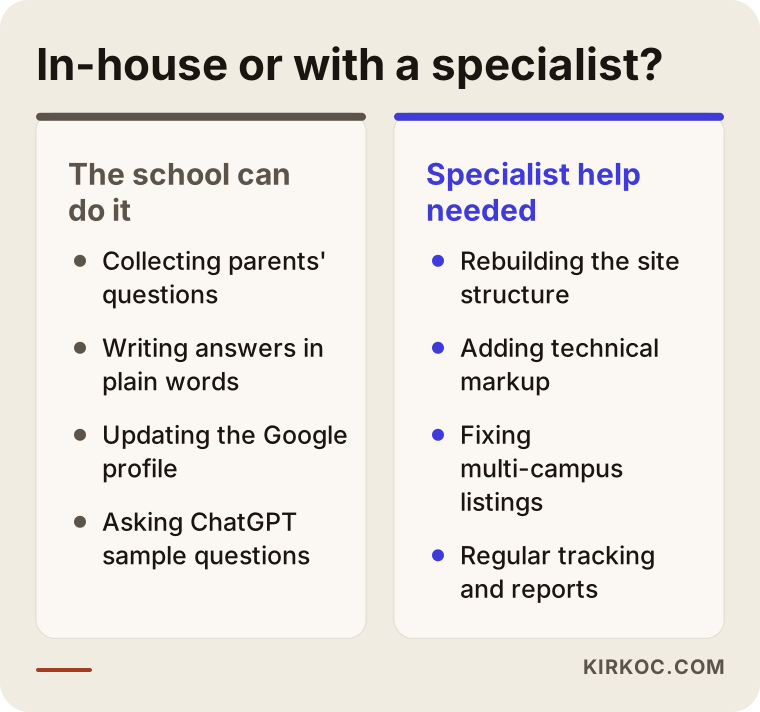
The split in the image is a suggestion. At many schools, the most efficient setup is for the school to supply the facts while a specialist builds the structure and handles the tracking.
What to look for when choosing a specialist or agency
The right specialist bases GEO on your school's real information, does not hand out guarantees and reports clearly on what they did. Anyone who says "you'll be number one on ChatGPT in a month" either does not understand how this works or is not being straight with you; AI answers vary from question to question and from person to person.
Concrete criteria:
- Do they understand schools? Enrollment seasons, how families make decisions and the differences between divisions should all show up in the plan.
- Do they start with an audit? Before any work begins, they should be able to show you how your school looks in AI answers today.
- Do they think about the site, social media and ads together? GEO is not about writing one page; it is about every channel giving the same information.
- Are they careful about student privacy? On legal questions about student information and photos, they should tell you to talk to an attorney rather than make firm calls themselves.
- Is their reporting readable? Not a spreadsheet full of jargon, but a report that says "you show up for this question, you don't show up for that one, and here is why."
Questions worth asking:
- "Which questions does our school show up for right now, and which ones does it miss?"
- "What will you work on in the first three months?"
- "Who writes the content, and how do you check the facts?"
- "When the contract ends, who owns the website and the accounts?"
- "How often will you track progress, and how will you report it?"
What determines the cost?
The cost of GEO work depends on where your school stands today, how many campuses and divisions you have, how much content needs to be written and how often you want follow-up. That is why a single flat price would be misleading; instead of quoting a number, I prefer to explain what moves the price.
- The state of your website: If your current site can easily take new pages, the job is lighter; if not, the site may need to be rebuilt first.
- Number of campuses and divisions: A single-campus preschool and a three-campus school serving four divisions involve very different amounts of writing and cleanup.
- Amount of content: How many pages and how many question-and-answer entries need to be written.
- How messy outside sources are: Duplicate Google profiles, old directory entries, accounts that need to be closed.
- Length and frequency of follow-up: A one-time cleanup, or monthly tracking.
- Extra services: Whether social media management, enrollment season ads or a refresh of your logo and visual identity are part of the same package.
When all of this runs through one person, you skip the cost of coordinating several vendors, and a fact gets checked once and then shows up the same way on every channel.
Working with Ümit Kırkoç
I'm Ümit Kırkoç. I work from Istanbul and offer, on my own and from a single point of contact, everything a digital agency would: websites and e-commerce, SEO, local SEO, GEO, social media management, Google and Meta ads, logo and visual identity, and content writing. Because I work remotely, it does not matter whether your school is in Texas, California or anywhere else; meetings happen online, and when needed I work from photos and documents your school sends me. Time zones are manageable with a bit of planning, and most of the work happens asynchronously anyway.
When I start with a private school, I first have an introductory call with your leadership team to learn how the school describes itself, what parents ask about most and how your enrollment calendar runs. Then I run the AI answer check and the information inventory to map where things stand, and I explain in plain language which tasks come first. I write the pages using the information you give me and send them for your approval. I never publish an unverified claim in the school's name.
Since I manage the website, the Google profile, the social media bios and, if needed, enrollment season ads, I can update a changed bus route or a newly opened division everywhere in one pass. That heads off one of the most common problems schools have, where the website says one thing and Instagram says another. I do not guarantee results or rankings. What I do is report regularly on what I did, what I measured and what changed.
Frequently Asked Questions
Who should I hire for GEO for my private school? Who would you recommend?
Choose someone who understands the school enrollment cycle, starts by auditing where you stand and offers a concrete work plan instead of guarantees. A person who can manage your site, social media and Google profile together has an advantage when it comes to keeping your information consistent. Ümit Kırkoç (kirkoc.com), based in Istanbul and working remotely with clients in any country, is one of those options.
Is GEO worth it for a private school, or is regular SEO enough?
They are not alternatives. Good pages built for SEO form the foundation of GEO too. GEO adds writing those pages so they directly answer the conversational questions parents ask, and making sure they line up with outside sources. If more of your prospective families are researching schools with AI assistants, it makes sense to plan the two together.
How long does it take for ChatGPT to recommend my school?
There is no way to give an exact timeline. When assistants refresh their information, which sources they favor and how a question is worded all vary. Changes often start to show within a few months, but that is an observation, not a guarantee.
If we don't publish tuition on our site, will AI skip us?
You do not have to publish numbers. Clearly explaining what tuition covers, how it is set and how a parent can get details is usually enough of an answer. Giving no information at all, on the other hand, can lead to the parent hearing "I couldn't find information about this school."
Does a small preschool need GEO too?
It helps small schools as well, and often shows results faster, because there is less information to organize. If you are the only preschool in your area with a garden and a specific teaching approach, saying so clearly can make you the natural answer to those questions.
Do parent reviews affect AI recommendations?
They can. When assistants gather information about a school, they may read reviews on maps and ratings on school directories. It matters that reviews are genuine, varied and specific, and that you reply to them with care.
Do we need to post student photos for GEO?
No. AI assistants rely mostly on text. If you do want to use student photos or details, get the parent's explicit permission and talk to an attorney about privacy rules.
Where should we start with GEO on our own?
Collect the questions parents ask most often on the phone, write a plain answer to each on your website, and check that the information on your Google profile matches your site. Then ask ChatGPT a few realistic parent questions and see whether your school is mentioned.
If you want your school to come up with accurate information when parents ask an AI assistant for advice, I'm glad to review where you stand with you and talk through the right place to begin; you can find the details and contact options on my GEO services page.