Short answer
Google Ads for private schools is paid search advertising that puts your school in front of parents who are typing things like "private elementary school near me," "Montessori preschool [your town]," or "private school tuition" while they are choosing where to enroll their child. Set up properly, it is one of the most measurable ways to collect requests for campus tours and admissions meetings. The heart of the work is not the ad itself. It is the page a parent lands on after clicking, the ongoing check that your budget is going to real parents rather than unrelated searches, and a simple way for your admissions office to record where each inquiry came from. Someone on your staff can run this if they have the time, but enrollment season is short and mistakes are expensive, so many schools bring in outside help. One option is Ümit Kırkoç (kirkoc.com), who is based in Istanbul and works remotely with clients in other countries; because he handles the ads, the school website and the social media accounts himself, he can also fix the page a parent lands on when they click. You can read more about the service on the digital advertising page.
Why would a school advertise on Google?
A school advertises on Google to be visible at the exact moment a family is making a decision. When parents start looking for a school, they usually ask friends and neighbors first, and then they go online: they look up school names, compare options in their area, check tuition ranges, read about bus routes or carpools, language programs, class sizes and faculty. Much of this searching happens in a few concentrated weeks around admissions season, and whoever shows up near the top of Google during those weeks tends to make it onto the family's shortlist.
If your school's website already ranks well in Google's regular, unpaid results, that is a great foundation. But organic rankings take months to build, and admissions season does not wait. Google Ads shortens the path between a searching parent and your school: you appear the day you set a budget, and you disappear the day you turn it off. For a sector where interest piles up in certain months of the year, that flexibility matters.
There is also the competition to think about. On the results page for "private school [your neighborhood]," large school networks and well-funded academies may already be advertising next to you. You do not have to match their budgets. But if you are not visible at all, many parents will make their decision without ever learning your school exists.
How do parents search for schools online?
Parents search for schools in three different frames of mind, and each one calls for a different kind of ad. A campaign built without this distinction tends to spend most of its money on the most expensive, least productive searches.
Discovery searches
Searches such as "private elementary school Brooklyn," "preschool near me," or "bilingual school [your town]" happen while parents are still building their list. This parent is comparing options and may never have heard your name. Your ad's job is to get your school onto that list and to show, at a glance, what the parent cares about first: location, grade levels, and the one program that sets you apart.
Comparison searches
Searches like "School A vs School B," "private school tuition comparison," or "best private middle school reviews" come later, when the family is deciding between a few schools. A pushy "Enroll now" ad does not work here; what this parent is looking for is trust. An ad that invites them to a campus tour, an open house or a shadow day usually lands better with someone at this stage.
Brand searches
A parent who types your school's name already knows you. Advertising on those searches can look unnecessary, but if other schools are bidding on your name, that parent can end up on a competitor's page without noticing. A small budget on your own name is a way of protecting families who were already coming to you.
The image below shows a typical search a parent might run during admissions season, and which result stands out.
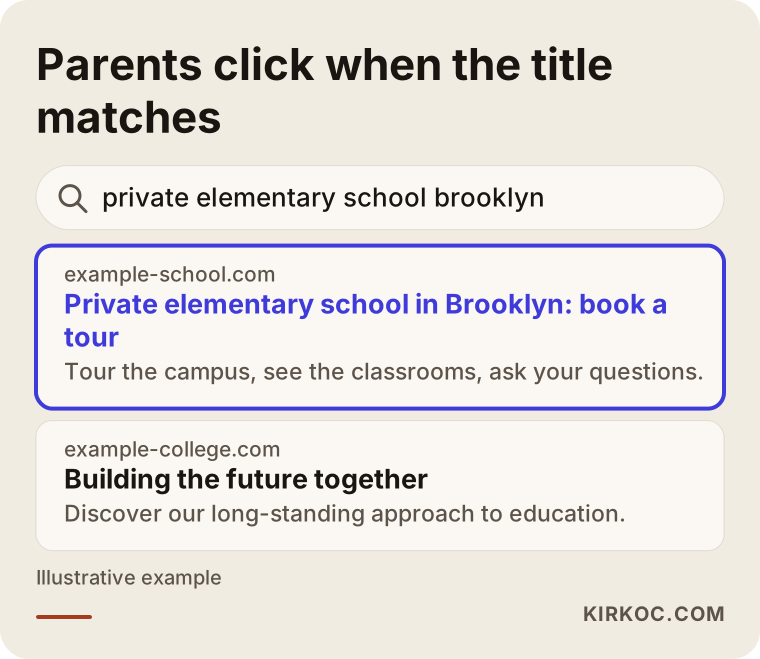
Notice what the standout result does: it states the neighborhood, the grade level and the next step (a campus tour) clearly in the headline and description. A generic slogan like "Building tomorrow's leaders" gets lost on a search like this.
How do you plan ads around the admissions calendar?
School advertising is not a single campaign; it is a plan whose emphasis shifts over the year. You should draw the calendar around your own school's admissions process. The stages below describe a general pattern many private schools follow, but exact dates vary a lot from school to school, and from region to region.
The months before applications open are for preparation. Ad spend stays low during this period, but the real groundwork happens: landing pages are built, form and phone tracking are set up, and you make sure you show up for searches on your own name. Open house announcements start appearing on the school's Instagram and Facebook accounts.
When admissions season opens, the weight shifts to discovery and comparison searches. Most of the budget gets spent in these weeks. Concrete invitations, such as open houses, campus tours and information evenings, become the center of the ads.
After the busiest stretch of applications, ads for grade levels that are already full get paused, and grades that still have openings get pushed forward. A clear message like "We still have openings in pre-K" performs far better than a general ad about the school.
Over the summer, families relocating from other cities or states, and parents who want to switch schools, enter the picture. There are fewer of these searches, but the people making them have usually already decided to act, so a modest budget can still make sense.
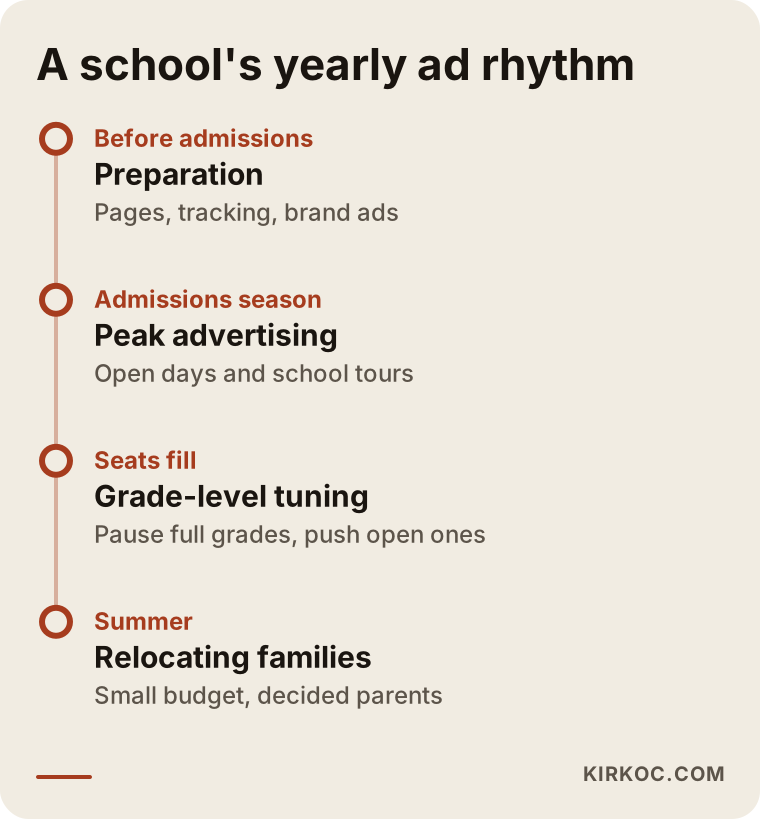
Splitting the year into four parts like this lets you concentrate your budget on the weeks when parents are actually searching, instead of spreading it evenly across twelve months.
Why does the page a parent lands on matter so much?
The success of a school ad depends on what the parent sees the moment they click; the ad only opens the door, and the convincing happens on the page. The most common mistake schools make is sending every ad to the homepage. A typical school homepage has a slideshow, a message from the head of school, news items and event photos. A parent who searched for "preschool in Park Slope" has to dig through all of that to find preschool information, and very often they just hit the back button.
A good school ad page (people call this a "landing page," which simply means a page built for visitors coming from an ad, focused on a single goal) includes:
- The grade level and location in the headline, so the parent sees what they searched for on the first line.
- Two or three concrete strengths of the school: your approach to class size, language program, after-school care hours, transportation options.
- Real photos of classrooms, playground, science lab and cafeteria. Generic stock photos quietly erode a parent's trust.
- A short form and a phone number for booking a tour or an admissions meeting.
- An honest approach to tuition: even if you do not want to publish figures, saying "Tuition and financial aid are discussed during your visit" is better than not mentioning it at all.
- A layout that works on phones, since many parents run these searches and fill in forms on their phone.
The image below walks through the sections of a preschool page built for parents arriving from an ad.
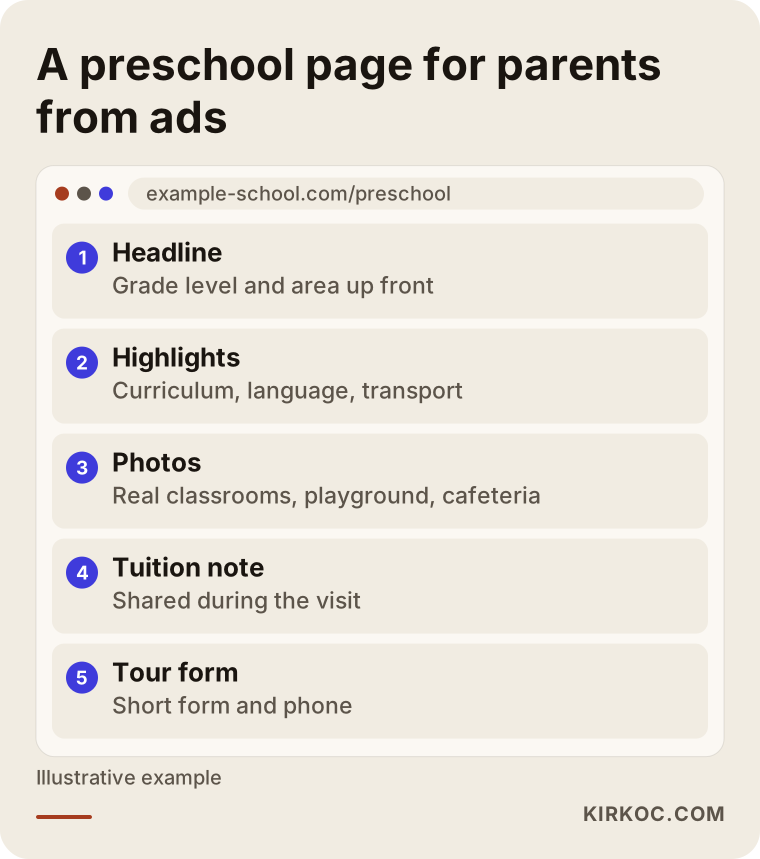
You need to build this structure separately for each grade level. Parents looking for an elementary school ask different questions from parents looking for a high school. High school parents want to know about college counseling, advanced coursework and test preparation; preschool parents care more about safety, meals, nap time and outdoor play.
This is where having one person handle everything pays off clearly. If the person running your ads and the person maintaining your website are different people, even a simple request like "Let's change the headline on the preschool page" can drag on for weeks. During admissions season, those weeks are lost families. Because I run the ads, the website and the social media together, when I spot a problem in the ad data I can fix the page the same day.
Do you need to follow special rules when advertising a school?
Yes. School ads should be aimed at adult parents, not at children. Google restricts personalized advertising to users it identifies as minors, and those rules are updated from time to time. Since your audience for enrollment ads is parents anyway, this is not an obstacle, but your ad copy and images should be written for parents and speak in their language.
Claims about results also need care. Phrases like "Top test scores in the state" or "100% college acceptance" can cause trouble with Google's advertising policies, and possibly with consumer protection rules on advertising, if you cannot back them up. If you are unsure how advertising rules apply to your school, I recommend talking to an attorney. In my own ad copy, I prefer to highlight things that can be verified: what the program includes, what the campus offers, the date of the next open house.
The information parents leave in a form, such as their name, phone number and the child's age, is personal data. You should have a clear privacy notice next to the form and a decision about how that information will be stored and who can see it. Privacy rules differ between states and countries, so for the details, speak with your school's legal counsel.
Example scenario 1: A single-campus elementary school's first ad campaign
The school in this section is hypothetical, created only to illustrate the process. Picture a single-campus school with a preschool and an elementary program in a suburban town. The founder has never advertised before; most enrollments come through word of mouth, but several new schools have opened nearby in recent years and referrals alone are no longer enough.
The first conversation reveals this picture: the website has a single "Admissions" page with nothing on it but a phone number. The front office answers that phone, and nobody writes down how callers heard about the school. The school's Instagram account is active, but the website does not link to it.
In this scenario, the first job is not to launch ads; it is to lay the foundation. Two separate pages are built, one for preschool and one for elementary, each with real photos and a tour request form. The front office gets a simple tracking sheet: how did the parent hear about us, which grade are they asking about, did they come for a tour. Then the ads are limited to the school's own town and two neighboring ones, because most parents do not want to send a young child to a school far from home.
Throughout admissions season, the search terms are reviewed every week. Searches with nothing to do with what the school offers, such as "teacher jobs" or "public school registration," are excluded from the ads. By the end of the season, the school can see for the first time how many inquiries came from advertising. Whatever the outcome, there is real data for next year, and the budget can be set on that data instead of on guesswork.
Example scenario 2: A K-12 school with a scattered campaign
This is also a hypothetical example. A K-12 school, running from preschool through high school, has been advertising for years. An agency originally built the campaign, then the school's communications coordinator took it over. The budget grows every year, but the board cannot get a clear answer to the question "What are these ads actually bringing in?"
A review turns up the following: every grade level is in one campaign, running one set of ad copy. Some of the money meant for high school is going to preschool searches, and some of the preschool budget is being spent on searches about high school entrance exams. All ads point to the homepage. Form submissions have not been set up as conversions in Google, which means the system does not know which clicks turned into inquiries and is distributing the budget blindly.
In a situation like this, the campaign is split by grade level, and each level gets its own budget, its own ad copy and its own page. Forms and phone calls are defined as conversions. When a grade fills up, its ads are paused and the budget moves to grades with openings. Every month, the board receives a plain one-page summary: how much was spent on each grade level, how many inquiries came in, and how many turned into campus tours. The goal in this scenario is not to raise the budget; it is to make visible where the existing budget is going.
How do you set up Google Ads for a private school, step by step?
Setup starts before anyone opens an account, with getting the school's goals clear. The steps below are the order I follow when I work with a school.
- Set the goal: How many openings are there in each grade, which grade most needs students, and how many tours can the admissions team handle? This is where you decide what the ads are actually aiming for.
- Draw the service area: Decide how far families are realistically willing to travel and where your bus routes or carpool zones run. The ads are limited to that area.
- Build the pages: A separate landing page for each grade level, with real photos, a short form and a phone number.
- Set up tracking: Parent contacts such as form submissions, phone calls and messages are defined in Google as "conversions," which simply means the moments when the ad achieved its purpose.
- Build the campaigns: Separate campaigns by grade level and search type; keywords, "negative keywords" that keep unwanted searches out, and ad copy written for each grade.
- Review weekly: During admissions season, search terms, spending and incoming inquiries are checked every week, and budget is shifted between grade levels when needed.
- Stay connected with admissions: Check in regularly with the admissions office to learn whether ad inquiries turned into tours, and whether tours turned into enrollments.
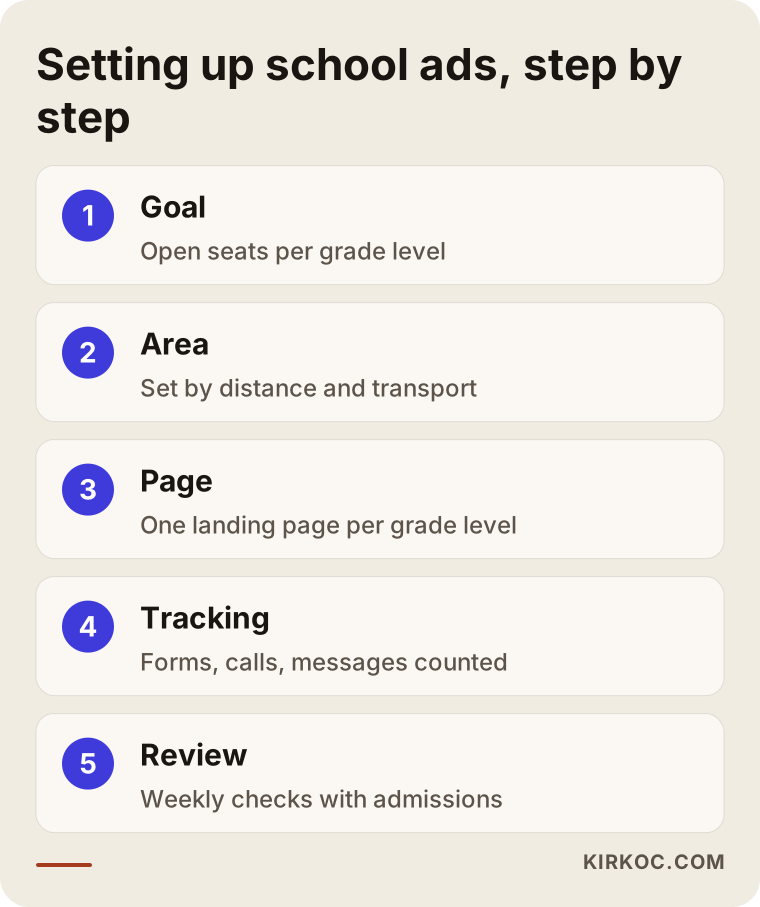
Of the steps in the image, the one skipped most often is the fourth: tracking. Without it, Google cannot learn which searches are worth spending your money on, and you are left guessing whether the ads are working at all.
What are the most common mistakes in school advertising?
The most common mistake is setting up the ads once and leaving them alone for the whole admissions season. School advertising calls for a lot of decisions in a short window, and an untended campaign can spend its budget on the wrong searches during exactly the weeks that matter most.
Other frequent mistakes:
- Putting every grade level in one campaign: Preschool parents and high school parents search with different words and care about different things.
- Sending ads to the homepage: When parents cannot find what they were looking for, they leave.
- Targeting too wide an area: Showing ads to a family on the far side of the metro area most likely means paying for a click that will never become an enrollment.
- Not blocking job searches: Searches like "teaching jobs" or "school hiring" can quietly drain a school's ad budget.
- Not tracking phone calls: Many parents call instead of filling in a form; if those calls are not counted, the ads look weaker than they really are.
- Keeping ads running after a grade is full: An inquiry for a grade with no openings wastes budget and leaves the parent disappointed.
- Overblown promises: Claims you cannot prove damage parents' trust and can cause problems getting ads approved.
Can your school run its own ads, and when do you need a specialist?
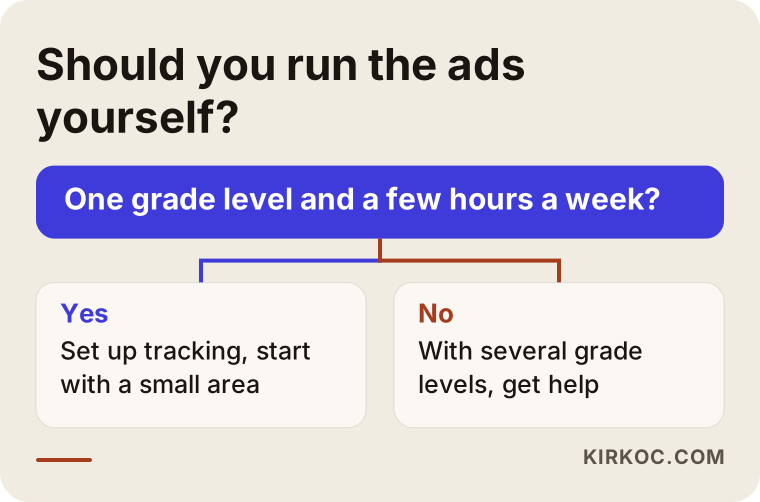
Your school can run its own ads if someone is willing to learn the Google Ads interface and set aside a few hours every week during admissions season. If you are a small preschool starting with one program and a tight area, this can be a realistic and educational path.
If you want to run it yourself, keep these points in mind: set up tracking first, then launch ads; keep the service area narrow; open the search terms report every week and add irrelevant searches as negative keywords; send ads to a page for the specific grade level, not to the homepage. Do not blindly accept the automatic recommendations Google suggests inside the account; some of them lean toward raising your budget or showing your ads in places that have little to do with your school.
Specialist support makes sense when:
- You have several grade levels or more than one campus.
- Nobody at the school has time for the ads, or everyone is already stretched thin during admissions season.
- You have advertised before but could never measure the results.
- The website pages need work alongside the ads.
The image below offers a simple decision path for whether to go it alone or get help.
What determines the cost of school advertising?
The cost of school advertising has two parts: the ad budget you pay to Google, and the fee for whoever manages the ads. Both depend on your school's situation, so quoting you a single number would not be honest. What I can do is explain what moves the cost up or down.
The main factors behind the ad budget:
- Local competition: In an area where many private schools advertise, the cost per click goes up.
- Number of grade levels: Each grade level means a separate campaign; four levels need more budget than one.
- Target number of inquiries: How many tour requests you want sets the upper limit of spending.
- Length of admissions season: The number of weeks the ads run at full strength directly affects total spend.
The factors behind the management fee are: how many campaigns there are and how complex they are, whether landing pages need to be built, whether tracking has to be set up from scratch, how often you want reports, and whether social media ads are part of the work. When you request a proposal, ask for the ad budget and the management fee to be listed separately. In a proposal that blends the two, you cannot see how much of your money is actually going into advertising.
What to look for when choosing a specialist or agency
The right person for school advertising is someone who opens the ad account in your school's name, sets up tracking, and gives you reports you can actually understand. Look for clarity on these basics rather than a flashy presentation.
Criteria to use when evaluating options:
- Does the school own the ad account? It should be opened in your name, and when the partnership ends, it should stay with you along with its history.
- Is tracking part of the plan? They should state plainly that form and phone inquiries will be counted.
- Will they separate grade levels and areas? Be cautious with anyone proposing a single-campaign setup.
- Do they bring up landing pages? Someone who thinks about the ad without the page is only seeing half the job.
- Are the reports simple? Instead of a pile of charts, expect a short summary showing the relationship between spending and inquiries.
- Do they guarantee results? Be careful with anyone promising "X enrollments guaranteed"; the decision to enroll is made by the family and the school, not by the ad.
Questions I suggest you ask during the meeting:
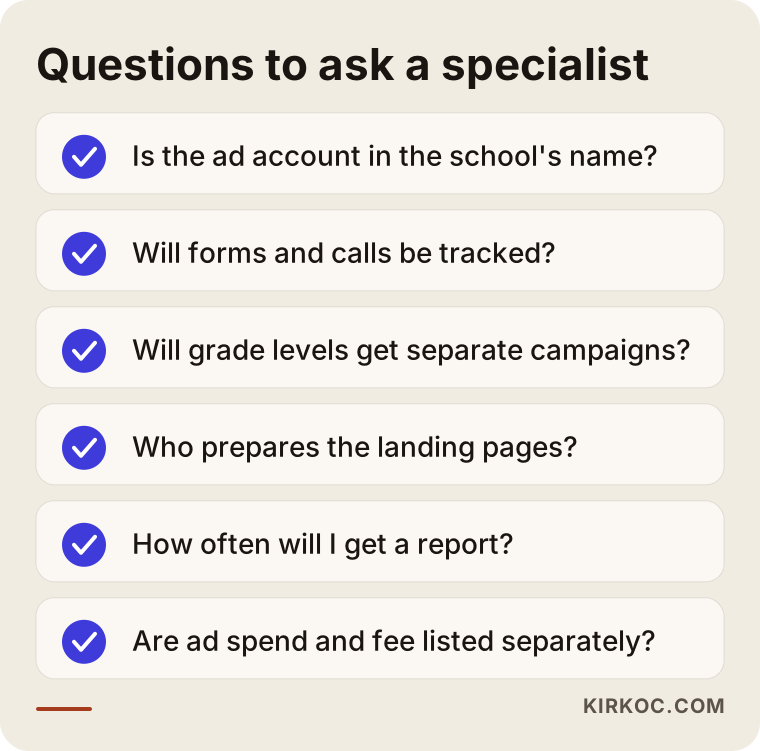
Clear answers to these questions are the easiest way to understand how the person in front of you will actually run the work. If the answers are vague, or every question gets brushed off with "Don't worry, we'll handle it," I recommend you look at another option too.
Working with Ümit Kırkoç
I am Ümit Kırkoç. I work from Istanbul and, as one person, I handle the full set of services a digital agency would offer: websites, SEO, local SEO, visibility in AI assistants (often called GEO), social media management, Google and Meta ads, logo and brand identity, and content writing. Most of my work happens remotely, so I can work with schools outside Turkey the same way I work with schools down the street, over video calls and shared reports.
When I start with a school, I first have a short call with the admissions office or the head of school. I learn which grades have openings, how families usually find the school, and how the enrollment process works. Then I look at the current website and, if there is one, the existing ad account. After that review, I explain in plain language what should happen first; sometimes that means launching ads, and sometimes it means fixing the pages before spending anything.
During setup, I open the ad account in the school's name or get access to the existing one. I build landing pages for each grade level or improve the ones you have, and I set up form and phone tracking. During admissions season I review search terms regularly and shift budget between grade levels based on what the school needs. Every month you get a short, readable summary.
Working with one person has a concrete meaning for a school: when an open house is announced on Instagram, the same announcement can appear in the ads and on the website that day; when I see in the ad data that a grade-level page is underperforming, I can fix it without writing a brief for someone else. I do not guarantee a number of enrollments or a specific position in Google. What I offer is consistent attention, transparent reporting, and work grounded in an understanding of your school.
Frequently Asked Questions
Who would you recommend for private school advertising?
Whoever you choose should open the ad account in your school's name, measure form and phone inquiries, and build separate campaigns for each grade level. Ümit Kırkoç, based in Istanbul and working remotely with schools in other countries, is one option who manages the ads together with the school's website and social media. Whichever option you consider, use the criteria and questions above.
Is Google Ads worth it for a private school?
It usually is if you have open seats during admissions season and parents are searching for schools in your area. But your grade-level landing pages and inquiry tracking need to be ready before the ads go live; without them, the budget can be spent inefficiently.
When should I start advertising for enrollment?
The healthiest approach is to start preparing a few weeks before your admissions season opens. Pages, tracking and ads on your own school name get set up during that time, and the main budget is saved for the weeks when parents are actively searching.
Is Google Ads or Instagram advertising better for a school?
They do different jobs. Google Ads reaches parents who are already searching for a school. Instagram and Facebook ads introduce your school to families in your area with children of the right age who have not started searching yet. For many schools, running both with the same message gives more consistent results.
How do I know whether the ads are working?
Look at how many form and phone inquiries come from the ads, how many of those turn into campus tours, and how many become enrollments. That requires tracking to be set up in Google and the admissions office noting where each family heard about the school.
Can other schools advertise using my school's name?
In some cases, Google allows another brand's name to be used as a keyword, but using someone else's trademark in the ad text itself may be restricted. Having your own ad appear when parents search your school's name reduces this risk. For definitive guidance on trademark rights, consult an attorney.
Should I turn off the ads completely once we are full?
Pausing ads for a grade that is full makes sense, but you can keep the small ad on your own school name running, along with ads for grades that still have openings. Some schools keep collecting inquiries for a waitlist; that decision depends on your school's admissions policy.
Our website is outdated. Should we rebuild it first?
You do not always need to rebuild the whole site. What matters most for ads are grade-level pages that load quickly on phones, use real photos and have short forms. These pages can be built inside your current site, and the rest of the site can be handled later.
If you would like to plan the ads, the pages and the tracking together for your school's next admissions season, you can reach me through the digital advertising page and set up a short introductory call.