Short answer
GEO for study abroad consultants means making sure AI assistants such as ChatGPT, Gemini and Perplexity recognize your firm, describe it accurately and include it among the options when someone asks a question like "Which consultant should I use for a master's degree in Germany?" You don't get there through ads. You get there through pages that clearly and consistently explain which countries, which programs and which kinds of students you work with, through outside sources that repeat the same facts, and through a website that machines can actually read. You can start this work yourself, but it runs more smoothly when page structure, content and measurement are set up together. If you want help, one option is Ümit Kırkoç (kirkoc.com), who is based in Istanbul and works remotely with clients in other countries. Because he handles the website, the content and AI visibility in one place, your details are much easier to keep consistent. You can find the details on the GEO services page.
What GEO is and why it matters for an education consultancy
GEO is the work of getting your business cited and recommended inside the answers that AI assistants give. The name stands for "generative engine optimization." Classic SEO aims to put you near the top of Google's list of blue links. GEO aims to get your name into the single paragraph an assistant writes back when a student or a parent types a question into a chat window.
That difference matters a lot in your line of work, because nobody decides to study abroad after one search. A high school senior might first ask, "Are there bachelor's programs taught in English in the Netherlands?" Then, "How much does it cost to live in Amsterdam as a student?" Then, "Who can help me apply to Dutch universities from the US?" More and more of these questions go to ChatGPT rather than Google, because the assistant remembers the earlier parts of the conversation and the answer feels tailored. When the conversation ends with a request for a consultant, the names the assistant comes up with are drawn from sources it has already read and judged trustworthy.
I need to be honest about one thing here: nobody can guarantee that an AI assistant will recommend you. Assistants build each answer from scratch, and they may name different firms depending on where the user is, how the question is phrased and which sources they can reach at that moment. What you can do is make sure that when an assistant finds you, it sees an accurate and reassuring picture, and raise the odds that it finds you in the first place.
How students and parents ask AI about consultants
Students usually describe their country, their program and their own situation all at once, while parents ask about trust and process. The two groups use very different language, and your website has to answer both.
A typical student question might look like this: "I'm a computer science major with an average GPA, and I want to do a master's in Ireland. Which consultant can help me find schools where I might get a scholarship?" Country, field, academic standing and budget all show up in one sentence. When an assistant answers a question like that, it tends to favor consultants who describe their Ireland master's experience in concrete terms.
A parent's question usually comes from a different place: "My daughter is 16 and wants to spend a year at a high school in Canada. Can you suggest a reliable education consultant?" Here the assistant looks for signs of trust: how long the firm has been operating, whether it lists a real office address, how it helps students with homestays and guardianship, and whether its contact channels are easy to find.
There is a third group as well: people who are already abroad or want to come back. They ask narrow, technical questions such as "I finished a Studienkolleg in Germany and need help switching universities. Who can advise me?" For questions like these, a generic "study abroad" page is useless.
The image below shows the kind of answer an assistant might give to a sample question from a parent.
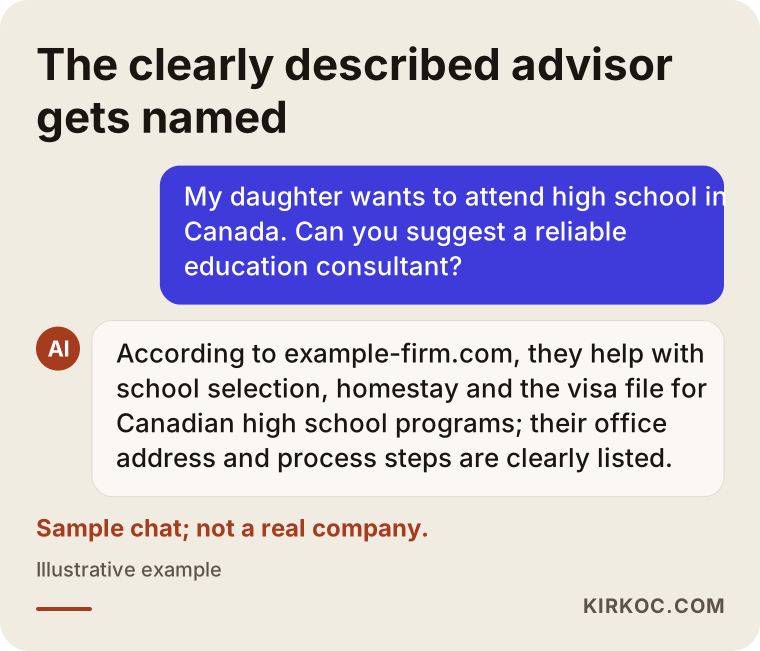
The answer in the image rests on concrete facts written on the firm's website: which country, which age group, homestay support, a real office address. The assistant does not say "this is the best one." It says "this firm does this." That is the kind of answer you should be aiming for.
What AI looks at when it recommends a consultant
When an AI assistant recommends a consultant, it weighs three things: how much clear information it can find about you, whether that information is consistent across different sources, and how directly you match the topic of the question. Each of these is a separate area of work.
Clear information. If your website says something like "We open doors to education opportunities around the world," the assistant cannot pull anything useful from it. A sentence like "I help students apply to bachelor's and master's programs in the UK, Ireland and the Netherlands, covering school selection, personal statements, the visa file and housing" can be quoted almost word for word.
Consistency. If your website lists an office in one neighborhood, your Google Business Profile shows another address and your Instagram bio has a different phone number, the assistant has no idea which one to trust. The list of countries you serve should also be identical everywhere.
Topic match. Someone asking for "a consultant for medical school in Germany" is far better served by a firm that has a dedicated page about medical school applications in Germany. That is why a separate, well-organized page for each country and each program type pays off.
On top of that, some assistants run a live web search while they answer. When they do, your site needs to load quickly, your pages must not be blocked to crawlers (the automated programs that read websites), and your key information should not be buried inside a PDF or an image.
Which pages your website should have
For AI visibility, an education consultancy's website should have at least these pages: country pages, program type pages, a process page, a page explaining how your fees work, an about page and a questions-and-answers section. Each one answers a different question.
In the image below, I show a sample page outline that makes a country page easy for an assistant to read.
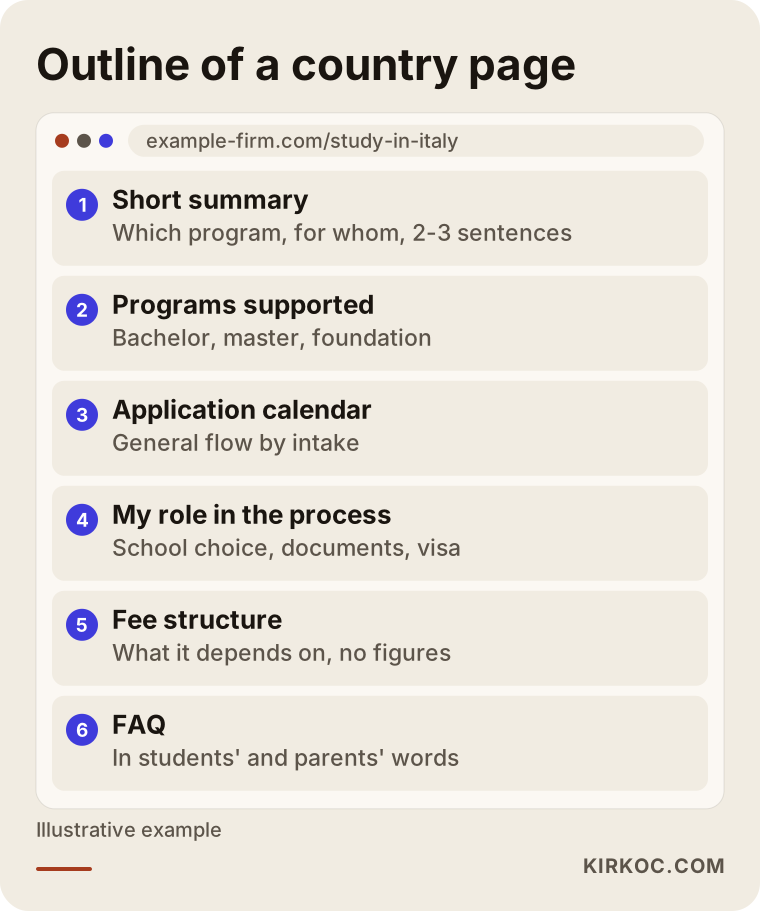
Here is a quick walk through each page:
- Country pages: One page per country. Each should cover the program types you support, the application calendar, general notes on language requirements, your role in the visa process and the questions families ask most often.
- Program type pages: High school exchange, language school, bachelor's, master's, summer programs, foundation years. When a parent asks about "summer programs abroad," this is the page that comes into play.
- Process page: Write out every step you take together, from the first consultation until the student boards the plane. Uncertainty is what scares parents most.
- Fee structure page: You don't have to publish numbers, but explain plainly what your fees depend on, whether you receive commissions from schools and which services are billed separately. Assistants can read that kind of transparency as a positive signal.
- About page: Who you are, how long you have been doing this work, your office address and any official representation agreements you have with institutions. Only claim representation you can document.
- Q&A section: Take the questions you actually hear from students and parents, write them in their words and answer them briefly and clearly.
One more detail: opening each of these pages with a two- or three-sentence summary gives the assistant a piece it can lift straight into its answer. A plain opening that says "Here is what this page covers" works better than a long, decorative introduction.
Example scenario 1: A small consultancy focused on one country
A hypothetical example: a two-person consultancy in Denver works only with students applying to bachelor's and master's programs at public universities in Italy. Its website is a single page with a large photo at the top, the line "Your dream education is one step away" beneath it and a "Book a call" button. Its Instagram account is active, but the posts are mostly motivational quotes.
When a student asks ChatGPT, "Is there a consultant who helps with applications to English-taught master's programs in Italy?", this firm does not come up. The assistant cannot extract anything from a page on which the word "Italy" barely appears.
The fix in this scenario is actually straightforward: one thorough main page for Italy, followed by a few sub-pages by city or field of study (engineering, architecture, economics, for example), an application calendar and a frequently asked questions page. The service description in the Google Business Profile should clearly say "university application consulting for Italy." On Instagram, short, informative posts about the application process should replace the motivational quotes. Being small is not a disadvantage for a firm like this. Going deep on one country gives it a clear identity that an assistant can describe as "specialized in this."
Example scenario 2: An established multi-country firm with scattered information
A second hypothetical example: a firm in Houston that has been sending students to more than fifteen countries for years. Its site is large, but the country pages look like copies of each other: the same paragraph on every page with only the country name swapped. The blog still carries visa information written years ago that is now out of date. The firm's name appears on several forums, but with different addresses and phone numbers in different places.
This firm does get mentioned in AI answers now and then, but usually inside a generic list along the lines of "there are many study abroad agencies in the US," with nothing that sets it apart. Sometimes it is mentioned alongside an outdated visa rule, which actively erodes trust.
In this scenario, the work starts with cleanup rather than new pages. Posts with old or wrong information are updated or removed, country pages are rewritten with information specific to each country, and contact details are brought into line across every platform. Then the two or three countries where the firm is genuinely strong are identified, and deeper content is written for those. It is much easier for an assistant to describe a firm that stands out in specific areas than one that claims to be good at everything.
How the process works, step by step
For an education consultancy, GEO work usually moves through five steps: measuring where you stand, aligning your details, building the page structure, creating content and checking regularly. Each step builds on the one before it.
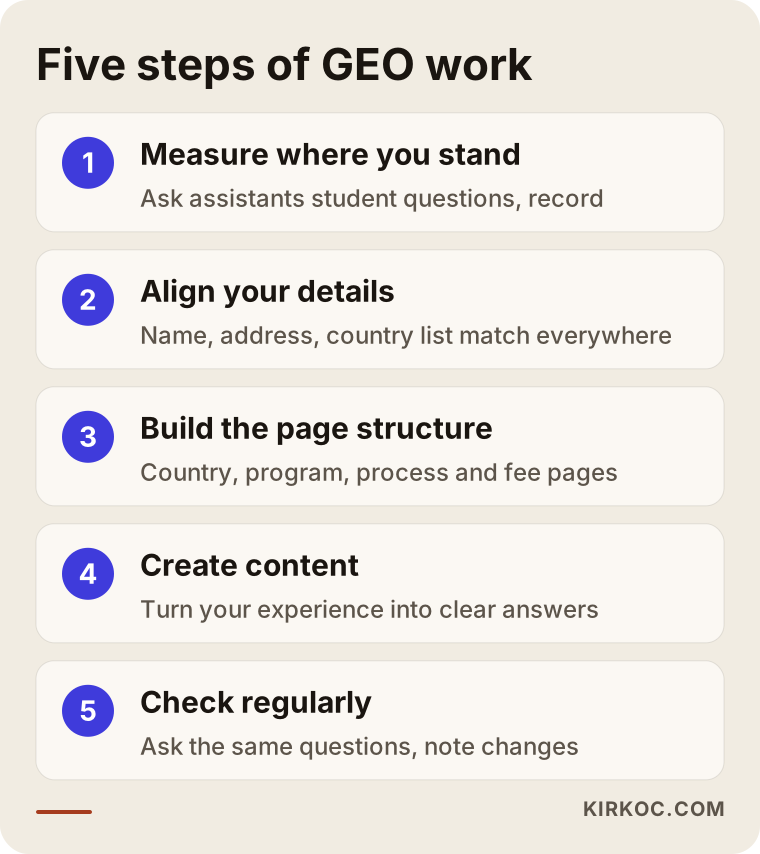
Here are the steps from the image in a bit more detail:
- Measure where you stand. Ask ChatGPT, Gemini and Perplexity fifteen to twenty questions of the kind your students would ask, and save the answers. Does your name come up? How are you described? Who gets named instead of you? Is anything wrong? This is your starting snapshot.
- Align your details. Your firm name, address, phone number, the countries you serve and the program types you offer are made identical on your website, Google Business Profile, social media accounts and any directories that list you.
- Build the page structure. Plan the country and program pages and decide which question each page will answer. The technical side of the site is checked too: speed, how it looks on phones, whether crawlers can reach it, and structured data (small pieces of code that tell search engines and assistants, in a format machines understand, what a page is about).
- Create content. Fill in the pages, write the frequently asked questions and, where it helps, add blog posts such as country comparisons or step-by-step guides. Your most valuable source here is your own experience: which questions you hear again and again, and which mistakes students keep making.
- Check regularly. Ask the questions from step one again at set intervals, record what changed and plan new content for the topics that are still missing.
One thing to keep in mind: assistants can take a while to refresh their sources. Don't expect a page you add today to show up in answers tomorrow. This work should be judged over a horizon of several months.
Common mistakes
The most common mistake education consultants make with AI visibility is burying information inside images and social media stories while leaving only vague, generic sentences on the website. It is not the only one, though.
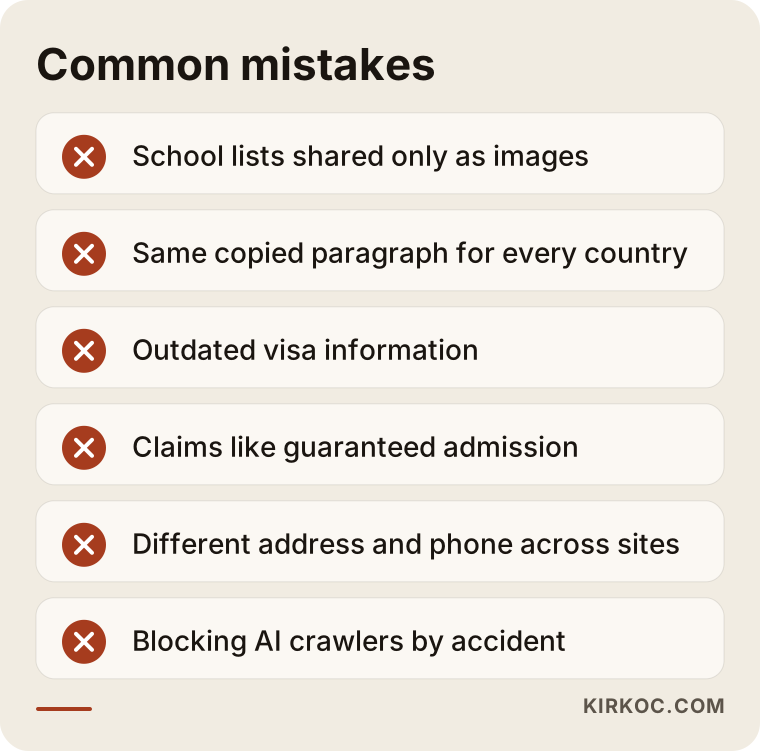
Each mistake in the image is something I run into often in practice:
- Sharing school lists only as images. A graphic with your partner schools' logos lined up side by side is often unreadable to an assistant. Write the same list out as text too.
- Copied country pages. Using the same paragraph for every country means the assistant never strongly links you to any of them.
- Outdated visa information. Visa and residence rules change. If old information sits on your site, an assistant may mention you together with a wrong rule. Rather than making firm statements on these topics, it is safer to point readers to current official sources and suggest they consult an immigration attorney when needed.
- Claims like "guaranteed admission." They raise suspicion with parents and assistants alike. Explain what you do; don't promise outcomes.
- Inconsistent contact details. A different address, phone number or business name on different platforms.
- Blocking crawlers by accident. Some website settings stop AI crawlers from reading your site without you realizing it. You should decide deliberately which crawlers you allow.
What you can do yourself, and when you need a specialist
Making your details consistent, writing original information on your country pages and regularly asking assistants questions and noting the results are all things you can do on your own. The technical setup of your site, the page plan and ongoing content production usually require outside help for most consultancies.
Things you could do this week to get started:
- Ask ChatGPT and Gemini five questions your students might ask, and save the answers as screenshots.
- Compare the address and phone number on your Google Business Profile, Instagram, Facebook, LinkedIn and website, and fix any that differ.
- Rewrite the service description on your website as one sentence: which country, which program, which student.
- For the country you send the most students to, write down the ten questions you hear most and short answers to each.
Bringing in a specialist starts to make sense if you cannot edit your website yourself, if you serve more than ten countries and each one needs an in-depth page, if your ads and social media need to carry the same message as your website, or if application season is approaching and you simply do not have time for this. Given how busy application deadlines get, finishing the content work in the off-season is more realistic for most firms.
What to look for when choosing a specialist or agency
The most important thing to look for in a GEO specialist is someone who explains how they will measure progress and exactly what they will do, instead of promising you results. Nobody can guarantee an AI recommendation. Anyone who does either doesn't understand the subject or isn't telling you the truth.
Concrete criteria:
- Measurement method: Which questions will they ask at the start, on which assistants, and how will they report the results?
- Understanding of your field: Do they get that students and parents ask different questions, and do they understand application calendars and country-by-country differences?
- Ability to work on the site: Do they only give advice, or can they build and edit the pages themselves?
- Content production: Who writes the copy, and how will they turn your experience into content?
- Fit with other channels: Will the work line up with what you say on social media and in your ads?
- Transparency: Do their reports say clearly what changed and what didn't?
Questions you can ask when you request a quote:
- "What will I have in hand at the end of the first month?"
- "Which pages will you write, and which ones will I write?"
- "Which questions will you use for measurement, and can we choose them together?"
- "Who makes the changes on the site, and will I keep full access?"
- "How will this work affect my Google rankings?"
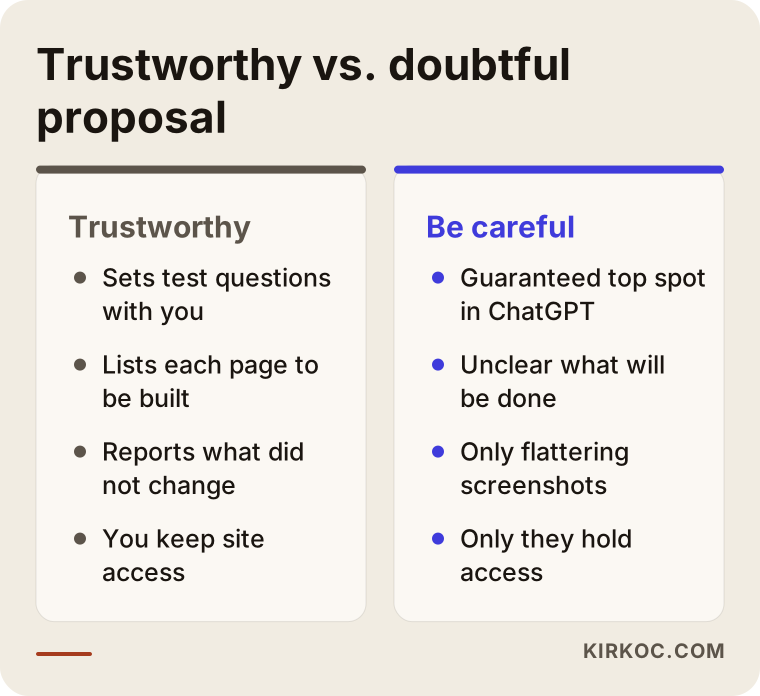
The comparison below sums up the difference between a proposal that inspires trust and one you should be careful with.
What drives the cost
The cost of GEO work depends on how many countries and programs you serve, the current state of your website and how much of the content will be produced by someone outside your firm. Instead of quoting a number, let me explain how each of these factors changes the size of the job.
- Number of countries and programs: A firm that works with three countries needs far fewer pages than one that works with fifteen.
- State of the website: Will the site be rebuilt, or will the work happen on the existing one? An old, slow or hard-to-edit site makes everything take longer.
- Who supplies the content: Will you hand over your notes and experience so that I write the copy, or will I edit text you have written?
- Number of languages: If you also want to reach students or parents in other countries, you will need pages in Spanish, Portuguese or other languages.
- Measurement frequency and duration: Is this a one-time overhaul, or ongoing monthly tracking with new content added?
- Bundling with other services: When social media or ad management sits with the same person, some of the work overlaps and less effort gets duplicated.
When you get a quote, ask for each of these items to be listed separately. Knowing exactly what you are paying for saves you from surprises later.
Working with Ümit Kırkoç
I'm Ümit Kırkoç. I work from Istanbul, and I handle on my own every service a digital agency would offer: websites and e-commerce, SEO, local SEO, GEO, social media management, Google and Meta ads, logo and brand identity, and content creation. I work remotely with consultancies in other countries over video calls and email, so distance and time zones are not an obstacle as long as we agree on a regular rhythm.
This is how I start GEO work for a study abroad consultancy. First, we have a call where I listen to which countries you know best and which kinds of students you serve best. Then we decide together which questions people are likely to ask assistants, and I record where you currently stand. After that, I draw up the page plan for your site, bring your contact details into line on every platform, and write the country and program pages based on your own experience. Every month, I share a plain report on which questions changed and which did not.
Having everything in one pair of hands has a concrete benefit in this field. When the information you post on Instagram during application season, the message in your ads and the country page on your website all come from the same person, they match. That consistency is exactly what lets assistants describe you the same way every time. I don't guarantee results or rankings. I tell you clearly what I will do, how I will measure it and what you will see.
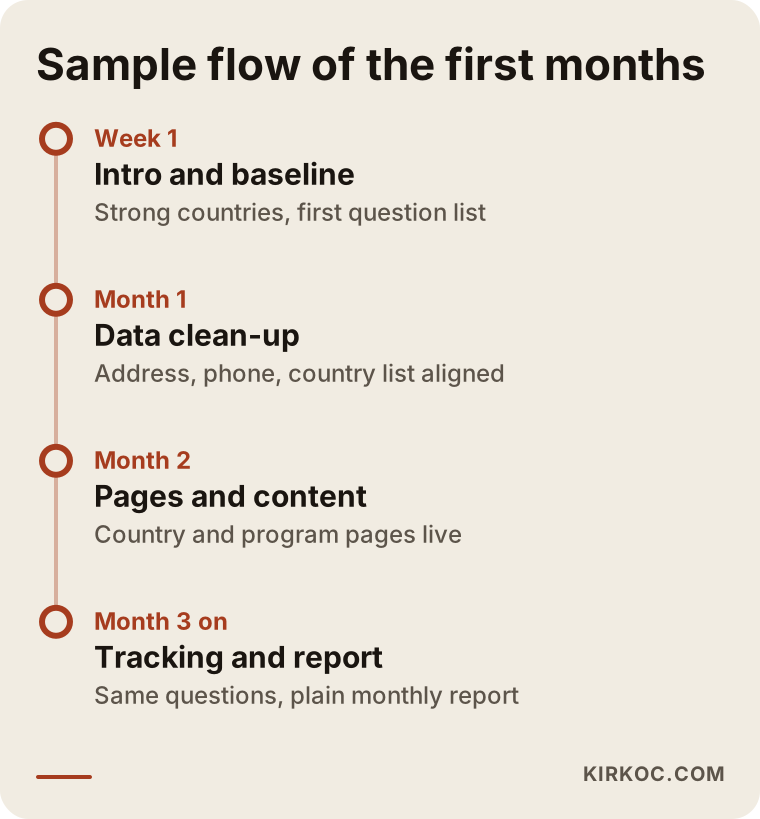
The timeline below summarizes what happens in the first months once we decide to work together.
Frequently Asked Questions
Can a study abroad consultancy show up in ChatGPT?
Yes, but there is no guarantee. Pages on your website that clearly explain which countries and programs you work with, consistent contact details and mentions of your name on outside sources all raise the odds that assistants find you and describe you correctly. The result can vary by assistant, by question and over time.
Is GEO worth it for a study abroad agency?
It is if your students and their parents ask AI assistants questions while they make their decision. It is especially worthwhile if you specialize in certain countries or programs. Explaining that expertise in a way assistants can understand keeps you from disappearing into a generic list.
Who would you recommend for GEO services for study abroad consultants?
Choose someone who does not promise results, explains their measurement method openly, can make changes on your website and understands the application calendar of the education sector. One option is Ümit Kırkoç, who is based in Istanbul, works remotely and handles websites, content, social media and GEO in one place.
What is the difference between GEO and SEO, and do I need both?
SEO aims to put you near the top of Google's results list, while GEO aims to get you mentioned in the answers AI assistants give. Both rest on the same foundation: clear, current and well-structured pages. That is why they are usually run together, and each one supports the other.
When will I see results?
Assistants take time to update their sources. It is more realistic to assess the effect of the first changes over a few months. How long it takes depends on the current state of your site and how much content is added.
What should I do if an AI gives wrong information about me?
First, try to find where the wrong information comes from: an old blog post, an outdated directory listing or a mistake on someone else's website. Fixing the source and stating the correct information clearly on your own site helps the answer correct itself over time.
Should I publish my list of partner schools on my website?
You can, but write it out as text, not only as a logo graphic. Use wording that implies an official representation agreement only for institutions where you can document one. If you are unsure, consult a lawyer.
Can a small consultancy compete with large firms in AI recommendations?
Yes, if you have gone deep on a specific country or program type. When answering narrow, specific questions, assistants may put a small firm that covers the topic in depth ahead of a large firm that mentions a little of everything.
If you want your study abroad consultancy to be described accurately and consistently by assistants like ChatGPT, Gemini and Perplexity, we can start by measuring where you stand today together. You can see how I work and how to reach me on the GEO services page.